Activity U (IV): The Engeström’s Triangle and the Power of Diagram
The perspective of diagram and diagramming on theoretical building and development.
This article is part of a case study: Activity U. I apply the HERO U framework and Diagram U to discuss the development of a large knowledge enterprise: Activity Theory or (Cultural-historical activity theory, CHAT).
- Activity U (I): The Landscape of Activity Theory
- Activity U (II): Unit of Analysis, Niches of Analysis, Levels of Analysis
- Activity U (III): Bonnie Nardi’s Choices and Boundary Knowledge Work
Today I am going to focus on Finnish educational researcher Yrjö Engeström’s work and review his theoretical building from the perspective of diagrams and diagramming. Yrjö Engeström upgraded the activity theory from the individual activity level to the collective activity level with a conceptual model of “activity system” in order to apply activity theory to educational settings, organizational development, and other fields (Engeström,1987).
Engeström considered the diagramming approach as an important tool for developing theory. His story is a great example of rethinking the value of diagrams and diagramming.
Contents
PART 1: Background
1.1 The landscape of Activity Theory 1.2 The development of work and expertise 1.3 The Engeström’s Triangle
PART 2: The Origin of the Engeström’s Triangle
2.1 Learning by Expanding 2.2 Theory as an instrument 2.3 Five steps of category construction 2.4 Diagramming as Theorizing 2.5 Set the stage 2.6 Finding inspiration from theoretical traditions 2.7 The evolution of activity 2.8 Four levels of contradictions 2.9 Gain mastery of the work activity 2.10 The network of human activities 2.11 The structure of learning activity
PART 3: The Evolution of the Engeström’s Triangle
3.1 The life of a wall (1996) 3.2: Individual actions v.s. Activity system (1999) 3.3: The third generation of Activity Theory (2001) 3.4: The place of engagement in an activity system (2008) 3.5: Large Runaway Objects (2008)
PART 4: The Application of the Engeström’s Triangle
4.1 Activity Notation: decomposing the organization’s activity system 4.2 A general diagram of activity network 4.3 Temporal interconnectedness and Situatedness of activities 4.4 Application of activity system and activity network
PART 5: Discussion
5.1 Diagram (Representation) v.s. Diagramming (Instrument) 5.2 Spatial thought v.s. Linguistic thought 5.3 Knowledge model v.s. Knowledge brand 5.4 Organization of activity v.s. Structure of activity
PART 1: Background
1.1 The Landscape of Activity Theory 1.2 The Development of Work and Expertise 1.3 The Engeström’s Triangle
1.1 The landscape of Activity Theory
Activity Theory or the “Cultural-historical activity theory (CHAT)” is an interdisciplinary philosophical framework for studying both individual and social aspects of human behavior. From the perspective of Activity Theory, human activity or ‘what people do’ represents the basic unit of analysis when studying human behavior. The most important aspect of Activity Theory is understanding both individual and collective aspects of human practices from a cultural and historical perspective.
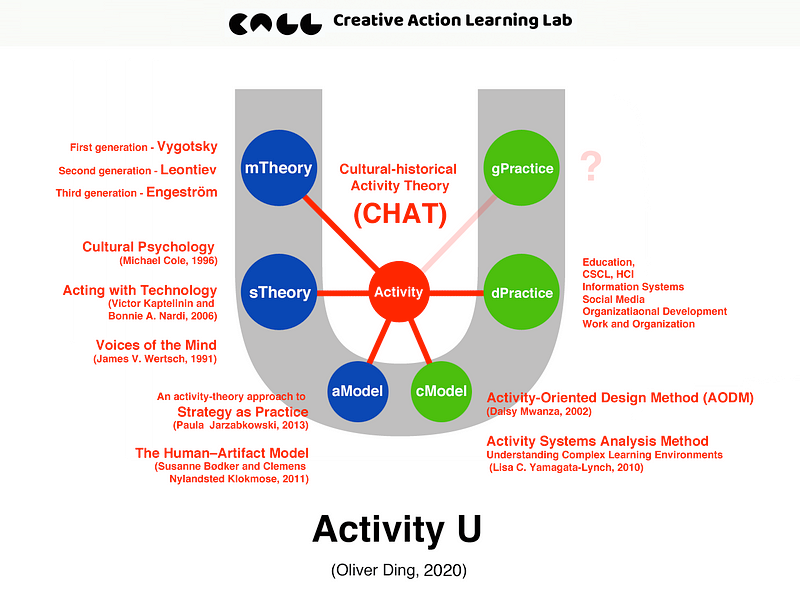
Activity Theory is a perfect case for making use of HERO U’s framework and the Diagram U because we can find various usages of activity theory. I selected some examples and placed them on Diagram U and made the above diagram which is the foundation of my case study. Part I provided more details behind the diagram. If you are not familiar with Activity Theory, you can find relevant information in Part I. If you want to know the HERO U framework and Diagram U, you can read this article: HERO U — A New Framework for Knowledge Heroes.
1.2 The development of work and expertise
Yrjö Engeström is a Professor of Adult Education and Director of the Center for Research on Activity, Development, and Learning (CRADLE) at the University of Helsinki and Professor Emeritus of Communication at the University of California, San Diego.
Yrjö Engeström was attracted by the Soviet-Russian tradition of cultural-historical activity theory when he was a university student and activist and started his first activity-theoretical study in 1982. In order to avoid the curricular constraints in school settings, he chose the world of work and organizations as the field of study in which he encountered a more open attitude toward novel ideas and practices. (Engeström & Glaveanu, 2012, p.515).
This start point anchored his research trajectory and led to a series of great innovations such as Activity System, Expansive Learning, and Developmental Work Research. In 1987, he published his keystone work titled Learning by Expanding (1987/2014) in which he developed the now-famous Activity System triangle, the concept and model of Expansive Learning, and the early version of the methodology of development work research. Since then, his research has significantly advanced our understanding of development and learning in different work settings and made significant contributions to cultural-historical activity theory.
Yrjö Engeström’s creativity and contribution to the development of activity theory and the field of organizational learning and innovation are for all to see. According to Georg Ruckriem and Joachim Lompscher (2005), “Yrjö Engeström is one of the most self-directed but certainly also most interesting representatives of contemporary activity theory. In the development of activity theory, his publications, starting with his early work on learning theory, signify the beginning of a new phase in which activity theory steps out of its mainly academic discourse and becomes an interdisciplinary approach increasingly engaged in the resolution of practical societal problems. This is happening internationally, in Europe, Latin America, North America, Japan, and elsewhere. Engeström made an essential contribution to this with his creative development of the methodology which he — unlike the psychologically oriented classics of the theory, Vygotsky, Leont’ev, Luria — founded on an understanding of activity as collective activity. He constructed and developed further the methodology by using it in and confronting it with empirical studies.”
1.3 The Engeström’s Triangle
One major outcome of Learning by Expanding is a diagram that aims for picturing Leontiev’s activity system. Now the diagram has a nickname called “Engeström’s Triangle”.
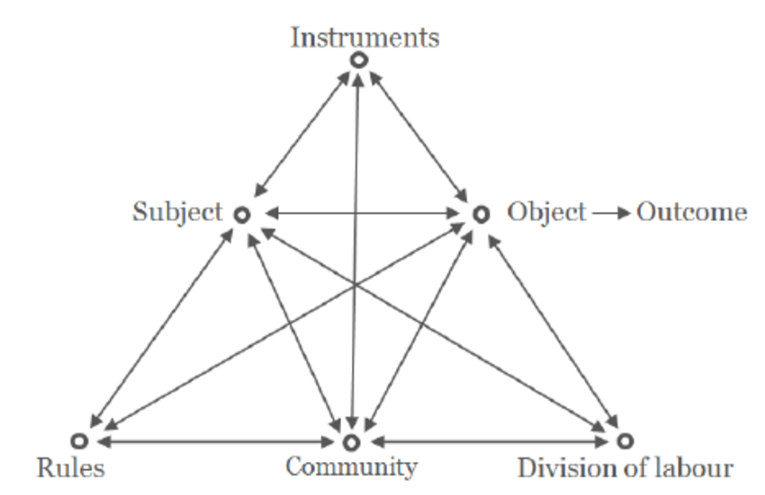
The above Engeström’s triangle is based on the cultural-historical psychologists’ notions of mediation as individual action (subject — instruments — object) at the top of the diagram. Engeström (1987) considered “a human activity system always contains the subsystems of production, distribution, exchange, and consumption.”(p.67), thus, he added the bottom of the triangle to the original individual triangle in order to include other people (community), social rules (rules), and the division of labor between the subject and others.
Some authors see this diagram as a graphical heuristic. For example, Geri Gay and Helene Hembrooke said, “…Building on these principles, Alexei N. Leont’ev (1981) created a formal structure for operationalizing the activity system as a complex, multilayered unit of analysis (figure 1.1). His model is less a representation of reality than a heuristic aid for identifying and exploring the multiple contextual factors that shape or mediate any goal-directed, tool-mediated human activity.” (2004, p.2).
Clay Spinuzzi (2020) also used “graphic heuristic” to review this model, “…Engeström provided a graphical heuristic (the now-famous triangle) for picturing Leontiev’s activity system. This heuristic, which has been derided by some critics (e.g., Miller, 2011)…”. However, Spinuzzi pointed out the positive value of the diagram, “This heuristic…was meant not only as an analytical device for researchers but (critically) also as a way to communicate with — and codesign work with — research participants (e.g., Engeström, 1999; Engeström & Sannino 2010). That is, it served as an interventionist “language game” (Ehn 1989) similar to the prototypes and organizational games that Bødker and other participatory designers used to leverage the tacit expertise of participants. This point has been overlooked by those who have critiqued the triangle heuristic as an oversimplified theoretical tool.”
The following section will trace back to the origin of Engeström’s Triangle and share some insights about diagramming for theory building.
PART 2: The Origin of the Engeström’s Triangle
2.1 Learning by Expanding 2.2 Theory as an instrument 2.3 Five steps of category construction 2.4 Diagramming as Theorizing 2.5 Set the stage 2.6 Finding inspiration from theoretical traditions 2.7 The evolution of activity 2.8 Four levels of contradictions 2.9 Gain mastery of the work activity 2.10 The network of human activities 2.11 The structure of learning activity
2.1 Learning by Expanding
The subtitle of Learning by Expanding is An Activity-theoretical Approach to Developmental Research. Usually, we will consider this work as an application of Activity Theory. There is a theory called Activity Theory, he just applied it to generate a new idea about Developmental Research.
Actually, this is not a simple “theory use” work, but an excellent “theory make” case. I have mentioned Nardi’s idea of “theory-user v.s. theory-maker” in Part III. She said, “We believe that HCI researchers can be described as not only ‘theory users’, but also as ‘theory-makers’.” For Engeström, he is not the original creator of Activity Theory, but he is a significant theory maker of Activity Theory.
Learning of Expanding has five chapters, and the following titles of each chapter point out different goals.
- Chapter 1: Introduction
- Chapter 2: The emergence of learning activity as a historical form of human learning
- Chapter 3: The Zone of Proximal Development as the basic category of expansive research
- Chapter 4: The Instruments of Expansion
- Chapter 5: Towards an expansive methodology
In order to develop a mode of learning in the work setting, Engeström decided to develop a mode of “learning activity”. In order to understand the “learning activity”, he chose to trace back to two lines. One line is about “activity” while another line is about “learning”. During the process, he had to develop a collective level version of “activity theory” for his research. This process is clearly displayed in Chapter 2.
I designed the picture below to visualize Engeström’s thoughts about this process. The picture has seven red dots: Domain, Resource, Tools, Problem, Method, Concept, and Diagram. These elements are from the HERO U framework (the article, the diagram). The seven red balls refer to Personal Conditions of Knowing. The first group is Domain, Resource, and Tools, they define the outside setting of the knowing activity. The second group is Method and Problem, they define the source of competence and solution. The third group is Diagram and Concept, they define the representation format of the outcome of knowing. These three groups form a process of knowing.
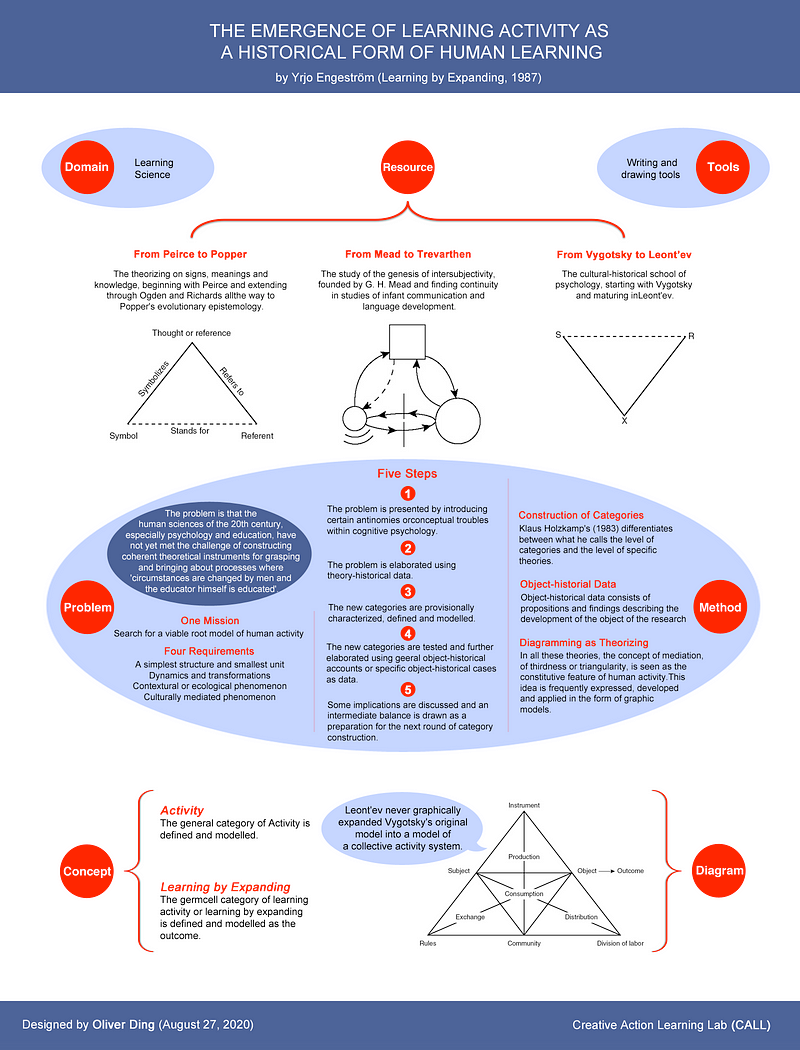
Since this article is only about the Activity System Triangle, the above picture only summarizes the half of thought behind the Chapter 2. I didn’t put the other half which is about “learning” into the picture.
- Domain: learning science. His goal is to develop a new theory about learning in the work setting.
- Resource: He adopted many theoretical resources. I only list the three lines about “triangle”.
- Tools: writing and drawing tools.
- Problem/Method: I used more sub-categories to highlight his thought. The following sections will explain this part.
- Concept/Diagram: This part presents the outcome of chapter 2.
The triangle is a very simple idea. However, there was a lot of enthusiasm and effort really behind the idea. Engeström said, “The limitation of the first generation was that the unit of analysis remained individually focused. This was overcome by the second generation, largely inspired by Leont’ev’s work. In his famous example of the “primeval collective hunt” Leont’ev (1981, p. 210–213) showed how the historically evolving division of labor has brought about the crucial differentiation between individual action and collective activity. However, Leont’ev never graphically expanded Vygotsky’s original model into a model of a collective activity system. Such a modeling effort was made in Chapter 2 of the present book.”(1987, p.5)
2.2 Theory as an Instrument
When researchers use a book to present the outcome of their theoretical study, they adopt different writing styles for communicating with their readers. Engeström points out there are three styles, a) only shows the pure thought of the author, b) shows the path of thought without the focus, c) shows the central focus such as new categories with the process.
Engeström chose the third style. He said, “The better this path of processing categories out of data is brought into the open, the greater is the possibility that the reader may become involved in the theory as an active discussion partner and contributor to its further development. The theory becomes a processual entity and an instrument of its own development. On the other hand, if the path or the process of derivation and critical analysis becomes the sole central focus, the outcome itself may get lost. When nothing seems to get fixed into clearcut categories, the reader has little to cling to in his own efforts of reconstruction, application and critique. Theory becomes a stream in which the reader tries to hold his head above the surface without quite knowing where he is floating to.”(1987, p.40)
He told readers his goal, methods, strategy, and plan in the beginning and guided readers to follow the track with him.
2.3 Five steps of category construction
For example, he told us the same logic for building new categories. It is a five-step strategy. He applied this strategy to chapters 2, 3, and 4.
- At first, the problem is presented by introducing certain antinomies or conceptual troubles within cognitive psychology.
- Secondly, the problem is elaborated using theory-historical data.
- Thirdly, the new categories are provisionally characterized, defined, and modeled.
- Fourthly, the new categories are tested and further elaborated using general object-historical accounts or specific object-historical cases as data.
- Fifthly, some implications are discussed and an intermediate balance is drawn as a preparation for the next round of category construction (1987, p.43)
The goal of chapter 2 is “find the initial abstraction, the germ-cell category that can mediate between learning and expansion.” The following plan is for achieving this goal:
- The problem is presented as the ‘learning paradox’ of Bereiter and as the problem of the evolution of learning as posed by Klix.
- The problem is elaborated using the theory-historical data from three lineages which have taken the system of man-in-society or individual in context as their basic unit of analysis.
- The general category of activity is defined and modeled.
- Three historical lines of the cultural evolution of human learning are interpreted with the model of activity.
- The germ-cell category of learning activity, or learning by expanding, is defined and modeled as the outcome of the preceding step.
- Two sets of implications are discussed, namely those concerning the subject of learning activity and those concerning the emergence of learning activity in the ontogenesis (1987, p.43–44).
The goal of chapter 3 is “ finding the mechanism of transition from learning to expansion” while chapter 4 focuses on “the central instruments needed for the mastery of expansive transitions”. You can read more details from the original text.
2.4 Diagramming as Theorizing
Engeström considered the use of graphic models as an important part of his method of theory building. He said, “There are further two specific features of presenting and processing data in this book. The first one is the extensive use of quotations from the theoretical sources discussed and analyzed. The second one is the almost equally extensive use of graphic models.”
He sees graphic models as both representations and instruments which invite readers to build their own versions of diagrams. He said, “My extensive use of graphic models serves a twofold purpose. For the first thing, it aims at making the central categories found transparent and compact. This is the representation function of the models. But I use the graphic models in a series of successive variations, not just as singular representations. The series of successive variations serve the instrumental or processual function of the models. With the help of such variations, I try to demonstrate how the models can depict movement and change. The reader is invited to formulate and test his own variations.” (1987, p.47)
How many diagrams did he use for chapter 2? The answer is not 1, it is 12.
2.5 Set the stage
Engeström adopted a big problem to guide his inquiry: “The problem is that the human sciences of the 20th century, especially psychology and education, have not yet met the challenge of constructing coherent theoretical instruments for grasping and bringing about processes where ‘circumstances are changed by men and the educator himself is educated’.” (p.60)
In order to solve this problem, he set a mission for his project: “…search for a viable root model of human activity.” (p.61)
He also framed this mission with the following four requirements:
- First, the activity must be pictured in its simplest, genetically original structural form, as the smallest unit that still preserves the essential unity and quality behind any complex activity.
- Second, the activity must be analyzable in its dynamics and transformations, in its evolution and historical change. No static or eternal models will do.
- Third, the activity must be analyzable as a contextual or ecological phenomenon. The models will have to concentrate on systemic relations between the individual and the outside world.
- Fourth, specifically human activity must be analyzable as a culturally mediated phenomenon. No dyadic organism-environment models will suffice. This requirement stems already from Hegel’s insistence on the culturally mediated, triadic, or triangular structure of human activity. (p.61)
We have to notice the last requirement includes an important message. Let’s repeat it, “…This requirement stems already from Hegel’s insistence on the culturally mediated, triadic or triangular structure of human activity…” It seems that He already had an ideal answer, the writing is just for sharing the process of his thought.
2.6 Finding inspiration from theoretical traditions
Now, the stage is ready. It is time to start the show.
In order to find an ideal model of human activity, Engeström adopted the following three lines of theoretical traditions as his resources.
- The first one is the theorizing of signs, meanings, and knowledge, beginning with Peirce and extending through Ogden and Richards all the way to Popper’s evolutionary epistemology.
- The second one is the study of the genesis of intersubjectivity, founded by G. H. Mead, and finding continuity in studies of infant communication and language development.
- And the third one is the cultural-historical school of psychology, starting with Vygotsky and maturing in Leont’ev.
I have presented three lines with their diagrams in the above picture. I think this is a great inspiration for Engeström. He confirmed, “In all these theories, the concept of mediation, of thirdness or triangularity, is seen as the constitutive feature of human activity. This idea is frequently expressed, developed, and applied in the form of graphic models.” (p.62)
However, this is just an inspiration. Engeström didn’t directly jump to his final diagram from this inspiration. In contrast, he adopted another method called genetic analysis for generating the final graphic model.
2.7 The Evolution of Activity
Engeström tracked back human activity to the animal form of activity. He said, “A central tenet embedded in this model is the immediately collective and populational character of animal activity and species development (see Jensen 1981).”(p.91)
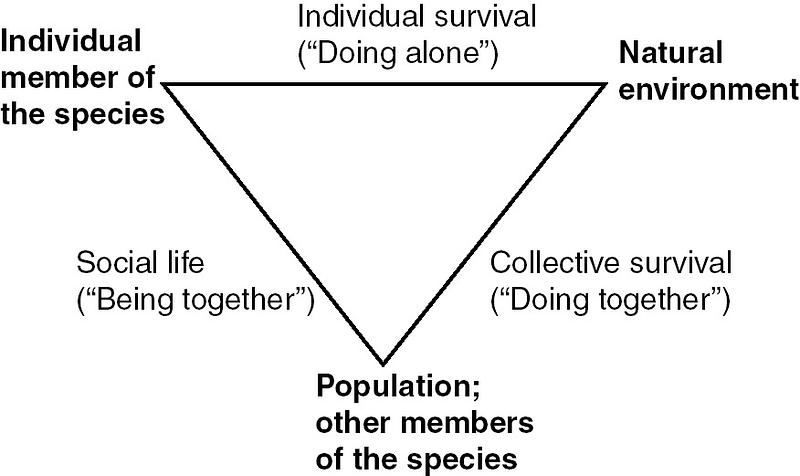
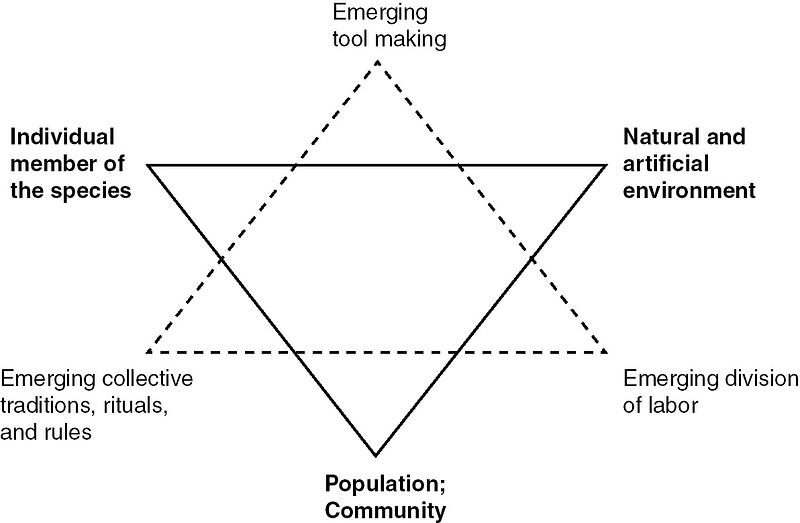
The next stage is the evolution from animal to human. Engeström pointed out three major changes which are represented within the following diagram.
- Doing alone: the emerging utilization of tools.
- Being together: collective traditions, rituals, and rules.
- Doing together: division of labor between the sexes and more.
The next stage is transforming from “ecological and natural” to “economic and historical”. Engeström said, “What used to be adaptive activity is transformed into consumption and subordinated to the three dominant aspects of human activity — production, distribution, and exchange (or communication). The model suggests the possibility of analyzing a multitude of relations within the triangular structure of activity. However, the essential task is always to grasp the systemic whole, not just separate connections.”
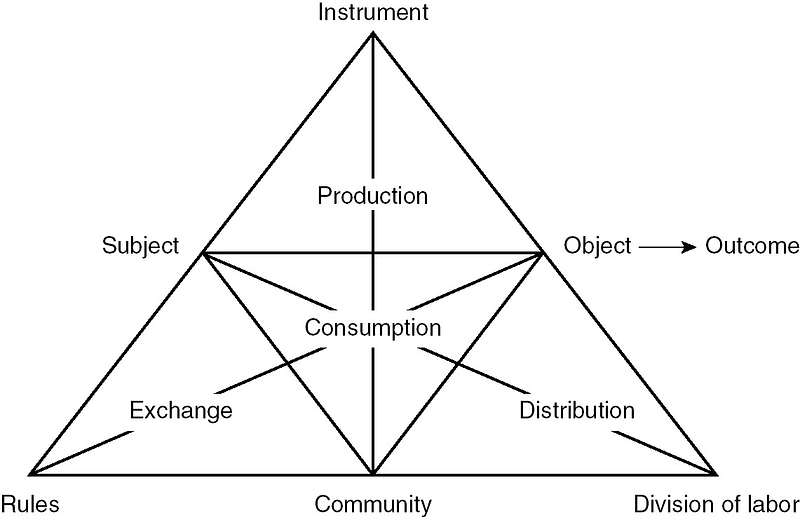
Now, we see another major theoretical tradition behind the diagram. Engeström pointed out, that Karl Marx provided an essential analysis in the introduction to Grundrisse, “Production creates the objects which correspond to the given needs; distribution divides them up according to social laws; exchange further parcels out the already divided shares in accord with individual needs; and finally, in consumption, the product steps outside this social movement and becomes a direct object and servant of individual need, and satisfies it is being consumed. Thus production appears to be the point of departure, consumption as the conclusion, and distribution, and exchange as the middle (…).” (Marx 1973, 89. cited in Engeström, 1987, p.94)
Engeström called this diagram the Activity System. This means “an activity is a system”. Also, he argued that “…there is no activity without the component of production; only actions may be void of it.”
2.8 Four levels of contradictions
A key concept of activity theory is “contradictions”. Engeström also used this concept to guide the notion of “expansion”. He said, “Within the structure of any specific productive activity, the contradiction is renewed as the clash between individual actions and the total activity system…The fundamental contradiction arises out of the division of labor…The two directions or ‘opposite starting points’, from within an activity and from between two activities, are essential for the emerging concept of expansion…”(1987, p.98-99)
The concept of “contradictions” can be applied to different levels of analysis. For example, it can be used to discuss contradictions within one activity or contradictions between two activities. It also can be used for analyzing high-level abstract “human activity system” such as “subject-producing activity”, or everyday life concrete “activity” such as “school bus activity”.
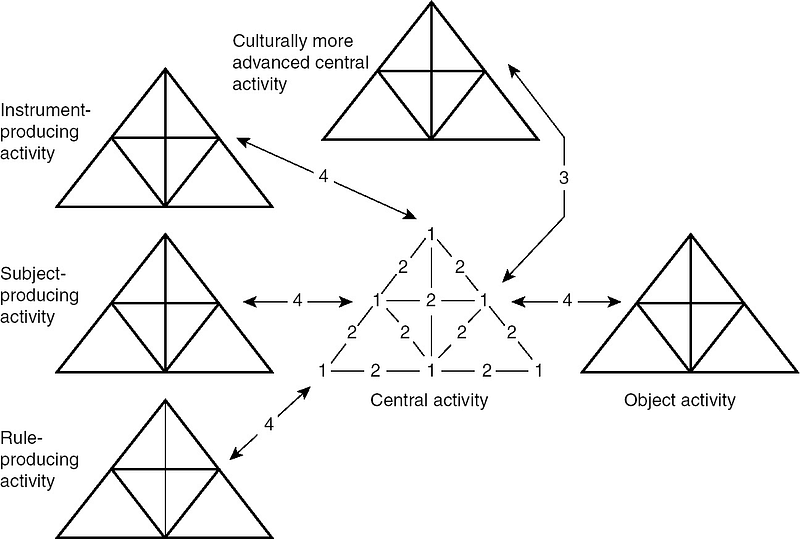
Engeström used the above diagram to discuss four levels of contradictions within the human activity system at the abstract high level:
- Level 1: Primary inner contradiction (double nature) within each constituent component of the central activity.
- Level 2: Secondary contradictions between the constituents of the central activity.
- Level 3: Tertiary contradiction between the object/motive of the dominant form of the central activity and the object/motive of a culturally more advanced form of the central activity.
- Level 4: Quaternary contradictions between the central activity and its neighbor activities.
Why did Engeström talk about it? He claimed that “the concept of learning activity can only be constructed through a historical analysis of the inner contradictions of the presently dominant forms of societally organized human learning.” (1987, p.106)
He said, “The original forms of human learning are those where learning appears predominantly as an unintentional and inseparable aspect of the basic work activity (Alt 1975; Wilhelmer 1979). In terms of activity theory, this kind of incidental learning consists of nonconscious learning operations, embedded in the daily participation in joint work.”
2.9 Gain mastery of the work activity
Thus, the next half of chapter 2 moved to discuss the cultural evolution of human learning. Engeström considered three activity types as practical lineages leading to the formation of learning activity, “These three are the activity of school-going, the activity of work, and the activities of science and art.” (1987, p.108)
The diagram below is for discussing the primary contradiction of modern work activity. Now, graphic models became a tool for theoretical development. Engeström pointed out, “In terms of activity theory, we may say that there is on the one hand the object-activity (appearing in the form of market demands) requiring high quality, flexibility, variability and short delivery times from the products, which in turn require complex programmable cybernated instruments. However, there is an acute conflict between these factors and the striving for immediate cost-efficiency, manifested above all in the polar and compartmentalized division of labor. In effect, industrial capitalism has split the work activity in two basic layers of actions, those of operating or performing and those of design and management.”
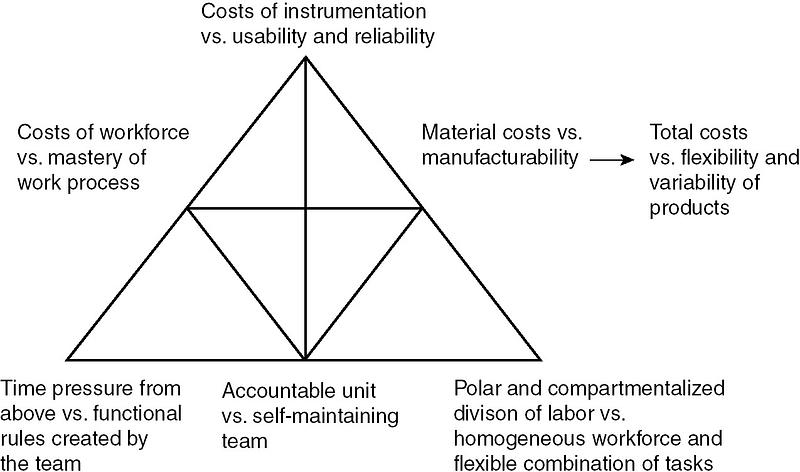
Engeström claimed that the learning activity emerges from these contradictions. He said, “To gain mastery of the whole work activity means to move from actions to activity in the sense tentatively characterized by Leont’ev and Ilyenkov. As I pointed out earlier, the expansive form of this transition implies that the actions themselves are objectively transformed. Moreover, such a transition requires ‘reflecting the relation of the motive of a given, concrete activity to the motive of a wider activity’ (Leont’ev). In other words, the subjects must become aware of the contradictory nature of their present work activity and relate it to a future form of the work activity ‘that realises a broader, more general life relation that includes the given, concrete activity’ (meaning that the given form of work is not eliminated or replaced at once). This is a tall order that cannot be accomplished without ‘a certain, special activity’ of new type — learning activity.” (1987, p.125)
2.10 The network of human activities
In order to discuss the relationship between learning activity and other types of human activities, Engeström used a new term called Activity Network. He said, “Human learning begins in the form of learning operations and learning actions embedded in other activities, phylogenetically above all in work. Learning activity has an object and a systemic structure of its own. Its prerequisites are currently developing within earlier activity types: school-going, work, and science/art. In the network of human activities, learning activity will mediate between science/art on the one hand and work or other central productive practice on the other hand.” (1987, p.133)
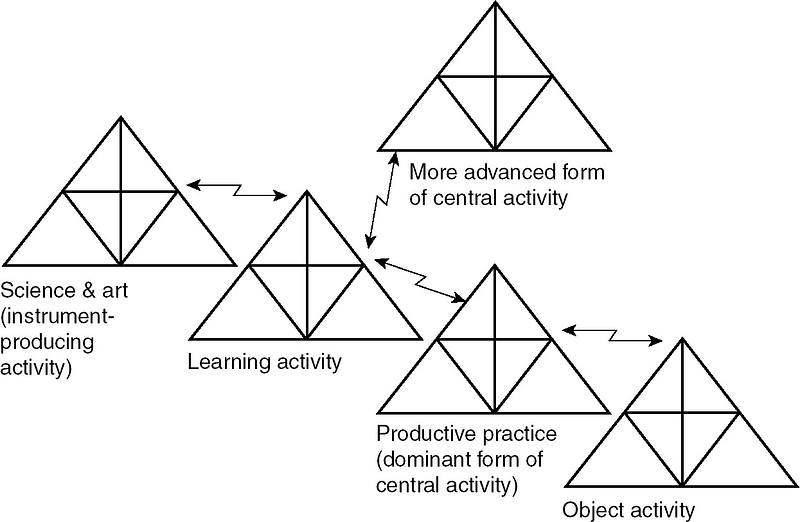
The above diagram and various types of diagramming indicate the future evolution of the Activity System theory.
While Engeström worked on adopting activity theory for developmental learning in work settings, HCI researcher Susanne Bødker applied activity theory to studies of HCI. These two lines work on different aspects of Leontev’s activity theory. Engeström focused on the general structure of human activity while Bødker worked on the hierarchical structure of activity and human-computer interaction. Later these two lines form as a whole the third generation of activity theory (Nardi, 1996; Kaptelinin & Nardi, 2006).
Both Engeström and Bødker published their books in 1987. Bødker’s book Through the Interface — a Human Activity Approach to User Interface Design is also a classical study of HCI and Activity Theory. According to Clay Spinuzzi (2020), “…without using the term, Bødker described activity networks: i.e., constellations of interconnected, not necessarily hierarchically related activities in which one activity’s object could function as another activity’s mediator. The concept was necessary for analyzing design within interconnected systems of expertise. Consider a writer, who labors to produce her object (a script). The script is then given to a television announcer, who uses the script as a tool in a second activity (Bødker, 1987, p.40). This concept of activity networks was critical for describing workplace development in activity theoretical terms for HCI, since HCI by definition involved applying computer expertise to domains that had not yet been computerized — that is, it involved making contact between two or more heretofore separate activities.”
The above diagram shows the layer of activity network in Engeström’s study. Spinuzzi (2020) also pointed out, “Engeström expanded the analysis to activity networks, that is, two or more interacting activity systems. Whereas Bødker described such networks in brief, Engeström coined the term ‘activity network’ and theorized the concept. This innovation was necessary for understanding interactions and quaternary contradictions in workplaces.”
2.11 The structure of learning activity
Finally, Engeström reached the conclusion of chapter 2 and presented a model of the structure of the learning activity with the diagram. Here we see the typical thoughts of using the activity system model. First, we should ask a primary question: what is the specific object of the activity? Then, we can analyze other elements once we confirm the content of the object. To put it another way, the “object” has higher priority within the analysis process than other elements.
Engeström confirmed, “Learning activity (a) analyzes and connects these discrete elements with their systemic activity contexts, (b) transforms them into contradictions demanding creative solution., and (c) expands and generalizes them into a qualitatively new activity structure within societal productive practice. According to V. V. Davydov (1982, 39), the motive of learning activity is theoretical relation to the reality. In other words, the components (a), (b) and (c) above result in a theoretical reconstruction of the object.” (1987, p.134)
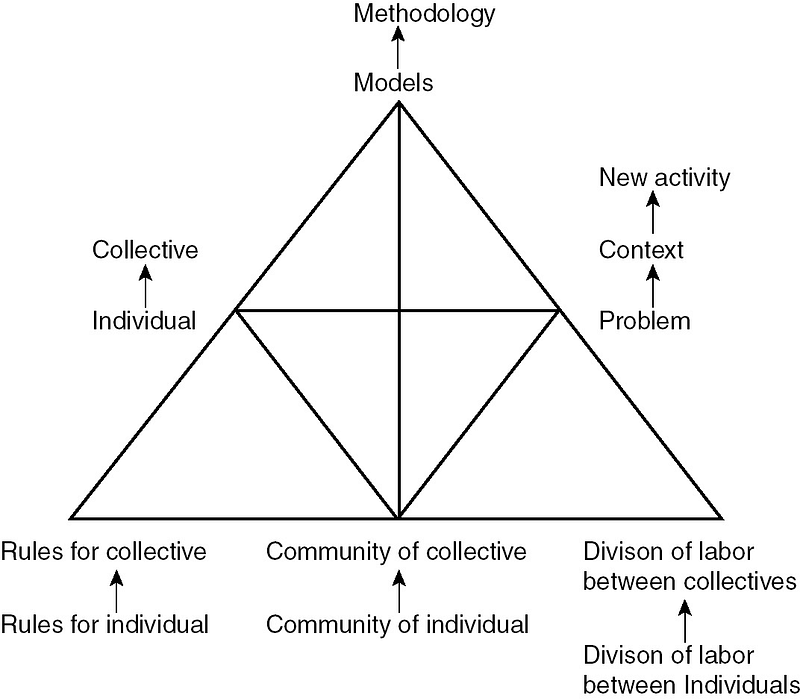
Chapter 2 is the foundation of Engeström’s theoretical building. First, he built the general concept of human activity. Second, he developed a special version of human activity: learning activity. He also called it learning by expanding.
The above discussion represents the origin of Engeström’s triangle. The next section will review the evolution of the triangle.
PART 3. The Evolution of the Engeström’s Triangle
This section will focus on Engeström’s own works after he published the book Learning by Expanding in 1987.
3.1 The life of a wall (1996) 3.2: Individual Actions v.s. Activity System (1999) 3.3: The third generation of Activity Theory (2001) 3.4: The place of engagement in an activity system (2008) 3.5: Large Runaway Objects (2009)
3.1 The life of a wall (1996)
In 1996, Bruno Latour published a paper titled On Interobjectivity and argued that human interaction is reduced and partitioned by material frames, including walls and clothes. Engeström (1996) wrote a paper and commented on Latour’s argument. He said, “When talking about artifacts, activity theorists are used to referring to implements and tools, such as spoons, hammers and machines. But walls, clothes, buildings, furniture, roads, parks and other such things are not so clearly tools used by actors to achieve ends. They are something like infrastructure — material and human-made, but not easily attached to a specific set of purposes and uses.”
Engeström used the following diagram to discuss the trajectory of a wall in the conceptual model of a human activity system.
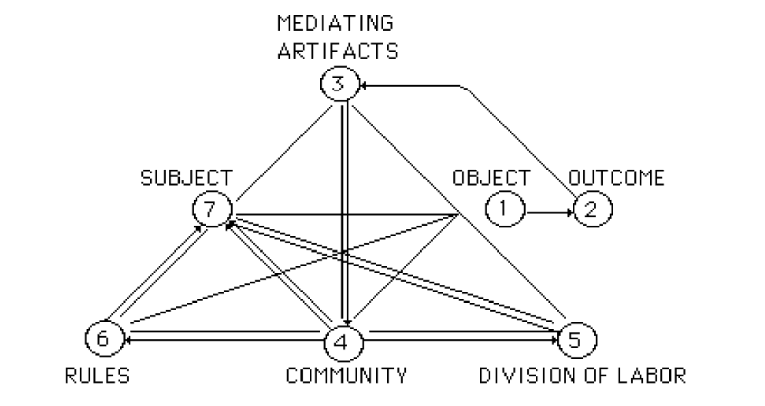
According to Engeström, “The wall begins its life as an object to be created (1) for the owner of a house by means of hiring a carpenter. When the construction is finished, the wall momentarily appears as an outcome, a product (2). For a while, the owner of the house sees the finished wall as a mediating artifact, a tool with which he reaches the purpose of rearranging his living space (3). Soon enough, the wall ceases to be a tool; it becomes an aspect of the tacitly assumed community infrastructure (4) for the family living in the house and for the friends visiting it. As a designated space, e.g., as the study of the husband, it begins to define the division of labor in the family (5), and the associated rules — e.g., children are not allowed to play in this room (6). Once it has taken root at this community level of the activity, the wall is on its way to become a constitutive element in the makeup of the subject’s identity (7).”
I have used the hammer as an example to discuss various perspectives on the materiality turn and Artifact-centered Interaction. Now we can add the wall into the discussion. Engeström went beyond object-in-use and paid attention to “incessant movement of objects between and across their multiple potential roles and meanings”.
3.2 Individual actions v.s. Activity system (1999)
In 1999, Engeström co-edited Perspectives on Activity Theory which is the first comprehensive presentation of contemporary work in activity theory. In fact, the chapters in the book originate mainly from selected contributions to the Second International Congress for Research on Activity Theory which was held in 1990.
Engeström used his own actions of preparing and presenting the speech titled Activity theory and transformation as an example to test his own triangle. I think this is a great case of eating your own dog food for theory makers.
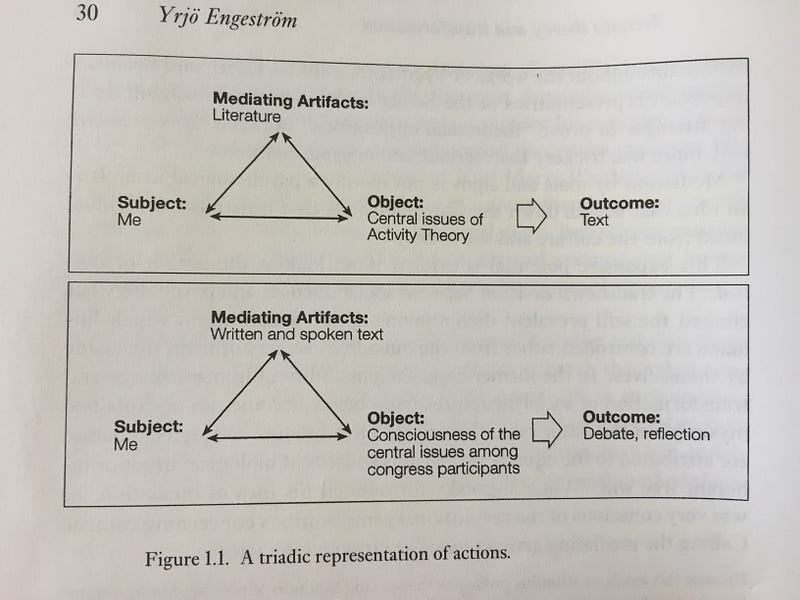
Engeström said, “The first triangle represents my actions of preparing and writing the speech with the help of available literature. The second triangle represents my subsequent actions of presenting the speech in the congress, using the written text and spoken words as my most important mediating artifacts.” (1999, p.30)
By using this example, Engeström pointed out the limit of the model of mediated actions. He argued, “The problem with this classical representation is that it does not fully explicate the societal and collaborative nature of my actions. In other words, it does not depict my actions as events in a collective activity system. The outcomes of my actions appear to be very limited and situation bound: a particular text, a momentary impact on the listeners. If this is all there is to gain, why did I bother to prepare this speech in the first place? Somehow, this level of representation hides or obscures the motive behind the actions.”(1999, p.30)
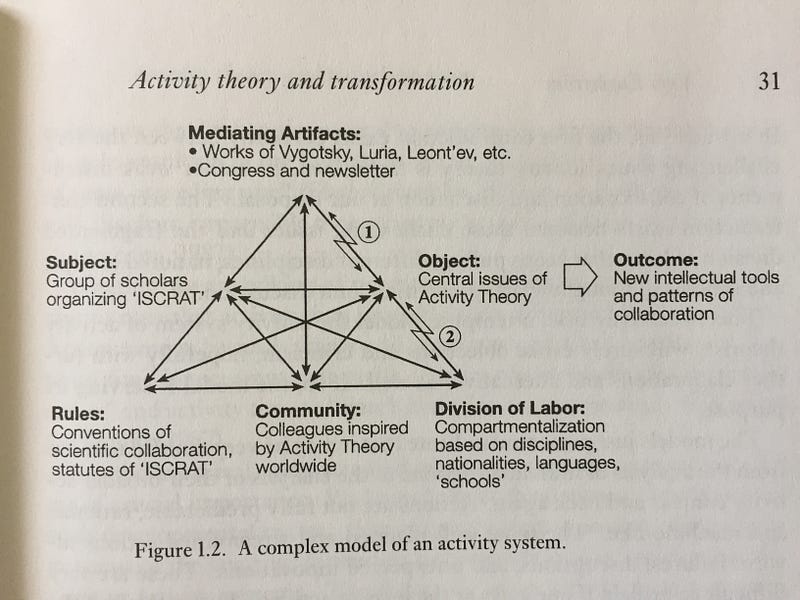
Then, he switched to the activity system and placed his own actions in the context of an activity system which he called international activity-theoretical collaboration. He said, “The subject has been changed. It is no longer ‘me’ as an individual. Rather, I place myself into a diverse international group of scholars who created this organization. The central issues of activity theory remain the object — that is what connects my individual actions to the collective activity. However, the projected outcome is no longer momentary and situational; rather, it consists of societally important new, objectified meanings and relatively lasting new patterns of interaction. It is this projection from the object to the outcome that, no matter how vaguely envisioned, functions as the motive of this activity and gives broader meaning to my actions. In addition to the legacy of the cultural-historical school objectified in texts, the most important mediating artifacts in this activity system are the international meetings and publications.” (1999, p.31)
The lightning-shaped arrows indicate contradictions between central components of the activity system. According to Engeström, “…the first contradiction exists currently between the very challenging issues activity theory is facing and the rather weak instruments of collaboration and discussion at our disposal. The second contradiction exists between those challenging issues and the fragmented division of labor that keeps pulling different disciplines, national groups, and schools of thought apart, preventing joint discussion.”(1999, p.32)
I have read this example many times. This time, I found it pointed out that the activity system is a great theory for understanding offline events. If you are an event designer and researcher, you can adopt activity theory for your work.
3.3 The third generation of Activity Theory (2001)
We have learned the interacting activity systems and activity networks from the above discussion. Though these notions were theorized in 1987, a key step to push these ideas to the front stage was taken in 2001. In order to respond to the emergent developments of activity theory in the international context, Engeström published a paper titled Expansive Learning at Work: toward an activity theoretical reconceptualization in 2001 and suggested “the third generation of activity theory”.
The problem was “develop conceptual tools to understand dialogue, multiple perspectives, and networks of interacting activity systems.” During the 1990s, many activity theorists developed various theoretical concepts to address this challenge:
- Dialogicality (Wertsch, 1991)
- Voice as communicative action (Ritva Engeström, 1995)
- Activity networks (Russell, 1997)
- Boundary crossing (Engeström, 1995)
- Third space (Gutierrez et al., 1995; Gutierrez et al., 1999)
Engeström (2001) considered these developments as a new opportunity for introducing the third generation of activity theory. He suggested that the two interacting activity systems as the minimal model for the third generation of activity theory. The diagram below represents this theoretical reconceptualization.
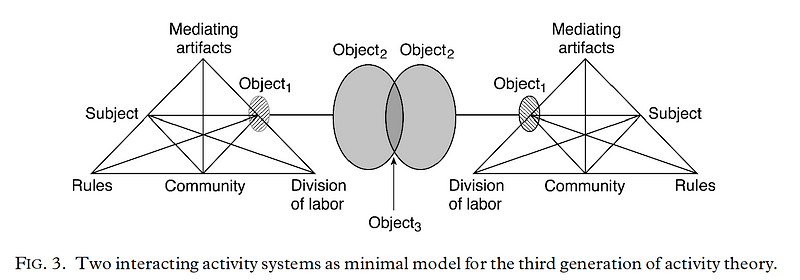
The core of theoretical reconceptualization is the change of the object. According to Engeström, “the object moves from an initial state of unreacted, situationally given ‘raw material’ (object 1; e.g., a specific patient entering a physician’s office) to a collectively meaningful object constructed by the activity system (object 2, e.g., the patient constructed as a specimen of a biomedical disease category and thus as an instantiation of the general object of illness/health), and to a potentially shared or jointly constructed object (object 3; e.g., a collaboratively constructed understanding of the patient’s life situation and care plan). The object of activity is a moving target, not reducible to conscious short-term goals.”(2001)
Later, the diagram was changed to a simpler version as the following one. It uses “potentially shared object” to replace “object 1”, “object 2”, and “object 3”.
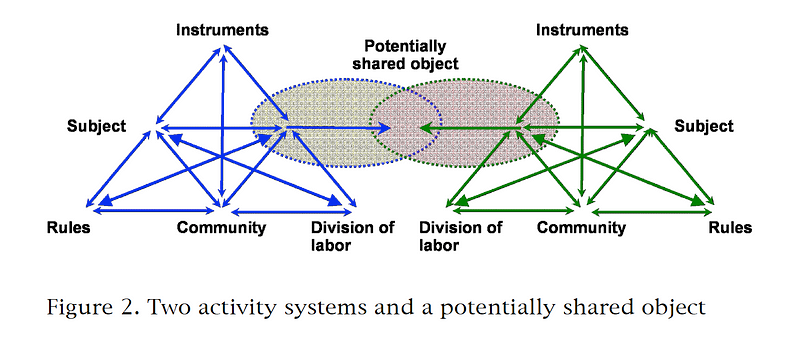
In the 2001 paper, Engeström also gave an example of the third-generation activity theory: the learning challenge in Children’s Health Care in Helsinki. The diagram below shows insights emerging from the study: “In both the hospital and the health center, a contradiction emerges between the increasingly important object of patients moving between primary care and hospital care and the rule of cost-efficiency implemented in both activity systems. In Helsinki, the per capita expenditure on health care is clearly above national averages, largely due to the excessive use and high cost of services provided by the central university hospital of which the Children’s Hospital is a part. Thus, there is an aggravated tension between the primary care health center and the university hospital. Health centers in the Helsinki area are blaming the university hospital for high costs, while the university hospital criticizes health centers for excessive referrals and for not being able to take care of patients who do not necessarily need hospital care.”
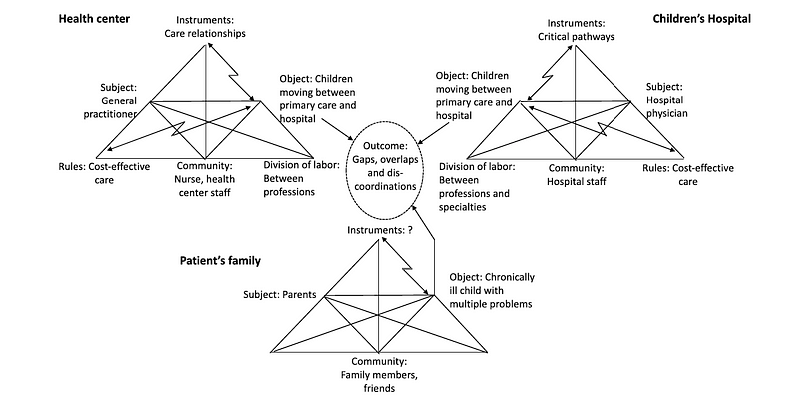
Engeström also pointed out another contradiction, “A contradiction also emerges between the new object (patients moving between primary care and hospital care) and the recently established tools, namely care relationships in primary care and critical paths in hospital work. Being linear-temporal and mainly focused on care inside the institution, these tools are inadequate for dealing with patients who have multiple simultaneous problems and parallel contacts to different institutions of care. In the activity system of the patient’s family, the contradiction is also between the complex object of multiple illnesses and the largely unavailable or unknown tools for mastering the object.”
In 2009, Engeström also shared a case of the activities of management and work (see the diagram below). He said, “Third-generation activity theory may open up new possibilities. In an organization, managing is usually best seen as an activity system of its own, relatively independent of the activity systems of primary productive work. A useful minimal unit of analysis might in some cases look like the diagram in Figure 4. In the diagram, the relationship between the activities of management and work, specifically the flow of rules from management to work units, is opened up for scrutiny. Yet these two activity systems and their takes on the potentially shared object are looked at in relation to the activity system of the client. Examination of the horizontal relations with the client should prevent the vertical power relationship from being turned into a closed iron cage.”
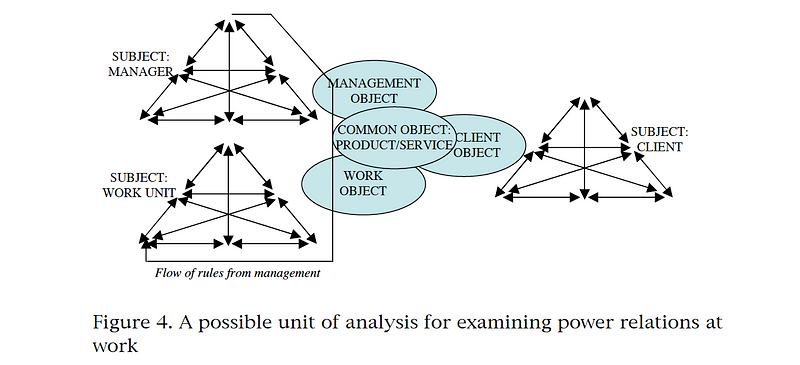
These cases indicate the power of the third generation of activity theory. The triangle grew from an individual triangle to a group of triangles. Now, activity theorists have a tool for studying complex social-ecological systems.
3.4 The place of engagement in an activity system (2008)
In 2006, Victor Gonzalez published his doctoral studies and dissertation titled The Nature of Managing Multiple Activities in the Workplace. The study was conducted at two different companies where he observed the practices of 36 information workers. Gonzalez proposed a notion of working sphere for representing the practical units in which individuals conceptualize their work. He defined it as “…a unit of work that, from the perspective of the individual, thematically connects a number of actions and their goals towards the achievement of a specific purpose, has a unique time frame, demands the use of particular resources and tools, and involves a particular collaborative structure.” He also identified five typical patterns of the working sphere (event, project, recurrent, request, and problems).
Traditionally, activity theorists adopted the hierarchical structure of activity with three layers (activity, action, and operation) from Leontiev’s theoretical construction. Based on his empirical study, Gonzalez found the notion of the working sphere, as a personal conceptualization of work, faces problems when it is compared with Leontiev’s model. Thus, he suggested that there is a need for an intermediate unit of work between activities and actions (see the left part of the diagram below).
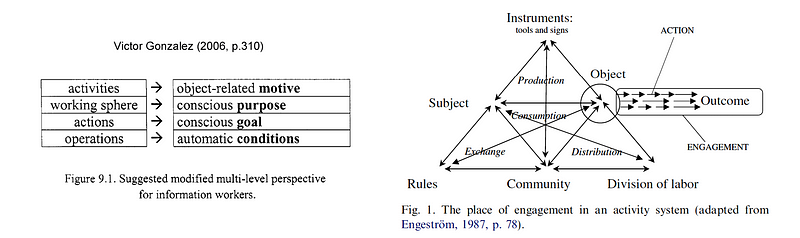
In 2008, Engeström published a short paper and responded to Gonzalez’s suggestion. He agreed that it is useful and necessary to identify an intermediate unit between collective activity and individual action within activity theory. However, he pointed out that the notion of working sphere (engagement) doesn’t match the theoretical tradition of activity theory because Gonzalez’s concept stands from the subjectivist position. He said, “Activities are oriented to and driven by objects and motives. Actions are oriented to and driven by goals…recurring working spheres/engagements…are also outcomes…they are historically built into the object, division of labor and rules of the work activity.” He placed the work spheres/engagement between object and outcome, see the left part of the above diagram.
This left part of the above diagram is not a normal form of Engeström’s Triangle. However, this example shows the power of a simple triangle and its flexibility in servicing theoretical discussion. It also reminds us that the “object-outcome” part is a critical component of the activity system model.
3.5 Large Runaway Objects (2009)
Activity theory is a theory of object-driven activity. Activity theorists also take seriously the idea that practice is essential for testing and improving theory. Engeström (2009) suggested, “To keep activity theory alive and productive, we need to read each other’s concrete studies, dig into each other’s data and visit each other’s field sites of research and intervention.”
In 2008, Engeström presented a keynote lecture titled The Future of Activity Theory at a conference. The lecture was collected in the book Learning and Expanding with Activity Theory in 2009. He said, “Objects are concerns, they are generators and foci of attention, motivation, effort and meaning. Through their activities people constantly change and create new objects. The new objects are often not intentional products of a single activity but unintended consequences of multiple activities. The societal relevance and impact of activity theory depend on our ability to grasp the changing character of objects. In the present era, we need to understand and deal with what I have called ‘runaway objects’ (Engeström, 2009). Runaway objects have the potential to escalate and expand up to a global scale of influence. They are objects that are poorly under anybody’s control and have far-reaching, unexpected effects.”
The idea of “Runway Objects” led to a major change in Engeström’s Triangle (See the diagram below).
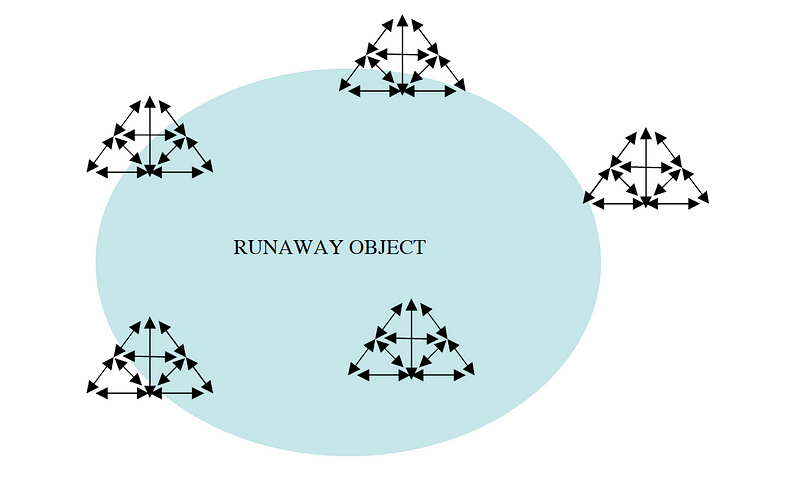
When “Runaway object” replaces “object” and “potentially shared object”, the activity systems lose connections through objects. Engeström (2009) said, “They are typically numerous activity systems focused on or affiliated with the object. But the object is pervasive and its boundaries are hard to draw. Thus, the positions of the activity systems are ambiguous and they often seem to be subsumed to the object rather than in control of it.”
Engeström also suggested a tentative way to adopt the notion of a runaway object: “benign runaway object”. He said, “First of all, a benign runaway object must have intrinsic properties that transcend the limits of utilitarian profit motive. In this sense, a benign runaway object is at the boundary between legitimate and illegitimate, sensible and crazy, work and leisure, technology and art. These properties are experienced in acting on and with the object over a long haul, with persistence and patience, oscillating between intensity and withdrawal. The object must yield useful intermediate products, yet remain an incomplete project. The object must be visible, accessible and cumulable — allowing participants to return time and again. There must be effective feedback from and exchange among the participants acting on the object.”
PART 4: The Application of the Engeström’s Triangle
This part will feature some real usage examples of Engeström’s Triangle from works contributed by other activity theorists and researchers.
4.1 Activity Notation: decomposing the organization’s activity system 4.2 A general diagram of activity network 4.3 Temporal interconnectedness and Situatedness of activities 4.4 Application of activity system and activity network
4.1 Activity Notation: decomposing the organization’s activity system
In 2001, Daisy Mwanza published a paper and introduced an activity theory-based methodology for guiding computer system design. She argued that “ Activity Theory (AT) has emerged as a suitable framework for analyzing social and cultural issues because it provides a language to describe what people do in context. However, many computer system developers have failed to benefit from this insight mainly due to lack of established methods to operationalize ideas from this framework for the purpose of guiding the design process.”
Noticing the lack of a standard and specified method for applying Activity Theory within HCI, Mwanza developed an Activity-Oriented Design Method (AODM) with four methodological tools. One of the tools is called Activity Notation which breaks down the situation’s whole activity system into smaller manageable sub-activity triangles (see the diagram below).
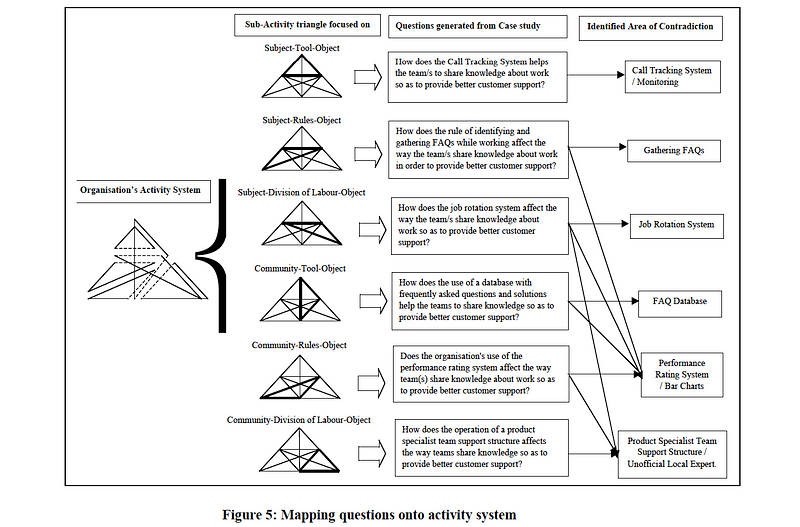
She also developed a set of general research questions which are specific to a particular combination within the activity notation. Mwanza said, “These questions are used as pointers to what to look for during observational studies, also in questionnaires and interviews as triggers to help decide on what questions to ask.” Finally, researchers and designers can analyze and interpret data they gathered with a key concept of activity theory: contradictions.
4.2 A general diagram of activity network
While the concept of Activity System focuses on the inside of an activity system, the concept of Activity Network pays attention to the outside of an activity system. There is no standard diagram for representing the idea of Activity Network, I adopted the diagram below from Clay Spinuzzi’s 2011 paper Losing by Expanding: Corralling the Runaway Object. It’s pretty good for visualizing the idea.
Spinuzzi pointed out, “Activity systems can, of course, be related in ways other than through shared objects. For instance, when one activity system takes a particular product as its object (e.g., a company develops software), that object can then become a tool in some other activity (e.g., other organizations then use that software to process their own orders). We might see such activity systems as atomic components that interlink to form larger, but relatively coherent, activity networks (see Miettinen, 1998, 1999; Miettinen & Hasu, 2002). Like the concepts in the first two method–movements, the concept of activity networks appeared early on in Engeström’s (1987, Chapter 2; 1990, p. 13) work. In fact, we can understand the concept introduced in method–movement 2 (two activity systems sharing an object) as a simple version of an activity network.”
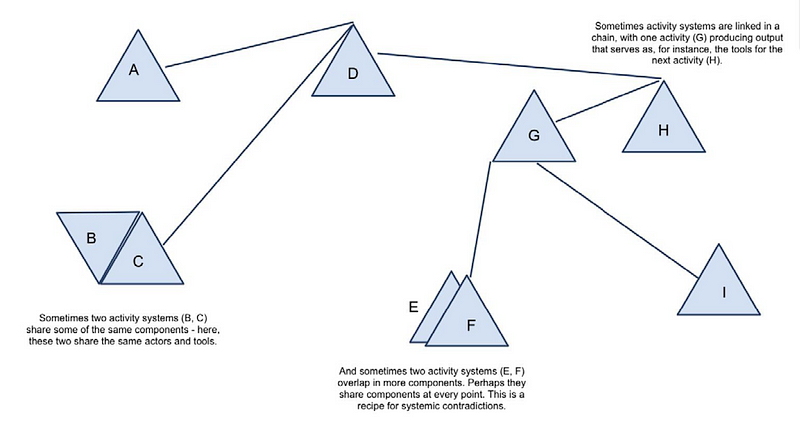
Though we can understand “two activity systems sharing an object” as a simple version of an activity network, the above diagram presents more possible ways of links between activity systems.
- Sometimes two activity systems (B, C) share some of the same components — here, these two share the same actors and tools.
- Sometimes activity systems are linked in a chain, with one activity (G) producing output that serves as, for instance, the tools for the next activity (H).
- And sometimes two activity systems (E, F) overlap in more components. Perhaps they share components at every point. This is a recipe for systemic contradictions.
4.3 Temporal interconnectedness and Situatedness of activities
In 2002, Niels-Ingvar Boer, Peter J. van Baalen and Kuldeep Kumar published a paper titled An Activity Theory Approach for Studying the Situatedness of Knowledge Sharing. They adopted activity theory to discuss the situated nature of the knowledge-sharing process. They argued, “ Besides the fact that an activity is situated in a network of influencing activity systems, an activity is also situated in time. An activity is never constructed ex nihilo, since it relies on the lore of language, equipment, institutions and conventions [32]. In order to understand the activity system under investigation, one therefore has to reveal its temporal interconnectedness [39]. History is not just an event in the past but is alive in the present and may shape the future. Rather than analyzing an activity system as a static picture of reality, the developments and tensions within the activity system need to be described and analyzed (see figure 3).”
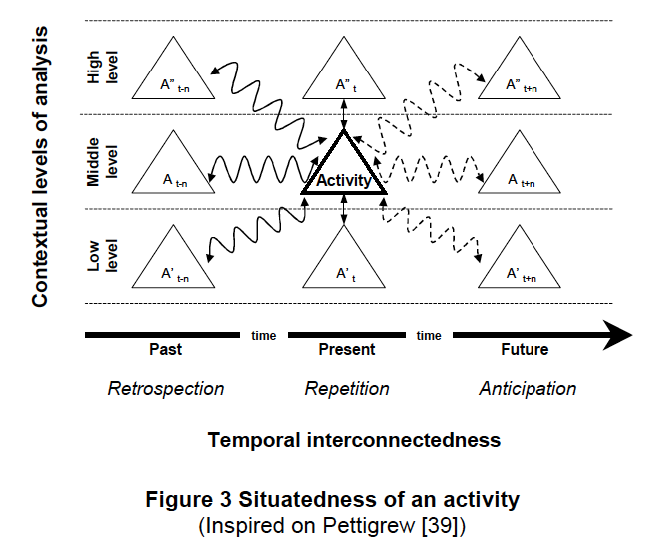
This diagram and concept of “situatedness of an activity” were embraced by other researchers. For example, Geri Gay and Helene Hembrooke adopted this model for their book Activity-centred Design: An ecological approach to designing smart tools and usable systems (2004, p.10).
Boer, Baalen, and Kumar also presented another diagram for discussing different contextual levels of analysis. See “figure 4” below.
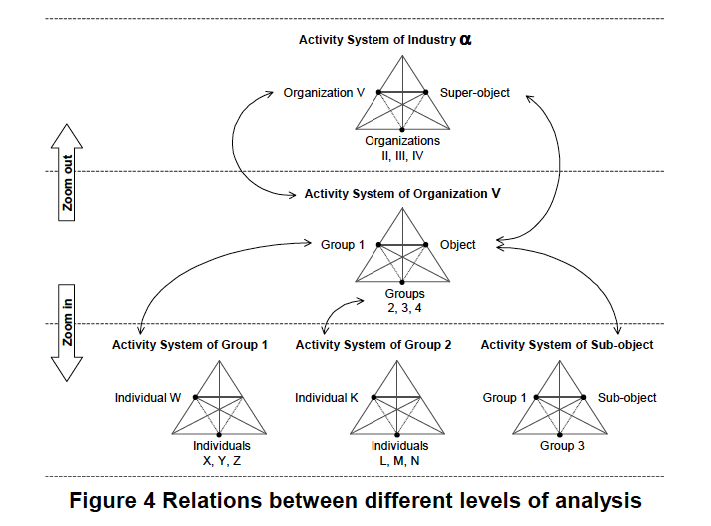
They pointed out, “ When analyzing an activity system at a particular contextual level, one should also take into account its relations with activity systems at other contextual levels (e.g., economic system, industry, supply chain, organization, department, or production process). Processes at different contextual levels of analysis are often observed to have their own momentum, rates, pace, and trajectory. An activity system should be studied in the context of these processes. For example, when analyzing knowledge sharing within an organization (activity system at middle contextual level), one could also define the industry within which this organization operates as an activity system at a higher contextual level of analysis or entitle different departments within the organization as activity systems at a lower level.” (2002)
4.4 Application of activity system and activity network
The diagram Spinuzzi presented is only for understanding the concept of activity network. In real study and analysis, researchers use their own styles of diagramming to visualize their insights. Sometimes, they even don’t use the term “activity network”.
For example, the diagram below is part of David R. Russell’s 1997 paper Rethinking Genre in School and Society: An Activity Theory Analysis.
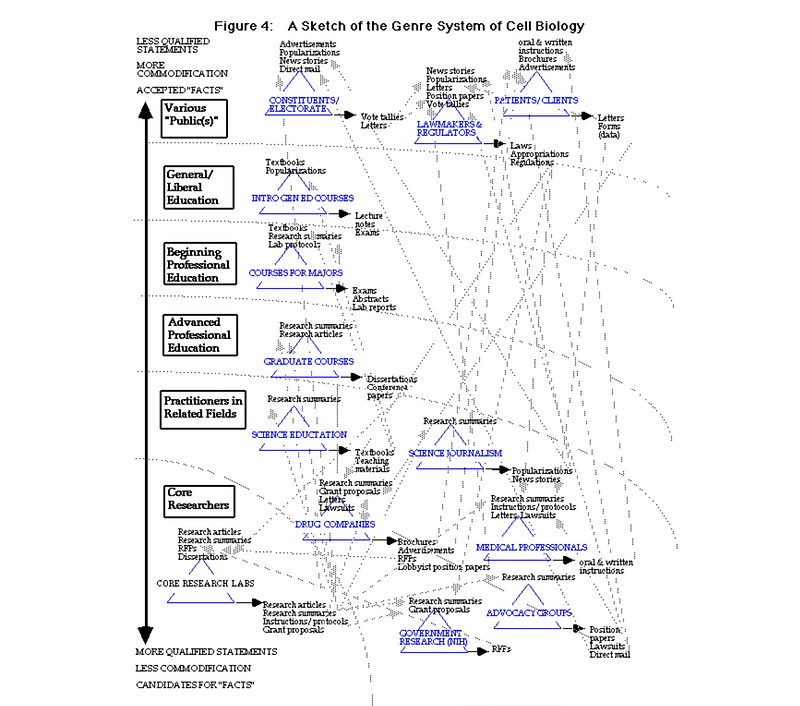
The above diagram shows the freedom of adopting Engeström’s triangle in real situations, especially for discussing the level of multiple activity systems. You can search “activity theory” on Google Images to find more examples.
PART 5: Discussion
The above discussion summarized the origin, evolution, and application of Engeström’s Triangle. Now let’s switch to some issues related to theoretical diagrams and diagramming. I’d like to highlight the following four topics:
- 5.1 Diagram (Representation) v.s. Diagramming (Instrument)
- 5.2 Spatial thought v.s. Linguistic thought
- 5.3 Knowledge model v.s. Knowledge brand
- 5.4 Organization of activity v.s. Structure of activity
5.1 Diagram (representation) v.s. Diagramming (Instrument)
Engeström really understood the power of the diagram and diagramming. I use the noun “diagram” to refer to what Engeström called “representation function of the models” and the gerund “diagramming” to refer to what Engeström called “instrumental or processual function of the models.”
The representation is static, permanent, and bounded while the instrument is dynamic, temporary, and boundaryless. From the perspective of activity theory, a diagram is an instrument of our knowing and understanding. Vygotsky, distinguished between two types of instruments in human activity: tools and signs which also means “psychological tools”. According to Vygotsky, “The following can serve as examples of psychological tools and their complex systems: language; various systems for counting; mnemonic techniques; algebraic symbol systems; works of art; writing; schemes, diagrams, maps, and mechanical drawings; all sorts of conventional signs; etc.” (Vygotsky 1981, 137. cited in Engeström, 1987)
Clay Spinuzzi (2020) reviewed some criticisms of Engeström’s triangle and gave a fair assessment as a response. He said, “Engeström provided a graphical heuristic (the now-famous triangle) for picturing Leontiev’s activity system. This heuristic, which has been derided by some critics (e.g., Miller, 2011), was meant not only as an analytical device for researchers but (critically) also as a way to communicate with — and codesign work with — research participants (e.g., Engeström, 1999; Engeström & Sannino 2010). That is, it served as an interventionist “language game” (Ehn 1989) similar to the prototypes and organizational games that Bødker and other participatory designers used to leverage the tacit expertise of participants. This point has been overlooked by those who have critiqued the triangle heuristic as an oversimplified theoretical tool. (See Sannino 2011 for further elaboration of this point, and see Engeström 2018, pp.23 and 78 for other representations Engeström has developed for local stakeholders.)”
As Engeström mentioned, “I use the graphic models in series of successive variations, not just as singular representations…With the help of such variations, I try to demonstrate how the models can depict movement and change. The reader is invited to formulate and test his own variations.” (1987, p.47) We should remember that the diagram is not a dogma but a guide to action.
5.2 Spatial thought v.s. Linguistic thought
When we think about thinking, we usually think we are thinking in words. However, linguistic thought is not the only way of the human mind. Cognitive scientist and psychologist Barbara Tversky argued that spatial thought is the foundation of our abstract thinking in her 2019 book Mind in Motion: How action shapes thought.
I want to highlight three ideas I learned from Barbara Tversky. The first is about taxonomy and partonomy, the second is about individual differences in mental rotation, and the third is a story about the Feynman diagram. First, Tversky said, “Spatial hierarchies are partonomies, not taxonomies like the categories of objects, events, and scenes…Partonomies are hierarchies of parts; taxonomies are hierarchies of kinds…categories allow reducing the amount of information in the world…Like taxonomies, partonomies allow inferences, but inferences of containment, not of properties…(p.77–78)”
According to Tversky, “Mental rotation is a distinctly visual-spatial transformation. It has been likened to watching something actually rotate in space…mental rotation task has become one of the major measures of spatial ability.” (p.89–90) She also pointed out the individual differences in mental rotation, “Surgeons, plumbers, electricians, football coaches, mathematicians, fashion designers, urban planners, gardeners, physicists, fire fighters, architects, basketball players, interior designers, dentists, and so many more use mental rotation and other forms of spatial reasoning regularly in their work…lawyers and journalists and historians and accountants and executives and philosophers and poets and translators don’t seem to need mental rotation in their work.” (p.91)
Tversky also directly talked about the diagram in chapter eight of Mind in Action. The title of the chapter is Spaces We Create: Maps, Diagrams, Sketches, Explanations, Comics. She said, “The ease of reasoning from well-designed diagrams has encouraged new fields to blossom, endeavors to make mathematics, logic, physics, and computer science diagrammatic, yet rigorous, in order to capitalize on our extraordinary abilities to see spatial relations and to reason about them. The rationale is the same, that diagrams use the power of spatial-motor reasoning for abstract reasoning.” (2019, p.210)
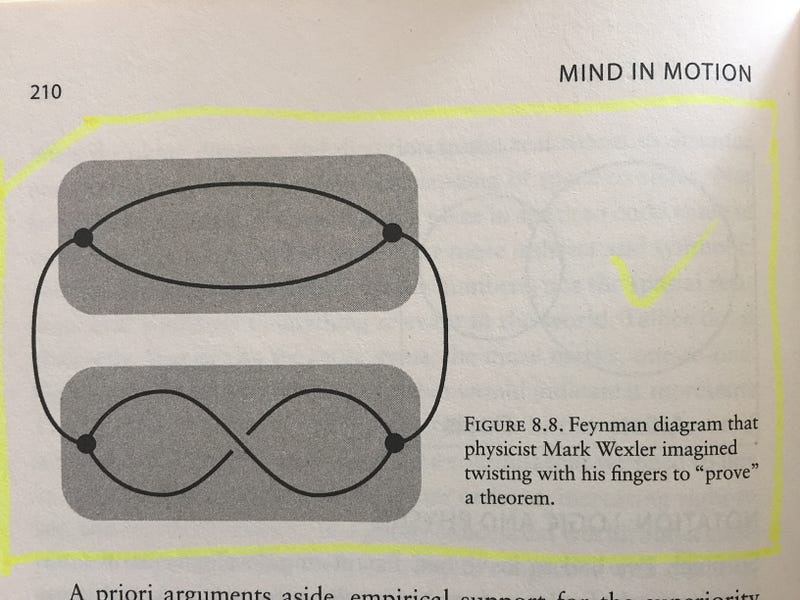
Tversky shared a story about the Feynman diagram with us, “Mark Wexler, now a cognitive scientist working on perception and mental imagery, used to be a physicist. When he was a physicist, he was working with the Feynman diagram in Figure 8.8. Each gray blob represents a separate universe. For the universe to be coordinated, the twist in the lower blob had to be undone. He imagined grabbing each of the lower ellipses with his thumb and index finger and twisting them in opposite directions, a bit like Cat’s Cradle. Doing that made him realize that untwisting the lower one twists the upper. The only way to remove the twist is to cut one of the attachments. This conclusion has implications for spacetime and quantum gravity, but that’s beyond me and thankfully beyond the scope of the book. His intuition turned out to be right, as he later showed in a rigorous line-by-line proof. Feynman diagrams are admittedly abstrute, as is the physics they represent, but once they are learned, like all effective visual spatial representations, they become a powerful thinking tool.” (p.211)
The goal of activity theory is for understanding various types of human activities in the real world. Engeström also targeted his audience as both researchers and practitioners. The value of learning activity theory is not only knowing some concepts and ideas but the real transformation in real life with the help of concepts and methods of activity theory. I want to claim that Engeström’s triangle and his graphical approach to theory building is a great case of “diagramming as theorizing”.
Since Barbara Tversky claimed the sixth law of cognition as “Spatial thinking is the foundation of abstract thought” (p.72), we should change our minds on theory development and knowledge building. It is time to switch from “language-based theorizing” to “spatial thinking-based theorizing”. Diagrams and Diagramming are great approaches for visualizing complex structural relationships such as “activity” and other social phenomena.
5.3 Knowledge model v.s. Knowledge brand
One of the key concepts of Engeström’s work is “models”. In chapter 4 of Learning by Expanding, he focused on “finding the central instruments needed for the mastery of expansive transitions.” He also defined three basic types of secondary instruments of expansive transitions: springboards, models, and microcosms.
In chapter 5 of Learning by Expanding, Engeström presented an initial version of the expansive research methodology. He summarized five steps of the methodological cycle in the diagram below. One of the tasks of the third step is “models (formulating the general instrumental model and its derivative models)”. He said, “Certainly it is important to let the participants proceed through tasks of problem solving and problem finding, so that the new general model is not acquired only mechanically and superficially at the outset. But no matter how cleverly such tasks are designed, the new model represents the given new and thus includes the aspect of guided or even imposed acquisition…Above I pointed out that the analysis of the activity produces a sketchy hypothetic model of the next, more advanced developmental form of the activity system. To make this sketchy hypothesis a real general instrument of expansion it is necessary to elaborate the strategic component(s) of the activity system (strategic ‘corners’ of the triangle) into novel models. Most typically, the strategic component is the object of the activity.” (p.254)
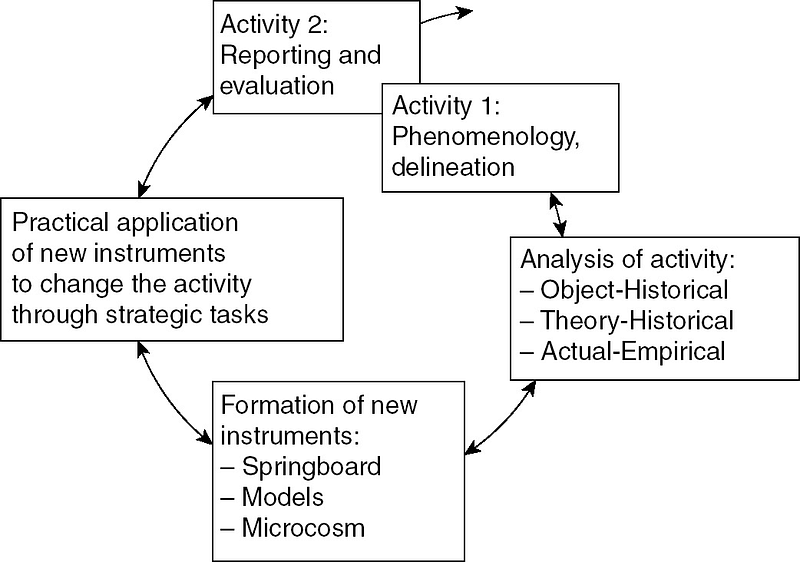
From the perspective of activity theory, knowledge is the instrument of the activity. The models built by participants can be seen as “practical knowledge models” which focus on guiding the process of transformation (see step 4 in the above diagram). Usually, practical knowledge models are only useful in some cases shared in similar situations. However, Yrjö Engeström’s own work such as the activity system models and the expansive learning models are “theoretical knowledge models” which have both academic value and practical value.
From the perspective of knowledge diffusion, I want to claim that Engeström’s triangle is an important part of Engeström’s successful research career. David Nicolini (2012) commented on Engeström’s work in his book Practice Theory, Work, & Organization, “As I have noted above, the idea of the complex and systemic-like nature of activity is one of the central and defining aspects of the theory. This dimension is captured in Engeström’s triangle that has become not only a powerful intermediary for the theory but also something of a brand. For example, the picture constitutes a powerful analytical tool of immediate utility for all those who need to analyze and describe practice for different purposes (for example, those who are in the business of designing systems for integrating work practices: see e.g. Nardi 1996), and as such, it has effectively supported the circulation and take-up of the theory.”(p.119)
Nicolini indecisively used “brand” to describe Engeström’s triangle. I want to go further and definitely claim that Engeström’s triangle and his theory is a knowledge brand. Traditionally, “brand” is used in the field of marketing. I coined the term “knowledge brand” to adopt the branding perspective to explain the micro-level activities of knowledge diffusion.
There are many theories of brand and branding, I simply claim three core aspects of knowledge brand for our discussion: identity, reality, and engagement. Engeström’s triangle is the “logo” of Engeström’s activity system model, this is the aspect of visual identity. Engeström’s triangle represents the activity system model, this is the aspect of conceptual reality. The Engeström’s triangle is also an instrument for researchers, learners, and participants, this is the aspect of practical engagement.
5.4 Organization of activity v.s. Structure of activity
Davide Nicolini (2012) also pointed out the limitation of activity theory and Engeström’s triangle. He said, “The problem is that an excessive emphasis on the notions of “system” and “system-ness” combined with the use of closed representations such as the “magic triangle” and other spatial metaphors (e.g. expansion) risk emphasizing the wrong thing, so to speak. Given that there are no neutral words and forms, the risk is that such imagery foregrounds the structural elements of the practice to the detriment of its processual dimension. In fact, these linguistic artifacts offer a way into the theory from attention to boundaries, elements, and interdependencies that at times obfuscate attention to the poietic, improvisational, uniquely-performed, and uniquely experienced nature of practice.
By following the complex patterns of mediation and relationship within and between triangles, we thus risk losing sight of the fact that CHAT is, first and foremost, a conceptual apparatus for talking about everyday doings and sayings, and how these combine to conjure the world we live in.
In other words, the risk is that of hypostatizing practice, i.e. turning the activity system into a “thing”, a real entity “containing” the different elements (objects, rules, etc.) that someone will, before long, try to measure or reduce to a series of factors.”
I want to respond to Nicolini’s argument with the following three points. First, It seems that Nicolini only focused on the representation function of models and diagrams but missed the instrument function.
Second, we can’t expect a theory that can explain everything about human activities. As a theoretical tradition, activity theory has various approaches. In fact, Leontiev didn’t use the term “activity theory”. According to Mescherjakov and Zinchenko (2003), “Leontiev himself referred to his framework as ‘activity approach’ (‘dejatelnostnyj podhod’), or ‘activity approach in psychology,’ rather than ‘activity theory’.” (cited in Kaptelinin & Nardi, 2012, p.14)
Engeström (2020) also claimed the diversity of activity theory and referred to his own approach as “the Finnish school of activity theory”. He said, “ Work activities were not a central focus in the empirical studies of the Russian founders of cultural-historical activity theory. However, as activity theory has been adopted in western capitalist countries, studies of work have emerged as one of its main areas of application… Activity theory is pursued in multiple variations around the world. Our own work has evolved within what is sometimes called the Finnish school of activity theory… Obviously, other approaches within activity theory may find our ideas and arguments limited in various ways. However, rather than trying to cover all the variations of activity-theoretical research, we find it more useful to focus on our own lineage and theoretical perspective, as a contribution to further dialogue and collaborative discourse with other strands of work in activity theory and related approaches.” Each approach has its own perspective for understanding the reality and methodology for turning theory into practice. We have to appropriate theories and choose the suitable one or curate two or more theoretical approaches together for our study. Actually, Nicolini did a great job of knowledge curation in his 2012 book which grouped several practice theories together and made a toolkit to study practice at work.
Third, I want to point out a theoretical opportunity of expanding Engeström’s activity system model.
In 1994, Yrjö Engeström and his colleagues established the Center for Activity Theory and Development Work Research at the University of Helsinki. In 2008, the center merged with another research center of the same university, the Centre for Research on Networked Learning and Knowledge Building, and became the Center for Research on Activity, Development, and Learning, CRADLE.
In 2013, Jaakko Virkkunen who is Yrjö Engeström’s colleague at CRADLE co-authored a book titled The Change Laboratory: A tool for Collaborative Development of Work and Education. Virkkunen used the diagram below to introduce the theoretical basis of human activity.
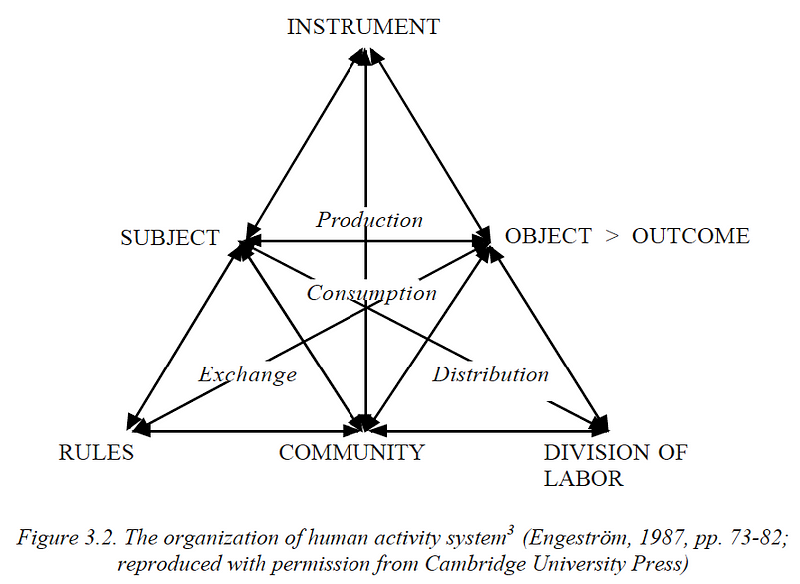
Is it the same triangle?
Yes. However, the name of the diagram was modified to “the organization of human activity system” from “the structure of human activity”. Virkkunen added a note for this change, “We apply here the distinction suggested by Maturana (2002, pp. 15–16) between organization and structure of a system. Organization is the basic configuration of the necessary elements and functional relationships that determines the principle of functioning and developing of a type of system. Structure refers to the specific features of an instance or kind of system that belongs to the type. All living cells have the same organization, a nucleus, a cell membrane, etc. They are, however, qualitatively different. In the same way, all human activities have the basic elements and relationships depicted in Figure 3.2, although they are qualitatively different in each specific activity, that is, the activities have the same organization but a different structure. ”
Following the distinction between organization and structure, we see a new opportunity of creating new models of human activity with new diagrams as representations and instruments at the level of structure.
Now, Engeström’s triangle is placed at the level of organization of human activity. If we select a specific type of activity, we can develop a new model for understanding its unique structure while we maintain the Engeström’ triangle at the higher abstraction level for indicating the same organization.
Let’s have a look at an example. In 2002, Gordon Wells published a paper titled The Role of Dialogue in Activity Theory in which he argued there is a need to highlight the importance of dialogue in Activity theory. He said, “Activity Theory as formulated by Leont’ev and expanded by Engeström has tended to emphasize activity systems in which the objects to which subjects’ actions are directed are material in form. In such accounts, discourse — if considered at all — is treated as just one of the artifacts or practices that mediate the subject’s object-directed actions. As several scholars have pointed out, however, this model does not provide a satisfactory account of the dialogue in which such semiotic artifacts as accounts, explanations, and theories are the objects created and in which the co-construction of meaning by two or more participants actually constitutes the action.”
Based on Engeström’s triangle, Wells developed a new version of the diagram which displays two subjects. He said, “The major change is in the way in which the relationship between subject(s), object, and outcome is represented. This is shown, first, as a separate triangle for each participant (dotted lines) and, second, as a triangle that subsumes the individual triangles (thick line), representing the participants’ joint action in transforming the object into the outcome. The outcome itself is multifaceted, being both material and ideal.”
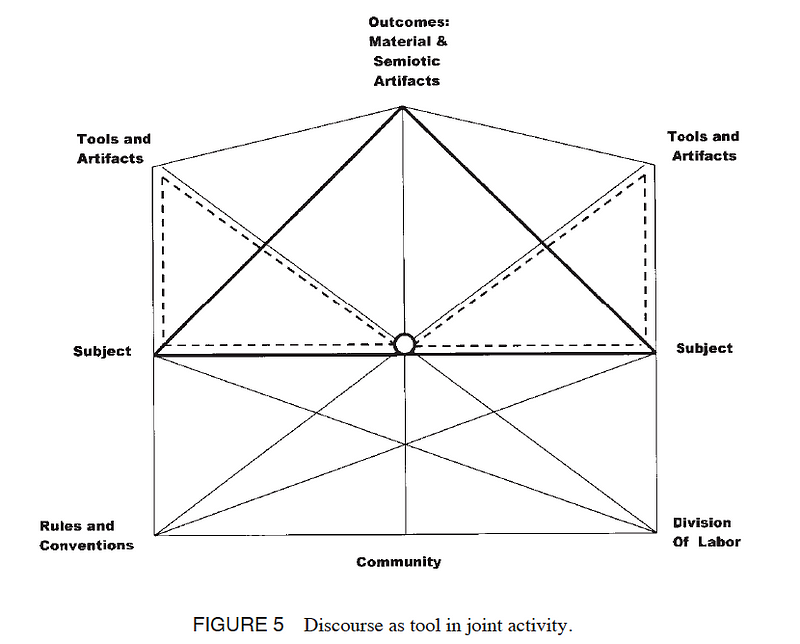
Wells didn’t mention the distinction between organization and structure. He also didn’t want to talk only about a special type of activity that focuses on dialogue or communication. However, we can adapt his diagram as a “structure” model for understanding dialogue-centered activity.
In a recent paper, Yrjö Engeström and Annalisa Sannino reviewed the historical development of four generations of activity-theoretical studies of work and learning. They suggested that “the main challenge that requires a fourth generation activity theory is the radical and fateful transformation in the objects of human activity.” (2020) They claimed that the unit of analysis for the fourth generation of activity theory should be “heterogenous work coalitions”.
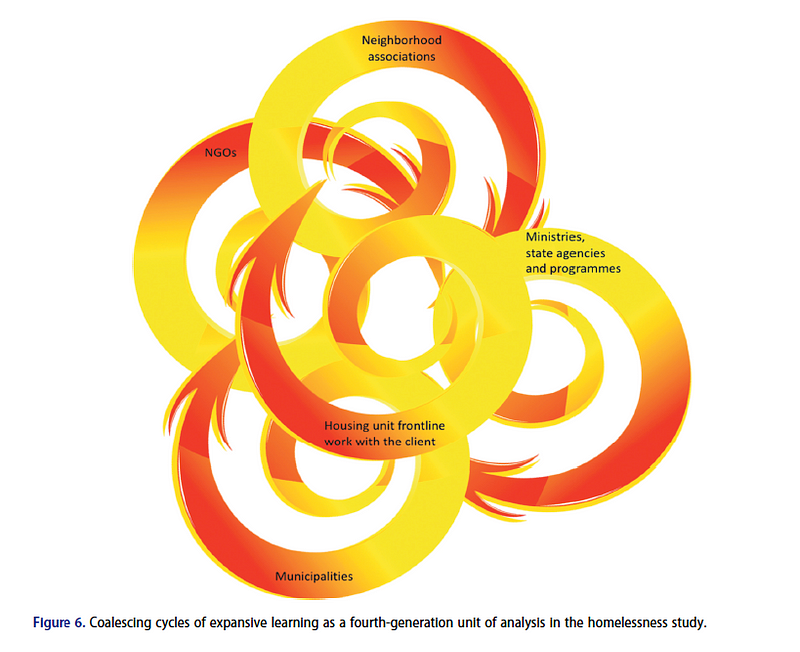
This time, they also use a diagram to represent the new unit of analysis (see the above diagram). However, the identity of Engeström’s triangle was removed.
Can we say this is the end of the story of Engeström’s triangle?
Related Resouces
- Activity Analysis: a new website for Activity Theory and other social practice theories
- Project-oriented Activity Theory: a new book (draft) that connects The Activity System Model (Yrjö Engeström, 1987) and Activity as Formation of Concept (Andy Blunden, 2010, 2012, 2014)
- Oliver Ding: The Activity U Project (2020–2022)
- The Deep Analogy Board — Activity Theory (April 22, 2022)
- Mapping Thematic Spaces #2 — The “Activity” Thematic Space
You are most welcome to connect via the following social platforms:
Twitter: https://twitter.com/oliverding Doowit: https://doowit.co/profile/gm0k2ax9 Linkedin: https://www.linkedin.com/in/oliverding
License
This work is licensed under the Creative Commons Attribution-NonCommercial-ShareAlike 4.0 International (CC BY-NC-SA 4.0) License. Please click on the link for details.
References
Bødker, S. (1987) Through the interface — a human activity approach to user interface design. DAIMI Report Series, 16(224). https://doi.org/10.7146/dpb.v16i224.7586
Boer, N-I., Baalen, P. J. v., and Kumar, K. (2002) “An activity theory approach for studying the situatedness of knowledge sharing,” Proceedings of the 35th Annual Hawaii International Conference on System Sciences, Big Island, HI, 2002, pp. 1483–1492, doi: 10.1109/HICSS.2002.994017.
Engeström, Y. (1987) Learning by Expanding: An Activity-Theoretical Approach to Developmental Research. Helsinki: Orienta-Konsultit Oy.
Engeström Y (1990) What is a tool? multiple meanings of artifacts in human activity.
Engeström, Y. and Miettinen, R. (1999) Introduction. In Engeström, Y.; Miettinen, R. & Punamaki, R-L. (Eds.) Perspectives on Activity Theory. Cambridge University Press
Engeström, Y. (2001) Expansive Learning at Work: Toward an activity theoretical reconceptualization, Journal of Education and Work, 14:1, 133–156, DOI: 10.1080/13639080020028747
Engeström, Y. (2008) Enriching activity theory without shortcuts. Interacting with Computers, ISSN: 0953–5438, Vol: 20, Issue: 2, Page: 256–259
Engeström, Y. (2009) The Future of Activity Theory. In Sannino, A.; Daniels, H. & Gutierrez, K. (Eds.) Learning and Expanding with Activity Theory. Cambridge University Press.
Engeström, Y. & Glăveanu V. (2012) On Third Generation Activity Theory: Interview With Yrjö Engeström. Europe’s Journal of Psychology, 2012, Vol. 8(4), 515–518, doi:10.5964/ejop.v8i4.555
Engeström, Y. & Sannino A. (2020) From mediated actions to heterogenous coalitions: four generations of activity-theoretical studies of work and learning, Mind, Culture, and Activity, DOI: 10.1080/10749039.2020.1806328
Gay, G. & Hembrooke, H. (2004) Activity-centered Design: An ecological approach to designing smart tools and usable systems. The MIT Press.
Gonzalez, V., (2006) The Nature of Managing Multiple Activities in the Workplace. Doctoral dissertation in Information and Computer Science, University of California, Irvine.
Kaptelinin V., & Nardi B. (2006) Acting with technology: activity theory and interaction design. The MIT Press.
Kaptelinin V., & Nardi B. (2012) Activity theory in HCI: fundamentals and reflections. Morgan & Claypool Publishers.
Latour, B. (1996) On Interobjectivity. Mind, Culture, and Activity Volume3, №4 1996 1074–9039196/228–245
Mwanza, Daisy (2001) Where Theory meets Practice: A Case for an Activity Theory based Methodology to guide Computer System Design. In: Proceedings of INTERACT’ 2001: Eighth IFIP TC 13 Conference on Human- Computer Interaction, 9–13 Jul 2001, Tokyo, Japan.
Nardi, B. A. (1996) Context and consciousness: activity theory and human-computer Interaction. The MIT Press.
Nicolini, D. (2012) Practice Theory, Work, & Organization: An Introduction. Oxford University Press.
Russell, D.R. (1997) Rethinking Genre in School and Society: An Activity Theory Analysis. Written Communication. 1997;14(4):504–554. doi:10.1177/0741088397014004004
Ruckriem, G. and Lompscher, J. (2005) Foreword. In Engeström, Y. Developmental Work Research: Expanding Activity Theory in Practice. Lehmanns Media.
Spinuzzi, C. (2011) Losing by expanding: Corralling the runaway object. Journal of Business and Technical Communication 25 (4), 449–486.
Spinuzzi, C. (2020) “Trying to predict the future”: third-generation activity theory’s codesign orientation, Mind, Culture, and Activity, 27:1, 4–18, DOI: 10.1080/10749039.2019.1660790
Torkil Clemmensen, Victor Kaptelinin & Bonnie Nardi (2016) Making HCI theory work: an analysis of the use of activity theory in HCI research, Behaviour & Information Technology, DOI: 10.1080/0144929X.2016.1175507
Tversky, B. (2019) Mind in motion: How action shapes thought. New York: Basic Books.
Virkkunen, J. & Newnham, D. S. (2013) The Change Laboratory: A tool for Collaborative Development of Work and Education. Sense Publishers.
Wells, G. (2002) The Role of Dialogue in Activity Theory. Mind, Culture, and Activity, 9:1, 43–66, DOI: 10.1207/S15327884MCA0901_04