
TalkThree 06: How to Approach Radical Innovation?
Creative Actions, Activity as Concept, and Anticipatory Activity System

@Maurizio Goetz made a comment about my work this morning, “What is interesting about your work is the possibility to give birth to new industries and new sectors. I was writing about this, today. New knowledge, new industries.”
Yes, I am working on theoretical approaches to Radical Innovation. However, I don’t directly work on Business Innovation. What I am doing is developing models for understanding the structure and dynamics of social practices and environments of human life.
Today I’d like to introduce three ideas of my work for approaching radical innovation.
In 2020, I developed a new approach called “Process as Product ” to Creativity Research. The new approach expands the Systems Models of Creativity and Contemporary Practices Theories by developing frameworks for “Creative Actions” and “Possible Practice”.
I’d like to use the term “Possible Practice” to name this knowledge enterprise about Radical Innovation.
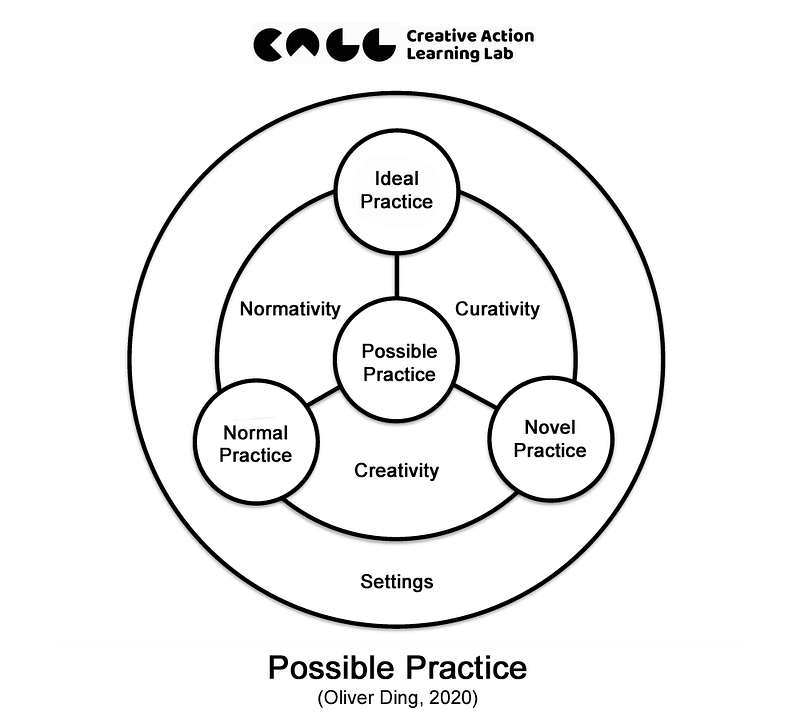
Why do I place Possible Practice at the center of the above diagram? I consider the possible practice as the origin of all types of practice. If we trace back the historical development of any social practice. We can always find that their sources are possible actions. In order to build the concept of Possible Practice, I use Possible Actions to replace Imagined Actions. I consider affordance and imagination are two sources of possible actions.
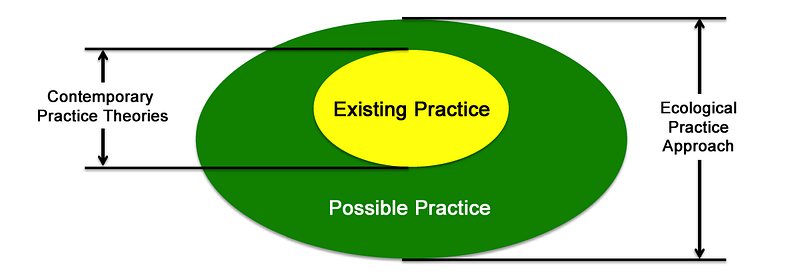
If we put Normal Practice, Novel Practice, and Ideal Practice into one category: Existing Practice. Then we can get the diagram below.
Since 2001, a group of philosophers, sociologists, and scientists have rediscovered the practice perspective and used it as a lens to explore and examine the role of practices in human activity. Researchers called it The Practice Turn in Contemporary Theory. As Schatzki pointed out, “there is no unified practice approach”(2001, p.2). Davide Nicolini adopted a way of a toolkit to introduce the following six different ways of theorizing practice in his 2013 book Practice Theory, Work, & Organization:
- Praxeology and the Work of Giddens and Bourdieu
- Communities of Practice (Lave & Wenger, 1991)
- Activity Theory / Cultural-historical activity theory (the Marxian/Vygotskian/Leont’evian tradition)
- Ethnomethodology (Harold Garfinkel, 1954)
- The Site of Social (contemporary developments of the Heideggerian/Wittgensteinian traditions, by Theodore R. Schatzki)
- Conversation Analysis / Critical Discourse Analysis (the Foucauldian tradition)
Nicolini also pointed out, “Practice theories are fundamentally ontological projects in the sense that they attempt to provide a new vocabulary to describe the world and to populate the world with specific ‘units of analysis’; that is, practice. How these units are defined, however, is internal to each of the theories, and choosing one of them would thus amount to reducing the richness provided by the different approaches.” (2012, p.9)
I suggest “Possible Practice” as a new term that expands the scope of contemporary practice theories from “actual actions and existing practice” to “possible actions and possible practice”. I consider “Possible Practice” as the special unit of analysis for my work the Ecological Practice Approach. Again, the Ecological Practice Approach is not an alternative to contemporary practice theories, but expands their scope and contains more theoretical concepts such as James J. Gibson’s Affordance.
The ecological practice approach claims that the original source of all human actions is affordance and imagination. Affordance refers to material engagement while imagination refers to linguistic engagement and others. If we accept the ideas from cognitive linguistics which claims that the source of linguistic conceptual metaphor is our embodied experience, we can reduce the linguistic engagement (imagination) to material engagement (affordance). In fact, we can learn more from philosophists of embodied cognitive science. They consider affordance as an essential concept for rethinking the mind from the perspective of embodied cognitive science.
Though the Ecological Practice Approach is my primary theoretical project, I also worked on other theoretical approaches projects in the past three years. For example, Activity Theory, Anticipatory System theory, and others. Some outcomes of this journey offer new solutions for understanding Possible Practice and Radical Innovation in particular.
Today I’d like to introduce the following three frameworks:
- The Creative Actions Framework
- The Activity as Concept Framework
- The Anticipatory Activity System Framework
My articles about the Creative Actions Framework are curated into a possible book Ecological Practice Design: The Lifesystem Approach to Everyday Life Innovation (2022). The Activity as Concept Framework is part of a possible book titled Project-oriented Activity Theory (2021).
Creative Actions
In 2020, I worked on the “Action-based Creativity” project that aims to develop a “Process as Product” view of Creativity Research. The project focused on Creative Actions, not Creative Products.
The Creative Actions Framework is also called the NICE Way. See the diagram below.
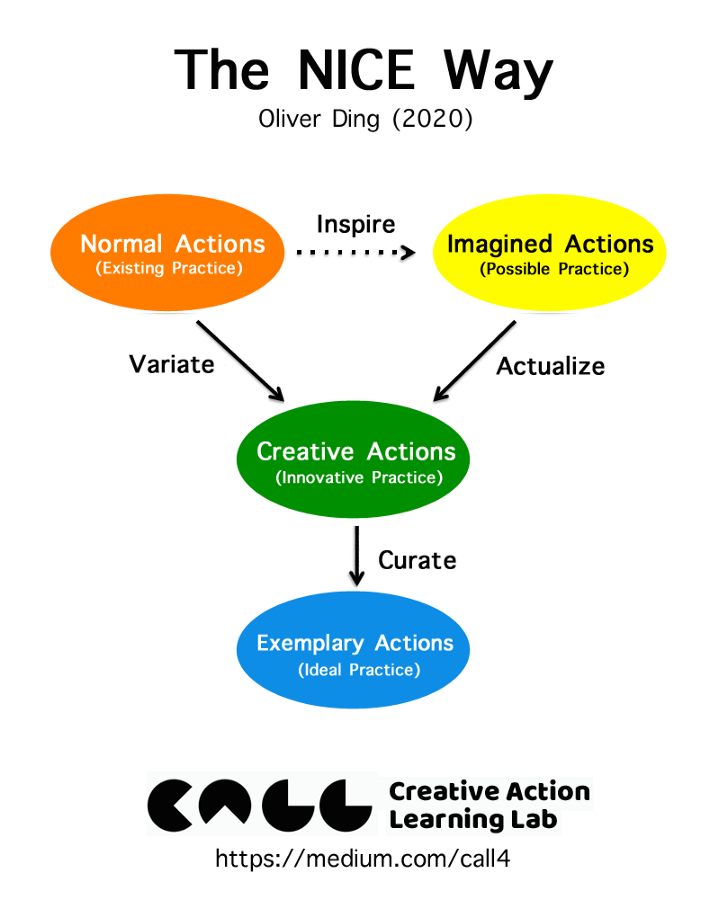
The above diagram is called the N.I.C.E. framework. N stands for Normal Actions, I stands for Imagined Actions, C stands for Creative Actions, and E stands for Exemplary Actions.
I also identified four types of transformation processes within Action-based creativity.
- Variate: from normal actions to creative actions
- Inspire: from normal actions to imagined actions
- Actualize: from imagined actions to creative actions
- Curate: from creative actions to exemplary actions
The N.I.C.E. way adopts many theoretical concepts from the tradition of creativity research.
The “Variation” is a key issue of creativity research. For example, Dean Keith Simonton developed a theory called chance-configuration theory by adopting Donald Campbell’s (1960) blind-variation and selective-retention model (BVSR) of creative thought (1988, p.3). For Action-based Creativity, the focus is on the transformation between existing practice and innovative practice. For example, “Other’s experience” can be transformed into “Your idea”.
The difference between imitation and innovation is Imagination which is a classic issue of traditional creativity research approach: individual approach and cognitive cognition. From the perspective of cognitive psychology, researchers focus on several topics such as Conceptual Combination, Conceptual Expansion, Metaphor, Analogy, and Mental Models (Ward, Smith & Vaid, 1997). Outside the domain of psychology, cognitive linguists developed another approach for understanding Conceptual Metaphor and Conceptual Blending. I personally like the Conceptual Blending theory developed by Gilles Fauconnier and Mark Turner (2002, 2014).
The “Actualize” refers to two ideas, one is “Prototyping” which means making an early model for testing an idea, and the other one is “Actualization of Affordances”. The former is popular in design thinking, engineering, software programming, and other domains. Since many people are familiar with the concept of “Prototyping”, I focus on the latter idea “Actualization of Affordances” which is a concept of Affordance Theory from ecological psychology. In studying creative actions, we pay attention to what kind of affordances can lead to “Novelty” and “Surprise.”
Inspired by Csikszentmihalyi’s social system model, I consider a new type of action called Exemplary Actions which represents Ideal Practice and highlights the morality and ethics of studying creative actions. The transformation process between Creative Actions (Innovative Practice) and Exemplary Actions (Ideal Practice) refers to Curate, Curation, Curator, and Curativity. In the age of platforms, the curation issue has become more complex than before. Individuals, organizations, and platforms have their own agency of curativity and may compete with each other.
You can find more details in The NICE Way and Possible Practice (a short version, 13 min read) and The NICE Way and Creative Actions (a long version, 41 min read).
Activity as Concept
Activity Theory or the “Cultural-historical activity theory (CHAT)” is an interdisciplinary philosophical framework for studying both individual and social aspects of human behavior. Activity Theory is an established theoretical tradition with several theoretical approaches developed by different theorists. Originally, it was inspired by the Russian/Soviet psychology of the 1920s and 1930s.
A major development of Activity Theory during the past decade is Andy Blunden’s account “An Interdisciplinary Theory of Activity”. Andy Blunden is an independent scholar in Melbourne, Australia. He works with the Independent Social Research Network and the Melbourne School of Continental Philosophy and has run a Hegel Summer School since 1998.
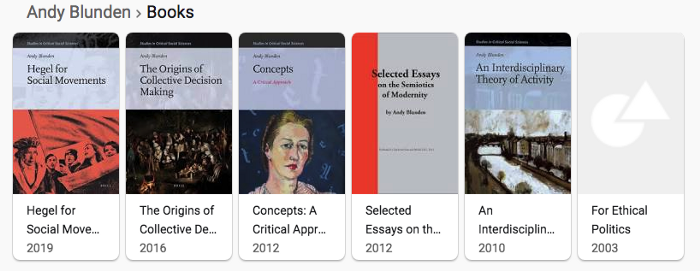
In order to develop the notion of “Project as a unit of Activity” as a theoretical foundation of the new interdisciplinary theory of Activity, Blunden adopts Hegel’s logic and Vygotsky’s theory about “Unit of Analysis” and “Concept” as theoretical resources. The process is documented in four books: An Interdisciplinary Theory of Activity (2010), Concepts: A Critical Approach (2012), Collaborative Projects: An Interdisciplinary Study (2014), and Hegel for Social Movements (2019).
What Blunden suggested are that 1) We can use “Project” as a new unit of analysis for Activity Theory, 2) Project should be understood as a formulation of concepts, and 3) The archetypal unit of “Project” is two people working together in a common project.
In 2020, I wrote several articles to expand Blunden’s approach and edited a possible book titled Project-oriented Activity Theory. The most important difference between Blunden’s original approach and my interpretation is that his vision is developing a general interdisciplinary theory of Activity as a meta-theory. However, my vision is to adopt his meta-theory and develop some frameworks and models for practical studies. Also, my focus is on knowledge works and knowledge workers.
In the book Project-oriented Activity Theory, the part of my interpretation is called “Project Engagement”. In the past few months, the “Project Engagement” part expanded to the Project-centered Approach.
Now I use the “Activity as Concept” framework as a nickname to call Blunden’s original approach. You can find the core ideas of the framework in the following article:
In order to explain Blunden’s ideas, I designed a series of diagrams for his approach. In the article, I also review the value of the new approach from two sides: theoretical contributions and practical heuristic functions.
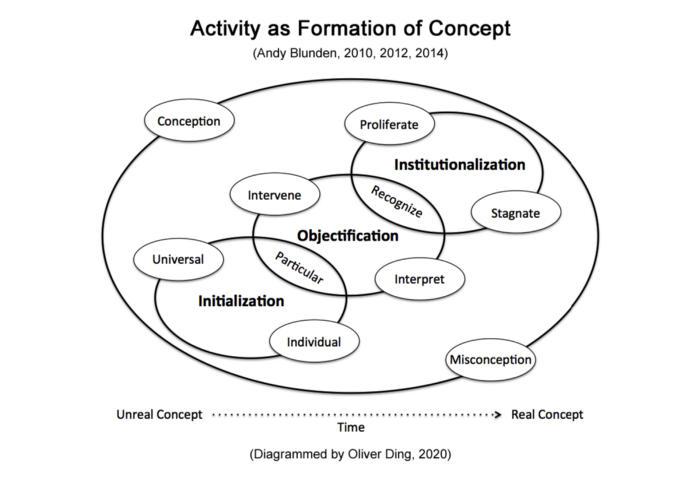
According to Blunden, there are three phases of the formation of a concept. Phase 1: Initialization; Phase 2: Objectification; Phase 3: Institutionalization. See the diagram below.
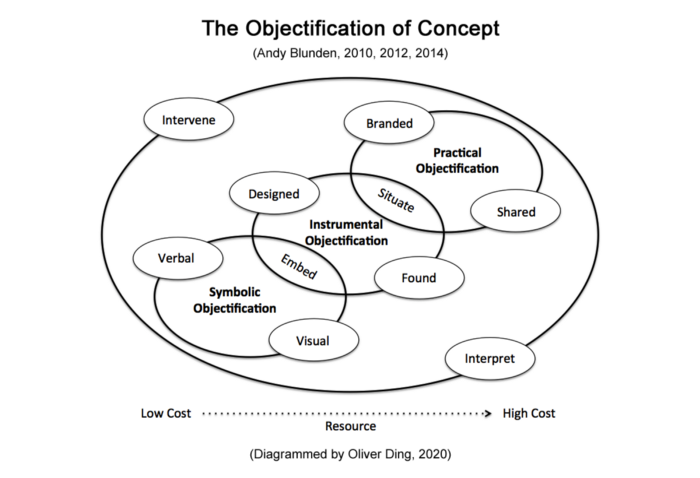
Blunden clearly claims that there are three aspects of objectification of concept: symbolic, instrumental, and practical. See the diagram below.
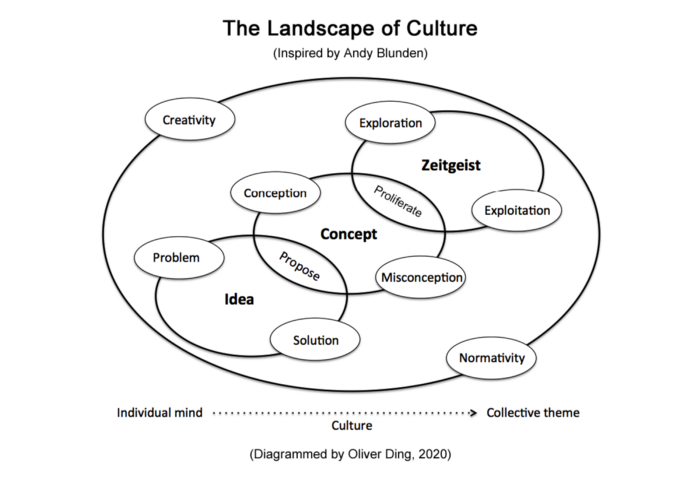
I also made a diagram for the zoom-out view. I have to point out that Blunden doesn’t obviously give this picture to us. However, he mentions related ideas in his books. If we connect the Individual mind (Idea) and Collective theme (Zeitgeist) through Collective Projects (Concept), then we get a new way of understanding “Culture”. See the diagram below.
Project-oriented Activity Theory can be adopted as a theory of radical innovation since the approach covers the whole developmental process of a brand new concept.
Organizational scholars use “Radical innovation — Incremental innovation” to discuss organizational innovation, I’d like to use “Radical innovation — Incremental Innovation” in a broader sense. From the perspective of Project-oriented Activity Theory, a “Radical Innovation” can be definitely defined as a project with a brand new concept while an “Incremental Innovation” can be understood as a project with a good idea that is not ready for proposing as a brand new concept.
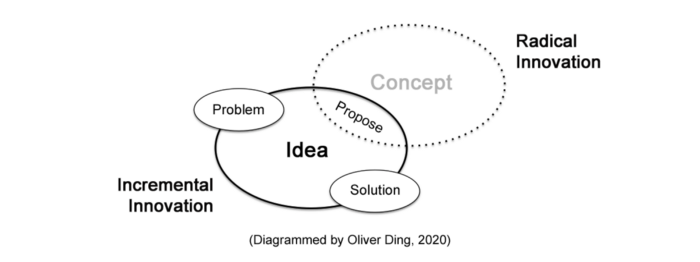
Since Blunden’s approach focuses on “the formation of a project with a concept of the problem is an original and creative social act”, applying it to only the “Idea” process without considering other processes is just using a sledgehammer to crack a nut.
One month ago, I applied the “Activity as Concept” framework to develop a model of Building Knowledge Enterprise Activity. See the diagram below.
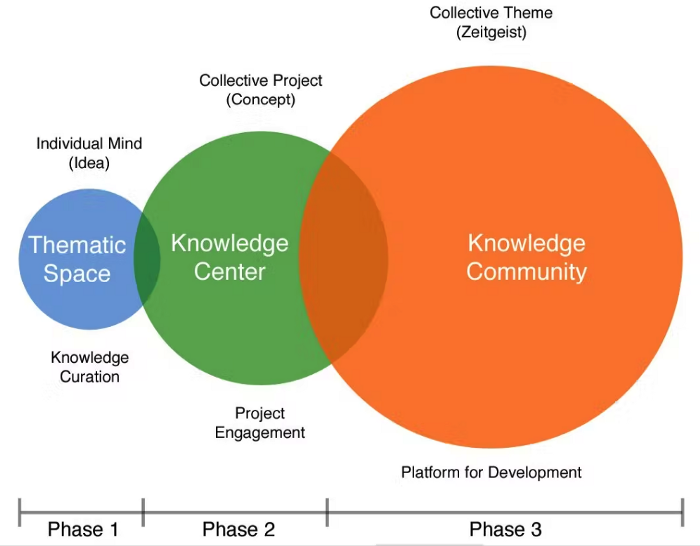
You can find more details in CALL: How to Grow A Knowledge Enterprise.
The Anticipatory Activity System (AAS) framework
I am also working on the Anticipatory Activity System (AAS) framework which is about “Self, Other, Present, and Future”.
As an intermediate framework, it is inspired by Activity Theory and Anticipatory System theory. It is not directly developed for discussing Strategy and Innovation, but it can be applied to the field.
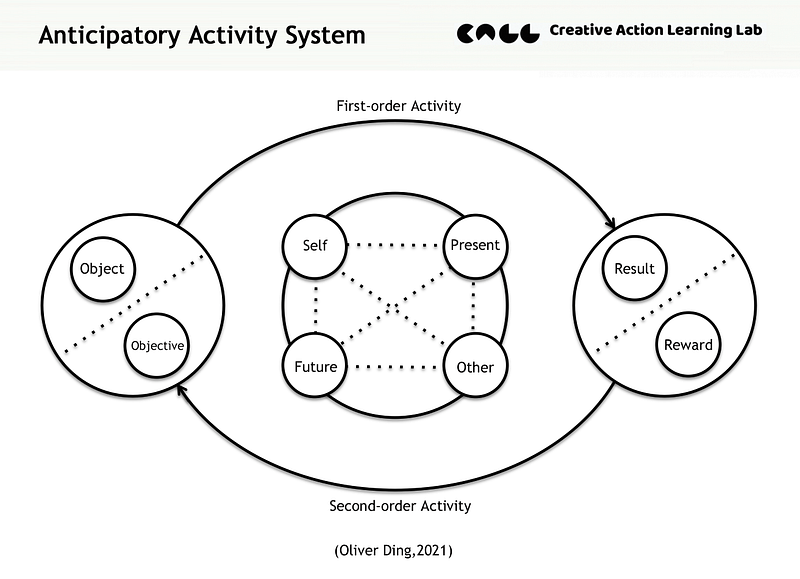
The AAS framework has five parts:
- First-order Activity: the “Discovery” part
- Second-order Activity: the “Production” part
- The Relevance of Zone: the “Self — Other” Relationship
- The Unfolding of System: the “Anticipation — Performance” Complexity
- The Predictive Models: the Developing of Tacit Knowledge
In the past few weeks, I work on testing the framework with a 1:1 Life Transitions coaching program. It considers “Life Discovery Project” as Second-order Activity and “Life Developmental Project” as a First-order Activity. The program is designed as an 8-step program. It is hosted on Milanote which is a digital whiteboard platform.
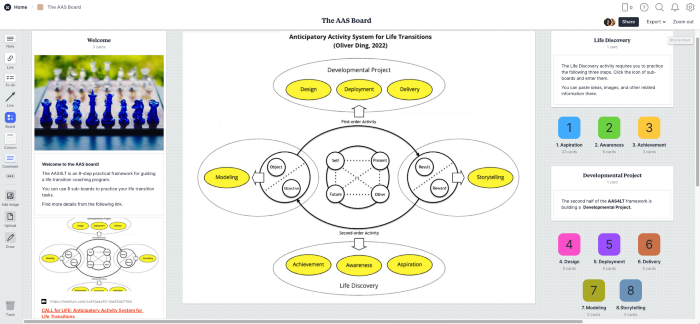
The program is based on the following knowledge models:
- The AAS4LT framework
- The Life-as-Project approach
- The Life Discovery Toolkit (v1.0)
- The Life Discovery Canvas (v1.0)
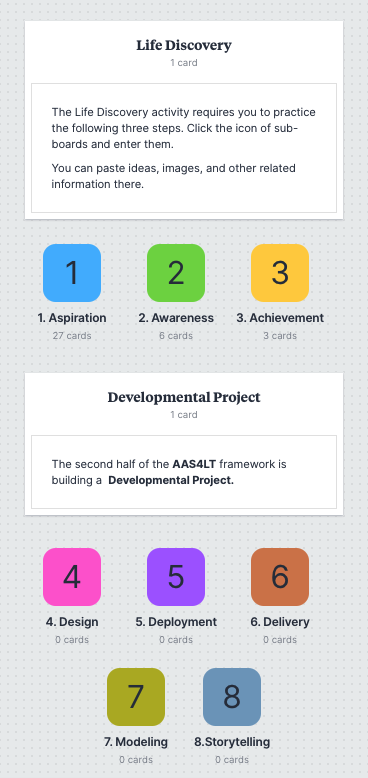
The program is designed with the above eight steps. Each step has its own sub-board where I and a client can work together on the following tasks:
- 1. Understanding The Concept
- 2. Understanding The Example
- 3. Share Your Information
- 4. Discussions
- 5. Reflection
Task 1 and Task 2 are for the client to learn basic ideas about each step. For Task 3, the client has to reflect on her or his own situations and experiences and share relevant information through text, images, links, etc on the sub-board. I will lead Task 4 and respond to the client’s information. Task 5 is for both of us.
I didn’t consider the AAS framework for discussing Radical Innovation. I planned to use it for discussing Life Strategy and other Strategy-related issues.
A core idea of Anticipatory System Theory is the Predictive Model. According to Robert Rosen, “An anticipatory system is a natural system that contains an internal predictive model of itself and of its environment, which allows it to change state at an instant in accord with the model’s predictions pertaining to a later instant.” In contrast, a reactive system only reacts, in the present, to changes that have already occurred in the causal chain, while an anticipatory system’s present behavior involves aspects of the past, present, and future.
From the perspective of the Anticipatory Activity System framework, Strategy is a process of developing advanced predictive models in order to manage the complexity of anticipation and performance. This notion goes beyond the scope of situated activity.
Strategy is both a situated activity and an anticipatory activity system.
We can't discuss Radical Innovation without discussing Strategy. The AAS framework is about the whole process of turning Discovery into Production. The “Discovery” is called Second-order Activity while the “Production” is about First-order Activity. Together, it offers a new solution to Radical Innovation.
You can find more details in the following articles:
The Final Words
The above three frameworks were developed with different theoretical resources under different knowledge enterprises.
If we put them together, then we see a chain of ideas:
Creative Actions > Activity as Concept > Anticipatory Activity System
What does this chain mean?
In fact, the Creative Actions framework has a 3i model for discussing Creative Actions. See the diagram below.
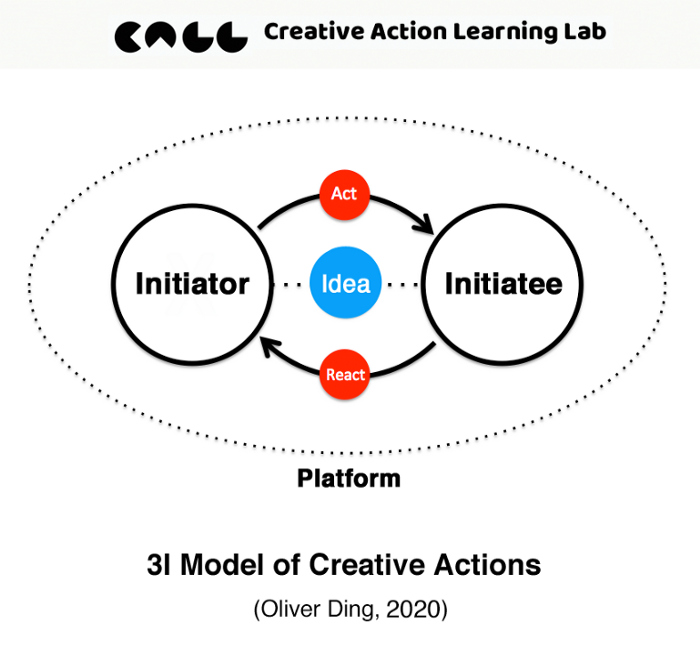
As the diagram below shows, the 3I model has three core entities which are idea, initiator, and initiatee. It also considers two types of events: act by the initiator and react by the initiatee. Finally, the model considers the platform as the context of entities and events.
In order to make the “Process as Product” approach possible, I use the term “Idea” to refer to the product aspect of creative actions and use the term “Act/React” to refer to the process aspect. This pair of concepts solve the problem of the disappearance of immediate experience. I further consider the “Idea” has three elements including name, form, and content.
We can connect the term “Idea” of the Creative Actions framework with the terms “Idea/Concept” of the Activity as Concept framework. Both two frameworks consider two aspects of human practice: the actual action side and the symbolic meaning side.
Also, we can connect the Activity as Concept framework with the Anticipatory Activity System framework. These two frameworks offer two approaches to Activity Theory. However, they can work together as a whole solution for dealing with Radical Innovation. The former is about developing the core idea while the latter is about managing the system of scaling the idea.
What’s the missing piece?
If we consider the above frameworks as a new toolkit for Running Radical Innovation, then we can consider the following framework as a member of the toolkit.
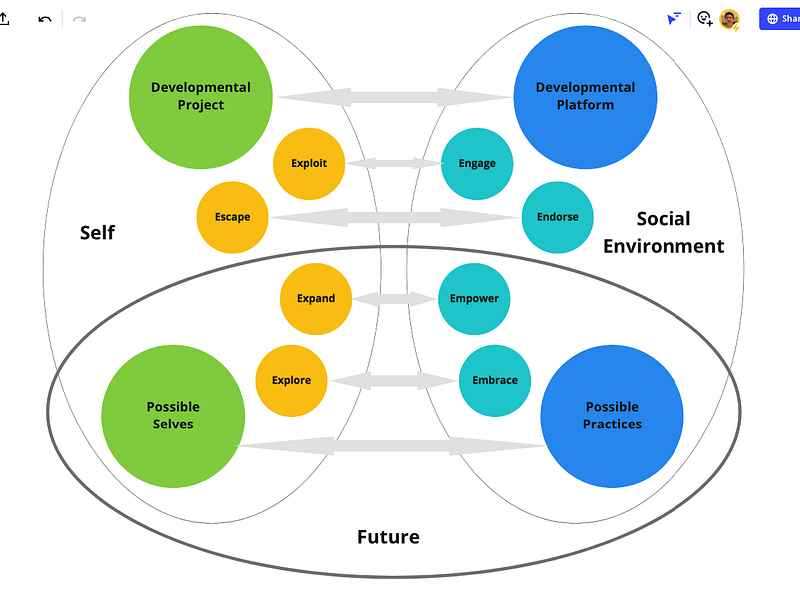
The above diagram is called the DEEP framework. You can find more details here. The framework is developed with three containers:
- Container X: Self, a person wants to actualize a Possible Self with a Developmental Project.
- Container Y: Social Environment, a platform wants to actualize a Possible Practice with projects initiated by its members.
The third container is Container Z. I define it as Future. For Self, the Future means Possible Selves. For Social Environment, the Future means Possible Practice.
- Container Z: Future, means a connection between a person’s Possible Selves and a platform’s Possible Practice.
Development is all about the Future.
Radical Innovation is about the Future too.
The DEEP framework considers the perspective of human development within the dynamic process of Radical Innovation.
The final toolkit is an ideal solution to Running Radical Innovation.
Related Articles
- Meet with Oliver Ding: 1 Mission, 4 Theories, and 12 Possible Books
- The Knowledge Curation Project
- How to Grow A Knowledge Enterprise
- Platform Genidentity: The Movements of Unfolding Uniqueness
- The Slow Cognition Project (Phase II): Activity Analysis for Creative Work Study
- CALL: The Launch Day of Curativity Center
- The NICE Way and Creative Actions
- Possible Practices: Attach, Detach, and Opportunities
- Activity U (VIIII): Project-oriented Activity Theory
- Project-oriented Activity Theory (Book)
- The Project Engagement Toolkit
- Life Discovery: The AAS Framework
- Strategy as Anticipatory Activity System
- Life Discovery: The Predictive Model and Anticipatory Activity System
- The 3I Model: Idea, Initiator and Initiatee
- The DEEP Framework
I am also working on building a new website for the Platform Ecology project. You can save the following links:
- PlatformEcology.org
- Twitter: @PlatformEcology
- Linkedin: @PlatformEcology
You are most welcome to connect via the following social platforms:
Linkedin: https://www.linkedin.com/in/oliverding Twitter: https://twitter.com/oliverding Polywork: https://www.polywork.com/oliverding Boardle: https://www.boardle.io/users/oliver-ding


