Project-oriented Activity Theory (Book)
Theoretical foundation, Concepts, and Diagrams.
The Activity U project has been planned to introduce Andy Blunden’s Project-oriented theoretical approach. The recent articles form a sub-series of articles and achieve this goal.
This article lists this sub-series of articles and provides a guide for new readers. I will update this article with links to the newest relevant articles and ideas. In order to celebrate this micro milestone, I designed a book cover for these articles and made a plan for a book.
It’s a pleasure to work on this special sub-series of articles. On Aug 20, 2020, I shared HCI-Activity Theorist Bonnie Nardi’s story and suggested the concept of Appropriating Theory as a way of knowing. Now I have a deep understanding of the concept of Appropriating Theory.
Andy Blunden’s version of Activity Theory
Activity Theory or the “Cultural-historical activity theory (CHAT)” is an interdisciplinary philosophical framework for studying both individual and social aspects of human behavior. Activity Theory is an established theoretical tradition with several theoretical approaches developed by different theorists. Originally, it was inspired by the Russian/Soviet psychology of the 1920s and 1930s.
A major development of Activity Theory during the past decade is Andy Blunden’s account “An Interdisciplinary Theory of Activity”. Andy Blunden is an independent scholar in Melbourne, Australia. He works with the Independent Social Research Network and the Melbourne School of Continental Philosophy and has run a Hegel Summer School since 1998.
Blunden’s vision of the interdisciplinary theory of Activity is inspired by Vasily Davydov’s argument:
I always argue that the problem of activity and the concept of activity are interdisciplinary by nature. There should be specified philosophical, sociological, culturological, psychological and physiological aspects here. That is why the issue of activity is not necessarily connected with psychology as a profession. It is connected at present because in the course of our history, activity turned out to be the thing on which our prominent psychologists focused their attention as early as in the Soviet Union days. Things just turned out this way. (Davydov, 1999: 50.)
In order to develop the notion of “Project as a unit of Activity” as a theoretical foundation of the new interdisciplinary theory of Activity, Blunden adopts Hegel’s logic and Vygotsky’s theory about “Unit of Analysis” and “Concept” as theoretical resources. The process is documented in four books: An Interdisciplinary Theory of Activity (2010), Concepts: A Critical Approach (2012), Collaborative Projects: An Interdisciplinary Study (2014), and Hegel for Social Movements (2019).
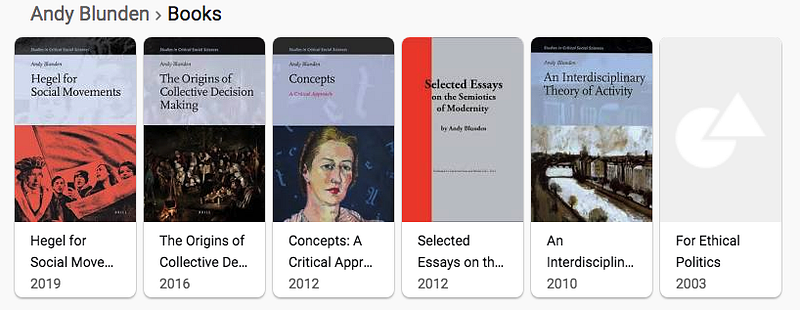
An essential challenge of theorizing “activity” in an interdisciplinary way is the source of activity. In order words, how is it possible to claim that there is an “activity” which contains various actions?
According to Andy Blunden, “In Activity Theory there is nothing in an activity other than human actions, and this is a thesis with which contemporary interactionist theories would be in agreement, eschewing recourse to biological determinism, religious or structural fatalism or any other force of human action as determinants of human life. But because there is nothing other than human actions to be found in an activity this does not mean that an activity is simply the additive sum of actions. In fact, the activity is generally a precondition for any of the component actions which instantiate it: when we act we do not generally create an activity, we join it. So Activity Theory recognizes that there are aggregates of actions which have a unity of their own for which, as the saying goes, the whole is greater than the sum of the parts. The question then is what is it that gives an activity its unity?” (2014, p.24)
In his 2010 book An Interdisciplinary Theory of Activity, Blunden traces the roots of Activity Theory from Goethe, Hegel, and Marx in order to present an immanent critique of Activity Theory and its contemporary version CHAT. The core of Blunden's argument is a theoretical-methodological issue: Unit of Analysis. For Blunden, the concept of “Unit of Analysis” should be understood as Goethe’s Urphanomen which is also known as the ‘cell’. Blunden believes that the unit of analysis should be followed by an explanatory principle of “the part contains the whole”. In other words, if we want to understand a complex phenomenon, we should start with the most primitive form of the phenomenon. For activity theorists, if they agree that their theoretical roots are ideas from Goethe, Hegel, Marx, and Vygotsky, then they have to respect this methodological criticism because the Urphanomen principle has been adopted by all of these predecessors.
Blunden adopts the Urphanomen principle and suggests a new unit of activity for developing an interdisciplinary theory of Activity. He says, “A project is something projected by the subject, rather than an object to which the subject is drawn; the subject may be an individual or many people who are united precisely in that they are pursuing the same project. A project is an on-going collection of actions and is both the aim of the actions and the process of attaining that object. A project is a concept, but every individual has a different concept of the project, these constituting the various shades of meaning and connotations to be found in representations of the project. People may be fully committed to the project, or they may pursue the project for external rewards provided for their participation; people may ‘own’ a project, or be only barely aware of its existence.”(2010, p.9)
The solution of “Project as a unit of Activity” is summarized in a paragraph at the end of Introduction to Collaborative Projects. Blunden said, “How can we understand the relation between the motivation of individual actions on one hand, and on the other hand, the immanent objective of the project which forms the unifying principle of the project uniting all the disparate individual actions into a single activity? Hegel resolved this problem in his solution to the problem of the subsumption of any number of individual actions under a concept, but there is no criteria other than the concept itself determining this subsumption. The relation between an action and the project which gives to the action its rational meaning is the same as the relation between any individual discursive act and the concept which it instantiates, and the same as the relation between any individual thing and the category under which the thing is subsumed. The relation between the individual and the universal is mediated by the particular, that is by praxis, and it not to be conflated with the subjective-objective relation which is a quite distinct relation. The universal has no separate existence, but exists only in and through its particularization by individuals.” (2014, p.26)
Blunden also gives an archetypal unit of a project in his 2010 book An Interdisciplinary Theory of Activity.
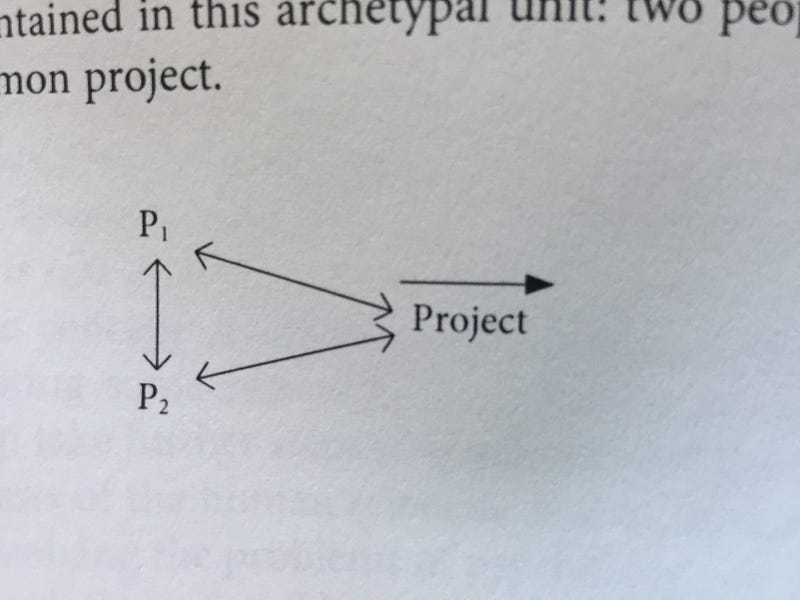
He says, “The rich context of the notion of collaboration also brings to light more complex relationships. The notions of hierarchy, command, division of labor, cooperation, exchange, service, attribution, exploitation, dependence, solidarity, and more can all be studied in the context of just two individuals working together in a common project. And yet almost all the mysteries of social science as well as a good part of psychology are contained in this archetypal unit: two people working together in a common project.” (2010, p.315)
Blunden’s 2012 book Concepts: A Critical Approach continues the journey. Blunden reviews the theoretical development of Concepts in an interdisciplinary approach that curates theories about Concepts from various disciplines such as cognitive psychology, analytic philosophy, linguistics, and the history of science. He adopts Hegel’s theory of concept and Lev Vygotsky’s cultural-historical psychology as theoretical resources and proposes a new approach to Concepts. He argues that concepts are equally subjective and objective: units both of consciousness and of the cultural formation of which one’s consciousness is part. In other words, the formation of concepts is activity.
“Project as a unit of activity” and “formation of concepts is activity” are combined in Blunden’s 2014 book Collaborative Projects: An Interdisciplinary Study which is a collection of twelve research reports with a common theme. As the editor of the book, Blunden invites his friends to write a report about a concrete collaborative project and write a review on their story. The book also contains an introduction and a conclusion which are written by Blunden. In addition, Blunden also writes a case study about “Collaborative Learning Space” which was initiated by him in 1999.
What Blunden suggested are that 1) We can use “Project” as a new unit of analysis for Activity Theory, 2) Project should be understood as a “formulation of concepts”, and 3) The archetypal unit of “Project” is two people working together in a common project.
In the first ten years of the 21st century, Blunden laid a new foundation for Activity Theory in an age of information overload and platform capitalism. According to Blunden, “CHAT is already an emancipatory science. It is committed to the ethos of self-emancipation. It does not seek to control people, test them or predict their behavior, but rather to join people in striving for their own goals…CHAT aims at the self-determination of human beings. We can not do this with concepts which fail to capture the essential nature of human activity as being tied up with the projection of our ideals, however mistaken they may be from time to time. But self-determination is never that of being an island. Self-determination, or sovereignty, is about participation in the self-determination of oneself and others, together as equals, through collaborative projects.” (2010, p.317-318)
In 1975, Charles A. Lave and James G. March published a book titled An Introduction To Models in The Social Sciences. They suggested an interpretation of the evaluation of models, “What we present here are some rather simple points of view about truth, beauty, and justice that we, and others, have found helpful in heightening the pleasures and usefulness of model building in social science.”
I think this simple idea is also helpful for the evaluation of theories. I am not sure if we can claim that Blunden’s approach has a strong aspect of truth. However, I think his approach is simple which is the principle of beauty. Finally, what Blunden wants to build is an interdisciplinary science about self-emancipatory which refers to justice.
It takes time to raise a new theoretical approach. As Blunden pointed out, “…But it is early days. This book marks only the very first effort.”(2014, P.370) Also, it takes a village to raise a child. The development of the theoretical approach is a collaborative project. We need more people to echo Blunden’s vision.
Project-oriented Activity Theory
Andy Blunden doesn’t use “Project-oriented Activity Theory” as an official name for his approach. Originally, I used this term to refer to Blunden’s approach. Now I realize the name becomes an issue because my articles present my interpretation of Blunden’s approach.
It is clear that I add some of my own ideas to expand Blunden’s original approach. Thus, we can use the name to refer to three things: 1) Blunden’s original approach, 2) My interpretation of Blunden’s approach, 3) Blunden’s original approach, my interpretation, and other interpretations and applications.
I suggest that we adopt the name to describe the whole account which is initiated by Blunden.
The following list can help readers distinguish Blunden’s original approach and my interpretation:
- I design a series of diagrams for Blunden’s approach.
- I add “Projectivity” and “Zone of Project” as two theoretical concepts to the original approach. Some theoretical resources behind “Projectivity” and “Zone of Project” are adopted from Ecological Psychologists.
- I distinguish between Idea and Concept in order to keep the term “Project” for normal works and social movements.
- Blunden’s original approach doesn’t adopt the Activity System model. I claim that it is possible to keep Blunden’s approach and the Activity System model within a theoretical framework by distinguishing between Idea and Concept. In this manner, we can grow Activity Theory without discarding the Activity System model since it is an established branch of Activity Theory.
- Based on the concept of “Projectivity”, I develop a model called “Cultural Projection Analysis”.
- I find a connection between my own idea “Themes of Practice” and Blunden’s “Formation of Concept”. I consider “Theme” as a special type of “Concept”. Based on “Formation of Concept”, I adopt “Themes of Practice” for discussing the internal structure and dynamics of Projects. In particular, I identify five “Themes of Practice” of Projects: “Idea”, “Resource”, “Program”, “Performance” and “Solution”.
- I find a connection between my own idea “Ecological Zone” and Vygotsky’s “Zone of Proximal Development”. I also notice that Blunden gives an archetypal unit of a project in his 2010 book An Interdisciplinary Theory of Activity: two people working together on a common project. By curating these ideas together, I develop a new concept of “Zone of Project” which can be considered as an expansive work of Blunden’s archetypal unit of Project.
- In addition, I develop “Impact Projects” and “Serial Creators” as new intermediate concepts for applying Project-oriented Activity Theory to study knowledge works and the development of knowledge workers. The purpose of these two intermediate concepts is only for bridging theory and practice.
The most important difference between Blunden’s original approach and my interpretation is that his vision is developing a general interdisciplinary theory of Activity as a meta-theory. However, my vision is to adopt his meta-theory and develop some frameworks and models for practical studies. Also, my focus is on knowledge works and knowledge workers.
In the article CALL: The House of Boundary Innovation, I mention that I choose ‘transdisciplinary thinking’ to refer to the knowing between academic domains and non-academic domains. According to the editors of The Oxford Handbook of Interdisciplinarity (2010), there are two words about inter- or transdisciplinary knowledge production. The ‘interdisciplinarity’ refers to current efforts of knowledge production that cross or bridge disciplinary boundaries and the ‘transdisciplinarity’ refers to the growing effort to make knowledge products more pertinent to non-academic actors. However, in the US, ‘interdisciplinarity’ covers both the integration of knowledge across disciplines, narrow and wide, and the intercourse between (inter)disciplines and society. The latter often goes by the name of transdisciplinarity, particularly in Europe (p.xxx).
Now we can consider two ways of growth of a theory of Activity. While Andy Blunden works on expanding Activity Theory from a psychological theory to an interdisciplinary theory, I work on expanding his meta-theory from academic domains to non-academic domains with the mindset of ‘transdisciplinary thinking’.
I encourage readers to read Blunden’s original books and develop their own frameworks and models. Together, we can build a community of Project-oriented Activity Theory.
How to read my articles?
I have written several articles about Project-oriented Activity Theory. You can find related articles from the following links.
- Activity U (VIII): Project as a Unit of Activity
- Activity U (VIIII): Project-oriented Activity Theory
- Activity U (X): Projecting, Projectivity, and Cultural Projection
- Activity U (XI): Process, Position, and Zone of Project
- Activity U (XII): 136 Ideas for Impact Projects and Micromovements
- Life as Activity (version 0.3)
- The Platform for Development (P4D) Framework (1.0)
Though these articles are my learning notes, they are also considered as my proposal since I add many new ideas to expand Blunden’s original approach. I’d like to give readers a guide to reading these articles.
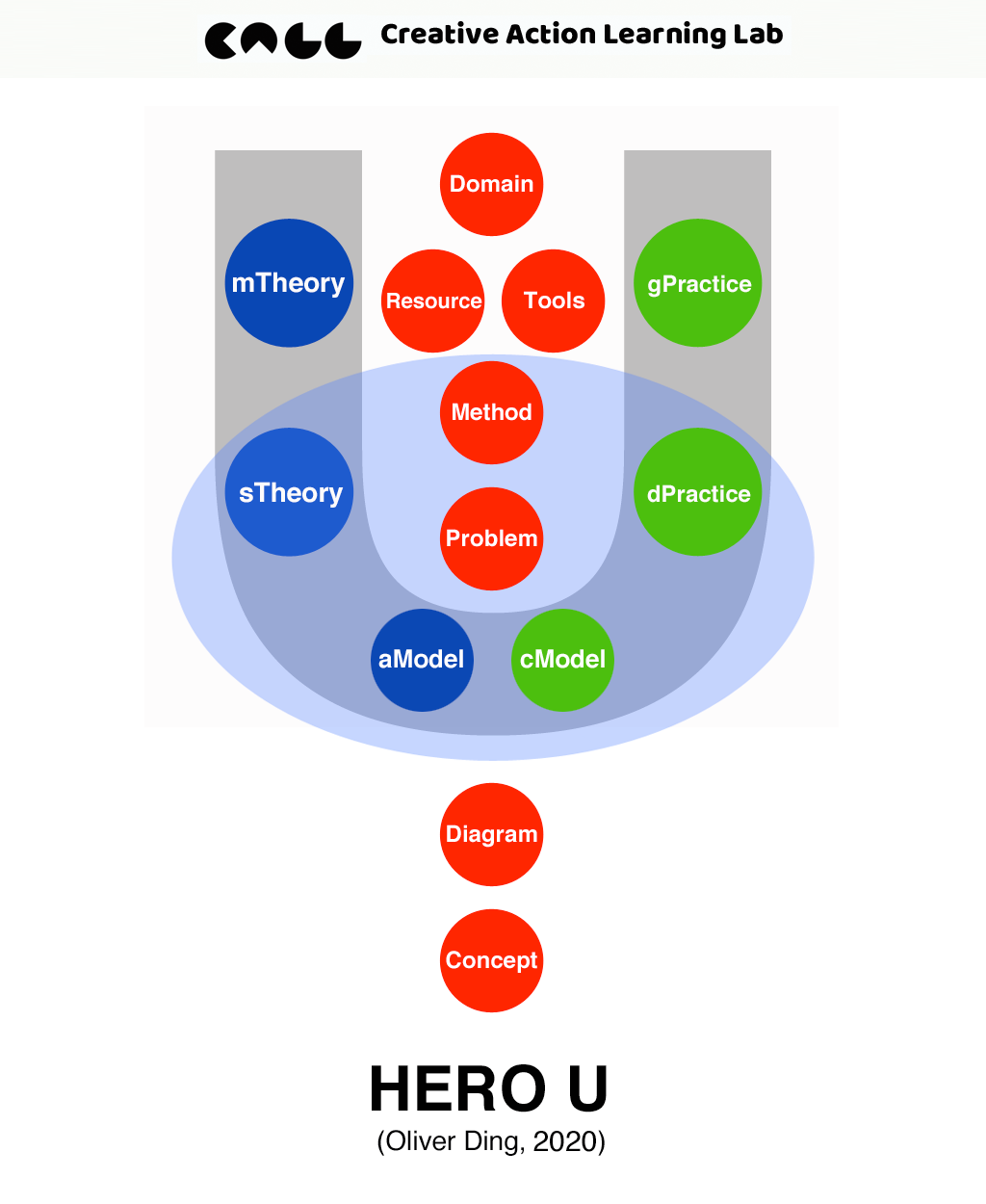
I designed the picture below to visualize my own thought behind the work. The picture has seven red dots: Domain, Resource, Tools, Problem, Method, Concept, and Diagram. These elements are from the HERO U framework (the article, the diagram). The seven red balls refer to Personal Conditions of Knowing. The first group is Domain, Resource, and Tools, they define the outside setting of the knowing activity. The second group is Method and Problem, they define the source of competence and solution. The third group is Diagram and Concept, they define the representation format of the outcome of knowing. These three groups form a process of knowing.
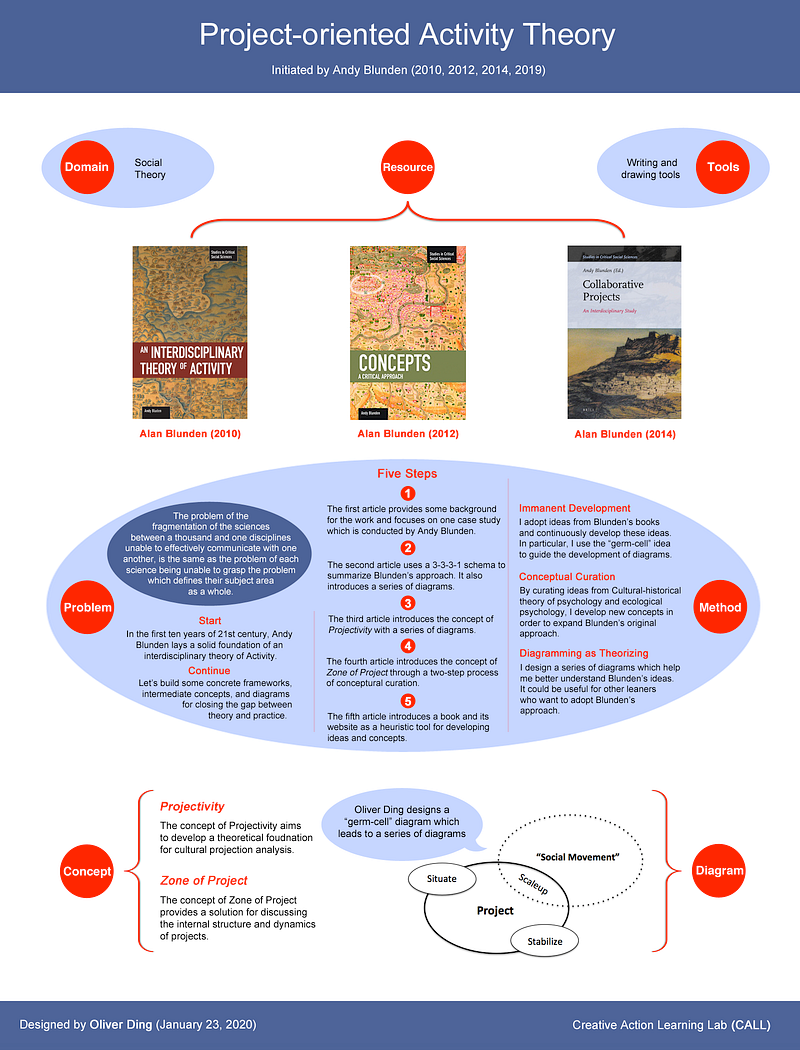
The above diagram represents the whole picture of my interpretation of Blunden’s approach. Readers can use this diagram as a map for reading my articles. The most important piece is the five steps.
- The first article provides some background for the work and focuses on one case study which is conducted by Andy Blunden.
- The second article uses a 3–3–3–1 schema to summarize Blunden’s approach. It also introduces a series of diagrams.
- The third article introduces the concept of Projectivity with a series of diagrams.
- The fourth article introduces the concept of Zone of Project through a two-step process of conceptual curation.
- The fifth article introduces a book and its website as a heuristic tool for developing ideas and concepts.
Readers can also pay attention to my methods: Immanent Development, Conceptual Curation, and Diagramming as Theorizing.
- Immanent Development: I adopt ideas from Blunden’s books and continuously develop these ideas. In particular, I use the “germ-cell” idea to guide the development of diagrams.
- Conceptual Curation: By curating ideas from the Cultural-historical theory of psychology and ecological psychology, I develop new concepts in order to expand Blunden’s original approach.
- Diagramming as Theorizing: I design a series of diagrams that help me better understand Blunden’s ideas. It could be useful for other learners who want to adopt Blunden’s approach.
For new readers who are not familiar with Activity Theory and CHAT, I suggest a better way of reading these articles. See the next part.
A Book
If we consider these articles as a book, then we can reorganize their structure. Also, we can add some sections of articles from the Activity U project as background for this new book.
I’d like to divide this new book into the following five parts.
Part 1: The Landscape of Activity Theory Part 2: The Projectification of Society Part 3: Project-oriented Activity Theory Part 4: Project Engagement Appendix: Lev Vygotsky’s “ecological mind”
The following sections list the Contents of the book with links to my articles. Readers don’t have to read all the whole articles. There are some notes which highlight relevant sections.
Part 1: The Landscape of Activity Theory
This part provides a theoretical background about Activity Theory and CHAT for new readers who are not familiar with them.
Chapter 1: Activity U: The Landscape of Activity Theory (Part I) (read the whole article)
Chapter 2: Unit of Analysis, Niches of Analysis, Levels of Analysis (read the following sections)
- 1. A Chart about Activity Theory
- 2. Unit of Analysis
Chapter 3: The Hierarchy of Human Activity and Social Practice (read the following section)
- Part 1: Leontiev’s hierarchy of activity
Chapter 4: The Engeström’s Triangle and the Power of Diagram (read the following sections)
- Part 1: Background
- Part 2: The Origin of the Engeström’s Triangle
- Part 3: The Evolution of the Engeström’s Triangle
Chapter 5: Typology of Activities and Other Practical Tools (read the following section)
- Part 1: Spinuzzi’s Typology of Activities
Chapter 6: The Chain of Activity and Life as Temporal Activity Chains (read the following section)
- Part2: Perspectives from other Activity Theorists
Part 2: The Projectification of Society
The term “projectification” was coined by Christophe Midler who is a management professor in 1995. Midler uses the term to refer to the trend of transformation from hierarchical function-centered organization to cross-functional project-centered organization.
I only write one section about this topic. However, I encourage readers to read more relevant materials. Thus, I will recommend some books and papers in this part.
Chapter 7: The Projectification of the Public Sector (this is a 2019 book. Also, you can read this 2012 book.)
Chapter 8: The Projectification of Everything: Projects as a Human Condition (this is a 2016 paper)
Chapter 9: Projectification of the Firm: the Renault Case (this is a 1995 paper)
Chapter 10: Project as “Objective of Activity” (this piece appears in section 2.5 of this article. It is inspired by Clay Spinuzzi’s 2015 book All Edge: Inside the new workplace networks).
Part 3: Project-oriented Activity Theory
The above part 1 and part 2 provide a theoretical and practical background for this work. Now it is ready to introduce Andy Blunden’s approach.
Chapter 11: Project as a Unit of Activity (read the whole article except part 4)
Chapter 12: Activity U (VIIII): Project-oriented Activity Theory (read the whole article except part 7)
Chapter 13: Projecting, Projectivity, and Cultural Projection (read the whole article except part 7)
Chapter 14: Process, Position, and Zone of Project (read part 3, part 4, and part 5)
Part 4: Project Engagement
This part moves to the practice field. I review the value of the new approach from two sides: theoretical contributions and practical heuristic functions. I also reflect on my own experience and recommend some heuristic tools for readers.
Chapter 15: A Theory of Radical Innovation (this piece appears in Part 7 of this article)
Chapter 16: 136 Ideas for Impact Projects and Micromovements (read the whole article)
Chapter 17: Reflection and Discussion (this piece appears in Part 4 of this article)
Chapter 18: The Life-as-Activity Approach (version 0.3) (read the whole article)
Chapter 19: The Platform-for-Development (P4D) Framework (1.0) (read the whole article)
Appendix: Lev Vygotsky’s “ecological mind”
In order to adopt my ideas “Projectivity” and “Zone of Project” to expand Blunden’s original approach, I have to discuss the possible connection between Ecological Psychology and Cultural-historical Theory of psychology because these two ideas are inspired by Ecological Psychology.
I have discussed the connection in some articles. I think it is better to present this work as an appendix for readers who have a theoretical consideration of this issue.
The following pieces can be found in the article Activity U (X): Projecting, Projectivity, and Cultural Projection.
7.1 Vygotsky, Kurt Lewin, and “Ecological Mind” 7.2 “Sign Meaning Develops” and Affordance 7.3 Affordance, Projectivity, ZPD, and Social Situation 7.4 Zone of Project, ZPD, and Behavior Settings
The following pieces can be found in the article Activity U (XI): Process, Position, and Zone of Project.
Part 1: Lev Vygotsky, Michael Cole, and Roger Barker Part 2: Bark Roger’s Behavior Settings Theory 3.4 Vygotsky’s “Zone of Proximal Development” 3.5 Vygotsky’s “Ecological Mind” and “Dramatic Development” 3.6 Michael Cole: Joint Artifact-mediation Activity
The new book is similar to the book Activity U: How to Think and Act Like an Activity Theorist. Though they share some common materials, the new book focuses on one particular theoretical approach of Activity Theory.
You are most welcome to connect via the following social platforms:
Twitter: https://twitter.com/oliverding Doowit: https://doowit.co/profile/gm0k2ax9 Linkedin: https://www.linkedin.com/in/oliverding
License
This work is licensed under the Creative Commons Attribution-NonCommercial-ShareAlike 4.0 International (CC BY-NC-SA 4.0) License. Please click on the link for details.
References
Andy Blunden (2010) An Interdisciplinary Theory of Activity. Brill.
Andy Blunden (2012) Concepts: A Critical Approach. Haymarket Books.
Andy Blunden (2014) Collaborative Project: An interdisciplinary study. Brill.
Andy Blunden (2019) Hegel for Social Movements. Brill.
Charles A. Lave & James G. March (1975) An introduction to models in the social sciences. University Press of America, Inc.
Robert Frodeman (2010) The Oxford Handbook of Interdisciplinarity. Oxford University Press.