
Life Discovery: The Predictive Model and Anticipatory Activity System
A Discussion about my “Prediction” thematic space and the “Anticipatory Activity System (AAS)” Framework

One week ago, a friend mentioned a YouTube video with the following question in a comment on Linkedin.
Nice job! I listened to this video and picked up that the younger man is assuming prediction to be the outcome of knowledge creation. Your thoughts?
I replied to her and wrote some comments about my “Prediction” thematic space and the “Anticipatory Activity System (AAS)” Framework. This article shares these ideas for further development.
The “Anticipatory Activity System (AAS)” framework adopts Activity Theory and Anticipatory System theory to discuss “Self, Other, Present, Future”. You can find more details here.
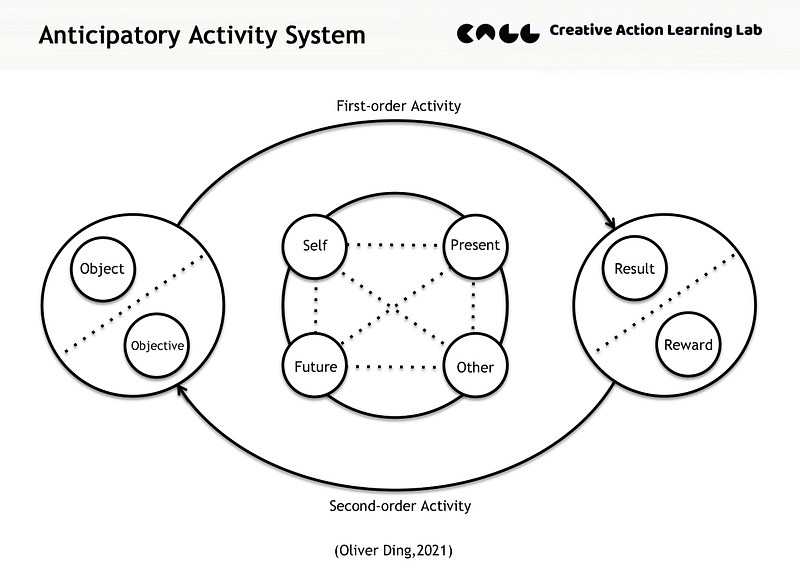
A core idea of Anticipatory System theory is the “Predictive Model”. In the past several weeks, I focused on the idea of “Second-order Activity” which is a core concept of the AAS framework. I have not discussed the concept of the “Predictive Model” from the perspective of the AAS framework.
I will share the original comments and add some new notes about my comments.
My “Prediction” Thematic Space
Thanks for sharing. This is a wonderful video. I need time to watch the video and understand the context of the issue.
Now I can only talk about my “prediction” thematic space which means my understanding of the word.
A thematic space refers to a large cognitive space about a particular theme which is represented with a word. Why did I use “my ‘prediction’ thematic space”? Because each person can has his/her own knowledge and experience about a particular theme. I have designed a tool to visualize thematic spaces and wrote a book (draft) about it. You can find more details about “Thematic Space” and its canvas here.
The “prediction” theme is related to Anticipatory System theory.
According to Robert Rosen, the creator of the theory, “An anticipatory system is a natural system that contains an internal predictive model of itself and of its environment, which allows it to change state at an instant in accord with the model’s predictions pertaining to a later instant.” In contrast, a reactive system only reacts, in the present, to changes that have already occurred in the causal chain, while an anticipatory system’s present behavior involves aspects of the past, present, and future.
The core idea is the “internal predictive model” and the model can predict Self and Environment.
As mentioned above, my “prediction” thematic space is different to others because I am working on the AAS framework which is inspired by the Anticipatory System theory. If we use “Thematic Space Canvas” to visualize my “Prediction” thematic space, then we can find “Anticipatory System theory” at the “Approach” block and “Internal Predictive Model” at the “Concept” block.
If we apply Anticipatory System theory to discuss Life Strategy, how to define the “internal predictive model”? My approach — — the AAS framework — — uses the “Self — Other” Relevance to define the boundary of the system.
- Intrapersonal Model (Only Self)
- Interpersonal Model (Self + Other’s feedback)
- Transactional Model (“Self+Other” = a whole)
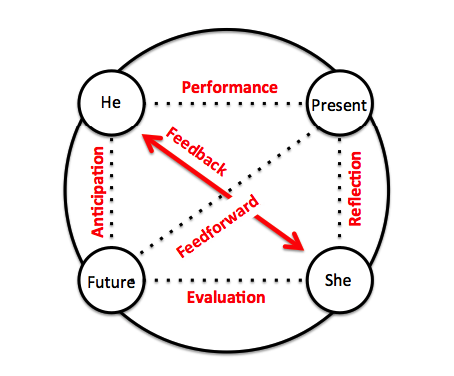
According to Roberto Poli, “The realization of life into actual organisms requires many more details extending beyond (M, R) — systems. The same applies to Luhmann’s social system theory, which addresses only the most basic, the deepest, aspect of social systems. Many more details are needed in order to understand this or that concrete system. ”
By connecting Anticipatory System Theory and Activity Theory, we can move from an abstract level to a concrete level and use a new framework to study the real-life world. This is my purpose behind the Anticipatory Activity System (AAS) framework.
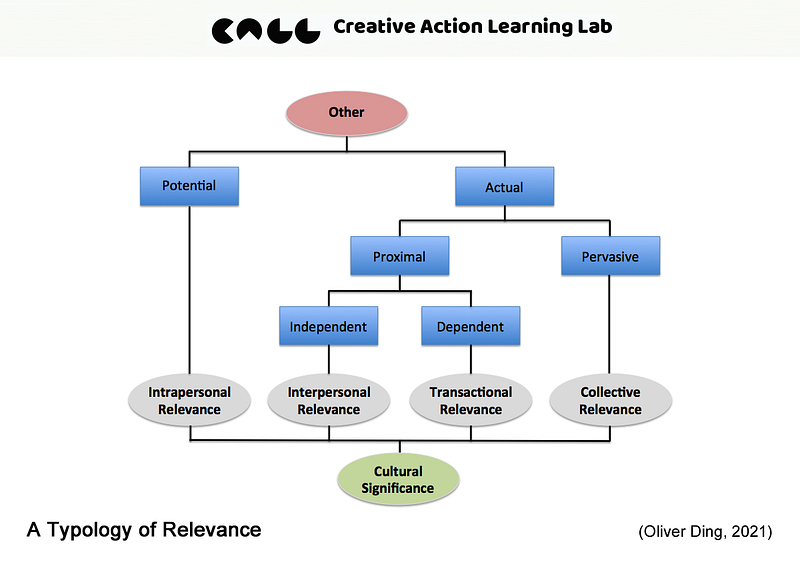
The Life Strategy Project focuses on adult life development. Self refers to a person while Other refers to another person or a social group. I use the “Self — Other” Relevance (see the above diagram) to define the “system”. See D as Diagramming: The iART Framework and Mapping Thematic Space #5: The “Relevance” Thematic Space.
How does the predictive model work?
The AAS framework uses the “Anticipation — Performance” Complexity to answer this question. See the diagram below.
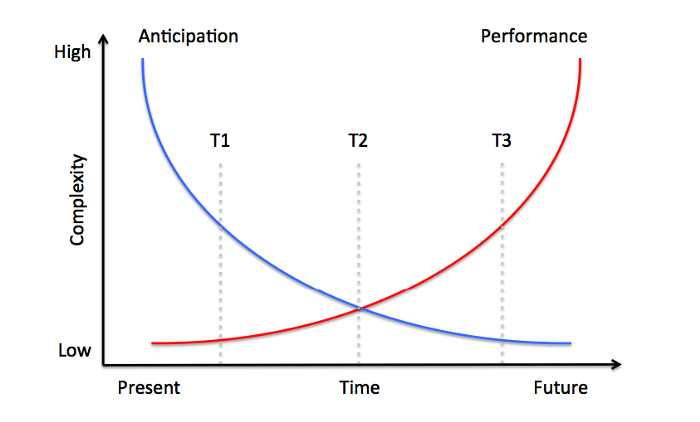
I see Prediction as a dynamic process since Self and Environment always change. The AAS framework uses “Objective” and “Object” to determine the First-order Activity.
The Objective is related to Anticipation while the Object is related to Performance.
For a further discussion, see D as Diagramming: The Defining Zone.
The Object connects to Self and Environment. The most important thing is watching the change of Object while working on the Object.
If we perceive the wrong sign from the change of Object, then a particular prediction fails. Then, we should jump from First-order Activity to Second-order Activity.
The Second-order Activity is a specific type of activity in which subjects aim to define objectives and goals for their further activities. For example, the Life Discovery Activity and the Knowledge Discovery Activity are two typical Second-order Activities.A First-order Activity is a normal activity that focuses on produce predifined outcomes. More details: Life Discovery: The “Tacit” Type of Second-order Activity.
There are two types of Second-order Activity. One is making a new prediction. The other one is improving the whole “internal predictive model” (Maybe I should call it Third-order Activity, anyway, it is just a name).
What does the predictive model look like?
So far, what I learned from my empirical research is the framework below:
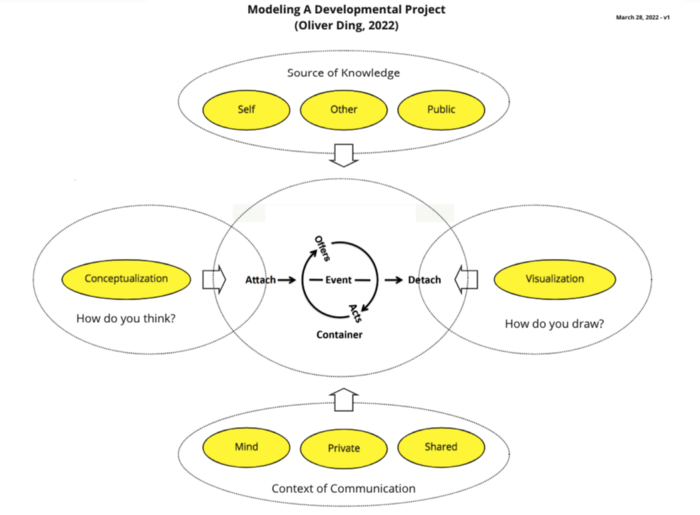
For a particular project, a person will develop a particular model to help her model the development of the project. In other words, she will use a model to predict the future of the project.
The model can be explicit, such as a diagram with a document. However, the model can be tacit, the person just uses her mind without any instruments to display the model. What I found from my empirical research is that sometimes the person would like to visualize or write her model about the project because this way is a great way of thinking. But the person would like to keep the model as a private information, unless the project needs the public versin of the model for storytelling.
The model is the outcome of the “objective — subjective” knowledge curation. For example, a friend of mine adopts some psychological knowledge and the OKR method to build a model and use the model to develop her life development program. She modified her model several times in order to match the change of her clients.
The above framework identifies three types of Sources of Knowledge: “Self, Other, and Public”. For example, I am her advisor. My ideas are considered as Other.
The other aspect of modeling a project is the Context of Communication. The person should write, say, draw, or take any action about the model. In this way, she could turn the model from a “tacit knowledge” into an “explicit knowledge”. The Context can be Mind Only (pure tacit knowledge), Private (written or drawn, not shared), or Shared (with others).
For more details about Modeling A Developmental Project, see here.
What about the whole predictive model of a system?
What about the whole predictive model of a system? For example, a person’s predictive model? I think this refers to a person’s mind or cognitive skills.
I don’t have a framework for it. But we can adopt the cognitive scientist Keith E. Stanovich’s model of mind and cognitive architecture.
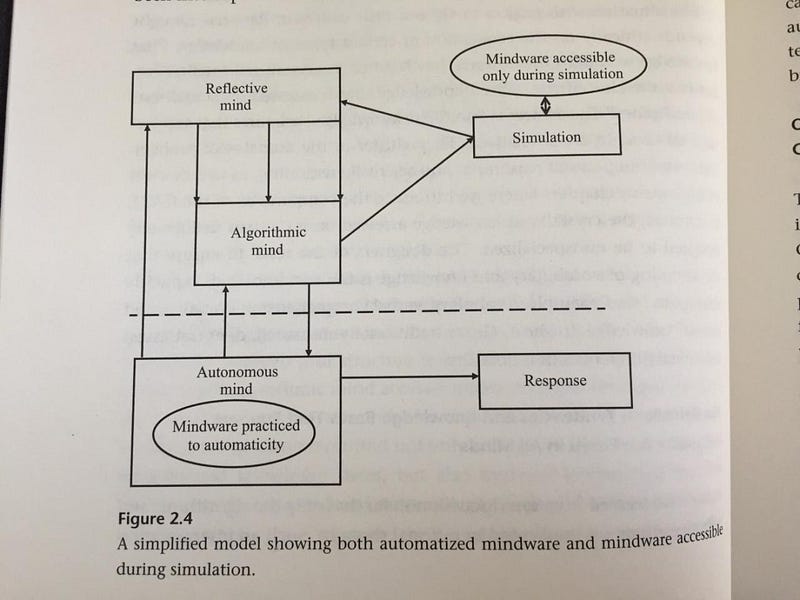
Stanovich and his co-workers developed a tripartite theory of mind (see the above diagram) which is different from the popular Type 1 v.s. Type 2 model of mind introduced by Daniel Kahneman in his 2011 book Thinking, Fast and Slow.
The tripartite theory of mind suggests that there are two types of mind for Type 2 processing: Algorithmic mind (individual differences in fluid intelligence) and Reflective mind (individual differences in thinking dispositions or cognitive styles).
According to Stanovich, “Many thinking dispositions concern beliefs, belief structure, and, importantly, attitudes toward forming and changing beliefs. Other thinking dispositions that have been identified concern a person’s goals and goal hierarchy.” (2016, p.25)
The “Algorithmic mind” echos to our discussion about a particular predictive model while the “Reflective mind” echos to the whole predictive model.
In fact, I have developed two models of the mind. One is the Mind as Play metaphor (2017), see D as Diagramming: The Mind as Play Metaphor. I used it to build an integrated epistemological framework for understanding the Mind, Meaning, and Experience. The other one is the model of Curated Mind (2022) which is inspired by the ecological practice approach. I use Proximal Mind and Pervasive Mind to define a system called the Curated Mind. More details: Slow Cognition: The Model of Curated Mind.
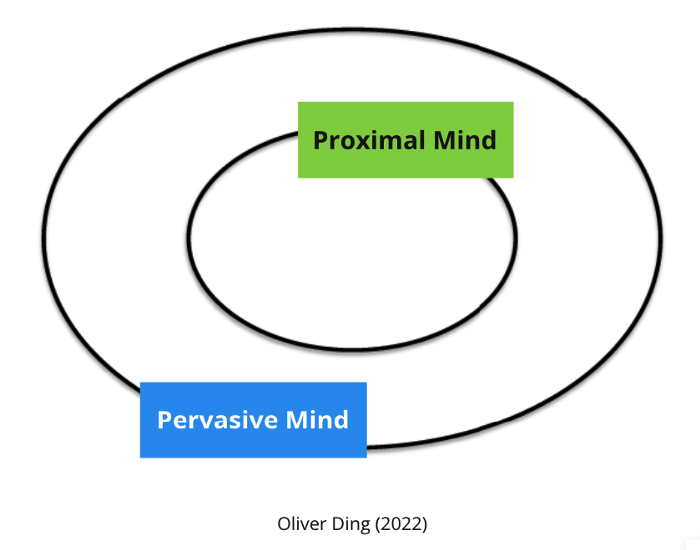
What about a two-people system? It’s a challenge since Stanovich’s model is about a one-person system, we need to find new answers.
Related articles
- D as Diagramming: The iART Framework
- D as Diagramming: iART Diagram Notation
- D as Diagramming: The iART Diagram Network
- D as Diagramming: The Defining Zone
- D as Diagramming: Strategy as Anticipatory Activity System
- Mapping Thematic Space #5: The “Relevance” Thematic Space
- Life Discovery: The AAS Framework
- CALL for LIFE: Anticipatory Activity System for Life Transitions
- CALL for LIFE: Modeling A Developmental Project
- CALL for LIFE: Oliver Ding @ 2021 and Second-order Activity
- Life Discovery: Twelve Significant Insights from Four Months
- Life Discovery: “Points of Observation” and “Significant Insights”
- Life Discovery: Significant Insights Analysis
- Life Discovery: The “Tacit” Type of Second-order Activity
- Life Discovery: The Unfoldness of Activity
I am also working on building a new website for the Platform Ecology project. You can save the following links:
- PlatformEcology.org
- Twitter: @PlatformEcology
- Linkedin: @PlatformEcology
You are most welcome to connect via the following social platforms:
Linkedin: https://www.linkedin.com/in/oliverding Twitter: https://twitter.com/oliverding Polywork: https://www.polywork.com/oliverding Boardle: https://www.boardle.io/users/oliver-ding


