Slow Cognition: The Model of Curated Mind
Eight Operational Concepts for developing the Curated Mind framework

On March 15, 2022, I published an article about the notion of “Curated Mind”. In the past week, I discussed the notion with several friends.
If you follow my articles, you probably know that my major theoretical interests are Ecological Psychology, Activity Theory, and similar Social Practice theories.
In July 2020, I wrote an article titled The NICE Way and Creative Actions, then I left the field of Creativity and Creative Actions and moved to the field of social practices.
My question is, if we can generate many creative actions, how can we grow them into real social innovations? This question led me to work on the Activity U project and wrote the book Project-oriented Activity Theory.
Though I work on Activity Theory and similar social practices, I am not satisfied with their approach to cultural innovation. They claim that social development is driven by problems-based innovation. I think the non-problem idea could develop into a real concept too. Cultural Innovations can be driven by problem-solution ideas and play-for-fun ideas too.
One reason for my argument is that I spent over five years watching my kid’s childhood and I found there are many “creative actions” in their life. Most of these creative actions can be explained by Ecological Psychology’s Affordance Theory. The Problem-solution mindset could produce innovations, but we should allow other kinds of mindsets for innovations.
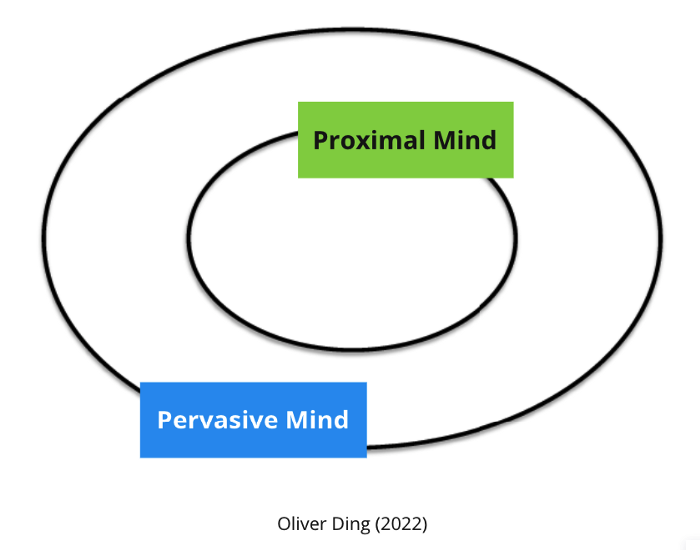
The above diagram is the basic model of the Curated Mind. This model is adopted the ecological approach to reflect on the Mind. While Proximal Mind corresponds to Proximal Contexts, Pervasive Mind corresponds to Pervasive Mind.
- Proximal Contexts (Proximal Mind)
- Pervasive Contexts (Pervasive Mind)
These two parts form a whole as a system which is called Curated Mind.
If we apply this diagram to reflect on my theoretical interests, then most of my writings are about the Proximal Contexts and Proximal Mind. I didn’t pay attention to Pervasive Contexts and Pervasive Minds before 2021. For example, I didn’t write some articles about cognitive representations and cultural significance. I didn’t pay attention to some fields about Future Studies, Social Discourse, Ecosystem Innovation, etc.
In the past several days, Maurizio Goetz, who is the Co-founder presso Italian Institute for the Future — Speculative Design Hub, encouraged me to explore Future Studies, Imagination Design, and Anticipative Communication /Storytelling.
Our discussion inspired me to expand the level of Pervasive Mind from the original two practical perspectives to four perspectives:
- Representation (old version)
- Significance (old version)
- Imagination (new version)
- Anticipation (new version)
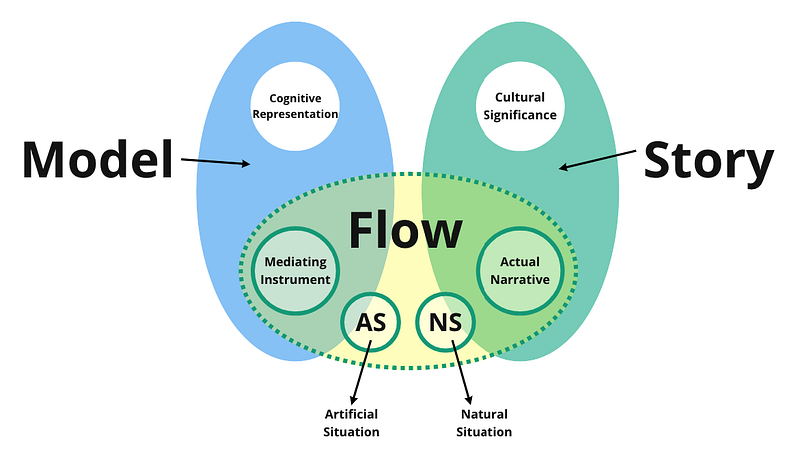
The diagram below is the original diagram for the model of Curated Mind.
Now we have eight practical perspectives for two nested layers. It’s time to adopt the NEST Way diagram to develop a new framework. The diagram below is the NEST Way meta-diagram that is designed with the following structures:
- Two nested layers
- Two Dimensions
- Eight operational concepts
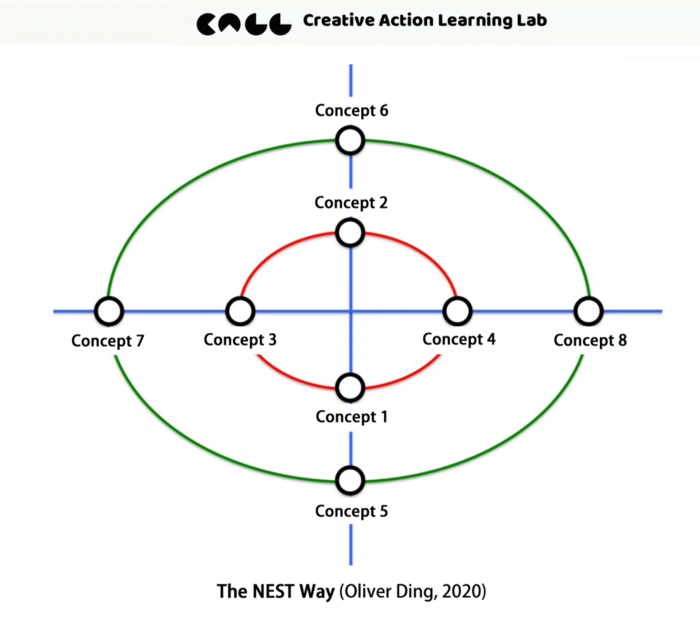
I have used the NEST Way to develop the Lifesystem framework, you can find more details here.
Theoretical Concepts for Curated Mind
As a tool for guiding research and reflection, a knowledge framework is a whole that contains concepts, diagrams, and methods. An ideal knowledge framework should contain two types of concepts:
- Theoretical Concepts
- Operational Concepts
Theoretical Concepts are adopted from Meta-theory or Specific Theory. Some frameworks don’t associate with any theories, they only have operational concepts. Operational Concepts are framework-dependent concepts for guiding research and reflection.
The purpose behind the Curated Mind framework is to develop a framework for discussing the mind and developing tacit knowledge from the perspective of Curativity Theory.
The Curated Mind Framework is defined with the following theoretical concepts:
- Curativity
- Attachance
- Contexts (Mind)
- Proximal Mind
- Pervasive Mind
- Curated Mind
- Proximal Contexts
- Pervasive Contexts
- Ecological Awareness
- Symbolic Awareness
I also adopted the perspective of Attachance to understand the “Proximal Mind — Pervasive Mind” relationship. We can detach from Proximal Mind and attach to Pervasive Mind, and vice-versa.
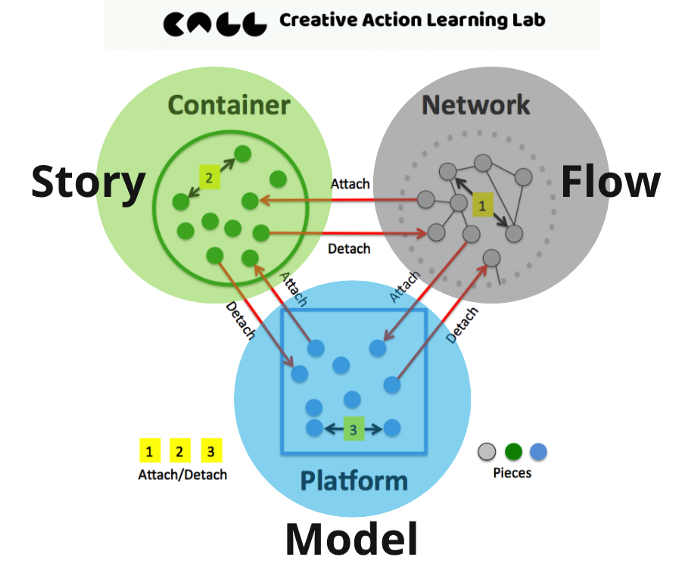
We also can pay attention to the following three types of Curativity:
- The Curativity of Proximal Mind: Turning pieces of experiences into a meaningful whole at the loop of Proximal Mind.
- The Curativity of Pervasive Mind: Turning pieces of experiences into a meaningful whole at the loop of Pervasive Mind.
- The Curativity of Mind: Turning “Proximal Mind” and “Pervasive Mind” into a meaningful whole.
You can find more details about the above theoretical concepts from a previous article: Slow Cognition: The Curated Mind.
Operational Concepts
We also need to discover several operational concepts for bridging theoretical concepts and knowledge curation, even further empirical research.
As mentioned above, the old version of Curated Mind has discovered the following practical perspectives:
- Natural Situation
- Artificial Situation
- Actual Narrative
- Cultural Significance
- Mediating Instrument
- Cognitive Representation
I also added two practical perspectives to the list in the last week:
- Imagination (new version)
- Anticipation (new version)
Based on these eight practical perspectives, I developed the following diagram called the Model of Curated Mind.
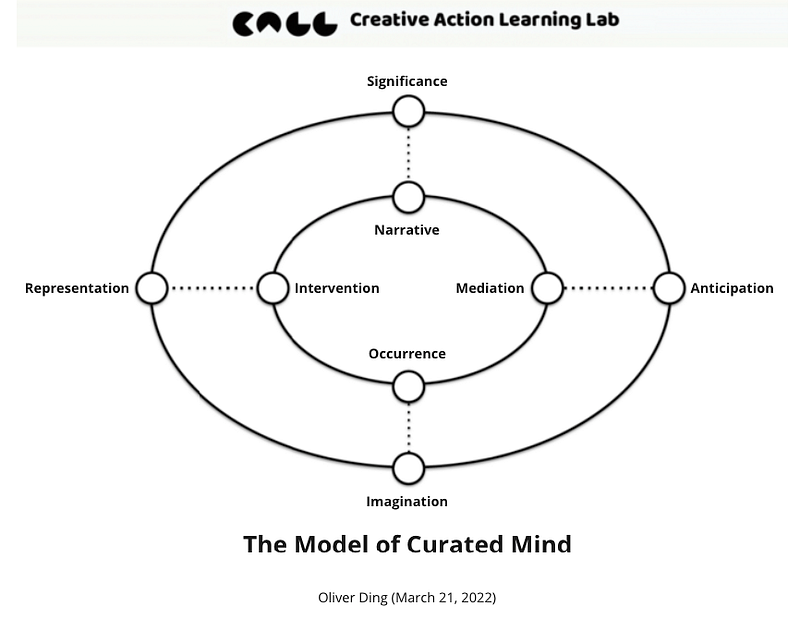
I use several single words to name eight operational concepts. Now the loop of Proximal Mind is represented with the following four operational concepts:
- Occurrence: It refers to the original “Natural Situation” which means non-designed situations and environments.
- Intervention: It refers to the original “Artificial Situation” which means designed situations and environments.
- Mediation: It refers to the original “Mediating Instrument” which means material objects and other tools for human activities and social practices.
- Narrative: It refers to the original “Actual Narrative” which means storytelling.
I also use the following four operational concepts for the loop of Pervasive Mind:
- Significance: It refers to the original “Cultural Significance” which means the dynamic historical development of cultural signs and other symbolic cultures.
- Representation: It refers to the original “Cognitive Representation” which means objects for solving cognitive tasks. For example, Diagrams, models, theory, floor plans, etc.
- Imagination: It refers to imagining some novel things that could guide to dramatic experiences and creative actions.
- Anticipation: It refers to predicting the future and managing the complexity of anticipation and performance.
Though I offer the above eight operational concepts for understanding the Curated Mind, It doesn’t mean that the Curated Mind is only about these ideas.
I’d like to keep the openness of the model of Curated Mind and explore more ideas with it for further development.
Now we have a conceptual model and a practical framework, what’s next? I think we can start from the following two things:
- Knowledge Curation
- Empirical Research
If you have more ideas, please lease your suggestions as comments.
The Knowledge Curation Direction
The above practical framework offers eight operational concepts that refer to eight practical perspectives. This is a wonderful framework for knowledge curation.
We can collect more knowledge resources around each practice perspective and build dialogues between these perspectives and resources.
The Empirical Research Direction
It’s so hard to design empirical research projects about the mind. A strategic way is developing several indirect projects such as Developing Tacit Knowledge.
We can also adapt the notion of the Curated Mind as a theoretical perspective for Life Curation, Life Discovery Activity, the Slow Cognition project, etc.
For example, I had a chat with a friend this morning and I used the three types of Curativity of Mind to discuss her career experiences.
You are most welcome to connect via the following social platforms:
Linkedin: https://www.linkedin.com/in/oliverding Twitter: https://twitter.com/oliverding Polywork: https://www.polywork.com/oliverding Boardle: https://www.boardle.io/users/oliver-ding