
Life Discovery: Significant Insights Analysis
Who is the significant other behind a significant insight?

The Life-as-Project Approach is inspired by Project-oriented Activity Theory, Anticipatory Systems Theory, Curativity Theory, and other theoretical resources, it was developed with the following six basic principles:
- Being by Doing
- Engagement as Projection
- End as Means
- Discovery as Development
- Performance as Experiment
- Curativity as Creativity
This article focuses on the notion of “Significant Insight” that echoes the “Discovery as Development” principle. I have shared 12 significant insights I captured in the past four months in the previous article.
Today I will follow the previous article and expand its third part with more details.
12 Examples of Significant Insights
I used the notion of “Significant Insights” for the Life Discovery Activity and consider it an important outcome of the activity.
From the perspective of the Anticipatory Activity System (AAS) framework, a Second-order Activity leads to the Objective and the Object of a First-order Activity. If we consider Life as an Anticipatory Activity System, then the Life Discovery Activity is a Second-order Activity.
Thus, a Significant Insight could directly or indirectly lead to a new activity. We don’t have to claim an insight as a significant insight when we are capturing an insight. We can reflect on our past experiences and identify significant insights if they lead to activities that change our life.
In the past four months, I captured many Significant Insights. In order to conduct a mini-research for the Slow Cognition project, I selected the following 12 significant insights as samples.
- #1 —The notion of “Thematic Space” (Jan 5, 2022)
- #2— The “Mandala“ thematic space and “Pair of Themes” (Jan 25, 2022)
- #3— The notion of “Life Strategy” (Jan 29, 2022)
- #4— The notion of “Service Thinking” (Feb 10, 2022)
- #5— The Project-centered Approach (Feb 13, 2022)
- #6— The notion of “Being by Doing” (Feb 27, 2022)
- #7— The Curated Mind Framework (March 15, 2022)
- #8 —The “Thematic Spirit” activity (March 19, 2022)
- #9— The AAS4LT Framework (March 27, 2022)
- #10— The Landscape of Project Network (April 14, 2022)
- #11 — The “Domains — Works” Mapping and “Domains(Works)” (April 20, 2022)
- #12 — The notion of “Activity as Project Engagement” (April 22, 2022)
You can find more details about the above significant insights in the previous article.
The Relevance of Zone
As mentioned in the previous article, I am going to use the following heuristic tool to develop a method for this task.
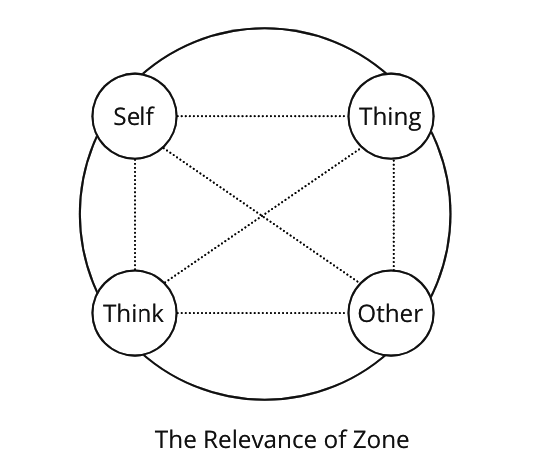
The above model is called the Relevance of Zone which considers Other as an important social context for the long-term development of thoughts. You can find more details here.
Based on the model, we can generate the following questions:
- Other: Who is the Significant Other for this insight?
- Thing: What’s the insight about? Why do I pay attention to it?
- Think: How did I get this insight? Is there a technique behind the process?
- Self: Where did I capture this insight?
- Self: When did I capture this insight?
- Activity: Is this insight part of an activity? What’s the activity?
- Activity: Has this insight led to a new action or a new activity?
The following section will share the first case study. I will work on other cases on this document @ Coda.
#1 — The notion of “Thematic Space” (Jan 5, 2022)
- Other: Who is the Significant Other for this insight?
Peter Gardenfors is the Significant Other because the notion of “Thematic Space” was inspired by his concept of “Conceptual Spaces”.
- Thing: What’s the insight about? Why do I pay attention to it?
Originally I used “Conceptual Spaces” for the Model of Knowledge Curation and its canvas. I also used the model and the canvas for the Diagramming as Practice framework. The term Conceptual Spaces is inspired by Peter Gardenfors’ 2004 book Conceptual Space: The Geometry of Thought. However, I roughly use it to describe large cognitive containers for curating similar theoretical approaches together.
- Think: How did I get this insight? Is there a technique behind the process?
I realized that there is a mismatch between what I want to describe and Peter Gardenfors’ concept of “Conceptual Spaces”. What I am talking about is not the original meaning of Peter Gardenfors’ concept of Conceptual Spaces.
Since I had used the word “theme” for Theme U, Theme Plus, and Themes of Practice. I thought it is better to use Thematic Space for the model and the canvas.
I’d like to use Creative Attachance to describe the technique behind this process. I detached my idea from Peter Gardenfors’ concept of “Conceptual Spaces”, and attached it to my theme-related work. This action creates a new space for my exploration.
- Self: Where did I capture this insight?
I captured this insight at my house.
- Self: When did I capture this insight?
I officially used “Thematic Spaces” to replace “Conceptual Spaces” on Jan 5, 2022. Originally I used “Conceptual Spaces” for the Model of Knowledge Curation and its canvas on Dec 16, 2021. The process took about two weeks.
- Activity: Is this insight part of an activity? What’s the activity?
It was born from making the Model of Knowledge Curation and its Canvas. I used the model and canvas for the Diagramming as Practice framework which is the final summary of the D as Diagramming project.
The model of Knowledge Curation and its Canvas is part of the Knowledge Curation project.
- Activity: Has this insight led to a new action or a new activity?
The notion of Thematic Spaces is part of a large knowledge enterprise that contains the following ideas:
- Curativity Theory > Cognitive Container > Knowledge Curation
- Curativity Theory > Themes of Practice
- Life as Activity > Creative Life > Slow Cognition
- Mind as Play > Diagramming as Practice
- Mind as Play > Developing Tacit Knowledge
- Mind as Play > Themes of Practice
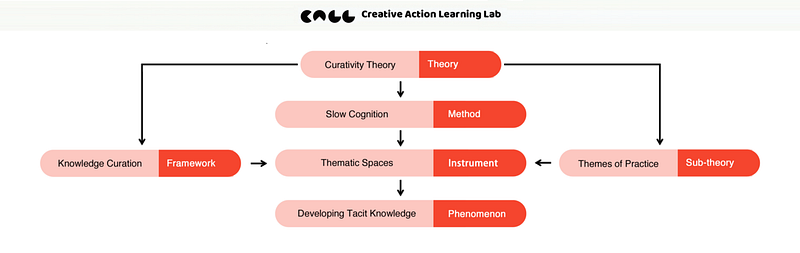
For Curativity Theory, the notion of Thematic Spaces is a new theoretical concept that is part of the Knowledge Curation framework. Also, Themes of Practice is a sub-theory of Curativity Theory, and the notion of Thematic Spaces is also part of the Themes of Practice framework.
The notion of Slow Cognition refers to the long-term development of thoughts and the historical-cognitive method. The notion of Thematic Spaces is a great tool for turning the notion of Slow Cognition from a concept into a project.
This insight led to Thematic Space Canvas and it led to a series of canvases. Eventually, it became a meta-canvas. It also led to three new projects: the Knowledge Discovery project, the Life Discovery project, and the Concept Discovery project.
The Significant Insights Analysis Project
I created a doc titled Life Discovery: Significant Insights Analysis on Coda. The picture below is a screenshot of the homepage of the project.
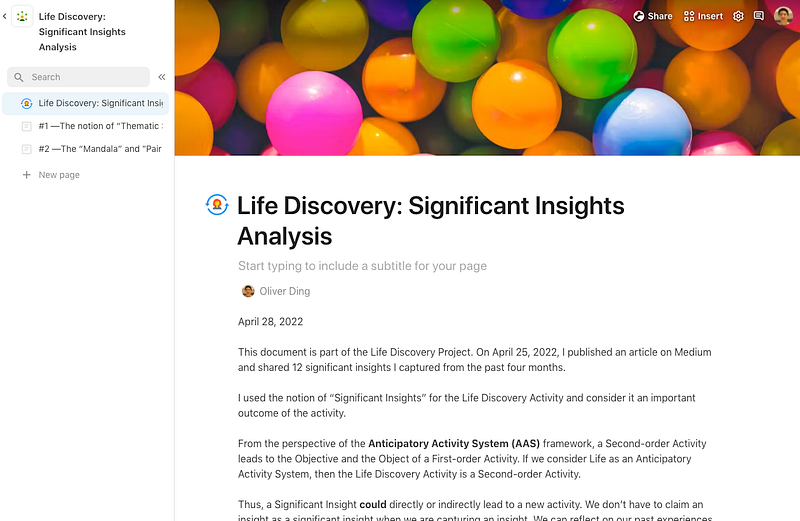
Now I have a new project called Significant Insights Analysis. I will use the above doc to conduct the other 11 cases. You can bookmark or save the link to the doc.
Related Articles
- Life Discovery: “Points of Observation” and “Significant Insights”
- Knowledge Discovery: The “Perspectives — Views” Mapping
- Life Discovery: Twelve Significant Insights from Four Months
- The Project Engagement Toolkit (2022)
- Life Discovery: The Life-as-Project Approach
- The Life Discovery Toolkit (v1)
- The Life Discovery Canvas (v1.0) — Part 1: Theoretical Background
- The Life Discovery Canvas (v1.0) — Part 2: Spatial Structure
- The Life Discovery Canvas (v1.0) — Part 3A: Concepts (THINK and LEARN)
- The Life Discovery Canvas (v1.0) — Part 3B: Concepts (SAY and DO)
- The Life Discovery Canvas (v1.0) — Part 4: Inspirations
- Life Discovery: The “Being by Doing” Principle
- Life Discovery: The “Performance as Experiment” Principle
- Life Discovery: The “Engagement as Projection” Principle
- Life Discovery: The “Discovery as Development” Principle
- CALL for LIFE: Anticipatory Activity System for Life Transitions
- CALL for LIFE: Modeling A Developmental Project
- CALL for LIFE: Oliver Ding @ 2021 and Second-order Activity
I am also working on building a new website for the Platform Ecology project. You can save the following links:
- PlatformEcology.org
- Twitter: @PlatformEcology
- Linkedin: @PlatformEcology
You are most welcome to connect via the following social platforms:
Linkedin: https://www.linkedin.com/in/oliverding Twitter: https://twitter.com/oliverding Polywork: https://www.polywork.com/oliverding Boardle: https://www.boardle.io/users/oliver-ding


