
Life Discovery: The “Engagement as Projection” Principle
The Project Engagement Approach for Life Discovery Activity

The Life-as-Project Approach is inspired by Project-oriented Activity Theory, Anticipatory Systems Theory, Curativity Theory, and other theoretical resources, it was developed with the following six basic principles:
- Being by Doing
- Engagement as Projection
- End as Means
- Discovery as Development
- Performance as Experiment
- Curativity as Creativity
This article offers some related ideas for the “Engagement as Projection” principle which is originally called “Engagement as Method”.
The Life-as-Project Approach is an application of the Project-centered Approach. The method behind the Project-centered approach is “Project Engagement” which is inspired by the Project Engagement Toolkit.
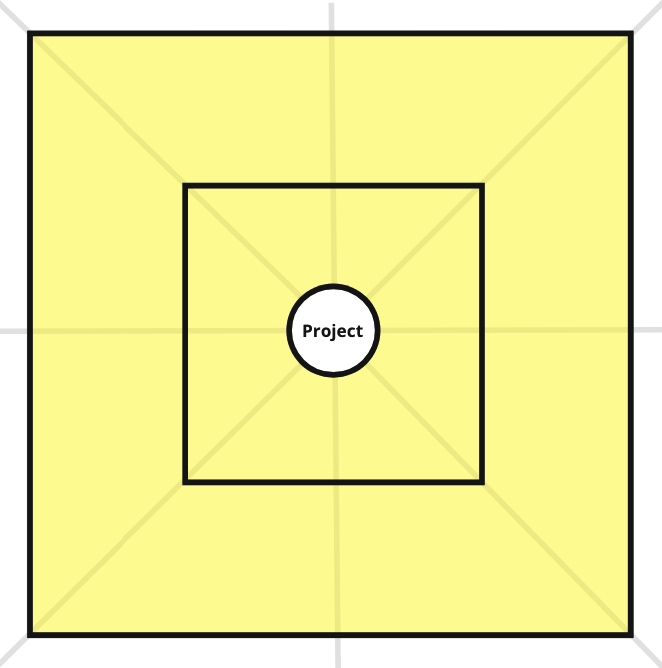
The “Engagement as Projection” principle highlights some essential ideas of the Project-centered Approach.
Life as Project
I have developed several frameworks from different perspectives. One challenge is making a balance between individual perspective and collective perspective. In fact, this is an essential challenge of social science. For example, psychological perspective v.s. the sociological perspective, methodological individualism v.s. methodological collectivism, etc.
Some scholars don’t consider the dichotomy as a problem and they just form two camps. Other scholars developed theoretical solutions to solve the theoretical conflict between these two camps.
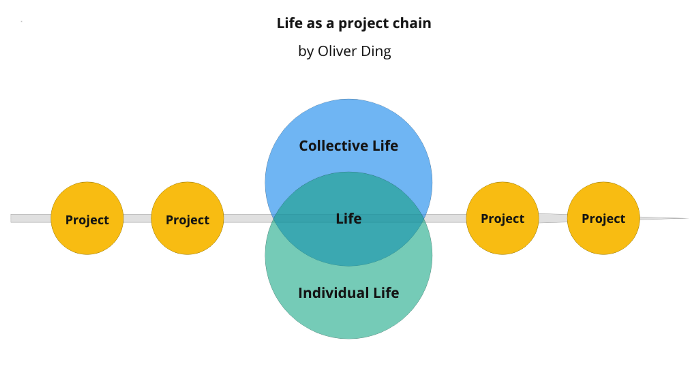
Inspired by Derek Layder’s Social Domains Theory (1997) and Andy Blunden’s “Project as a Unit of Activity” (2010, 2014), I adopted the concept of “Project” as a Container for understanding Life.
Andy Blunden mentions a project-oriented approach in both psychology and sociology, “A project is a focus for an individual’s motivation, the indispensable vehicle for the exercise of their will and thus the key determinant of their psychology and the process which produces and reproduces the social fabric. Projects, therefore, give direct expression to the identity of the sciences of the mind and the social sciences. Projects belong to both; a project is a concept of both psychology and sociology.” (2014, p.15)
The concept of Life can be understood as Collective Life and Individual Life. We can use the concept of Project to understand both of them. A person’s real life is a set of real actions. The concept of Project is a way of curating these actions. On the other hand, Collective Life can be curated with Projects too.
Project Engagement
The term “Engagement” is inspired by Nelson Zagalo’s 2020 book Engagement Design: Designing for Interaction Motivations. While many researchers focus on “User Experience”, Zagalo moves from “Experience” to “Engagement” because “Experience” is too subjective. He proposes a triadic approach to engagement design as a direct answer to the triadic experience — context, subjects, and artifacts — and triadic interaction — know, do and feel — made of three non-hierarchical streams. (Note 1)

What I learned from Zagalo is that experience is too subjective. Activity Theorists reject phenomenology and existentialism which are great theoretical approaches for research user experience. Though Activity Theorists also talk about design and experience, it seems the term “Engagement” is better than “Experience” for Activity Theorists. (Note 2)
According to Blunden, “What distinguishes Activity Theory from Phenomenology and Existentialism is that for Activity Theory, the project has its origin and existence in the societal world in which the person finds themself; for Phenomenology and Existentialism, the psyche projects itself on to the world. For Activity Theory, commitment to a project and formulation of actions towards it is mediated by the psyche, but a project is found and realized as something existing in the world, be that an entire civilization, a single personality, or anything in between. (See MacIntyre, 1981, p.146)” (2014, p.7).
Thus, I use “Project Engagement” as the name of this project in order to highlight the fundamental theoretical aspect of Activity Theory: it is both subjective and objective, also both individual and collective. At least, this is the theoretical commitment of Project-oriented Activity Theory.
Moreover, “Project Engagement” is not only a method for research. In fact, “Engage with Projects” is the essential action of Life Discovery Activity from the Project-centered approach.
Engagement as Projection
The slogan “Engagement as Projection” is inspired by the “Cultural Projection Analysis” method which is part of Project-oriented Activity Theory. You can find more details here: Activity U (X): Projecting, Projectivity, and Cultural Projection.
The “Cultural Projection Analysis” method can be used for research and self-reflection. For example, Last year, I started an empirical research project about an adult development program which was initiated by a friend of mine. I’d like to call the program SSL which stands for Shaper & Supporter Lab. Anyway, it is just a codename. I used the “Cultural Projection Analysis” method to research the program and reflect on my actions.
The program was designed with three components: 1) Life Purpose Awareness, 2) Personal OKR Practice, 3) Peer Review and Feedback. My friend also adopted the Building In Public approach to sharing her goals, challenges, progress, and discussions with others on social media platforms.
I use the Project Engagement approach to guide my research about the program. The approach uses a method called “Multiple-level Project Engagement”. I reflect on the following levels:
- The “My friend — Members” Engagement
- The “Member — Member” Engagement
- The “I — My friend” Engagement
In Jan 2022, the SSL (Shaper & Supporter Lab) program launched its new version of developmental service. I realized that I can apply Project-oriented Activity Theory and the Project Engagement toolkit to study its development.
Last month I joined the SSL program’s digital setting which is based on an enterprise collaboration platform and started researching the whole program. The founder of the program shares videos of their learning workshops with me on a private channel.
I moved from the outer space of the project into the inner space of the project. If we apply the Cultural Projection Analysis method to discuss this moment, then it is about Secondary Projecting.
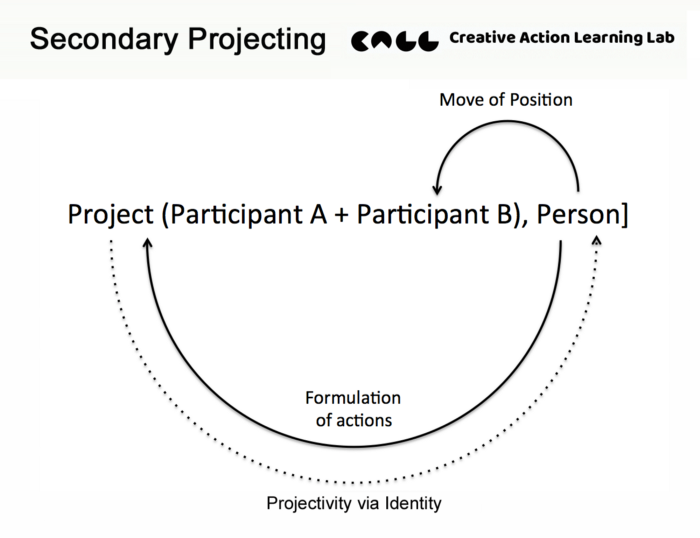
According to Project-oriented Activity Theory, at the phase of Objectification, an established project starts attracting people as its participants. Once a project is initiated, it offers Secondary Projectivity for other people to recognize the potential action opportunities of participating in the project. For the Second Projectivity, its sense-maker is the Identity of an established Project.
The above diagram shows an abstract model of secondary projecting with two people and one project. Participant A is the first person who initiates the project while Participant B is the second person who recognizes Secondary Projectivity and participates in the project.
The core of the spatial logic is the synchronization of formulation of actions and move of position. The second person moves from the outside space of the project into the inside space of the project while he actualizes the Secondary Projectivity of the project by taking real actions.
Here we have to pay attention to the spatial boundary of the project. Before becoming Participant B, the second person only can perceive the secondary projectivity of the project through its sense-maker Identity of Project because he is not in the inside space of the project.
The Transformation of Themes and Identity
The “Engagement as Projection” Principle considers the “Person — Project” relationship as a significant connection of social life.
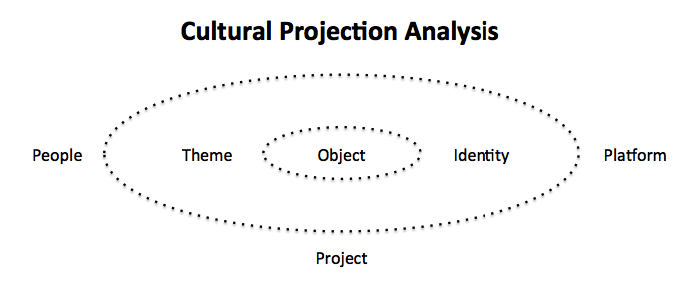
A project is a container of cultural themes which will attract a person. By participating in the project, the person could enhance his life themes or expand his life themes.
A person is attracted by a project through its identity and his Identity could be shaped by the project. On the other side, the actions of the person also could shape the Identity of the Project.
Thus, The “Engagement as Projection” Principle echos the “Internalization — externalization” principle of Activity Theory (note 3).
Related Articles
- The Project Engagement Toolkit (2022)
- Activity U (X): Projecting, Projectivity, and Cultural Projection
- Life Discovery: The “Trilogy” Strategy for Knowledge Creators
- Life Discovery: The Life-as-Project Approach
- The Life Discovery Toolkit (v1)
- The Life Discovery Canvas (v1.0) — Part 1: Theoretical Background
- The Life Discovery Canvas (v1.0) — Part 2: Spatial Structure
- The Life Discovery Canvas (v1.0) — Part 3A: Concepts (THINK and LEARN)
- The Life Discovery Canvas (v1.0) — Part 3B: Concepts (SAY and DO)
- The Life Discovery Canvas (v1.0) — Part 4: Inspirations
- Life Discovery: The “Being by Doing” Principle
- Life Discovery: The “Performance as Experiment” Principle
You are most welcome to connect via the following social platforms:
Linkedin: https://www.linkedin.com/in/oliverding Twitter: https://twitter.com/oliverding Polywork: https://www.polywork.com/oliverding Boardle: https://www.boardle.io/users/oliver-ding
Note 1
According to Zagalo, “Engagement has been a topic of debate over the past decade in different domains, from Education (Antonetti & Garver, 2015 ; Butin & Seider, 2012 ; Moore, 2013 ) to Management (Rothmann, 2016 ; Saks, 2019 ; Seijts & Crim, 2006 ) and Marketing (Brodie, Hollebeek, Juri´c, & Ili´c, 2011 ; Harmeling, Moffett, Arnold, & Carlson, 2017 ), and particularly with the emergence of social media (Harrigan, Evers, Miles,& Daly, 2017 ; Hollebeek, Glynn, & Brodie, 2014 ; Voorveld, van Noort, Muntinga, & Bronner, 2018 ). There has been an interest in understanding how engagement occurs, not only in how it produces meaning but in how it affects behaviour and through which patterns. However, as we have already seen, an enormous barrier of subjectivity inhibits it. If we followed through communication pragmatics, focused on meaning-making, with Watzlawick (e.g. “axioms of communication”), we would be completely captive to subjectivity, context-dependent, with every case being a case, on its own and belonging to no general category. At the other end of the spectrum, we could follow with the recent cutting-edge digital tools of marketing, which by defining itself within a fully persuasive environment immersed in digital data, registering the entire relations continuously, has crafted a set of clear formulas (numbers of clicks, likes, comments, shares, views, etc.) to calculate behavioural change: the engagement.We must, however, curb this approach in the interest of our research, in the sense that all this quantitative data is merely indicative and often misleading in the analysis (e.g. a campaign will not always be shared for the best reasons — it may contain a whole negative charge — but of course in the restricted area of marketing we know that no negative publicity exists).” (2020, p.19)
Note 2
According to HCI Activity Theorist Victor Kaptelinin and Bonnie Nardi, “…there are deep conceptual similarities between activity theory and phenomenology. Like other post-cognitivist theories such as distributed cognition (e.g., Hollan et al., 2000)” and actor-network theory (e.g., Callon, 1986), they are highly critical of Cartesian mind-body dualism and maintain that there is a fundamental unity of the mind and the world. Another basic idea shared by most post-cognitivist theories is that technology plays a vital role in human life. In addition, both activity theory (Leontiev’s version) and phenomenology, as opposed to some other post-cognitivist theories, are primarily interested in individual subjects…One more common feature of activity theory and phenomenology is that they both describe subjective experience in terms of meaning.” (2012, p.50)
However, there are significant differences between these two theoretical traditions. Victor Kaptelinin and Bonnie Nardi point out, “A substantial different between activity theory and phenomenology lies in their respective conceptual points of departure. Activity theory understands subjects as constituted by their inherently social activities that transform both subjects and the world (objects). Activities, therefore, set subjects apart and, at the same time, relate them to the world. Since subjects have need-based agency and become what they are through their socially and physically distributed activities, a detailed account of motivation, development, and social-cultural context is a necessary precondition for understanding subjects, their ‘acting — in — the world’.” (2012, p.51)
Now let’s look at the essential aspect of phenomenology. Victor Kaptelinin and Bonnie Nardi say, “In phenomenology, subjects are also assumed to be one with the world — their very existence is defined as ‘’being — in — world’ (Heidegger, 1962). However, the most fundamental issue to be explored is formulated in phenomenology in terms of how people make sense of their existence and how the world reveals itself to subjects. The issue of how subjects come to exist in the first place is not systematically analyzed, and neither are the specific needs and goals underlying the active, engaged nature of ‘being — in — the — world.’ In addition, while the importance of the social context was recognized (and reflected), for instance in the Heidegger’s notion of ‘being with,’ which was mentioned, but not elaborated upon (Polt, 1999), it did not become a central issue in the phenomenological tradition until the notion of intersubjectivity was introduced to phenomenology discourse (see Dourish, 2001). ”(2012, p.51)
Note 3
Researchers have been adopting Activity Theory as a descriptional and orientational framework for analysis and evaluation in a variety of empirical studies. Some researchers also developed practical tools for connecting Activity Theory and empirical studies, for example, the Activity Checklist (Kaptelinin, Nardi, and Macaulay 1999).
According to Kaptelinin and Nardi (2006), there are five basic principles of Activity Theory:
- Object-orientedness
- Tool mediation
- Internalization — externalization
- The hierarchical structure of activity, and
- Development
References
Andy Blunden (2014) Collaborative Project: An interdisciplinary study. Brill.
Engeström, Y. (1987) Learning by Expanding: An Activity-Theoretical Approach to Developmental Research. Helsinki: Orienta-Konsultit Oy.
Kaptelinin V., & Nardi B. (2012) Activity theory in HCI: fundamentals and reflections. Morgan & Claypool Publishers.
Nelson Zagalo (2020) Engagement Design: Designing for Interaction Motivations. Springer.


