
The Life Discovery Toolkit (v1)
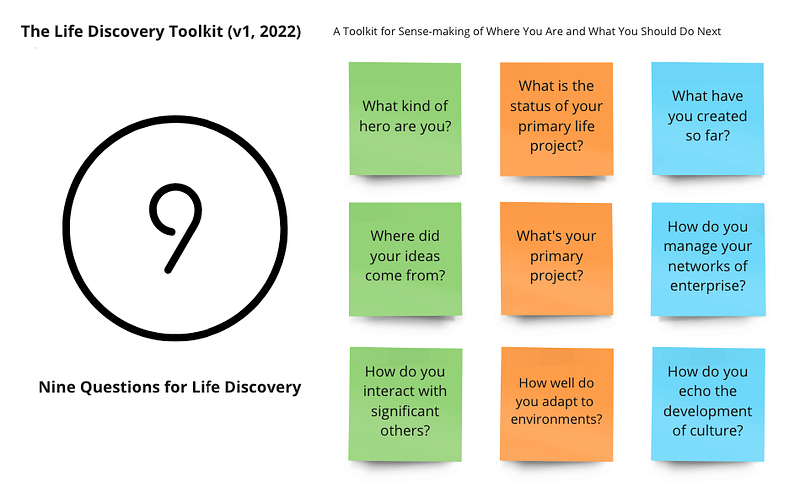
Nine Questions for Life Discovery!

Today I made the Life Discovery Toolkit (v1.0) on Miro. I’d like to share some screenshots and some background information with readers.
- The Life Discovery Toolkit (v1.0) is an application of the Project Engagement Approach.
- The Sailor’s Mandala diagram is a Life Discovery Framework for a particular program.
The Life Discovery Toolkit (v1.0) is designed as a mediating instrument for the Life Discovery Activity which is a general social practice.
Contents
Part 1: Screenshots Part 2: Theoretical Foundation
2.1 “What” v.s. “Where” 2.2 “Individual” v.s. “Collective” 2.3 “Project” v.s. “Activity” 2.4 “Creativity” v.s. “Curativity”
Part 3: The Structure of the Toolkit
3.1 Life as A Meaningful Journey 3.2 Life as A Project Chain 3.3 A Curated Mind for A Creative Life
Part 4: The Life Discovery Activity
4.1 The “Anticipation — Performance — Reflection” structure 4.2 Anticipatory Activity System 4.3 How to Use the Toolkit
Part 1: Screenshots
Part 1 shares some screenshots of the Life Discovery Toolkit (v1.0).
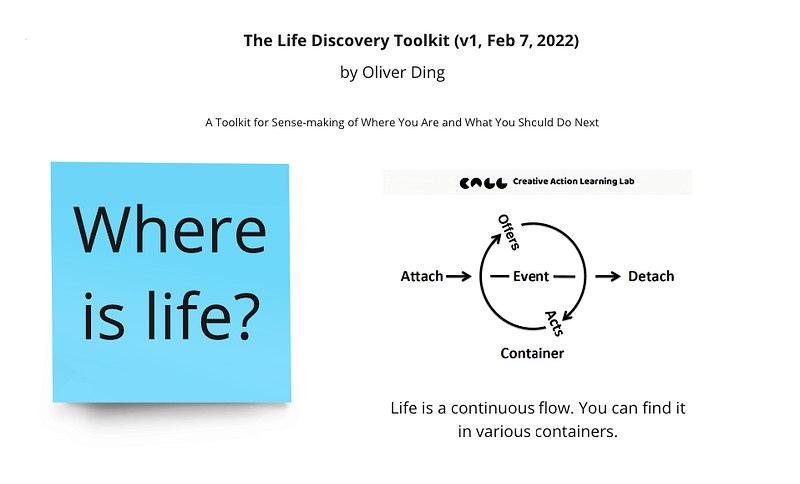
1.1 Where is Life?
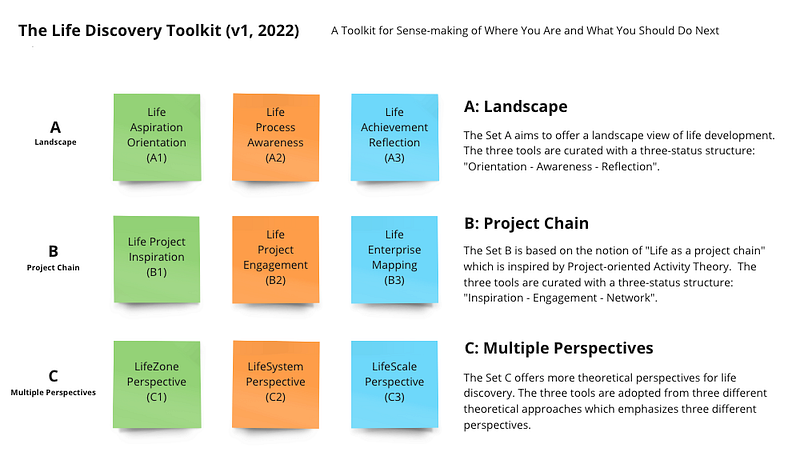
1.2 A Nine-module Toolkit
1.3 Questions for Life Discovery
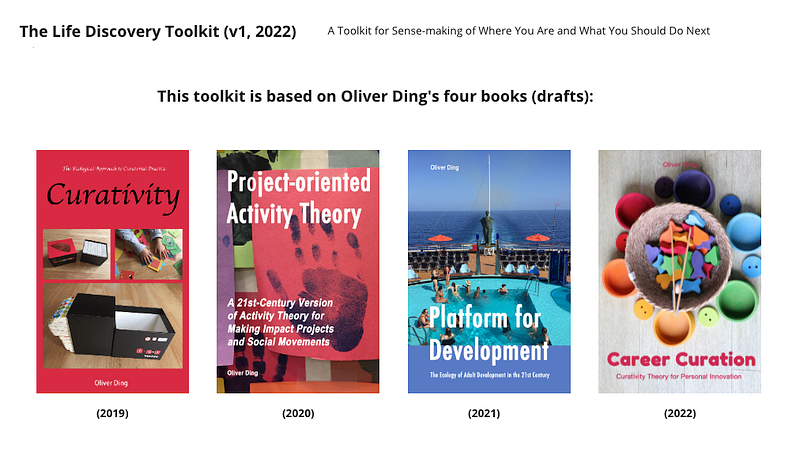
1.4 Supported by Four Books
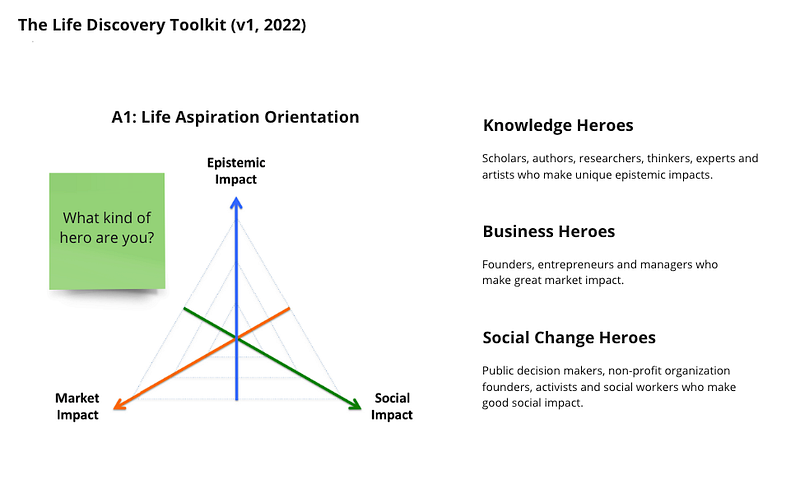
1.5 Q1: What kind of hero are you?
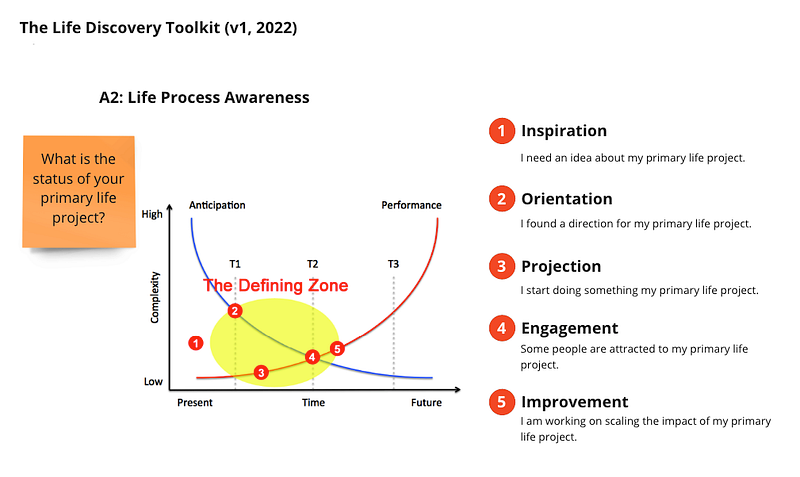
1.6 Q2: What is the status of your primary life project?
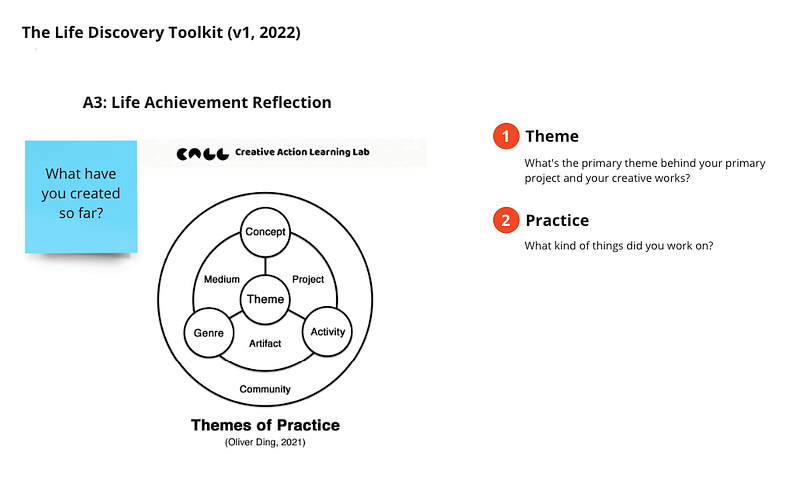
1.7 Q3: What have you created so far?
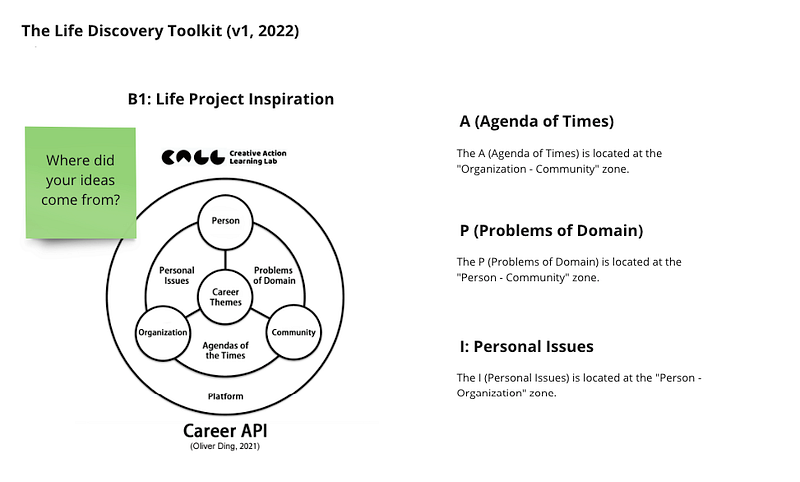
1.8 Q4: Where did your ideas come from?
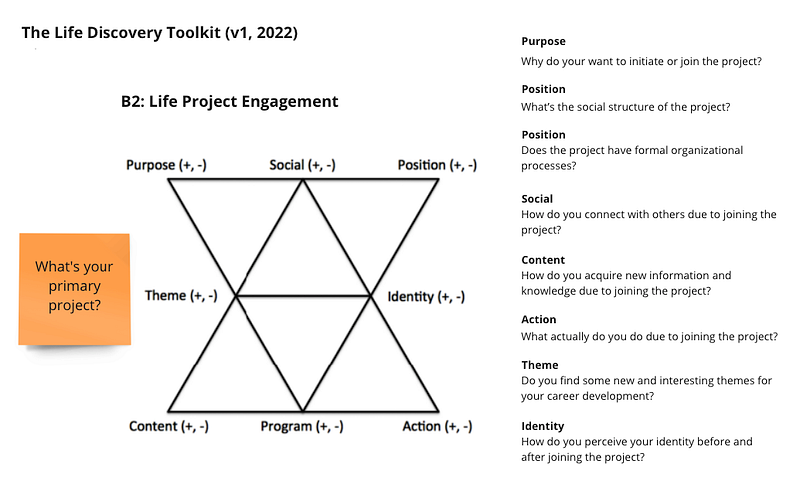
1.9 Q5: What’s your primary project?
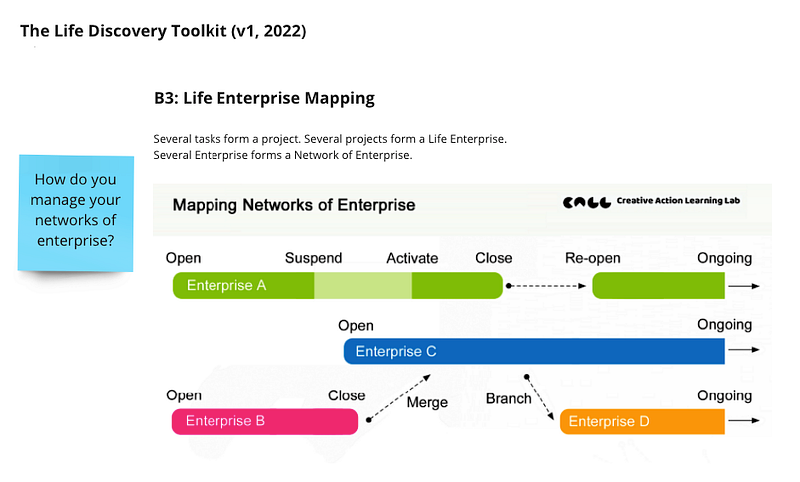
1.10 Q6: How do you manage your networks of enterprise?
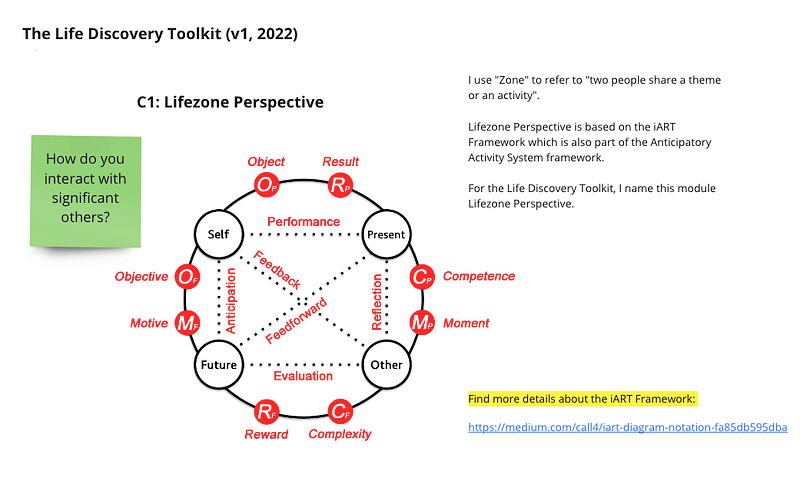
1.11 Q7: How do you interact with significant others?
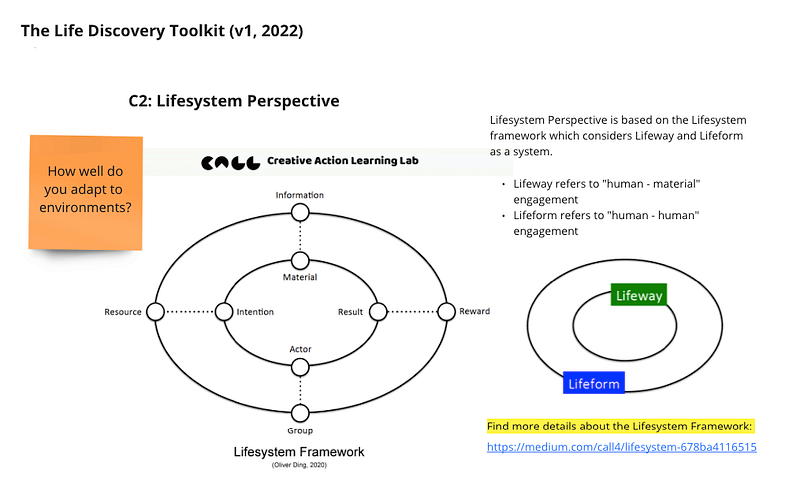
1.12 Q8: How well do you adapt to environments?
1.13 Q9: How do you echo the development of culture?
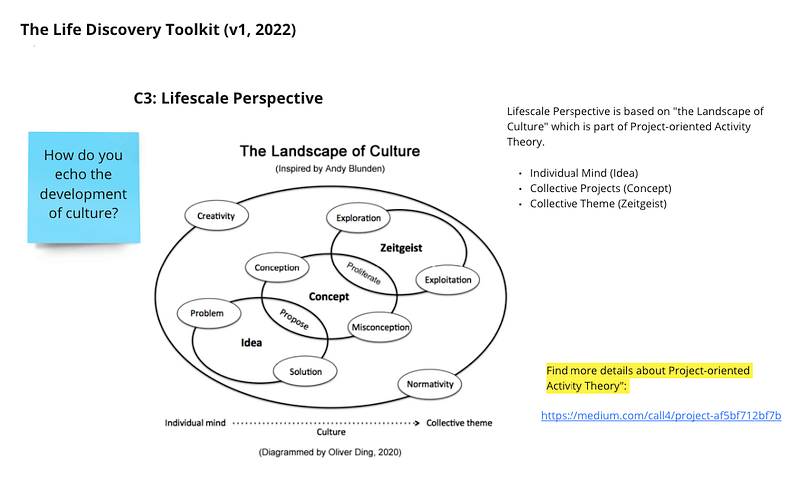
For each module, I also add an example of related materials. If you want to visit the Miro board, please leave a comment or DM me on Linkedin or Twitter.
Part 2: Theoretical foundation
Now we can start discussing deep issues behind the toolkit.
2.1 “What” v.s. “Where”
The starting point of the Life Discovery Toolkit (v1.0) is a simple question:
Where is Life?
In fact, I have the other option:
What is Life?
There are at least three ways to understand the concept of “Life”.
- Life as Organism: this is the perspective of biological theories.
- Life as Practice: this is the perspective of social theories.
- Life as Ideal Type: this is the perspective of humanities.
There are two simple reasons behind my decision on choosing one between “What is Life” and “Where is Life”.
- My primary theoretical work is the Ecological Practice approach. I have been developing many frameworks and models which are all about “Who — Where”.
- “Where” refers to concrete situations, environments, activities, and works. We should start a deep conversation with a graspable topic.
The Ecological Practice approach uses “Container(Containee)” as a core concept as its theoretical foundation. The diagram below is the basic model of the approach.
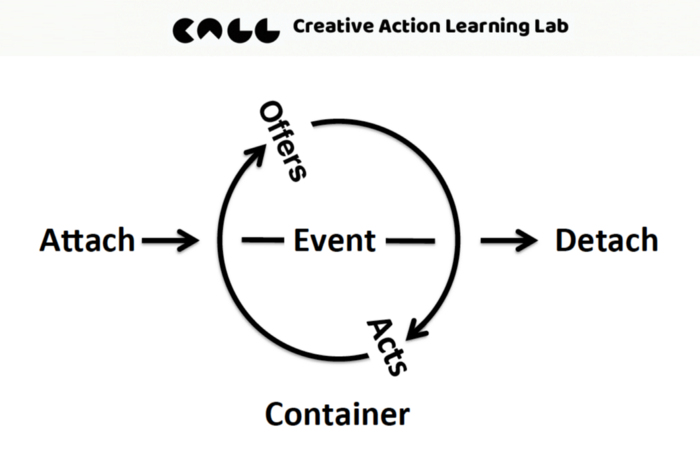
For discussing Life Discovery and Life-related topics, I use “Life Container” for discussions.
Where is Life? Life is a continuous flow. You can find it in various containers.
2.2 “Individual” v.s. “Collective”
I have developed several frameworks from different perspectives. One challenge is making a balance between individual perspective and collective perspective. In fact, this is an essential challenge of social science. For example, psychological perspective v.s. sociological perspective, methodological individualism v.s. methodological collectivism, etc.
Some scholars don’t consider the dichotomy as a problem and they just form two camps. Other scholars developed theoretical solutions to solve the theoretical conflict between these two camps. Inspired by Derek Layder’s Social Domains Theory (1997) and Andy Blunden’s “Project as a Unit of Activity” (2010, 2014), I adopted the concept of “Project” as a Container for understanding Life.
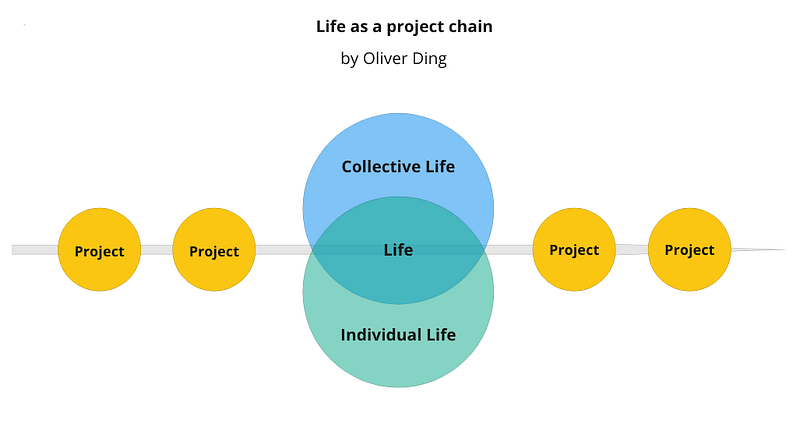
The concept of Life can be understood as Collective Life and Individual Life. We can use the concept of Project to understand both of them. A person’s real life is a set of real actions. The concept of Project is a way of curating these actions. On the other hand, Collective Life can be curated with Projects too.
Moreover, Life is a set of Projects. These projects can be told as stories or explained with models.
2.3 “Project” v.s. “Activity”
In 2014, Andy Blunden edited a book titled Collaborative Projects: An Interdisciplinary Study and argued that there is a need to establish a concept of “project” as a unit of activity theory and human sciences. He said, “There are already many writers who address themselves to collaborative projects as part of their research, and among these, some who share a commitment to Activity Theory or the Cultural-Historical Psychology which underpins Activity Theory. However, these writers do not constitute a coherent current of thinking, as each writer does not take the concept of ‘project’ as central to their own project. Nonetheless, this literature provides a beginning for interdisciplinary research in the human sciences which can reach across the chasm between the sciences of the individual and the science of society… In what follows I will outline the origins of ‘project’ as a unit for the human sciences and its value as an interdisciplinary concept, and then briefly review the foundation of the concept in different domains of theory, and conclude with a concise definition of the concept of ‘collaborative project’.”
Blunden pointed out, “A concept is needed which is concerned equally with how a person’s mind is shaped by their social situation and cultural context, and how social formations and cultural constellations are shaped by the actions of individuals. The same concept must facilitate scientific investigation at all levels of aggregation. Such a concept must meet certain requirements. It must be able to represent a self-sufficient Gestalt of social life at the individual level, the meso-level with which ‘project’ is normally associated in common parlance, and the cultural-historical level. It must embody movement and change, not some functional or structural conception of ‘dynamic equilibrium’. And it must capture both how the individual human psyche is determined by a person’s social situation and how individual persons participate in real social change. Finally, it must express both a viable ethical conception of modern life and a unit of scientific analysis for the formation of modern life and its conduct.” (2014, p.14)
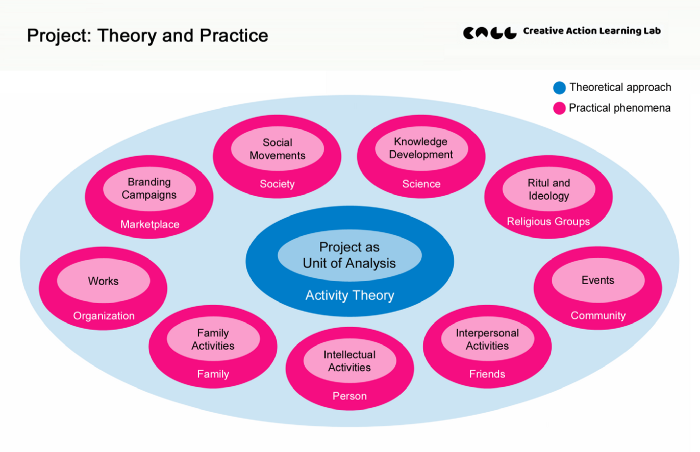
The above diagram visualizes the landscape of “Project”. The pink ellipses refer to practical phenomena and the blue ellipse refers to theoretical approaches. I roughly select nine social domains such as a person, family, friends, organization, community, marketplace, religious groups, science, and society. For each type of social domain, I identify their typical activities. After thinking about these concrete practical phenomena with the theoretical concept “Project”, I accept Blunden’s proposal.
Blunden also emphasizes the benefit of developing the concept of “Project” as the foundation of social life, “By taking ‘project’ as a unit of analysis a number of other notorious dichotomies become manageable. For example, if we replace the conception of ‘social structure’ with that of the world as a fabric woven from interacting projects, and at the same time, understand that a project is the only possible manifestation of the human will as a collective will, then the agency/structure dichotomy can be resolved. If we understand that the object of a project is immanent within the development of the project itself, the real unfolding of which is equally a learning process, then there is no dichotomy between development and immanence. There is no quandary between determinism and contingency, because in commitment to projects the individual’s life is itself a determining factor. Because projects both create and instantiate concepts, and are therefore, like actions, are both subjective and objective, this ancient dichotomy is no longer problematic.” (2014, p.15)
2.4 “Creativity” v.s. “Curativity”
Life is a real practice. How do we apply various theoretical knowledge to such a practice?
This question leads to a significant gap between Theory and Practice. Knowledge heroes create various theories, frameworks, models, etc. Their creativity drives them to make unique and general ideas. Eventually, they build a highly fragmented knowledge ecology that is not accessible to ordinary people.
In 2019 I developed Curativity Theory for understanding general curation practice and wrote a book. In 2020, I started the Knowledge Curation project which aims to apply Curativity Theory to connect Theory and Practice. From the perspective of Curativity Theory, ordinary people need to add “Curation” to develop their minds.
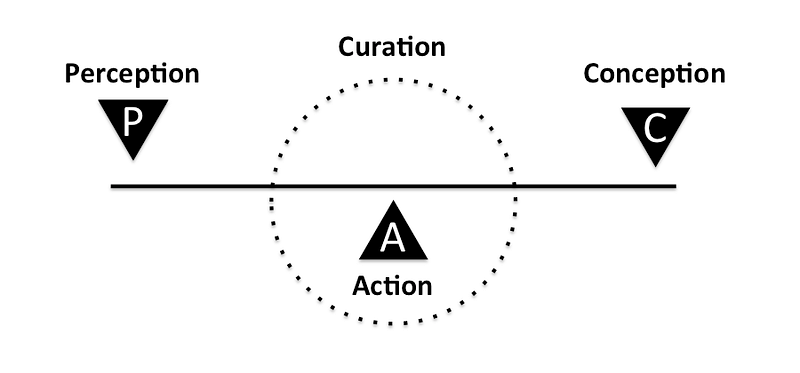
Traditionally, researchers tend to use “perception, conception, and action” as three keywords to discuss mind-related topics. From the perspective of Curativity Theory which is about turning pieces into a meaningful whole, I want to expand the foundation of mind-related topics from three keywords to four keywords.
The Epistemology of Curation refers to considering pieces of perceiving experience, pieces of concepts, pieces of actions at a level and moving to a higher level to curate these pieces into a meaningful whole.
For Life Discovery, this theoretical consideration leads to the third group of modules: Multiple Perspectives. I deliberately select three different theoretical perspectives and put them together.
Part 3: The Structure
The Life Discovery Toolkit (v1.0) is designed as three groups of modules.
- Context (abstract container): each group has its own structure.
- Content (concrete container): each module adopts one framework or model from my works.
As a curated toolkit, the abstract containers and the concrete containers are two layers. The abstract containers form a framework for the toolkit as a meaningful whole.
In real-life practice, we can select other frameworks or models as concrete containers in order to satisfy a particular person’s needs.
3.1 Life as A Meaningful Journey
The first group of modules offers a landscape of life. It starts from common sense: Life is a meaningful journey.
In fact, this is a metaphor. Moreover, there is a deep idea behind the metaphor: Life is about Spatial Difference.
This view is inspired by George Lakoff and Mark Johnson’s ideas on the Cognitive Science of the Embodied Mind in their 1999 book Philosophy in The Flesh and other books. According to Lakoff and Johnson, “Very little of our understanding of time is purely temporal. Most of our understanding of time is a metaphorical version of our understanding of motion in space.” They introduce a metaphor system of time in the book, see the note below:
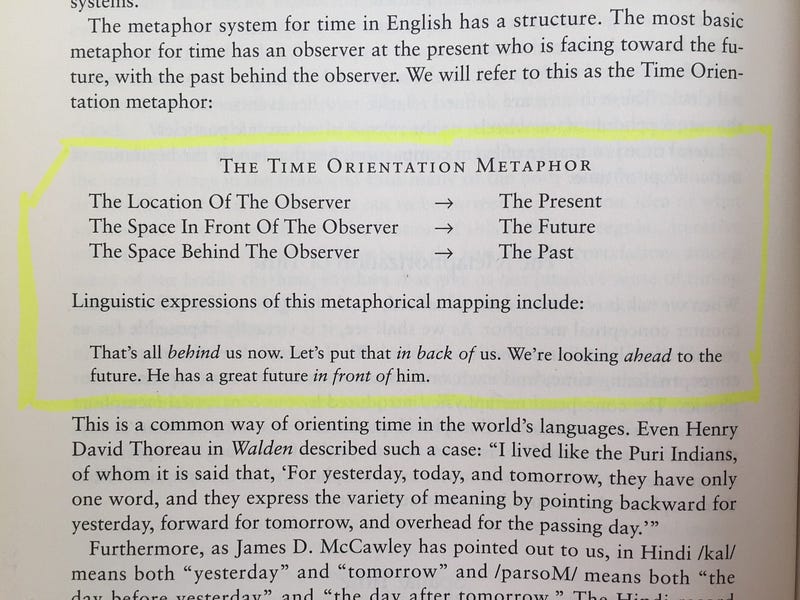
In the 2000 book Where Mathematics Comes From, George Lakoff and Rafael E. Nunez use the Source-Path-Goal schema as an example of the cognitive science of the embodied mind. See the picture below:
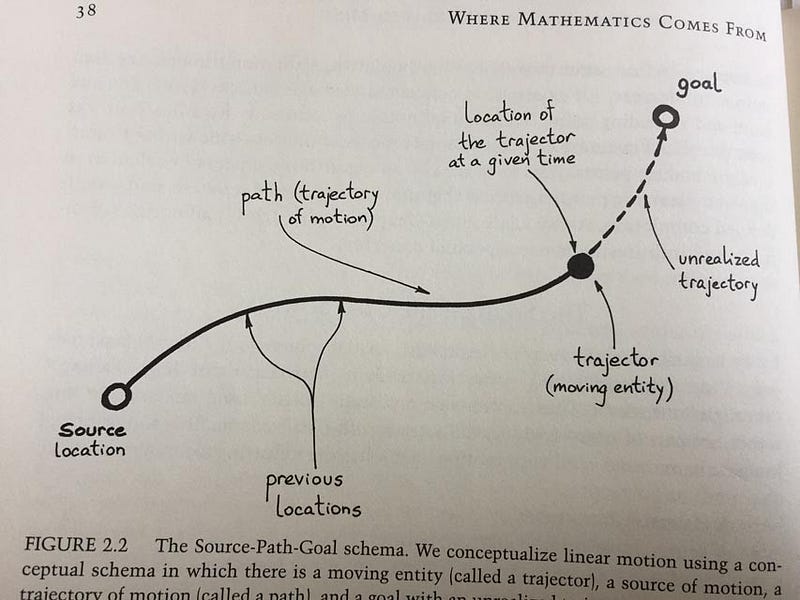
The Source-Path-Goal schema points out that there is an unrealized trajectory between the location of the trajector at a given time (present) and the goal (future). The diagram clearly shows the Temporal Difference between Present and Future is the Spatial Difference between the present location and future goal.
For the Life Discovery Toolkit (v1.0), the “Landscape” group of modules aims to offer a landscape view of life development from the perspective of Spatial Difference. I use the Source-Path-Goal schema to design a three-status structure:
- Source: Life Aspiration Orientation
- Path: Life Process Awareness
- Goal: Life Achievement Reflection
This three-status structure is an abstract container. I also select three frameworks or models as concrete containers for each status.
- Life Aspiration Orientation: the “Epistemic — Market — Social” impact model.
- Life Process Awareness: the Defining Zone model
- Life Achievement Reflection: the Themes of Practice framework
As a curated toolkit, the abstract containers and the concrete containers are two layers. The abstract containers form a framework for the toolkit as a meaningful whole. In real-life practice, we can select other frameworks or models as concrete containers in order to satisfy a particular person’s needs.
3.2 Life as A Project Chain
The second group of modules offers a Zoom In view of life. As mentioned above, I use the concept “Project” as the foundation for understanding Life.
In fact, we can consider the Source-Path-Goal schema again. However, this time we apply it to a Project.
Following Andy Blunden’s “Project as a unit of activity”, I wrote a book titled Project-oriented Activity Theory in 2020. Later, I started expanding my perspectives on the concept of “Project”.
My newest view on the concept of “Project” was described in an article titled Thematic Space: Project as Story with the following diagram:
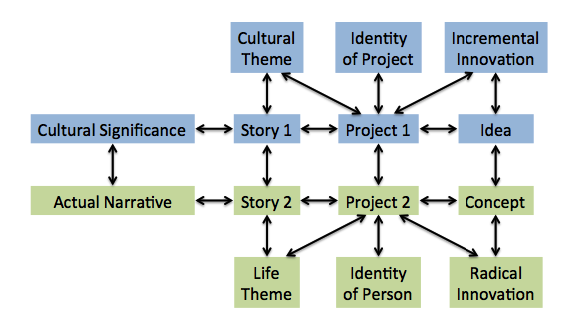
The above diagram places the concept of “Project” in a web of concepts. The major idea behind it is called “Project Engagement” and “Cultural Projection Analysis”.
The notion of “Project Engagement” refers to the name of this project-centered theoretical approach while the notion of “Cultural Projection Analysis” refers to a method for the approach.
For the Life Discovery Toolkit (v1.0), I design a structure for the second group of modules from the perspective of Spatial Difference:
- Outside: Life Project Inspiration
- Inside: Life Project Engagement
- Zoom out: Life Enterprise Mapping
This three-status structure is an abstract container. I also select three frameworks or models as concrete containers for each status.
- Life Project Inspiration: Career API (Agenda of Times / Problems of Domain / Personal Issues)
- Life Project Engagement: Developmental Project Model
- Life Enterprise Mapping: Network of Enterprise
As mentioned above, “As a curated toolkit, the abstract containers and the concrete containers are two layers. The abstract containers form a framework for the toolkit as a meaningful whole. In real-life practice, we can select other frameworks or models as concrete containers in order to satisfy a particular person’s need.”
However, the Developmental Project Model is the core of the Life Discovery Toolkit (v1.0). I can’t replace it with other models. In other words, if we want to reduce the Life Discovery Toolkit (v1.0) to only one model, then it is the Developmental Project Model.
3.3 A Curated Mind for A Creative Life
The third group of modules is guided by the Epistemology of Curation.
As discussed above, “The Epistemology of Curation refers to considering pieces of perceiving experience, pieces of concepts, pieces of actions at a lower level and moving to a higher level to curate these pieces into a meaningful whole.”
For Life Discovery, this theoretical consideration leads to the third group of modules: Multiple Perspectives. I deliberately select three different theoretical perspectives and put them together with the following structure:
- Micro: Lifezone Perspective
- Meso: Lifesystem Perspective
- Macro: Lifescale Perspective
This three-status structure is an abstract container. I also select three frameworks or models as concrete containers for each status.
- Lifezone Perspective: iART Framework and Relevance Theory
- Lifesystem Perspective: Lifesystem Framework
- Lifescale Perspective: The Landscape of Culture
iART Framework and Relevance Theory focus on the “Self — Other” relationship, this is the micro perspective of intersubjectivity.
Lifesystem Framework is an abstract model of the Ecological Practice approach. It defines a new concept called “Lifesystem” as a unit of analysis for practice studies. A “Lifesystem” is formed with two parts: “Lifeway” and “Lifeform”. The “Lifeway” is related to human-material engagement, affordance, and individual actions while the “Lifeform” is related to human-human engagement, supportance, and social contexts. For the Life Discovery Toolkit (v1.0), we can pay attention to Lifeway > Material Adaptability and Lifeform > Social Adaptability.
The Landscape of Culture is part of the Project-oriented Activity Theory. It considers a path of connecting individual life experience with collective culture: Individual Mind (Idea) > Collective Projects (Concept) > Collective Themes (Zeitgeist).
These three theoretical frameworks belong to different theoretical traditions and different perspectives. I expect the third group of modules could guide people to move from Reflection on Practice to Reflection on Epistemology by switching between different perspectives.
Part 4: The Life Discovery Activity
From the perspective of Activity Theory, a toolkit is a Mediating Instrument of an Activity.
What’s the Activity? It is the Life Discovery Activity.
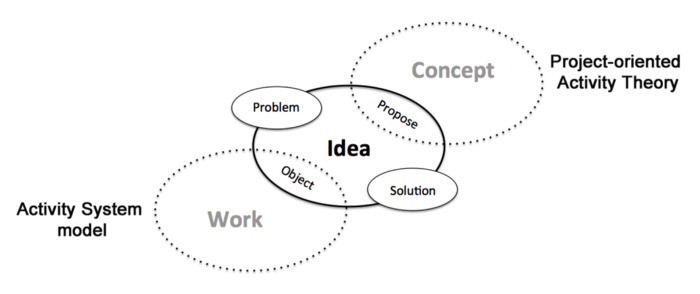
The Project Engagement Approach adopts two major theoretical approaches of Activity Theory for the toolkit. See the above diagram.
- The Activity System Model (Yrjö Engeström, 1987)
- Activity as Formation of Concept (Andy Blunden, 2010, 2012, 2014)
While Engeström’s model is perfect for dealing with traditional work projects, Blunden’s approach considers collaborative projects as the foundation of social movements and cultural innovation.
By curating the above two approaches together, the Project Engagement approach offers a cross-boundary solution for achieving a balance between individual impact and collective impact. In this way, the approach could lead us to an innovative way of connecting personal life themes and cultural themes in order to build a sustainable society together.
From the perspective of the Activity System model, the Life Discovery Activity focuses on detecting potential contradictions within a person’s life activities.
From the perspective of Project-oriented Activity Theory, the Life Discovery Activity focuses on exploring potential concepts within a person’s life activities.
4.1 The “Anticipation — Performance — Reflection” structure
The nine modules are also labeled with three colors: Green, Orange, and Blue. They refer to a deep similarity between three groups of modules.
- Green: Anticipation
- Orange: Performance
- Blue: Reflection
The “Anticipation — Performance — Reflection” structure can be applied to the Life Discovery activity too.
4.2 Anticipatory Activity System
This leads to our last theoretical resource: Anticipatory Activity System.
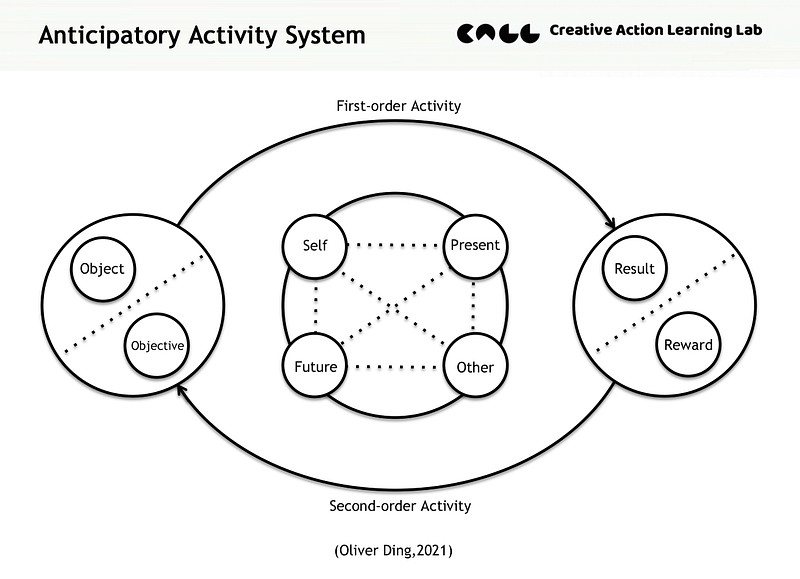
While a person’s projects are “First-order Activities”, the Life Discovery activity is a “Second-order Activity”.
For the Life Discovery activity, “Self” refers to the person while “Other” refers to a Life Discovery Coach.
However, this model is only considered for Life Discovery Coaches. Ordinary people don’t need this model for their Life Discovery practices.
4.3 How to Use the Toolkit
The toolkit is developed for a minimum collaborative project: “a two-people interactive activity”.
Andy Blunden gives an archetypal unit of a project in his 2010 book An Interdisciplinary Theory of Activity.
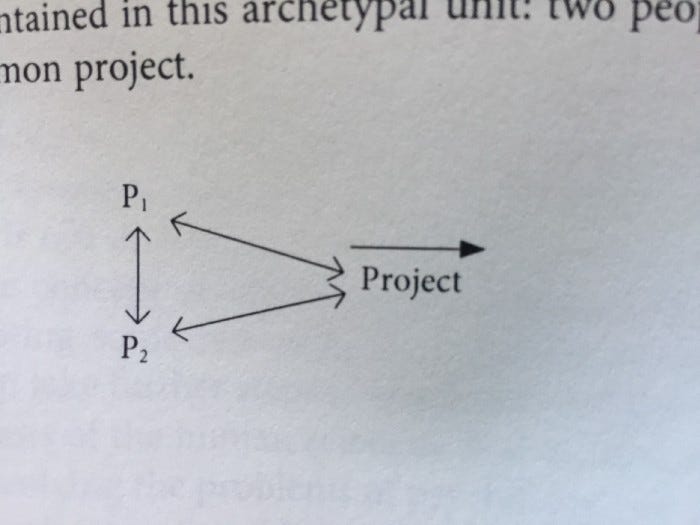
He says, “The rich context of the notion of collaboration also brings to light more complex relationships. The notions of hierarchy, command, division of labor, cooperation, exchange, service, attribution, exploitation, dependence, solidarity, and more can all be studied in the context of just two individuals working together on a common project. And yet almost all the mysteries of social science, as well as a good part of psychology, are contained in this archetypal unit: two people working together in a common project.” (2010, p.315)
As an ordinary user, you can invite a friend to join your Life Discovery activity. You can tell your stories and reflect on your projects with the toolkit with your friend. You don’t have to go through all the modules. You can start from one module and expand to more modules.
As a life coach, you can consider adopting the toolkit for your life coaching activity. You can select one or more modules and design your own life coaching activity.
As a Life Discovery Coach, you are expected to adopt the Project Engagement Approach and the Life Discovery Toolkit as a system to guide your Life Discovery Activity.


