
The Life Discovery Canvas (v1.0) — Part 4: Inspirations
Some knowledge sources behind the canvas
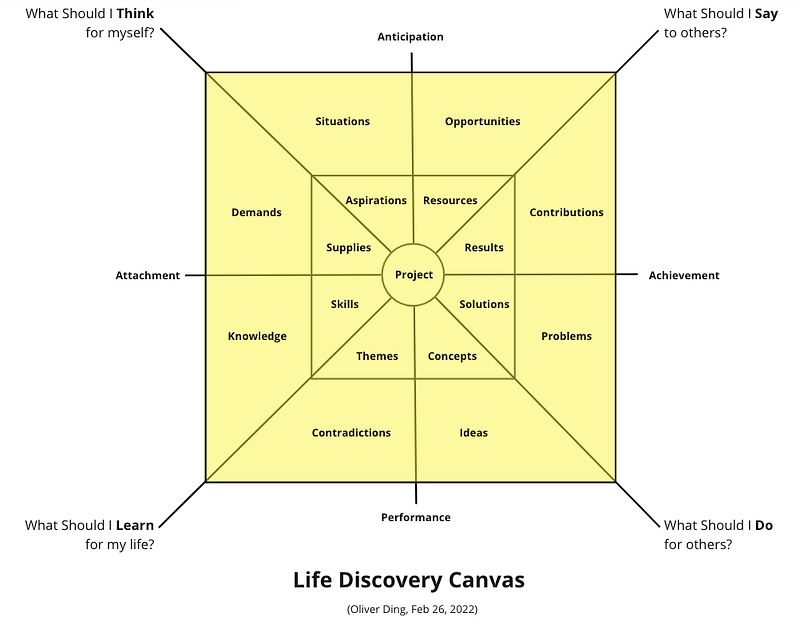
The above picture is the Life Discovery Canvas. This article is part of a long introduction to the new canvas and its context with the following four parts:
- Part 1: Theoretical Background
- Part 2: Spatial Structure
- Part 3: Concepts (3A: THINK and LEARN |3B: SAY and DO)
- Part 4: Inspirations
The theoretical background of the canvas is the Project-centered approach. You can find six basic principles of the approach from Part 1. My design thoughts behind the canvas is a deep analogy between Thematic Space Canvas and Life Discovery Canvas. Both of them share the same spatial structure. You can find more details about spatial structure from Part 2.
The Life Discovery Canvas is a meaningful whole that is formed by 16 pieces of blocks. Each block refers to a thematic space around a particular theme which is a concept in a general sense. Part 3A introduces 8 themes which are located at the THINK area and the LEARN area. Part 3B introduces other themes about SAY and DO.
This article shares some sources of my inspirations for designing the Life Discovery Canvas.
Part 4: Inspirations
I have introduced theoretical background in Part 1 and relevant frameworks in Part 3. My thoughts about the canvas are also inspired by many other sources.
I’d like to mention some of my ideas and recommend others’ works.
4.1 The Context of Developing Tacit Knowledge
As mentioned in Part 2, Life Discovery Activity is considered as a special type of Developing Tacit Knowledge.
The diagram below is Context of Developing Tacit Knowlege, now we can directly apply it to Life Discovery Activity.
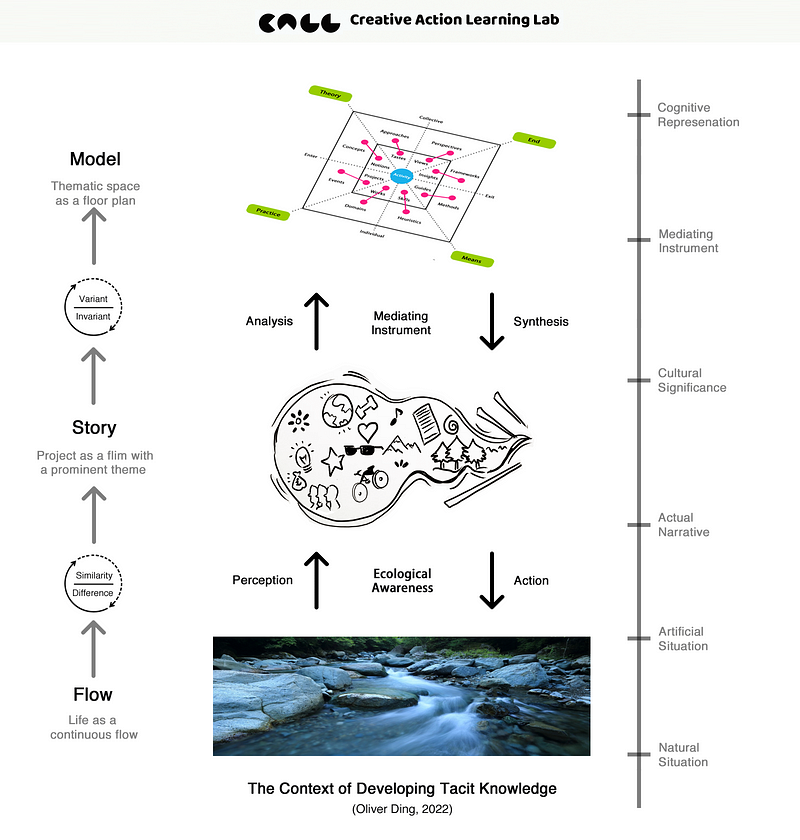
The above “Flow — Story — Model” hierarchy is suitable for Life Discovery Activity. We should notice that the canvas is a model which is only one layer of the Activity. You can find more details about the above diagram in Thematic Space: Flow, Film, and Floor Plan.
4.2 The “Life Strategy” Dialogue Knowledge Curation
On Feb 4, 2022, I shared The Dialogue Knowledge Curation Framework on Linkedin. See the canvas below.
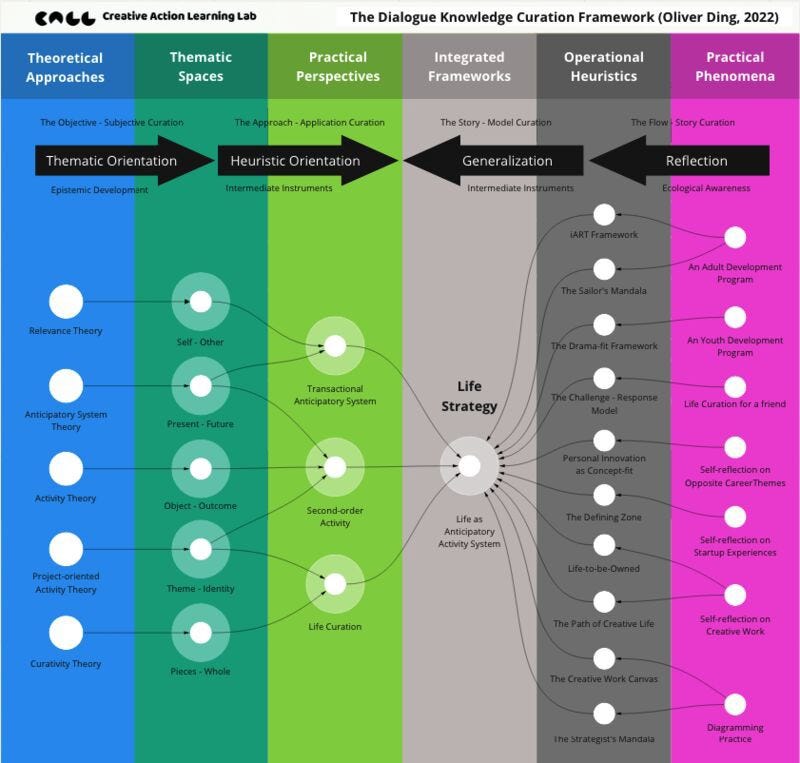
The example is “Life Strategy” (Life as Anticipatory Activity System) and I used the draft I made on Jan 28, 2022.
Now we can consider Life Discovery Canvas as a new Operational Heuristics and add it to the above map. I should also add the Project-centered approach to the column of Practical Perspectives.
4.3 My “Life” Thematic Space
A major source of Life Discovery Activity is my “Life” Thematic Space. You can find more details from the original article:
As a serial creator and a lifelong thinker, I am passionate about intellectual development and life reflection. Initially, I was influenced by Chris Argyris’ Action Science and Donald Schön’s Theory in Practice and The Reflective Practitioner. In 2014, I started learning Ecological Psychology, Activity Theory, and other theoretical approaches.
I wrote my first learning autobiography in 2015 and was attracted to biographical studies. In 2016, I developed a framework called Career Landscape which is inspired by Activity Theory, Communities of Practice, and other ideas. I also developed a series of tools such as Learning Autobiography Guide, Learning & Reflective Cards, Learning & Reflective Canvas, Learning & Reflective Monthly Report Template, etc.
At the end of 2017, I wrote a series of articles on the relationship between Knowledge and Personal Development and developed a framework called Dynamic System of Personal Knowing.
In June 2018, I was thinking about a typical question of middle crisis:
What should I do with the rest of my life?
I focused on the side project about intellectual development and life reflection. It was clear that this is one of my life enterprises because I had worked on it for several years without any pay. If a person can do a thing for many years without any pay, the thing is his passion.
The next question is not about life’s meaning, but techniques.
4.4 The Slow Cognition Approach
I adopt the historical-cognitive approach to study the long-term development of thought and life development.
I coined a new term called Slow Cognition to describe my favorite methods such as Howard E. Gruber’s evolving systems approach to creative work.
Life Discovery Activity is also a long-term development of thoughts. My idea of the Life Discovery Canvas is also an outcome of the Life-as-Activity project. The events below are the historical development of the Life-as-Activity project.
- The Life-as-Activity (v0.3) version was published on Nov 29, 2020.
- Project-oriented Activity Theory (book-in-draft) was published on Jan 24, 2021.
- The Project Engagement was published on Feb 3, 2021.
- The Developmental Project Model was born on March 31, 2021.
- Themes of Practice (2019–2021) was published on August 7, 2021.
- The Life-as-Activity Framework (v2.0) was published on Sept 10, 2021.
- The Sailor’s Mandala: A Life Discovery Framework was published on Jan 4, 2022.
- The Notion of Thematic Spaces was published on Jan 5, 2022.
- Mapping Thematic Spaces #2 — The “Activity” Thematic Space was published on Jan 9, 2022.
- The Life Discovery Toolkit (v1) was published on Feb 7, 2022.
- The Life-as-Project Approach was published on Feb 13, 2022.
- Mapping Thematic Spaces #6 — The “Life” Thematic Space was published on Feb 17, 2022.
- The Life Discovery Canvas was published on Feb 27, 2022.
A major milestone of the project is the Developmental Project Model and its empirical research cases. During the past year, I conducted several empirical research about Developmental Project Model with the Project Engagement method.
These methods are primary methods for Life Discovery Activity.
4.5 The Shaper & Supporter Lab
In 2021, I did an empirical research project about an adult development program with the Developmental Project model and the Project Engagement method.
I’d like to call the program SSL which stands for Shaper & Supporter Lab. Anyway, it is just a codename.
The program was designed with three components: 1) Life Purpose Awareness, 2) Personal OKR Practice, 3) Peer Review and Feedback. My friend also adopted the Building In Public approach sharing her goals, challenges, progresses, and discussions with others on social media platforms.
I use the Project Engagement approach to guide my research about the program. The approach uses a method called “Multiple-level Project Engagement”. I reflect on the following levels:
- The “My friend — Members” Engagement
- The “Member — Member” Engagement
- The “I — My friend” Engagement
This method is what I called “Cultural Projection Analysis” of Project-oriented Activity Theory. You can find more details here: Activity U (X): Projecting, Projectivity, and Cultural Projection.
As mentioned above, the program has three components: 1) Life Purpose Awareness, 2) Personal OKR Practice, 3) Peer Review and Feedback. We can roughly understand it as a Life Discovery project. To understand the whole program, I made several diagrams and frameworks. One of the by-products of the research project is the Anticipatory Activity System framework.
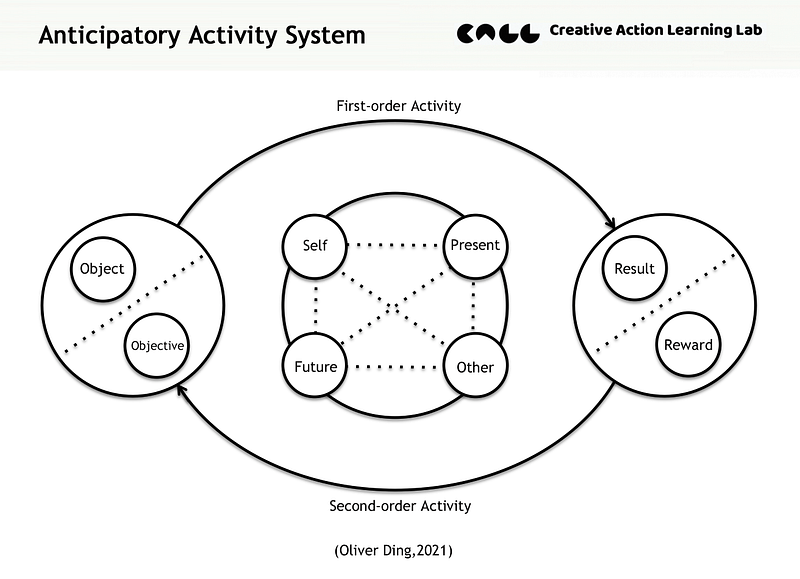
Why did I use “Self, Other, Present, Future” (this is iART Framework) as the core of the framework?
It matches the program’s two components:
- Life Purpose Awareness: the “Present — Future” conversation will lead to a life strategy.
- Peer Review and Feedback: the “Self — Other” conversation will change a person’s decision and behavior.
The first-order activity is about a person’s performance which is guided by their OKRs. The second-order activity refers to the planning and reviewing of their OKRs.
OKRs stands for “Objectives and Key Results” which is a concrete framework for goal setting and management.
The Anticipatory Activity System framework is not concrete, but an abstract model. It offers a general framework for understanding Second-order Activity from the perspective of Anticipatory Systems Theory. In order words, the Anticipatory Activity System framework is a hybrid theoretical framework that curates the following two theories together:
- Activity Theory
- Anticipatory System Theory
This hybrid approach is inspired by Clay Spinuzzi’s book Network: Theorizing Knowledge Work in Telecommunications. To understand a telecommunications company’s knowledge work, Clay Spinuzzi focuses on the concept of “Network”, and adopts the following two theories to build an abstract framework for theorizing “Network” of knowledge work:
- Activity Theory
- Actor-network theory (ANT)
I also designed some diagrams for internal discussions. For example, I made the Sailor’s Mandala on Jan 4, 2022. You can find more detail here: The Sailor’s Mandala: A Life Discovery Framework.
As discussed in old articles, I used knowledge diagrams for building knowledge frameworks. In the past several weeks, I moved from knowledge frameworks to toolkits. What’s the difference between these two things?
- A knowledge framework is an application of theoretical approaches and it considers Theoretical Concepts and Significant Dimensions.
- A toolkit is an Operational Heuristic and the best practice of building a toolkit is using Heuristic Questions and Structured Modules.
A knowledge canvas is similar to a toolkit because it is an Operational Heuristic. Thus, we can use Heuristic Questions to design a canvas. I use the “Four Questions” technique to design the Life Discovery Canvas, I’d like to mention two sources behind the technique.
4.6 Four Questions: Strategic Doing
Last month, I read Ed Morrison’s book about Strategic Doing and I participated in the activities of the Strategic Doing community. While the traditional approach of “Strategy Planning” is about command and control, the “Strategic Doing” approach is about aligning and activating a network of people and organizations.
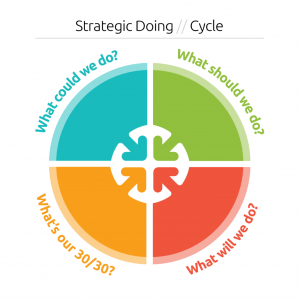
The Strategic Doing approach is a model of developing strategy by curating strategic communicative activities. The model is guided by the following four significant questions:
- What could we do? What are all the possible opportunities before us, based on the resources that we currently have, that would help us move toward the future we’d like to see?
- What should we do? We can’t do everything — which opportunities, out of all the possibilities, should we pursue right now?
- What will we do? What commitments are we going to make to one another to start pursuing that opportunity that we’ve identified as the best one?
- What’s our 30/30? When are we going to get back together (usually about 30 days from now) to talk about what we’ve learned, to adjust our direction based on those lessons if needed, and to set our course for the next 30 days?
To support the Strategic Doing workshops, the model also offers 10 rules for curating the whole activity.
4.7 Four Questions: Designing for Growth
Designing for Growth is a design thinking tool kit which is developed by Jeanne Liedtka and Tim Ogilvie. The toolkit was introduced with the following three books and other books:
- Designing for Growth: A design thinking tool kit for managers (2011)
- The Designing for Growth Field Book: A step-by-step project guide (2014)
- Designing Thinking for the Greater Good: Innovation in the social sector (2017)
In the 2011 book, the authors use four questions and ten tools to frame the popular design thinking approach. The four questions are:
- What is? — Step away from that crystal ball, this is the data-based exploratory stage.
- What if? — Pursue possibilities, this is the creativity-focused hypothesis-generating stage.
- What wows? — Find the sweet spot, this is the concept-to-market testing and validation stage.
- What works? — Time to get real, this is the launch-and-learn stage.
The authors also design a unique simple diagram to represent these four questions. See the picture below.
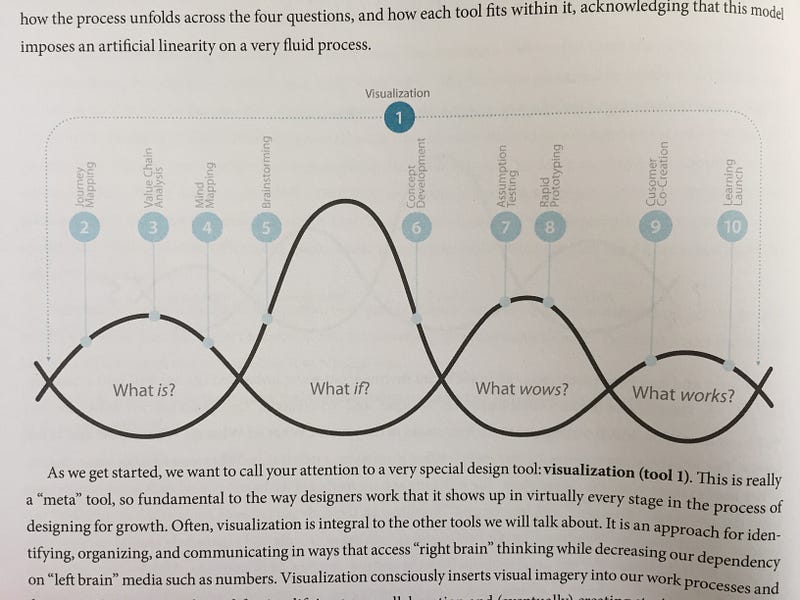
The main content of the 2011 book is the following ten tools (2011, p.23):
1. Visualization: using imagery to envision possibilities and bring them to life.
2. Journey Mapping: assessing the existing experience through the customer’s eye.
3. Value Chain Analysis: assessing the current value chain that supports the customer’s journey.
4. Mind Mapping: generating insights from exploration activities and using those to create design criteria.
5. Brainstorming: generating new possibilities and new alternative business models.
6. Concept Development: assembling innovative elements into a coherent alternative.
7. Assumption Testing: isolating and testing the key assumptions that will drive the success or failure of a concept.
8. Rapid Prototyping: expressing a new concept in a tangible form for exploration, testing, and refinement.
9. Customer Co-Creation: enrolling customers to participate in creating the solution that best meets their needs.
10. Learning Launch: creating an affordable experiment that lets customers experience the new solution over an extended period, to test key assumptions with market data.
In the 2014 book, the authors use the four questions to design a step-by-step project guide. See the diagram below.
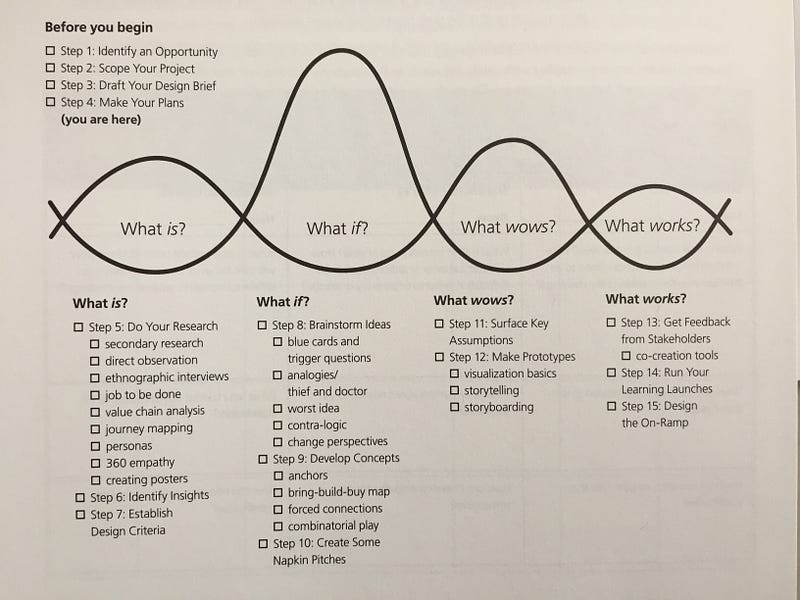
The 15 steps are created into five groups:
Before You Begin
- Step 1: Identify an Opportunity
- Step 2: Scope Your Project
- Step 3: Draft Your Design Brief
- Step 4: Make Your Plans
What is?
- Step 5: Do Your Research
- Step 6: Identify Insights
- Step 7: Establish Design Criteria
What if?
- Step 8: Brainstorm Ideas
- Step 9: Develop Concepts
- Step 10: Create Some Napkin Pitches
What wows?
- Step 11: Surface Key Assumptions
- Step 12: Make Prototypes
What works?
- Step 13: Get Feedback from Stakeholders
- Step 14: Run Your Learning Launches
- Step 15: Design the On-Ramp
In the 2017 book, the authors use “the four-question design thinking approach” to replace “Designing for Growth” as the name of their knowledge model. The below diagram removes the section of Before Your Begin and keeps the other 11 steps.
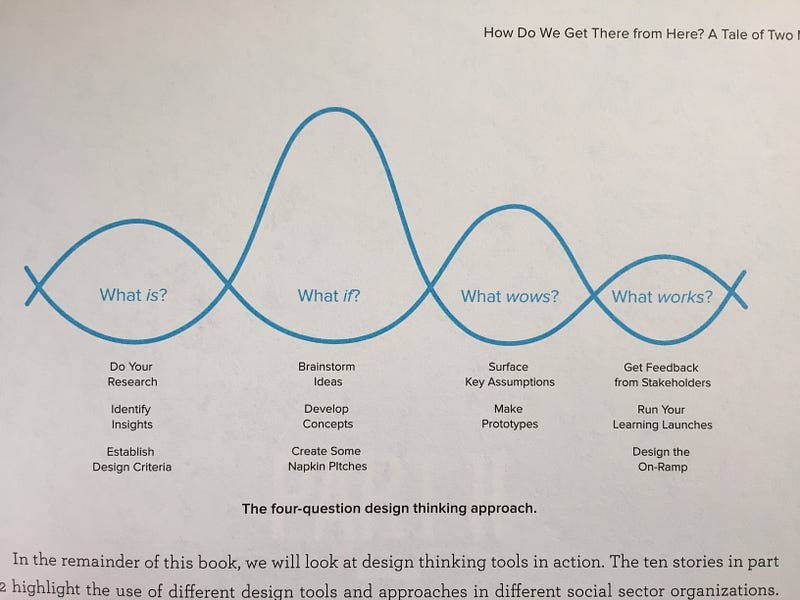
This is an awesome work of designing a practical framework for a popular approach. The authors use four questions and a unique simple visual diagram to build a core identity for their knowledge brand Designing for Growth.
As a primary frame, the Four-question model connects audiences and creators. It also creatives a space for knowledge curation such as organizing tools and steps. Though even the three books offer different content, the authors can retain the same identity for their knowledge brand.
Last year, I conducted the D as Diagramming project for understanding the relationship between Diagramming and Tacit Knowledge. My primary object is knowledge diagrams and knowledge frameworks.
At the end of the project, I also expanded from knowledge diagrams to knowledge canvas. I use the “Action Research” method to study canvas. I just designed some knowledge canvas and reflect on the process. Eventually, I developed a principle and some rules for designing knowledge canvases.
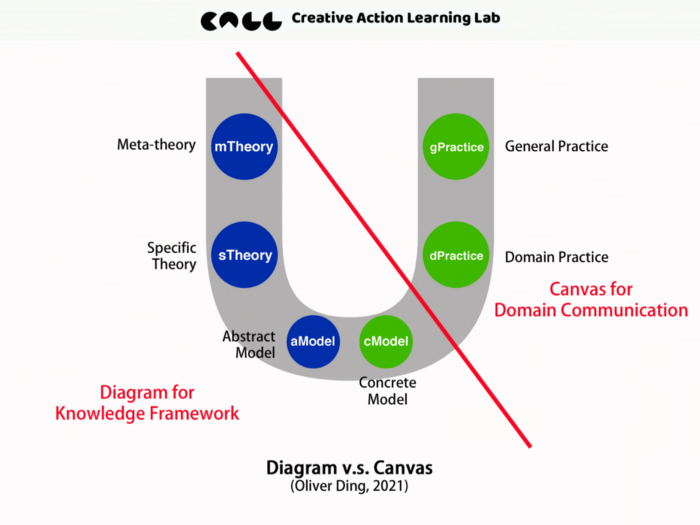
I’d like to mention two sources for the journey of studying and designing knowledge canvases.
4.8 Canvas: Business Model Canvas
In 2010, Alexander Osterwalder and Yves Pigneur published Business Model Generation: A Handbook for Visionaries, Game Changers, and Challengers. The authors introduced a new tool called Business Model Canvas for business thinking.
The creators of Business Model Canvas use “Building Blocks” to describe nine visual areas of the canvas. Their simple design established a model of knowledge canvas and attracted many followers.
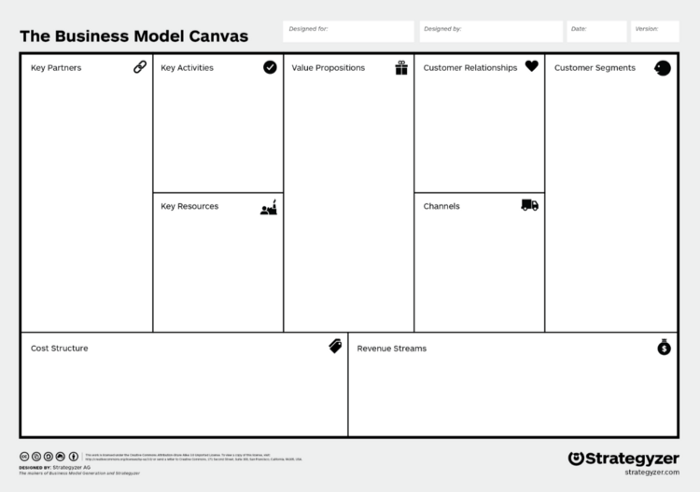
What I learned from Business Model Canvas is the first rule of design knowledge canvases:
Rule 1: Separate several visual areas clearly with lines. Make sure each visual area is identified easily.
Visual Areas refer to several spaces in a canvas. Each visual area refers to a conceptual space. Conceptual Spaces refer to a curated group of conceptualized knowledge. This idea is adopted from Peter Gardenfors’ Conceptual Space: The Geometry of Thought. According to Gardenfors, a Conceptual Space is defined as a set of Quality Dimensions with a geometrical structure. Also, there is a middle layer called Domain in Cardenfors’ theory. As Gardenfors explained, “A domain is a set of integral dimensions that are separable from other dimensions… A conceptual space can then be defined as a collection of one or more domains.”
4.9 Canvas: Product Field
As mentioned above, the Business Model Canvas made a standard format for Knowledge Canvas and it attracted many followers.
However, there are two strategies of adopting a standard format: 1) you can adopt both the concept of Knowledge Canvas and the visual layout from the Business Model Canvas, 2) you can only adopt the concept of Knowledge Canvas and create your visual layout.
Can we find an example of the second approach? Let’s look at the Product Field canvas.
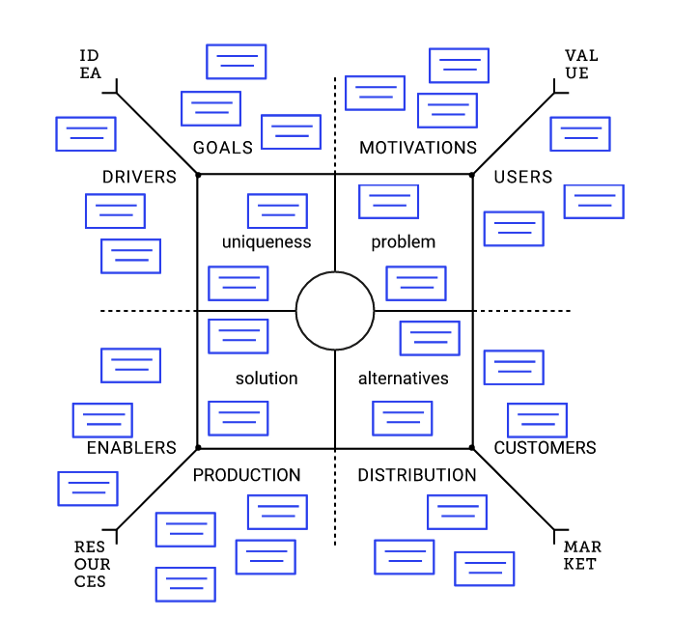
According to the authors of the framework, “The visual form of the Product Field is a Mandala. According to the Groups Keyboard, a mandala helps you and your team to perceive wholeness and see gaps and unities under a diversity of perceptions.”
This is the difference! While The Business Model Canvas puts a set of “building blocks” in an A4 sheet, The Product Field Canvas jumps out of the box and gives a Mandala a free space.
Here I want to mention Rule 2 and Rule 4 for designing knowledge canvases. Rule 2 refers to visual — conceptual match.
Rule 3: Make sure the layout of visual areas matches the structure of conceptual spaces. Take the visualization radically.
Rule 4 is about uniqueness and knowledge brand.
Rule 4: Develop a simple and unique visual style that represents a spatial configuration. The uniqueness is the starting point of a knowledge brand.
Unique Style refers to a simple and unique style of spatial configuration. This idea is about knowledge branding.
4.10 Canvas: Actant Mapping Canvas
As a tool for guiding research and reflection, a knowledge framework is a whole that contains concepts, diagrams, and methods. Theoretical Concepts are adopted from Meta-theory or Specific Theory. Some frameworks don’t associate with any theories, they only have operational concepts. Operational Concepts are framework-dependent concepts for guiding research and reflection.
Though it is about knowledge frameworks, the same logic can be applied to canvas.
- Theoretical Concepts: you can directly show them on a canvas or not.
- Operational Concepts: use them as names for visual areas and conceptual spaces.
For example, the Actant Mapping Canvas was created by Monika Sznel who is a design anthropologist, UX researcher, and service designer. By adopting a term called Actant from the Actor-network theory, Sznel expanded the well-known stakeholder mapping to non-human stakeholders to develop an environment-centered design method.
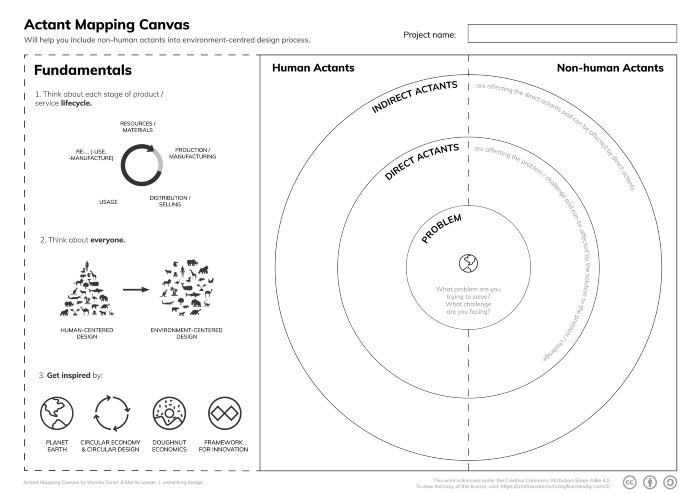
You can find more details from Sznel’s articles (1, 2, 3). The Actant Mapping Canvas directly puts the term “Actants” on the canvas. I have been reading some books and papers about the Actor-Network theory (ANT) for several years. It is interesting to know that there is an ANT-inspired canvas for designers. However, if a person isn’t familiar with the Actor-Network theory, he can’t quickly understand the meaning of the term “Actants” and the value of the canvas.
It is a risk to directly use uncommon theoretical terms to name visual areas and conceptual spaces for a canvas because people can’t understand it easily. It is also a risk to only use common words to name visual areas and conceptual space because people can’t directly perceive the innovative value of a canvas.
This is a trade-off between easy-to-learn and learn-for-deep. My Rule 2 for designing knowledge canvases is about this issue.
Rule 2: Adopt a special and unique perspective to develop a conceptualized knowledge for building conceptual spaces. The more unique the perspective, the greater the value of the canvas.
The Life Discovery Canvas adopts the Project-centered approach as its theoretical foundation. The reason is very simple, I am the creator of the Project-centered approach.
For me, designing a knowledge canvas is not an END, but a Means for developing a knowledge enterprise.
4.11 The Dynamics of Tacit Knowledge
Finally, I’d like to close this long introduction to the Life Discovery Canvas with the following diagram which is about the dynamics of tacit knowledge.
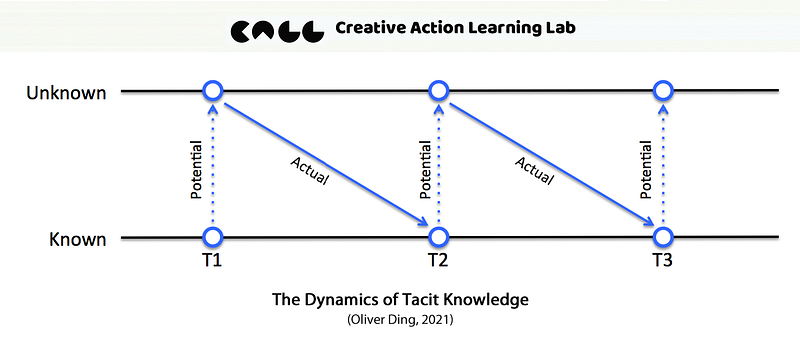
On Dec 31, 2022, I published an article titled the Dynamics of Tacit Knowlege and used the above model to the transformation between Potential Knowledge and Actual Knowledge.
- Actual Knowledge: A present thing known.
- Potential Knowledge: A future thing unknown based on a present thing known.
The “Future Thing Unknown” doesn’t need the intention as a necessary precondition. The only necessary precondition is “based on a present thing known”.
It sounds radical, but the value of this conceptualization is connecting Tacit Knowledge with Creativity. Moreover, this claim is also guided by the Ecological Practice approach which is my primary creative work. In this way, the Ecological Practice approach can build a new theoretical framework: the Potential Knowledge/Actual Knowledge framework.
This article is the starting point of the Slow Cognition project. It led to the Thematic Space Canvas which led to the Life Discovery Canvas.
Here we can pay attention to an interesting thing behind the whole journey. See the diagram below:
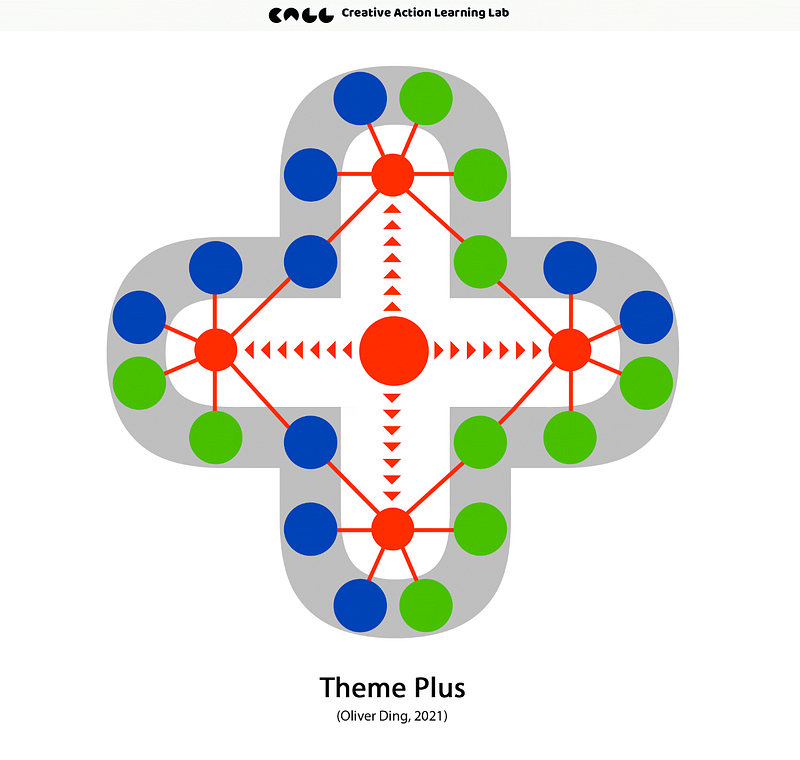
The above diagram was made on Dec 29, 2021, and it is the expanded version of the following diagram:
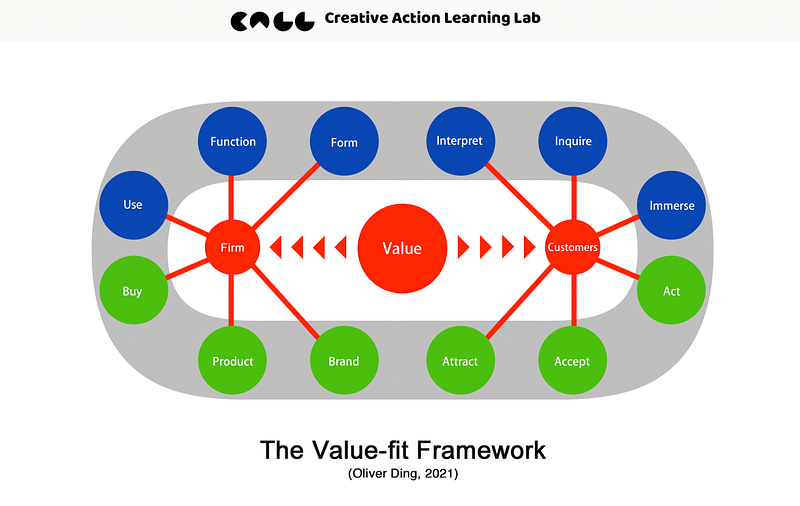
The Value-fit framework was blended from two Theme U diagrams. The Theme U is a U shape that presents six themes. The diagram below is one example of Theme U.
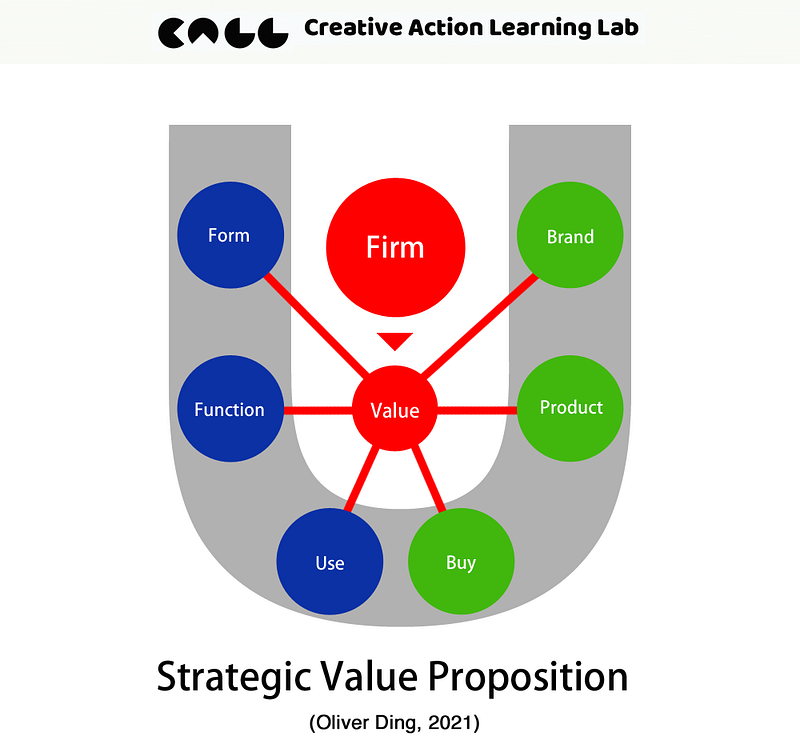
Now we can review the transformation from a single U diagram to the Life Discovery Canvas.
- August 16, 2019 — I made the When X Meets Y diagram
- June 26, 2020 — I made the Theme U diagram
- Oct 8, 2021 — I made the Value-fit Framework
- Oct 15, 2021 — I made the Value Engagement Canvas
- Dec 29, 2021 — I made the Theme U Plus diagram
- Jan 1, 2022 — I made the Mandala Plus diagram
- Jan 5, 2022 — I made the Thematic Space Canvas
- Feb 26, 2022 — I made the Life Discovery Canvas
- March 3, 2022 — I made the Optimal Context Canvas
Is there a law behind this journey? I mentioned the notion of “1, 2, 4, 8, 16…” in The Mandala Plus Diagram. We can apply the law to the Life Discovery Canvas too.
- 1 = 1 primary theme (Life Discovery)
- 2 = 2 Subspaces (Inner Space +Outer Space)
- 4 = 4 Significant Areas (THINK, SAY, LEARN, DO)
- 8 = 8 Pairs of Themes
- 16 = 16 blocks
The uniqueness of the Life Discovery Canvas is the “Inner — Outer” Mapping which corresponds to Pairs of Themes because it defines a unique match between a spatial configuration and a conceptual configuration.
The notion of Pairs of Themes is originally represented by the Theme U diagram.
What a magic thing! The Potential Knowledge could be guided by a simple law.
You are most welcome to connect via the following social platforms:
Linkedin: https://www.linkedin.com/in/oliverding Twitter: https://twitter.com/oliverding Polywork: https://www.polywork.com/oliverding Boardle: https://www.boardle.io/users/oliver-ding


