
The Project Engagement Toolkit (2021)
Introduce a project-oriented toolkit for theory-based reflection and beyond.

I am recently working on two frameworks that are both inspired by Activity Theory. The first one is the Life-as-Activity approach, I adopted Yrjö Engeström’s Activity Systems model (1987) which is a popular theoretical approach of Activity Theory, and Howard E. Gruber’s Evolving Systems approach to the study of creative work as major theoretical resources for discussing biographical studies. I use the terms “life”, “projects”, and “events” for the Life-as-Activity approach. The term “Project” is adopted from Gruber’s approach.
The second one is the Platform for Development (P4D) framework, I adopted Andy Blunden’s Project-oriented theoretical approach (2010, 2012, 2014) which is the newest development of Activity Theory, and James Gibson’s Ecological Psychology as major theoretical resources for discussing platform-based activities. Inspired by Ecological Psychology’s concept of Affordance, I developed a new concept called Supportance for defining Platform. By adopting the notion of “Project as a unit of Activity”, I defined a nested social structure Platform[Project(People)] as the core of the framework.
On the other side, I am also working on the Activity U project which is a knowledge curation project. The project aims to review the development of Activity Theory and test the concept of Knowledge Curation which is an application of Curativity Theory.
One by-product of the Activity U project is a series of diagrams and articles about Project-oriented Activity Theory. This by-product can support my two works: 1) the Life-as-Activity approach, and 2) the Platform-for-Development framework. In order to make sense of these ideas as a meaningful whole, I give them a new name: Project Engagement.
Project Engagement
The goal of the Project Engagement project is not to produce a book for Project-oriented Activity Theory, but directly apply it to the real world. The new project is designed in the following three parts:
- Part A: Project Impact Orientation
- Part B: Theory-based reflection
- Part C: Domain-based reflection
The Project Impact Orientation is the starting point of the Project Engagement project. I roughly highlight three aspects of the impact of a project: market impact, social impact, and epistemic impact. If we consider a project only has one type of aspect, then we can reduce it to a category of projects: a business project, a non-profit project, and a knowledge project. As a starting point, we can use the category approach.
Part B and Part C are two sets of challenges. The set of Theory-based Reflections focuses on Activity Theory and its frameworks. The set of Domain-based Reflections focuses on practical domains.
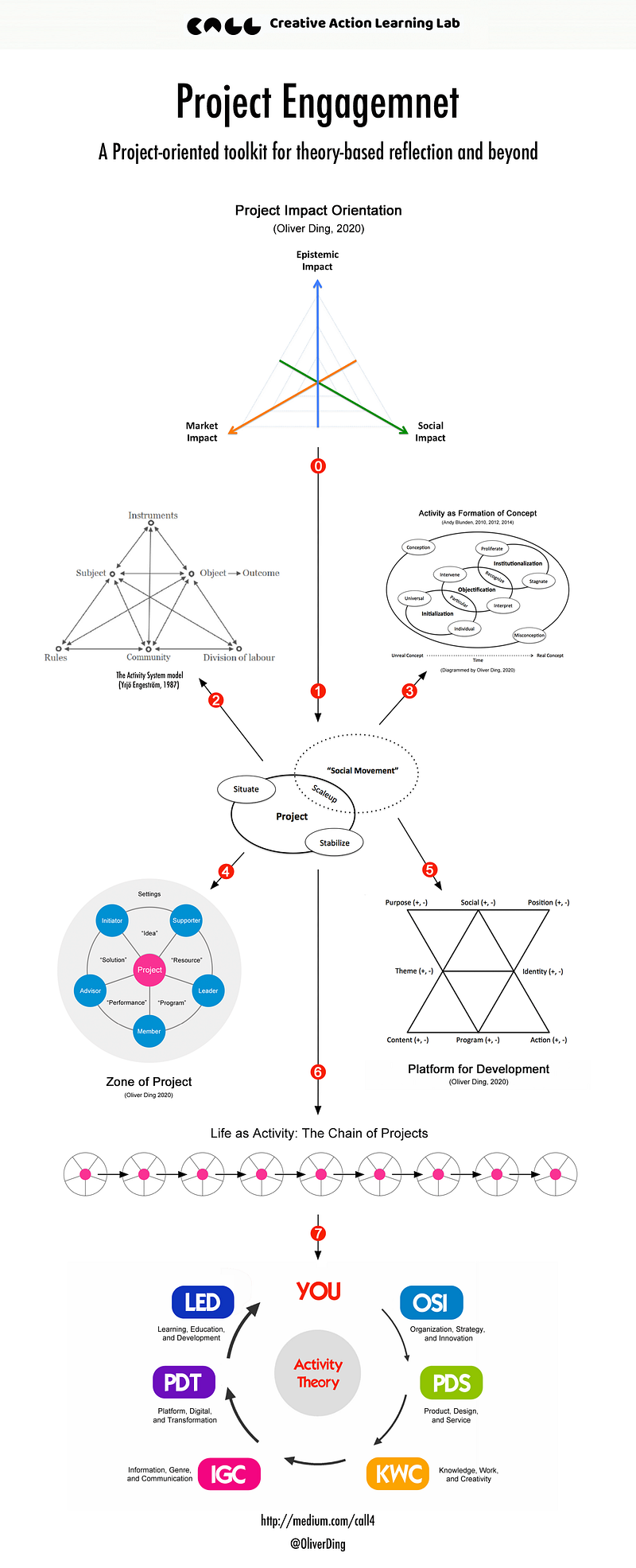
I design an infographic to present the whole picture of the Project Engagement project. The infographic below puts several diagrams together. Readers can learn these diagrams from previous articles.
Theory-based Reflection
Guided by the principle of theory-based reflection, the first set of challenges adopt six theoretical models/frameworks as thinking tools and require readers to reflect on their real-life experiences with these theoretical tools. The six thinking tools are:
- 1) Project as “Social Movement”
- 2) The Activity System Model
- 3) Activity as Formation of Concept
- 4) Zone of Project
- 5) Platform for Development
- 6) Life as Activity: The Chain of Projects
The starting point of theory-based reflection is 1) Project as “Social Movement”. This framework helps us define the status of a project from the perspective of Activity Theory.
- If the project is a normal project within a routine work setting, then we move to 2) the Activity System model, which helps us understand the object of the project and the transformation of the project.
- If the project is an impact project with a brand new concept, then we move to 3) Activity as Formation of Concept, which helps us understand the process of formation of a new concept for social change.
If readers pay attention to the individual and interpersonal level actions within a project, then 4) Zone of Project, which is an ideal framework for such a task.
If readers consider platforms as the social context or digital settings of projects, then you can choose 5) Platform for Development, which combines “project” and “platform” together.
Finally, readers can adopt 6) Life as Activity for personal biography study and life curation.
Domain-based Reflection
The #7 part of the above infographic refers to the second set of challenges which are designed with the principle of domain-based reflection. These challenges ask readers to connect their domains with theoretical-based relevant studies. For example, a designer can choose an activity-theoretical study about product design.
I choose horizontal domains for the Activity U project because I want to service boundary innovators and knowledge workers.
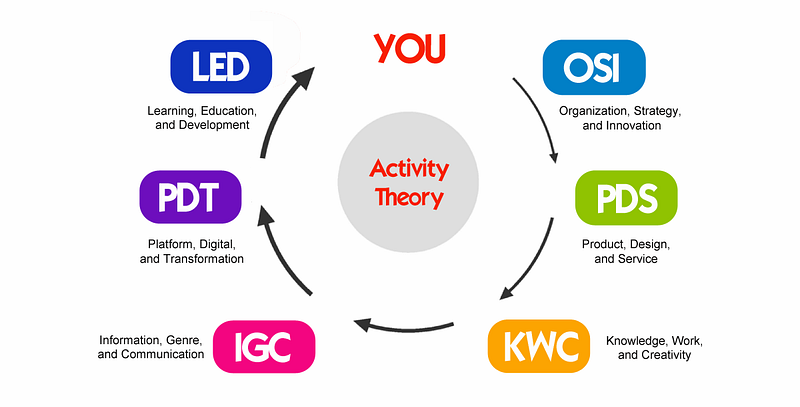
This idea has been planned within the Activity U project as Learning Interest Groups (LIGs).
- Organization, Strategy, and Innovation (OSI)
- Product, Design, and Service (PDS)
- Knowledge, Work, and Creativity (KWC)
- Information, Genre, and Communication (IGC)
- Platform, Digital, and Transformation (PDT)
- Learning, Education, and Development (LED)
Inspired by the naming approach of Academy of Management’s Divisions and Interest Groups (DIGs), I set six Learning Interest Groups (LIGs) to represent horizontal domains about knowledge works.
Though there are various activity-theoretical empirical studies, I have to point out that most of these studies adopt the Activity System model as their theoretical foundation. It’s hard to find some cases which adopt Blunden’s “Project as a Unit of Activity” for empirical research. However, I think this also means a great learning opportunity and a possible creating opportunity.
From Theory to Practice
Moreover, I’d like to encourage readers to launch your own impact projects. The essential idea of Activity Theory is that the mind is embedded in activity. In order to understand Activity Theory, the best way is to take actions such as joining an existing project or initiating a new project.

One of the sub-projects of the Project Engagement project is curating a list of impact projects. The term Impact Project is not defined yet. It can be considered as “a project which has a significant impact on your life or career” from the individual perspective or “a project which has an impact on your community or society” from the collective perspective.
As Blunden says, “A project is the focus for an individual’s motivation, the indispensable vehicle for the exercise of their will and thus the key determinant of their psychology and the process which produces and reproduces the social fabric. Projects therefore give direct expression to the identity of the sciences of the mind and the social sciences. Projects belong to both; a project is a concept of both psychology and sociology.” (2014, p.15) In other words, we need cases for both the individual level of analysis and the collective level of analysis.
Obviously, there might be a contradiction between individual impact and collective impact. Activity Theorists see contradictions as sources of development from the dialectical perspective. Contradiction leads to change and transformation.
Experience v.s. Engagement
The term “Engagement” is inspired by Nelson Zagalo’s 2020 book Engagement Design: Designing for Interaction Motivations. While many researchers focus on “User Experience”, Zagalo moves from “Experience” to “Engagement” because “Experience” is too subjective. He proposes a triadic approach to engagement design as a direct answer to the triadic experience — context, subjects, and artifacts — and triadic interaction — know, do and feel — made of three non-hierarchical streams. (Note 1)
What I learned from Zagalo is that experience is too subjective. Activity Theorists reject phenomenology and existentialism which are great theoretical approaches for research user experience. Though Activity Theorists also talk about design and experience, it seems the term “Engagement” is better than “Experience” for Activity Theorists. (Note 2)
According to Blunden, “What distinguishes Activity Theory from Phenomenology and Existentialism is that for Activity Theory, the project has its origin and existence in the societal world in which the person finds themself; for Phenomenology and Existentialism the psyche projects itself on to the world. For Activity Theory, commitment to a project and formulation of actions towards it, are mediated by the psyche, but a project is found and realized as something existing in the world, be that an entire civilization, a single personality, or anything in between. (See MacIntyre, 1981, p.146)” (2014, p.7).
Thus, I use “Project Engagement” as the name of this project in order to highlight the fundamental theoretical aspect of Activity Theory: it is both subjective and objective, also both individual and collective. At least, this is the theoretical commitment of Project-oriented Activity Theory.
You are most welcome to connect via the following social platforms:
Twitter: https://twitter.com/oliverding Doowit: https://doowit.co/profile/gm0k2ax9 Linkedin: https://www.linkedin.com/in/oliverding
License
This work is licensed under the Creative Commons Attribution-NonCommercial-ShareAlike 4.0 International (CC BY-NC-SA 4.0) License. Please click on the link for details.
Notes
Note 1
According to Zagalo, “Engagement has been a topic of debate over the past decade in different domains, from Education (Antonetti & Garver, 2015 ; Butin & Seider, 2012 ; Moore, 2013 ) to Management (Rothmann, 2016 ; Saks, 2019 ; Seijts & Crim, 2006 ) and Marketing (Brodie, Hollebeek, Juri´c, & Ili´c, 2011 ; Harmeling, Moffett, Arnold, & Carlson, 2017 ), and particularly with the emergence of social media (Harrigan, Evers, Miles,& Daly, 2017 ; Hollebeek, Glynn, & Brodie, 2014 ; Voorveld, van Noort, Muntinga, & Bronner, 2018 ). There has been an interest in understanding how engagement occurs, not only in how it produces meaning but in how it affects behaviour and through which patterns. However, as we have already seen, an enormous barrier of subjectivity inhibits it. If we followed through communication pragmatics, focused on meaning-making, with Watzlawick (e.g. “axioms of communication”), we would be completely captive to subjectivity, context-dependent, with every case being a case, on its own and belonging to no general category. At the other end of the spectrum, we could follow with the recent cutting-edge digital tools of marketing, which by defining itself within a fully persuasive environment immersed in digital data, registering the entire relations continuously, has crafted a set of clear formulas (numbers of clicks, likes, comments, shares, views, etc.) to calculate behavioural change: the engagement.We must, however, curb this approach in the interest of our research, in the sense that all this quantitative data is merely indicative and often misleading in the analysis (e.g. a campaign will not always be shared for the best reasons — it may contain a whole negative charge — but of course in the restricted area of marketing we know that no negative publicity exists).” (2020, p.19)
Note 2
According to HCI Activity Theorist Victor Kaptelinin and Bonnie Nardi, “…there are deep conceptual similarities between activity theory and phenomenology. Like other post-cognitivist theories such as distributed cognition (e.g., Hollan et al., 2000)” and actor-network theory (e.g., Callon, 1986), they are highly critical of Cartesian mind-body dualism and maintain that there is a fundamental unity of the mind and the world. Another basic idea shared by most post-cognitivist theories is that technology plays a vital role in human life. In addition, both activity theory (Leontiev’s version) and phenomenology, as opposed to some other post-cognitivist theories, are primarily interested in individual subjects…One more common feature of activity theory and phenomenology is that they both describe subjective experience in terms of meaning.” (2012, p.50)
However, there are significant differences between these two theoretical traditions. Victor Kaptelinin and Bonnie Nardi point out, “A substantial different between activity theory and phenomenology lies in their respective conceptual points of departure. Activity theory understands subjects as constituted by their inherently social activities that transform both subjects and the world (objects). Activities, therefore, set subjects apart and, at the same time, relate them to the world. Since subjects have need-based agency and become what they are through their socially and physically distributed activities, a detailed account of motivation, development, and social-cultural context is a necessary precondition for understanding subjects, their ‘acting — in — the world’.” (2012, p.51)
Now let’s look at the essential aspect of phenomenology. Victor Kaptelinin and Bonnie Nardi say, “In phenomenology, subjects are also assumed to be one with the world — their very existence is defined as ‘’being — in — world’ (Heidegger, 1962). However, the most fundamental issue to be explored is formulated in phenomenology in terms of how people make sense of their existence and how the world reveals itself to subjects. The issue of how subjects come to exist in the first place is not systematically analyzed, and neither are the specific needs and goals underlying the active, engaged nature of ‘being — in — the — world.’ In addition, while the importance of the social context was recognized (and reflected), for instance in the Heidegger’s notion of ‘being with,’ which was mentioned, but not elaborated upon (Polt, 1999), it did not become a central issue in the phenomenological tradition until the notion of intersubjectivity was introduced to phenomenology discourse (see Dourish, 2001). ”(2012, p.51)
References
Andy Blunden (2014) Collaborative Project: An interdisciplinary study. Brill.
Engeström, Y. (1987) Learning by Expanding: An Activity-Theoretical Approach to Developmental Research. Helsinki: Orienta-Konsultit Oy.
Nelson Zagalo (2020) Engagement Design: Designing for Interaction Motivations. Springer.


