
#TalkThree 04: How Does Collective Learning Work?
People, Centers, and Themes

Yesterday, a friend of mine sent an academic paper about Regenerative Economics to me and asked for some potential opportunities of using my knowledge frameworks.
The authors of the paper identify four categories of elements of regenerative economics:
- Circulation
- Organizational Structure
- Relationships and Values
- Collective Learning
The paper also suggests ten principles for building regenerative economics and provides network metrics to measure the ten principles.
For the category of Collective Learning, the authors don’t offer rich ideas and resources. In order to respond to my friend, I discovered an idea called “Project Network” from my knowledge frameworks and developed it as a solution for developing collective learning.
The new solution is named “The Knowledge Network Model for Developing Collective Learning”. This article will introduce this solution with three keywords (People, Centers, and Themes) and three related models.
The Model of Building A Knowledge Enterprise
The first model is about building a knowledge enterprise. See the diagram below.
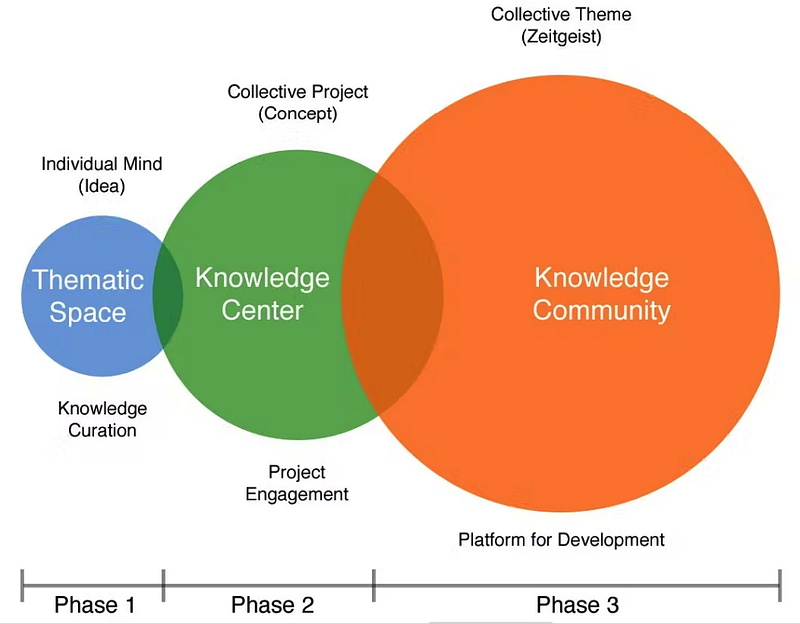
On May 6, 2022, I published an article titled CALL: How to Grow A Knowledge Enterprise and introduced the above model for thinking about the next stage of my personal studio CALL (Creative Action Learning Lab).
The model is inspired by Project-oriented Activity Theory. Each phase refers to a focus. The three-phase development is inspired by the following diagram which is one of a series of diagrams in the book.
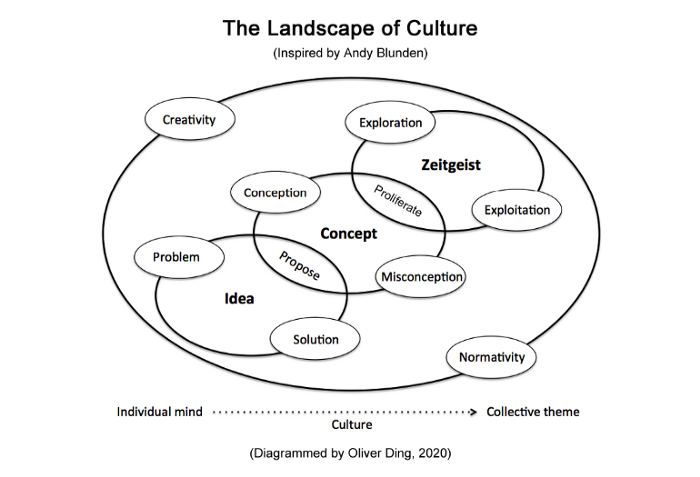
I used the above diagram to explain the concept of “culture” from the perspective of Project-oriented Activity Theory. It zooms out to a large view that connects the Individual mind (Idea) and Collective theme (Zeitgeist) through Collective Projects (Concept).
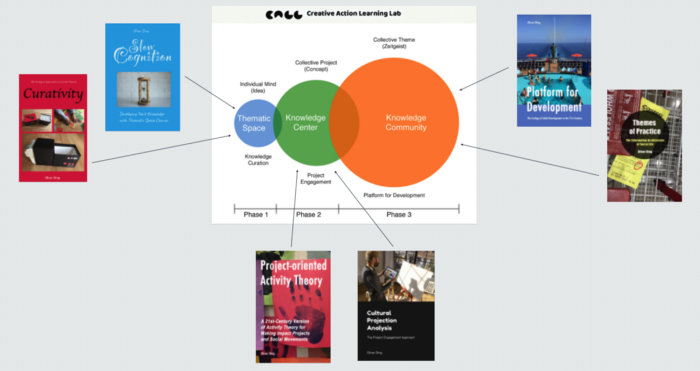
I considered Building Knowledge Enterprises as a special type of “Project-oriented Activity” and applied the above diagram to build a new model. I also found I have written several books which can be used to support the new model.
- Phase I: Individual Mind > Thematic Space | Knowledge Curation
- Phase II: Collaborative Project > Knowledge Center | Project Engagement
- Phase III: Collective Theme > Knowledge Community | Platform for Development
Each Knowledge Enterprise is defined by a unique theme and it should be developed by its founders with a unique perspective. For example, Activity Theory is a successful knowledge enterprise and its primary theme is “Activity”. Its founder Aleksei N. Leontiev developed an activity-theoretical approach to psychological science.
While Phase 1 is about an individual mind, Phase 2 is about a collective project.
A knowledge center is a collective project that aims to develop a certain unique knowledge. A “center” should have its own uniqueness in order to establish its identity and theme. Otherwise, there is no need to build a “center”.
For a high degree of uniqueness, we can look at the following examples:
- Santa Fe Institute
- Niche Construction Theory
- CSDT (Center for Self-Determination Theory)
- CRADLE (Center for Research on Activity, Development and Learning)
- Presencing Institute (Theory U)
Phase 3 is building a Knowledge Community. The difference between Knowledge Center and Knowledge Community is Scope and Scale. A knowledge center may only have less than 15 members while a knowledge community may have thousands of members.
The concept of “Knowledge Community” points to two themes: the “Knowledge” theme and the “Community” theme. From the perspective of adult development, a knowledge community is a developmental platform for knowledge workers. From the perspective of cultural development, a knowledge community is a connected hub of “Themes of Practice” which connects people’s life themes and collective cultural themes.
The Model of Project Network
The second model is called “Project Network” which is inspired by the above model of Building A Knowledge Enterprise and the Project-centered approach.
From Oct 2020 to Oct 2021, CALL (Creative Action Learning Lab) became a Knowledge Curation Studio that produced a set of knowledge frameworks and built an ecology of ideas. I also wrote seven books in drafts. In the past 6 months, CALL entered a new phase which could be called “Collective Network of Enterprise” or “Project Network”
The new phase of CALL has two different aspects:
- 1) CALL’s creative work is live. I shared the whole process of CALL’s creative work on the social web, and
- 2) CALL’s creative work was driven by the “Self — Other” Relevance, not the individual mind.
I started considering the Project-centered approach for CALL’s development.
On April 14, 2022, I wrote a short post about “Collective Network of Enterprise” and “Project Network” on Linkedin. This post shared a significant insight called “Project Network”. You can find more details here.
Howard E. Gruber’s approach has two aspects:
- 1) his resources are creators’ private notebooks, documents, and other files, and
- 2) his focus is on individual creators’ cognition development.
Howard E. Gruber’s Evolving Systems Approach to the study of Creative Work (1974,1989) is only suitable for phase 1 of CALL. While Howard Gruber’s approach focuses on great creators such as Charles Darwin, the Project-centered approach aims to focus on professional workers.
The notion of “Project Network” and the above model of “Knowledge Enterprise” led to the following diagram:
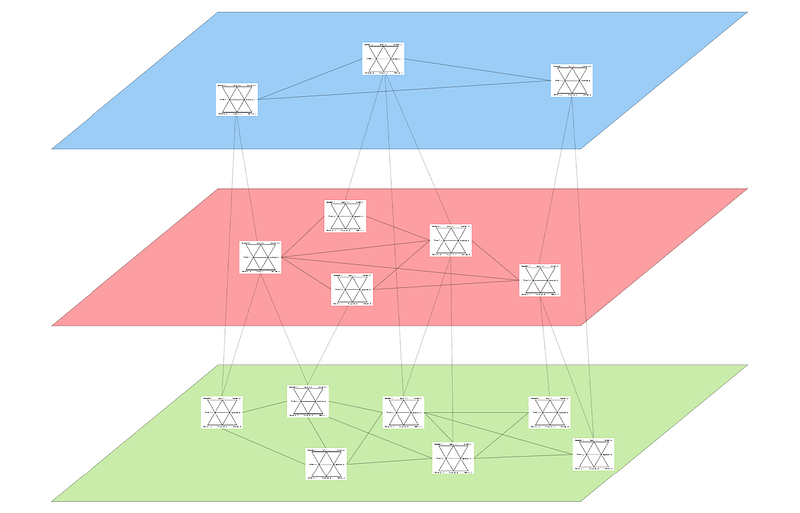
The Model of “Project Network” is for discussing the notion of “Knowledge Centers”. It’s a multiple-level network, not a one-level network.
- A Network of Themes
- A Network of Knowledge Centers
- A Network of People
Each level refers to one type of Project. The “Themes” level refers to “Concept as Project”. For example, “TEDx” and “Startup Weekend” are Concepts, and the global TEDx community is a large global project. The global Startup Weekend community is a large global project too.
The “Knowledge Centers” level refers to “Center as Project”. For example, Each local TEDx program and each local Startup Weekend chapter are local projects.
The “People” level refers to “Engagement as Project”. For example, if a person joins a local TEDx team as a volunteer, she can consider her own experiences and actions of participating in the team as a Developmental Project for her.
These three types of Projects are also embedded in three types of networks: a network of themes, a network of knowledge centers, and a network of people.
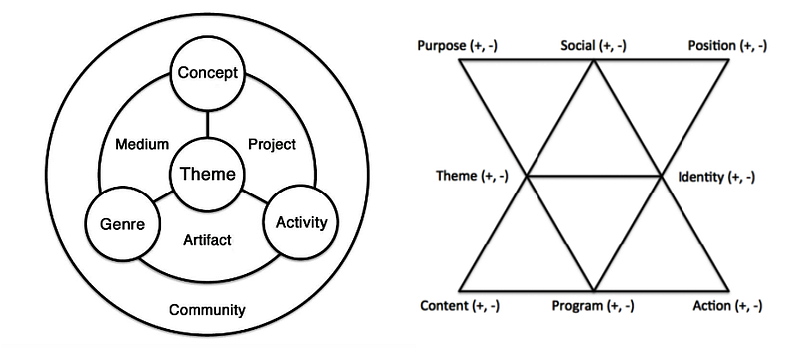
The above two diagrams are the Themes of Practice framework (left) and the model of Developmental Project (right). They can be used for understanding the “Themes” level (“Concept as Project”) and the “Center” level (“Center as Project”).
The Model of Knowledge Network
If we apply the model of “Project Network” to understand Collective Learning of a local economic system, then we can understand the Developing Collective Learning as a collaborative activity.
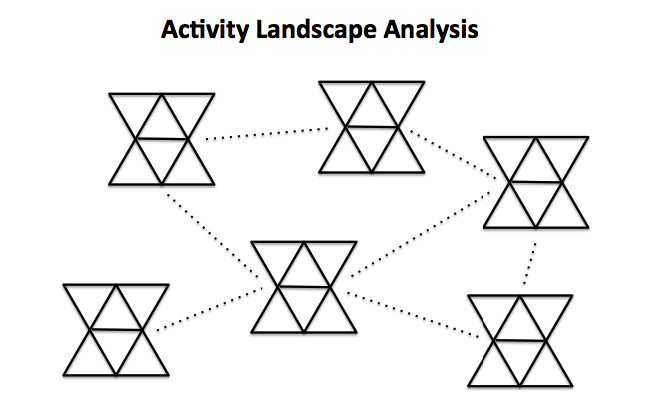
By adopting “Project (Center)” as the starting point, we can see a network of projects (centers). See the diagram above.
Then we can expand it from the one network to three networks and watch the network of themes and the network of people too.
While the Model of Knowledge Enterprise focuses on one person, one knowledge center, and one knowledge enterprise, the model of Knowledge Network is about the landscape of developing collective learning and the development of a local economic system.
Related Articles
- Meet with Oliver Ding: 1 Mission, 4 Theories, and 12 Possible Books
- The Knowledge Curation Project
- How to Grow A Knowledge Enterprise
- Platform Genidentity: The Movements of Unfolding Uniqueness
- The Slow Cognition Project (Phase II): Activity Analysis for Creative Work Study
- CALL: The Launch Day of Curativity Center
I am also working on building a new website for the Platform Ecology project. You can save the following links:
- PlatformEcology.org
- Twitter: @PlatformEcology
- Linkedin: @PlatformEcology
You are most welcome to connect via the following social platforms:
Linkedin: https://www.linkedin.com/in/oliverding Twitter: https://twitter.com/oliverding Polywork: https://www.polywork.com/oliverding Boardle: https://www.boardle.io/users/oliver-ding


