
#TalkThree 03: How to Use an Abstract Model?
Three examples of using the “Relevance of Zone” model
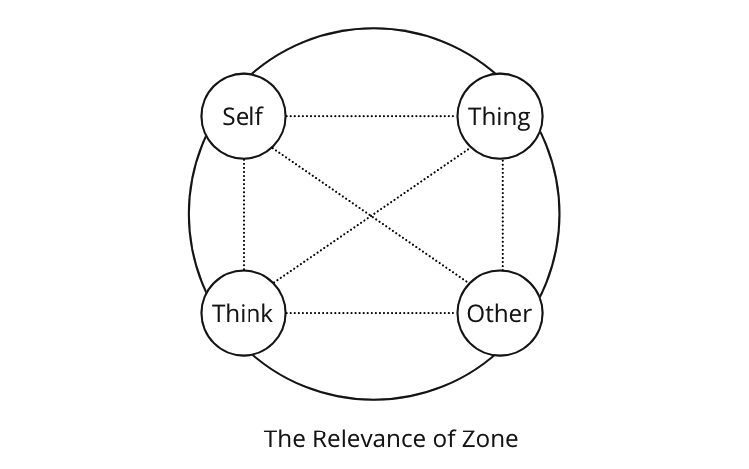
The above diagram is called “the Relevance of Zone” which is an Abstract Model. It considers four keywords: Self, Other, Thing, and Think. It was inspired by the iART Framework and the Typology of Relevance.
You can find more details about the model in Mapping Thematic Space #5: The “Relevance” Thematic Space.
This is a typical Abstract Model because it doesn’t describe any concrete practical social practice.
I often use Abstract Model and Concrete Model to discuss Knowledge Frameworks. What’s the difference between these two types of frameworks?
- Abstract Models are more abstract than Concrete Models. Abstract Models (aModel) are high-level models which connect theoretical approaches with special domains. Concrete Models (cModel) are lower-level models with details for directly guiding domain practice.
- Abstract Models tend to use Theoretical concepts while Concrete Models tend to use ordinary words as Operational Concepts. Theoretical Concepts are adopted from Meta-theory or Specific Theory. Some frameworks don’t associate with any theories, they only have operational concepts. Operational Concepts are framework-dependent concepts for guiding research and reflection.
- You can find more details about this issue in HERO U — A New Framework for Knowledge Heroes and Knowledge Discovery: The “Frameworks — Insights” Mapping.
How to use such an abstract model?
By using Abstract Models, you can do two things at one time: 1) respond to a challenge of sensemaking, and 2) create a new knowledge framework for yourself and others.
While a Concrete Model directly guides you to understand a concrete social practice, an Abstract Model asks you to build a Concrete Model for dealing with your challenges and situations.
Today I will share three examples of making Concrete Models by using the Relevance of Zone model.
First example: Art as Activity.
In Nov 2021, I worked with a startup founder who is building a digital Art Inventory platform. In order to design a user research plan, I used the Relevance of Zone model to develop a Concrete Model for understanding Art Inventory as a Social Practice.
The new model is called Art as Activity.
The Relevance of Zone focuses on “Self, Other, Thing, Think”. Originally, I used “Thought” for the diagrams below. It is perfect for discussing a special object which has double properties: material property and mental property. This idea was inspired by cultural-historical psychologist Lev Vygotsky’s two types of mediating tools: technological tools and psychological tools.
Art is such a special object, at least for the field of Art Inventory, we have to pay attention to the content of Art (what the artist created) and the form of Art (what the material thing is). For example, a painting has a material aspect and a mental aspect which means an idea.
The model also considers the “Self — Other” Relevance, it offers a creative space for discussing various types of social roles and relationships.
For the Art as Activity model, I defined four types of roles. Let’s use paintings as an example.
- Creators: they create paintings.
- Curators: they buy paintings to sell them.
- Collectors: they buy paintings for using them.
- Commenters: they view paintings and talk about them.
I use the “Self — Other” relevance to represent three Zones between four roles. A Zone means a long-term social interaction between two actors around a particular theme or a thing. You can find more details about the concept of Zone in Activity U (XI): Process, Position, and Zone of Project.
- The Creator — Curator Zone
- The Curator — Collector Zone
- The Collector — Commenter Zone
In order to explain the model, I use REMO Jr and his artwork Ballet Dancer CCVII as an example.

I found REME Jr.’s profile on Artfinder which is a digital platform. You can find the painting Ballet Dancer CCVII in his profile. However, you can search and find it on Google Images.
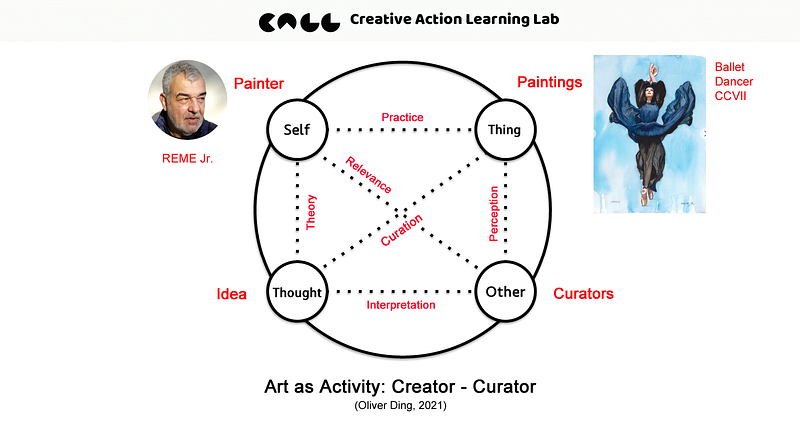
The above diagram is for discussing the “Creator — Curator” Zone.
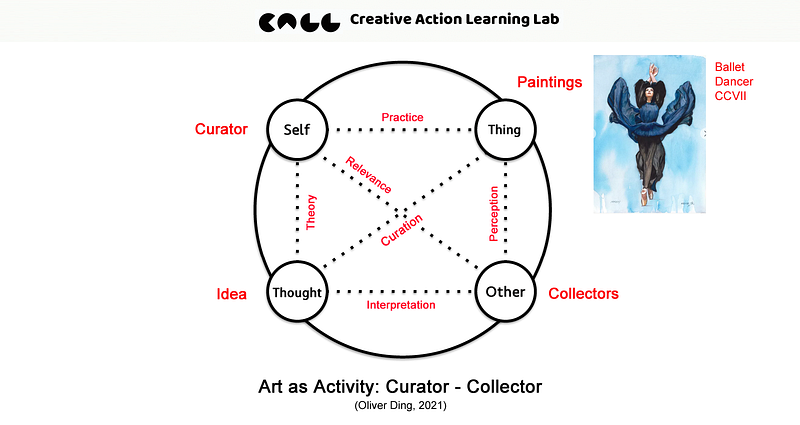
The second Zone is about the “Curator — Collector” interactions. For example, a curator of a gallery or a digital platform may invite REME Jr to show his artworks in their gallery or platform. A collector may purchase Ballet Dancer CCVII from the gallery or the platform.
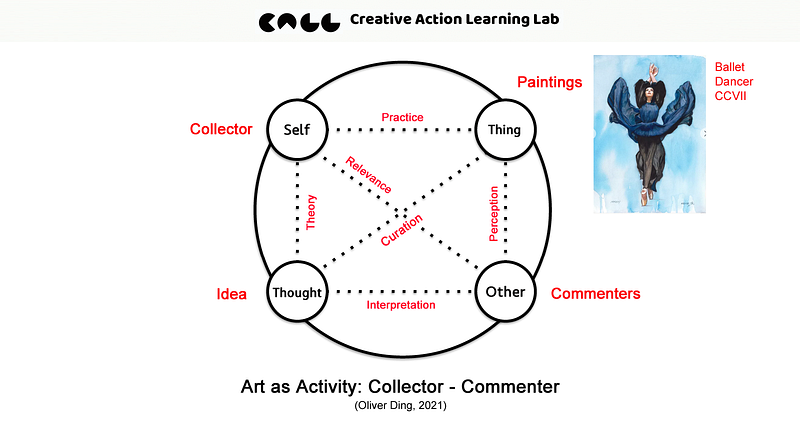
The third Zone is about the “Collector — Commenter” interactions. The Collector may place Ballet Dancer CCVII in his house, office, or a collection in a museum. Commenters can be professional experts or ordinary people. For example, if the collector place Ballet Dancer CCVII in his house, a friend of his visits his house and gives some words about the painting.
The above diagrams represent a Concrete Model for understanding the social practice of “Art as Activity.” It is a good starting point for a user research project.
Second example: Relevance and Diagramming.
In Nov 2021, I worked on closing the D as Diagramming project (phase I). In order to develop an integrated framework for summarizing insights of the project, I used four themes to form the framework.
One theme is about Relevance and Diagramming, see the diagram below.
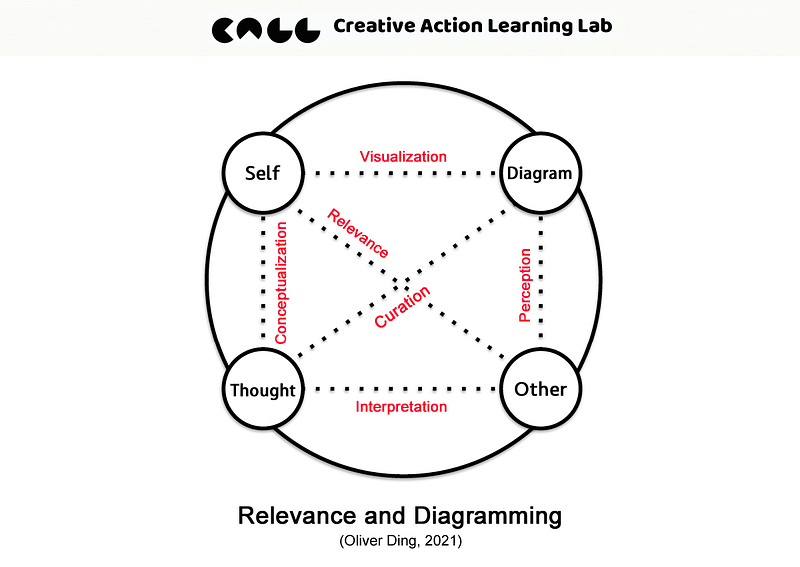
What’s the difference between the “Relevance and Diagramming” model and the “Art as Activity” model?
We can pay attention to two red words:
- Visualization
- Conceptualization
The “Self — Diagram” relation refers to Visualization while the “Self — Thought” relation refers to Conceptualization. As a special type of cognitive representation, knowledge diagrams combine Visualization and Conceptualization. This leads to a classical issue: Form and Content. A great knowledge diagram should achieve a perfect form-content fit which has three challenges:
- How to develop a unique conceptualization?
- How to develop a unique visualization?
- How to match visualization with conceptualization?
You can find more details in D as Diagramming: An Integrated Framework for Studying Knowledge Diagrams (Part 1).
The red word Curation refers to the “Diagram — Thought” relation because the “Visualization — Conceptualization” fit is a process of curation.
The “Self — Other” relation refers to the idea of Relevance. There are four types of relevances since we have four ways of defining Other.
The “Other — Diagram” relation refers to the idea of Perception. Since diagrams are visual graphics, perception is important for Others to understand the meanings of diagrams.
The “Other — Thought” relation refers to the idea of Interpretation which refers to a dynamic interactive process between Self and Other. Others may not understand the meanings of a diagram, they could ask the author of the diagram. Other also could share a diagram with their friends and other people, they could share their own understanding of the diagram too.
You can find more details in An Integrated Framework for Studying Knowledge Diagrams (Part 2).
Third example: Significant Insights Analysis.
In April 2022, I worked on the Significant Insights Analysis project which is a sub-project of the Slow Cognition project and the Life Discovery project. From January to April 2022, I captured many Significant Insights. In order to conduct a mini-research for the Slow Cognition project, I selected 12 significant insights as samples.
I also used the Relevance of Zone model to develop a method with the following questions:
- Other: Who is the Significant Other for this insight?
- Thing: What’s the insight about? Why do I pay attention to it?
- Think: How did I get this insight? Is there a technique behind the process?
- Self: Where did I capture this insight?
- Self: When did I capture this insight?
- Activity: Is this insight part of an activity? What’s the activity?
- Activity: Has this insight led to a new action or a new activity?

On May 24, 2022, I shared a summary of the sub-project in Slow Cognition: It takes a village to raise a creative mind. Where did I capture this insight?
- 9 insights are captured at home (#1, #4 to #11)
- 2 insights are captured in my car (#2, #3)
- 1 insight is captured in a room without the Internet (#12)
Who is the Significant Other for this insight?
- Three Significant Insights were inspired by Pervasive Others: #1 — Peter Gardenfors, #6 — Kenichi Ohmae and Robert Kegan, #10 — Howard E. Gruber.
- Two Significant Insights (#11, and #12) were born from self-reflection.
- Seven Significant Insights were inspired by proximal others.
How did I get this insight? Is there a technique behind the process? This question is related to creative thinking. I highlight the following techniques:
- Creative Attachance: #1, #2, #3, #5, #7, #10, #12
- Symbol Awareness: #1, #11
- Writing as Thinking: #2, #5, #11
- Double Container: #2
- Deep Analogy: #2, #11, #12
- Double Dialogues: #3
- Diagramming as Thinking: #4, #5, #6, #7
- The ECHO Way: #4
- Thematic Curation: #5, #12
- Concept Analysis: #6
- Expandness: #6, #7
- Co-creation: #8, #10
- Self-reflection: #8, #11
- Theoretical Development: #9, #12
- Empirical Research: #9
- Ecological Awareness: #10
- Immanent Development: #12
The most popular technique is Creative Attachance!
You can find details of all 12 case studies on a Coda doc.
The final words.
What are the differences between the above three cases?
I used different red words for Case 1 and Case 2.
What do these red words mean? These refer to Relevant Themes. Art Inventory and Diagramming are different social practices, though they share a deep structure from the perspective of Zone, they have their own specific issues. In order to conduct empirical research, we need to discover relevant themes for each type of social practice.
For Case 3, I did not make a new diagram with red words, but I expanded the model with some questions.
What do these questions mean? These are called Heuristic Questions which turn a high-level abstract model into a practical tool for research and reflection.
In Platform Genidentity: The Movements of Unfolding Uniqueness, I used the Platform Genidentity framework and toolkit to discuss the development of a knowledge enterprise. The diagram below is the basic model of the framework.
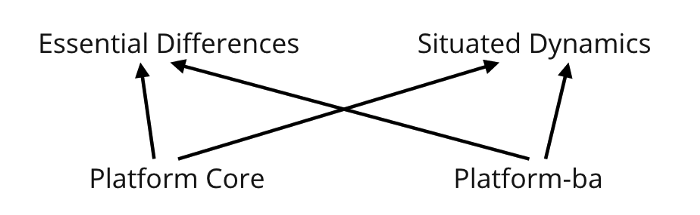
The framework considers a knowledge enterprise as a Developmental Platform for knowledge creators. A Platform Core is made by the creator of the platform. For example, the “Relevance of Zone” model is an abstract model which is a platform core, and the possible “Zone” platform is made by me.
A Platform-ba refers to people who use the platform and their social interactions. For example, if the “Relevance of Zone” model is adopted by a group of people, then this group forms a platform-ba of the “Zone” platform.
The Platform Core is defined by its Essential Differences and it only can offer a general solution for people. The members of a Platform-ba need to use the Platform Core to build their own solutions for dealing with Situated Dynamics.
Thus, the development of a platform such as a knowledge enterprise is a dynamic process of social collaboration.
Since Abstract Models don’t directly offer solutions for concrete situations, there is a Creative Space for people who want to make Concrete Models for themselves and others.
You are most welcome to connect via the following social platforms:
Linkedin: https://www.linkedin.com/in/oliverding Twitter: https://twitter.com/oliverding Polywork: https://www.polywork.com/oliverding Boardle: https://www.boardle.io/users/oliver-ding


