
The Design Wisdom Project
How to help designers develop their mental models
Tanner Christensen is the Head of Design at Gem. Yesterday he shared an article about Ambiguous Design Problems on Linkedin. In the past several months, I read many similar articles which call a new approach for growing designers’ design wisdom.
The challenge is well described by Tanner Christensen in his article. See the following highlight:
How do you approach a problem that has no definition, not even a hypothesis?
As product designers grow in their careers we are tasked with taking on more complex and ambiguous problems. We find ourselves in situations where our job is to help others envision and explore a complex and often poorly defined landscape.
The task of figuring out what hasn’t been figured out already can be daunting, even debilitating, for designers.
Thankfully the path through ambiguity is clear once you do one thing. As Lewis Carroll famously wrote in Alice’s Adventures in Wonderland: “If you don’t know where you are going, any road will get you there.”
There are many ways to grow a designer’s wisdom in dealing with wicked problems. For example, some designers move from design thinking to system thinking, even Complex Adaptive Systems.
In this article, I’d like to suggest other ways of growing wisdom. By using these suggestions as examples, I want to encourage you to expand your knowledge scope.
Let’s start the Design Wisdom project.
Designers as Knowledge Heroes
On June 26, 2020, I published an article and introduced the HERO U framework for knowledge heroes.
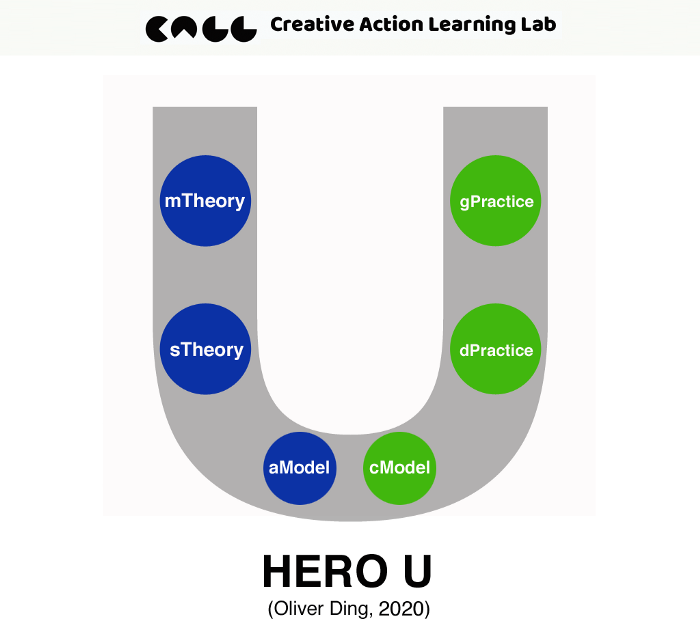
The HERO U framework uses a U shape to present six types of wisdom:
- mTheory: Meta-theory
- sTheory: Specific Theory
- aModel: Abstract Model
- cModel: Concrete Model
- dPractice: Domain Practice
- gPractice: General Practice
In the past several years, I used the framework to guide my tacit knowledge development. I’d like to share my perspective on the journey. I also have over 20 years of work experience in design, product, business strategy, etc.
In 2014, I started my journey of learning theories. My major theoretical interests are Ecological Psychology, Activity Theory, Anticipatory System theory, and social practice theories in general. Eventually, I became an independent designer-turned-researcher.
In the past three years, I wrote 10 books-in-drafts and designed 10 meta-diagrams.
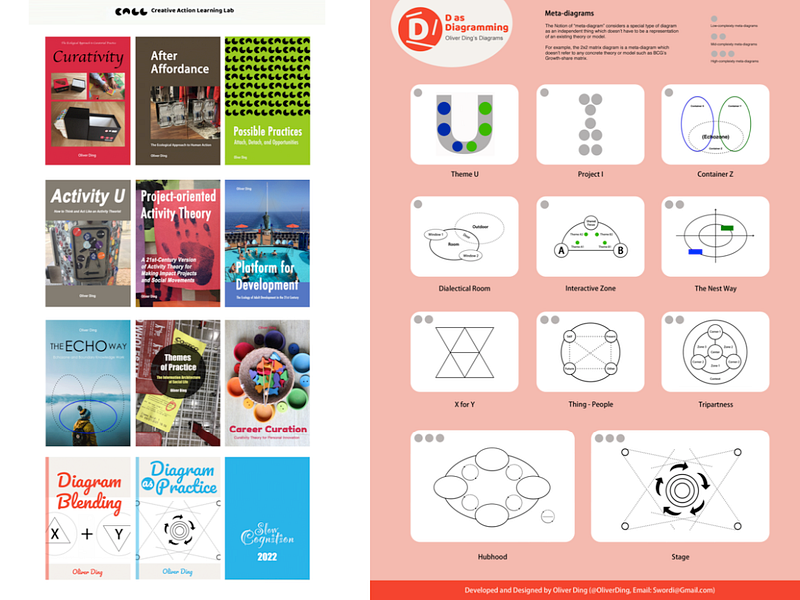
I also work on a new approach called Knowledge Curation that aims to connect Theory and Practice. The approach suggests the following three steps:
1. Practice-based reflection 2. Theory-based reflection 3. Practice — Theory dialogue
Both researchers and designers are knowledge heroes. Designers are not only users of knowledge, they can be makers of new knowledge too. I hope the Knowlege Curation approach could help designers grow their design wisdom.
Appropriating Theoretical Frameworks
Here is an example, I developed a theoretical framework called “Lifesystem” for modeling social practices.
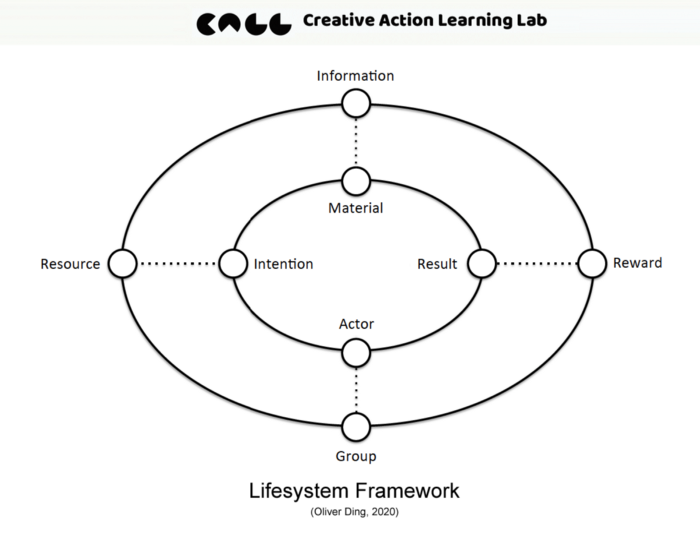
You can find more details about the framework from the following articles.
- Lifesystem: Modeling Ice Skating and Other Social Practices
- Lifesystem: Theory-based Reflection
- Lifesystem: Operation-based Reflection
- Lifesystem: Design for A Meaningful Journey
The Lifesystem framework was not developed as a framework for design. Originally, it was developed as an abstract model for modeling social practices. Its primary users are empirical researchers. My purpose behind the Lifesystem framework is to build a bridge between the ecological practice approach and a creative career or creative life.
There are two types of knowledge frameworks: Descriptive and Prescriptive.
- The descriptive frameworks tend to tell us what the thing is.
- The prescriptive frameworks tend to tell us how to do it.
Researchers tend to use descriptive frameworks to explain what they care about while designers tend to use prescriptive frameworks to guide their design processes.
The Lifesystem framework is descriptive, not prescriptive. However, we can expand the Lifesytem framework at its operational level and adopt other related frameworks to build a toolkit for various design activities.
In Lifesystem: Operation-based Reflection, I expanded operational concepts of the Lifesystem framework with several related other frameworks and offer the following design wisdom:
- Design for Material Engagement
- Design for Social Engagement
- Design for Value Engagement
- Design for Resource Engagement
- Design for Future Engagement
A framework is a tool for thinking. To appreciate a new theoretical framework is to adopt a new perspective. This is a small step in developing our tacit knowledge.
Improving Thematic Cognition with Thematic Space Canvas
I also developed a new tool called Thematic Space Canvas for developing tacit knowledge.
The tool is a meta-canvas and it was designed for combined two types of cognitive skills:
- Thematic Cognition
- Spatial Cognition
Both cognitive skills are highly abstract creative skills. Designers tend to master spatial cognition while they are often struggling with thematic cognition.
For cognitive psychologists, thematic cognition is about mastering different types of similarities, especially thematic similarity. For cultural anthropologists, thematic cognition is about the hierarchy of human life experience.
I started developing the concept of Themes of Practice in 2019 for Curativity Theory. I have mentioned the concept in my previous articles many times. The purpose of the concept is to connect “life theme” and “culture theme”.
Anthropologist Morris Opler (1945) developed theoretical “themes” for studying culture. Career counseling therapists and psychologists also developed a theoretical concept called “life theme.” If we put culture themes and life themes together, we see a great debate of social science: “individual — collective”.
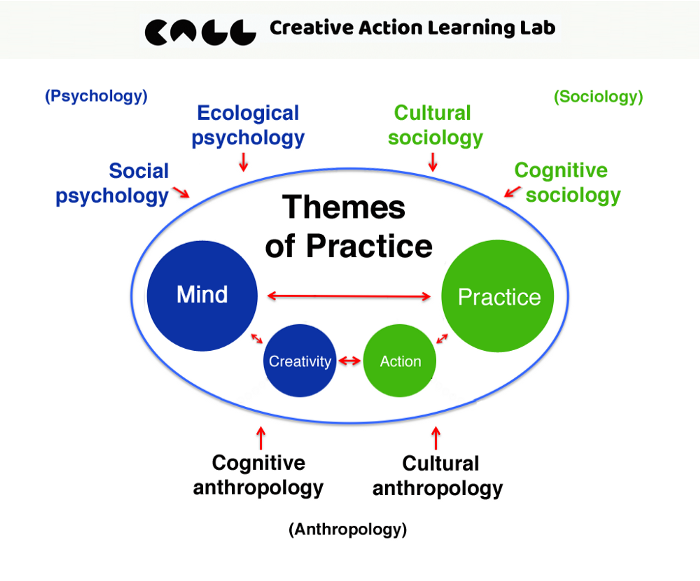
The “Themes of Practice” project is a mini interdisciplinary project. You can find more details here.
In the past three months, I developed a new tool called Thematic Space Canvas for Developing Tacit Knowledge. For designers, developing tacit knowledge means growing design wisdom.
Thematic Space Canvas is a meta-canvas that is used to create new canvases for curating various data and ideas to develop tacit knowledge about particular themes.
The diagram below is the newest design of the meta-version of Thematic Space Canvas. A meta-canvas is an abstract canvas that doesn’t tie to any domain. The goal of designing a meta-canvas is to highlight a unique spatial structure for designing domain-specific canvases. I use abstract terms such as “area”, “dimension”, “block”, and “theme” for the meta-canvas.
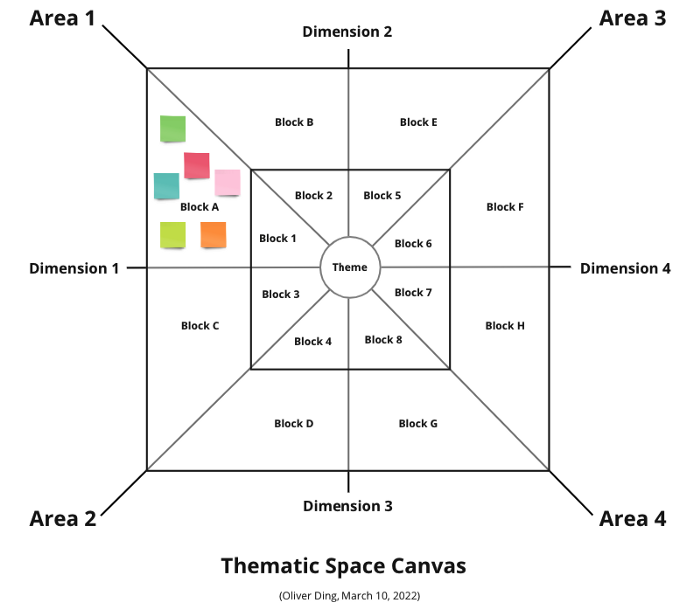
The Thematic Space Canvas is not a simple 2x2 matrix for building a typology, but a multiple-dimension model for visualizing a holistic view to sense-make a dynamic meaningful whole. You can find more details here: The Notion of Thematic Spaces.
The Thematic Space Canvas’ spatial structure is designed with the following aspects:
- Four Significant Areas
- Four Dimensions
- Two Subspaces: Inner Space and Outer Space
- Eight Pairs of Blocks
- A Primary Theme
In the past three months, I created the following canvases based on the Thematic Space Canvas:
- The Knowledge Discovery Canvas (its original name is “Thematic Space Canvas”)
- The Spark Space Canvas
- The Statue Space Canvas
- The Life Discovery Canvas
- The Optimal Context Canvas
Though the above domain-specific canvases share the same spatial structure which is defined by the meta-canvas, each domain-specific canvas has its purpose and content. For example, The Life Discovery Canas is developed for Life Discovery Activity.
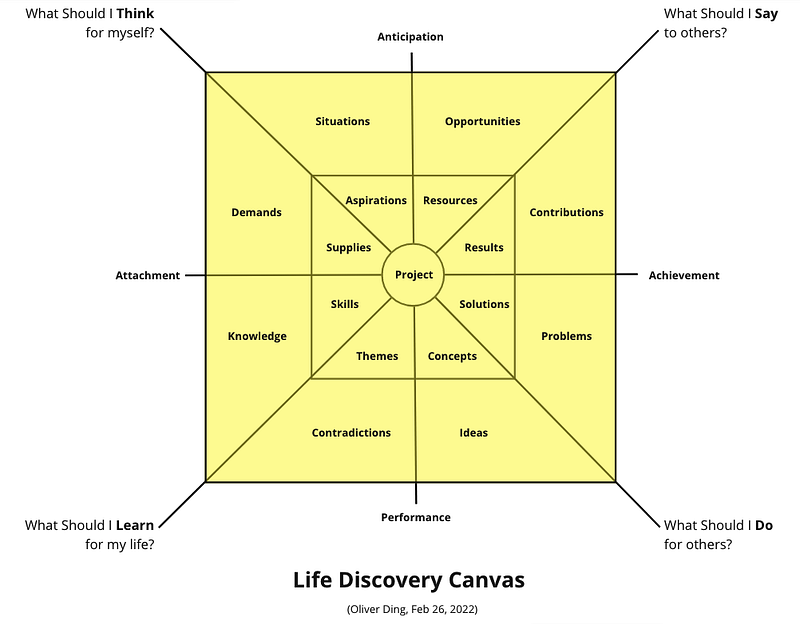
You can find more details about Thematic Space Canvas here. If you want to know more about Life Discovery Canvas, you can find links here: theoretical background, Spatial Structure, THINK and LEARN, SAY and DO Inspirations.
What does the Thematic Space Canvas mean to Designers?
The answer is very simple.
If you are a designer who feels that it is hard to deal with conceptual thinking tasks, then you can take the Thematic Space Canvas as a challenge to practice the thematic cognition skill.
There are three levels of the challenge:
- Level 1: Play as User
- Level 2: Curate as Host
- Level 3: Design as Thinker
Level I is called Play as User. You can pick one canvas from the following canvases and play with it as a user.
- The Knowledge Discovery Canvas (its original name is “Thematic Space Canvas”)
- The Spark Space Canvas
- The Statue Space Canvas
- The Life Discovery Canvas
- The Optimal Context Canvas
The task requires you to read instructions about the family of the Thematic Space Canvas and practice with it.
Level 2 is called Curate as Host. You can invite a friend to play a canvas at Level I and you are going to guide her or him.
Level 3 is called Design as Thinker. Now you are going to design a new version of Thematic Space Canvas for a particular topic or issue. We have done a thematic spirit last weekend. You don’t have to finish the task in one hour. You can play with the meta-diagram for several days or several weeks.
Need More Ideas?
If you don’t like the above ideas, tell me more about what you want to play?
You are most welcome to connect via the following social platforms:
Linkedin: https://www.linkedin.com/in/oliverding Twitter: https://twitter.com/oliverding Polywork: https://www.polywork.com/oliverding Boardle: https://www.boardle.io/users/oliver-ding


