
Lifesystem: Theory-based Reflection
How to use a practical framework with several theoretical concepts?

The Lifesystem framework is a practical framework for modeling social practices and creating brand new social practices. The framework is part of the Ecological Practice approach.
On Sept 30, 2021, I introduced the framework with the example of Ice Skating. You can find more details in the original article Lifesystem: Modeling Ice Skating and Other Social Practices.
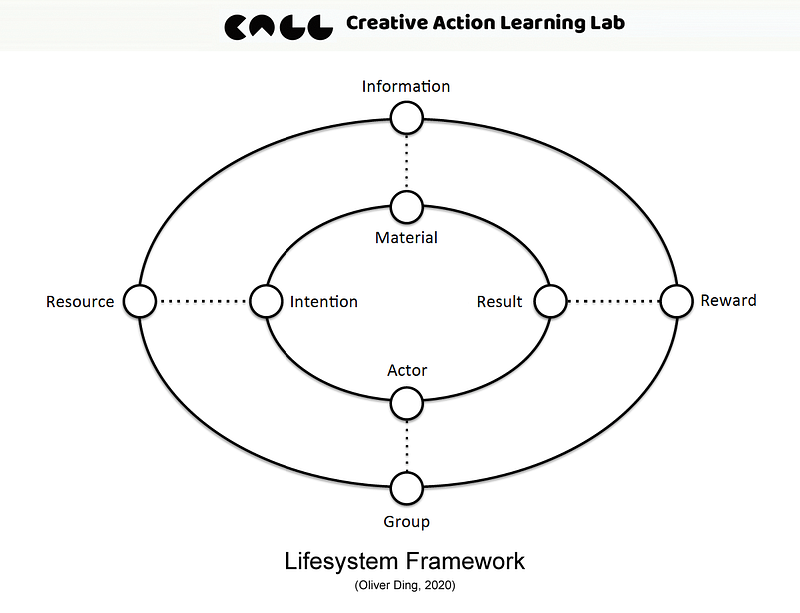
Today I want to discuss the connection between the Lifesystem framework and the Ecological Practice approach and use this discussion as an example of Theory-based Reflection.
Theory-based Reflection
My studio CALL (Creative Action Learning Lab)’s primary project is the Knowledge Curation Project which aims to produce knowledge frameworks.
What’s a knowledge framework? I roughly defined it with the following formula:
Concepts + Diagrams + Methods = Knowledge Framework
As a tool for guiding research and reflection, a knowledge framework is a whole that contains concepts, diagrams, and methods. An ideal knowledge framework should contain two types of concepts:
- Theoretical Concepts
- Operational Concepts
Theoretical Concepts are adopted from Meta-theory or Specific Theory. Some frameworks don’t associate with any theories, they only have operational concepts. Operational Concepts are framework-dependent concepts for guiding research and reflection.
There are two types of reflection. Theory-based reflection adopts theoretical concepts as instruments for reflection while Practice-based reflection uses operational concepts or other heuristics as instruments for reflection.
The Lifesystem framework is a member of the family of Ecological Practice approaches, so theory-based reflection is one of the methods of using the Lifesystem framework.
This is my motivation behind the Lifesystem framework. I want to use the framework to connect the Ecological Practice approach and real-life social practices.
The Ecological Practice Approach Toolkit
In Oct 2020, I wrote an article titled The Ecological Practice Approach Toolkit and shared my work on a new approach for practice studies. This approach was originally called the Gibson — Lakoff — Schön approach because I adopted theoretical concepts from James J. Gibson, George Lakoff, and Donald Schön.
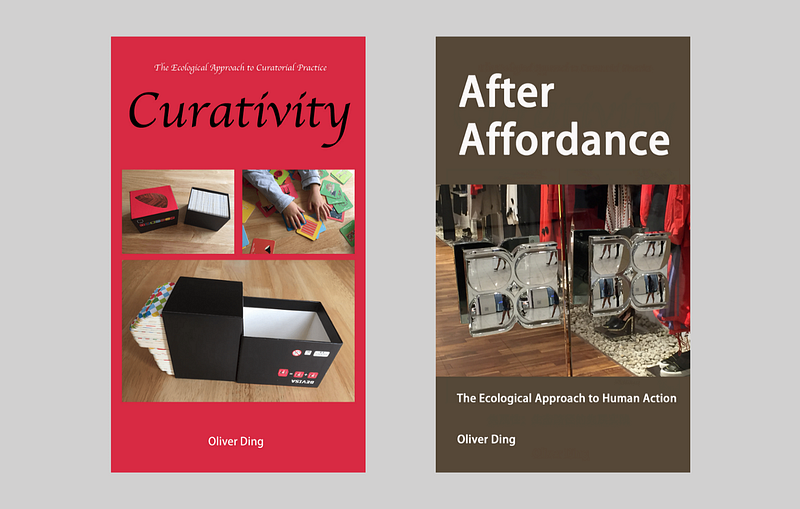
From Sept 2018 to March 2019, I wrote a book titled Curativity: The Ecological Approach to Curatorial Practice to reflect on one of my life themes: Curation. The Ecological Practice Approach was born from the process of writing Curativity.
After March 2019, I continuously worked on revising Curativity and developing the Ecological Practice Approach as a new project. In May 2020, I wrote another book titled After Affordance: The Ecological Approach to Human Action in which I proposed several new theoretical ideas for expanding ecological psychology to the modern digital environment.
A major development of the Ecological Practice approach is the concept of Supportance. I have been searching for a concept for expanding Ecological Psychology from perception-centered psychological analysis to social practice analysis for about two years after I finished the draft of Curativity.
The concept of Supportance means the Ecological Practice approach has transformed from a curated toolkit to an original theoretical framework. This is a major milestone of the approach. You can find more details in The Development of Ecological Practice Approach.
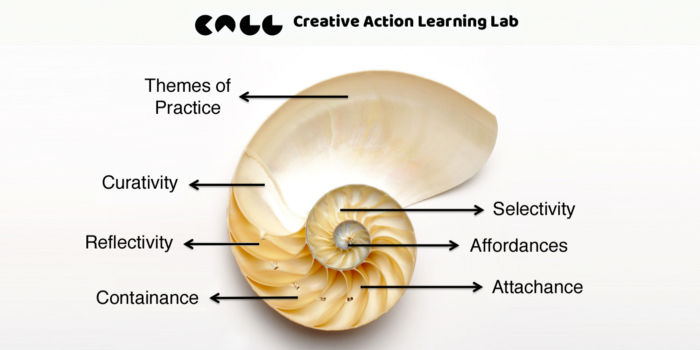
The above diagram is the 2019 version of the Ecological Practice approach.
In a broad sense, the Ecological Practice approach has its philosophical roots in traditional Pragmatism and contemporary embodied cognitive science. Inspired by practice studies theorist Davide Nicolini (2013)’s “tool-kit approach” which curates various concepts from different theoretical accounts based on a family relationship, allowing a network of dissimilarities and similarities, I consider the Ecological Practice approach a toolkit.
The above diagram shows several theoretical concepts. Some concepts are adopted from theoretical resources. The concept of Selectivity is adopted from William James’ Radical Empiricism. The concept of Affordance is adopted from Ecological psychologist James J. Gibson. The concept of Reflectivity is adopted from Donald Schön. I also developed several original concepts such as Attachance, Containance, Curativity, and Themes of Practice. You can find more details here.
Though even the Lifesystem Framework doesn’t list theoretical concepts on its diagram, we can use them with the framework for our empirical research projects.
Lifeway, Lifeform, and Life Coordinate
The Lifesystem framework is designed with two ideas: the pair of concepts of “Lifeway — Lifeform” and Life Coordinate.
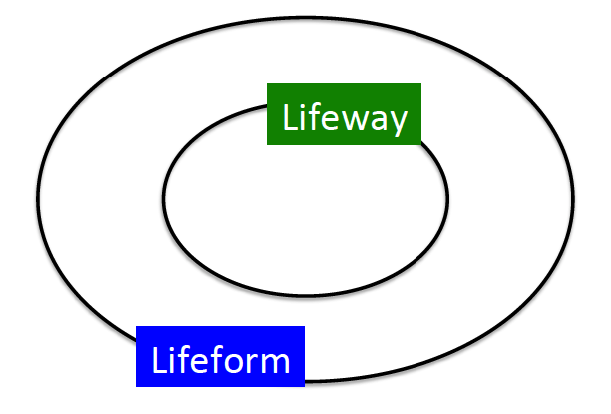
The term “Lifeway” is inspired by the ecological psychologist James. J. Gibson’s writing: “The natural environment offers many ways of life, and different animals have different ways of life.” I use the term “Lifeway” to refer to the “human—material” engagement which is related to physical environment and affordance.
The term “Lifeform” is inspired by the philosopher Ludwig Wittgenstein’s writing: “It is easy to imagine a language consisting only of orders and reports in battle…And to imagine a language means to imagine a form of life…Here the term ‘language game’ is meant to bring into prominence the fact that the speaking of language is the part of an activity, or a form of life.” I use the term “Lifeform” to refer to the “human-human” engagement which is related to social environment and supportance.
The Lifesystem framework considers the “Lifeway — Lifeform” hierarchical loops and the “Affordance — Supportance” hierarchical loops as a whole system which defines a new unit of analysis.
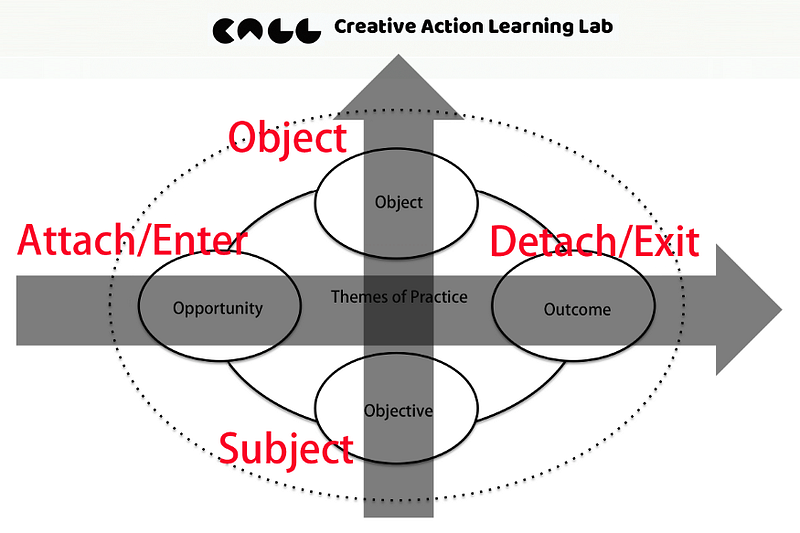
The above diagram is called Life Coordinate which is inspired by the Life-as-Activity (v1.5) diagram. You can find more details here. The pair of concepts of “Subject-Object” is adopted from Activity Theory while the pair of concepts of “Attach/Enter-Detach/Exit” is adopted from the Ecological Practice approach.
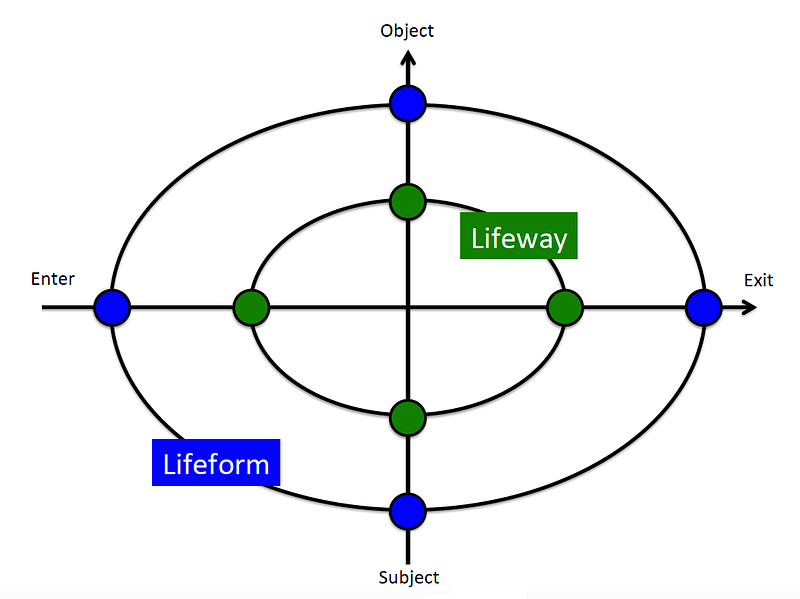
The above diagram is the basic model of the Lifesystem framework. Based on the model, I developed several Operational Concepts for the framework. You can find more details here.
The Perspective of Affordance
The concept of Affordance is an important theoretical concept for understanding human—material engagement.
What’s Affordance? Let’s have a look at the original definition made by Gibson:
The affordances of the environment are what it offers the animal, what it provides or furnishes, either for good or ill. The verb to afford is found in the dictionary, but the noun affordance is not. I have made it up. I mean by it something that refers to both the environment and the animal in a way that no existing term does. It implies the complementarity of the animal and the environment. (p.119)
Though the core of Gibson’s theory is visual perception, we can see the whole “Perception-Affordance-Action” loop as a theory of action and apply it to new fields. Perceiving affordances is for taking actions, taking actions has an impact on the environment and changes the affordances of the environment. I draw the diagram below to visualize this loop.
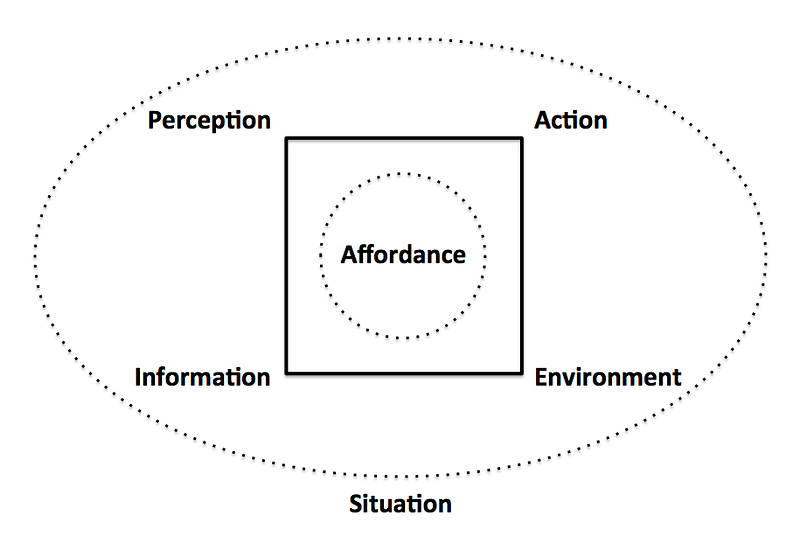
If we adopt Gibson’s version of Affordance, then we can pay attention to the Immediate Experience of human—material engagement. For the Lifesystem framework, we can use the perspective of Affordance to guide our observation of the real-life research.
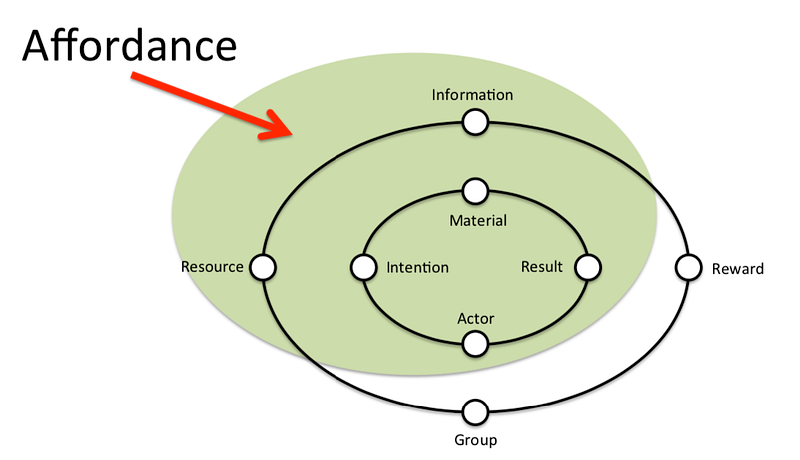
The above diagram shows the perspective of Affordance for Lifesystem study. The perspective focuses on an Actor, not the Group which is defined as the social context of the Actor. It doesn’t consider Reward because Immediate Experience is about a particular moment while Reward is about an outcome of a long-term activity.
We can start with the following simple question:
How does a person use a material thing and act with a partucular environment?
I use “material thing” because I want to remove cultural meaning from the thing. This is the essential point of Affordance theory because it is about the Perceive-Affordances-Action loop.
Anthropologist Tim Ingold (1993) argued a distinction between tools and artifacts: “A tool, in the most general sense, is an object that extends the capacity of an agent to operate within a given environment; an artefact is an object shaped to some pre-existent conception of form” (p.433) Ingold’s view focused on “non-designed” or “designed”.
Ecological psychologist Harry Heft (2001) suggested that it’s better to use “Found Tools” to refer to “non-designed” tools. He gave many examples, “…found tools, are identified and selected because of the suitability of their affordance properties in support of some action. Long grasses or stripped branches employed as probes in feeding at insect nests; broad, rigid leaves used to shovel insects into the mouth; stones used as hammers for cracking hard shells of nuts are examples. ” (p.341)
Another distinction is “Immediate use” and “Conventional use” suggested by Heft, “…in addition to learning about how to use an object, the individual learns the meaning of the object itself within the practices of the culture. To the extent that this possibility has merit, it is an important step in understanding how objects take on conventional or culturally prescribed meaning beyond their immediate use functions.”(p.345)
“Immediate use” can be “designed use” or “found use”. I think the most important idea behind “immediate use” is resourcefulness or everyday creativity while Heft used the distinction to highlight the aspect of social learning. A designer can get an insight from his own creative “immediate use” or observe others’ creative “immediate use” and turn the insight into a “designed use” which could be turned into a “conventional use” by the distribution of a newly designed artifact.
For example, the following photos are about a carpool hangtag.
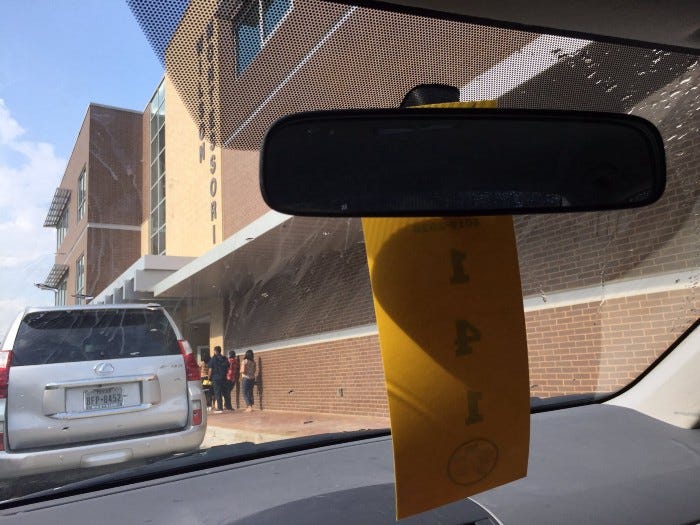
From the perspective of affordance, the part of the mirror (not the mirror) affords hanging something.

I don’t know the first person who found this “found use” and made a carpool hangtag.

Now it is a “conventional use” by many of us. For some people, it is a meaningful business.
A simple way to adopt the perspective of Affordance is by taking pictures in a real-life world and writing notes. I roughly call this approach Ecological Interaction Analysis. You can find an example of Ecological Interaction Analysis here.
The Perspective of Attachance
I coined the term Attachance by combining Attach and Chance in 2018 to discuss some ideas related to the concept of Affordance which is a core idea of Ecological Psychology.
Affordance means potential action opportunities offered by environments. I want to highlight the meaning and value of actual action itself, however, the term Affordance only refers to potential actions. Thus, I coined the term Attachance to emphasize the potential opportunities offered by actual actions, especially the attaching act and the detaching act.
In 2019, I started working on my theoretical account of the Ecological Practice approach after finishing a book titled Curativity. The 2019 version of the approach is a curated toolkit version. The concept of Attachance is part of the toolkit. In May 2020, I wrote a book titled After Affordance: The Ecological Approach to Human Action in which I proposed several new theoretical ideas for expanding ecological psychology to the modern digital environment. The primary theme of After Affordance is the concept of Attachance.
The concept of Attachance is planned to develop as 1) an ecological practice concept for practice studies such as interaction design and startup innovation, 2) a philosophical concept for developing a social theory.
The book After Affordance only achieves the first goal and it focuses on the following acts:
- Attaching to an environment
- Detaching from an environment
- Attaching to an object
- Detaching from an object
On Sept 17, 2021, I published D as Diagramming: The Attachance Perspective in which I used the Attachance Perspective to refer to its philosophical meaning.
How can we use the concept of Attachance in a Lifesystem study project? We can adopt both its first meaning: an ecological practice concept for practice studies such as interaction design and startup innovation.
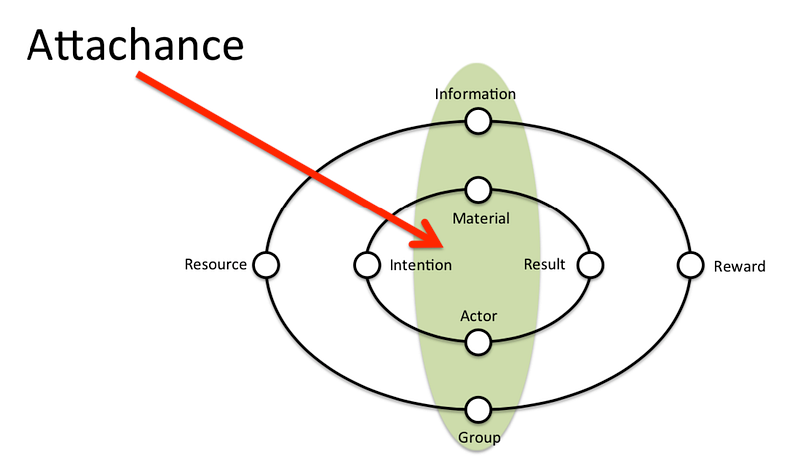
The perspective of Attachance guides us to observe the following four types of acts:
- Attaching to an environment
- Detaching from an environment
- Attaching to an object
- Detaching from an object
If you adopt this perspective and focus on the above four types of acts, you will see the world in this way: any act is either an attaching art or a detaching act. Then, you get the following worldview:
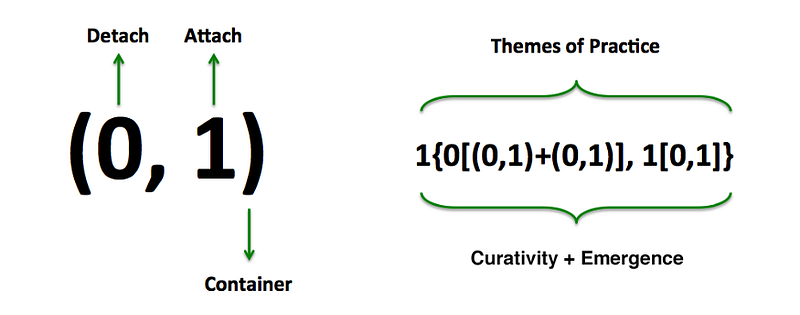
The above picture is another way of representing the perspective of Attachance. The two forms of acts are represented by binary numbers. The 0 represents detaching act and the 1 represents attaching act. The parenthesis represents the Container. The right diagram shows an example of complex status which brings out other two concepts: Curativity and Themes of Practice. I also add the concept of Emergence from complexity theory to the above diagram.
You can see it anywhere in the real-life world.
One week ago, I found the following picture on Linkedin.
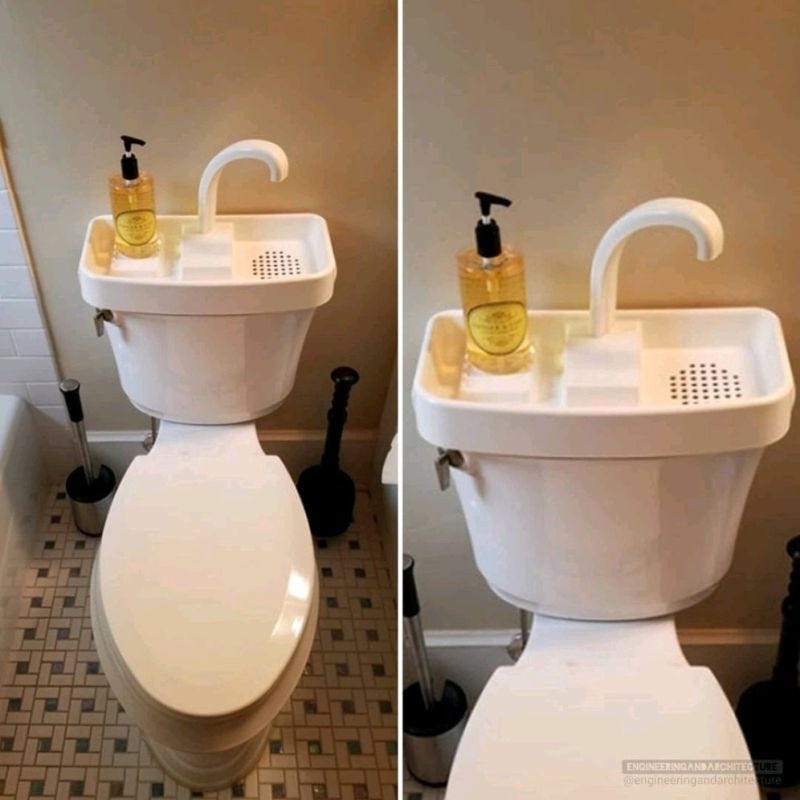
According to Mehrtash Soltani, the author of the original post, “On many Japanese toilets, the hand wash sink is attached so that you can wash your hands and reuse the water for the next flush. Japan saves millions of liters of water every year doing this. According to the 2017 Time Survey — we don’t use 80% of wastewater again and 5500 liters of water is wastage by leaking taps every year.”
How to use the perspective of Attachance to explain Japanese toilets? There is one Lifesystem with at least three Lifeways.
- Lifeway 1: Body attaches to a Toilet, Body detaches from a Toilet (a Toilet is a life container of a body)
- Lifeway 2: Hand attaches to a Wash sink, Hand detaches from a Wash sink (a Wash sink is a life container of hands)
- Lifeway 3: Water attaches to a Wash sink, Water detaches from a Wash sink (a Wash sink is a life container of water)
To make social innovations, we don’t have to abandon some social practices. We can re-arrange the configuration of multiple Lifeways within a Lifesystem. By connecting the Toilet and Wash sink together, we can change the configuration of the above Lifeways. See the following Lifeway 4:
- Lifeway 4: Water detaches from a Wash sink, Water attached to a Toilet (a Wash sink and a Toilet are both life containers of water)
Moreover, life containers can be understood from three dimensions: physical dimension, cognitive dimension, and social dimension. You can find an example of the cognitive dimension from Possible Practices: Attach, Detach, and Opportunities.
The Perspective of Reflectivity
The perspective of Reflectivity is adopted from Donald Schön’s “Reflection” which expanded John Dewey’s “Reflection” to double reflections:
- Reflecting-in-action
- Reflecting-in-practice
Schön refers to reflecting-in-action to immediate situations while reflecting-in-practice means cross-situation level.
For the Lifesystem framework and related empirical research, the perspective of Reflectivity guides us to reflect on multiple levels:
- Single element level
- Cross-element level
- Single loop level (the Lifeway loop or the Lifeform loop)
- Single Lifesystem level
- Cross-Lifesystem level (a Lifesystem is an Environment of another Lifesystem)
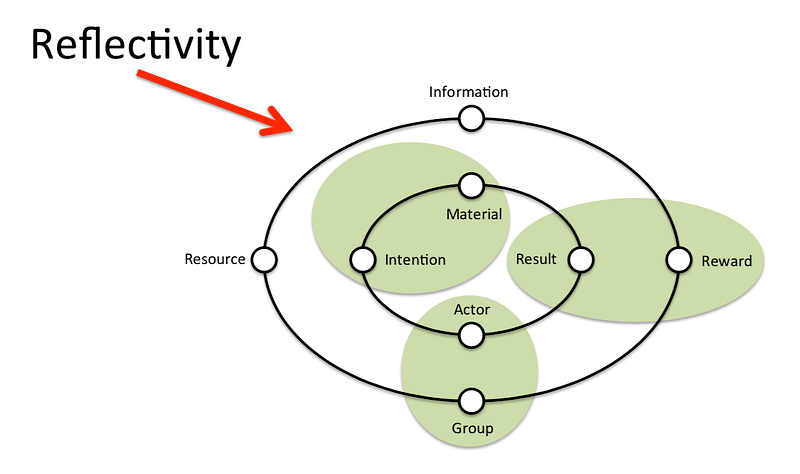
We don’t have to conduct all levels of analysis for a Lifesystem-base research project. It all depends on the purpose of a particular research project.
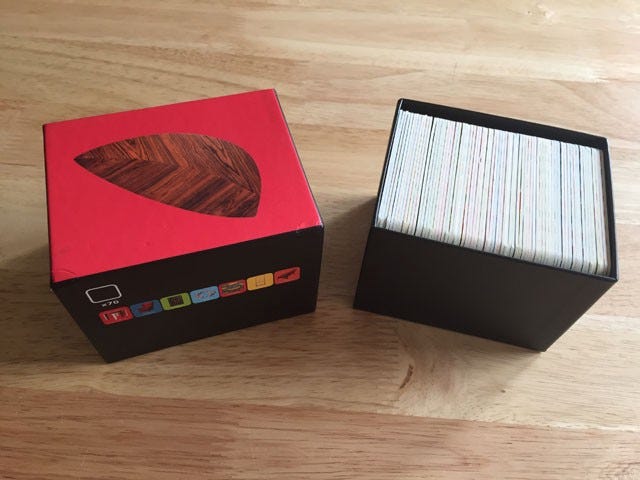
Several years ago, my son came to my office and I gave him IKEA Bevisa memory cards.
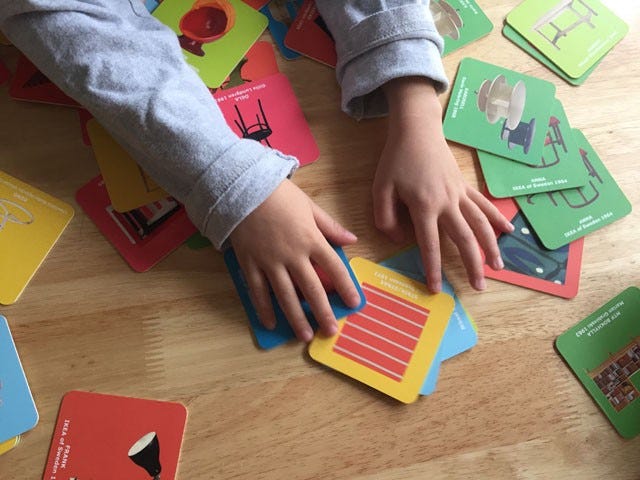
Usually, people play the memory card for training memory. You turn over any two cards. If the two cards match, then keep them. If they don’t match, turn them back over. If you can remember what was on each card and where it was, you can quickly match many cards and win the game. However, what my son played is not the normal way. He just randomly played these cards as “cards” instead of “memory cards” and turned them into a “truck”.
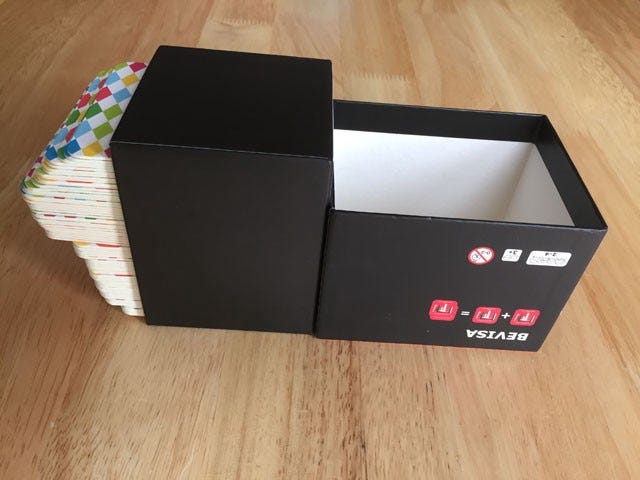
The side of these cards offers an affordance for shaping, my son actualized this affordance and surprised me. He didn’t know the term affordance but the theory exactly explained his behavior. Since the environment offers so many affordances, any person has to pick up one or some affordances from many affordances and actualize them in a particular situation. My son picked the affordance for shaping offered by the side of these cards.
When I saw the “truck” my son built, I realized this is a great case of Affordance theory and Curativity Theory. Thus, I took pictures to record this case. At that moment, I did Reflecting-in-action on a particular situation. Later, I often did Reflecting-in-practice during the process of writing Curativity: The Ecological Approach to Curatorial Practice. I also used these pictures to design the cover for the book.
If we reflect on the Lifeform level, then my responses to my son’s behavior refer to Group and Reward. I am the social context of my son and I asked my son to do the “truck” again and took pictures. My son earned a reward from me by making an “unofficial” result.
This means that I was encouraging my sons to explore novel affordances in the real-life world. This is a way of teaching creativity.
The Perspective of Curativity
In 2019, I had wonderful various epistemic activities. I wrote a book for my favorite topic Curation and developed a theory called Curativity Theory.
I have worked in the curation field for over ten years. I was the Chief Information Architect of BagTheWeb.com which was an early tool for content curation (We launched the site in 2010). This experience inspired me to make a long-term commitment to the Curation theme. After having 10 years of various curation-related practical work experience and theory learning, I coined a term called Curativity and developed Curativity Theory which became a book.
The core idea of Curativity Theory is very simple:
In order to effectively curate pieces into a meaningful whole, we need Container as part to contain pieces and shape them.
The theory built a brand new ontology called “Whole, Piece and Part” and adopted James Gibson’s “Affordance”, George Lakoff’s “Container” and Donald Schön’s “Reflection” as epistemological tools.
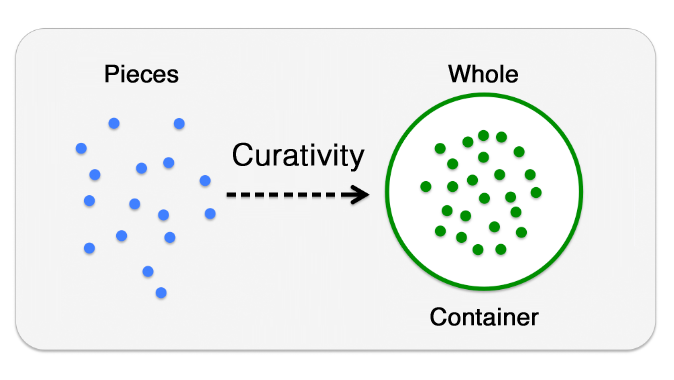
Pieces, Container, and Whole together form a triad which is the basic unit of analysis of Curativity theory. Also, this unit of analysis establishes a new theoretical category at the ontological level. The concept of Curativity indicates three statuses of things:
- Things-in-Pieces
- Things-in-Container
- Things-in-Whole
Curativity theory is all about understanding the structure and dynamics of these three statuses.
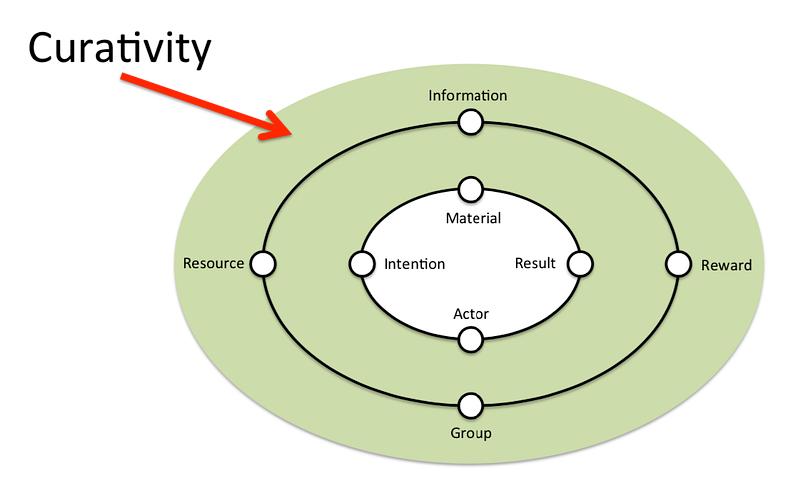
For the Lifesystem framework, the perspective of Curativity guides us to reflect on the relationship between Lifeway and Lifeform. It refers to the following simple question:
How does a Lifesystem maintain a meaningful whole by curating the configuration between multiple Lifeways and Lifeforms?
Curativity theory claimed that there are many ways of perceiving and thinking of the Whole in the real world. For example, a typical normal routine practice can be a container for shaping a whole.
Several years ago, I went to Discount Tire to repair tires. I observed their routine work process and found there was a transparent plastic bag that contained my car key and the bill of my case (see the picture below).
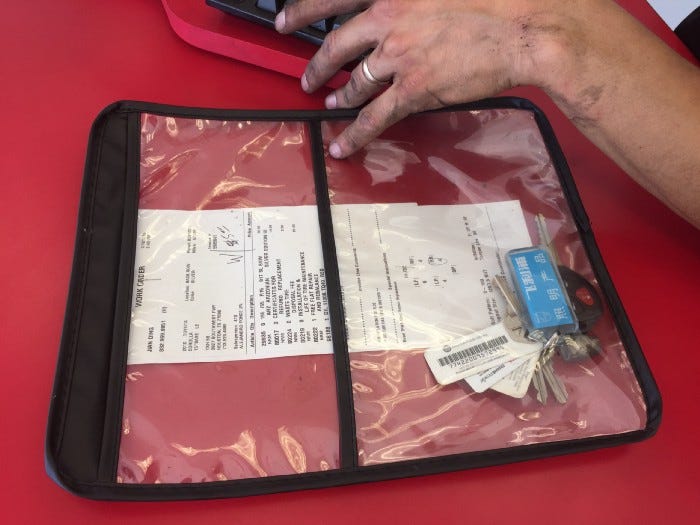
My car key and the bill of my case are two things-in-pieces. They connected through a theme of practice: repairing tires. The company finds a simple way to make a container containing these two things-in-pieces as a whole for their workflow.
As a normal container, the transparent plastic bag doesn’t make these two things-in-pieces as a whole. The whole is defined by the routine practice of repairing tires. The bag-in-use provides a material function that turns the whole-in-mind into a whole-in-environment.
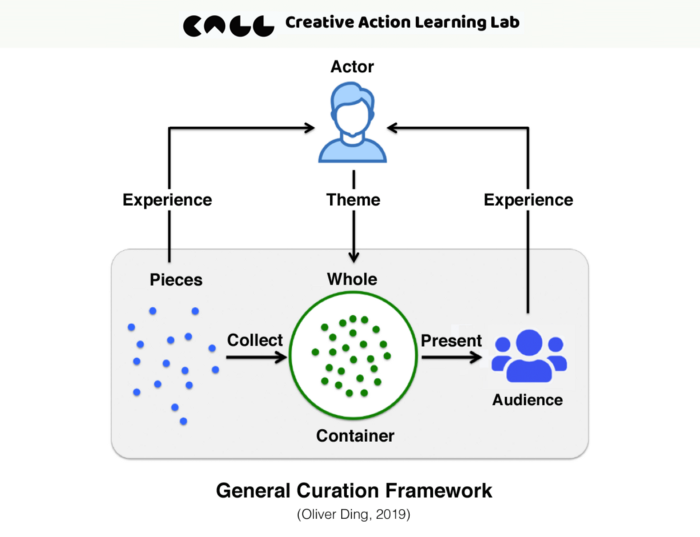
For Lifesystem-based research projects, the following General Curation Framework is also a useful tool.
Museum curators and Art curators tend to use Curatorial Practice to refer to their professional activities. I consider Curatorial Practice as a subcategory of General Curation. From the perspective of Curativity Theory, the following social practices are considered part of the family of General Curation.
- Educational activities.
- Event organizing and curating.
- Web content curation.
- Knowledge Curation.
- Publishing and editing a catalog or a magazine.
- Toy Curation.
- Grocery shopping and other types of shopping.
- etc.
Thus, the General Curation is about social practices which require selecting, collecting, organizing, presenting, and reflecting. It goes beyond the scope of traditional professional Curatorial Practice.
The above diagram highlights several pairs of concepts:
- Pieces v.s. Whole
- Whole v.s. Container
- Collect v.s. Present
- Actor v.s. Audience
- Experience v.s. Theme
As an application of Curativity Theory, the above General Curation Framework represents the structure and dynamics of general curation practice. The activity of general curation aims to collect pieces of things into a meaningful whole to present a theme to a group audience.
There are three immanent contradictions within the activity of curating: “pieces — whole”, “things — themes” and “curator — audience”. For the first dichotomy, I use the concept of “Container” to balance the pieces and whole. For the last dichotomy, I use the notion of “Everyone A Curator” to deconstruct the concept of “Curator” because I want to claim that the activity of curating is a general social practice.
The dichotomy of “things — themes” refers to two classical great debates of social science: “mind — matter” and “individual — collective.” After reviewing the concept of “theme” in various disciplines such as Cultural Anthropology, Counseling Psychology, Cognitive Psychology, and the Philosophy of Science, I developed a new concept “Themes of Practice” to propose a process view of “Theme.” You can find more details here.
You are most welcome to connect via the following social platforms:
Linkedin: https://www.linkedin.com/in/oliverding Twitter: https://twitter.com/oliverding Polywork: https://www.polywork.com/oliverding Boardle: https://www.boardle.io/users/oliver-ding


