
#TalkThree 10: How to use a Hierarchy?
A case study: SSAT, CHAT, and Possible Practice

Hierarchy is a typical thinking tool. Today I’d like to share a hierarchy of human activity and social practices.
In September 2020, I reviewed A. N. Leontiev’s three-level hierarchical structure of activity, which is a popular model of Activity Theory, and compared it with other models. The outcome is a universal hierarchy of activity and practice. You can also view its original file on Google Spreadsheet.

Based on perspectives from activity theorists and other researchers, I found there are eight levels of the hierarchy of activity and practice. The six mid-levels are adopted from activity theorists. The top-level is adopted from anthropologist Morris Opler (1945). The low level is adopted from ecological psychologist James J. Gibson (1979).
I also classify these eight levels into three types: “logical level”, “actual level”, and “possible level”. We can call the logical level as ideal level too. I don’t have perfect terms to name these types. Bedny and other SSAT theorists distinguished “Objects of study” and “Units of analysis”. They think “activity” and “task” are considered the objects of study while the other levels as the units of analysis. “Logical level” is similar to their “objects of study”, I think both “theme”, “activity network”, and “activity (or activity system)” are only needed for the analysis requirement. “Actual level” is similar to their “units of analysis”.
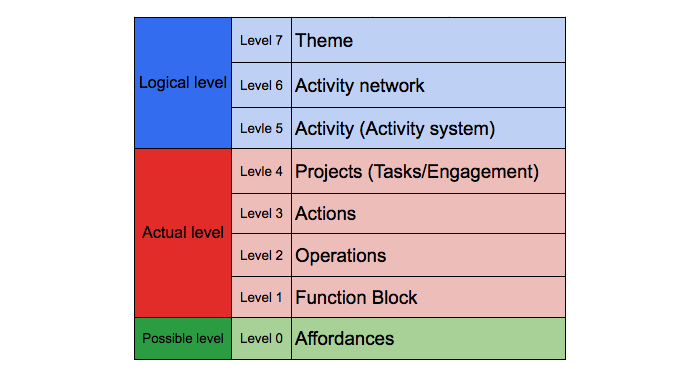
A new animal within the list is “affordance” which refers to the possible level.
What’s Affordance? Let’s have a look at the original definition made by Gibson: “The affordances of the environment are what it offers the animal, what it provides or furnishes, either for good or ill. The verb to afford is found in the dictionary, but the noun affordance is not. I have made it up. I mean by it something that refers to both the environment and the animal in a way that no existing term does. It implies the complementarity of the animal and the environment. (p.119)”
Why do I add the idea of affordance to the hierarchy of activity and practice? I think the value is it could expand the scope of the hierarchy from “actual” to “possible” because affordance refers to “action possibilities.”
Activity theorists tend to adopt the idea of affordance at the operation level. Victor Kaptelinin and Bonnie A. Nardi pointed out, “Affordances are typically interpreted in terms of low-level manipulation with physical artifacts. Therefore, the concept is limited to the level of operations.” (2006, p.81) Bærentsen & Trettvik’s (2002) provided a framework of Affordance levels which suggested the concept of affordance can be extended to levels of actions and activities.
I personally suggested another way to adopt the concept of affordance to activity theory. Instead of matching the existing three levels of the hierarchy of activity, the concept of affordance can be considered as a new level for extending the scope of the hierarchy of activity. In other words, affordance can be a new unit of analysis of activity theory and other practice theories.
At the general philosophical level, both ecological psychology and activity theory share the same view of the inseparability of human beings and the world. Victor Kaptelinin and Bonnie A. Nardi claimed, “In Western thought, the fundamental insight of the inseparability of subjects and objects is expressed, for instance, in the philosophical views of Hegel and Marx, Goethe’s poetry, Brentano’s ‘act psychology’, and the ecological psychology of Gibson.” (2012, p.13)
However, there is an important theoretical difference between ecological psychology and activity theory. Activity theorists define the “activity” as “object-oriented”, according to Leontiev, “Any activity of an organism is directed at a certain object; an ‘objectless’ activity is impossible” (Leontiev, 1981). Ecological psychologists don’t use “activity” as a theoretical concept, they use “action” and “activity” interchangeably. Ecological psychologist Edward S. Reed (1996) pointed out there are two kinds of action, “We should thus differentiate between two kinds of activity, performatory and exploratory — because the selective contingencies are very different for the two cases. Exploratory activity, as I call the scanning for and use of information (following James Gibson; see Reed, 1988a) typically does not require the expenditure of a significant amount of force to alter the substances or surfaces of the environment. Instead, it involves the adjustment of the head and sensory organs to the ambient energy fields. These adjustments are typically embodied in cyclic, low-energy, and low-impact movements of the sense organs or the head. The selective advantage thus obtainable is that of having information useful for regulating one’s activity pattern. These latter performatory activities are precisely those cases in which the animal does use significant amounts of force to alter the substances and surfaces of its environment. It is one thing to see or to smell a piece of food, it is quite another thing to obtain it, masticate it, and eat it — and this applies whether one is a dragonfly or a mammalian carnivore.”(1996, pp. 80–81)
The operation level can’t cover the meaning of the concept of exploratory action. The exploratory action goes beyond the scope of activity theory. Thus, the “possible level — affordances — exploratory action” combination is a heterogeneous theoretical resource to activity theory.
It depends on the needs of theoretical development and empirical research. Thus, I call the new hierarchy “a universal hierarchy of activity and practice” in which I use “activity” as a regular word, not the concept of activity theory. We can see this new hierarchy as a basic reference, readers can adopt some levels from it and form their own version of the hierarchy to match their needs.
How to use the universal hierarchy of activity and practice?
The following sections will share three examples of using the new hierarchy:
- SSAT > HCI
- CHAT > HCI
- Possible Practice > Creative Action
Both SSAT and CHAT are about HCI, so let’s start with the HCI.
0. HCI as a cross-disciplinary
Let’s use the HCI domain as an example. The diagram below summarizes the structure of HCI and its main research themes. According to Steven Robert Harris, “HCI is a relatively young, rapidly developing scientific field that is inherently multi- and cross-disciplinary (Carroll, 2003, p. 1). From the computer side, HCI can be considered as a branch of computer science which was defined by Newell, Perlis, and Simon as ‘the study of computers and the major phenomena surrounding them’ (Newell et al., 1967, p.373), HCI can be considered as that branch of computer science concerned with the design of computer applications and their interfaces. However, HCI also forms a specialized area of concern within other disciplines (Dix et al., 2003, Hewett et al., 1996): in psychology, HCI studies focus on the application and testing of theories of cognition and the empirical analysis of user behavior (e.g. Rauterberg, 1995a, Sedig et al., 2001); in sociology and anthropology, on the interactions between computer-based technologies, work processes, and organizations (e.g. Gärtner and Wagner, 1996, Törpel et al., 2003); and in industrial design, on the development and use of computer-based products (e.g. Kaikkonen and Roto, 2003).”
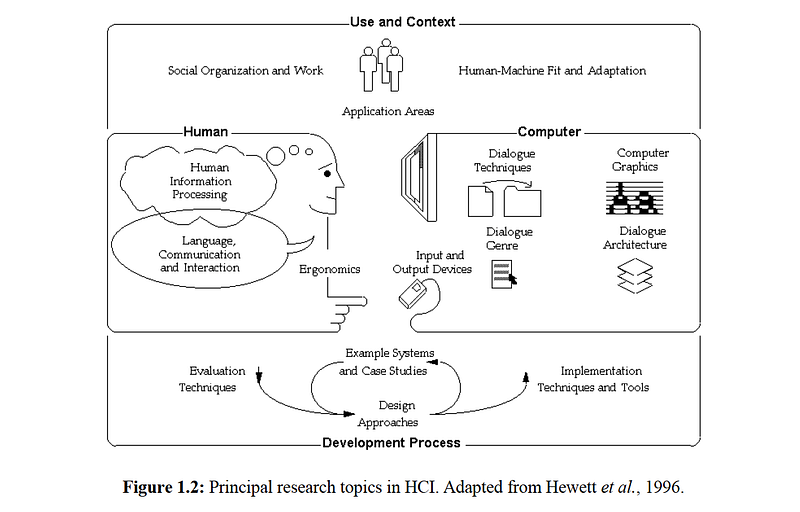
How do HCI researchers apply the hierarchy of activity to HCI study? I have mentioned two branches of activity theory: SSAT and CHAT. The following section shall review their frameworks with the universal hierarchy framework.
1. SSAT and Ergonomics
I have mentioned a branch of activity theory: Systemic—Structural Activity Theory (SSAT). Bedny and other SSAT theorists argued that Leontev’s activity theory is too general and inappropriate to design research. In order to clarify this issue, they presented a general scheme of the structural components of activity: Activity — Task — Action — Operation — Function Block.
The SSAT framework is very complicated for ordinary readers because it is primarily developed for human factors and ergonomics which is a special domain of micro-level work processes.
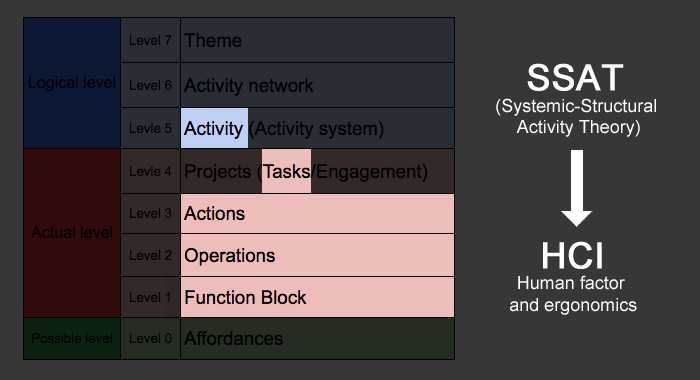
SSAT theorists don’t talk about “activity systems”, “activity networks” and other terms related to the level of “social organization and work.”
2. CHAT and social context
Victor Kaptelinin and Bonnie A. Nardi argued a post-cognitivist perspective for HCI in their 2006 book Acting with Technology, they said “…we believe we will get the most leverage from theory are those involving complex systems with multiple actors and objects. The focus in design is changing from a knowledge worker using a desktop computer to (a) collaborative uses of technology by groups and the larger society, (b) varied virtual and physical contexts, and an expanded set of activities (including those conducted at home), and (d) human experience in general, not just cognition. Of particular interest are the ways individual and collective activities are linked, negotiated, and managed over time.”(p.25)
They used the diagram below to represent “the complexity of real practice, widening analysis to include a cycle of evaluation and design in which people and artifacts influence one another.”(p.25)
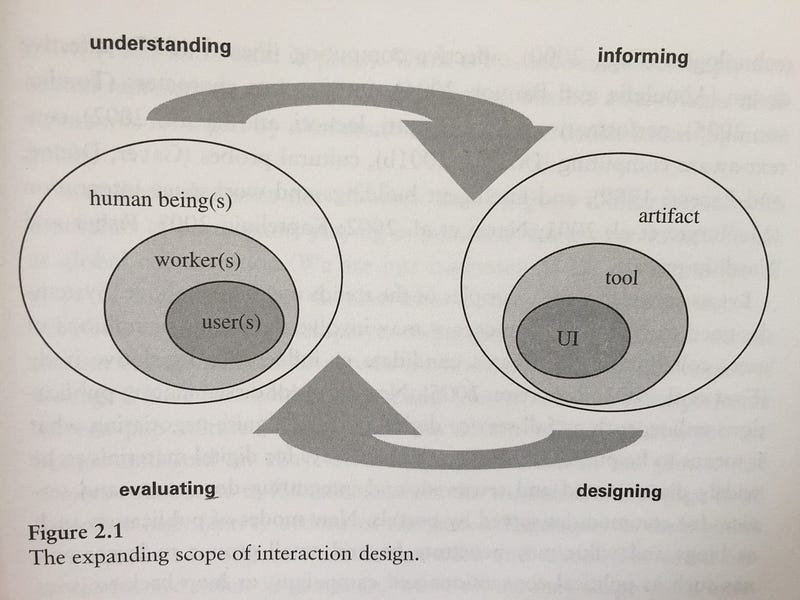
In the 2012 book Activity Theory in HCI, Victor Kaptelinin and Bonnie A. Nardi also reviewed the applications of activity theory in the HCI domain. They focus on two versions of activity theory: the approach developed by Leontiev and a closely related approach proposed by Yrjö Engeström. They said, “By ‘activity theory’ in general we mean an aggregated framework comprising a combination of these two approaches. There are other approaches, which have ‘activity theory’ in their names, as well. A systematic exploration of the question of what (if any) conceptual links are there between these approaches and the ones developed by Leontiev and Engeström is beyond the scope of our discussion here.” (p.11)
The combination of Leontiev’s approach and Engeström’s approach can be referred to as CHAT (cultural-historical activity theory).
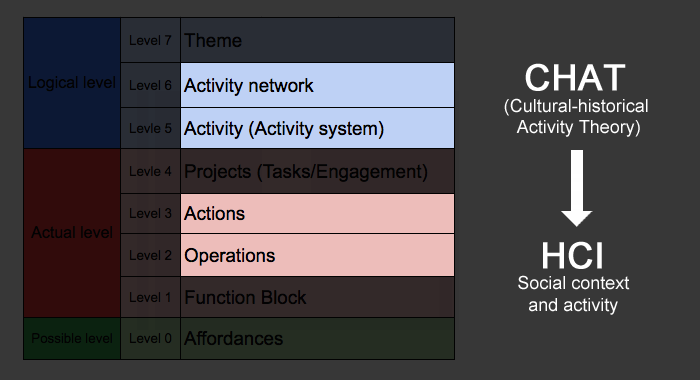
CHAT theorists don’t pay attention to the level of “Function Block”, the level of Operations is the lowest level of analysis for CHAT theorists. They also talk about “activity system” and “activity network” since they pay attention to the social context of human-computer interaction.
3. Possible Practice and Creative Actions
In 2020, I developed a new framework for discussing social practice. See the diagram below. The new framework places Possible Practice in the center.
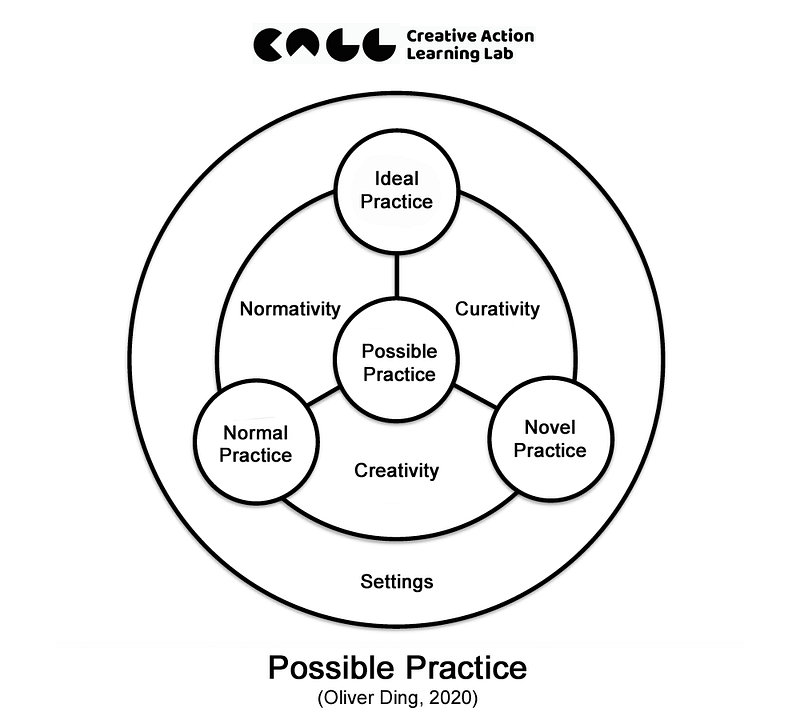
I suggest “Possible Practice” as a new term that expands the scope of contemporary practice theories from “actual actions and existing practice” to “possible actions and possible practice”. The Possible Practice framework is not an alternative to contemporary practice theories, but expands their scope and contains more theoretical concepts such as James J. Gibson’s Affordance.
The notion of Creative Actions is part of the Possible Practice framework. I consider Possible Practice at the macro collective level while Creative Actions at the micro individual level. However, the detail of the mid-level analysis is not clear. Now the universal hierarchy of activity and practice can help me solve the problem. I’d like to select “Themes”, “Projects”, “Actions”, “Acts (Operations)”, and “Affordances” to form a new hierarchy for the Possible Practice approach.
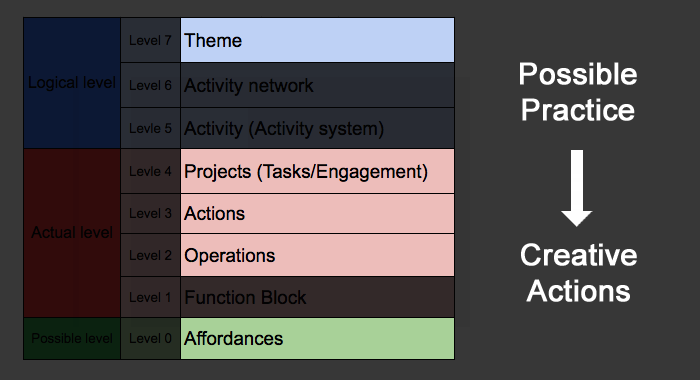
Obviously, this is not a new version of activity theory, but a new approach to social practice, especially creative behavior-related social phenomena.
4. The Final Words
I consider the universal hierarchy of activity and practice as a meta-framework that can be used as a heuristic tool for building frameworks. Readers could use it in the following ways:
- Use it as a list for reference. You can select some levels from the list to build your own hierarchy.
- Use it as a reflecting tool for understanding theories. You can ask yourself: Why does this particular theory (for example, SSAT) accept some levels and refuse other levels?
- Use it as an innovative tool to explore new theoretical spaces. You can ask yourself: Can I add a new level to the list?
- Use it with other heuristic tools. For example, fractal distinction.
Moreover, a hierarchy is part of a theoretical framework or approach. Though this article focuses on hierarchy, we should understand it with its theoretical background and inspect the deep theoretical assumptions and inherent consistencies.
Original article:
You can find references and more details about the universal hierarchy of activity and practice in Activity U (VI): The Hierarchy of Human Activity and Social Practice.
You can find more thinking tools in my book Knowledge Discovery (draft).

Knowledge Discovery: Developing Tacit Knowlege with Thematic Space Canvas
Related Articles
- Meet with Oliver Ding: 1 Mission, 4 Theories, and 12 Possible Books
- The Knowledge Curation Project
- How to Grow A Knowledge Enterprise
- Platform Genidentity: The Movements of Unfolding Uniqueness
- The Slow Cognition Project (Phase II): Activity Analysis for Creative Work Study
- CALL: The Launch Day of Curativity Center
- TalkThree: A Tiny Idea for Knowledge Engagement (June 2, 2022)
- #TalkThree 01: How to Read a Handbook? (June 2, 2022)
- #TalkThree 02: How to Name “X Innovation”? (June 3, 2022)
- #TalkThree 03: How to Use an Abstract Model? (June 6, 2022)
- #TalkThree 04: How Does Collective Learning Work? (June 7, 2022)
- #TalkThree 05: How to Connect X and Y? (June 8, 2022)
- #TalkThree 06: How to Approach Radical Innovation? (June 12, 2022)
- #TalkThree 07: How to Understand “X as Y” (June 14, 2022)
- #TalkThree 08: How to Expand a Framework with Friends (June 15, 2022)
- #TalkThree 09: The Art of Intelligence or Mind (June 16, 2022)
I am also working on building a new website for the Platform Ecology project. You can save the following links:
- PlatformEcology.org
- Twitter: @PlatformEcology
- Linkedin: @PlatformEcology
You are most welcome to connect via the following social platforms:
Linkedin: https://www.linkedin.com/in/oliverding Twitter: https://twitter.com/oliverding Polywork: https://www.polywork.com/oliverding Boardle: https://www.boardle.io/users/oliver-ding


