
#TalkThree 09: The Art of Intelligence or Mind
System 1/System 2, Ecological Rationality, and Curated Mind

This morning I had a wonderful discussion about Emotional Experience, Effectuation, Ecological Rationality, and similar issues. Since these topics are about Intelligence or Mind, I decided to write a short post and share three models about Intelligence or Mind.
In order to offer the context of mind, I collected all posts I shared on Linkedin this morning:
- [#Curativity] Designer as Knowledge Curators
- [#Curativity] The Cross-community Knowledge Curation
- [Creative Actions] A Design Book for Anti-design
- [#Curativity] Connecting Theory and Practice: The Mentorship Theme
I also discussed Emotional Experiences and Personality with a friend.
This post will focus on the issue of Intelligence/Mind.
System I, System II, and Beyond
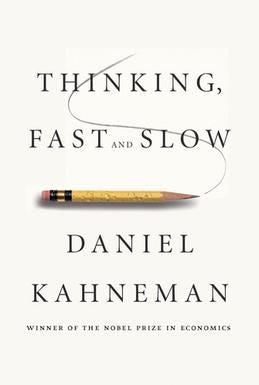
The term “System I/System II” of Mind is introduced to business thinkers by Daniel Kahneman’s 2011 book Thinking, Fast and Slow.
Keith Stanovich and his co-workers developed a tripartite theory of mind which introduces three types of mind: Autonomous mind, Algorithmic mind, and Reflective Mind.
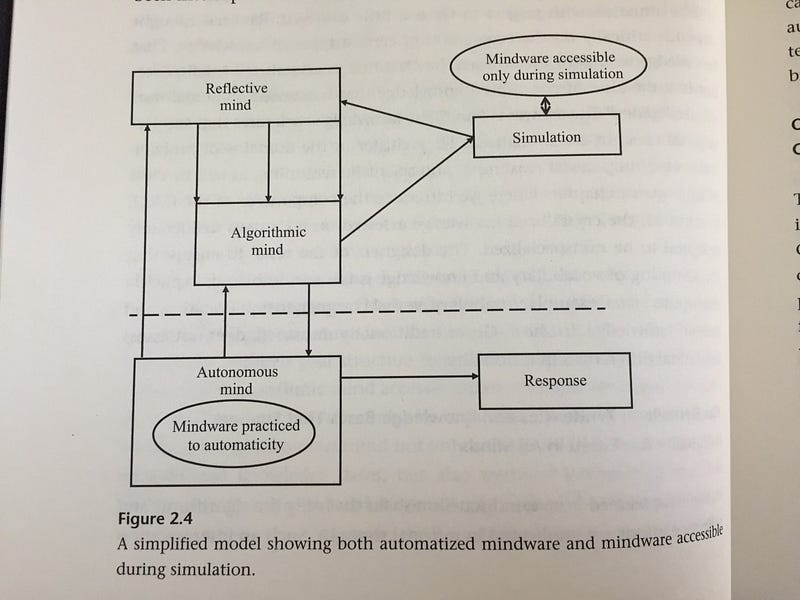
The tripartite theory of mind suggests that there are two types of mind for Type 2 processing: Algorithmic mind (individual differences in fluid intelligence) and Reflective mind (individual differences in thinking dispositions or cognitive styles). According to Stanovich, “Many thinking dispositions concern beliefs, belief structure, and, importantly, attitudes toward forming and changing beliefs. Other thinking dispositions that have been identified concern a person’s goals and goal hierarchy.” (2016, p.25)
Stanovich points out that there are five types of reasoning errors (2016, p.49). One of these errors is about Contaminated Mindware. The reason is very simple if we misunderstand some knowledge, rules, procedures, and strategies, this learned mindware is not original mindware.
The term Mindware was initially coined by the Harvard cognitive development psychologist David Perkins in the 1995 book Outsmarting IQ: The Emerging Science of Learnable Intelligence. Later, the cognitive scientist Keith E. Stanovich adopted the term for his books and his model of cognitive architecture. According to Stanovich, “The knowledge, rules, procedures, and strategies that can be retrieved and used to transform decoupled representations have been referred to as ‘mindware’…The mindware available for use during cognitive simulation is, in part, the product of past learning experiences.” (2016, p.34)
For example, I adopted Activity Theory to reflect on the BagTheWeb project in 2018. However, I used the wrong version of Activity Theory which was built by myself. I didn’t correctly adopt both visualization and conceptualization behind the Activity System model. That means all my learned knowledge about the Activity System model was Contaminated Mindware for me at that time.
Why do I like Stanovich’s framework about Intelligence/Mind?
Because it suggests a new theory of Intelligence and rejects the popular IQ (Intelligence Quotient) test. The distinction between the Algorithmic mind (individual differences in fluid intelligence) and the Reflective mind (individual differences in thinking dispositions or cognitive styles) indicates the lack of IQ test because it doesn’t cover the Reflective mind.
Ecological Rationality
Both Daniel Kahneman and Keith Stanovich emphasize the “right mind”. While Daniel Kahneman considers heuristics in judgment and decision-making and cognitive bias, Keith Stanovich cares about installing the right mideware in the right way.
Other cognitive psychologists have different views on heuristics. For example, Gerd Gigerenzer developed the concept of “Ecological Rationality” and emphasized the ecological aspect of Intelligence.
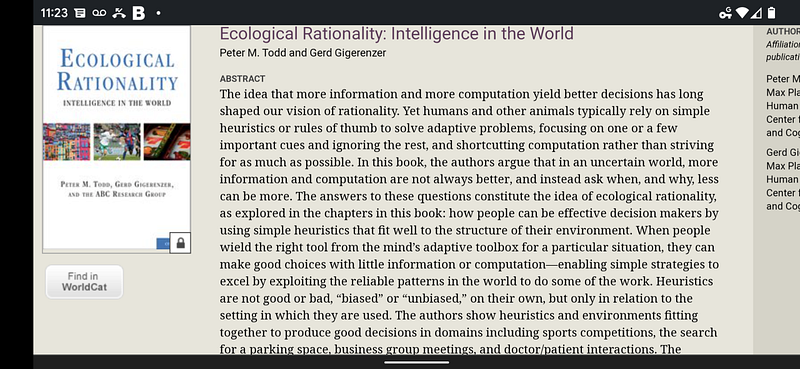
The idea that more information and more computation yield better decisions has long shaped our vision of rationality. Yet humans and other animals typically rely on simple heuristics or rules of thumb to solve adaptive problems, focusing on one or a few important cues and ignoring the rest, and shortcutting computation rather than striving for as much as possible. In this book, the authors argue that in an uncertain world, more information and computation are not always better, and instead ask when, and why, less can be more. The answers to these questions constitute the idea of ecological rationality, as explored in the chapters in this book: how people can be effective decision makers by using simple heuristics that fit well to the structure of their environment. When people wield the right tool from the mind’s adaptive toolbox for a particular situation, they can make good choices with little information or computation — enabling simple strategies to excel by exploiting the reliable patterns in the world to do some of the work. Heuristics are not good or bad, “biased” or “unbiased,” on their own, but only in relation to the setting in which they are used. The authors show heuristics and environments fitting together to produce good decisions in domains including sports competitions, the search for a parking space, business group meetings, and doctor/patient interactions. The message of Ecological Rationality is to study mind and environment in tandem. Intelligence is not only in the mind but also in the world, captured in the structures of information inherent in our physical, biological, social, and cultural surroundings.
The key point of Gerd Gigerenzer’s account is the fit between the structure of our environment and simple heuristics.
This leads to two challenges: 1) the issue of ecological mindset because we have to understand the structure of our environment, and 2) the issue of knowledge curation because we have to choose suitable knowledge heuristics for the present situation.
The Curated Mind
In March 2022, I started working on a new model called the Curated Mind in order to respond to the above two challenges. However, I didn’t pay attention to Intelligence and Rationality from the perspective of cognitive psychology.
The Curated Mind is more about ecological—cultural psychology which goes beyond the individual trait of the mind. Its primary focus is the person—context interaction and its impact on the mind.
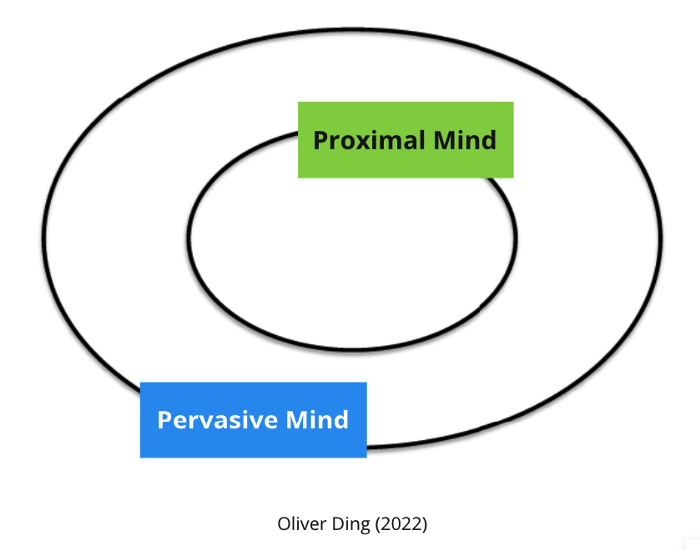
The above diagram is the model of the Curated Mind which is defined as an Anticipatory Activity System. As a system, the Curated Mind has two parts: Proximal Mind and Pervasive Mind.
This model adopted the ecological approach to reflect on the Mind. While Proximal Mind corresponds to Proximal Contexts, Pervasive Mind corresponds to Pervasive Mind.
- Proximal Contexts (Proximal Mind)
- Pervasive Contexts (Pervasive Mind)
A special meta-theory behind the model is Curativity Theory. The term Curativity refers to turning pieces into a meaningful whole. The Curated Mind means the ideal status of the mind. If a person claims that her or his mind is a meaningful whole, then she or he can understand the world as a meaningful whole.
To achieve the Curated Mind, a person has to curate the following dimensions:
- Near — Far
- Self — Other
- Present — Future
- Thing — Think
- etc.
I also pay attention to the following three types of Curativity:
- The Curativity of Proximal Mind: Turning pieces of experiences into a meaningful whole at the loop of Proximal Mind.
- The Curativity of Pervasive Mind: Turning pieces of experiences into a meaningful whole at the loop of Pervasive Mind.
- The Curativity of Mind: Turning “Proximal Mind” and “Pervasive Mind” into a meaningful whole.
From the perspective of the Ecological Practice approach, I use Context(Mind) as the primary unit of analysis to develop the model of the Curated Mind. The above other dimensions can be considered secondary dimensions.
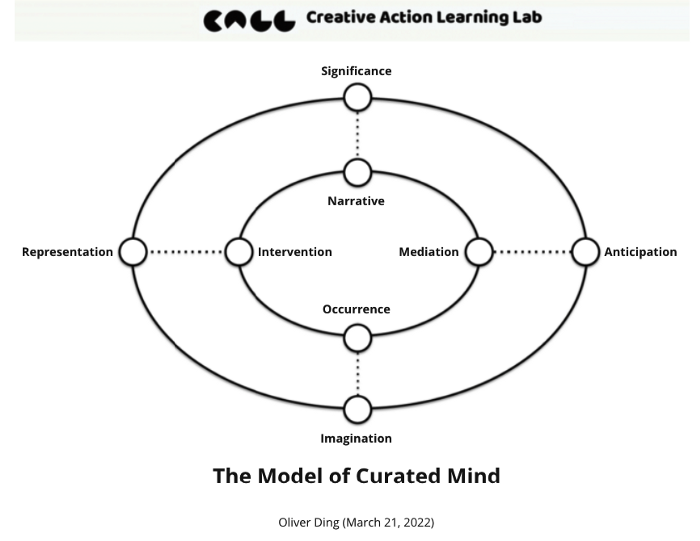
I also used eight operational concepts to expand the basic model of the Curated Mind. The loop of Proximal Mind is represented with the following four operational concepts:
- Occurrence: It refers to the “Natural Situation” which means non-designed situations and environments.
- Intervention: It refers to the “Artificial Situation” which means designed situations and environments.
- Mediation: It refers to the “Mediating Instrument” which means material objects and other tools for human activities and social practices.
- Narrative: It refers to the “Actual Narrative” which means storytelling.
I also use the following four operational concepts for the loop of Pervasive Mind:
- Significance: It refers to the “Cultural Significance” which means the dynamic historical development of cultural signs and other symbolic cultures.
- Representation: It refers to the “Cognitive Representation” which means objects for solving cognitive tasks. For example, Diagrams, models, theories, floor plans, etc.
- Imagination: It refers to imagining some novel things that could guide dramatic experiences and creative actions.
- Anticipation: It refers to predicting the future and managing the complexity of anticipation and performance.
Though I offer the above eight operational concepts for understanding the Curated Mind, It doesn’t mean that the Curated Mind is only about these ideas.
This is just a rough idea. It’s a starting point of the Ecological Approach to the Mind.
The Final Words
Daniel Kahneman, Keith Stanovich, Gerd Gigerenzer are cognitive psychologists. Their work follows the tradition of cognitive psychology.
In a broad sense, the Ecological Practice approach has its philosophical roots in traditional Pragmatism and contemporary embodied cognitive science.
The Curated Mind is a holistic view of the mind and it considers individual actions (that refers to the proximal mind) and collective practices (that refers to the pervasive mind) as a meaningful whole. It is inspired by ecological psychology and cultural psychology.
While the theory of Intelligence and Rationality focuses on individual traits, the Curated Mind cares about the person—context interaction and its impact on the mind.
Each knowledge enterprise has its own primary interest and perspective. Thus, there are various debates between different knowledge enterprises.
Why do we need to care about academic/scientific debates?
Because it tells us that this is not the only choice.
The IQ test is not the only option for evaluating a person’s Intelligence.
The System 1/System 2 model is not the only option for evaluating the value of Heuristics.
Cognitive Psychology is not the only option for understanding the Mind.
There are more choices in the world.
This is a short post, I encourage you to read more original books and papers about Intelligence and Rationality.
Knowledge Discovery: Developing Tacit Knowlege with Thematic Space Canvas
Related Articles
- Meet with Oliver Ding: 1 Mission, 4 Theories, and 12 Possible Books
- The Knowledge Curation Project
- How to Grow A Knowledge Enterprise
- Platform Genidentity: The Movements of Unfolding Uniqueness
- The Slow Cognition Project (Phase II): Activity Analysis for Creative Work Study
- CALL: The Launch Day of Curativity Center
- TalkThree: A Tiny Idea for Knowledge Engagement (June 2, 2022)
- #TalkThree 01: How to Read a Handbook? (June 2, 2022)
- #TalkThree 02: How to Name “X Innovation”? (June 3, 2022)
- #TalkThree 03: How to Use an Abstract Model? (June 6, 2022)
- #TalkThree 04: How Does Collective Learning Work? (June 7, 2022)
- #TalkThree 05: How to Connect X and Y? (June 8, 2022)
- #TalkThree 06: How to Approach Radical Innovation? (June 12, 2022)
- #TalkThree 07: How to Understand “X as Y” (June 14, 2022)
- #TalkThree 08: How to Expand a Framework with Friends (June 15, 2022)
I am also working on building a new website for the Platform Ecology project. You can save the following links:
- PlatformEcology.org
- Twitter: @PlatformEcology
- Linkedin: @PlatformEcology
You are most welcome to connect via the following social platforms:
Linkedin: https://www.linkedin.com/in/oliverding Twitter: https://twitter.com/oliverding Polywork: https://www.polywork.com/oliverding Boardle: https://www.boardle.io/users/oliver-ding


