
Slow Cognition: This is just an accident
An example of Ecological Awareness
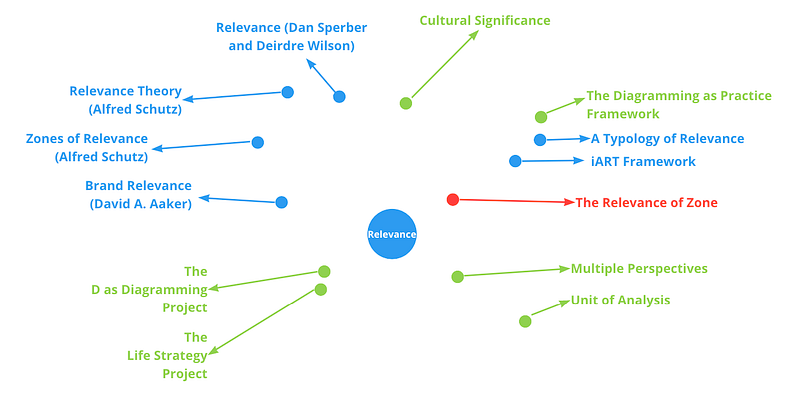
I made the above picture accidentally yesterday morning. The untended action led to a new significant insight: the free version of “Mapping Thematic Space”. It also inspired me to reflect on the concept of “Space” for the “Thematic Space” project.
I have written a short post about this experience on Linkedin. This article offers more details for further discussion.
The Original Intention
Originally, I wanted to design a new diagram for the Platform Ecology project. If you pay attention to my Medium articles and my Linkedin posts, you will notice my recent activities about the Platform Ecology project which is a master project of my 2021 book Platform for Development: The Ecology of Adult Development in the 21st Century (2021). You can save the following links:
- PlatformEcology.org
- Twitter: @PlatformEcology
- Linkedin: @PlatformEcology
In fact, I started the Platform Ecology project in 2019. In Social Platform Experience Design (#SocialPxD), I suggested a multi-perspective framework for understanding social platform experience design. I also considered an ecology view which focuses on the “organism-environment” relationship.
In fact, I list 25 types of O-E relationships for discussing the platform-related “organism-environment” relationships. This is the beginning of the Platform Ecology project.
The book Platform for Development adopts the perspective of adult development to discuss the platform-related “organism-environment” relationships. Yesterday I use the ECHO Way diagram to make a new typology of Platform Players.
An Accident
I duplicated a Frame in a miro board and used it for the new idea. See the screenshot below.
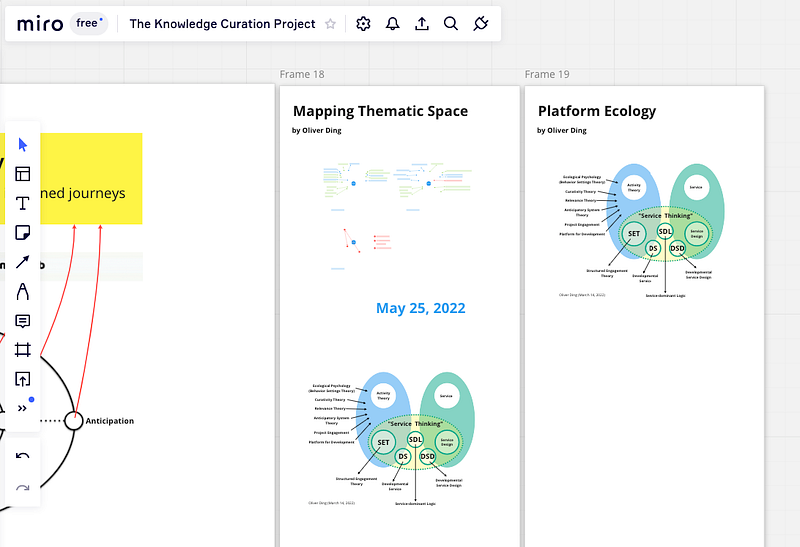
The Frame has two things, one is a set of diagrams of Mapping Thematic Space, and the other one is the model of “Service Thinking” which was made with the Echo Way diagram.
Since I only wanted to use the Echo Way diagram for making a typology of platform players, I decided to remove the set of Thematic Space Canvas. However, I didn’t successfully remove them. Miro only removed the original Thematic Space Canvas but kept the following picture which shows some notes.
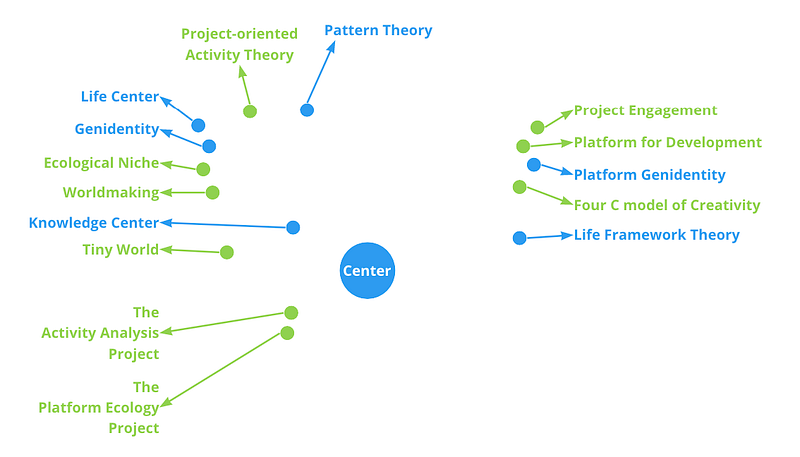
Wow! This was an accident!
A New Significant Insight
But, the result is not bad. I realized that this indicates a new version of Mapping Thematic Space. I named it “Mapping Thematic Space (Free version)”.
The original version was renamed “Mapping Thematic Space (Guided version)”. For example, the picture is the guided version of the above picture. You can find the original Thematic Space Reflection Report here.
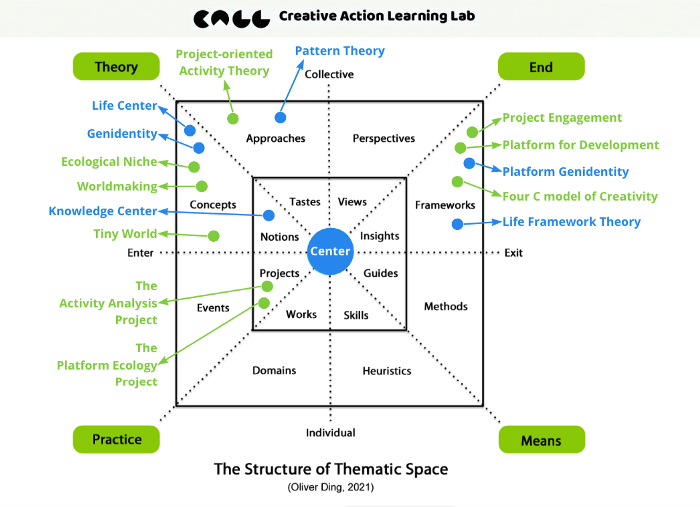
The difference between the above two versions is the following canvas:
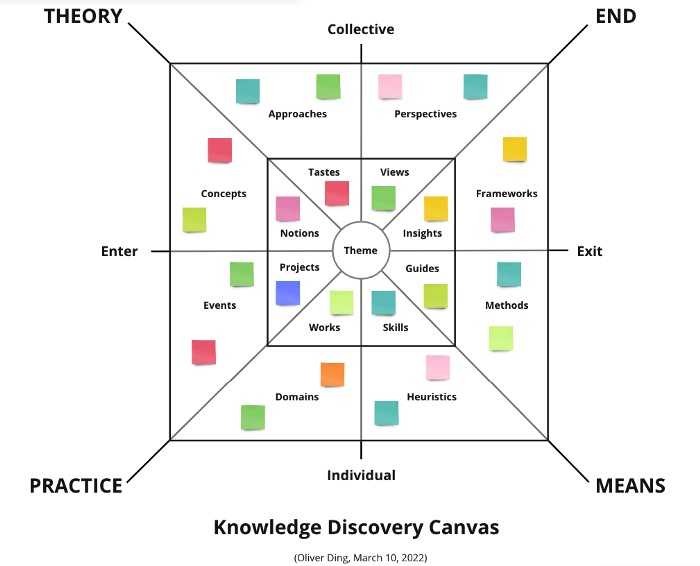
The above canvas was designed with 4 areas and 16 blocks. Each block refers to a category. This is a designed instrument for guiding a reflection on the development of tacit knowledge about a particular theme.
I want to emphasize that there is a difference between the concept of “Thematic Space” and the instrument of “Thematic Space Canvas”.
While “Thematic Space Canvas” is a good tool for understanding the concept of “Thematic Space”, we can do something with the concept of “Thematic Space” without using the “Thematic Space Canvas”.
For example, I wrote two Thematic Space Reflection Reports without making a Thematic Space Canvas. See the link below:
I didn’t make a thematic space canvas for the report about my “Life” thematic space.
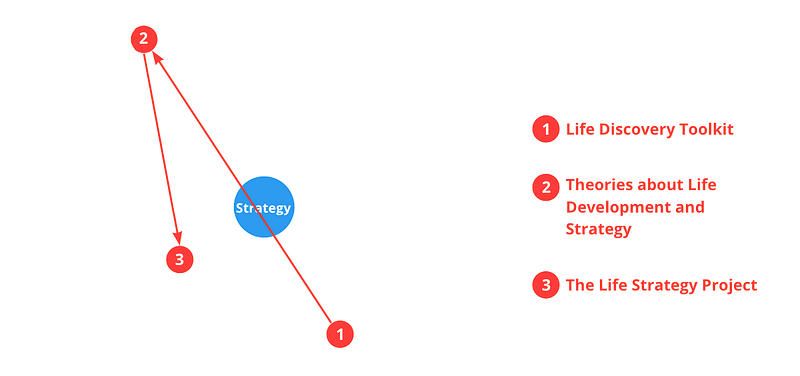
In the above report about my “Strategy” thematic space, I only used the canvas to discuss a decision about the “Life Strategy” project. See the picture below.
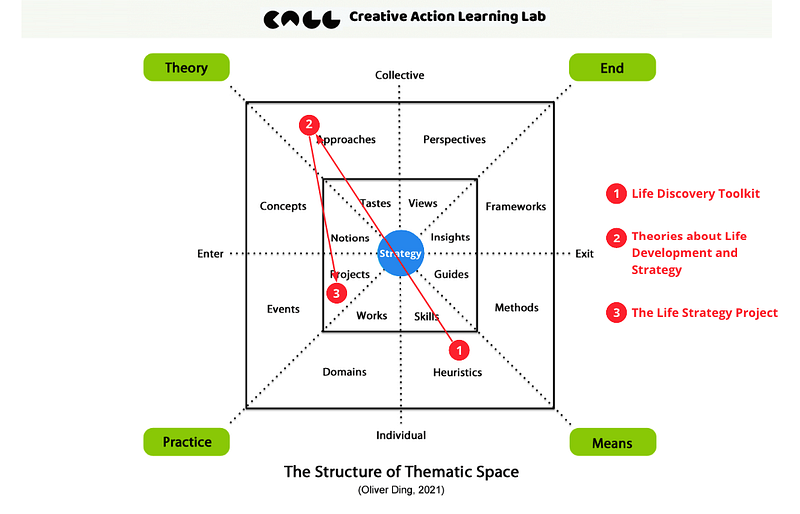
The free version of Mapping Thematic Space removes the structure of the canvas, it allows us to think about a theme without a predefined frame. There are more possible ways to play with “Thematic Space”.
A Technique
Since I claim that there is a Significant Insight, then we can ask a question:
- How did I get this insight? Is there a technique behind the process?
In the previous article Slow Cognition: It takes a village to raise a creative mind, I mentioned the following techniques for capturing 12 significant insights.
- Creative Attachance: #1, #2, #3, #5, #7, #10, #12
- Symbol Awareness: #1, #11
- Writing as Thinking: #2, #5, #11
- Double Container: #2
- Deep Analogy: #2, #11, #12
- Double Dialogues: #3
- Diagramming as Thinking: #4, #5, #6, #7
- The ECHO Way: #4
- Thematic Curation: #5, #12
- Concept Analysis: #6
- Expandness: #6, #7
- Co-creation: #8, #10
- Self-reflection: #8, #11
- Theoretical Development: #9, #12
- Empirical Research: #9
- Ecological Awareness: #10
- Immanent Development: #12
Yesterday, I shared an example of “Symbol Awareness”. Today, I’d like to claim that the above accident is an example of “Ecological Awareness”.
Ecological Awareness refers to making sense of the spatial aspect of environments, including stable status and changes in environments.
The original Thematic Space Canvas was removed, but the original notes were kept. This is a change of environment. I perceived the change and discovered a meaning from the change.
The “Space” of “Thematic Space”
This morning, I reflected on the accident and moved to “Symbol Awareness”.
While “Ecological Awareness” is about non-language spatial sensemaking, “Symbol Awareness” is about language-based symbol sensemaking.
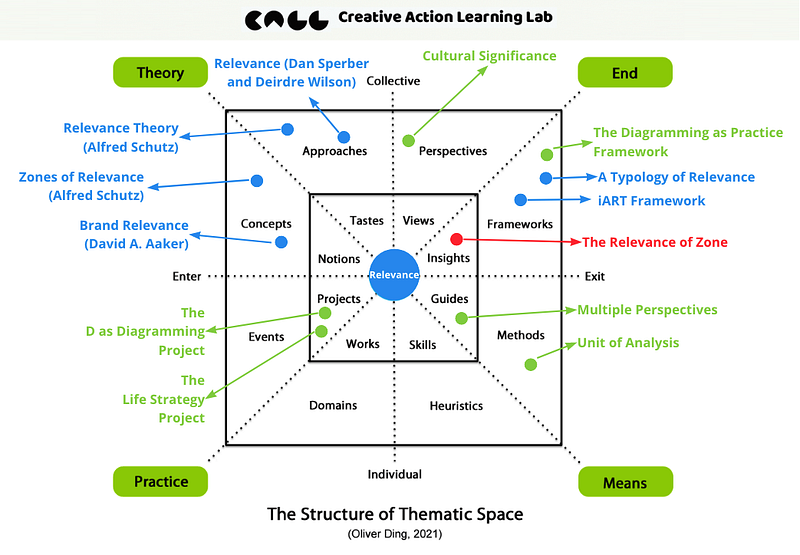
The above picture is the guided version of my “Relevance” thematic space. You can find the original Thematic Space Reflection Report here.
The picture below is its free version.
This morning I made a comment on the Linkedin post. It was clearly produced with the technique of “Symbol Awareness”.
The new insight inspired me to reflect on the concept of “Thematic Space”. Originally, I developed the notion of “Thematic Space” and designed the “Thematic Space Canvas” in the following article.
I used “Thematic Space Canvas” to define a Structure for the notion.
Is the Structure Real?
We can ask Peter Gardenfors a similar question: Is Conceptual Spaces Real? I’d like to quote Gardenfors’ answer as my answer:
Finally, a philosophical question: What is the ontological status of conceptual spaces? I view conceptual spaces as theoretical entities that can be used to explain and predict various empirical phenomena concerning concept formation…Since my basic methodological position is instrumentalistic, I avoid questions about how real the dimensions of conceptual spaces are but view them as instruments for predictive and constructive purposes (compare, for example, the question of what the equator is). (Conceptual Spaces, 2004, p.31)
For me, the notion of Thematic Space and the Thematic Space Canvas are both instruments of the Slow Cognition project. The notion of Slow Cognition refers to the long-term development of thoughts and the historical-cognitive method. The notion of Thematic Spaces is a great tool for turning the notion of Slow Cognition from a concept into a project.
The “Space” of “Thematic Space Canvas” is a guided space. This time, I see the “Space” in a different status: the free space. This refers to a dimension of space: free—guided.
There is also a dimension of space: mental — physical.
If we only think about it as a concept, then the space is a “mental space” or “cognitive space”, if we put it on a paper or a digital board, then it is a “physical/digital space”.
It seems this is a typology of “Thematic Space”. In the past four months, I developed several typologies for some blocks of “Thematic Space Canvas / Knowledge Space Canvas”. However, I didn’t realize that I have to develop a typology for “Thematic Space” itself.
This is a wonderful insight!
Theme as Space
Moreover, I’d like to mention the notion of “Theme as Space”.
My notion of “Theme” can be understood as “Topic”. Originally, the source of “Topic” is “Topos”. According to the Merriam-webster dictionary, “Latin Topica Topics (work by Aristotle), from Greek Topika, from topika, neuter plural of topikos of a place, of a topos, from topos place, topos”.
According to Aristotle, we need a Topos because we can remember a thing by remembering the Topos in which the thing is placed.
If we use the technique of “Deep Analogy” and use “Etymology” as a perspective, then we can understand “Theme” and “Space” into one thing. Theme (Topos) is Space!
Originally, I read the idea of “Theme (Topos) is Space” from a Chinese scholar‘s book Spatial Narratology. The scholar quoted Christian Norberg-Schulz’s discussion about the topic — topos relationship from Genius Loci: Towards a phenomenology of architecture.
Traditional narratology is about the linear temporal narrative because a story or a text is easy to understand if its structure is organized in a temporal sequence. However, some modern writers use spatial simultaneity as the primary approach to organize their stories. They often use the technique of “Juxtaposition” to create a spatial sense in their writing.
The technique of “Juxtaposition” is a nonlinear spatial narrative approach. I adopt it for Thematic Space Reflection Report. If you read my thematic space reflection reports, you can find there is no linear temporal narrative structure. All notes are just listed without a predefined logic structure.
Though the Structure of Knowledge Discovery Canvas (and Life Discovery Canvas, etc) has its predefined logic structure, it is still a structure of “Juxtaposition”. All 16 blocks are not organized in a linear way.
A person can use Thematic Space Canvas in different ways by perceiving its spatial structure and potential connections between different blocks. The canvas doesn’t control the process of sensemaking but offers a space for sensemaking.
Related Articles
- Knowledge Discovery: The “Perspectives — Views” Mapping
- The Project Engagement Toolkit (2022)
- Life Discovery: The Life-as-Project Approach
- The Life Discovery Toolkit (v1)
- The Life Discovery Canvas (v1.0) — Part 1: Theoretical Background
- The Life Discovery Canvas (v1.0) — Part 2: Spatial Structure
- The Life Discovery Canvas (v1.0) — Part 3A: Concepts (THINK and LEARN)
- The Life Discovery Canvas (v1.0) — Part 3B: Concepts (SAY and DO)
- The Life Discovery Canvas (v1.0) — Part 4: Inspirations
- Life Discovery: The “Being by Doing” Principle
- Life Discovery: The “Performance as Experiment” Principle
- Life Discovery: The “Engagement as Projection” Principle
- Life Discovery: The “Discovery as Development” Principle
- Life Discovery: The AAS Framework
- CALL for LIFE: Anticipatory Activity System for Life Transitions
- CALL for LIFE: Modeling A Developmental Project
- CALL for LIFE: Oliver Ding @ 2021 and Second-order Activity
- Life Discovery: Twelve Significant Insights from Four Months
- Life Discovery: “Points of Observation” and “Significant Insights”
- Life Discovery: Significant Insights Analysis
- Slow Cognition: It takes a village to raise a creative mind
- Slow Cognition: The Network Effect of Discovery (Draft)
- Life Discovery: The “Tacit” Type of Second-order Activity
- Life Discovery: The Unfoldness of Activity
I am also working on building a new website for the Platform Ecology project. You can save the following links:
- PlatformEcology.org
- Twitter: @PlatformEcology
- Linkedin: @PlatformEcology
You are most welcome to connect via the following social platforms:
Linkedin: https://www.linkedin.com/in/oliverding Twitter: https://twitter.com/oliverding Polywork: https://www.polywork.com/oliverding Boardle: https://www.boardle.io/users/oliver-ding


