
#TalkThree 13: How to Use the concept of “Self-reference”?
Destructive Self-reference, Neutral Self-reference, and Constructive Self-reference (9 min read, 2003 words)

The above picture refers to the ancient symbol Ouroboros, a dragon that continually consumes itself. It refers to the concept of Self-reference.
According to Wikipedia,
Self-reference occurs in natural or formal languages when a sentence, idea or formula refers to itself. The reference may be expressed either directly — through some intermediate sentence or formula — or by means of some encoding. In philosophy, it also refers to the ability of a subject to speak of or refer to itself, that is, to have the kind of thought expressed by the first person nominative singular pronoun “I” in English.
Self-reference is studied and has applications in mathematics, philosophy, computer programming, second-order cybernetics, and linguistics, as well as in humor. Self-referential statements are sometimes paradoxical, and can also be considered recursive.
A popular book about the topic is Douglas Hofstadter’s 1979 book GEB (Gödel, Escher, Bach: an Eternal Golden Braid).
There are three types of Self-reference:
- Destructive Self-reference
- Neutral Self-reference
- Constructive Self-reference
The ancient symbol Ouroboros refers to Desctuctive Self-reference. The damage is caused by the self-reference of a system.
Neutral Self-reference doesn’t refer to real damage, but just for the logical game. For example, Dale Thomas wrote the following tweet a few years ago:
This tweet has one hundred and forty characters, seventy-four consonants, thirty-nine vowels, nineteen spaces, five commas, and a full stop.
This tweet doesn’t cause real damage.
I particularly like the third one: Constructive Self-reference. Moreover, I want to apply it to my work and life.
In the past several years, I found that it was so hard to apply it in real-life practice. In contrast, we can frequently use the 2x2 matrix in our daily work and life.
Today I’d like to share three examples of using the concept of Self-reference in my projects from the perspective of Constructive Self-reference.
2019: Curativity Theory > Knowledge Curation
I have been working in the curation field for over ten years. I was the Chief Information Architect of BagTheWeb which was an early tool for content curation (We launched the site in 2010). This experience inspired me to make a long-term commitment to the Curation theme. After having 10 years of various curation-related practical work experience and theory learning, I coined a term called Curativity and developed Curativity Theory which became a book.
The new term Curativity refers to “curating pieces into a meaningful whole” which means general curatorial practice. The reason why I coined the term is that I was not satisfied with the specific view of curation such as “professional curation means art and museum.” I argued that there is a need to redefine “curatorial practice” as a general social activity and a universal experience. In other words, I was calling an interdisciplinary view of curation or curatorial practice.
From Oct 2018 to March 2019, I wrote a book titled Curativity: The Ecological Approach to General Curation Practice. It is a 615-page Google Doc file. Unfortunately, it was written in Chinese.
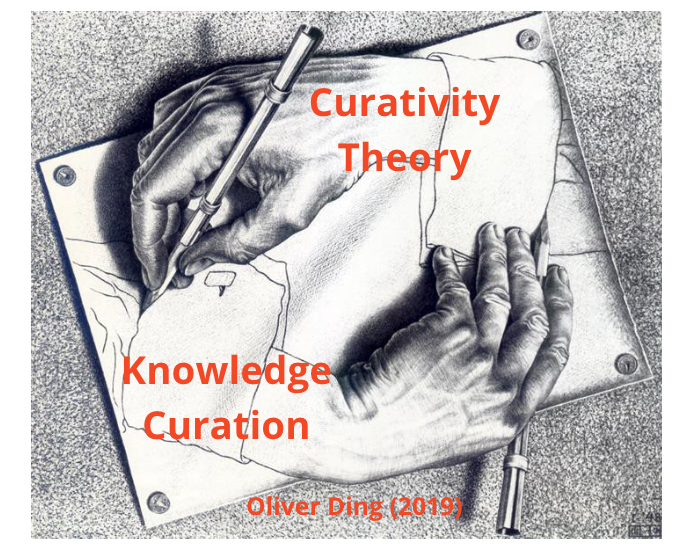
Chapter 7 of the book is titled Curativity Analysis. I chose four fields to test my theoretical concepts and frameworks: Toy Design, Clothing Customization, Family Curation, and Knowledge Curation. These four cases can be considered as the prototype of Curativity Analysis.
In 2020, I needed to decide on a new strategy for CALL (Creative Action Learning Lab). I chose Knowledge Curation as the primary application of Curativity Theory and started the Knowledge Curation Project.
An interesting thing is one of the applications of Curativity theory is Knowledge Curation which can be used to guide the development of Curativity theory. Thus, I roughly make a theoretical self-reference.
However, it depends on the boundary of self. From the perspective of Curativity theory, it is too naive to claim that the pieces and parts are determined by the whole. In fact, Curativity theory embraces the dialectical hierarchy of the pieces-whole relationship. For example, as an application of Curativity theory, Knowledge Curation is a piece while the whole is the Curativity theory. The outcome of Knowledge Curation can be returned to guide the development of Curativity theory.
How do I explore the direction of Knowledge Curation?
The first principle is making new cognitive containers such as diagrams, concepts, and frameworks. For example, I designed the HERO U Framework in June 2020 and applied it to guide the Activity U project in August 2020.
Since then, I have been using the HERO U framework to guide my knowledge curation projects. From August 2020 to May 2022, I wrote 12 books in drafts. This was an amazing experience!
On June 2, 2022, I launched Curativity Theory as a new home for the Knowledge Curation project and other projects.
2022: Project Engagement > Life Discovery
In 2022, I realized that I “USE” the concept of “Self-reference” again for developing the Life-as-Project approach.
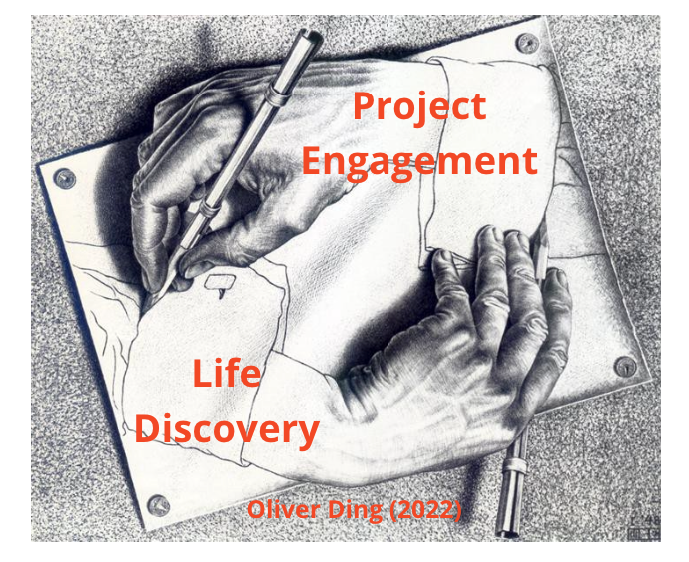
The Life-as-Project approach is an application of my 2021 book Project-oriented Activity Theory. The object of the approach is “Life Discovery”.
In the past six months, I worked on developing the concept of “Life Discovery” by working on three “Life Discovery Projects”. This strategy is just guided by Project-oriented Activity Theory.
I didn’t claim this issue because I intended to develop a new approach called the “Project-centered Approach” which detaches from Project-oriented Activity Theory. However, what I did with the concept of “Life Discovery” is described by Project-oriented Activity Theory.
For me, the Project-centered Approach is inspired by Project-oriented Activity Theory and other theoretical resources.
How did I develop the Project-centered Approach?
- I developed it by working on three Life Discovery Projects.
- I also used the Project-centered Approach to guide my work on three Life Discovery Projects.
This refers to “Self-reference”.
The outcome is a new thing called the “Life-as-Project” approach which connects THEORY and PRACTICE. You can find more details about the “Life-as-Project” approach in Life Discovery: Biography, Journey, Program (and a possible book, Part 1, Part 2).
2021: Anticipatory Activity System (AAS)
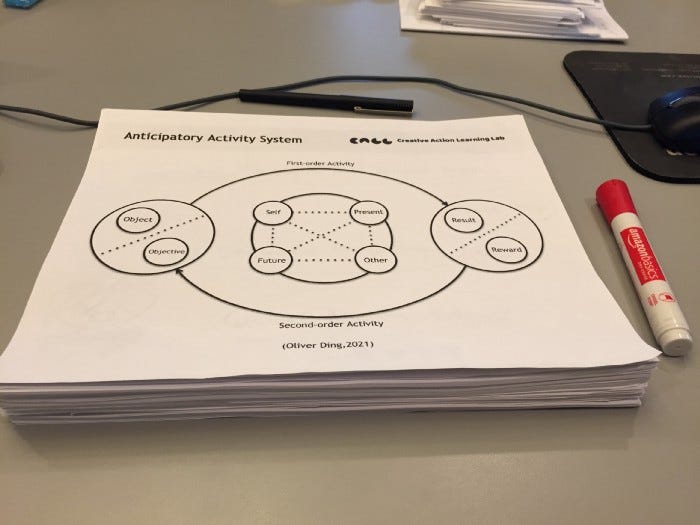
In Sept 2021, I developed the Anticipatory Activity System (AAS) framework which was inspired by Activity Theory, Anticipatory System theory, and other theoretical resources.
The AAS framework is perfect for thinking about the complex of “Self, Other, Present, and Future”. For example:
- Sustainable Business Development
- Organizational Strategy
- Startup Studio or Venture Studio
- Technology Choices
- Educational Strategy
- Family Development
- Intimate Relationship
The complex of “Self, Other, Present, and Future” refers to a special type of Activity. In order to understand its uniqueness, I adopted some ideas from the Anticipatory System theory to the AAS framework.
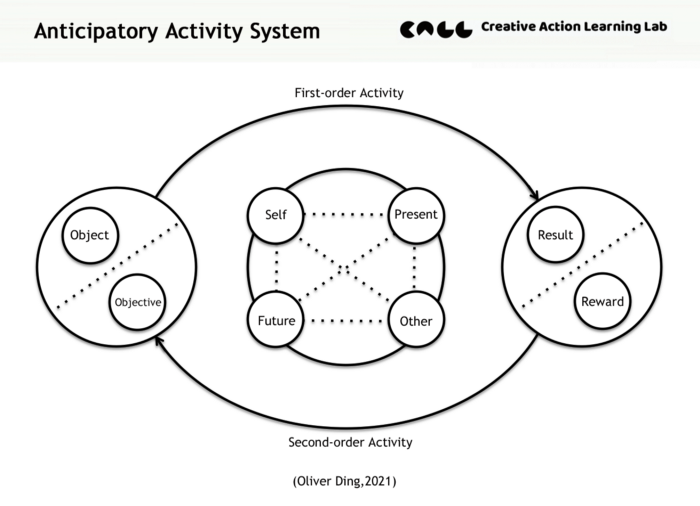
The above diagram is the basic model of the AAS framework. It refers to a special type of Anticipatory System: Activity. The system has one whole and two parts:
- One whole: Anticipatory Activity System
- Part 1: First-order Activity
- Part 2: Second-order Activity
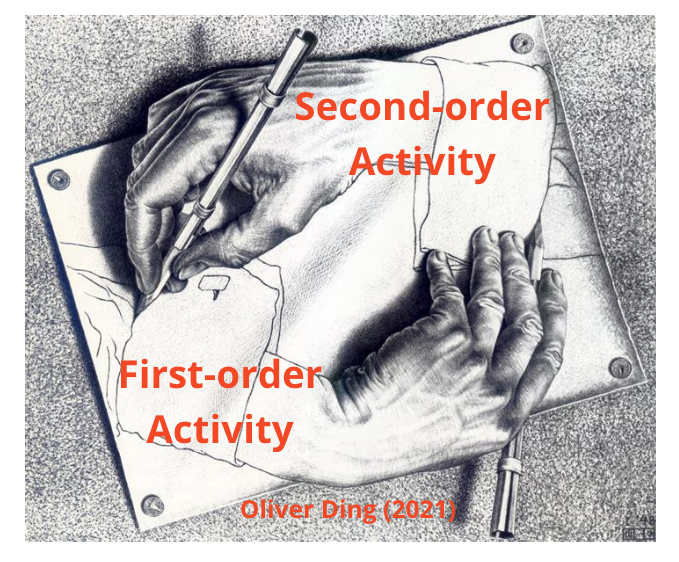
I consider the AAS framework is an application of the “Self-reference” concept.
Why?
First, Anticipatory System is a type of Autopoietic system. Second, Autopoietic system is also called Self-referential systems.
However, we have to pay attention to the difference between the concept of “Self-reference” and the Self-referential systems because Autopoiesis is the capacity of a system to reproduce the components of which it is composed.
According to Robert Poli, “An autopoietic system does not start from pre-given elements, neither does it assemble them…Autopoietic systems are self-referential systems, means that the system’s relational self-production governs the system’s capacity to have contacts with its environment. Put otherwise, the system’s connection with its environment is no longer a kind of immediate and direct relation between the system and its environment but becomes a reflexive relation, mediated by the self-referential loops that constitute the system itself.” (The Complexity of Anticipation, 2009)
Second-order Activity is defined as a special type of Activity that define Objectives for First-order Activity. In this way, Second-order Activity refers to the activity of self-production.
The AAS4LT framework is born from curating insights from both theoretical development and empirical research.
Though most of the ideas are adopted from the Anticipatory Activity System framework and other knowledge frameworks, the whole structure is inspired by an empirical research project about a person’s one-year life transitions.
If you read my articles about iART Framework, you probably know that The Anticipatory Activity System is an expanded version of iART Framework which was born from an empirical research project about an adult development program.
I’d like to call the program SSL which stands for Shaper & Supporter Lab. Anyway, it is just a codename. SSL was founded by a friend of mine in April 2021.
The program was designed with three components: 1) Life Purpose Awareness, 2) Personal OKR Practice, 3) Peer Review and Feedback. My friend also adopted the Building In Public approach to share her goals, challenges, progress, and discussions with others on social media platforms.
My friend started the journey in Feb 2021. In April 2022, we worked on reflecting on her life transition in the past 12 months. In the process of reflection, I realized that she did two activities during the one-year journey.
- Second-order Activity: She spent several months on Life Discovery.
- First-order Activity: Seh started the Shaper & Supporter Lab program as a Developmental Project.
I also observed that she also worked hard on modeling her project and storytelling about her life discovery. This insight inspired me to create the AAS4LT framework. This is an awesome discovery!
From March 2022 to June 2022, I also worked on the AAS4LT program which is a 1:1 life coaching program for applying AAS to Life Transitions (LT). It considers “Life Discovery Project” as Second-order Activity and “Life Developmental Project” as a First-order Activity.
I used the program to test the AAS framework and developed a framework as an intermediate framework.
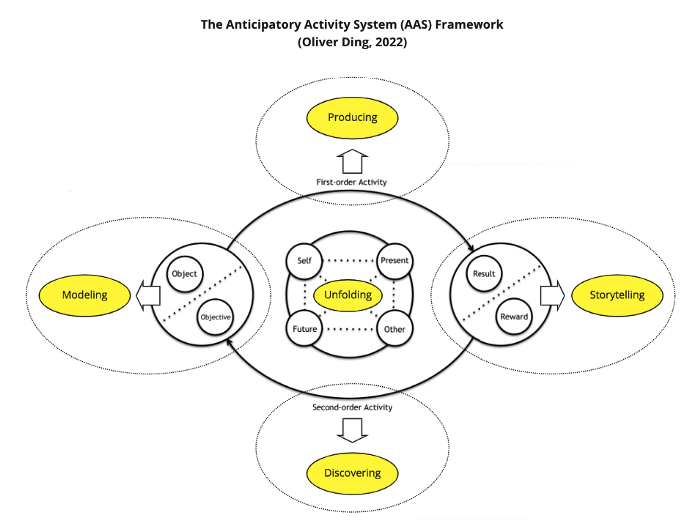
The above diagram is the expanded model of the AAS framework. It highlights five movements to the basic model of AAS.
- Part 1: First-order Activity (Producing)
- Part 2: Second-order Activity (Discovering)
- Whole: Anticipatory Activity System (Unfolding, Modeling, and Storytelling)
The most important movement is Discvering because it refers to Second-order Activity.
Since Anticipatory System is about the future, we need to pay attention to two types of Potentialities.
- Hidden
- Latent
According to Roberto Poli, the entity that is hidden refers to “they are there, only waiting for the triggers able to activate them.” However, “latent determination emerges ‘automatically,’ which means that the context of activation may eventually be provided by the simple passage of time…truly latent components do not exist at all in the entity’s actual state, which may imply that their internal structural determinations have not been formed.”(The Complexity of Anticipation, 2009)
I use the “Unfolding” movement to refer to the process of “the simple passage of time” in order to highlight the “latent” part of the system. This is also the reason that I adopted the “Slow Cognition” method to design the AAS4LT program.
Life Discovery Project is designed for discovering hidden entities and latent entities of Anticipatory Activity Systems.
The Final Words
Most academic theoretical concepts are not useful for practitioners because they are developed for dealing with theoretical issues.
However, some academic theoretical concepts are really useful if they offer brand new perspectives. For example, the concept of “Affordance” offers me the ecological perspective, the concept of “Urphanomen” offers me Goethe’s scientific perspective, and the concept of “Autopoietic system” offers me a new perspective of “System”.
As mentioned above, it is hard to apply academic theoretical concepts to practical works and everyday life. It just needs to take time to understand them and develop some intermediate instruments to connect THEORY and PRACTICE.
Let’s embrace the unfoldness of learning.
You can find more thinking tools in my book Knowledge Discovery (draft).
Knowledge Discovery: Developing Tacit Knowlege with Thematic Space Canvas
Related Articles
- Meet with Oliver Ding: 1 Mission, 4 Theories, and 12 Possible Books
- The Knowledge Curation Project
- How to Grow A Knowledge Enterprise
- Platform Genidentity: The Movements of Unfolding Uniqueness
- The Slow Cognition Project (Phase II): Activity Analysis for Creative Work Study
- CALL: The Launch Day of Curativity Center
- TalkThree: A Tiny Idea for Knowledge Engagement (June 2, 2022)
- #TalkThree 01: How to Read a Handbook? (June 2, 2022)
- #TalkThree 02: How to Name “X Innovation”? (June 3, 2022)
- #TalkThree 03: How to Use an Abstract Model? (June 6, 2022)
- #TalkThree 04: How Does Collective Learning Work? (June 7, 2022)
- #TalkThree 05: How to Connect X and Y? (June 8, 2022)
- #TalkThree 06: How to Approach Radical Innovation? (June 12, 2022)
- #TalkThree 07: How to Understand “X as Y” (June 14, 2022)
- #TalkThree 08: How to Expand a Framework with Friends (June 15, 2022)
- #TalkThree 09: The Art of Intelligence or Mind (June 16, 2022)
- #TalkThree 10: How to use a Hierarchy? (June 21, 2022)
- #TalkThree 11: How to find a SIG (Special Interest Group)? (June 26, 2022)
- #TalkThree 12: Re-learning Activity Theory (June 27, 2022)
I am also working on building a new website for the Platform Ecology project. You can save the following links:
- PlatformEcology.org
- Twitter: @PlatformEcology
- Linkedin: @PlatformEcology
You are most welcome to connect via the following social platforms:
Linkedin: https://www.linkedin.com/in/oliverding Twitter: https://twitter.com/oliverding Polywork: https://www.polywork.com/oliverding Boardle: https://www.boardle.io/users/oliver-ding


