
This Title Is Blatantly Self-Referential
And this subtitle has a bit of an attitude. Got a problem with that?
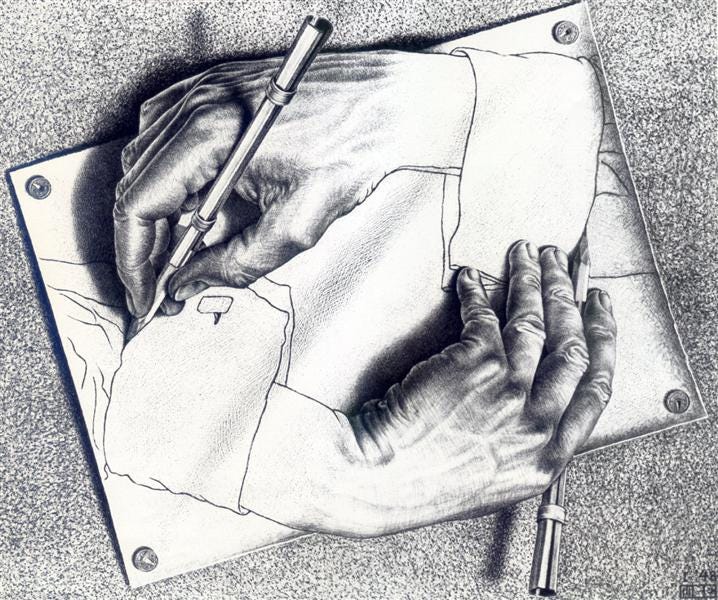
Self-referential sentences are exactly what you think they are. They are sentences that refer to themselves.
“What’s the point of that?” I hear you ask.
Well, I find them fun to read and construct. Isn’t that enough? For me, they have the same effect on the brain as a well-constructed joke. That is, while reading them, my brain is forced to perform a flip, like suddenly seeing the opposite side of a Necker Cube. That’s really satisfying.
A few years ago, I went through a period of writing microfiction and other silly tweets, including self-referential ones. This is the one I am most proud of:
This tweet has one hundred and forty characters, seventy-four consonants, thirty-nine vowels, nineteen spaces, five commas, and a full stop.
Go on, count them. I’ll wait. Think about how difficult it is to create that kind of sentence. Changing a single thing means the whole sentence has to be rewritten. It’s like balancing dozens of items on the head of a pin and then trying to replace one without the whole structure falling down. Try to make your own, it’s better than Sudoku!
There are a few other things that make them interesting. For example, they are a deep insight into the domain of logical paradoxes.
Let’s look at a very simple one.
This sentence is false.
It is an example of the liar’s paradox. It seems innocuous enough until you start to think about it. Is it false? Well, if it is, then what it is saying is actually true, and if it is true, then it must be false. Argh, my head hurts!
Here are some more:
This sentence no verb.
Disobey this command!
This sentence refers to all sentences that do not refer to themselves.
sentence is missing the first and last
This sentence contains exactly threee erors.
Each one makes you stop and think. I particularly like the last one.
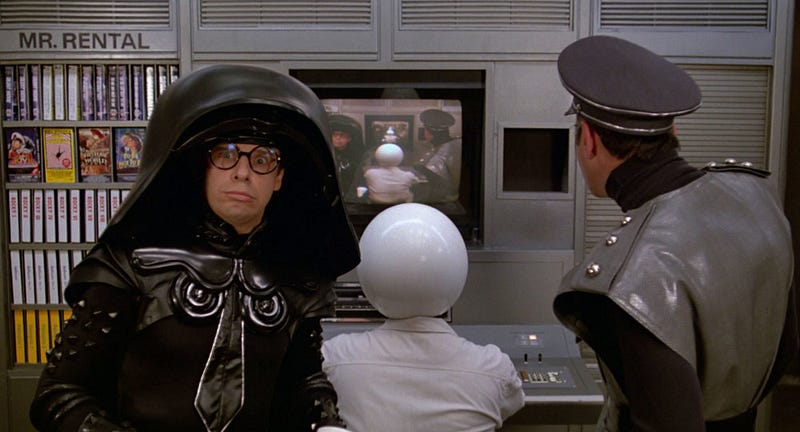
The movie Spaceballs has a fourth-wall-breaking scene where they watch the very movie that they are making within the story. It’s a very surreal and funny moment, a rare example of a self-referential movie.
While it may all seem like fun and games, the concept of self-reference is a big deal for some.
Consider this statement:
The barber is the “one who shaves all those, and those only, who do not shave themselves”. The question is, does the barber shave himself?
Well, come on, does the barber shave himself or not? Obviously, there is no definitive yes or no answer. It’s called the barber paradox and it’s very similar to the liar’s paradox. The issue at hand is that such a statement can be phrased in the language of mathematics, specifically set theory. And since it is a paradox and cannot be answered, it means that mathematics is incomplete. There are some mathematical problems that cannot be proved.
This relates to the halting problem in computer science and Gödel’s incompleteness theorems in mathematics. It’s actually a big problem for the boffins because it means there are serious limits to our understanding of things and what we can theoretically solve. Not a problem for you or me though. Just a bit of fun.
It is also of interest to Artificial Intelligence programmers. Using symbolic reasoning systems, it’s easy for an AI to trip up on such sentences. Consider this:
The following sentence is true. The previous sentence is false.
What is an AI supposed to make of that? Humans have the ability to immediately pull out of the mutual-referential loop and see that it’s a paradox, but unless an AI is specifically programmed to do such a thing, there is a danger of it getting stuck in an infinite loop while trying to work out the veracity and validity of each statement. We’ve all seen movies where a robot says “cannot compute” and then shuts down as smoke and sparks fly out of its head. For AI researchers, the concept of self-reference can be a deadly minefield.
Anyway, I hope you have enjoyed this short introduction to a curiosity of language and logic. Many of them come from the books of Douglas Hofstadter, go check them out. So, do you like the concept of self-reference? Can you come up with your own sentences and logical/linguistic constructions that boggle the mind? I’d love to see them.


