
Slow Cognition: A Meta-canvas for Developing Tacit Knowledge
Thematic Space Canvas and Knowledge Discovery Canvas

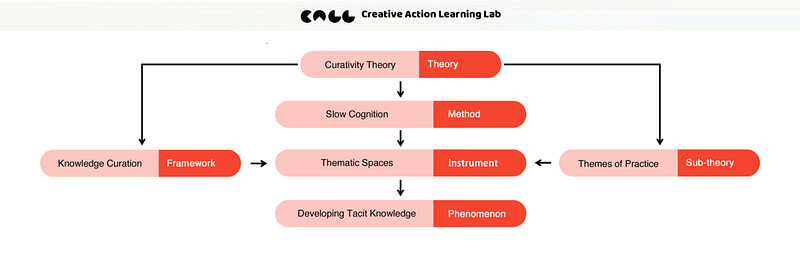
As mentioned before, I want to adopt the historical-cognitive method to study creative work and creative life. In Jan 2022, I started the Slow Cognition project which is designed with the following ideas:
- Theory: Curativity Theory
- Sub-theory: Themes of Practice
- Framework: Knowledge Curation
- Method: Slow Cognition
- Instrument: Thematic Space Canvas
- Phenomenon: Developing Tacit Knowledge
See the diagram below. The essential parts of the project are Thematic Space Canvas and Developing Tacit Knowledge.
My idea is very simple. I focus on the long-term development of a theme. If we use Andy Blunden’s term, then the long-term development of a theme is the germ-cell of Slow Cognition.
A thematic space refers to a person’s ideas, activities, and practices around one particular theme. A theme can be an established theory such as “Activity Theory”; or a normal concept such as “Platform”, “Life”, etc; and an idea in the middle, such as “design thinking”, “UX”, etc.
The Thematic Space Canvas as a Meta-canvas
In the past two months, I designed the Thematic Space Canvas and used it to design other canvases. Today I realized that I should use the term “Thematic Space Canvas” to name a meta-canvas, and use “Knowledge Discovery Canvas” to rename the original Thematic Space Canvas.
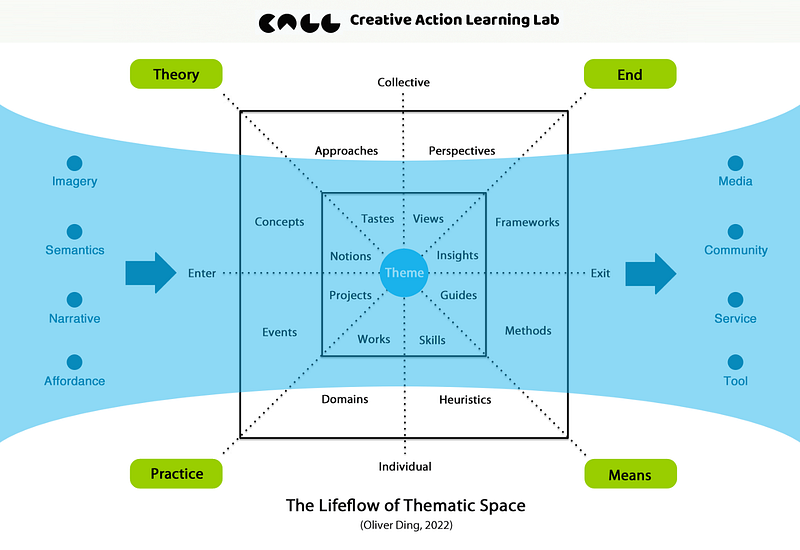
The diagram below is the newest design of the meta-version of Thematic Space Canvas.
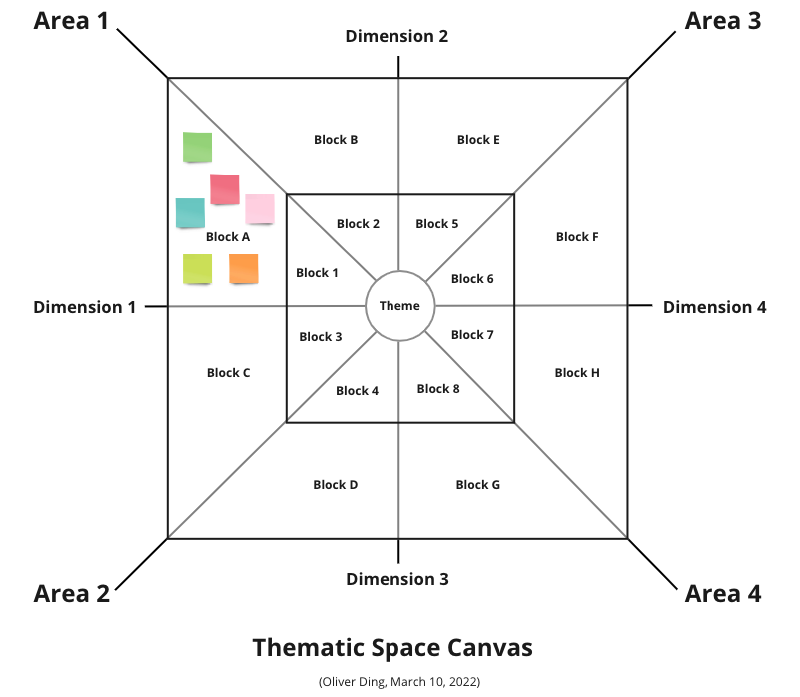
I use general abstract terms for the above meta-canvas which is only about a special type of Spatial Structure without using any domain-special terms. In other words, this is a meta-canvas.
From Meta-diagram to Meta-canvas
In 2018, I wrote a 108-page thesis titled Diagram Explained. I developed a framework for understanding multiple layers of diagrams and wrote a list of topics about diagramming.
The thesis considers two groups of ideas. The first group is “meta-diagram, diagram, and diagram system” and the second group is “diagramming as an activity of knowing, theorizing, and reflecting”.
The notion of “meta-diagram” considers a special type of diagram as an independent thing that doesn’t have to be a representation of an existing theory or model. For example, the 2x2 matrix diagram is a meta-diagram that doesn’t refer to any concrete theory or model such as BCG’s Growth-share matrix. A diagram system is a series of diagrams that share an intrinsic spatial logic and a visual identity.
The notion of “diagramming as an activity of knowing, theorizing and reflecting” adopts a process view to understand Diagrams. In other words, it is “becoming.” That means we can use diagrams as a tool for our thinking. We don’t need to consider all diagrams as outcomes.
The Diagramming as Practice Framework has expanded the above two groups of ideas. You can find more details here. However, the framework can’t document my work on Meta-diagrams since it is a thinking tool.
During the past years, I designed several Meta-diagrams and used them for my work. Last year, I adopted these meta-diagrams for the D as Diagramming project and other projects. Some meta-diagrams were designed years ago, others were designed recently. The picture below is an updated version of my diagrams.
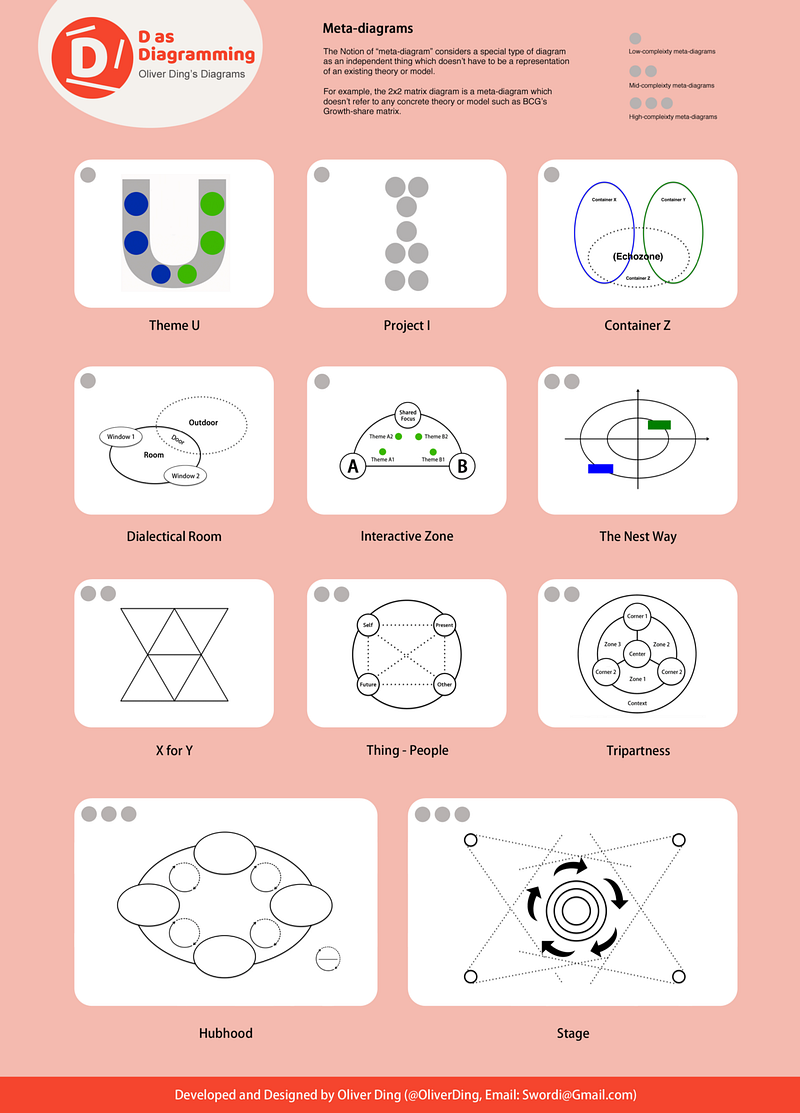
A meta-diagram is not a knowledge framework or model. The value of meta-diagrams is highlighting the hierarchy of diagrams and the cognitive diversity of diagramming. You don’t have to only use the 2x2 matrix meta-diagram to frame your thoughts.
The above 11 meta-diagrams are classified into three categories due to their complexity. I used small grey dots to mark this aspect.
- One grey dot: Low-complexity meta-diagrams
- Two grey dots: Mid-complexity meta-diagrams
- Three grey dots: High-complexity meta-diagrams
The Part-Whole Curativity is the foundation of Diagram Blending. Low-complexity meta-diagrams can form higher complexity meta-diagrams. Thus, the low-complexity meta-diagrams can be considered as parts of the higher complexity meta-diagrams.
For me, the above 11 meta-diagrams connect and form a large dynamic network that can roughly match the dynamic network of my tacit knowledge. You can use these meta-diagrams or develop your meta-diagrams too.
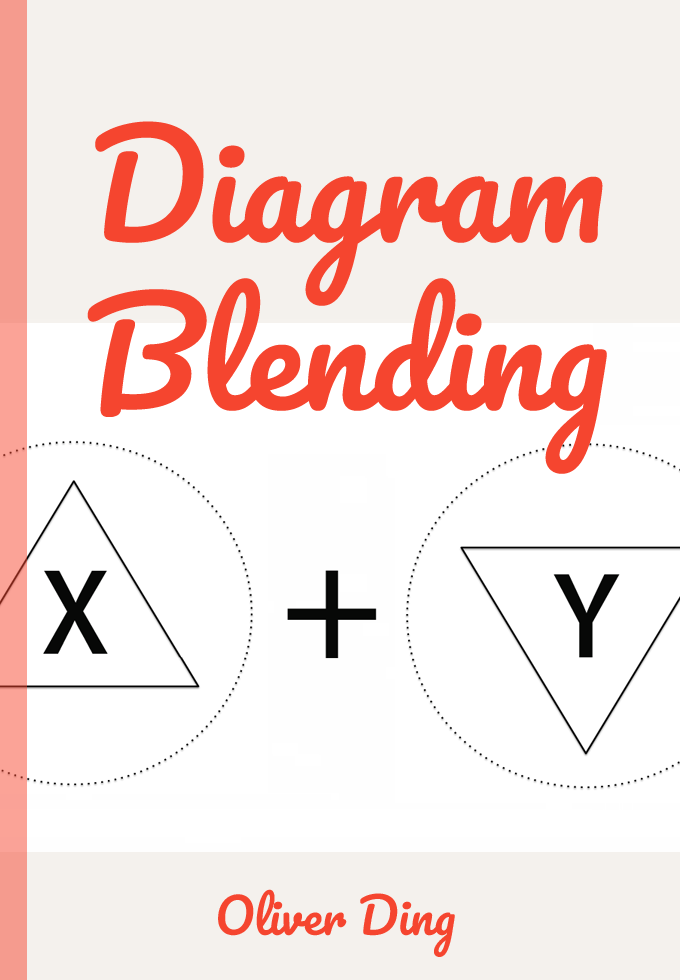
The above picture is designed for a possible book that collects my articles about meta-diagrams and the new practice of diagram blending. You can find more details here.
The book is the outcome of the D as Diagramming project (phase I). I published an article about the book on Dec 28, 2021.
In Jan 2022, I started designing some toolkits and knowledge canvases. Eventually, I designed six canvases.
- The Thematic Space Canvas
- The Spark Space Canvas
- The Statue Space Canvas
- The Life Discovery Canvas
- The Optimal Context Canvas
- The Lifesystem Development Canvas
As the primary canvas of the Slow Cognition project, the Thematic Space Canvas also defines the spatial structure of the other five canvases.
Today, I realized that I have to highlight the meta-canvas behind these five canvases with the name “Thematic Space Canvas”. The original Thematic Space Canvas is renamed Knowledge Discovery Canvas.
The Spatial Structure of Thematic Space Canvas
A meta-canvas is an abstract canvas that doesn’t tie to any domain. The goal of designing a meta-canvas is to highlight a unique spatial structure for designing domain-specific canvases.
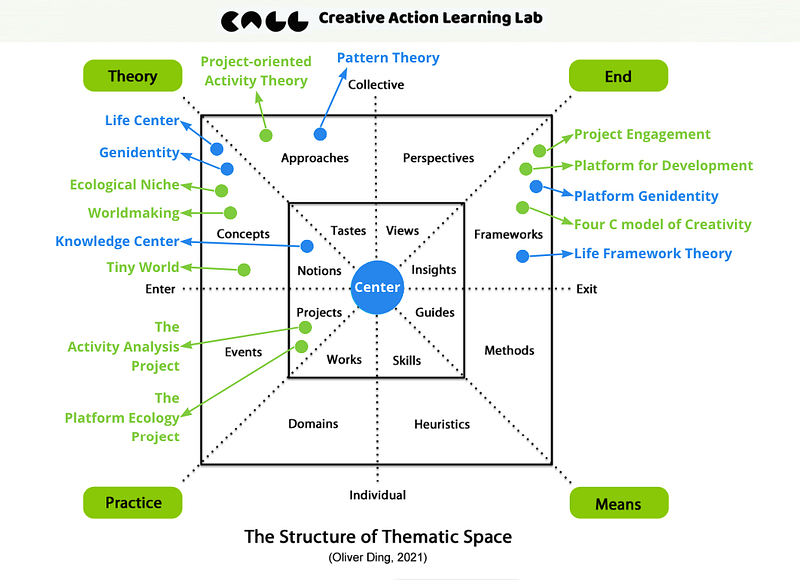
The diagram below is the new Thematic Space Canvas. I use abstract terms such as “area”, “dimension”, “block”, and “theme” for the new canvas.
The Thematic Space Canvas is not a simple 2x2 matrix for building a typology, but a multiple-dimension model for visualizing a holistic view to sense-make a dynamic meaningful whole. You can find more details here: The Notion of Thematic Spaces.
The Thematic Space Canvas’ spatial structure is designed with the following aspects:
- Four Significant Areas
- Four Dimensions
- Two Subspaces: Inner Space and Outer Space
- Eight Pairs of Blocks
- A Primary Theme
The uniqueness of the Thematic Space Canvas is that it adopts the perspective of Activity Theory and considers the whole process of using the canvas as an activity. Moreover, it uses Inner Space and Outer Space to represent the “Internalization — externalization” principle of Activity Theory.
For the Developing Tacit Knowledge, I call it “Objective — Subjective” Knowledge Curation. While Objective Knowing refers to Outer Space, Subjective Knowing refers to Inner Space.
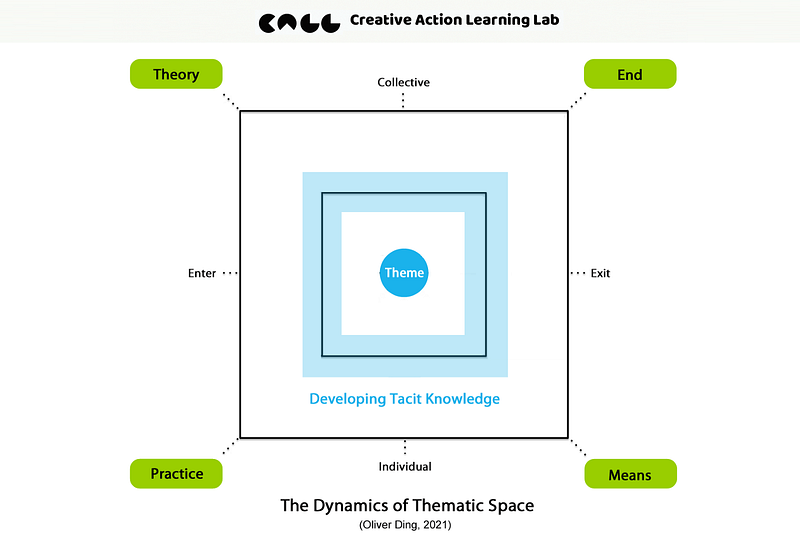
For other canvases, I defined other aspects of Inner Space and Outer Space.
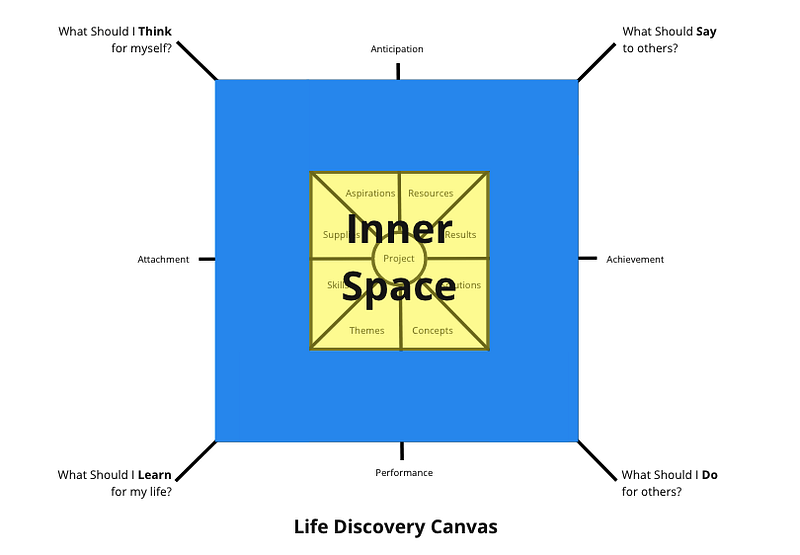
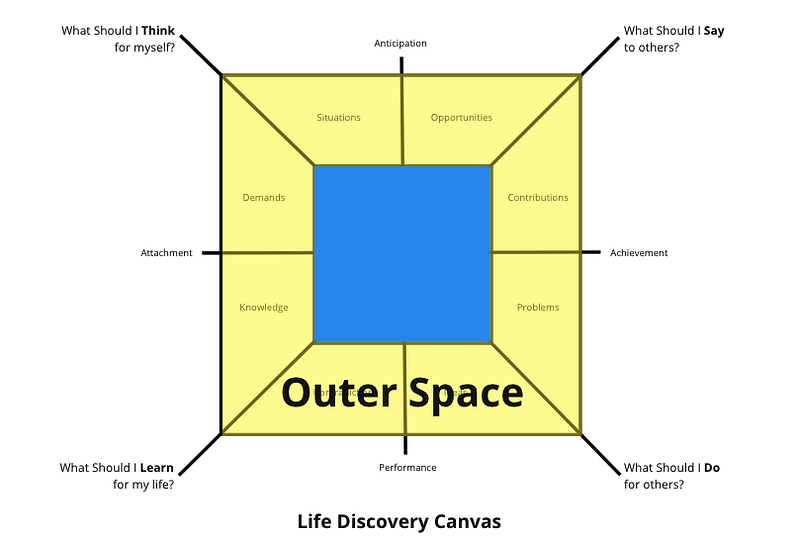
The Thematic Space Canvas has 16 blocks that offer spaces for pasting notes. For example, the below picture is an example of Mapping Thematic Space. If you use a large size canvas, then you can directly put notes inside blocks.
You can find more details about the spatial structure here.
Knowledge Discovery Canvas
The original Thematic Space Canvas is renamed Knowledge Discovery Canvas. See the picture below.
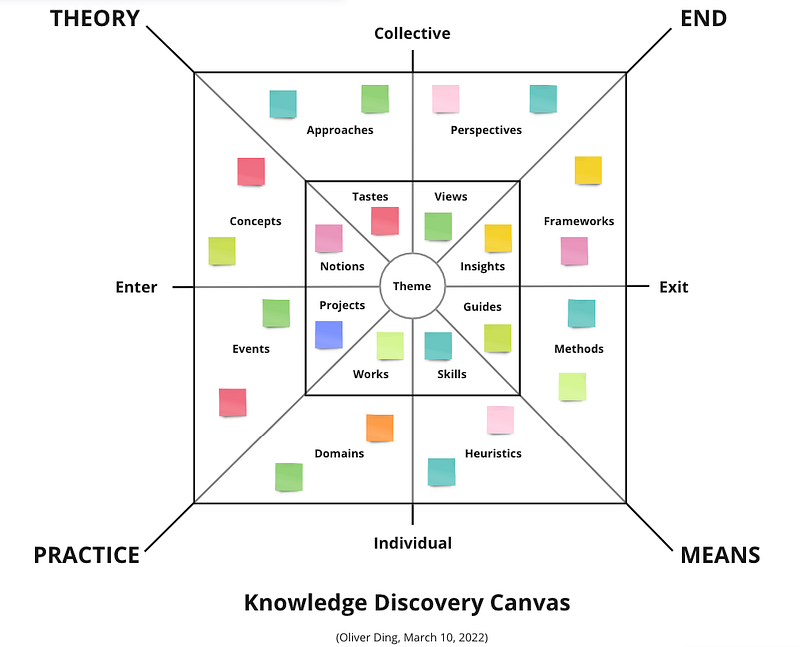
I will keep using “Thematic Space”, “Thematic Space Canvas”, and “Knowledge Discovery Canvas” for the Slow Cognition project.
Discovery as Activity
In The Life Discovery Canvas (v1.0) — Part 2: Spatial Structure, I used the following diagram to discuss a deep analogy between Developing Tacit Knowledge and Life Discovery Activity.
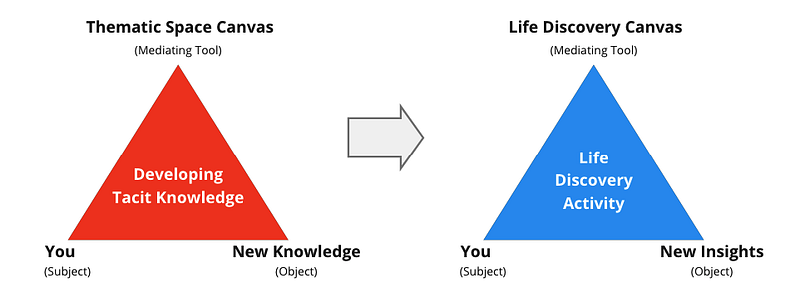
This deep analogy is based on the basic model of Activity Theory: Subject — Mediating Tool — Object. This model is inspired by Lev Vygotsky’s Cultural-historical Theory. You can find more details on the Activity Analysis website.
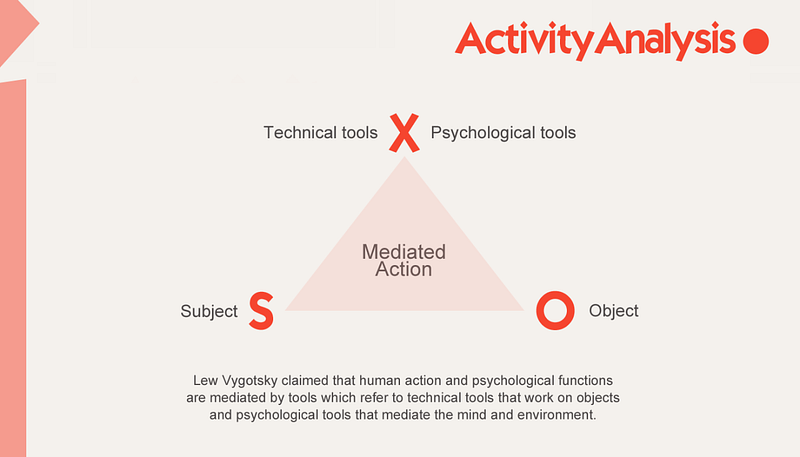
Vygotsky claimed that human action and psychological functions are mediated by tools which refer to technical tools that work on objects and psychological tools that mediate the mind and environment. The idea of “mediated action” is usually represented by a triangle that contains three elements: subject, mediating artifact/tool, and object.
I’d like to point out that there are different versions of understanding Vygotsky’s idea. Lev Vygotsky didn’t develop the term “Activity” as a theoretical concept. Activity Theory was initiated by A. N. Leontiev.
We should pay attention to the difference between “mediated action” and “mediating activities”.
For Vygotsky, “Man himself determines his behavior with the help of artificially created stimuli-devices…human behavior was determined not only by the stimuli present but by a new or changed psychological situation created by the man himself. (Vygotsky 1977, pp. 49–54)”.
Thus, the key to developing our minds is not adopting things from the outside, but creating some things from the inside to respond to the outside change. It means that the man can change his psychological situation for himself.
If we adopt the model of “Subject — Mediating Tool — Object” to reflect on the Thematic Space Canvas and other canvases, then we see a series of activities:
- Knowledge Discovery
- Life Discovery
- Opportunity Discovery
- etc.
Now we can add the notion of “Discovery as Activity” to the Slow Cognition project.
Discovery v.s. Delivery
The opposite side of “Discovery” is Delivery. Thus, the pair of themes of “Discovery — Delivery” echoes the Means-End Spectrum.
From the perspective of Activity Theory, I consider the Means v.s. End issue within concrete activities. For a particular activity, a diagram might be an end, I call it Thought-to-Diagram. For another particular activity, the same diagram might be a means, I call it Diagram-to-Thought. If we combine these two situations, we can develop a Means-End Spectrum and use it to present various instrumental values of diagrams.
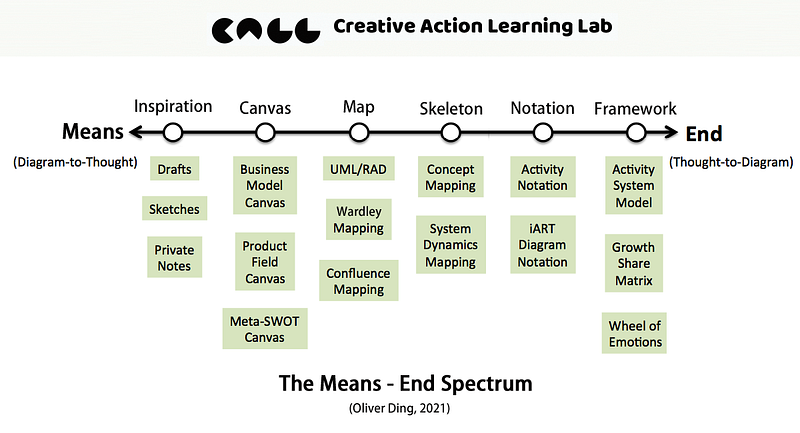
The above diagram offers a spectrum with six types of diagrams. The left side refers to Means (Diagram-to-Thought) and it stands for a weak ontological position of diagrams. We don’t have to require a perfect form of diagrams if we use them as means for our thinking since we don’t make diagrams as final products. The right side refers to End (Thought-to-Diagram) and it requires a strong ontological position of diagrams. To make diagrams as final products for others to use, we have to work hard to produce ideal diagrams.
Based on the spectrum of the ontological position of diagrams, I identify six types of diagrams: Inspiration, Canvas, Map, Skeleton, Notation, and Framework. The weakest position is Inspiration which refers to drafts, sketches, private notes, etc. The most strong position is Framework which refers to formal knowledge models.
If we adopt the Means-End Spectrum to reflect on the family of Thematic Space Canvas, then they are located on the left side. It means that we are using these canvases for our thinking activities.
Moreover, I’d like to claim that Knowledge Discovery, Life Discovery, and Opportunity Discovery are all located on the left side. They are about thinking-for-self activities, not producing-for-other activities.
The primary objects of thinking-for-self activities are notes, drafts, inspirations, sketches, notions, debates, misunderstandings, etc. They are not final products for public delivery.
In the past few years, I have had a keen interest in the intellectual biographies of academic creators. Authors of these biographies often collect private notes and personal letters to explore creators’ thought development deeply. I often saw some amazing diagrams in these books.
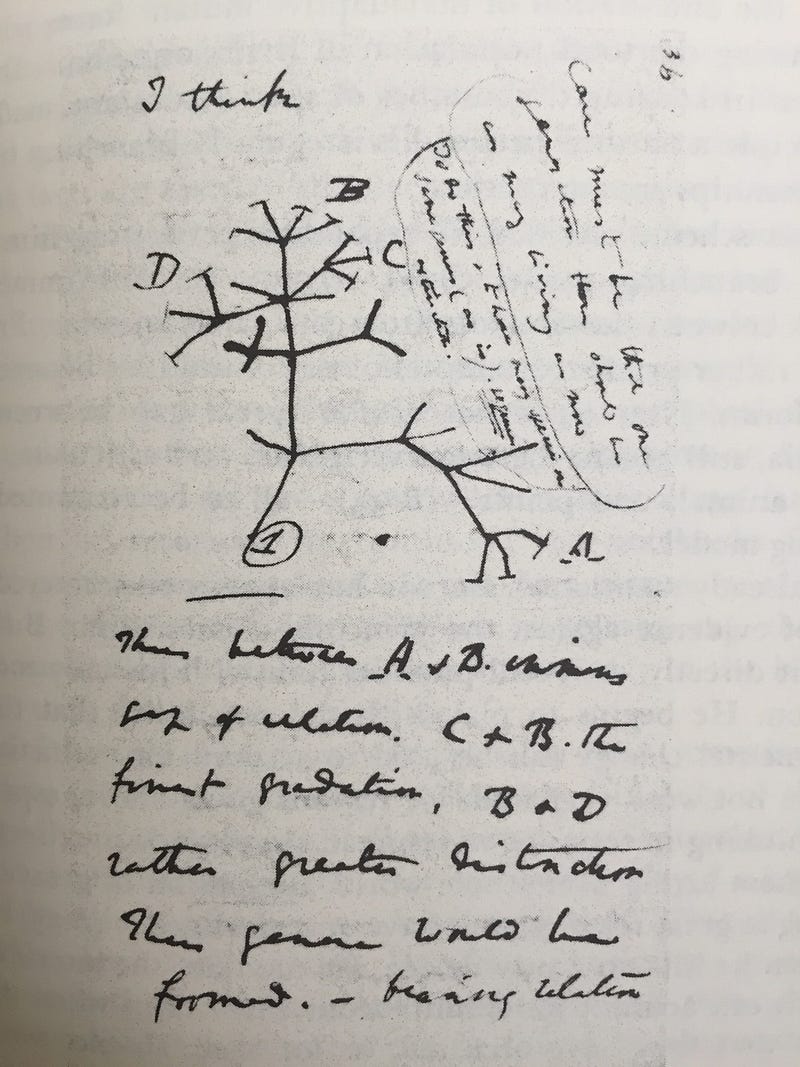
For example, the above picture is Darwin’s second attempt to sketch the idea of the irregularly branching tree of nature. I saw this diagram in Howard E. Gruber’s 1974 book Darwin on Man. Let me quote what Gruber described Darwin’s thoughts behind the diagram.
Soon he realizes that the coupling of monadism and the branching model requires the simultaneous extinction of many related species, not as an occasional event but as a regularly recurring phenomenon. The evidence patently does not support this deduction. (B 35) But he does not immediately abandon either idea. Instead, he goes on to develop the branching model with much greater precision and detail, stresses the point that conserving the numbers of species requires extinction, and explores in a quasi-mathematical form the amount of divergence that the branching model can permit him to imagine.
He redraws his sketch of a tree; where the first two sketches were rough, mainly intended to show the idea of a dead base and consequent discontinuities, the second sketch is cleanly drawn and more abstract, with a definite symbol used to distinguish between extinct and living forms, so that the number of each is actually countable.
Almost immediately Darwin reformulates the branching model in terms of human survival and descent, as though the ordinary form of a genealogical family tree were inherent in his idea from its conception (B 40–41) in this early treatment of the subject, the idea of selective survival in order to keep the number of species constant is clearly stated. But at this time he applies the idea only to extinction, not to the production of new species. (Darwin on Man, p.143–144)
Such sketches and diagrams are private tools for sensemaking. Creators rely on these tools to turn their ideas (personal tacit knowledge) into unshared drafts and notes (personal explicit knowledge). Sometimes, new ideas are born from the process of diagramming.
The Slow Cognition project adopts the historical-cognitive method to study creative work and creative life. What I care about is the long-term development of thoughts.
A Possible Book
Yesterday I designed the following picture for a possible book: Slow Cognition: Developing Tacit Knowledge with Thematic Space Canvas.
As mentioned above, the Thematic Space Canvas is a great instrument for studying Developing Tacit Knowledge.
My idea is very simple. I focus on the long-term development of a theme. If we use Andy Blunden’s term, then the long-term development of a theme is the germ-cell of Slow Cognition.
A thematic space refers to a person’s ideas, activities, and practices around one particular theme. A theme can be an established theory such as “Activity Theory”; or a normal concept such as “Platform”, “Life”, etc; and an idea in the middle, such as “design thinking”, “UX”, etc.
The book will collect my articles about Slow Cognition, Thematic Space Canvas, and Developing Tacit Knowledge.
By-products
In addition, we have to notice that there are some by-products of the Slow Cognition project.
For example, the Life Discovery Toolkit (v1.0) and The Life-as-Project approach are developed for the Life Discovery Activity.

Since it’s based on the Life-as-Project approach, I’d like to separate it as an independent project about the Project-centered approach.
The Project-centered approach is based on my 2020 book Project-oriented Activity Theory and the Project Engagement toolkit. You can find more details on the Activity Analysis website.
The other by-product is the Optimal Context Canvas which belongs to the Ecological Practice approach. I should consider it as a part of the Opportunity Discovery family.
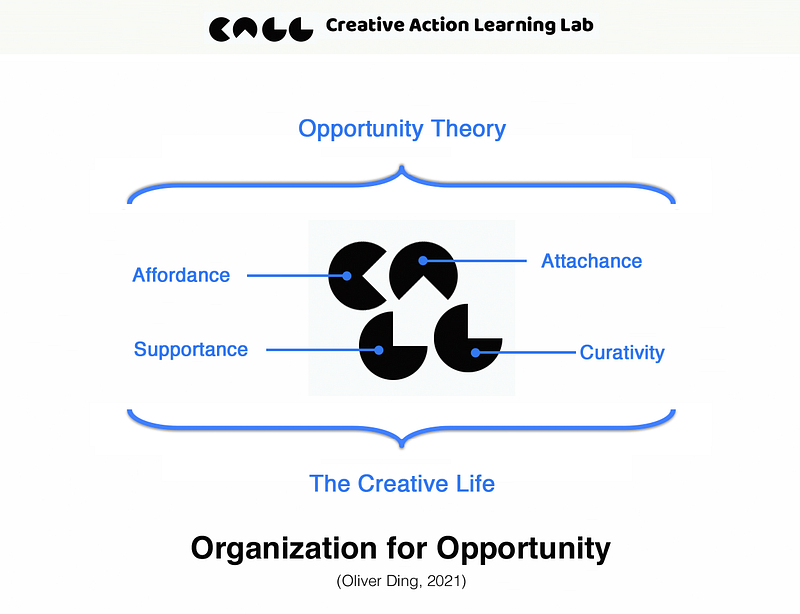
The above diagram represents the new annual theme of CALL for the years 2021 to 2022. The core concepts of the Ecological Practice approach are Affordance, Attachance, Supportance, and Curativity. Since I have written several books about these concepts, the next step is applying these concepts to develop more knowledge frameworks, guide case studies, and curate theory-practice dialogues.
I consider my frameworks as opportunities for other knowledge creators. Thus, the challenge for CALl is searching and finding an approach of the organization to actualize the above opportunities of knowledge creation for a group of talents.
The above canvases are also an important step for achieving CALL’s goals.
You are most welcome to connect via the following social platforms:
Linkedin: https://www.linkedin.com/in/oliverding Twitter: https://twitter.com/oliverding Polywork: https://www.polywork.com/oliverding Boardle: https://www.boardle.io/users/oliver-ding


