
Mapping Developmental Projects (book, v1, 2023)
Life, Stories, and Thematic Spaces
One of my favorite themes is Adult Development. The concept of Development Projects is my primary work about the theme.
From 2020 to 2023, I worked on a series of knowledge projects about the concept of “Project” and related ideas, especially the concept of “Developmental Projects”.
- 2020/2021: Project-oriented Activity Theory (book, v1)
- March 2021: The Developmental Project Model
- Feb 2022: Life Discovery: The Life-as-Project Approach (1,2,3)
- August 2022: The Project Engagement Approach (v2.1)
- Sept 2023: The Concept of Activity (Activity-as-Project)
- Oct 2023: Projectivity as Cultural Attachance
- Dec 2023: Social Moves: Ecological Formism (Quasi-invariant: Projects — Thematic Areas — Derived Forms)
I also developed a series of diagrams to represent and understand the concept of “Development Projects”.
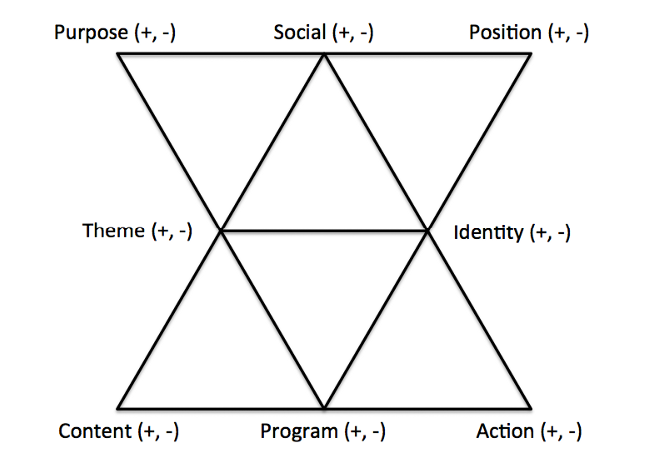
The above diagram is the basic model of the Developmental Project Model.
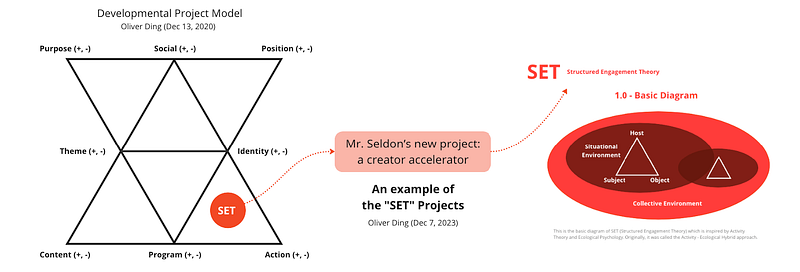
I also used the “Diagram Blending” technique to connect the Developmental Project Model and other knowledge frameworks. For example, the diagram below shows a connection between it and the “SET” (Structured Engagement Theory) framework. More details are in The “Identity — Program — Action” Thematic Space and the “SET” Projects.
In Dec 2022, I edited a book titled Creative Life Curation: Turning Experiences into Meaningful Achievements. The book used five units of analysis to understand creative life.
- Creative Actions
- Creative Projects
- Creative Journey
- Creative Landscape
- Creative Lifescope

Each Unit of Analysis refers to a unique time scale, spatial scale, and theoretical focus. The Project is the second unit of analysis. Also, we can understand a Project as a set of curated Actions. Moreover, the Journey is a set of curated Projects.
In the Creative Life Curation framework, the Project is the most significant unit of analysis. You can find more details in A Semiotic System Diagram for Creative Life Curation.
In the past several years, I also wrote a set of articles to reflect my knowledge projects. Some articles were written as case studies of the Developmental Project Model, while others were written as normal life reflections.
This article aims to collect my articles about the concept of Project, the Developmental Project Model, and my project-based life reflections.
Since I often used diagrams to represent my projects, the new collection is titled Mapping Developmental Projects: Life, Stories, and Thematic Spaces.
It is divided into five parts. Some numbers about the possible book:
- 5 parts
- 73 articles
- Total 1,049 min read
- Total 277,985 words (about 556 sing-spaced pages)
Contents
Part 1: Project, Theme, and Identity Part 2: Thematic Triangles Part 3: Developmental Project Model + Part 4: Mapping Real-life Projects Part 5: Toward A Strategic Developmental Psychology
Part 1: Project, Theme, and Identity
The Developmental Project Model was formed with two triangles. The first triangle refers to Developmental Resources which are framed with three dimensions: Content, Social, and Action. It was led by the concept of “Theme”.
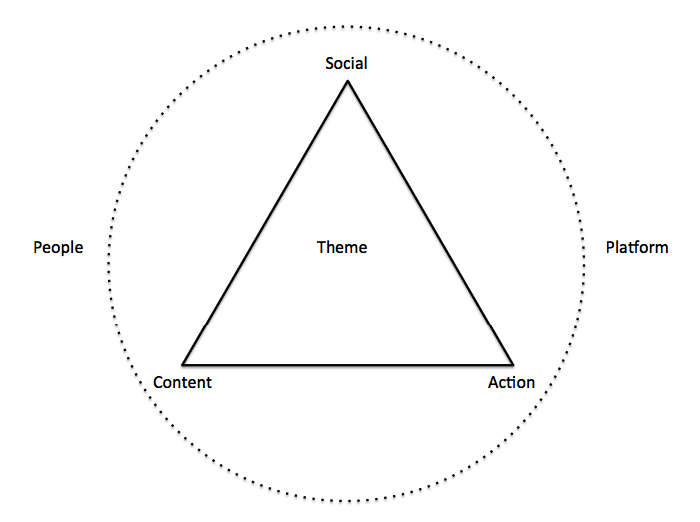
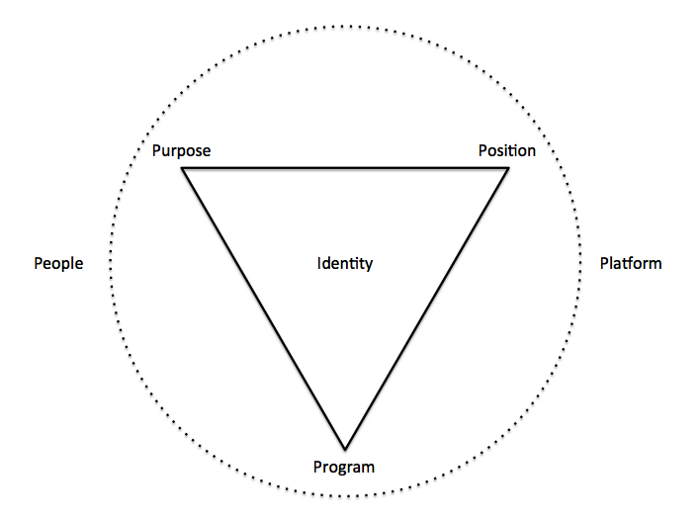
The second triangle refers to Situational Context which is framed with three dimensions: Purpose, Position, and Program. It was led by the concept of “Identity”.
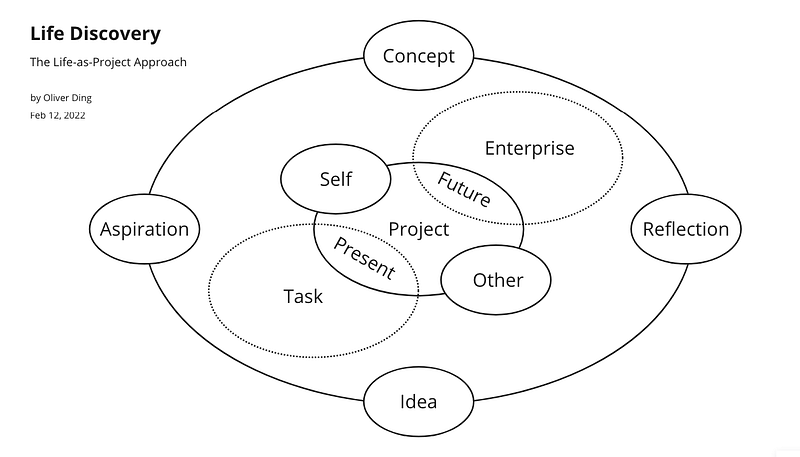
In Feb 2022, I developed a toolkit for Life Discovery Activity. I adopted several theoretical approaches to discussing “Life as Project” and used “the Life-as-Project approach” to name the toolkit. This was a significant step in developing the concept of “Project” as a multiple-dimension concept. You can find more details in Life Discovery: The Life-as-Project Approach.
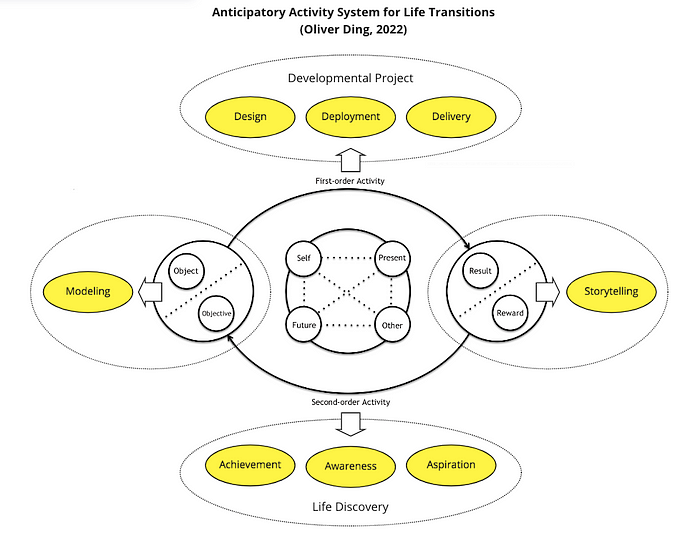
In 2022, I also developed an eight-step practical framework called AAS4LT (Anticipatory Activity System for Life Transitions) for dealing with a difficult challenge. The framework also led to a real program. In this framework, I choose the Developmental Project model to design and develop First-order Activities for the duration of Life Transitions. You can find more details in CALL for LIFE: Anticipatory Activity System for Life Transitions.
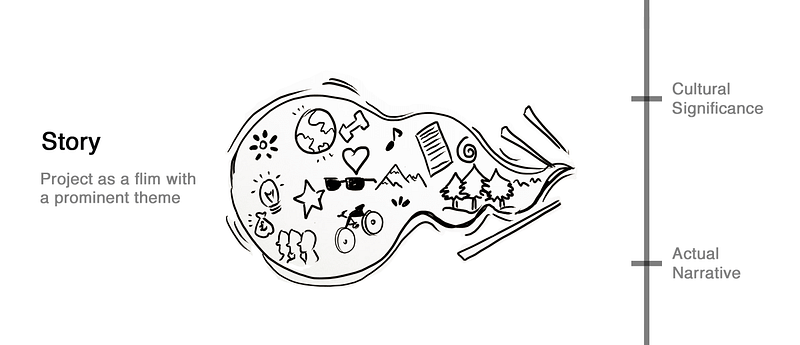
I also wrote some articles about the concept of Theme, the concept of Story, and the concept of Project by connecting Project and Story. You can find more details in Thematic Space: Project as Story, Life Discovery: “Project Engagement” and “Themes of Practice”, and Project Engagement (v2): Life, History, and Multiverse.
The above models and stories represent my thoughts on the Concept of Development Projects.
Part 1 collects related articles as a background for understanding “Development Projects” and the concept of “Project” in general.
- 1.1 Project as a Unit of Activity — 40 min
- 1.2 The Developmental Project Model (Archived) — 24 min
- 1.3 Developmental Project Canvas — 6 min
- 1.4 Project-oriented Activity Theory (Book) — 16 min
- 1.5 Life Discovery: The Life-as-Project Approach — 9 min
- 1.6 CALL for LIFE: Anticipatory Activity System for Life Transitions — 7 min
- 1.7 Thematic Space: Project as Story — 15 min
- 1.8 Project Engagement (v2): Life, History, and Multiverse — 16 min
Part 2: Thematic Triangles
The basic model of the Developmental Project Model only highlights eight dimensions of Developmental Projects.
Can these eight dimensions cover the complexity of Developmental Projects?
How can we deal with other aspects of Developmental Projects in some special cases?
What about some situations in which we only need to pay attention to three dimensions?
These questions challenge the traditional model of the one-diagram knowledge framework.
In the past several months, I also developed the “Creative Diagramming” method to utilize the power of knowledge diagrams and knowledge frameworks. The method considers several ideas such as Graphic Space Affordances, Exploring Thematic Spaces, Connecting Knowledge Frameworks, etc. These ideas were summarized in Frame for Work: The Ontology of Knowledge Frameworks and Ecological Actualism.
I also applied the method to explore potential thematic spaces of the Developmental Project Models and developed several types of sub-frameworks.
I used “Thematic Triangles” to name these thematic spaces because they are formed by three themes. For example: The D.I.V.E. Framework is located in the “Theme — Content — Program” thematic space.
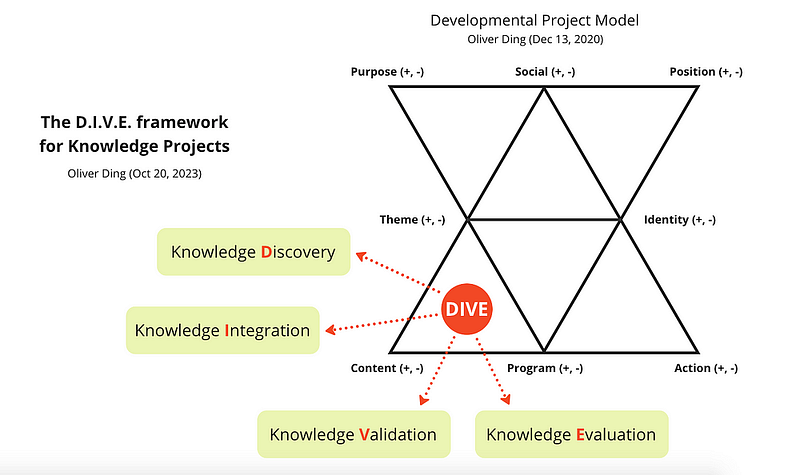
We can place more than one type of Developmental Project and related framework in one Thematic Triangle. In this way, we expand the Developmental Project Model into a set of knowledge frameworks. Each sub-framework can be customized for a specific type of Developmental Project.
- 2.1 [Creative Diagramming] Graphic Space Affordances, Thematic Space, and Possible Paths — 24 min
- 2.2 The D.I.V.E. Framework for Knowledge Projects — Oct 20, 2023
- 2.3 The “META” Projects — Oct 22, 2023
- 2.4 The “ECHO” Projects — Oct 23, 2023
- 2.5 The “SET” Projects — 5 min (Dec 11, 2023)
- 2.6 The CLUE Projects — 4 min (Dec 12, 2023)
- 2.7 The “GAP” Projects — 24 min (Dec 8, 2023)
- 2.8 Kinds of Project Engagement — 14 min (Nov 3, 2022)
Part 3: Developmental Project Model +
In the past several years, I often used the concept of Developmental Projects in various knowledge frameworks. Eventually, the Developmental Project Model became a member of a large network of knowledge frameworks.
In 2021, I wrote a book titled Diagram Blending: Building Diagram Networks and introduced the concept of “Diagram Network” which means a network of connected diagrams.
I used knowledge frameworks, knowledge models, and knowledge diagrams interchangeably. In this way, a Diagram Network refers to a Network of Knowledge Frameworks too.
To be honest, my network of knowledge frameworks doesn’t have a solid central node. Each node of the network could be seen as a center of the network. If we see the Developmental Project Model as a center, we can select related knowledge frameworks from the network and make a new network.
In reality, I used the “Creative Diagramming” method to develop a diagram network around the Developmental Project Model. For example, the diagram below is a draft for making a new framework called “Creative Identity Engagement” by using a thematic space of the Developmental Project Model. You can find more details in Situational Note-taking: The Serendipity of Making A New Framework.
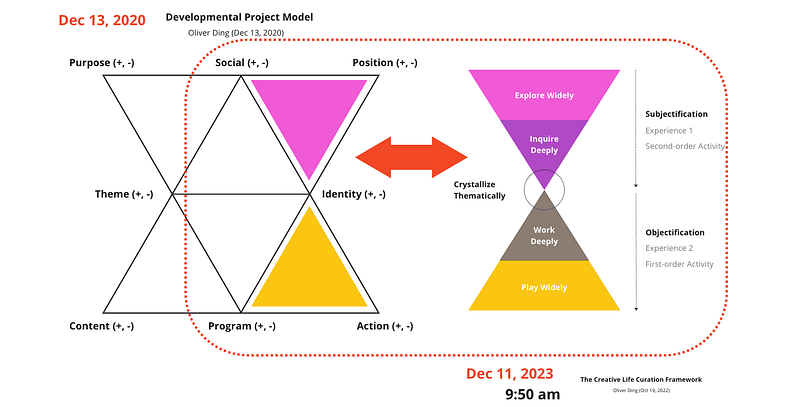
Now we can use “Developmental Project Model +” to name this new diagram network.
If one diagram is not enough, we can use one diagram network! In this way, we have a “1+N” model for understanding the concept of Developmental Projects.
- The “1” refers to the concept of “Developmental Projects” and the basic model of the Developmental Project Model. It is an independent theoretical concept and a knowledge model.
- The “N” refers to various theoretical approaches and knowledge frameworks.
Let’s use the short name DPM (which stands for Developmental Project Model) to replace the “1” and use some knowledge frameworks to replace the “N”. See the examples below.
- DPM+Activity Theory
- DPM+Attachance Theory
- DPM+Knowledge Center
- DPM+ECHO (The ECHO Way)
- DPM+Value Circle
- DPM+AAS (Anticipatory Activity System)
- DPM+PDF (Persona Dynamics Framework)
- DPM+CLC (Creative Life Curation)
This is a fantastic model!
This is a new model of building knowledge frameworks!
Part 3 collects articles that represent the above “1+N” model.
3.1 DPM+Activity Theory
In this article, I used the basic model of Activity Theory (Subject — Mediating Instruments — Object) to visualize four knowledge projects.
3.2 DPM+Attachance Theory
- Projectivity as Cultural Attachance — 37 min
In 2021, I wrote a book (draft) titled Project-oriented Activity Theory which introduces Andy Blunden’s new approach to Activity Theory. The second part of the book was called Project Engagement (v1.0) and it introduced the Developmental Project Model and the concept of “Projectivity”.
From the perspective of the Ecological Practice Approach, the concept of “Projectivity” can be understood as a sub-concept of “Attachance”. In this article, I connect the Developmental Project Model and Attachance Theory.
3.3 DPM+Knowledge Center
- How to Grow A Knowledge Enterprise? — 16 min
- The Hierarchy of Knowledge Centers — 19 min
- Mental Models and the Attachance of Multiple Moves — 18 min
In May 2022, I developed a model of Building Knowledge Enterprise (BKE) Activity. The model roughly considered three phases and used “Knowledge Center” for the second phase.
In 2023, I developed a three-level hierarchy of Knowledge Centers: Knowledge Centers, Knowledge Projects, and Knowledge Elements.
On June 12, 2023, I made a case study of Creating A New Knowledge Element which is about “Mental Models” and “Project”. The case study used the “Theory/Concepts — Mental Elements — Projects/Actions” schema to develop a map for visualization.
3.4 DPM+ECHO (The ECHO Way)
- The ECHO Way (v2.0) — 15 min
- Life Discovery: The “Present — Future” Fit and The ECHO Way — 22 min
- Personal Innovation as Career-fit — 22 min
The above three articles are about the ECHO Way for career development.
- Slow Cognition: The Echoes of A Thematic Dialogue — 13 min
- Mental Moves #4: Attachance and Creative Dialogue — 14 min
- Creative Dialogue and Mental Moves: The Development of Creative Life Theory — 28 min
In the above three articles, I used the ECHO way to discuss knowledge projects.
3.5 DPM+Value Circle
- Value Circle #3: TALE as A Thematic Transformation Hub — 14 min
- Value Circle #2: Engaging with Lui’s Theoretical Sociology — 27 min
- Value Circle #5: Building A Joint Knowledge Center — 12 min
Originally, I used the theme of “Value Circle” to refer to the three-level model of “Project Network”: a network of Themes, a network of Projects, and a network of People.
Later, I used the Value Circle project aims to reflect on the development of several knowledge centers and explore the dynamics of networked knowledge centers.
3.6 DPM+AAS (Anticipatory Activity System)
- Life Discovery: Running A Developmental Project — 9 min
- CALL for LIFE: Modeling A Developmental Project — 8 min
- Life Strategy: The “Possible Journey” — 9 min
In 2022, I worked on developing the Anticipatory Activity System (AAS) framework. I also considered Developmental Projects as the basic unit of the AAS framework. You can find more details in the above three articles.
3.7 DPM+PDF (Persona Dynamics Framework)
- Advanced Life Strategy: The Microdynamics of Creative Identity — 13 min
- A Possible Theme called “Possible Personas” — 10 min
- Notes about Persona Dynamics: Self, Agency, and Activity (Part 1) — 20 min
The concept of “Identity” is related to the concept of “Self” and the concept of “Role”. On Feb 16, 2023, I developed the Persona Dynamics Framework and used it to offer a solution to discuss the “self-role” issue. You can find more details in the above three articles.
3.8 DPM+CLC (Creative Life Curation)
- D as Diagramming: Challenge as Opportunity — 10 min
- Personal Innovation as Career-fit — 22 min
- The “Means — End” Spectrum and Becoming — 15 min
- The ECHO Trip: A 10-day Road Trip and Creative Life Curation — 24 min
- Once Upon A Whiteboard: The 5A Slow Cognition Model — 18 min
- Appropriating Activity Theory — 10 min
As mentioned above, Project is a significant unit of analysis of the Creative Life Curation method. You can find more details in Creative Life Curation: Turning Experiences into Meaningful Achievements and A Semiotic System Diagram for Creative Life Curation.
In general, Creative Life Curation is about life reflections. The above six articles collect my reflections on several projects and my life experiences.
Part 4: Mapping Real-life Projects
From 2020 to 2023, I also wrote a set of articles to reflect my knowledge projects. Some articles were written as case studies of the Developmental Project Model, while others were written as normal life reflections.
In general, I consider these knowledge projects as my Developmental Projects.
Part 4 collects these articles as my real-life experiences of Developmental Projects.
4.1 2019
- The Ecological Practice Approach Project (2019–2023) — (link 1, link 2, link 3)
- How did I develop Curativity Theory? (2019) — 28 min
- The WXMY (When X Meets Y) Diagram Project
- The SET Project (the Ecological — Activity Hybrid Approach)
- The Life Curation Project (link 1, link 2)
4.2 2020
- Activity U — A Knowledge Curation Project (2020)— 19 min
- The Activity U Project and Creative Life Curation — 20 min
- The Affordance Analysis Project (2020) — 15 min
- The Knowledge Curation Project (2020–2022) — 8 min
- The Platform Ecology Project (2020–2023) — 8 min
- The Doo Project (a private project, a case study about a digital platform, March 20, 2020)
- The “Platform Container and Digital Transformation” Project (Action, Experience, and Relationship) (a private project, March 24–27, 2020)
- The HERO U Project
- The Ecological Interaction Project (Frame Analysis in Context)
- The Creativity U Project (The NICE Way)
- CALL: Network of Enterprise (2020–2021)
4.3 2021
- The Re-Engagement Project (2021)— 8 min
- The D as Diagramming Project (2021) — 6 min
- The Development of AAS (August 21, 2021 — August 26, 2022) — 17 min
- The ECHO Way Project — (link 1, link 2, link 3, link 4)
- The Lifesystem Project
- The Attachance Project
- The Once Upon A Whiteboard Project
- The Infoniche Project
- The iART Project
- The Startup Curation Project
4.4 2022
The Thematic Canvas Project (2022) The Life Discovery Toolkit Project (2022) The Shaper & Supporter Lab Project (2022) The AAS4LT 1:1 Life Coaching (the AAS Board) Project (2022) The Project Network Project (2022) The Significant Insights Project (2022) The Life-Strategy Thematic Dialogue Project (2022)
- The Slow Cognition Project (2022) — 8 min
- The Creative Life Curation Project (2022) — 12 min
- The Thematic Engagement Project (2022–2023) — (link 1, link 2)
- The Knowledge Engagement Project (2022–2023) — (link 1, link 2)
- The Knowledge Center Project (Building A Knowledge Enterprise)
- The Project Engagement (v2.1) Project (link 1, link 2)
- The Rethinking Activity Theory Project
- The Anticipatory Activity System Project
- The Activity Analysis & Intervention Project (link 1, link 2)
- The Aspects of Creative Life Project
- The TalkThree Project (2022–2023)
- The Thematic Space Project (2022–2024)
4.5 2023
- The Design as Creative Life Project (2023) — 7 min
- The Product Engagement Project (2023) — 8 min
- The Thematic Exploration Project (2023) — 14 min
- The Mental Moves Project (2023) — 11 min
- The Value Circle Project (2023) — 14 min
- The Creative Life Theory Project (2023) — 10 min
- The Territory of Concepts Project (2023) — 24 min
- The Mental Engagement Project (2023) — (link 1, link 2)
- The Social Moves Project (2023) — 13 min
- The TALE Project (link 1, link 2)
- The Early Discovery Project
- The ECHO Trip Project
- The Slow Talk Project (link 1, link 2)
- The CALL for DIVE Project (2023, the 100-day knowledge challenge program)
- The Ecological Strategic Cognition Project (link 1, link 2)
Part 5: Toward A Strategic Developmental Psychology
After reviewing the above articles, I see a clear path to the development of the concept of Developmental Projects:
I didn’t only use the concept of Developmental Projects as a scientific/academic tool for explanation but also used it as a practical/strategic tool for intervention.
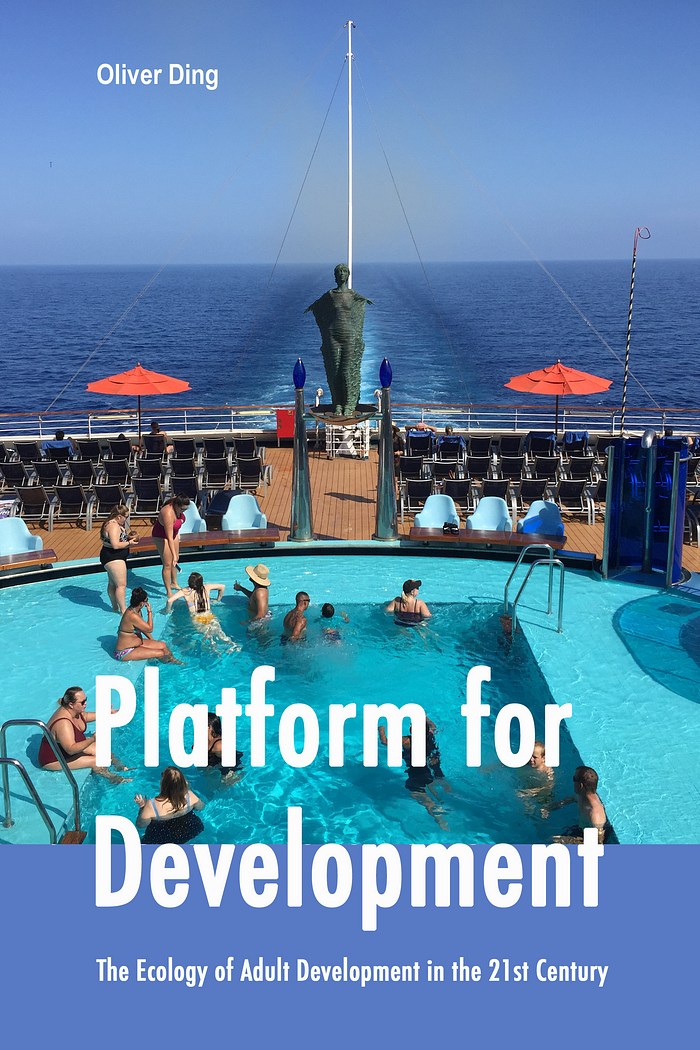
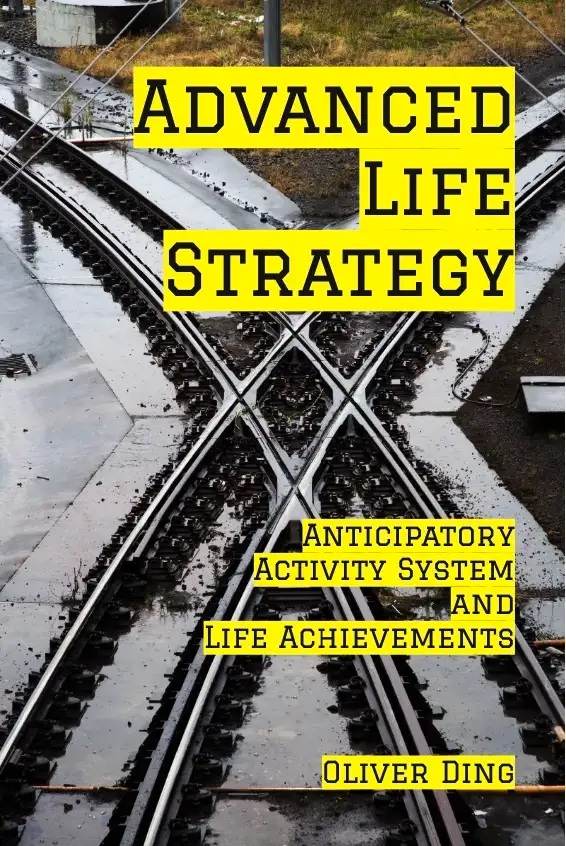
Let's consider my work on “Development Projects” with my books (drafts) Platform for Development, Advanced Life Strategy, and Creative Life Curation together. We see a new theme: Strategic Developmental Psychology.
In Feb 2022, I applied the Project Engagement approach to understanding Life Discovery Activity.
I have developed several frameworks about Life Discovery and Life Development in general from different perspectives. One challenge is making a balance between individual perspective and collective perspective. This is an essential challenge for social sciences. For example, psychological perspective vs. the sociological perspective, methodological individualism vs. methodological collectivism, etc.
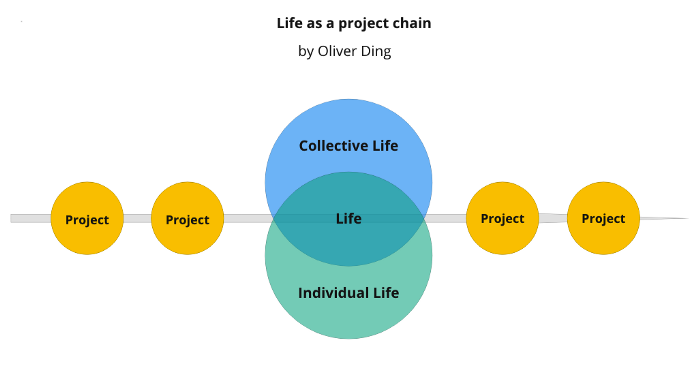
Some scholars don’t consider the dichotomy as a problem and they just form two camps. Other scholars developed theoretical solutions to solve the theoretical conflict between these two camps. Inspired by Derek Layder’s Social Domains Theory (1997) and Andy Blunden’s “Project as a Unit of Activity” (2010, 2014), I adopted the concept of “Project” as a Container for understanding Life.
Andy Blunden mentions a project-oriented approach on both psychology and sociology, “A project is a focus for an individual’s motivation, the indispensable vehicle for the exercise of their will and thus the key determinant of their psychology and the process which produces and reproduces the social fabric. Projects, therefore, give direct expression to the identity of the sciences of the mind and the social sciences. Projects belong to both; a project is a concept of both psychology and sociology.” (2014, p.15)
The concept of Life can be understood as Collective Life and Individual Life. We can use the concept of Project to understand both of them. A person’s real life is a set of real actions. The concept of “Project” is a way of curating these actions. On the other hand, Collective Life can be curated with Projects too.
Following this theoretical framework, the concept of Developmental Projects could be a unique and powerful unit of analysis for a new type of developmental psychology.
On a highlighter level, the Anticipatory Activity System (AAS) framework offers us a solution to understanding Developmental Projects in the context of “Self, Other, Present, Future”.
The Anticipatory Activity System (AAS) framework is inspired by Activity Theory, Anticipatory System theory, Relevance theory, and other theoretical resources.
An Anticipatory Activity System is formed by two parts: First-order Activity and Second-order Activity.
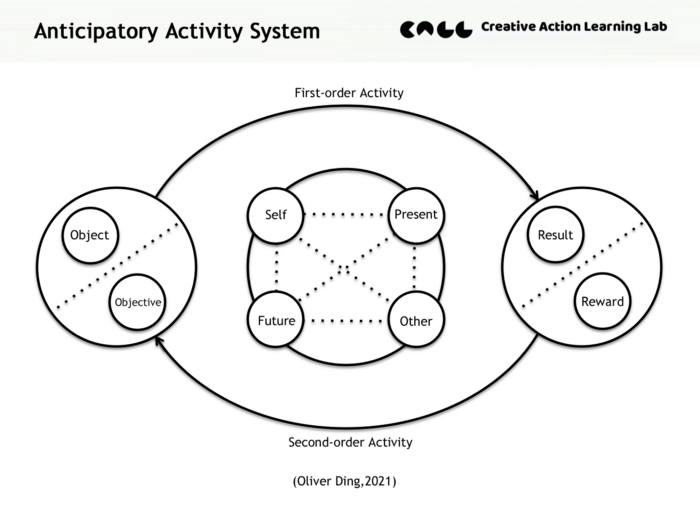
In real-life case studies, both First-order Activity and Second-order Activity can be understood as Developmental Projects.
While the AAS framework is more about Anticipation, the Creative Life Curation framework is more about Reflection. The concept of Developmental Projects and the Project Engagement approach are more about Emergence. If we connect these ideas, we see a clear path to creative life.
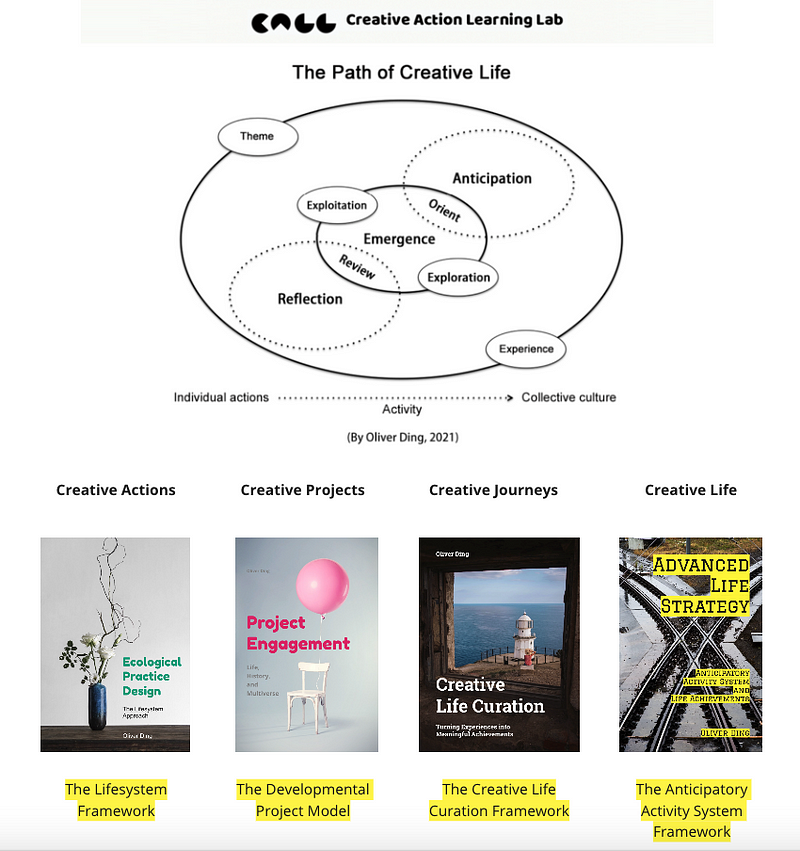
Last year, I used the above diagram as the basic structure to curate four books (drafts) together.
Now if we focus on the concept of Developmental Projects, and consider it as a new idea for the field of Developmental Psychology, we could find a new creative space called Strategic Developmental Psychology.
The theme of “Strategic Developmental Psychology” was born in an email I sent to a friend on Nov 22, 2023.
Part 5 collects some articles as references for further developing the brand-new theme.
- 5.1 Psychological Knowledge Engagement and Robert Kegan’s Knowledge Enterprise — 59 min
- 5.2 Knowledge Engagement: The Hermeneutics of Creative Life — 6 min
- 5.3 A “Strategy-as-Curation” Weekend — 19 min
- 5.4 Ecological Strategic Cognition — 8 min
- 5.5 Situational Note-taking: Lazarus’ Perspective and “Coping Activity as Mental Tuning” — 6 min
- 5.6 Advanced Life Strategy: Anticipatory Activity System and Life Achievements — 19 min
Related books (Drafts)
- Creative Life Theory: Building A Knowledge Enterprise
- Thematic Exploration: The Early Discovery of Knowledge Engagement (book, v1)
- Mental Moves: The Attachance Approach to Ecological Creative Cognition
- Social Moves: The Attachance Approach to Social Cognition
- Knowledge Discovery: Developing Tacit Knowledge with Thematic Space Canvas
- Knowledge Curation: Turning Pieces into A Meaningful Whole
- Life Discovery: Biography, Journey, Program
- Perspectives on Product Engagement
- Diagramming as Practice
- Diagram Blending: Building Diagram Networks
- Creative Life Curation: Discover Thematic Spaces of Creative Life


