
Situational Note-taking: Lazarus’ Perspective and “Coping Activity as Mental Tuning”
A short note about a case study of the mental tuning framework
As mentioned in Value Circle #5: Building A Joint Knowledge Center, I worked on building a Joint Knowledge Center called Mental Engagement Center (code name) with a friend from Sept 2023 to Dec 2023.
In Nov 2023, my friend asked me to review Richard S. Lazarus’ approach to emotion and adaptation. I was not familiar with Lazarus’ work before that conversation.
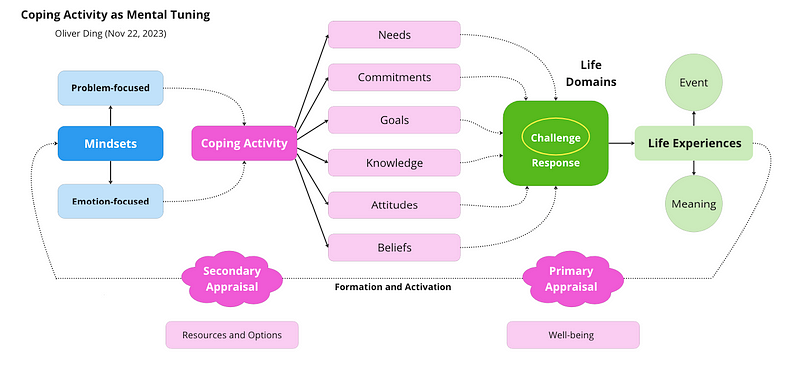
After reading two papers by Richard S. Lazarus, I made the above diagram based on the Mental Tuning Framework.
I also sent an email about my thoughts to my friend on Nov 22, 2023.
Now I am going to share the email as a Situational Note.
After reading Lazarus’ 1990 paper titled Emotion and Adaptation, I made a Mental Tuning diagram:
“Coping Activity as Mental Tuning”
See the attached files (see the above diagram).
1. Life Domains
I use Response (Challenge) to refer to Lazarus’ theory’s object.
2. Life Experiences
Lazarus mentioned two layers in life experiences: event and meaning.
The divorce of emotional response from specific stimuli and its replacement with a cognitive evaluation of the significance of the organism-environment relationship is the centerpiece of the emotion process in humans. By centering on the person’s interpretation or evaluation of what an encounter signifies for its well-being, the effective stimulus for emotion has shifted from a concrete event to an abstract meaning. In becoming meaning-centered, emotions have achieved a flexibility and adaptational power that is simply not possible for stimulus~centered adaptational systems such as drives and reflexes.
3. Formation and Activation
I put Primary Appraisal (related to Well-being) and Secondary Appraisal (related to Resources and Options) in this section.
4. Mindests
Here I use “mindsets” to refer to “mindset of coping activity”. According to Lazarus, there are two types of coping activities:
- Problem-focused coping
- Emotion-focused coping
He also mentioned that there are many coping activity strategies. This idea matches the Mental Tuning framework.
Just as the top part of the model in Figure 23.1 depicts personality factors as influencing appraisal, the bottom portion depicts them as determinants of coping. The emotional response includes an action tendency — that is, an urge to respond to the encounter in a particular way: to attack in anger, cry in sadness, flee or avoid in anxiety, and so on. Nevertheless, at all but the most extreme levels of emotional arousal, people have the ability to suppress the action tendency and select from a wide array of coping options; this illustrates the flexibility of the emotion process.
For example, we are free to engage in any of a number of problem-focused coping activities that reflect active attempts to influence the person-environment relationship and to maintain or increase its degree of motivational congruence. We are also free to engage in any of a number of emotion-focused coping strategies that attempt to regulate the emotional response itself (cf. Folkman & Lazarus, 1980, 1985; Lazarus & Folkman, 1984). We are not constrained to a single coping strategy, and under stressful circumstances it appears that people most often engage in a combination of many problem-focused and emotion-focused strategies (Folkman & Lazarus, 1980; Lazarus & Folkman, 1984).
5. Mental Tuning
Lazarus didn’t list all categories of coping strategies. But he used “Personality” to frame many relevant individual facts. I put them into the section “Mental Tuning”.
- Needs
- Commitments
- Goals
- Knowledge
- Attitudes
- Beliefs
7. A System
His theory is a “relational” approach to emotion. Also, he used “cognitive — motivation — emotive configuration” to describe his unit of analysis.
The suggestion that emotions lack stimulus specificity does not imply that they are random response states. On the contrary, we see each distinct emotion as a response to a particular kind of significant event — a particular kind of harm or benefit (see Lazarus, 1968, 1982; Lazarus & Smith, 1988) — that motivates coping activity. However, because there is no simple mapping between objective stimulus properties and adaptive significance, the task of detecting significant events becomes quite formidable, and to accomplish it the organism must be able to somehow classify what is being confronted into a relatively small number of categories, corresponding to the various kinds of harm or benefit it may face. Above all, the emotional response is not a reaction to a stimulus, but to an organism (person)-environment relationship. Given the properties of the stimulus context and the organism’s pattern of motivation, what must be detected is that the convergence of these two sets of characteristics results in harm or benefit. This is what it means to speak of a “relational” approach to emotion. Moreover, with the adaptational responses having become less innate, more flexible, more variable, and more dependent upon the species’ cognitive capabilities, emotions are not only reactions to ongoing relationships with the environment but are also cognitive.
However, the adaptive solution has not been merely to produce a purely cold cognitive process of detection and evaluation. Instead, it comprises a complex psychobiological reaction that fuses intelligence with motivational patterns, action impulses, and physiological changes that signify to both the actor and observer that something of significance for well~being is at stake in the encounter with the environment. We call this psychobiological reaction an “emotion.” It is a very complex reaction that simultaneously encompasses motives and cognitive evaluations of the adaptational requirements of the encounter, and, if the encounter is evaluated as having important consequences for personal well-being, it results in organismic involvement. Therefore, in place of “emotion,” we often use the expression “cognitive — motivational — emotive configuration.’’
I think the Mental Tuning framework’s Behavioral System (Mental System) could be used as a meta-framework to capture Lazarus’ theory and other similar “relational” approaches.
8. Problem-focused Coping Activity
This section is relevant to my work on Activity Theory and Strategy because it refers to concrete work/activities.
9. Emotion-focused Coping Activity
As mentioned before, I didn’t pay attention to Emotion because some of my friends are working on it. However, Lazarus’ theory inspired me to rethink the AAI (Activity Analysis & Intervention) program.
My original purpose behind the AAI is all about knowledge and activity.
For AAI, First-order Analysis is about Work/Activity while Second-order Analysis is about Knowledge.
Problem-focused Coping Activity can be connected to the AAI program.
I also realized that the AAI program could consider Emotion as its service object. Second-order Analysis could consider both Knowledge and Emotion.
10. Strategic Developmental Psychology
Inspired by Robert Kegan’s knowledge enterprise, I was thinking of a new theme called “Strategic Developmental Psychology”.
If I want to connect Activity Theory with Western action psychology, maybe I can use “Strategic Developmental Psychology” to reframe my works about Activity Theory and Ecological Psychology.
Last week, I chatted with a friend of mine who lives in China. Several years ago, she was a visitor student of Edward L. Deci who is a co-founder of Self-Determination Theory. We talked about the concept of “Strategy” in the field of psychology. She told me that the term “Strategy” is just a normal word for psychologists.
Last year, I edited the book (draft) Advanced Life Strategy: Anticipatory Activity System and Life Achievements. The book is based on the AAS framework which defines the concept of “Strategy” as “Anticipatory Activity System”.
As mentioned in the first article about the Mental Tuning framework, I consider the Mental Tuning framework as a bridge between the AAS and Western action psychology.
For AAS, the concept of “Strategy” is about Anticipation (Future).
However, I found the Strategic technique is related to coping activities which are about the Present.
If we put these together, then we can set a foundation for Strategic Developmental Psychology: 1) strategic techniques for coping with present challenges, 2) strategy for capturing present opportunities for the future.
Furthermore, Ecological psychology is about “Opportunity”.


