
Thematic Exploration: The Early Discovery of Knowledge Engagement (book, v1)
A possible book about thematic creativity and thematic curativity
On Jan 1, 2023, TALE (Thematic Analysis Learning Engagement) was launched as a new knowledge center for hosting the Thematic Engagement project.
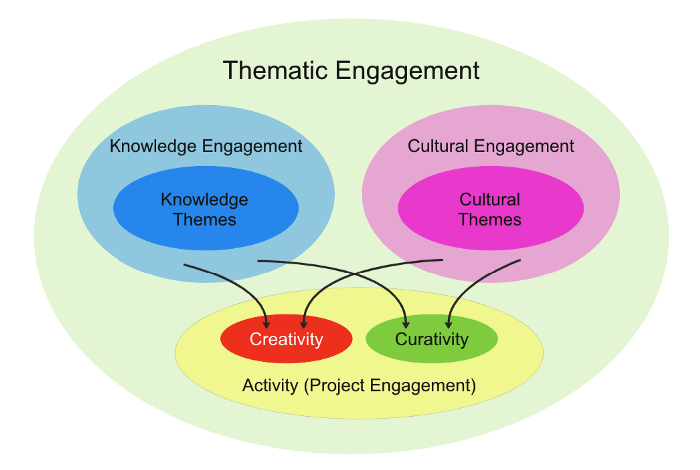
Thematic Engagement refers to the “Person — Theme” relationship and interaction. As a knowledge center, TALE considers the “Person — Theme” relationship and interaction as its primary object.
Anthropologist Morris Opler (1945) developed a theoretical concept called “cultural themes” for studying culture. Career counseling therapists and psychologists also developed a theoretical concept called “life themes”. From the perspective of innovation, we consider Themes as a sign of Trends in social life and individual life.
There are two types of themes. While Established Themes refer to normal practices, Emerging Themes refer to possible practices. TALE aims to tell the story of innovation thematically. We will pay attention to Exploration and Imagination.
In the past six months, I worked on a series of sub-projects. Eventually, I found an emerging theme from TALE’s projects:
Thematic Creativity and Thematic Curativity of Early Discovery
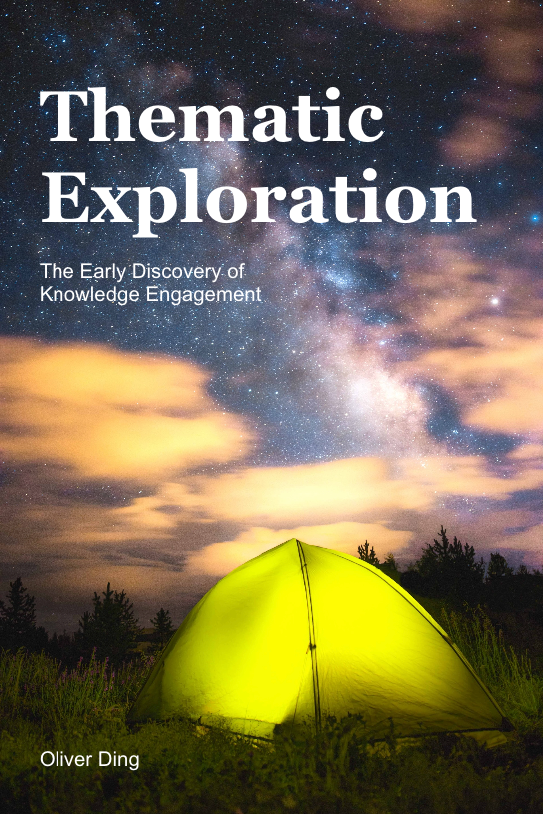
Today I decided to edit a new possible book titled Thematic Exploration: The Early Discovery of Knowledge Engagement. This post is version 1.0 of the TOC of the possible book.
Contents
0. Introduction
0.1 — The Thematic Engagement Project 0.2 — A Journey of Knowledge Engagement 0.3 — Early Discovery as Second-order Activity 0.4 — From Theme to Framework 0.5 — The Workfield of Thematic Exploration
Part 1: Strategic Thematic Exploration
- Early Responses
- Possible Configuration
- Themes in the Field
Part 2: Possible Themes
- A Typology of Themes
- Early Objectification
- Multiple Thematic Reflection
Part 3: Slow Talk
3.2 — A Thematic Conversation about “Strategic Exploration” 3.3 — A Thematic Conversation about “Social Affordance” 3.4 — A Thematic Conversation about “Intellectual Experience” 3.5 — A Thematic Conversation about “Note-taking and Knowledge Engagement” 3.6 — A Thematic Conversation about “Persona”
Part 4: Possible Frameworks
4.1 Method: Diagramming as Thinking (Example: The Value-fit Framework) 4.2 Method: Frame of Reference (Example: The Strategic Curation Model) 4.3 Method: Concept Development (Example: The Anticipatory Activity System Framework) 4.4 Method: Metaphorical Integration (Example: The “Mind as Play” Framework) 4.5 Method: Rediscovery (Example: The “Persona Dynamics” Framework) 4.6 Method: Multiple Moves (Example: The “Context (Mind)” Framework)
Part 5: Spontaneous Concept System
Theme (Concept) Spontaneous Concept System Defined Concept System Scientific Concept System
Part 6: A Toolkit
It is divided into six parts. Some numbers about the possible book:
- 6 parts
- 86 articles
- Total 765 min read
- Total 202,725 words (about 405 single-spaced pages)
0. Introduction
In the Introduction, I’d like to discuss the following topics which offer the background of the project and the primary framework.
- 0.1 — The Thematic Engagement Project
- 0.2 — A Journey of Knowledge Engagement
- 0.3 — Early Discovery as Second-order Activity
- 0.4 — From Theme to Framework
- 0.5 — The Workfield of Thematic Exploration
0.1 The Thematic Engagement Project
In Sept 2022, I launched the Thematic Engagement Toolkit (v1.0) which led to the Thematic Engagement Project and TALE Center. The toolkit was the outcome of a dialogue between the following two theoretical approaches:
- The Themes of Practice Approach (2019, 2021)
- The Project Engagement Approach (2021, 2022)
The Themes of Practice Approach (2019, 2021) is part of Curativity Theory, while the Project Engagement Approach (2021, 2022) is inspired by Activity Theory, especially Andy Blunden’s Project-oriented approach to Activity Theory.
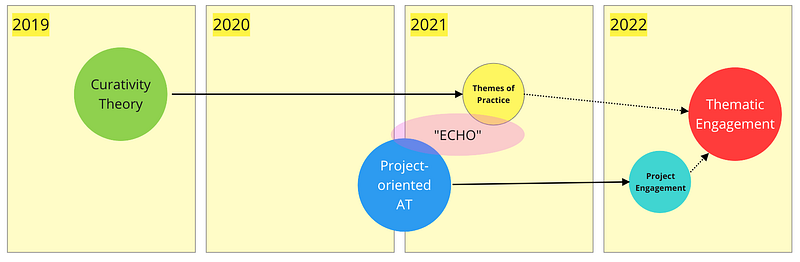
You can find more details in The “Activity — Opportunity” Thematic Dialogue and The Echoes of A Thematic Dialogue.
0.2 A Journey of Knowledge Engagement
While Thematic Engagement refers to both Knowledge Themes and Cultural Themes, I only worked on Knowledge Themes in the past six months.
The diagram below represents my mind about a network of recent projects. The diagram was made with four thematic spaces, four themes, and one framework. The framework is the basic model of the Ecological Practice approach which features the following concepts:
- Container / Containee
- Event
- Offers / Acts
- Attach / Detach
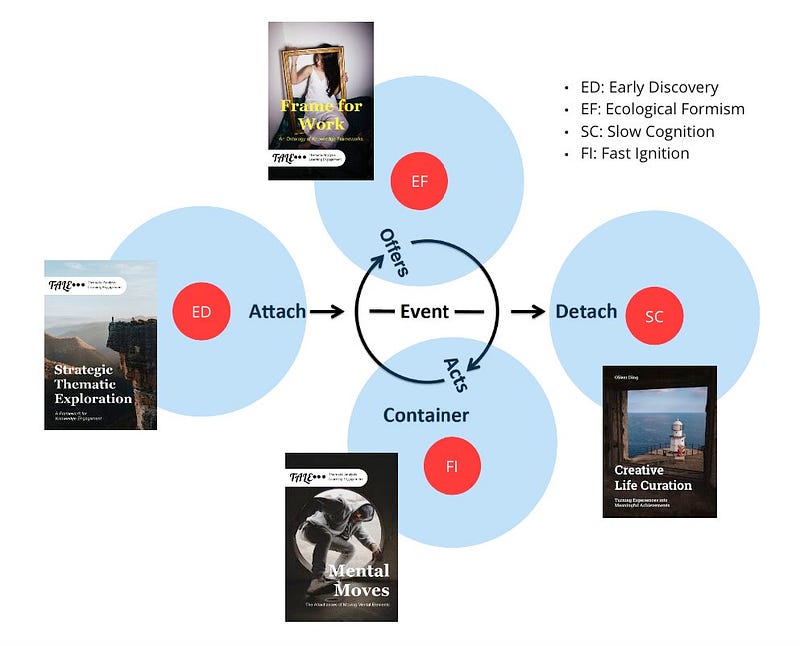
The “Attach — Event — Detach” schema echoes a time structure: Before — Event — After. It connects to the following thematic spaces:
- Attach: Early Discovery (ED)
- Detach: Slow Cognition (SC)
- Offers: Ecological Formism (EF)
- Acts: Fast Ignition (FI)
We can also find four projects in these thematic spaces:
- The “Frame for Work” project > Offers
- The “Strategic Thematic Exploration” project > Attach
- The “Creative Life Curation” project > Detach
- The “Mental Moves” project > Acts
In Nov 2022, I finished a book (draft) titled Creative Life Curation: Turning Life Experiences into Meaningful Achievements.
In Jan 2023, the “Frame for Work” theme was born (1, 2).
In Feb 2023, my mental focus was “Developing Knowledge Frameworks” (1, 2) which led to the “Strategic Thematic Exploration” project.
In March 2023, I started working on the “Mental Moves” knowledge project (1, 2).
This was my journey of knowledge engagement in the past several months.
0.3 Early Discovery as Second-order Activity
I consider Strategic Thematic Exploration and Conceptual Elaboration as two phases of EARLY DISCOVERY of the journey of knowledge Engagement. See the diagram below.
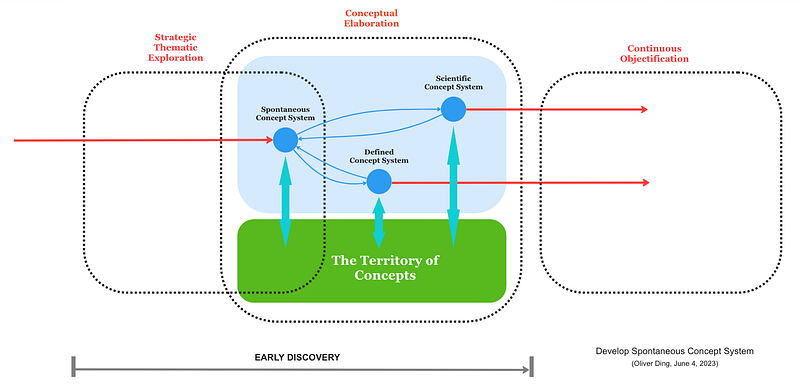
The further phase is Continuous Objectification which aims to turn a concept system into real things.
0.4 From Theme to Framework
I use “Strategic Thematic Exploration” to frame a creative space for exploring the strategic intent with the thematic analysis methods, especially for knowledge engagement.
I consider “From Theme to Framework” as a significant early phase for the journey of knowledge engagement. There are six stages in the phase.
- A Possible Theme without Clue
- A Possible Theme with Clue
- A Primary Theme without related themes
- A Primary Theme with its network
- A Knowledge Concept with a working definition
- A Knowledge Framework with a set of concepts
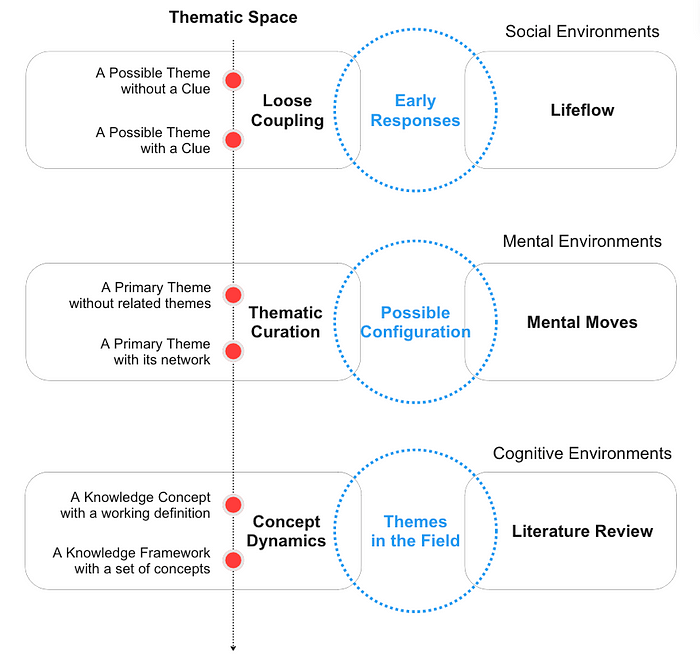
Since a knowledge framework is formed by a set of concepts, I also use Spontaneous Concept System to refer to the early version of a knowledge framework.
This is the basic idea of the Strategic Thematic Exploration framework.
0.5 The Workfield of Thematic Exploration
The process of Thematic Exploration is not a short-term immediate experience such as a workshop. I used the metaphor Workfield to refer to a long-term creative space. We can see it in two types of containers:
- Abstract Container: a thematic space which is a large cognitive space about a particular theme
- Concrete Container: a project with related actions and tools such as digital platforms.
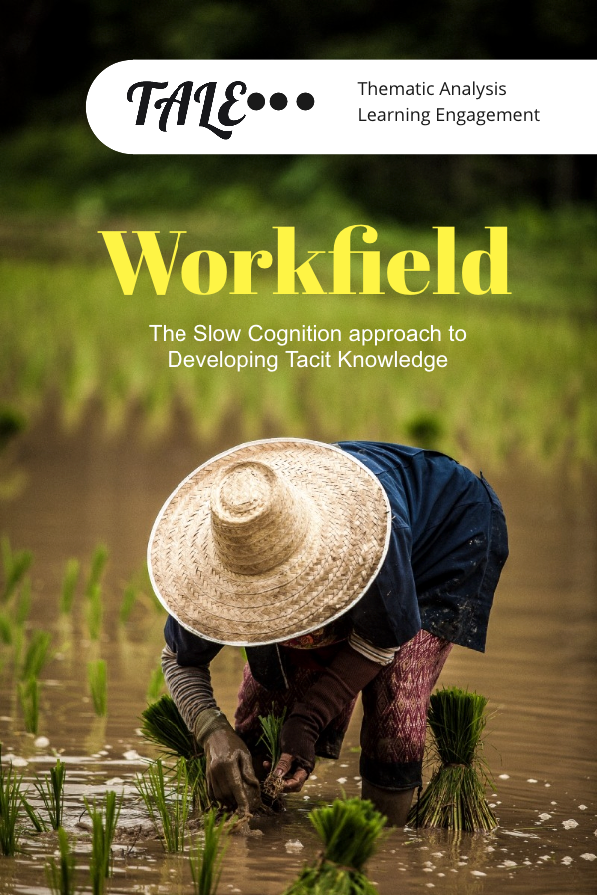
You can find more details in How to Develop a Possible Knowledge Theme? and The “5A” Slow Cognition Model.
Part 1: Strategic Thematic Exploration
While I define “Thematic Exploration” as a general activity, I consider the “Strategic Thematic Exploration” framework as a practical tool. You can use it as a meditation for your journey. However, you can develop your own framework for the “Thematic Exploration” activity.
Part 1 collects articles about the “Strategic Thematic Exploration” framework. You can start with the following diagram.
The framework roughly defines three phases of Strategic Thematic Exploration:
- Early Responses
- Possible Configuration
- Themes in the Field
You can find more details in the following articles:
- 1.1 — The “Strategic Thematic Exploration” Framework (v1.1) — 10 min read
- 1.2 — Social Pieces: An example of “Early Responses” — 11 min read
- 1.3 — Possible Configurations of A Theme Network — 15 min read
- 1.4 — Themes in the Field: Self, Agency, and Activity (Part I) — 20 min read
- 1.5 — Themes in the Field: Self, Agency, and Activity (Part II) — 10 min read
- 1.6 — Configurational Theory and “Possible Discipline” — 9 min read
- 1.7 — Configurational theory and “Platform Ecology” — 21 min read
- 1.8 — Deep Analogy Technique for Thematic Exploration — 7 min read
- 1.9 — Themes in the Field: The Art of Prestudy — 11 min read
- 1.10 — The “Strategic Thematic Exploration” Framework (v1.0) — 13 min read
Part 2: Possible Themes
Part 2 shares some ideas about my practice of creating possible themes and some examples of possible themes. You can pay attention to the following three ideas:
- A Typology of Themes
- Early Objectification
- Multiple Thematic Reflection
On Jan 6, 2023, I developed a typology of creative themes. From the perspective of “Themes of Practice”, we make a distinction between Fictional Creative Themes and Non-fictional Creative Themes. Fictional Creative Themes can be found in literature and the field of entertainment. Novels and films often share some similar creative themes.
TALE doesn’t pay attention to Fictional Creative Themes unless a real person is behind a Fictional Creative theme. For example, a writer invents a new creative theme. We only care about Non-fictional Creative Themes such as 1) real people’s life themes, and 2) actionable cultural themes.
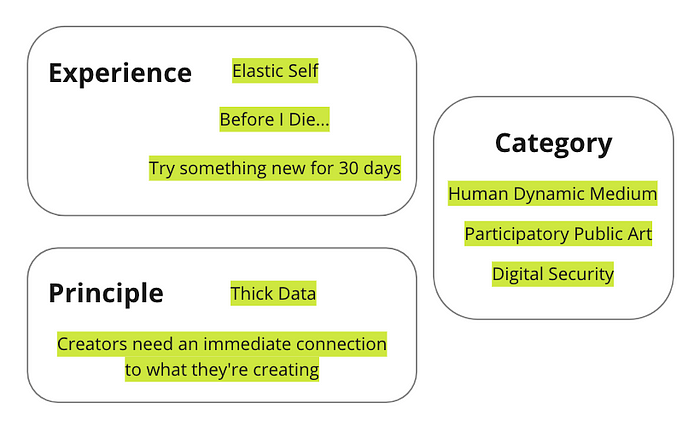
You can find more details in TALE: Find 100 People’s Life Stories and Creative Themes.
Early Objectification refers to actions of making some real material things about a particular theme. For example, I often design a fake cover image for a possible book because the format of the cover image is a perfect medium for representing a possible theme. In the past six months, TALE used this technique to design a set of images for over 50 possible themes.
I used a board on Miro for this task. Each time I find a picture on Unsplash.com and upload it to the Miro board. The workflow is very simple. I only need to change the title and the subtitle. Below is a large view of my work area.

I made each cover image quickly. Sometimes I needed to tweak it a little. See the screenshot below.
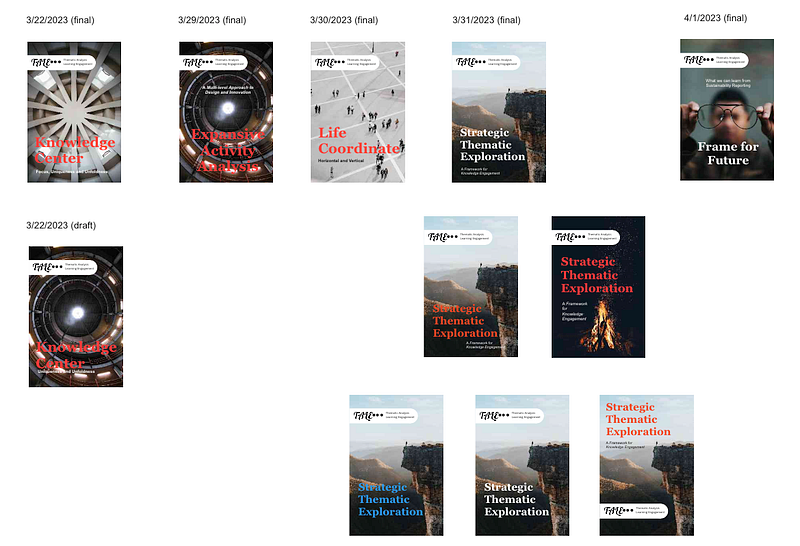
You can also find some cover images on the TALE (2023) board on Milanote.
Multiple Thematic Reflection is a technique for creating multiple possible themes from one experience. For example, I applied this technique to reflect on a thematic conversation project about “Strategic Exploration” in Jan 2023.
The project was closed on Jan 29, 2023. Later, I reflected on the project from multiple thematic perspectives:
- The Achievement Chain
- Possible Selves and Possible Practice
- Strategic Exploration and Second-order Activity
- Aspects of Thematic Engagement
- Creative Journey
- Crystallize Thematically
- Continuous Curation
- Supportive Immanent Development
- Multi-thematic Reflection
In the past six months, I made over 50 possible themes. You may find inspiration from the following themes:
- 2.1 — “How AI Curate” — 12 min read
- 2.2 — “Slow Talk” — 14 min read
- 2.3 — “Founder as Curator” — 17 min read
- 2.4 — “Product Langue” — 3 min read
- 2.5 — “The Hierarchy of Fit” — 4 min read
- 2.6 — “Frame for Work” — 8 min read
- 2.7 — “Frame for Future” — 8 min read
- 2.8 — “Mental Moves” — 11 min read
- 2.9 — “TalkThree” — 7 min read
- 2.10 — “Blade with Blood” — 6 min read
Part 3: Slow Talk
Part 3 introduces a special type of activity of thematic exploration: Thematic Conversation.
I defined Thematic Conversation as the practice of theme-centered conversation between professional workers.
Inspired by a friend of mine, I launched the “Slow Talk” theme and expand it into a project. I used “Slow Talk: From Controversy to Collaboration” to frame a thematic space and run a knowledge curation project in order to achieve “improve communication” and “enhance understanding”. You can find more details in How to develop a framework for a possible theme called “Slow Talk”? (3.1–14 min read)
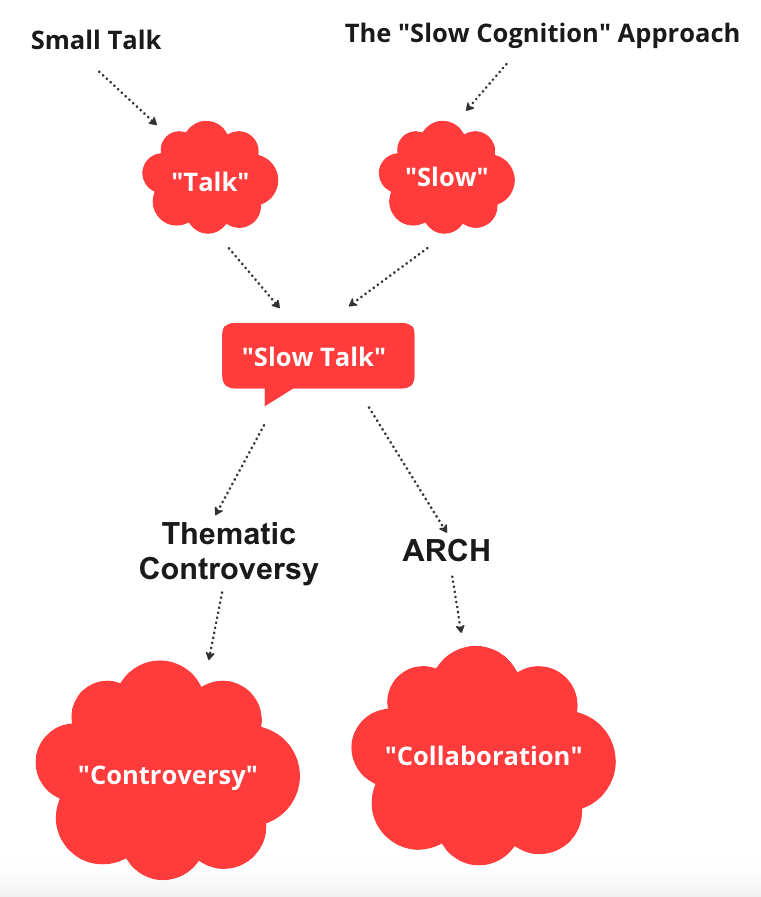
In the past several months, I had a series of thematic conversations with my friends.
- 3.2 — A Thematic Conversation about “Strategic Exploration” (1 — 8 min read, 2–8 min read)
- 3.3— A Thematic Conversation about “Social Affordance” (8 min read)
- 3.4 — A Thematic Conversation about “Intellectual Experience” (7 min read)
- 3.5— A Thematic Conversation about “Note-taking and Knowledge Engagement” (1 min read)
- 3.6 — A Thematic Conversation about “Persona”
In this part, I also introduce a method called Mapping Thematic Conversation which is based on the ARCH meta-diagram. See the diagram below.
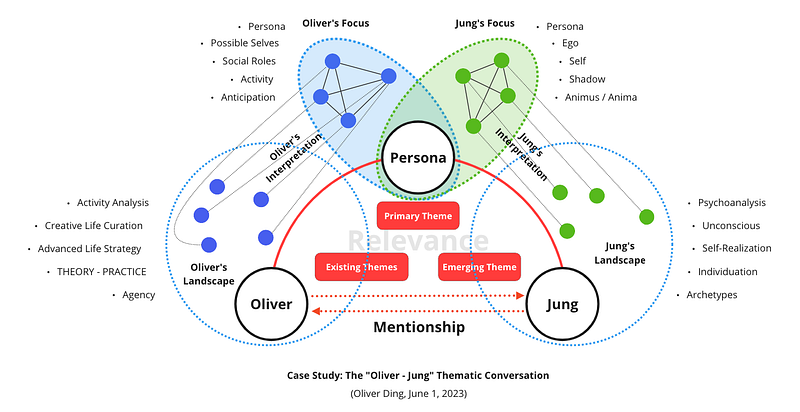
You can also find a story about the development of the ARCH diagram in Mental Moves #5: The Attachance of Rediscovery and Diagram Development (3.7— 23 min read).
Part 4: Possible Frameworks
In order to discuss various methods for developing knowledge frameworks, I collected some old articles for Part 4.
4.1 Method: Diagramming as Thinking
- Example: The Value-fit Framework
- 4.1.1 — Strategic Value Proposition — 3 min read
- 4.1.2 — The Dialectic Room and Value Engagement — 11 min read
- 4.1.3 — The Interactive Zone and Value Engagement — 7 min read
- 4.1.4 — The Value-fit Framework and Canvas — 9 min read
4.2 Method: Frame of Reference
- Example: The Strategic Curation Model
- 4.2.1 — A Five-space Model for Strategic Curation — 14 min read
- 4.2.2 — A Five-space Model for Strategic Curation Activity — 7 min read
4.3 Method: Concept Development
- Example: The Anticipatory Activity System Framework
- 4.3.1 — The iART Framework — 12 min read
- 4.3.2 — iART Diagram Notation — 12 min read
- 4.3.3 — Meet with Martin Prechelmacher — 15 min read
- 4.3.4 — Strategy as Anticipatory Activity System — 16 min read
4.4 Method: Metaphorical Integration
- Example: The “Mind as Play” Framework
- 4.4.1 — The Mind as Play Metaphor — 13 min read
- 4.4.2 — The Diagramming as Practice Framework — 15 min read
4.5 Method: Rediscovery
- Example: The “Persona Dynamics” Framework
- 4.5.1 — A Possible Theme called “Possible Personas” — 10 min read
- 4.5.2 — A Possible Theme called “Possible Discipline” — 9 min read
- 4.5.3 — Themes in the Field: Self, Agency, and Activity (Part I) — 20 min read
4.6 Method: Multiple Moves
- Example: The “Context (Mind)” Framework
- 4.6.1 — The Curated Mind — 22 min read
- 4.6.2 — The Model of Curated Mind — 6 min read
- 4.6.3 — A Possible Theme called “Context (Mind)” — 15 min read
Part 5: Spontaneous Concept System
Part 5 is a connection between the Thematic Exploration phase and the Conceptual Elaboration phase.
I consider Strategic Thematic Exploration and Conceptual Elaboration as two phases of EARLY DISCOVERY of the journey of knowledge Engagement. See the diagram below.
If we see the Conceptual Elaboration phase as an Activity, the raw material is a Spontaneous Concept System and the outcome is a Defined Concept System or Scientific Concept System.
All actions of the Activity are about deliberately developing individual concepts, relationships between concepts, diagrams of concepts, and representations of frameworks. The mediation of the Activity can be various tools and methods case studies, etymology, thematic analysis, concept choices, etc.
For the Strategic Thematic Exploration framework, I made a distinction between “Theme” and “Concept”. While “Theme” emphasizes subjective experience and understanding, “Concept” is more about objective meaning and definition.
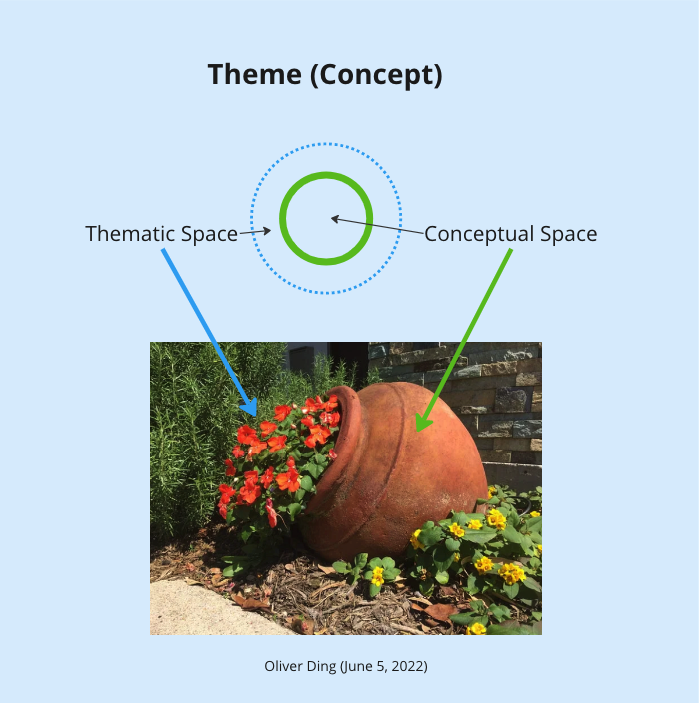
I also see “Theme” from the perspective of “Themes of Practice” which is a core concept of the Ecological Practice approach.
In this way, we can see two types of cognitive space from the perspective of “Container Thinking”.
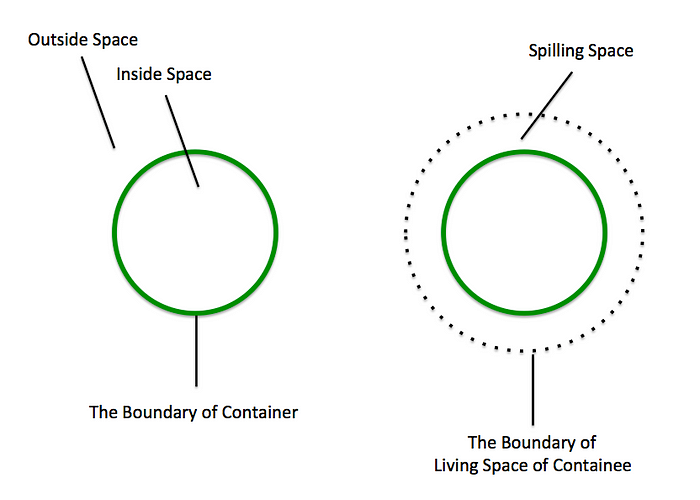
- Container: Concept
- Containee: Theme
- Container’s boundary: Conceptual Space
- Containee’s living space: Thematic Space
As mentioned above, “the Spilling Space is a dynamic space because it can be smaller than the inside space or bigger than the outside space. In this way, the spilling space connects the inside space and the outside space.” The Thematic Space can be smaller than the Conceptual Space or bigger than the Conceptual Space because it is a dynamic space.
My notion of “Theme” is similar to Spontaneous Concepts. Developmental psychologists use Spontaneous Concepts to discuss the development of a child’s cognitive structure and skills. In general, Spontaneous Concepts refer to “conceptions about the world that we form without any formal education”.
Jean Piaget made a distinction between two types of children’s tendency of concept formation: Spontaneous and non-spontaneous.
- Spontaneous conception represents a child’s original reflections, which are decisively not influenced by adults.
- Non-spontaneous conceptions are internalized from family, school, and conversation, that a child attends to.
Lev Vygotsky made a similar distinction with two terms: Spontaneous Concepts and Scientific Concepts. For example, “Archimedes’s Law” is a scientific concept while “Brother” is a spontaneous concept.
For the Strategic Thematic Exploration framework, I used a distinction between Spontaneous Concept System and Defined Concept System. I roughly list several criteria to compare these two ideas. See the table below.
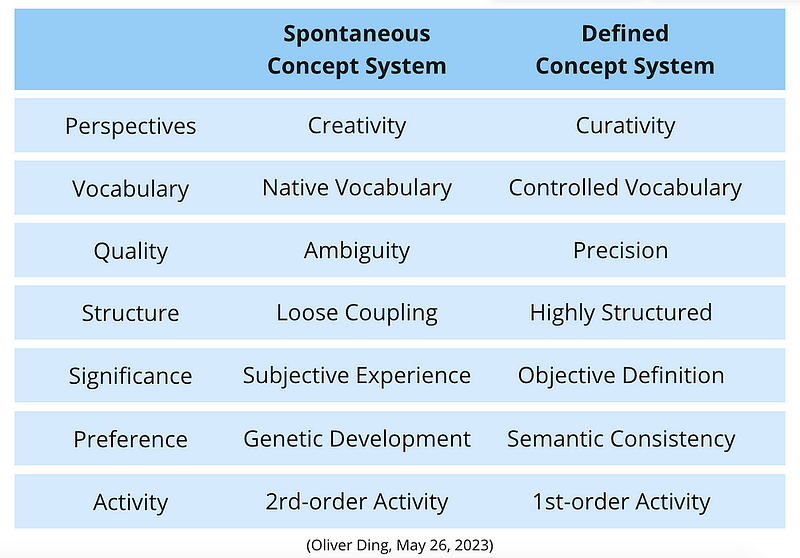
The Spontaneous Concept System is based on a person’s subjective experience with a thing while the Defined Concept System is based on the verbal definition of the thing.
A Spontaneous Concept System can be seen as a Theme Network since both emphasize the personal subjective experience and the genetic historical development of the system/network.
In contrast, a Defined Concept System looks like a formal concept network that emphasizes semantic consistency.
You can find more details in the following articles:
- 5.1 — A Possible Theme called “Spontaneous Concept System” — 18 min read
- 5.2 — The Territory of Concepts — 11 min read
- 5.3 — A Possible Theme called “Concept Choices” — 10 min read
- 5.4 — Knowledge Discovery: The Concept Dynamics Framework — 15 min read
- 5.5 — Knowledge Discovery: Concepts, Notions, and the Concept Dynamics Framework — 14 min read
- 5.6 — Against Conceptual Heterogeneity — 20 min read
- 5.7 — AAI: Cross-boundary Knowledge Curation — 16 min read
- 5.8 — Themes of Practice (2019–2021) — 13 min read
- 5.9 — #TalkThree 16: Concepts, Themes, and Culture — 6 min read
- 5.10 — The Challenge of Thematic Conversation — 13 min read
- 5.11 — The Dynamics of Thematic Space (v2.0) — 13 min read
- 5.12 — A Possible Theme called “Continuous Curation” — 10 min read
- 5.13 — A Linguistic Perspective on Product Engagement — 14 min read
Part 6: A Toolkit
On Sep 15, 2022, I launched the Thematic Engagement Toolkit (v1.0) which featured 12 tools. See the list below:
- The “Theme U” Diagram
- The “Themes of Practice” Framework
- The “Thematic Network” Model
- The “Thematic Space” Canvas
- The “Thematic Controversy” Framework
- The “Project Network” Model
- The “Thematic Journey” Map
- The “Thematic Landscape” Map
- The “Life — History” Complex
Later, I moved some tools for the Creative Life Curation framework. For the Strategic Thematic Exploration framework, I’d like to recommend the following tools:
- 6.1 — The “Fake Cover” Technique
- 6.2 — The Knowledge Discovery Canvas — 14 min read
- 6.3 — The Themes of Practice Framework
- 6.4 — The Concept Dynamics Framework
- 6.5 — The HERO U canvas — 22 min read
- 6.6 — The 5A Slow Cognition Model — 18 min read
- 6.7 — The Art of Semantic Awareness — 8 min read
- 6.8 — #TalkThree 07: How to Understand “X as Y” — 9 min read
- 6.9 — #TalkThree 10: How to use a Hierarchy? — 10 min read
- 6.10 — #TalkThree 03: How to Use an Abstract Model? — 9 min read
What’s next?
As mentioned above, I considered Strategic Thematic Exploration and Conceptual Elaboration as two phases of EARLY DISCOVERY of the journey of knowledge Engagement.
The next phase of the journey of knowledge engagement is Conceptual Elaboration which aims to turn a Spontaneous Concept System into a Defined Concept System or a Scientific Concept System.
The further phase is Continuous Objectification which aims to turn a concept system into real things.


