avatarOliver Ding

Free AI web copilot to create summaries, insights and extended knowledge, download it at here

4674

Abstract

You only need to use some words to replace Corner, Zone, Center, and Context. For example, I created a diagram to curate my three theoretical accounts in July 2021. See the diagram below:</p><figure id="0f7d"><img src="https://cdn-images-1.readmedium.com/v2/resize:fit:800/0*MLpgkOPxzYe1yEgu.png"><figcaption></figcaption></figure><p id="be9e">On July 4, 2021, I finished a 64-page thesis titled <b><i>The Epistemology of Domain </i></b>which offers a brand new theory about <b>Domain</b>. On July 5, 2021, I sent an email to a friend with my draft. At the end of the email, I used the following three keywords to summarize my three major theoretical creations.</p><ul><li><b>Opportunity</b>: The Ecological Practice Approach</li><li><b>Objective</b>: Project-oriented Activity Theory</li><li><b>Outcome</b>: The Epistemology of Domain</li></ul><p id="1960">Later, I used the Tripartness diagram to re-organize these ideas. I also adopted the pair of concepts “Lifeway/Lifeform” to the diagram. Finally, I made a new framework for discussing career development.</p><p id="b505">This led to a new book! I added the new diagram to the <a href="https://miro.com/app/board/o9J_l_Dii9s=/"><b>Career Curation</b></a> board and started writing! I have written 106 pages for the first draft in Chinese. However, I stopped the project on July 17, 2021.</p><p id="8cf4">The first draft of Career Curation has six chapters:</p><ul><li>Chapter 1: The background (32 pages)</li><li>Chapter 2: Lifeway, Lifeform, and Lifeworld (6 pages)</li><li><b>Chapter 3: Opportunity, Object, and Outcome (22 pages)</b></li><li>Chapter 4: Lifesystem (20 pages)</li><li>Chapter 5. The Landscape of Lifeworld (10 pages)</li><li>Chapter 6: The Method (6 pages)</li></ul><p id="dcab"><b>Chapter 3 (Opportunity, Object, and Outcome)</b> is an example of TalkThree. I adopted ideas from the above three theoretical accounts to discuss these three keywords. It is a hard task of deep conceptual inquiry. Eventually, I discovered nine insights about the Lifeworld of Career. See the diagram below.</p><figure id="c83a"><img src="https://cdn-images-1.readmedium.com/v2/resize:fit:800/0*j08IFGhbzsw7zKPk.png"><figcaption></figcaption></figure><p id="8673">At the end of Chapter 3, I introduced a new diagram as a summary of the discussion. I noticed that the difference between “the process of achieving objectives” and “the process of transformation of objects” is significant because it challenges the traditional concept of “object” in Yrjö Engeström’s <a href="https://readmedium.com/triangle-fdbecbba7ac2?sk=54e8e6a6a7b3b531febc83ab6be1f040"><b>Activity System model</b></a> which is an established branch of Activity Theory.</p><p id="1283">Later, I confirmed this insight from the perspective of the <a href="https://readmedium.com/strategy-f285d397ad1e">iART framework</a> in Sept. From the perspective of the iART framework, it’s clear that we have to use two terms because <b>Objective (what is motive about)</b> is about the <b>Future</b> while <b>Object (what is acted on)</b> is about <b>Present</b>. Moreover, for the iART framework, the <b>Objective</b> is related to <b>Anticipation</b> while the <b>Object</b> is related to <b>Performance</b>.</p><p id="1275">I used the diagram below to expand the original three keywords into five keywords: <b>Concept (Opportunity > Objective > Object > Outcome). </b>I didn’t give a name to this diagram. Later, I realized that it could be considered a new version of the Life-as-Activity framework.</p><figure id="cde9"><img src="https://cdn-images-1.readmedium.com/v2/resize:fit:800/0*ziVB7EjkEJ27zQQe.png"><figcaption></figcaption></figure><p id="d287">Eventually, I destroyed “The Lifeworld of Career” diagram and rebuilt a new diagram.</p><p id="a16d">This is a power of TalkThree. You can use three keywords at the beginning, but the outcome can be four keywords, two keywords, etc. You don’t have to only use three keywords to frame your outcome.</p><p id="313c">More details about this story:</p><ul><li><a href="https://readmedium.com/tripartness-101fb0e6a23a"><i>D as Diagramming: Tripartness and Diagram Blending</i></a></li><li><a href="https://readmedium.com/72303d09ca8"><i>Career Curation: Curativity Theory for Personal Innovation</i></a></li></ul><h1 id="1787">Infowoo: Information, Places, and Actions</h1><p id="7a55">TalkThree refers to a typical structure of frame a theoretical approach. You can find it in many books’ subtitles. For example:</p><ul><li><i>Communities of Practice: <b>Learning, Meaning, and Identity</b></i> (Etienne Wenger, 1998)</li><li><b><i>Practice Theory, Work, & Organization</i></b> (Davide Nicol

Options

ini, 2012)</li><li><i>Ecological Psychology in Context: <b>James Gibson</b>, <b>Roger Barker</b>, and the Legacy of <b>William James</b>’s Radical Empiricism</i> (Harry Heft, 2001)</li></ul><p id="c64a">This is a simple heuristic of using three keywords to define a theme for your creative work. In this way, you can also use one thematic space to build a theoretical work and write a book.</p><p id="7cdc">If you don’t want to write a book or develop a theory, you can develop a perspective. In the past years, I used “<b>Information, Places, and Actions</b>” to develop a perspective about “<b>Action-centered Information</b>”.</p><p id="f5a1">I took many pictures of “Information, Places, and Actions” in my real-life world.</p><h2 id="57f2">Jan 30, 2022: A Tiny Place without Sign</h2><p id="8e43">On the morning of Jan 30, I moved a ladder to my room in order to replace a dead light bulb. Then I took several pictures.</p><figure id="fca6"><img src="https://cdn-images-1.readmedium.com/v2/resize:fit:800/0*ANiEiKc74w9LPSlo.jpeg"><figcaption></figcaption></figure><p id="cb52">Why did I take these pictures? I want to show readers a tiny place without a sign: <b>the place around the blue mini platform</b>.</p><p id="5a8e">This is an example of <b>Spot</b> of Infoniche. Spot refers to the body scale minimal environment which is defined by a set of Affordances. We can perceive the affordance of the mini platform without any sign.</p><h2 id="953c">Jan 30, 2022: A Sign for Place</h2><p id="a694">On the afternoon of Jan 30, I went to the Apple store to repair my iMac. I took the following pictures.</p><figure id="d0a9"><img src="https://cdn-images-1.readmedium.com/v2/resize:fit:800/0*xjtl5f_6H9JyClIq.jpeg"><figcaption></figcaption></figure><p id="dbfc">This sign indicates a place called Genius Bar.</p><figure id="8218"><img src="https://cdn-images-1.readmedium.com/v2/resize:fit:800/0*yswtJDB_7P_JUSPp.png"><figcaption></figcaption></figure><p id="a457">This place is part of a workflow and Apple’s customer service system. Once a place has its name, it could be coded into a workflow and a software system.</p><p id="b1f0">In 2017, I was fascinated by the special type of artifact which is “a combination of <b>Language/information/text</b> and <b>Material</b>”. In order to save time, I name the type of artifact <b>Infowoo(</b>信息物<b>)</b>.</p><p id="0d4a">The new term <b>Infowoo(</b>信息物<b>) </b>is a combination of the English word “Info” and a sound of the Chinese character “woo(<a href="https://en.wiktionary.org/wiki/%E7%89%A9"></a>)”.</p><p id="e5d7">The “woo(<a href="https://en.wiktionary.org/wiki/%E7%89%A9"></a>)” means material objects.</p><p id="3222">Anyway, the term “Infoniche” is a private label for naming one of my thematic spaces.</p><p id="ed39">Now let’s have a look at my “Infowoo” thematic space. The below picture is one of the pictures of the thematic space.</p><figure id="54d7"><img src="https://cdn-images-1.readmedium.com/v2/resize:fit:800/0*vY57UvGvSzDOhFpJ.jpeg"><figcaption></figcaption></figure><p id="1a34">Why did I take the above picture? Because there is no real fire extinguisher under the sign “Fire Extinguisher”.</p><p id="2f72">You can find more details in the original article:</p><div id="5c3e" class="link-block"> <a href="https://readmedium.com/infoniche-836d27f3155f"> <div> <div> <h2>Thematic Space: Some Sparks for the “Infoniche” thematic space</h2> <div><h3>Information, Places, and Actions</h3></div> <div><p>medium.com</p></div> </div> <div> <div style="background-image: url(https://miro.readmedium.com/v2/resize:fit:320/1*pAaDp6HLFR3uO1mLxu_9lQ.jpeg)"></div> </div> </div> </a> </div><h1 id="cac2">Related articles</h1><ul><li><a href="https://readmedium.com/how-do-i-respond-to-a-talkthree-challenge-2fa1872356d7"><i>CALL: How to respond to a TalkThree challenge?</i></a></li><li><a href="https://readmedium.com/talkthree-3-0-82c555917105"><i>TalkThree: A Tiny Idea for Knowledge Engagement</i></a></li><li><a href="https://readmedium.com/semantic-awareness-611a0795f27c"><i>The Art of Semantic Awareness</i></a></li><li><a href="https://readmedium.com/tripartness-101fb0e6a23a"><i>D as Diagramming: Tripartness and Diagram Blending</i></a></li><li><a href="https://readmedium.com/72303d09ca8"><i>Career Curation: Curativity Theory for Personal Innovation</i></a></li><li><a href="https://readmedium.com/infoniche-836d27f3155f"><i>Thematic Space: Some Sparks for the “Infoniche” thematic space</i></a></li></ul></article></body>

TALE: A Possible Theme called “TalkThree”

Using three keywords to frame a creative space
The above picture represents a Possible Theme called “TalkThree”.

The theme of “TalkThree” was initiated by CALL in 2019. Later, Curativity Center followed it in 2022. Now, TALE joined the micro movement in 2013.

It’s clear that “TalkThree” is not a scientific concept. However, if we adopt the perspective of Thematic Engagement, we can consider it as a theme, more specifically a cultural theme.

What’s the major difference between knowledge themes and cultural themes? While knowledge themes aim to develop useful or reliable knowledge, cultural themes are used for cultural innovation which encourages diverse behaviors and multiple-dimensional thinking.

CALL, Curativity Center, and TALE are three different agents, they have their own perspectives and agency while using the word “TalkThree”.

For TALE, what’s the purpose of using “TalkThree”? It aims to offer readers a simple technique for thematic engagement: using three keywords to frame a creative space.

A Technique of Semantic Awareness

Yesterday I published an article titled The Art of Semantic Awareness and introduced the following diagram:
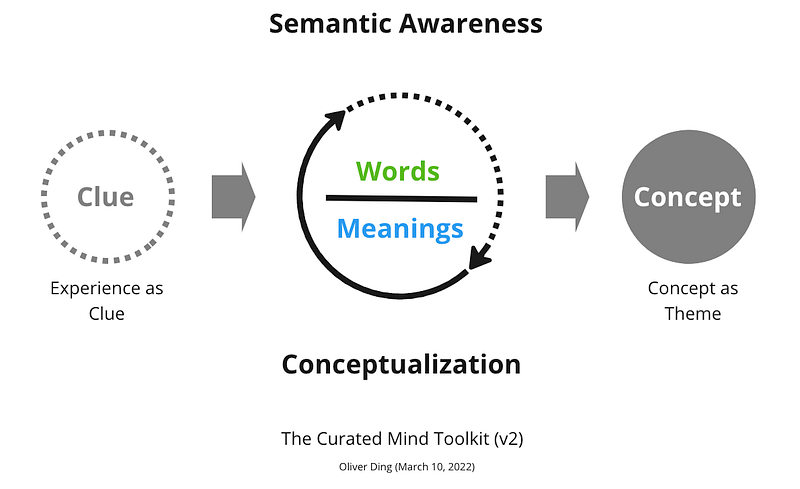
Semantic Awareness is about the “Experience — Language” transformation. You can find more details in the original article.

TalkThree is a simple technique of Semantic Awareness.

“Strategy, Design, and Society“

How to use the TalkThree technique to frame a creative space?

For example, I can use “Strategy, Design, and Society” to frame my journey of thematic engagement in 2022.

  • Strategy: I worked on the Life Strategy project and wrote a book titled Advanced Life Strategy in 2022.
  • Design: I edited a book titled Ecological Practice Design in 2022.
  • Society: I started learning a new theory called Theoretical Sociology in 2022.

In fact, I used “Aspects of Creative Life” to describe my primary creative achievement in 2022. Thus, we should use “Creative Life” as the annual theme of my 2022.

However, we encourage multiple-thematical thinking for Creative Life Curation, Strategic Life Discovery, and Cultural Thematic Engagement.

A simple technique of multiple-thematical thinking is using a different type of theme. “Creative Life” is two words. We can use three different words to find a new theme.
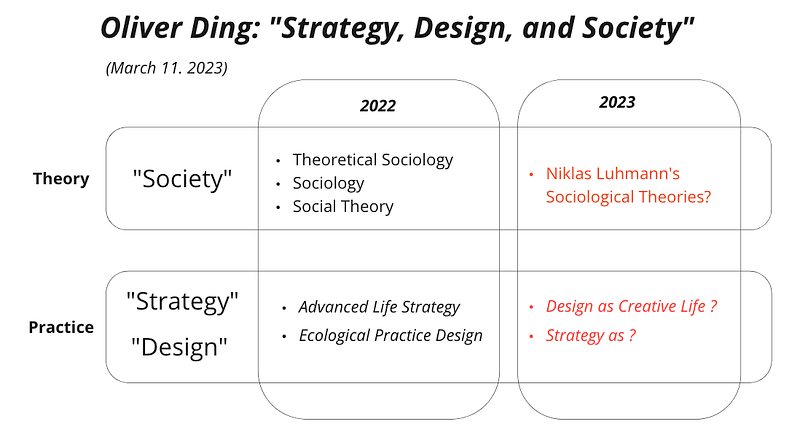
I think these three themes are major themes in my creative life. So I can work on them in 2023 too. By using the above diagram, I can explore some potential ideas for 2023.

Tripartness: A Meta-diagram for TalkThree

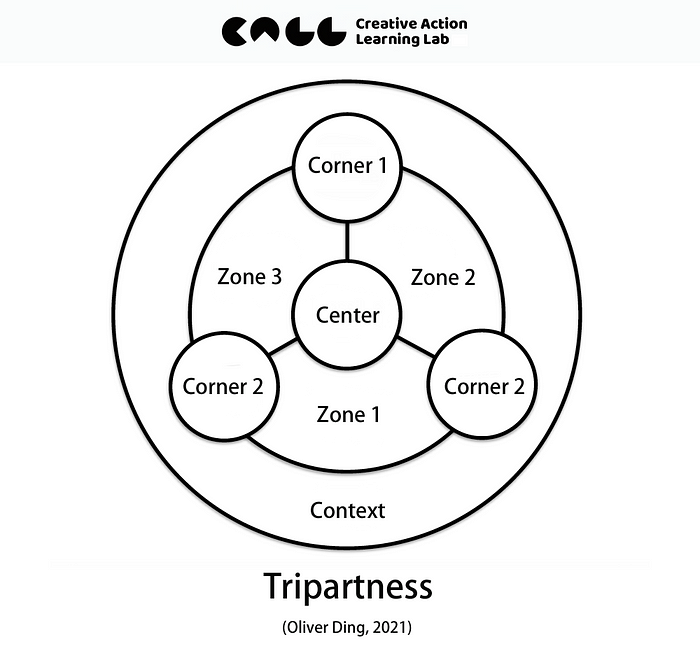
Tripartness is one of a set of meta-diagrams I designed in past years. The Tripartness diagram has two pairs of concepts:

  • Corner and Zone
  • Center and Context

It’s easy to create a new diagram with the Tripartness meta-diagram. You only need to use some words to replace Corner, Zone, Center, and Context. For example, I created a diagram to curate my three theoretical accounts in July 2021. See the diagram below:
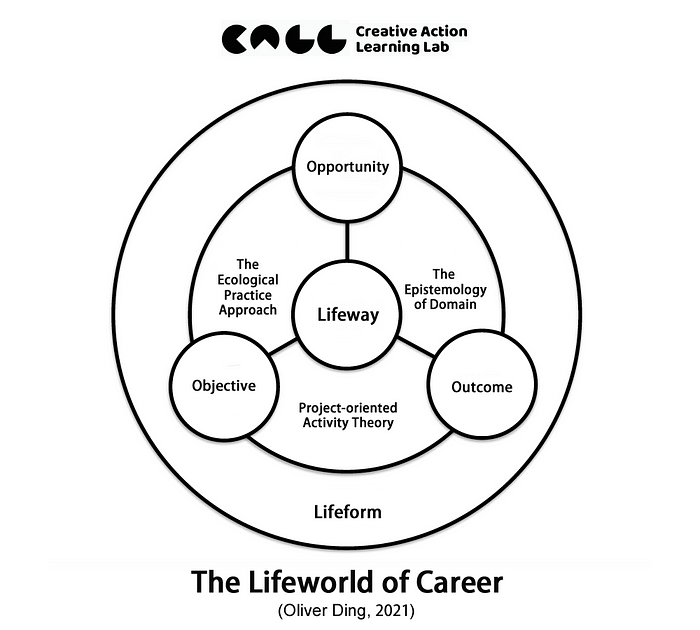
On July 4, 2021, I finished a 64-page thesis titled The Epistemology of Domain which offers a brand new theory about Domain. On July 5, 2021, I sent an email to a friend with my draft. At the end of the email, I used the following three keywords to summarize my three major theoretical creations.

  • Opportunity: The Ecological Practice Approach
  • Objective: Project-oriented Activity Theory
  • Outcome: The Epistemology of Domain

Later, I used the Tripartness diagram to re-organize these ideas. I also adopted the pair of concepts “Lifeway/Lifeform” to the diagram. Finally, I made a new framework for discussing career development.

This led to a new book! I added the new diagram to the Career Curation board and started writing! I have written 106 pages for the first draft in Chinese. However, I stopped the project on July 17, 2021.

The first draft of Career Curation has six chapters:

  • Chapter 1: The background (32 pages)
  • Chapter 2: Lifeway, Lifeform, and Lifeworld (6 pages)
  • Chapter 3: Opportunity, Object, and Outcome (22 pages)
  • Chapter 4: Lifesystem (20 pages)
  • Chapter 5. The Landscape of Lifeworld (10 pages)
  • Chapter 6: The Method (6 pages)

Chapter 3 (Opportunity, Object, and Outcome) is an example of TalkThree. I adopted ideas from the above three theoretical accounts to discuss these three keywords. It is a hard task of deep conceptual inquiry. Eventually, I discovered nine insights about the Lifeworld of Career. See the diagram below.
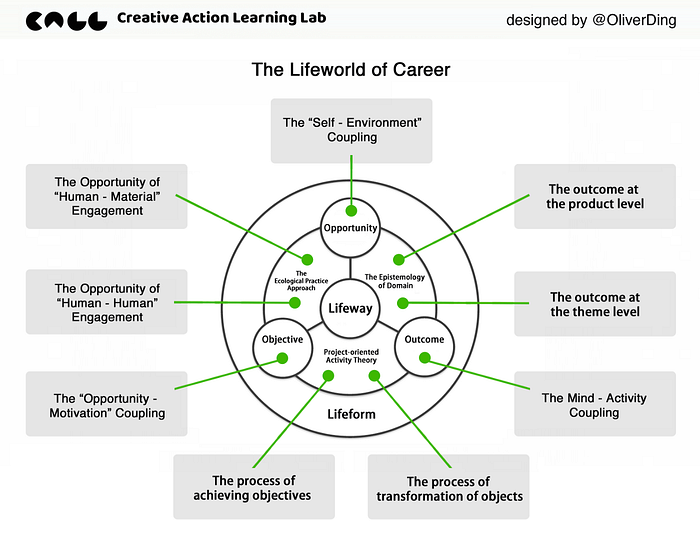
At the end of Chapter 3, I introduced a new diagram as a summary of the discussion. I noticed that the difference between “the process of achieving objectives” and “the process of transformation of objects” is significant because it challenges the traditional concept of “object” in Yrjö Engeström’s Activity System model which is an established branch of Activity Theory.

Later, I confirmed this insight from the perspective of the iART framework in Sept. From the perspective of the iART framework, it’s clear that we have to use two terms because Objective (what is motive about) is about the Future while Object (what is acted on) is about Present. Moreover, for the iART framework, the Objective is related to Anticipation while the Object is related to Performance.

I used the diagram below to expand the original three keywords into five keywords: Concept (Opportunity > Objective > Object > Outcome). I didn’t give a name to this diagram. Later, I realized that it could be considered a new version of the Life-as-Activity framework.
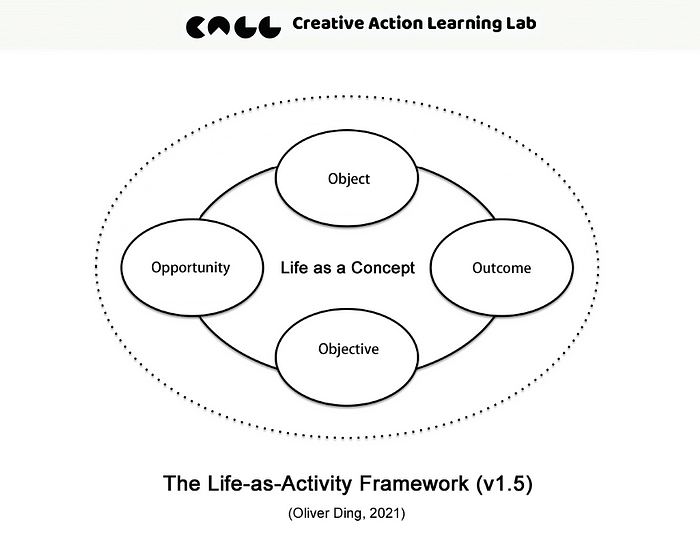
Eventually, I destroyed “The Lifeworld of Career” diagram and rebuilt a new diagram.

This is a power of TalkThree. You can use three keywords at the beginning, but the outcome can be four keywords, two keywords, etc. You don’t have to only use three keywords to frame your outcome.

More details about this story:

Infowoo: Information, Places, and Actions

TalkThree refers to a typical structure of frame a theoretical approach. You can find it in many books’ subtitles. For example:

  • Communities of Practice: Learning, Meaning, and Identity (Etienne Wenger, 1998)
  • Practice Theory, Work, & Organization (Davide Nicolini, 2012)
  • Ecological Psychology in Context: James Gibson, Roger Barker, and the Legacy of William James’s Radical Empiricism (Harry Heft, 2001)

This is a simple heuristic of using three keywords to define a theme for your creative work. In this way, you can also use one thematic space to build a theoretical work and write a book.

If you don’t want to write a book or develop a theory, you can develop a perspective. In the past years, I used “Information, Places, and Actions” to develop a perspective about “Action-centered Information”.

I took many pictures of “Information, Places, and Actions” in my real-life world.

Jan 30, 2022: A Tiny Place without Sign

On the morning of Jan 30, I moved a ladder to my room in order to replace a dead light bulb. Then I took several pictures.
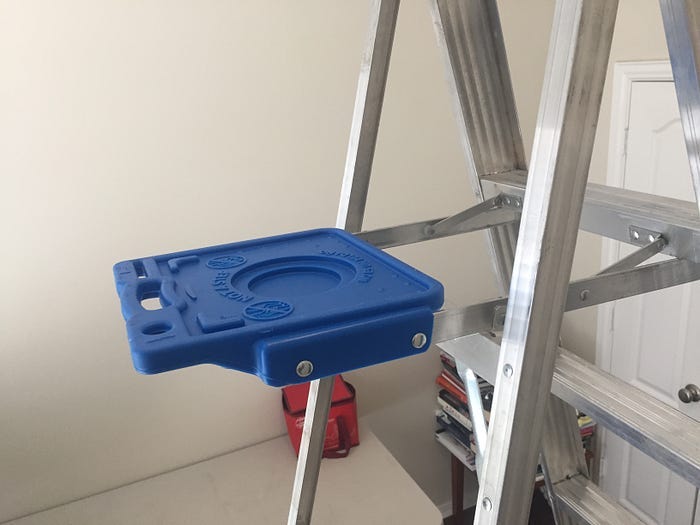
Why did I take these pictures? I want to show readers a tiny place without a sign: the place around the blue mini platform.

This is an example of Spot of Infoniche. Spot refers to the body scale minimal environment which is defined by a set of Affordances. We can perceive the affordance of the mini platform without any sign.

Jan 30, 2022: A Sign for Place

On the afternoon of Jan 30, I went to the Apple store to repair my iMac. I took the following pictures.
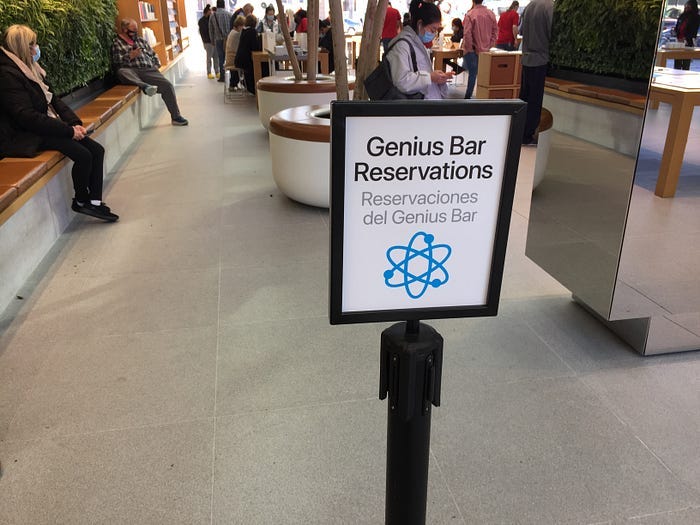
This sign indicates a place called Genius Bar.
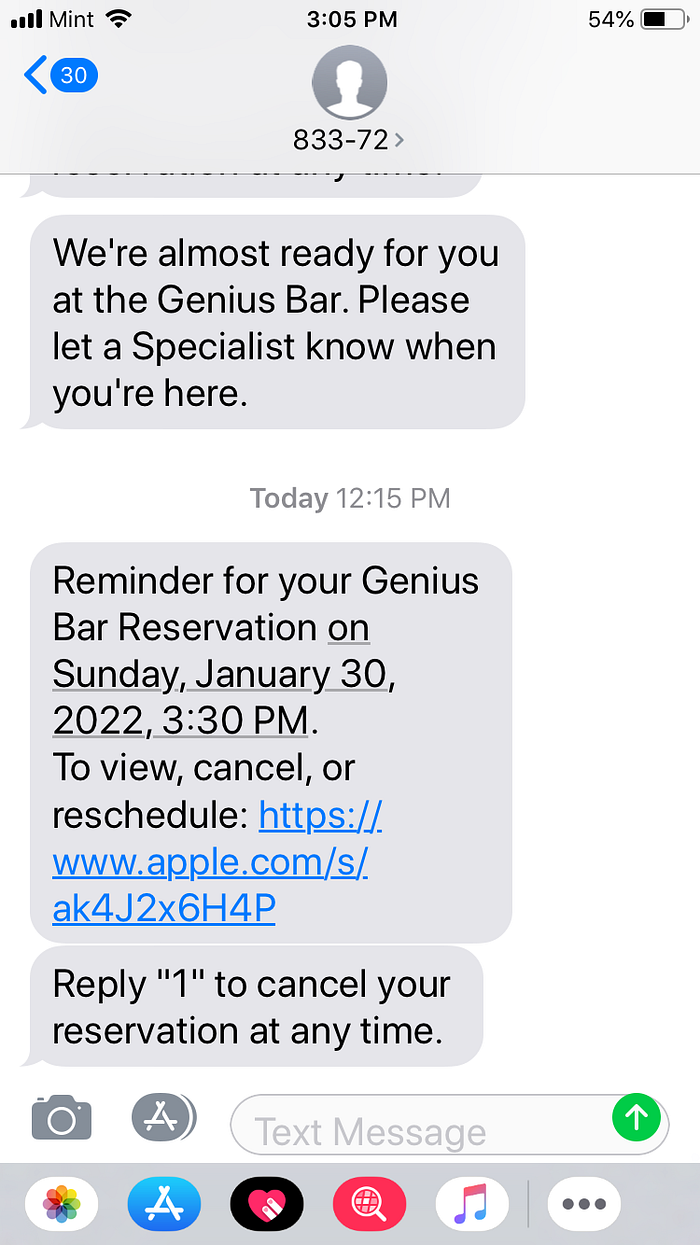
This place is part of a workflow and Apple’s customer service system. Once a place has its name, it could be coded into a workflow and a software system.

In 2017, I was fascinated by the special type of artifact which is “a combination of Language/information/text and Material”. In order to save time, I name the type of artifact Infowoo(信息物).

The new term Infowoo(信息物) is a combination of the English word “Info” and a sound of the Chinese character “woo()”.

The “woo()” means material objects.

Anyway, the term “Infoniche” is a private label for naming one of my thematic spaces.

Now let’s have a look at my “Infowoo” thematic space. The below picture is one of the pictures of the thematic space.
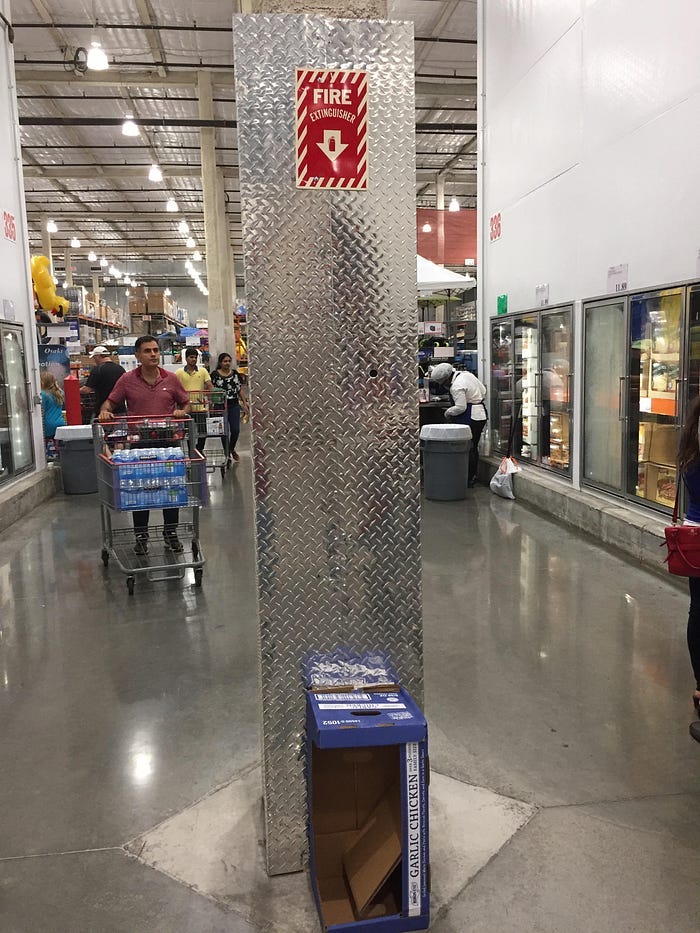
Why did I take the above picture? Because there is no real fire extinguisher under the sign “Fire Extinguisher”.

You can find more details in the original article:

Related articles

Themes
Talkthree
Creative Process
Ideas
Imagination
Recommended from ReadMedium