
#TalkThree 19: The Art of Semantic Awareness
Words That Matter

In The Curated Mind Toolkit (v1.0), I introduced several techniques for developing tacit knowledge. One of them is called Symbolic Awareness. See the diagram below.
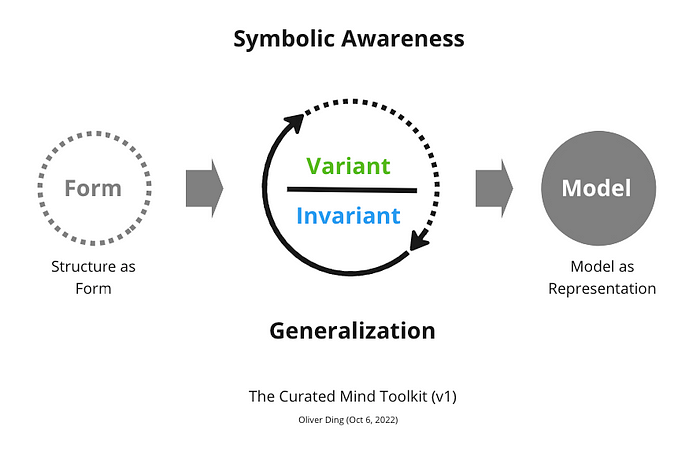
This one is about turning concrete data into abstract ideas such as concepts and models. If you read my articles, you probably find that I often develop a model from one case study. Yes, one story can be a sample for building a model if you can find Significant Invariants and Variants from the deep structure of the story.
Today I am going to introduce a similar technique called “Semantic Awareness”.
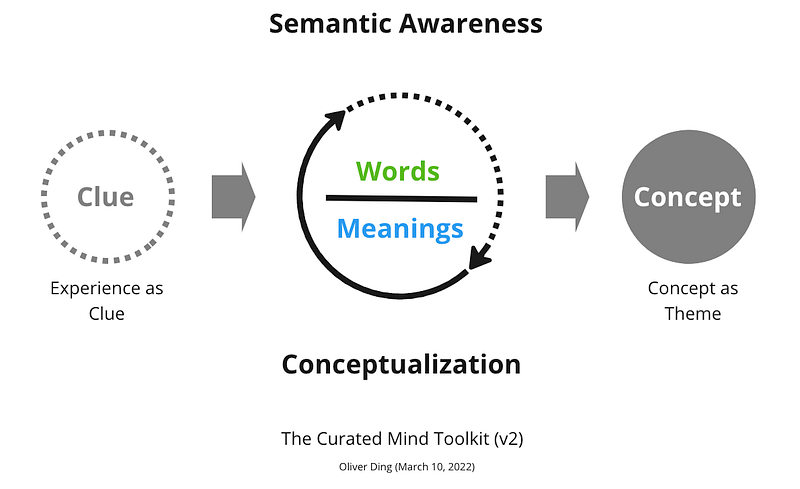
Though both Symbolic Awareness and Semantic Awareness are about creative abstract thinking, there is a difference between these two. While Symbolic Awareness is about generating models, Semantic Awareness is about generating concepts.
Also, they have different resoueces. Symbolic Awareness is based on perceived structures within data while Semantic Awareness is based on words and text.
I use Semantic Awareness to describe the following two situations:
- You have an idea, however you can’t find some words which can be sued to describe your idea. At a moment, you just get it. You find a perfect word.
- You are reading a book or an article, you pay attention to a word or some words. Suddenly, a new idea comes to your mind.
Both two situations are related to the “Experience — Language” transformation. We have to detach a mental element from one zone and attach it to the other zone.
This technique is significant to writers and other creators. I’d like to share some real examples from my own creative work.
#1 Mental Moves

I made this picture before writing this article. Why did I design the picture?
This morning I wrote a short post about the journey of developing the concept of Attachance. I coined the term Attachance by combining Attach and Chance in 2018 in order to discuss some ideas related to the concept of Affordance which is a core idea of Ecological Psychology.
Affordance means potential action opportunities offered by environments. I want to highlight the meaning and value of actual action itself, however, the term Affordance only refers to potential actions. Thus, I coined the term Attachance to emphasize the potential opportunities offered by actual actions, especially the attaching act and the detaching act.
In May 2020, I wrote a book titled After Affordance: The Ecological Approach to Human Action in which I proposed several new theoretical ideas for expanding ecological psychology to the modern digital environment. The primary theme of After Affordance is the concept of Attachance.
The concept of Attachance is planned to develop as 1) an ecological practice concept for practice studies such as interaction design and startup innovation, and 2) a philosophical concept for developing a social theory.
The book After Affordance only achieves the first goal and it focuses on the following acts:
- Attaching to an environment
- Detaching from an environment
- Attaching to an object
- Detaching from an object
What was the newest development of the concept of “Attachance” in the past several months?
I moved to discover various types of “Thematic Spaces” and identify various types of “Attachances” of moving things between different “Thematic Spaces”.
If you read articles I wrote in the past several months. You can find this deep theme.
For example:
The attached diagram is about my journey of developing the AAS framework. AAS stands for the Anticipatory Activity System (AAS) framework.
There are nine moves between five thematic spaces.
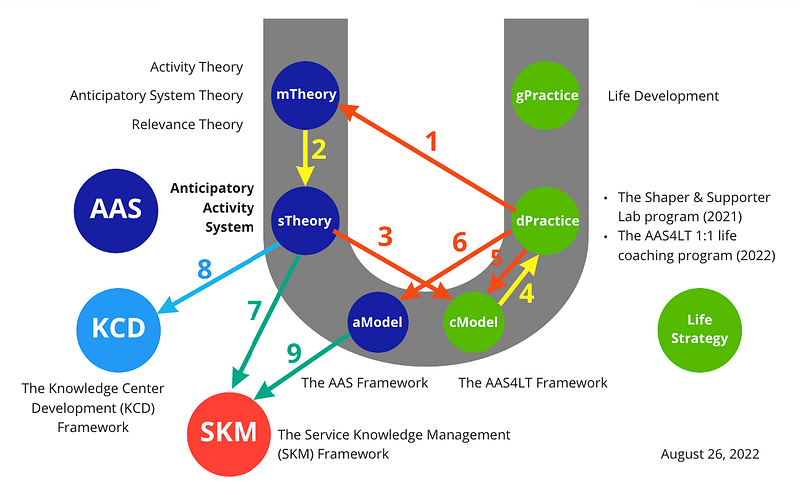
This is a significant insight!
It indicates a deep theme behind a series of projects in the past several months.
There are many clues we can find from my articles. For example, I wrote an article titled The Attachances of Moving Mental Elements two days ago.
In order to highlight this significant insight, I made a new possible theme called “Mental Moves”.
How did I get this idea?
The theme of “Mental Moves” is inspired by “Moving Mental Elements”.
#2 Slow Talk
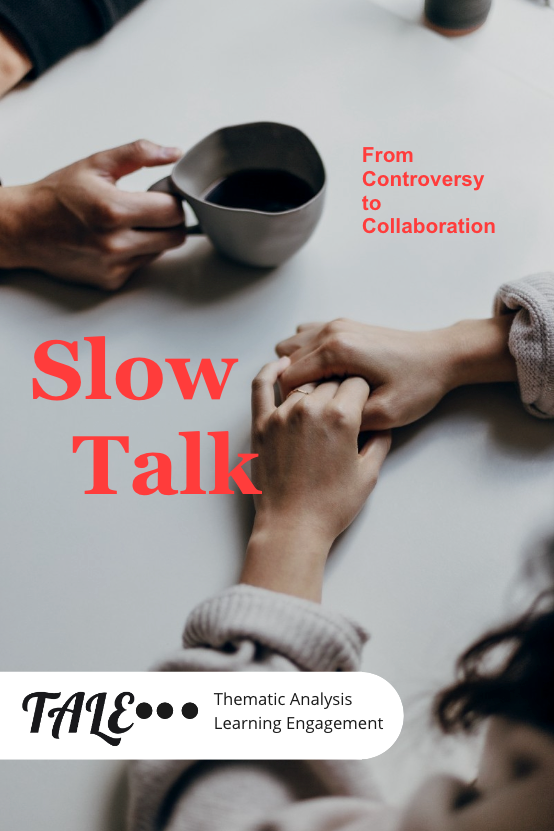
On Jan 23, 2023, I wrote an article titled TALE: How to develop a framework for a possible theme called “Slow Talk”?
Inspired by a friend of mine, I decided to use “Slow Talk: From Controversy to Collaboration” to frame a thematic space and run a knowledge curation project in order to achieve “improve communication” and “enhance understanding”.
How did I get the name of “Slow Talk”? See the diagram below.
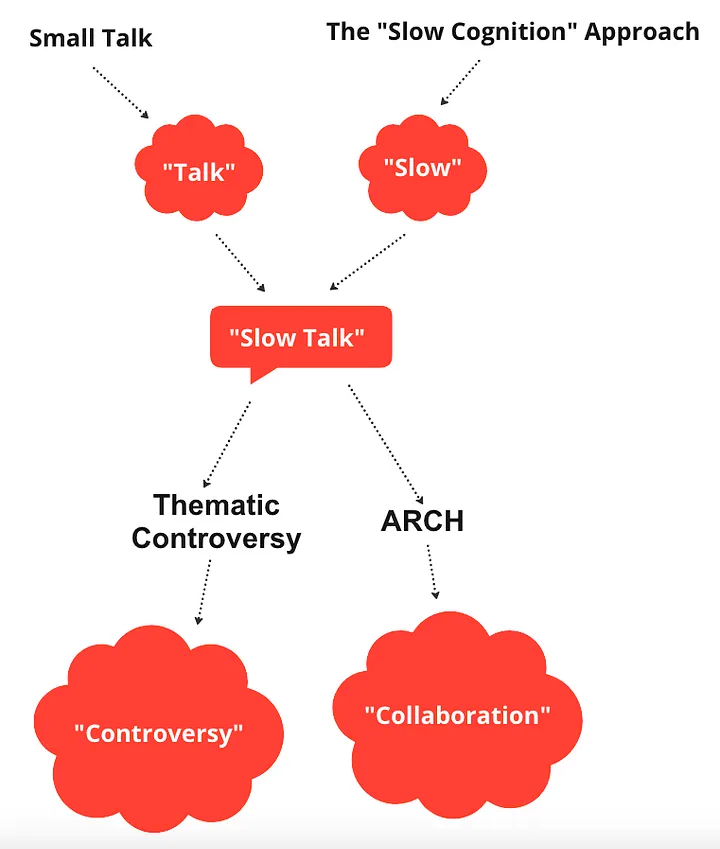
The diagram represents a simple process of Conceptualization behind the theme of “Slow Talk”.
The name is inspired by “Small Talk” and the “Slow Cognition” approach. Small Talk refers to light, informal conversation, especially between people who don’t know each other well. The “Slow Cognition” approach refers to my approach to studying creative work.
I also connect the Thematic Controversy framework and the ARCH framework with this theme.
The ARCH framework is a visual language of interpersonal interactions and collaborative project engagement. The keyword of the ARCH framework is Collaboration.
If we put the Thematic Controversy framework and the ARCH framework together, we see a new path: From Controversy to Collaboration. This is the clue of the theme of “Slow Talk”.
#3 Blade with Blood
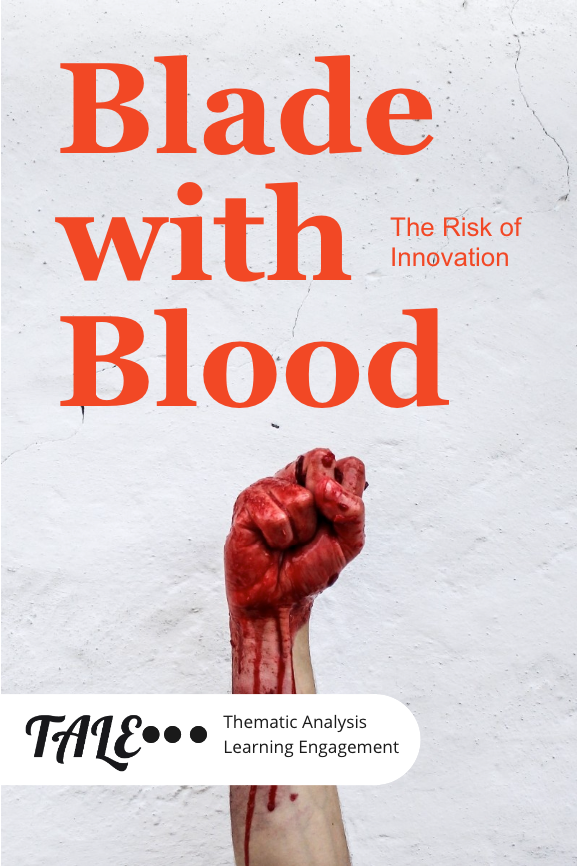
On Feb 13, 2023, I made the above picture in order to highlight an important aspect of innovation: Risk.
The theme of “Blade with Blood” was inspired by a post about the definition of Innovation on Linkedin.
Jason Frasca started the conversation with an argument about using the word “Innovation”.
If we follow Jason Frasca’s argument, then we can focus on the Linguistic Reality of the word “Innovation”. This direction requires some techniques, for example, using Etymology.
I tried it with Chinese Etymology.
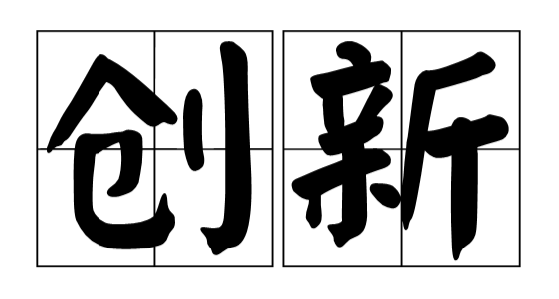
In Chinese, Innovation refers to two characters. See the attached picture:
The first character is “创 chuàng”. Originally, it was 刱 which means digging a well for the first time. Also, the source of 创(chuāng) was 刅 which means blade with blood.
The second character is “新 xīn”. Originally, it was 薪 which means felling wood with an ax.
Wow, this is significant insight! Now we can discover three aspects of Innovation from Chinese Etymology.
1. Originality
Innovation should be the activity of doing something or making something for the first time.
2. Risky
“blade with blood” means that Innovation has potential risks such as loss or hurting others.
3. Affordance
“felling wood with an ax” means taking double affordances: the affordance of natural things and the affordance of human-made artifacts.
This is an interesting discovery, so I made a possible theme about it.
Discussion
As James G. March mentioned, the evocation of meaning is a natural product of crossing disciplinary, cultural, national, and linguistic boundaries. He says, “Nevertheless, for those who see the creative beauty generated by the wanderings of ideas, the magic and mystery of language is a wonder of intellectual discourse. Scholars celebrate the evocation of new meanings that arise when others discover, not exactly what they thought they meant when they wrote their words or characters but rather what the words or characters themselves might be imagined to mean.” (2008, p.140)
However, the new term is not a real concept even though it has its own word meaning. According to Andy Blunden, “…we must always remember that a word meaning is only the realisation of a concept, not a concept in itself. The human mind is an indivisible whole. A concept is the sum of all the meanings it produces, but these meanings have to be taken in the context in which they are produced. A concept may be realised in quite different meanings according to whether a person has to give an instant definition, recognise an object, use the concept to complete a categorisation task, write an extended essay on the concept, evoke the concept in an intellectual action of some other kind or is simply mistaken…In short, it is only possible to say what a concept is, even in terms of its realisation in word meanings, in the context of the activity in which the concept is to be realised. A word is meaningful only within the context of the relevant project. One and the same concept will be realised differently in different projects.” (2012, pp. 292–293)
Blunden’s view on ‘concept’ is inspired by Hegel and Lev Vygotsky. His suggestion points out that concepts are equally subjective and objective, they are units both of consciousness and of the cultural formation of which one’s consciousness is part.
I have been working on idea generation which can be considered a practice of conceptual development for many years. I recently developed a tool called the Concept Dynamics framework for my own works. The framework echoes Blunden’s view to a certain extent. I agree that a word doesn’t equal a concept. I also consider the dynamic development process of a concept and its social context. However, my framework primarily pays attention to the structure of a theoretical concept.
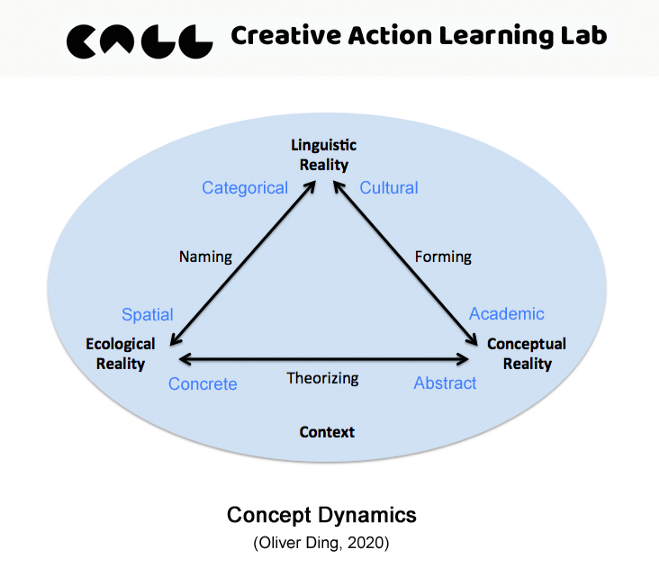
As Berger et al. (1972) argue, “it is difficult to build meaningful theoretical research programs without concepts that are internally consistent and clearly defined in relation to other existing concepts.” (cited in Kallinikos, Leonardi, and Nardi, 2012). In order to discuss the complexity of theoretical concepts, I created the above diagram which suggests every theoretical concept has three basic aspects: ecological reality, conceptual reality, and linguistic reality.
- Ecological reality refers to the real experience of discovery in the real world from the perspective of researchers.
- Conceptual reality refers to the outcome of the creative conceptualization process.
- Linguistic reality refers to expressional form with verbal and rhetorical effects.
Based on the framework, I believe that an ideal theoretical concept should not have intrinsic contradictions between these three aspects and extrinsic contradictions between these aspects and context which means the dynamic background of concepts. Thus, it is hard work to create an ideal theoretical concept. The harder work is detaching an existing concept from its original context and attaching it to a new context by reconceptualizing it with new meaning.
The ‘Semantic Awareness” technique is only about producing Primary Concept which only considers using words to represent meanings. We can see it is a sub-part of the Concept Dynamic framework.
A primary concept can be used as a theme for creative projects. Its value is taking the first step of objectification of concept.
An idea without a name and an idea with a name are located at two different zones. Creative work is all about moving mental elements between different zones.


