
#TalkThree 07: How to Understand “X as Y”
X as Nail, Y as Hammer, and Beyond
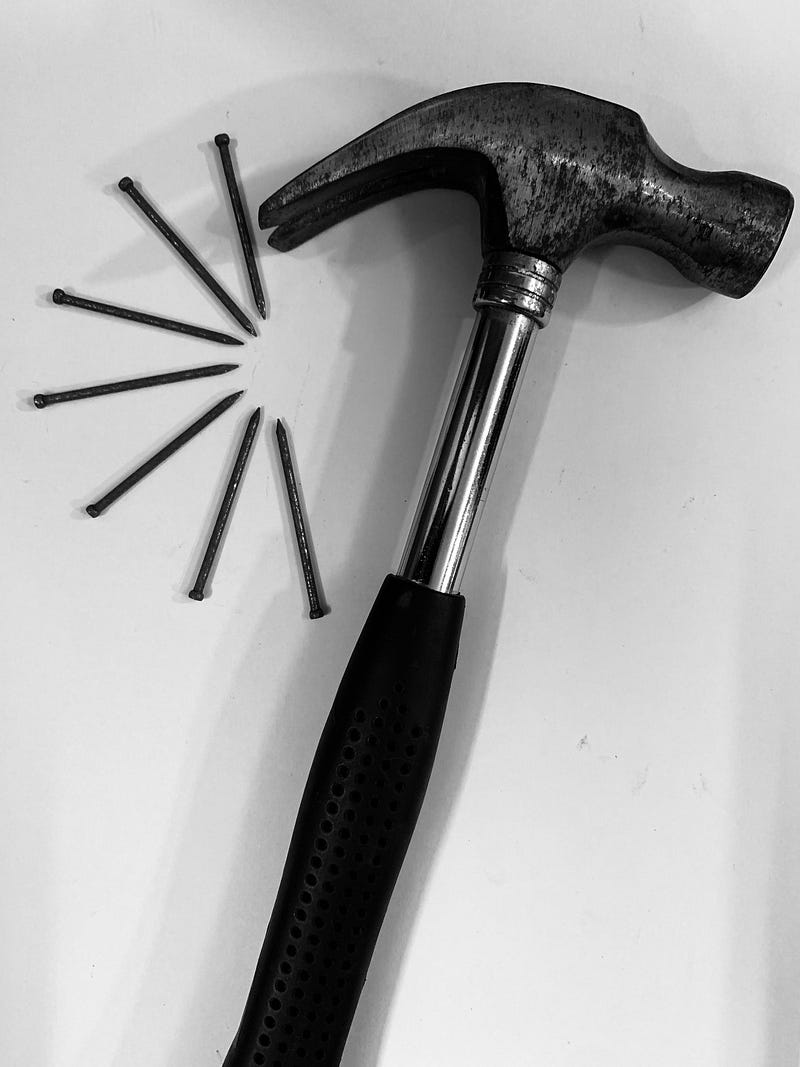
The “X as Y” technique is a simple heuristic tool for theoretical development. It is also a key for learning theories. Basically, we can understand “X as Y” as “Nail” and “Hammer”.
- X: Nail
- Y: Hammer
- X as Y: Using Y (a hammer) to understand X (a nail)
X refers to a thing we want to understand while Y refers to a tool for our understanding. For learning theories and making theories, Y tends to be a perspective.
A great example of “X as Y” is “Strategy as Practice” which is a new approach to Strategy Research. In 2018, I learned the approach by reading The Cambridge Handbook of Strategy as Practice (Second Edition, 2015). Chapter 1 of the handbook is titled Practice in research: phenomenon, perspective, and philosophy. The author Wanda J. Orlikowski distinguishes three modes of engaging with practice in organizational research (p.33):
- Practice as a phenomenon: what is most important in organizational research is understanding what happens “in practice”, as opposed to what is derived or expected from “theory”;
- Practice as a perspective: the articulation of a practice-centered theory about some aspect of organizations;
- Practice as a philosophy: the commitment to an ontology that posits practice as constitutive of all social reality, including organizational reality.
These three modes are made with different assumptions about the power of Practice to produce the world. These assumptions lead to different implications for how practice studies are understood and performed.
- Practice matter: Researchers engaging in studies of practice as a phenomenon may choose to do so without employing either a practice theory or a practice ontology.
- Practice shapes Reality: Researchers drawing on a practice perspective will certainly focus on some form of practice phenomenon and do so through a practice-theoretic lens, but they need not also take on board a practice ontology.
- Practice is Reality: Researchers drawing on a practice philosophy believe in the primacy of practices in constituting social life, and will thus necessarily engage with practice through all three modes: philosophically, theoretically (practice as a perspective), and empirically (practice as a phenomenon).
Orlikowski’s notion is pretty useful for understanding all themes. For a given theme “X”, we can understand it from the following modes:
- X as a Phenomenon: X really matters. We only care about X.
- X as a Perspective: We use X-centered theories to understand a phenomenon.
- X as a Philosophy: We develop X as a philosophy which means a new worldview.
Today I’d like to share my experiences of using the “X as Y” technique.
Becoming as Become (2017)
In 2016, I learned Howard E. Gruber’s evolving systems approach to creative work. He uses private notes as materials to study a creative person’s long-term thoughts. This approach is called the Historical-cognitive method which combines historical research and cognitive research together.
As a serial creator and a lifelong thinker, I am passionate about intellectual development and life reflection. Initially, I was influenced by Chris Argyris’ Action Science and Donald Schön’s Theory in Practice and The Reflective Practitioner. In 2014, I started learning Ecological Psychology, Activity Theory, and other theoretical approaches.
I wrote my first learning autobiography in 2015 and was attracted to biographical studies. In 2016, I developed a framework called Career Landscape which is inspired by Activity Theory, Communities of Practice, and other ideas. I also developed a series of tools such as Learning Autobiography Guide, Learning & Reflective Cards, Learning & Reflective Canvas, Learning & Reflective Monthly Report Template, etc. However, these methods and tools were not adopted by others. So, I stopped making such tools and focused on my own journey of intellectual discovery.
On the other side, I was inspired by Howard E. Gruber’s evolving systems approach to creative work. I was attracted to the Historical-cognitive method. I wondered if we can adopt the method to study professional knowledge workers.
On Jan 1, 2017, I wrote a blog post to review my 2016 and used “Becoming as Become” as the title of the post. It means I consider recording the process of my thoughts and sharing them with others.
At the end of 2017, I wrote a series of articles on the relationship between Knowledge and Personal Development and developed a framework called Dynamic System of Personal Knowing.
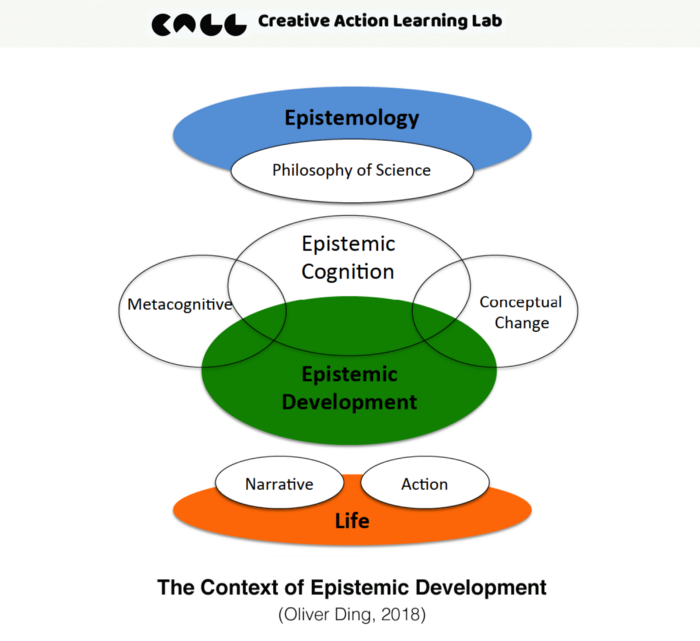
Later, I used “Epistemic Development” to name my knowledge enterprise. See the above diagram and more details in D as Diagramming: Challenge as Opportunity.
Process as Product (2020)
In July 2020, I wrote an article titled The NICE Way and Creative Actions and suggested a new approach for studying Action-based Creativity in the age of platforms.
The article is inspired by a project called BED Talks.

In May 2020, I found an interesting video on my Linkedin homepage. The video has a brand name called BED Talks. Since I was familiar with TED Talks (TED, for those who haven’t opted in, stands for Technology, Entertainment, Design, and refers to TED conference and related programs), I was curious about the idea of BED Talks. I searched and found more BED talk videos on Linkedin and figured out the story behind them.
The BED Talk challenge was initiated by the speaker and author David Rendall and Stan Phelps. The idea behind a BED Talk is to share a short, unscripted video sharing something helpful…recorded from your bed since you’re (hopefully) at home.
My article focuses on Creative Actions such as BED Talks and other similar projects. I did a rough literature review of creativity research and the finding points to two critical theoretical issues of creativity research.
First, we need a theoretical approach that puts action first and doesn’t consider actions as the “creating process” of a “creative product”. In other words, what I called Action-based Creativity can be seen as a “Process as Product” approach.
Second, there is a need to develop a new framework that can help us connect the individual daily experiences of Action-based Creativity at the micro level with the dynamic historical development of collective culture at the macro level.
Then I proposed a new approach called “Process as Product” and developed two modes for the new approach: the 3I model and the NICE framework. You can find more details in the original article.
Platform as Infoniche (2021)
Last year, I wrote a book titled Platform for Development: The Ecology of Adult Development in the 21st Century. The book adopts Project-oriented Activity Theory and the Ecological Practice Approach as theoretical resources. In order to connect theory and practice, I develop several intermediate concepts and frameworks.
The primary concept of the book is “Platform”. For the Ecological Practice Approach, the term “Platform” is about a philosophical concept. For the Platform-for-Development framework (v2.0), the term “Platform” is about a Perspective.
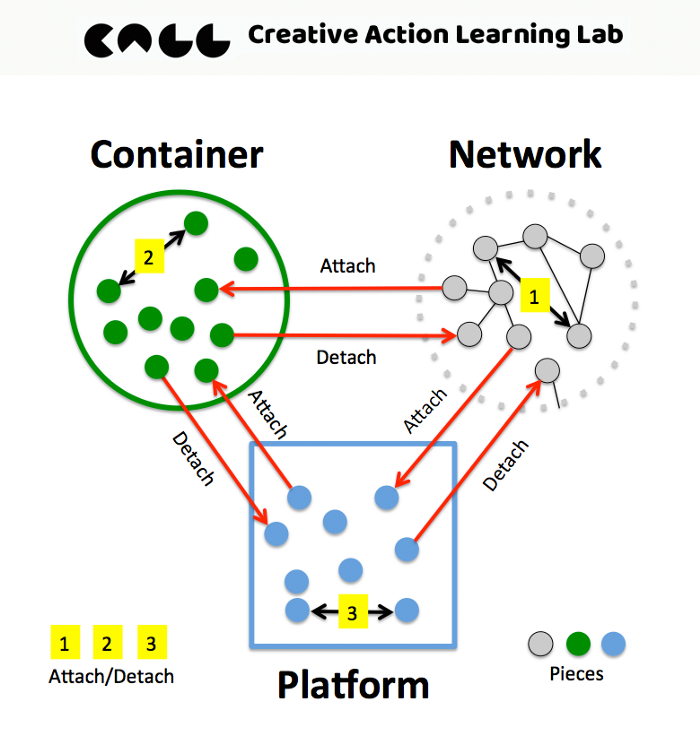
The above diagram shows a triad: Network — Container — Platform. I consider the triad as the basic form of collective context for applying the Ecological Practice approach.
Based on the concept of Container, I developed two related ideas: Network and Platform.
- The Network refers to the pre-container status which means pieces loose coupling outside a container.
- The Platform refers to the post-container status which means pieces loose coupling within a super large container.
However, the Platform-for-Development framework (v2.0) uses the other triad: Platform — Project — Platformba.
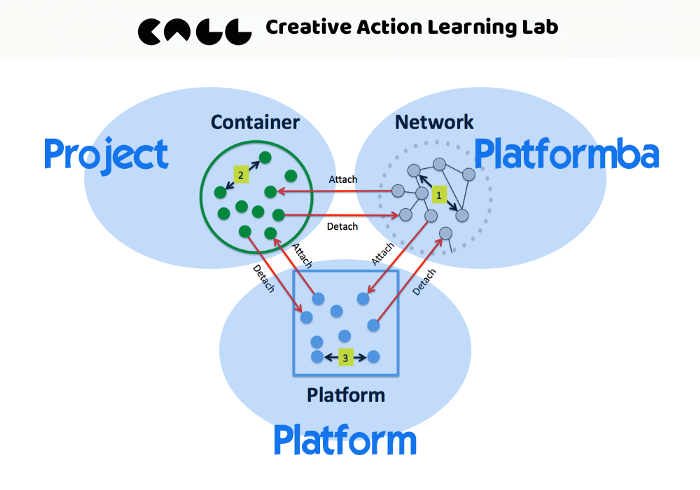
The Ecological Practice approach doesn’t have a concept of a “Project”. However, we can consider a Project as a Container at the concrete practical level because Project is a social container that has a clear boundary. We can deal with the concept of Platform-ba in the same way. The Platform-ba can be considered a Network because the human activities of a group of people can be understood from the perspective of the social network and the network of activity.
Thus, we can reduce the triad of Platform — Project — Platformba to the triad of Platform — Container — Network.
If we only develop a concrete framework or model, then we don’t have to consider the above issue. However, my goal is to apply the Ecological Practice approach to Platform Ecology. The former is a meta-theory and the latter is a concrete framework. I have to maintain the internal consistency of a brand new theoretical account.
Moreover, I defined a new concept called “Developmental Platforms” for the framework. It is defined as a social environment that could strongly support adult development in various ways. I consider it as an intermediate concept that aims to connect theory and practice.
In practice, the Development Platform is the core of the Platform-for-Development framework. For theory, the Development Platform offers a creative space for testing my theoretical project: the Ecological Practice approach.
I used “Platform as Infoniche” as the title of an article that introduces the Infoniche framework for understanding the structure of the Developmental Platform. Here we see a nail and a hammer:
- Nail: Developmental Platforms
- Hammer: The Infoniche Framework
The Infoniche Framework is an intermediate framework of the Ecological Practice Approach. See the diagram below and more details in The Infoniche Model and Platform as Infoniche.
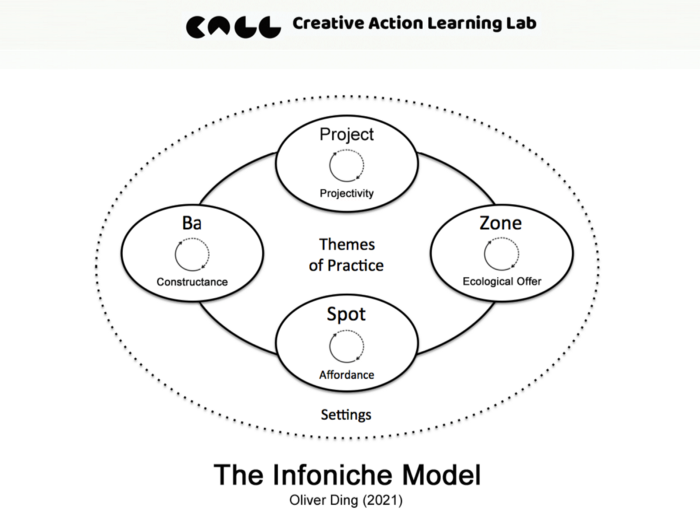
It originally appeared in my 2020 book (draft) After Affordance: The Ecological Approach to Human Action in which I used one chapter to develop this idea as an intermediate theoretical framework for discussing various action possibilities.
The Final Words
I often use the “X as Y” technique to develop ideas and wrote articles. See examples below:
- Platform Innovation as Concept-fit
- Personal Innovation as Career-fit
- Strategy as Anticipatory Activity System
- Strategy as Curation
- Life as Activity
- Life as Project
- Project as Story
- Place as Container
In Knowledge Discovery: The “Double Theme” Strategy, I mentioned several techniques to apply the “Double Theme” strategy. Now, we can add the “X as Y” technique to the list.
A heuristic tool should be simple and powerful. You should try using the “X as Y” technique for learning theories and making theories.
Knowledge Discovery: Developing Tacit Knowlege with Thematic Space Canvas
Related Articles
- Meet with Oliver Ding: 1 Mission, 4 Theories, and 12 Possible Books
- The Knowledge Curation Project
- How to Grow A Knowledge Enterprise
- Platform Genidentity: The Movements of Unfolding Uniqueness
- The Slow Cognition Project (Phase II): Activity Analysis for Creative Work Study
- CALL: The Launch Day of Curativity Center
- TalkThree: A Tiny Idea for Knowledge Engagement (June 2, 2022)
- #TalkThree 01: How to Read a Handbook? (June 2, 2022)
- #TalkThree 02: How to Name “X Innovation”? (June 3, 2022)
- #TalkThree 03: How to Use an Abstract Model? (June 6, 2022)
- #TalkThree 04: How Does Collective Learning Work? (June 7, 2022)
- #TalkThree 05: How to Connect X and Y? (June 8, 2022)
- #TalkThree 06: How to Approach Radical Innovation? (June 12, 2022)
I am also working on building a new website for the Platform Ecology project. You can save the following links:
- PlatformEcology.org
- Twitter: @PlatformEcology
- Linkedin: @PlatformEcology
You are most welcome to connect via the following social platforms:
Linkedin: https://www.linkedin.com/in/oliverding Twitter: https://twitter.com/oliverding Polywork: https://www.polywork.com/oliverding Boardle: https://www.boardle.io/users/oliver-ding


