
TALE: One Project, Many Insights
The Power of Multi-thematic Reflection
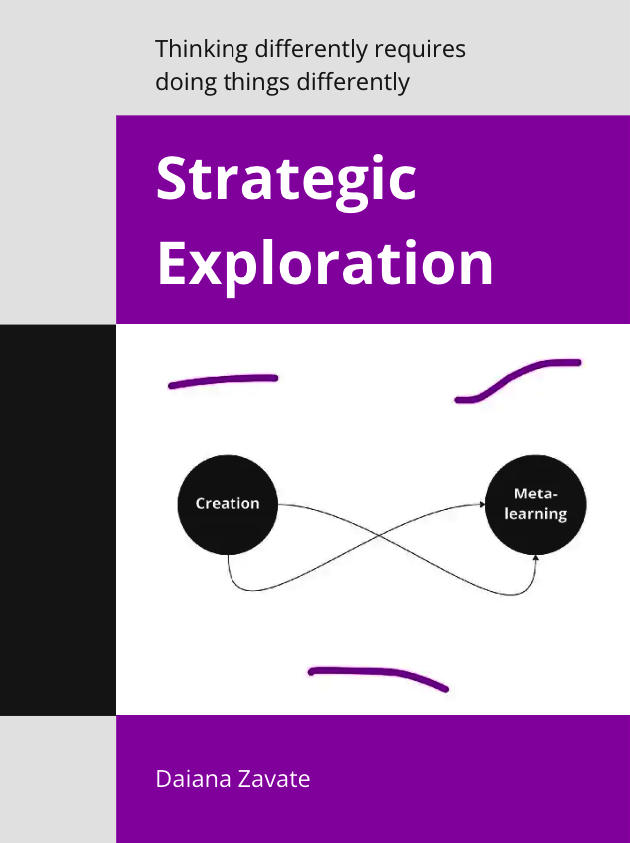
In the past two weeks, I worked with my friend Daiana Zavate on a Thematic Conversation project about “Strategic Exploration”. You can visit the links below to follow our conversation:
- Jan 17 — Oliver — How to Set Annual Themes for 2023?
- Jan 18 — Daiana — Personal Project on Strategic Exploration: Thinking differently requires doing things differently
- Jan 18 — Oliver — TALE: Start A Thematic Conversation
- Jan 19 — Daiana — Strategic Exploration: Peeling onions without shedding tears
- Jan 20 — Oliver — TALE: The Challenge of Thematic Conversation
- Jan 23 — Daiana — Strategic Exploration: Breaking Symmetries
- Jan 23 — Oliver — TALE: How to develop a framework for a possible theme called “Slow Talk”?
- Jan 24 — Oliver — TALE: The Dynamics of Thematic Space (v2.0)
- Jan 27 — Oliver — TALE: Possible Configurations of A Theme Network
- Jan 27 — Daiana — Strategic Exploration: You can’t swim in the same river twice
- Jan 29 — Oliver — TALE: The Field of Meta-learning (V1.0)
- Jan 30 — Daiana — Strategic Exploration: Reflections and milestones turn curiosity into courage
- Jan 30 — Oliver — TALE: A Strategic Designer’s Creative Journey
- Jan 31 — Oliver — TALE: Supportive Immanent Development
This is the third post for Reflecting on the project. Actually, I want to reflect on the process of Reflection too.
Yesterday I wrote a post about the theme of “Supportive Immanent Development” and shared it on Linkedin.
This morning I had a conversation with Maurizio Goetz about the topic of “Strategic Exploration” in the comments section.
After replying to his comment, I wrote a short note there. See the note below:
Actually, I found the Slow Cognition method is really hard to implement because you have to replay the whole story of another mind.
This is the big difference between Reading an Intellectual Biography and Writing an Intellectual Biography.
However, I found the “thematic conversation project” is a good approach to making MINI SLOW COGNITION for training this method.
2 weeks, 14 articles. This is a great example of MINI SLOW COGNITION.
The second idea is about Participating and Reflecting Immediately.
The researcher (or curator) should be a participant in the project, in this way, he could have embodied experience. If he doesn’t participate in the project, he can only rely on documents that can’t offer the real experience to him.
Reflecting Immediately is also a key because this is about memory management and attention management. It’s better to record fresh ideas and details in a short time.
I have trained myself in this way over the past many years.
What does this mean?
I was reflecting on my Subjective Experience as a Creative Life Curator from the perspective of the Slow Cognition method.
In Nov 2022, I edited a possible book titled Creative Life Curation: Turning Experiences into Meaningful Achievements. The book is about Experience Curation, especially the Experience of a Creative Life.
I also defined a role called “Creative Life Curator” who works as a researcher with some techniques. However, the Creative Life Curator doesn’t aim to produce public knowledge but offers private knowledge to Actors. You can find more details in Creative Life Curation: Kinds of Actors.
A related method is called Slow Cognition. In fact, I used the term “Slow Cognition” to refer to a group of similar methods such as the “historical-cognitive” method, the “cultural-historical” method, the “Experience Sampling” method, etc. You can find more details in The Slow Cognition Project and related methods.
What does the Subjective Experience of a Creative Life Curator look like?
The above note describes my experience of Reflecting on the Thematic Conversation project.
Replay Creative Life
In order to highlight this experience, I also designed a new picture and developed a new possible theme called “Replay Creative Life”.
When I was designing the above picture, I recalled my experience as a Creative Life Curator with the following two projects:
- A project about Ping-keung Lui’s creative life and his Theoretical Sociology (20 years)
- A project about Stephen Beller’s creative life of exploring Wellbeing Wisdom (40 years)
These two projects are real “Slow Cognition” projects because the time span of the first one is about 20 years and the other one is about 40 years.
In the past several months, I read many documents about these two projects. I had to rebuild their journey in my mind. It’s a challenge for me.
This is what “Replay Creative Life” means.
Mini Slow Cognition
I also designed the other picture in order to highlight the theme of “Mini Slow Cognition”.
As mentioned in the above note, the theme of “Mini Slow Cognition” refers to a short time span such as two weeks.
The two-week “thematic conversation project” is a pretty good format for running a “Mini Slow Cognition” project.
There are two differences between “Mini Slow Cognition” projects and “Mega Slow Cognition” projects.
Embodied Experience v.s. Non-embodied Experience
As a Creative Life Curator, I can participate in a two-week “Mini Slow Cognition” project and acquire real-time first-hand embodied experience of the project.
If I want to work on a “Mega Slow Cognition” project, I have to select a past project. In this way, I can only have non-embodied experience. Even though I can contact a creator and directly talk with him/her, the new embodied experience is only about our communication. The creator only can recall him/her experience.
Reflecting-in-action v.s. Reflecting-in-practice
The Creative Life Curation framework is an application of Curativity Theory. One of several theoretical resources behind Curativity Theory is Donald Schön’s “Reflection”.
Schön expanded John Dewey’s “Reflection” to double reflections:
- Reflecting-in-action
- Reflecting-in-practice
Reflecting-in-action is about immediate situations while Reflecting-in-practice means cross-situation level.
If I can participate in a two-week “Mini Slow Cognition” project, then I can work on both Reflecting-in-action and Reflecting-in-practice.
However, if I work on a “Mega Slow Cognition” project about the past, I can only work on Reflecting-in-practice.
This is a major difference in methodology.
Multi-thematic Reflections
Stephen Beller also made a comment from the perspective of Collaborative Strategic Exploration.
What you’re saying here makes sense to me, Oliver. When I set out on my journey to create digital tools for psychotherapists in the early 1980s, there were no such tools. So, I did not view my efforts as a “design project.” Instead, explored how inexpensive off-the-self desktop software (spreadsheet applications) could be used in novel ways to collect and analyze biopsychosocial data and produce clinically useful information that builds insightful knowledge about each client.
Over the decades I discovered that the best way to understand my clients broadly and deeply is by focusing on supporting the therapeutic process with whole-person (mind-body-spirit) knowledge that enables a client-centered collaborative-care approach that enables client engagement and positive outcomes through joint care planning and shared decision-making.
So, it doesn’t surprise me that repeating the story of this long-term emergent exploratory process is not (and was never meant to be) an efficient implementation of a Collaborative Strategic Exploration design.
“Collaborative Strategic Exploration” and “Creative Life Curation” are two things and we can use them as triggers to activate Multi-thematic Reflections.
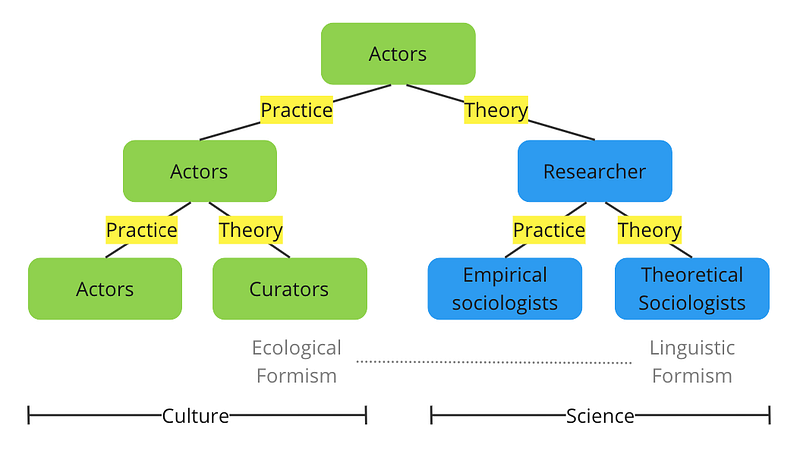
What’s the difference between these two things? See the diagram below.
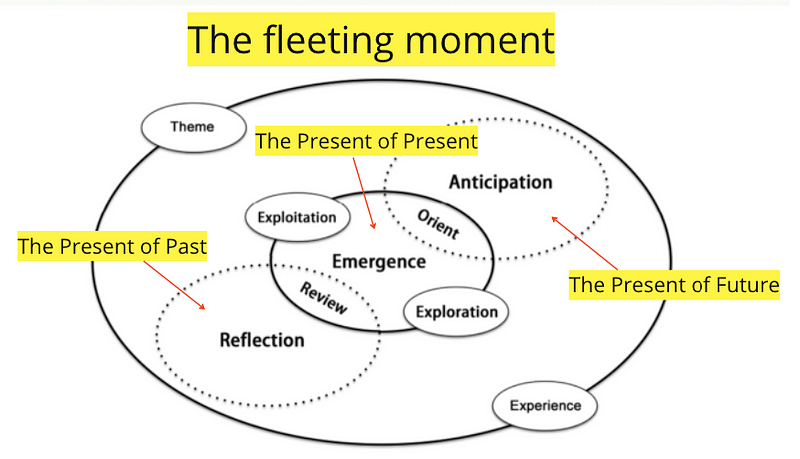
The above diagram is based on my diagram “the Path of Creative Life” and the concept of “the fleeting moment” is adopted from Ping Keung Lui’s Theoretical Sociology. You can find more details in Three Paths of Creative Life and A Semiotic System.
In 2007, Lui published a book titled Gaze, Action, and the Social World in which he presented his account of theoretical sociology. The fundamental starting point of his approach is an Ontology of action, which was inspired by Saint Augustine (354–430), Martin Heidegger (1889–1976), and Maurice Merleau-Ponty (1908–1961). See the statement below:
The body is in action, action is in the fleeting moment, the fleeting moment is in the body.
According to Lui, “This moment is Augustinian, it comprises at the same time the Present of the Past, the Present of the Present, and the Present of the Future. The actor Remembers in the present of the past, Pays Attention in the present of the present, Expects in the present of the future.” (p.235–236, 2010, The Scientific Project of Sociology)
- Reflection: Remembers in the present of the past
- Emergence: Pays Attention in the present of the present
- Anticipation: Expects in the present of the future
“Creative Life Curation” is about the Present of Past. It means we reflect on the past of a creative life from the present time.
“Strategic Exploration” is about the Present of Future. While we are exploring something new in the present time, the thing is anticipated to be useful in the future or used to guide us to the future.
In other words, “Strategic Exploration” and “Creative Life Curation” have their own logic. However, we can apply them to the same present project. In both two ways, our present life themes are possible triggers for Multi-thematic Reflection.
Related Articles
- TALE: A New Knowledge Center
- The Thematic Engagement Toolkit (v1.0)
- Why did I coin the new term “Thematic Engagement”?
- TALE: Find 100 Thematic Curation Projects
- TALE: Find 100 People’s Life Stories and Creative Themes
- TALE: Find 100 Novel Themes and their Communities
- TALE: Start Your Journey of Knowledge Engagement with A Possible Theme
- TALE: How to Develop a Possible Knowledge Theme? A Simple Answer
- TALE: How to Set Annual Themes for 2023?
- TALE: Start A Thematic Conversation
- TALE: The Challenge of Thematic Conversation
- TALE: Find 100 Cultural Themes for City Curation
- TALE: How to develop a framework for a possible theme called “Slow Talk”?
- TALE: The Dynamics of Thematic Space (v2.0)
- TALE: A Possible Theme called “Product Langue”
- TALE: Possible Configurations of A Theme Network
- TALE: The Field of Meta-learning (V1.0)
- TALE: A Strategic Designer’s Creative Journey
- TALE: Supportive Immanent Development
- Themes of Practice (2019–2021)
- Discover Pairs of Opposite Themes of career experience and beyond
- The Career Theme Canvas
- Project Engagement (v2.1) as an Innovation Approach
- CALL: How to Grow A Knowledge Enterprise
- Platform Genidentity: The Movements of Unfolding Uniqueness


