
Situational Note-taking: The Serendipity of Making A New Framework
Turn a significant insight into a creative action
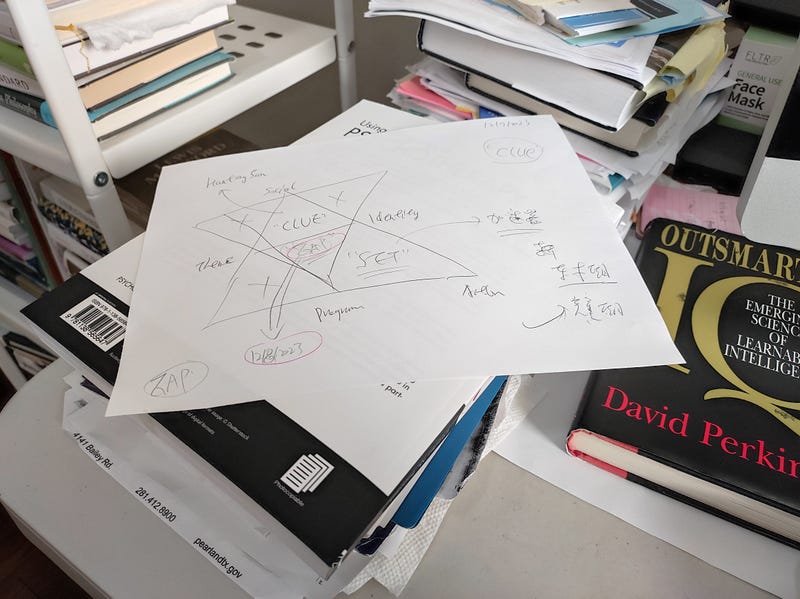
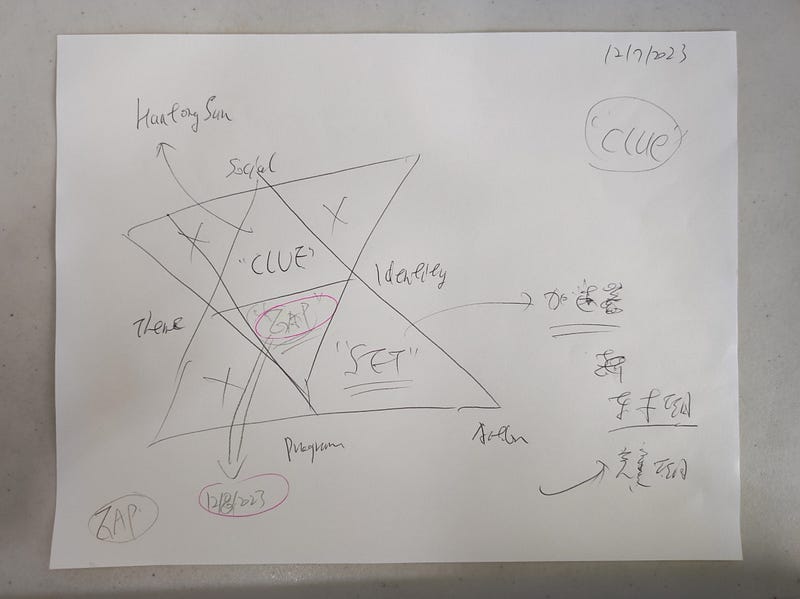
The above two pictures are about my notes on new types of projects.
On Dec 7, 2023, I made a situational note about two new types of projects: “CLUE” and “SET” on an A4 sheet.
On Dec 8, 2023, I added “GAP” to the note. I also wrote a long article about it: The Art of Situational Note-taking: Running the “GAP” Project.
This morning I opened the file “Project Engagement (Creative Life Curation)” on Miro and wanted to work on ideas about “CLUE” and “SET”.
However, I found a new idea. See the diagram below.
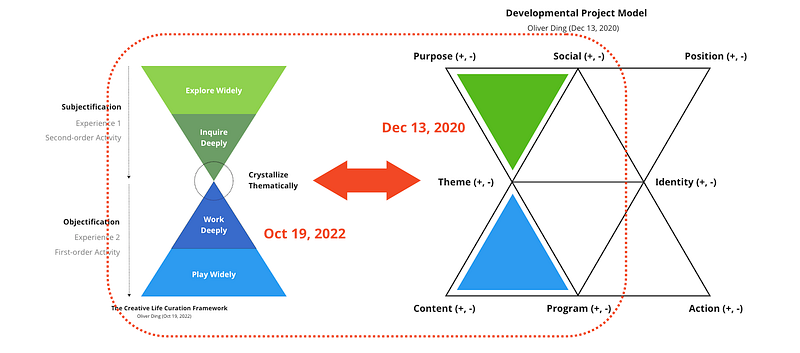
On April 24, 2023, the file “Project Engagement (Creative Life Curation)” was created to reflect on the historical development of the Project Engagement approach by using the Creative Life Curation framework. You can find more details on Slow Cognition: The Development of “Project Engagement”.
I recently used the file to make diagrams to discover potential thematic spaces around the Developmental Project model. You can find more details in [Creative Diagramming] Graphic Space Affordances, Thematic Space, and Possible Paths.
This morning, I captured a significant insight!
There is a Spatial Mapping between the Developmental Project Model and the Creative Life Curation Framework.
Wow! This is an interesting idea.
What does it mean for me?
The idea inspired me to think about the following question:
Can I use the other part of the Developmental Project Model to generate a New Knowledge Framework?
I just quickly validated it. I just copied the Creative Life Curation Framework and placed it on the right side. See the diagram below.
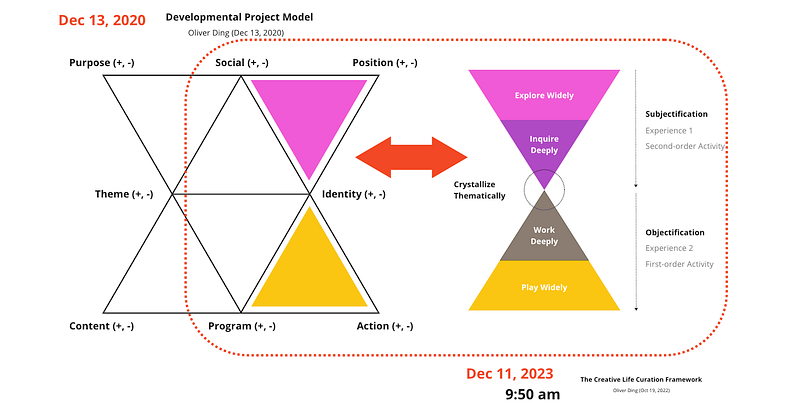
To create a brand-new creative space, I used new colors to replace old colors.
Now I can do some “Mental Moves”!
What should it be?
It should be a new framework for developing Identity in a social context.
So, I started quickly reviewing my knowledge about the notion of “developing identity in a social context”.
I revisited The Developmental Project Model (Archived) — Dec 13, 2020 and the piece below.
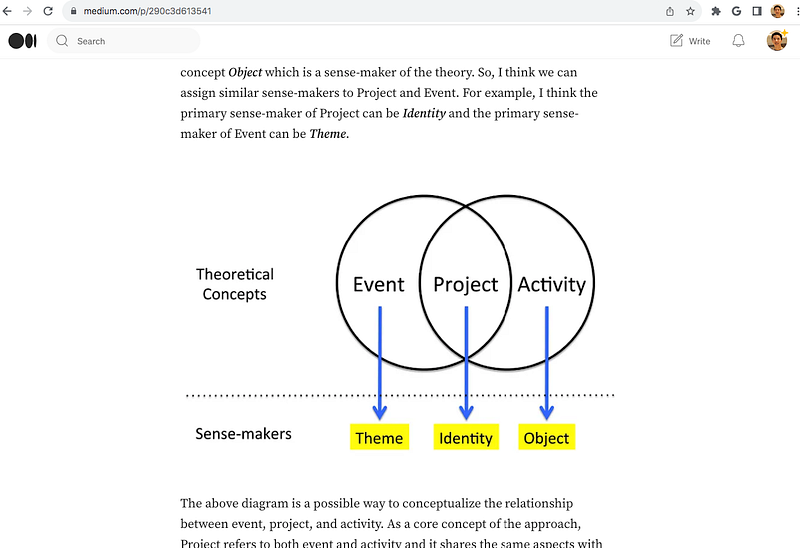
I revisited Activity U (VIII): Project as a Unit of Activity — Dec 26, 2020, and found Andy Blunden’s writings on Identity. See the screenshot below.
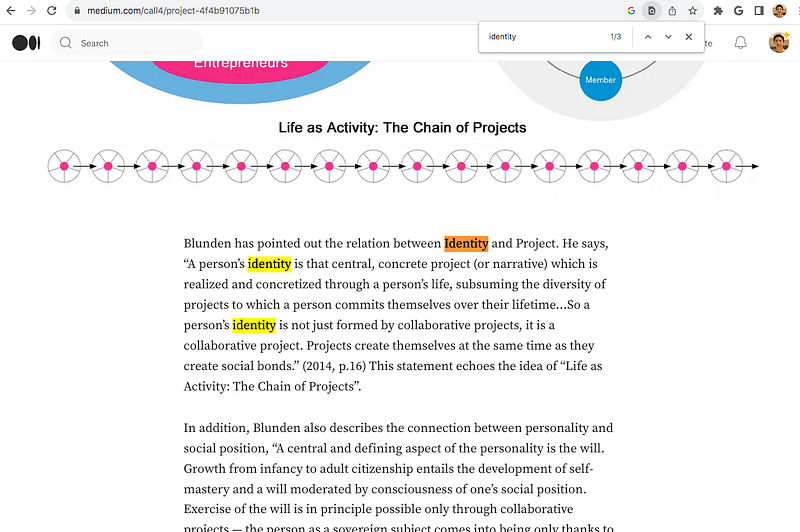
I also revisited my recent article about conceptual elaboration and re-read the piece below.
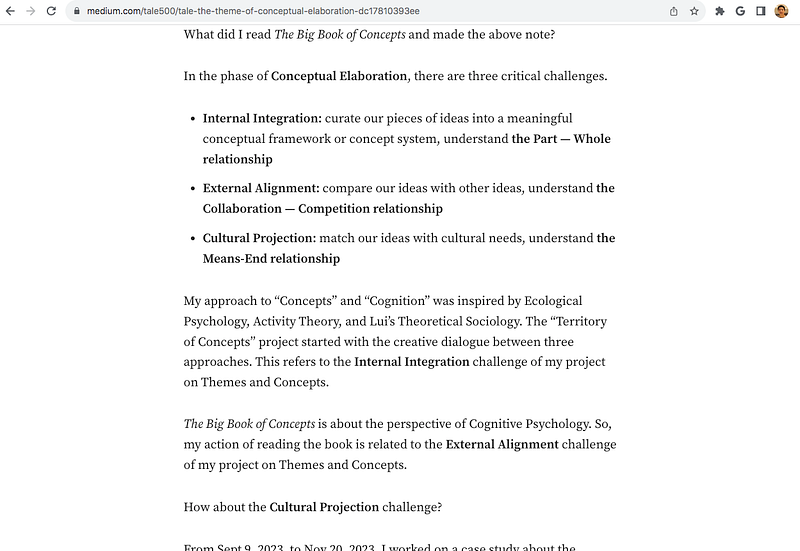
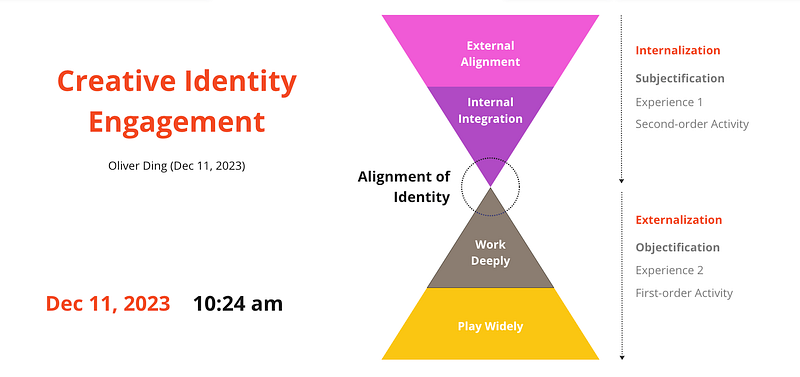
Finally, I decided to use “Alignment of Identity” to replace “Crystallize Thematically”.
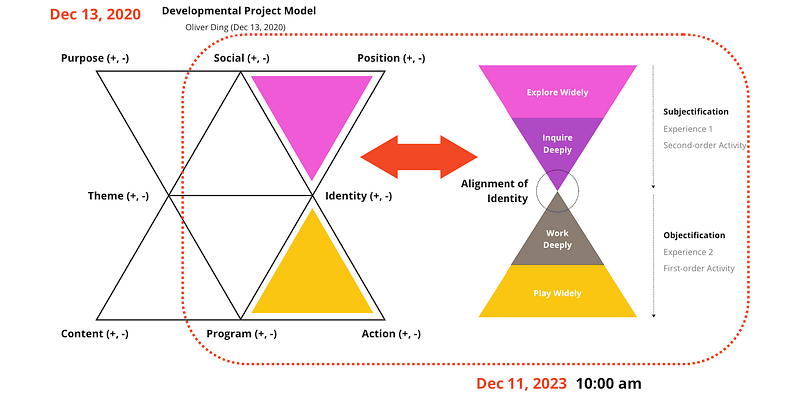
I didn’t modify the following terms:
- Explore Widely
- Inquire Deeply
- Work Deeply
- Play Widely
Should I keep “Subjectification” and “Objectification”?
Yes.
However, I’d like to use some new terms to replace them to highlight the aspect of social context.
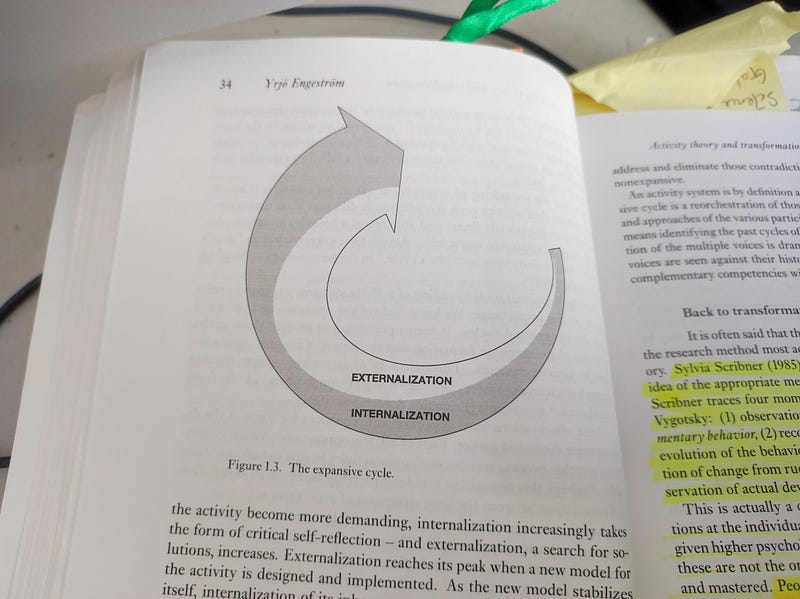
The ideal candidates are “Internalization” and “Externalization”.
Internalization and Externalization
I found a book titled Perspectives on Activity Theory on my bookshelf and revisited the diagram about “Internalization” and “Externalization”.
At this moment, I decided to modify “Explore Widely” and “Inquire Deeply”.
They were replaced by “External Alignment” and “Internal Integration”.
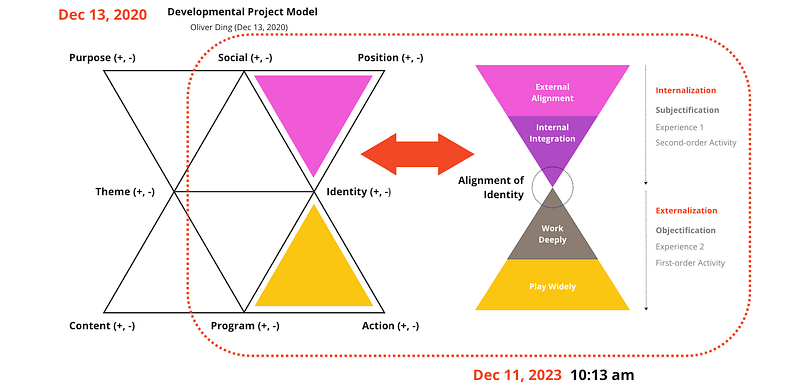
I wanted to keep “Work Deeply” and “Play Widely”.
Almost Done!
The final step is naming.
The new knowledge framework needs a new name.
I revisited my article about the microdynamics of creative identity.
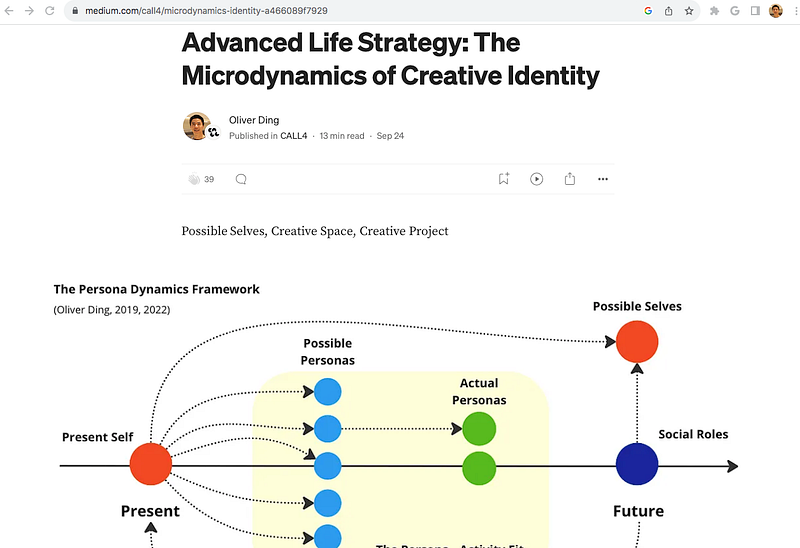
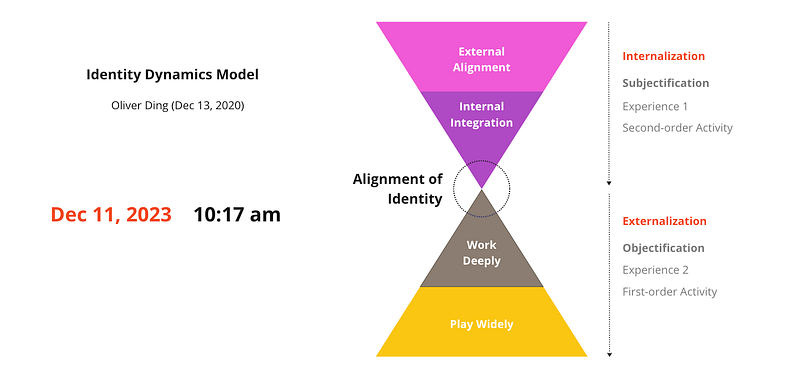
Inspired by the term “Persona Dynamics”, I decided to use “Identity Dynamics” to name the new knowledge project.
New Name
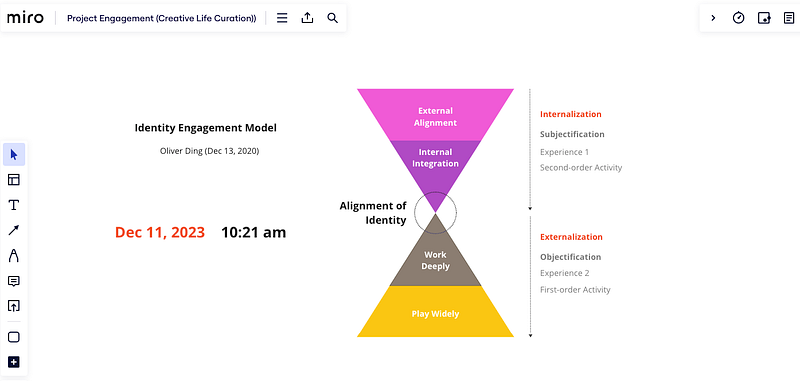
See the diagram below.
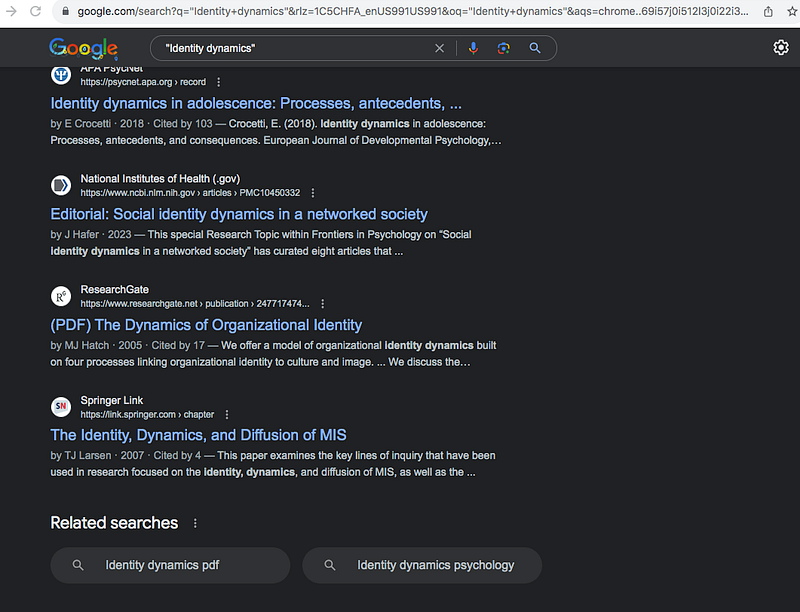
I also tested it on Google.
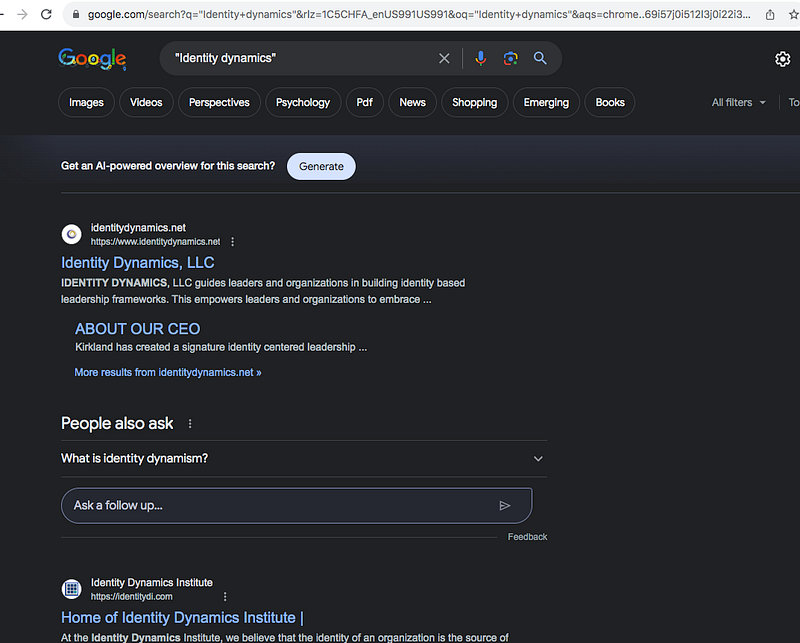
People used the term “Identity Dynamics” to name organizations and knowledge frameworks.
Ok, let’s use a new name.
Since the Developmental Project model is a sub-framework of the Project Engagement approach, I decided to use “Identity Engagement” to name the new model.
Then, I tested it again.
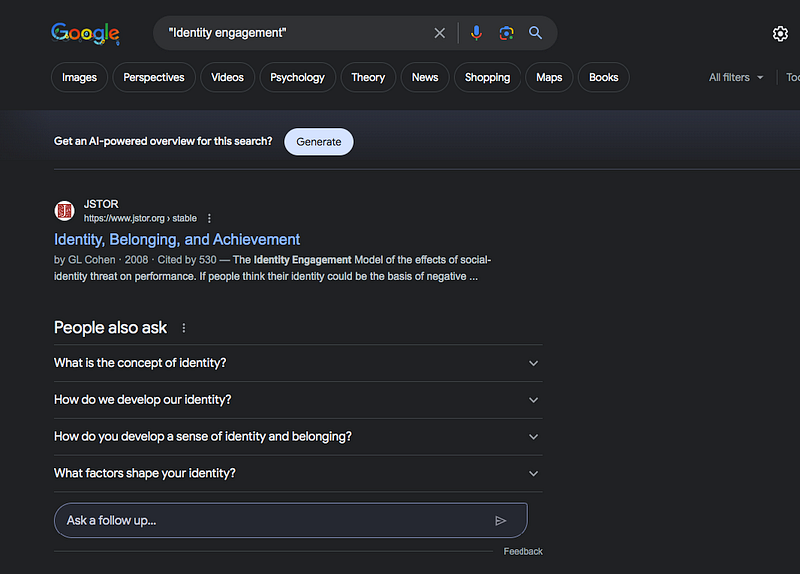
Other people already used it for their knowledge creations.
I gave up on finding a unique name.
Finally, I decided to use “Creative Identity Engagement” to name the new model.
Do you have a similar creative experience?
Leave a comment to share your stories. Or, you can directly send an email to me: Swordi at Gmail dot com
Updated (Jan 15, 2024)
This post is just a note. I published it publicly because I want to make an archive for my research on “Early Discovery”.
A reader used this framework to make her framework for a program. She sent it to me and I replied to her with the following message:
I am sorry I didn’t say the details of the “Creative Identity Engagement” framework.
Here are some ideas behind the framework.
1. It follows the pattern of the Creative Life Curation model because they share the same spatial structure.
2. It suggests three major phases:
Phase 1: Internalization
Phase 2: Alignment of Identity
Phase 3: Externalization
3. The key is “Phase 2: Alignment of Identity” because we use it to define Phase 1 and Phase 3. At some point, everyone agrees on the “New Identity of Our Project”.
4. Phase 1: Internalization has two sub-phases: External Alignment and Internal Integration
4A: External Alignment refers to Finding the Differences and Similarities between Our Project and Others’ Projects. In this way, we could find a reason to establish the Identity of Our Project.
4B: Internal Integration refers to Curating the various Internal Connections around the new Identity of Our Project into a meaningful whole. Various internal connections refer to 1) the connections between the present project and our other projects, 2) the different ideas and resources from individual people, 3) etc.
5. Phase 3: Externalization has two sub-phases: Work Deeply and Play Widely
5A: Work Deeply refers to Internal Works about the new identity of our projects. In this phase, it is all about team members.
5B: Play Widely refers to External Activities about the new identity of our projects. In this phase, Consumers or other types of stakeholders become the core of the activities.
I hope this information is useful to you too.


