
The Developmental Project Model (Archived)
Original title: The Platform for Development (P4D) Framework (v1.0)
Supportance, Themes of Practice, and Identity in Practice

This article has been archived. For the newest development of my ideas about “Project”, see Project Engagement (v2.1) as an Innovation Approach — Aug 2, 2022.
Update
This article was written on Dec 13, 2020. The framework has been upgraded to v2.0 which is a set of frameworks. I renamed the original framework as Developmental Project Model on Mar 31, 2021.
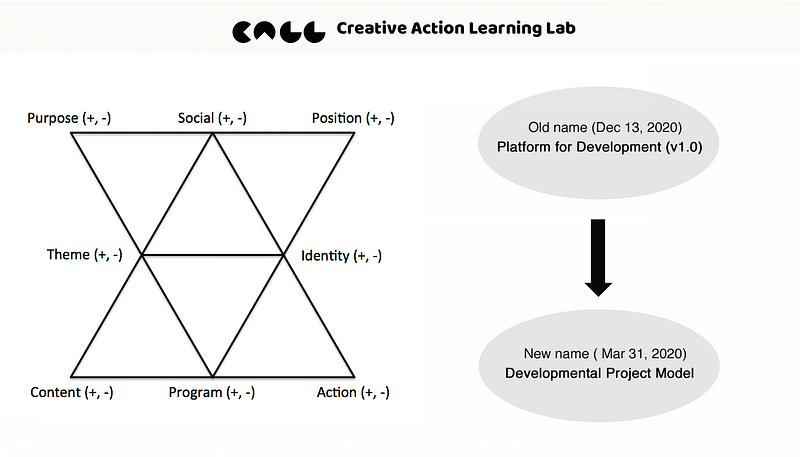
If you want to know more sub-frameworks of the Platform for Development framework (v2.0), you can read this article. I am working on editing a book titled Platform for Development, you can find its table of contents here.
The Developmental Project Case Study
On May 23, 2021, I did my first Developmental Project Case Study. I used the model to reflect on the Activity U project.
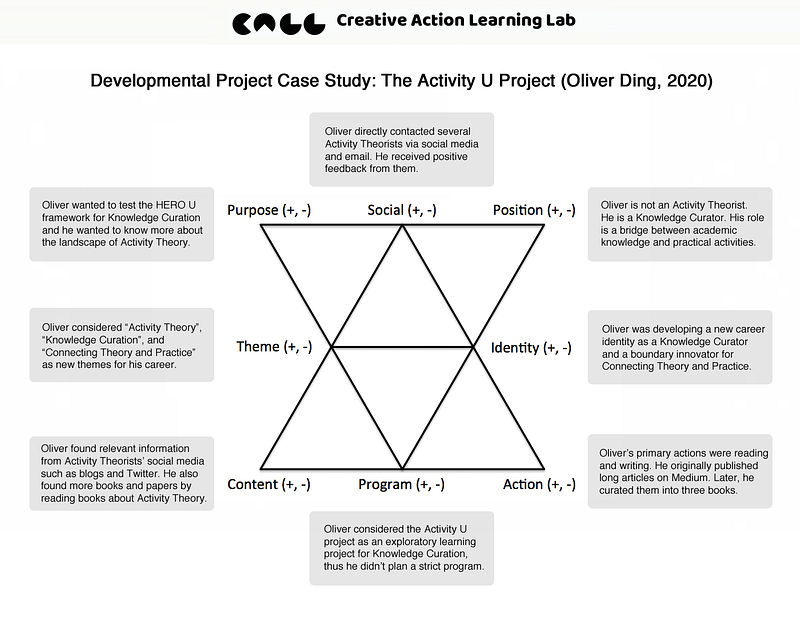
This case study is part of an article about career development and career reflection. In fact, I adopt the Developmental Project Model for a new framework: the Career-fit framework for Personal Innovation.
Archive
Below is the original article about the diagram of Developmental Project Model and the basic idea of the Platform for Development framework.
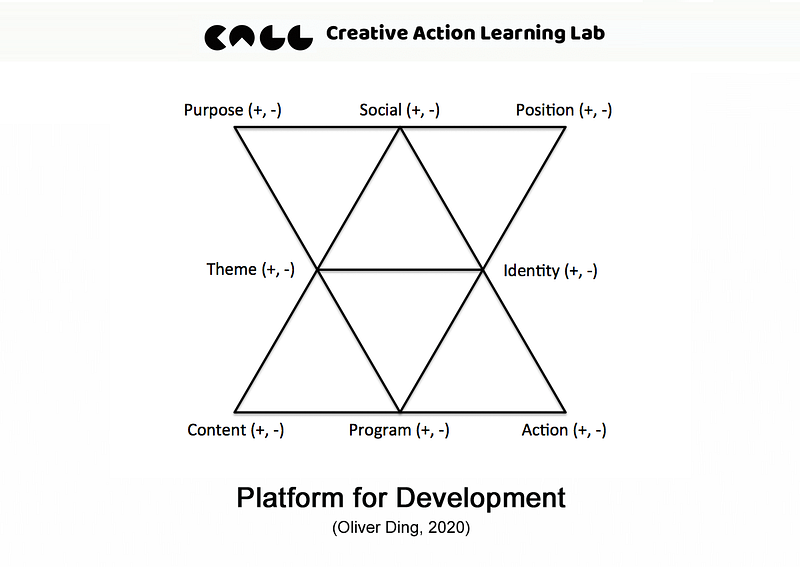
On Oct 1, 2020, I mentioned that one of three themes of CALL (Creative Action Learning Lab) in 2021 is Platform for Development. Today I’d like to share a framework for this theme: The Platform for Development (P4D) Framework (1.0).
The P4D framework is a platform-based project-oriented activity-theoretical approach. The core of the framework is Platform[Project(People)] which defines a nested social structure for understanding the transformation of individuals and society.
The framework presents a systematic model of Platform[Project(People)] with three innovative concepts: “Supportance”, “Themes of Practice”, and “Identity in Practice”.
The major theoretical resources behind the framework are Activity Theory (the project-oriented approach, Andy Blunden, 2014), Social Domains Theory (Derek Layder, 1997), Ecological Psychology (James Gibson, 1979), and Self-Determination Theory (Edward Deci and Richard Ryan, 1971, 2017). I was also inspired by Knud Illeris’ How We Learn (2007) and John Hagel’s The Power of Platform (2015).
The P4D framework is expected to apply to various domains such as Startup Ecosystem, Brand and Communication, Community Engagement, Content Curation, Theoretical Traditions, Knowledge Platforms, etc.
Contents
1. The 0.1 Version
1.1 Social Platform Experience Design 1.2 Platform Ecology 1.3 People (O) — Activity(A) — Platform (E) 1.4 The Project-oriented Approach 1.5 Small Social Domains 1.6 A Nested Social Structure
2. The 1.0 Version
2.1 The Supportance of Platforms 2.2 Developmental Resources 2.3 Themes of Practice 2.4 Project as Situational Context 2.5 Identity in Practice 2.6 The Platform for Development (P4D) Framework (v1.0) 2.7 Engagement and Coping
3. Analysis Modules
3.1 Developmental Resources Analysis 3.2 Situational Context Analysis 3.3 Cultural Projection Analysis 3.4 Social Engagement Analysis 3.5 Activity Landscape Analysis
4. The Applications
4.1 Ecosystem as Platform 4.2 Brand as Platform 4.3 Community as Platform 4.4 Theory as Platform 4.5 The P4D for Sustainable Future
1. The 0.1 version
I coined the term “Platform for Development” and developed the 0.1 framework on Oct 1, 2020.
1.1 Social Platform Experience Design
In March, I introduced the Social Platform Experience Design framework and shared my passion on social platforms, “I really like digital social platforms because they have made a significant impact on my life. I met my wife by joining a local blogger network. I learned knowledge and skills about web technologies and digital business by participating in the early blogosphere. I joined several digital non-profit projects and found my own youth digital communities. Finally, I became a designer and developer of digital products and social platforms.
Social platforms offer me opportunities for learning and creating. Social platforms allow me to build communities as leverage to unite youth people for learning, creating, and servicing other people. While most people focus on “Social Media as Entertainment”, I prefer “social platforms as Creative Spaces”. The term Creative Spaces was from The Power of Pull. According to John Hagel, a co-author of The Power of Pull, social platforms can be push environments or pull environments. It depends on how you engage with them.”
1.2 Platform Ecology
I also provided two views of social platform experience design. The zoom-in view (lifecycle view) focuses on one particular social platform with a process perspective. I suggested four stages: social practice stage, social software stage, social product stage, and social platform stage. The zoom-out view (ecology view) focuses on the landscape at one particular time with an ecology perspective that considers the “organism (O) — environment (E)” relationship.
I list 25 types of O-E relationships for discussing platform ecology. One type of O-E relationship is the “People (O) — Platform(E)” relationship, it is the primary O-E relationship within platform ecology. Inspired by Activity Theory and Derek Layder’s Social Domains Theory, I got an idea for discussing this primary O-E relationship.
1.3 People (O) — Activity(A) — Platform (E)
The first step is expanding O-E to O-A-E. The A stands for Activity. Inspired by Activity Theory, I adopted the concept of “Activity” and turned the O-E relationship into the O-A-E relationship (People — Activity — Platform).
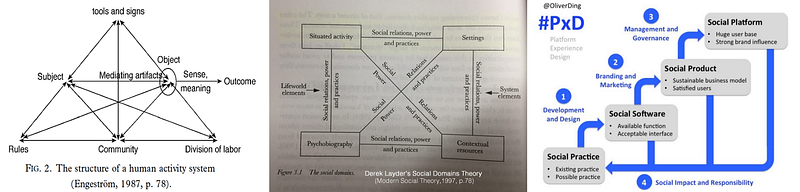
There are several models and approaches within the theoretical tradition of Activity Theory. One popular model is Yrjö Engeström’s Activity System model which focuses on the collective activity and the transformation of the activity system. It is possible to conceptualize Platform as Activity System. However, the model doesn’t pay attention to individual personal development enough.
1.4 The Project-oriented Approach
In 2014, Andy Blunden edited a book titled Collaborative Projects: An Interdisciplinary Study and argued that there is a need to establish a concept of “project” as a unit of activity theory and human sciences. He said, “There are already many writers who address themselves to collaborative projects as part of their research, and among these, some who share a commitment to Activity Theory or the Cultural-Historical Psychology which underpins Activity Theory. However, these writers do not constitute a coherent current of thinking, as each writer does not take the concept of ‘project’ as central to their own project. Nonetheless, this literature providers a beginning for interdisciplinary research in the human sciences which can reach across the chasm between the sciences of the individual and the science of society… In what follows I will outline the origins of ‘project’ as a unit for the human sciences and its value as an interdisciplinary concept, and then briefly review the foundation of the concept in different domains of theory, and conclude with a concise definition of the concept of ‘collaborative project’.”
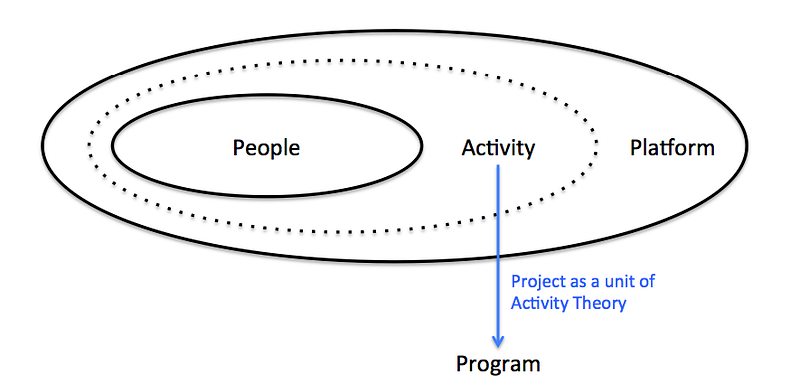
I was fascinated by Andy Blunden’s innovative approach. The “project” is a perfect concept for conceptualizing various activities within platforms. Inspired by Andy Blunden’s idea “project as a unit of activity”, I use “program” to refer to informal organizing activities on platforms. Thus, I made a new triad: People (O) — Program (A) — Platform (E).
1.5 Small Social Domains
The second step is adopting Derek Layder’s Social Domains Theory as another theoretical resource.
Layder suggested four principal social domains: Psychobiography (including self-identity), Situated activity, Social setting (including fields), and Contextual resources. We have to notice these four social domains are “principal” and they can be subdivided into smaller “domains” or even understood as component elements of larger “domains”.
Thus, I applied it to expand the People (O) — Program (A) — Platform (E) framework:
- Psychobiography: Purpose (personal motivation on the development of self-identity)
- Situated activity: Program
- Contextual resources: Position
- Settings: Platform
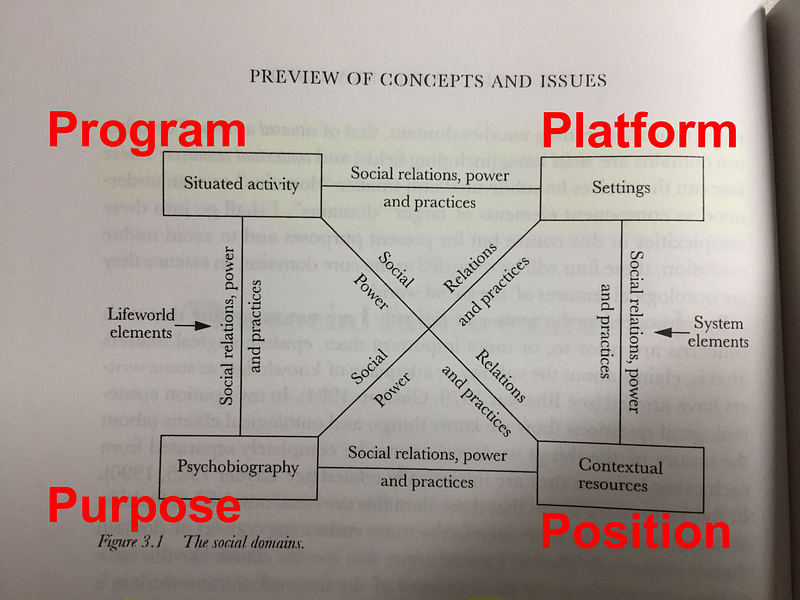
The result is a 5P framework: People (O, organism) — Purpose (M, motivation) — Program (A, activity) — Position (R, resources) — Platform (E, Environment).
1.6 A Nested Social Structure
I call this new framework “Platform for Development (P4D)”. This is its 0.1 version. If we consider “Purpose”, “Program”, and “Position” as three aspects of “Project” — (this is not the original claim of Andy Blunden’s approach) — then we get a simple model of a nested social structure:
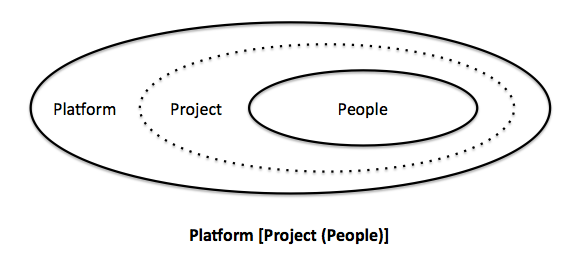
If we put Project and Platform together, I’d like to claim that Project is embedded social context and Platform is the setting of Project. Without any Project (informal and flexible social activities), a Platform is only a Tool that helps People take individual actions.
This is a great starting point for a new approach!
2. The 1.0 Version
I developed the 0.5 framework on Oct 15, 2020, and the concept of “Supportance” on Oct 27, 2020. By putting them together, I got the 1.0 version.
2.1 The Supportance of Platforms
However, the 0.1 version of P4D framework doesn’t incorporate ecological theoretical concepts such as Affordance. As the developer of the Ecological Practice approach which is inspired by Ecological Psychology, I wish to adopt some ecological concepts for the P4D framework.
What’s Affordance? Let’s have a look at the original definition made by Gibson, “The affordances of the environment are what it offers the animal, what it provides or furnishes, either for good or ill. The verb to afford is found in the dictionary, but the noun affordance is not. I have made it up. I mean by it something that refers to both the environment and the animal in a way that no existing term does. It implies the complementarity of the animal and the environment.” (1979, p.119)
The affordance concept describes the possibilities for action that the environment including objects and other people offer for a particular person. The theory is complex, according to ecological psychologist Edward S. Reed (1996), there are two ways of using the concept of affordances: concrete analysis of an affordance and abstract analysis of an affordance. The former shows “how particular environment properties can promote a particular species’ habits of life (e.g., how this kind of terrain does or does not support human locomotion).” while the latter shows “these particular relationships between an organism and its habit are instances of ecological regularities or laws.”(p.40)
I adopted the concrete analysis approach and developed an ecological physics method for discussing Twitter in June.
Inspired by the concept of Affordance, I developed a new concept called Supportance for Platform Ecology in October. In fact, this concept is part of the whole conceptual framework of Platform Ecology.
First, I coined a new term called Platformba which refers to a platform-based sociocultural field. The “ba” is originally found in Japanese. The concept of “ba” has been used extensively by Japanese management researcher Ikujiro Nonaka in his SECI model of knowledge creation. The platformba is an emergent social substance that is formed by people who have relations to a platform. While a platform is designed, managed, and controlled by its owner, its platformba is determined by people, the users, and stakeholders of the platform. By using the new term Platformba, I can highlight the active aspect of platform practice which refers to people’s activity.
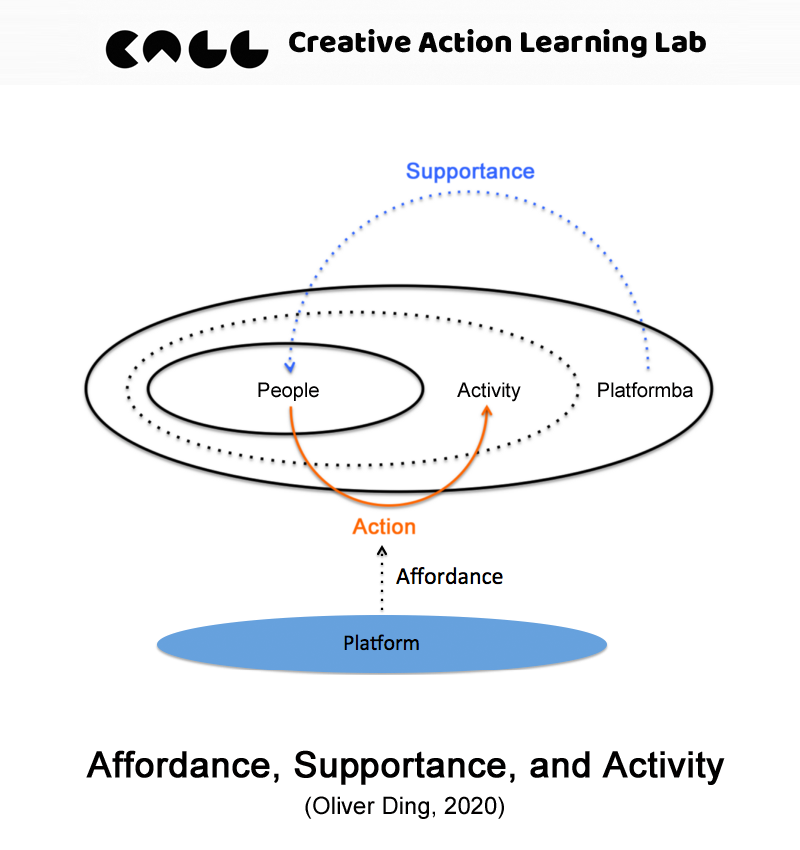
Second, I coined a new term called Supportance to highlight the potential social support offered by social context. For Platform Ecology, the social context is Platformba. Now, we can build a new layer of ecological analysis by assigning Supportance to Platformba.
Moreover, we have to notice the complex relationship between Affordance and Supportance. At the first layer of ecological analysis, Affordance is assigned to Platform. As the basic environment, a platform offers ecological affordances to its users and stakeholders. By actualizing platform’s affordances, people take real actions which form activities. People and their activities form a platformba. Then, some people and their activities offer Supportances to other people. In order to simplify the discussion, we can say that the platformba offers Supportances to people.
For the Platform for Development framework, the concept of Supportance inspires me to ask the following questions:
What kind of resources do platforms offer for people in order to support their development? How do platforms offer these developmental resources? How do people perceive these resources and take actions to transform these resources into achievements? What kind of achievements are considered as outcomes of development?
It’s not easy to answer these deep questions. However, the “Platformba— Supportance — People” triad established a new foundation for Platform Ecology. There are three theoretical claims behind the diagram:
- As an ecological environment, Platformba offers Supportances for People. Supportance refers to potential action opportunities which could support people from the perspective of development.
- People are both perceivers and participants in Platformba. They perceive and select some supportances and take actions for their Purpose.
- Some actions are curated within Programs and organized into Activities as Projects which offer Positions in order to serve the function of Activity.
The second and third claims incorporate “Purpose”, “Programs”, and “Positions”. In order words, the above diagram connects the concept of Supportance and the 5A framework.
I have mentioned the 25 types of O-E relationships within Platform Ecology. It is not a correct way to develop 25 frameworks for understanding these relationships. A better way is developing a new unit of analysis as a germ cell of a theoretical account. The “Platformba — Supportance — People” triad is just what I am looking for.
2.2 Developmental Resources
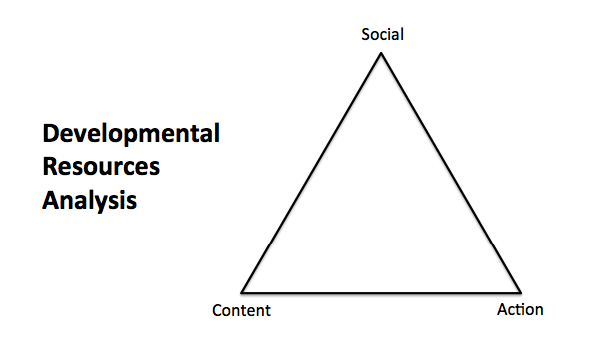
At the operational level, there are many ways to apply the concept of Supportance. In order to complete the framework of “Platform for Development”, I develop a triangle to represent three dimensions of developmental resources. The diagram below represents “Content”, “Social”, and “Action”. “Content” refers to information that is to be expressed through some medium, such as speech, writing, or any of various art. “Social” refers to opportunities of connecting to other people. “Action” refers to operational opportunities offered by platforms. The center of the triangle is “Theme” which refers to “Themes of Practice”.
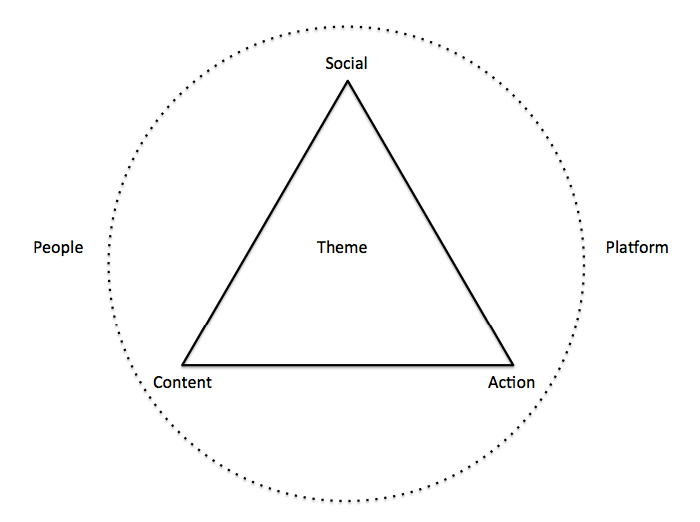
The three dimensions of developmental resources are inspired by Knud Illeris’ How We Learn: Learning and Non-Learning in School and Beyond (2007). Knud Illeris use three dimensions (Content, Incentive, Interaction) to curate and sort various learning theories. I adopted the dimension of Content and separated the dimension of Interaction into Social and Action.
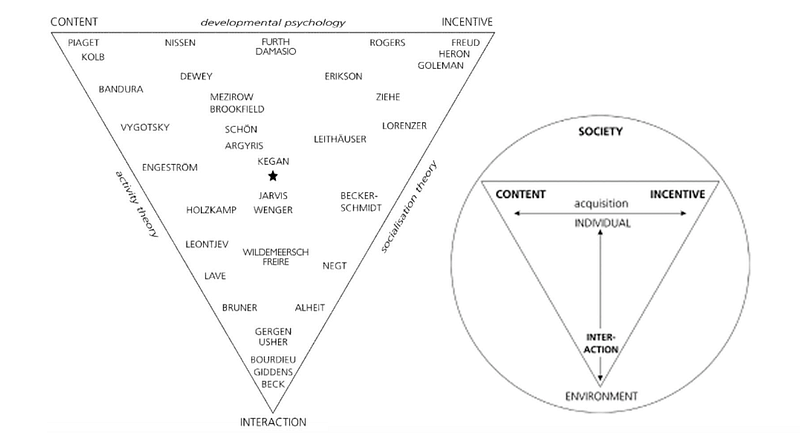
These three dimensions also roughly correspond to John Hagel’s typology of platforms.
- Connect users to resources — Content
- Connect individuals to communities — Social
- Move people to act together — Action
We have to notice that three dimensions are abstract ideal aspects. In real life, some developmental resources have two or three aspects. So, I am not claiming that there are only three categories of developmental resources.
2.3 Themes of Practice
Anthropologist Morris Opler (1945) developed theoretical “themes” for studying culture. Career counseling therapists and psychologists also developed a theoretical concept called life theme. If we put cultural themes and life themes together, we see a “great debate” of social science: “individual — collective”.
In 2009, I coined a new term Themes of Practice, and developed it as a new theoretical concept for my book Curativity: The Ecological Approach to Curatorial Practice. I recently used the WXMY diagram to represent the idea of Themes of Practice, the result is the diagram below.
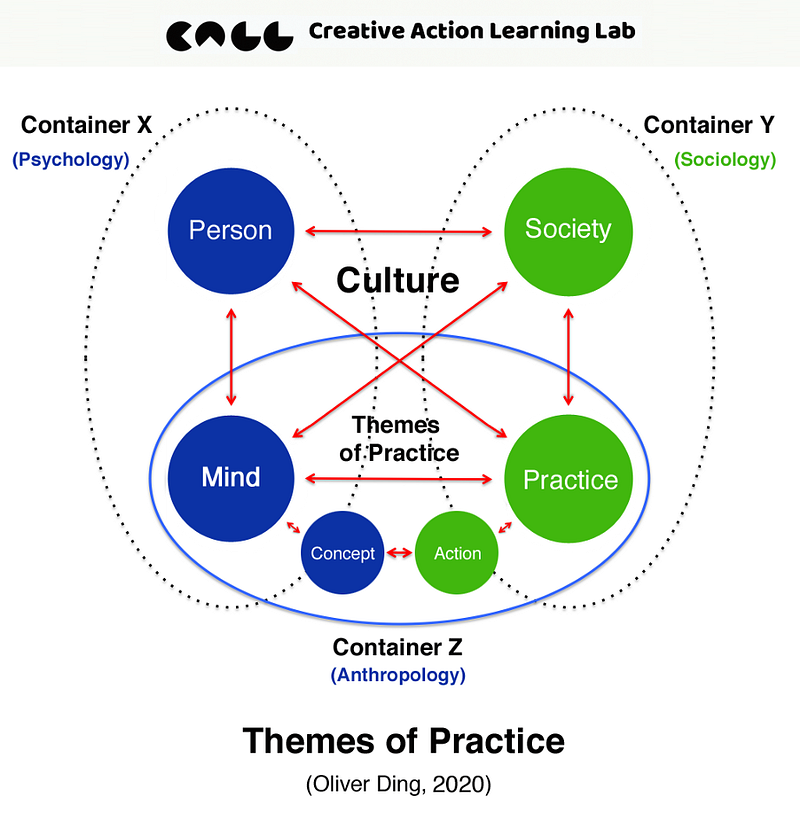
I consider the notion of Themes of Practice as a “process” type of concept, not a “substance” type of concept. Thus, it is not a new category of themes, but a transformational process between individual life themes and collective culture themes. It refers to both concept and action. It connects mind and practice. It indicates the transformation of both person and society.
For the “Platform for Development” framework, “Themes of Practice” connects individual actions and developmental resources offered by Platforms. On one side, various resources can be sorted by themes. On the other side, people perceive potential resources and take actions that refer to themes too.
2.4 Project as Situational Context
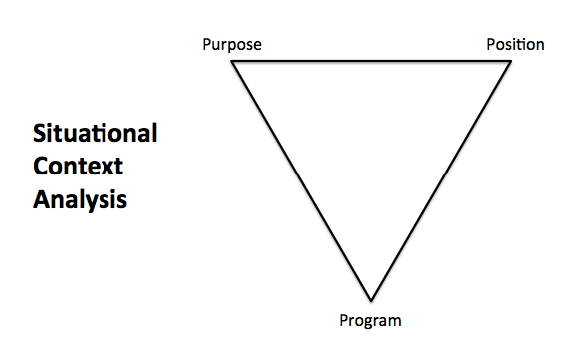
The triangle of developmental resources inspired me to turn the 5A framework into a new triangle. The result is the following diagram. As mentioned early, the 5A framework is inspired by two theoretical resources: Derek Layder’s Social Domains Theory and activity theorist Andy Blunden’s idea “project as a unit of activity”.
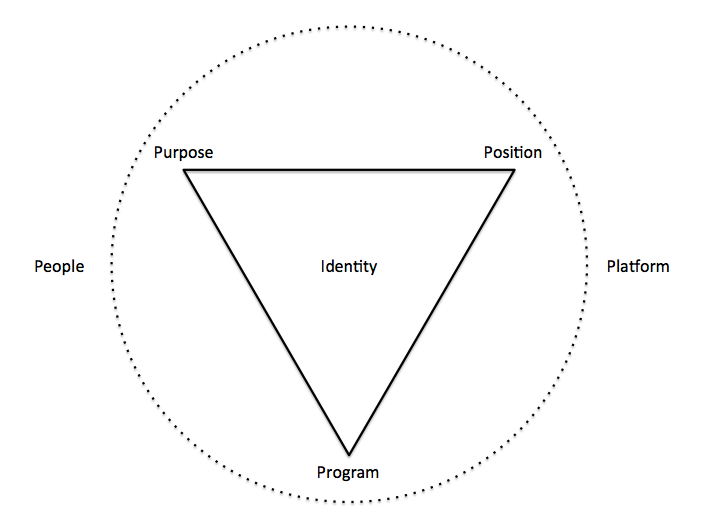
The above triangle uses “Purpose, Program, and Position” to describe three important aspects of Projects. I’d like to point out that this is not the original claim of Andy Blunden’s approach. What I am looking for the “Platform for Development” framework is a concept that can describe informal and flexible social activities.
If we put Project and Platform together, I’d like to claim that Project is embedded social context or situational context and Platform is the setting of Project. Without any Project (informal and flexible social activities), a Platform is only a Tool that helps People take individual actions.
2.5 Identity in Practice
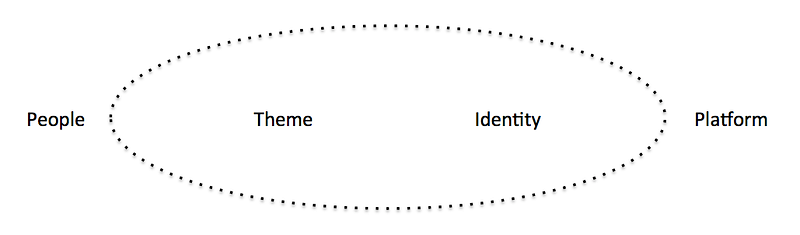
The center of the triangle is “Identity” which refers to “Identity in Practice”. To be honest, it is too technical to use this style to name new concepts. However, it is hard to describe what I want to say by only using one word “Identity”. I want to claim that there are two types of Identity, the identity of a person and the identity of an activity (project).
The concept of “Identity in Practice” refers to the dialectical relation between these two types of Identity. A person is attracted by an activity (project) through its Identity and his Identity could be shaped by the activity. On the other side, the actions of the person also could shape the Identity of the Activity.
There are two theoretical resources behind the concept of “Identity in Practice”. The first one is Theory in Practice which was presented by Chris Argyris and Donald A. Schon in 1974. In that book, the authors distinguished between “Theories-in-Use” and “Espoused Theory”. According to Argyris and Schon, “When someone is asked how he would behave under certain circumstances, the answer he usually gives is his espoused theory of action for that situation. This is the theory of action to which he gives allegiance, and which, upon request, he communicates to others. However, the theory that actually governs his actions is his theory-in-use, which may or may not be compatible with his espoused theory; furthermore, the individual may or may not be aware of the incompatibility of the two theories.”(1974, p.7) Inspired these ideas, I found there two ways of understanding “Identity”, one is “Identity in Practice” and another one is “Espoused Identity”. The concept of “Identity in Practice” argues that one’s identity is defined by his actual actions. The concept of “Espoused Identity” refers to what the person says about his identity and others’ thinkings and sayings about the person.
The second one is ecological psychologist James J. Gibson’s notion “To perceive the world is to perceive oneself”. Identity is about self-knowledge. Inspired by Gibson, Ulric Neisser developed the concept of the “Ecological Self” in his essay “Five Kinds of Self-Knowledge” (1988). Neisser argued that there are five distinct forms of self-knowledge: ecological and interpersonal perception, conceptualization, memory, and private experience. “Identity in Practice” is related to ecological and interpersonal perception. According to Neisser, “It is through ecological self-perception that we are aware of our immediate situation: of where we are and what we are doing. Through interpersonal self-perception we are aware of our ongoing social interactions: of who we are with and what is going on.”(1993) A person’s actual actions are related to the real environment and others. By perceiving the environment/others and the person’s action with the environment/others, we become more aware of “Identity in Practice”.
2.6 The Platform for Development (P4D) Framework (v1.0)
The final outcome is the diagram below which integrates two triangles together. Now we have a systematic way of discussing “Platform for Development”. The framework highlights eight key components and aspects of platforms that are considered social and cultural contexts and environments of individual life development.
The new diagram also brings a pair of concepts for analysis: theme and identity. As I mentioned above, Theme refers to “Themes of Practice”. Here Identity refers to “Identity in Practice”. Together, these two concepts describe the meaning of “Development” from the perspective of “Platform for Development”. In order words, Life Development means the Transformation of Themes of Practice and Identity in Practice.
2.7 Engagement and Coping
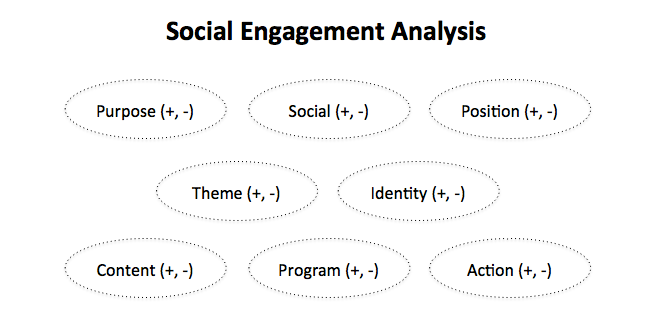
The dynamics of “Platform for Development” is emphasized by plus sign and minus sign. Plus sign refers to positive impacts and the minus sign refers to negative impacts.
This component refers to individual psychological status. In order for further discussion, I’d like to adopt a model developed by Ellen Skinner and Kathleen Edge in 2000. According to the authors, “The motivational model is an action-theoretical account of motivation, and its goal is to provide a framework for explaining psychological sources of energized and directed action. The basic model integrates work on attachment, perceived control, and self-determination.”
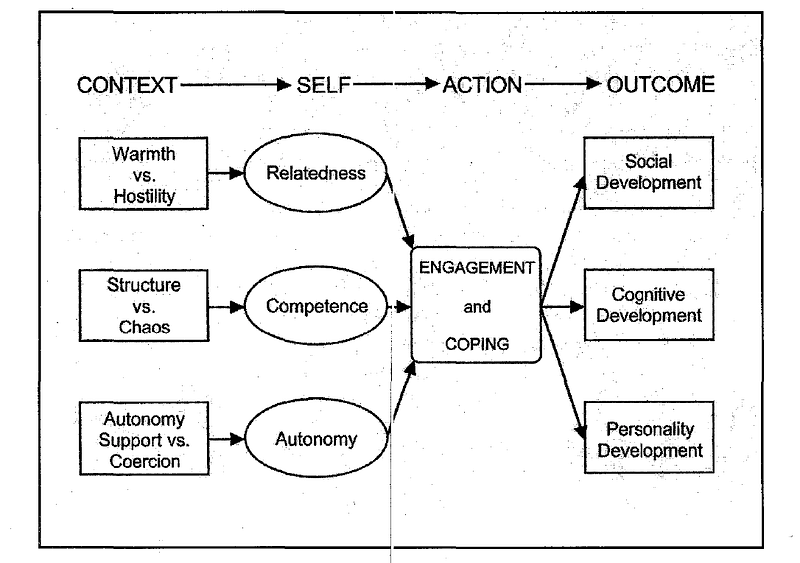
The model is based on Self-determination theory (SDT) which is one of my favorite psychological theories. SDT claims that there are three basic psychological needs — namely, the needs for Relatedness, Competence, and Autonomy.
Skinner and Edge pointed out, “Ongoing engagement refers to active, goal-directed, flexible, constructive, persistent, focused interactions with the social and physical environments. In contrast, patterns of action are described as disaffected when individuals are emotionally alienated or behaviorally disengaged from participation in an enterprise. Coping describes patterns of action when ongoing engagement encounters resistance or is disrupted. Energetic resources (effort, executive capacity, ego resources) are required to regulate actions. Action regulation under stress is considered ‘coping.’ Engagement and coping are critical mechanisms through which motivational processes influence the quality of self-systems and social relationships and, over time, shape development.”
3. Analysis Modules
The above sections describe the historical development of the “Platform for Development” framework. The final outcome is a diagram. However, the diagram is just a container that compresses many ideas. For real studies, we need to unpack them as analysis models one by one.
In November, I developed the following five analysis modules from the P4D framework.
- Developmental Resources Analysis
- Situational Context Analysis
- Cultural Projection Analysis
- Social Engagement Analysis
- Activity Landscape Analysis
Each module has its own goal and focuses on observation, data collection, and data analysis.
3.1 Developmental Resources Analysis
This module refers to the concept of Supportance and its application which is mentioned in the above 2.2 section.
3.2 Situational Context Analysis
This module refers to the original 5P framework and its revision which is mentioned in the above 2.4 section.
3.3 Cultural Projection Analysis
This module refers to “Themes of Practice” and “Identity in Practice”. See the above 2.3 section and 2.5 section.
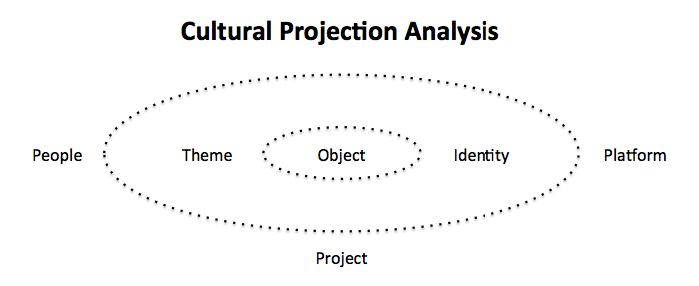
The term “Projection” is inspired by Brecht De Smet who adopts Andy Blunden’s idea “project as a unit of activity” to analyze the 25 Jan Revolution. In an article titled Tahrir: A Project(ion) of Revolutionary Change, Smet (2014) said, “The collaboration of Tahrir not only entailed a project, in the sense of people jointly working towards a shared goal, but also a projection: an image that shone forth from this activity.” (p.297) He also pointed out, “The concept of projection denotes the capacity of a project to universalize itself and attract new participants to its cause, and, most importantly, it underscores collaboration as a process of learning and instruction.” (p.299)
At the end of the article Life as Activity (version 0.3), I mentioned the sense-maker of “Activity, Project, and Event”. Since Activity Theory has the key concept Object which is a sense-maker of the theory. So, I think we can assign similar sense-makers to Project and Event. For example, I think the primary sense-maker of Project can be Identity and the primary sense-maker of Event can be Theme.
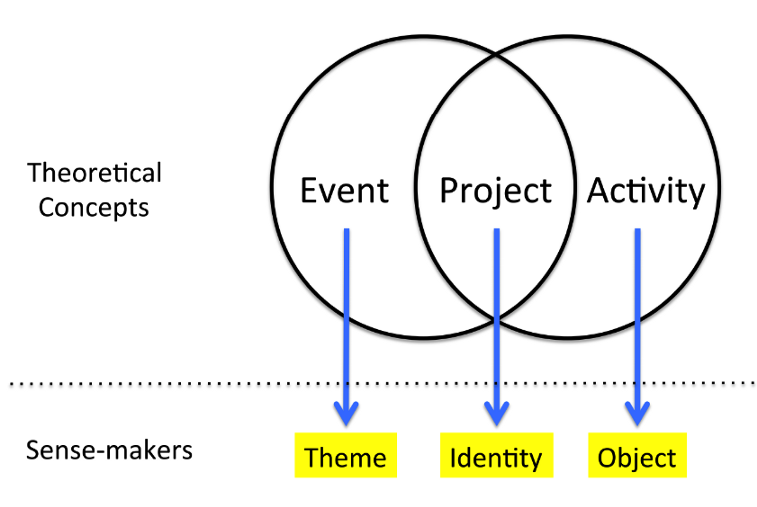
The above diagram is a possible way to conceptualize the relationship between event, project, and activity. As a core concept of the approach, Project refers to both event and activity and it shares the same aspects with them. In other words, Project’s primary sense-maker is Identity and its secondary sense-makers are theme and object.
For normal people, the 25 Jan Revolution is an event. For participants of the Revolution, it is a project. Thus, the concept of “Projection” can connect “the Object of Activity”, “Themes of Practice”, and “Identity in Practice” together. As Smet emphasized, “Hence, a projection also constitutes the inward appearance of the project to its own participants. Tahrir was not only the actual collaboration of protesters on the Square (project), it was also a glimpse of a better society (projection); an imagination that moved ahead of their current project and instructed and inspired them to develop their activity accordingly. Within the development of revolutionary collaboration, there was a continuous, reciprocal transformation of imagined goals by actual activities and vice versa, which highlights the dual character of a project as both a teleological and immanent movement.” (p.299)
The “Platform for Development” framework also highlights the dual character of activity within platforms and the reciprocal transformation of themes and identities.
3.4 Social Engagement Analysis
This module refers to positive impact (Engagement) and negative impact (Coping). See the above 2.7 section.
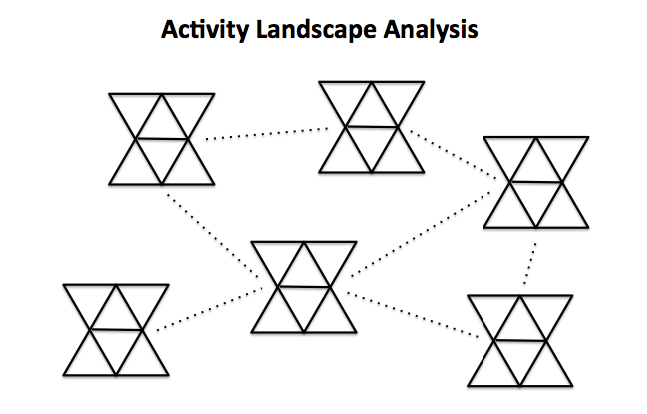
3.5 Activity Landscape Analysis
This module refers to the network of projects within one platform or multiple platforms. This is similar to “Activity Network”.
4. The Applications
It seems the “Platform for Development” framework is a powerful framework for discussing various platform-related activities. I realized its applications could go beyond the scope of digital technological platforms.
It depends on the way of conceptualizing phenomena as “Platform”. For example, we may claim “Ecosystem as Platform”, “Brand as Platform”, “Community as Platform”, “Theory as Platform”, etc.
From the perspective of ecological practice, the “Platform” is defined by its Supportance and how people take actions to actualize Supportances. A Platform without activities is a ghost town.
4.1 Ecosystem as Platform
The original focus of Social Platform Experience Design is digital social platforms. However, the “Platform for Development” is also suitable for general social platforms.
What is a general social platform? In The Power of Platforms, John Hagel pointed out that “Platforms help to make resources and participants more accessible to each other on an as-needed basis. Properly designed, they can become powerful catalysts for rich ecosystems of resources and participants…Platforms are increasingly supported by global digital technology infrastructures that help to scale participation and collaboration, but this is an enabler, rather than a prerequisite, for a platform.” Thus, we can consider a startup ecosystem as a platform too.
From the perspective of Ecological Practice approach, Platform is part of the “Network — Container — Platform” triad. Based on the concept of Container, I coined two related ideas: Network and Platform. The Network refers to the pre-container status which means pieces loose coupling outside the container. The Platform refers to post-container status, which means pieces loose coupling within a super-large container. These three ideas form a triad: Network — Container — Platform. I consider the triad as the primary form of collective context.
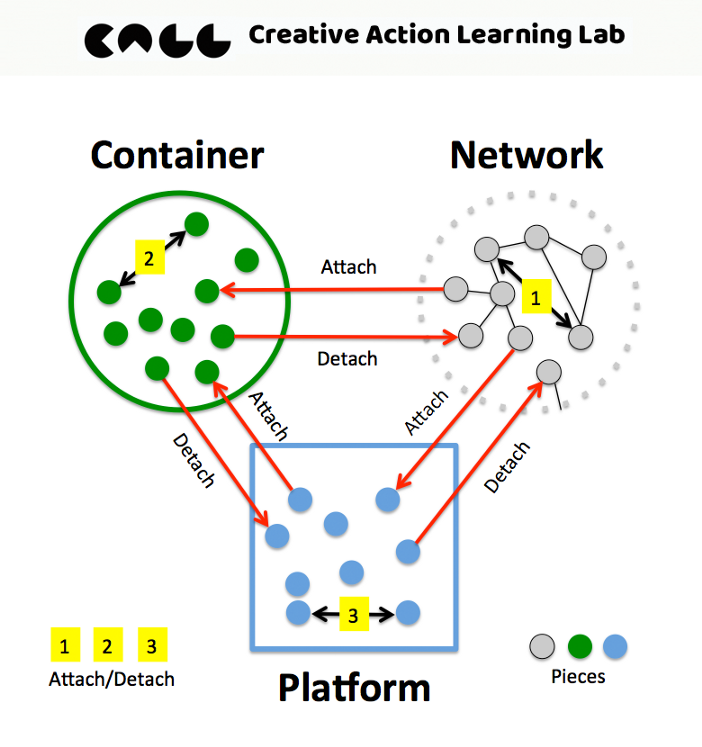
The above diagram represents a large map of the ecological practice approach. Here we see three basic types of collective context and attaching/detaching acts inside contexts and between contexts.
As a practical framework of the Ecological Practice approach, the “Platform for Development” framework can adopt more theoretical concepts from the approach for concrete studies.
4.2 Brand as Platform
A normal practice of branding campaigns can be conceptualized as projects. Thus, we can conceptualize Brands as Platforms.
One of my favorite brand practices is open brand movement. I was an early member of the global TEDx community. Inspired by the innovative open brand approach behind the TEDx program, I coined a term Brand Common and collected over 50 relevant examples. Now it is time to reflect on these real cases with the Platform for Development framework.
4.3 Community as a Platform
In Collaborative Projects: An Interdisciplinary Study, Andy Blunden mentioned Communities of Practice. He said, “The other current of Activity Theory which offers considerable opportunities for the development of an understanding of the internal workings of projects is Jean Lave and Etienne Wenger’s (1991) notion of Community of Practice, in particular, Jean Lave’s critical work on the various modes of apprenticeship which mediate the interaction between newcomers and old-timers and how newcomers become, over time, old-timers. These ideas must be utilized along-side the ‘modes of collaboration’ already discussed in the introduction and the chapters above.”(p.371)
Initially, the term Communities of Practice is part of a 1991 book titled Situated Learning: Legitimate Peripheral Participation which was written by Jean Lave and Etienne Wenger. In 1998, Wenger published a new book titled Communities of Practice: Learning, Meaning, and Identity and developed the term as a new social theory of learning. In 2015, Wenger edited a book titled Learning in Landscapes of Practice and introduced a new concept called “Landscapes of Practice” which consist of many different communities of practice and the boundaries between them.
In practical settings such as organization management, the theory of Communities of Practice was transformed into a community building theory from a social learning theory. Activities, programs, and projects become essential aspects of the community.
I consider large scale communities as platforms. For small scale communities, I only consider programs hosted by these communities as projects and consider their social context such as technological web applications as platforms.
4.4 Theory as Platform
For researchers, an established theoretical tradition is a platform for academic studies and career development.
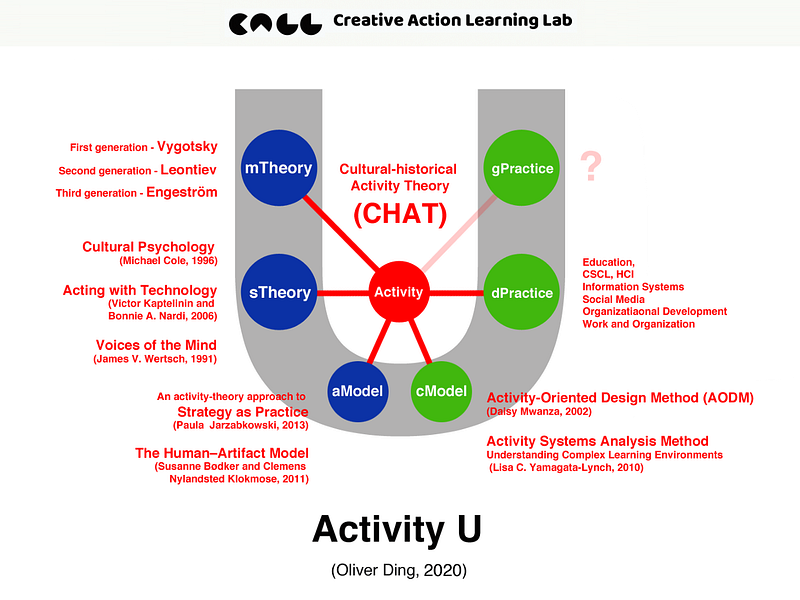
Activity Theory is a great example of “Theory as Platform”. Activity Theory or the “Cultural-historical activity theory (CHAT)” is an interdisciplinary philosophical framework for studying both individual and social aspects of human behavior. According to Kaptelinin & Nardi (2012), “The immediate conceptual origins of activity can be found in Russian/Soviet psychology of the 1920s and 1930s. During that time theoretical explorations in Russian psychology were heavily influenced by Marxist philosophy… Leontiev’s activity theory emerged as an outgrowth of the sociocultural perspective. The theory employs a number of ideas developed by Lev Vygotsky, Leontiev’s mentor and friend. It is also strongly influenced by the work of Sergei Rubinshtein, a major figure in Russian psychology and a long-time colleague of Leontiev.” (p.13–14)
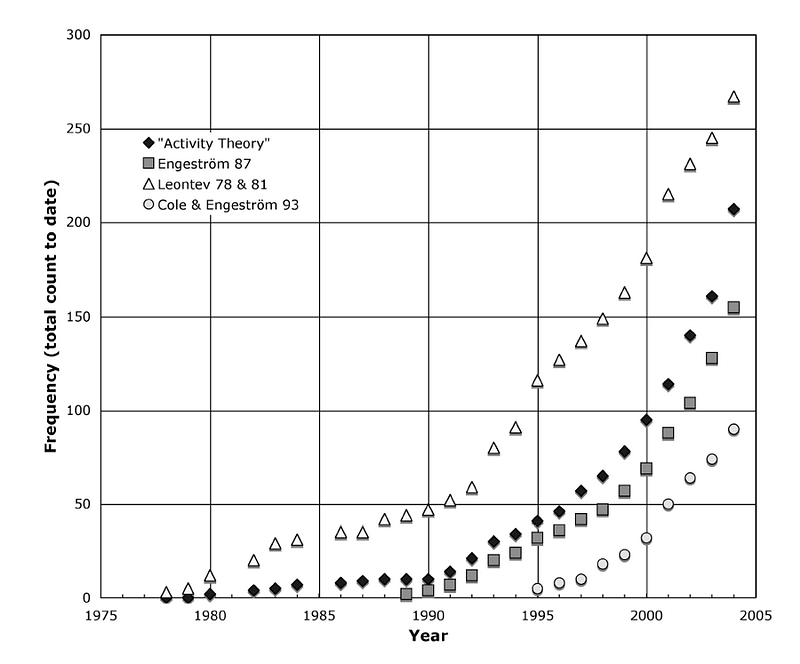
The figure below (Roth and Lee, 2007) shows a growth between 1975 and 2005 in the frequency of journal citations to the term “activity theory” and three books and one article about activity theory.
In the beginning, activity theory is a psychological theory about the mind and it focused on the development of individual psychological functions. A major development of activity theory was contributed by Finnish educational researcher Yrjö Engeström who upgraded the activity theory from the individual activity level to the collective activity level with a conceptual model of “activity system” in order to apply activity theory to educational settings, organizational development and other fields (Engeström,1987).
4.5. The P4D for Sustainable Future
Activity theorist Yrjö Engeström developed a theory called expansive learning and a method called Development Work Research based on the activity system model. His focus is on organizational learning and transformation. The “Platform for Development (P4D)” framework echoes Engeström’s primary notion of “activity for development” and places individual development within the setting of platforms.
Scholars use new terms such as ICT4D and HCI4D to connect technology design and economic development. The ICT4D stands for Information and Communications Technologies for Development and HCI4D is a subfield of ICT4D, some authors defined HCI4D as “A subfield of ICT4D that focuses on understanding how people and computers interact in developing regions and on designing systems and products specifically for these contexts.”
Obviously, the meaning of “development” within “Platform for Development (P4D)” is not the same as it is within ICT4D and HCI4D. However, I consider the young generation potential innovators as its target customers. The P4D can service the young generation of potential innovators from developing regions, thus the P4D could indirectly contribute to ICT4D/HCI4D and 17 sustainable development goals in a broad sense.
You are most welcome to connect via the following social platforms:
Twitter: https://twitter.com/oliverding Doowit: https://doowit.co/profile/gm0k2ax9 Linkedin: https://www.linkedin.com/in/oliverding
License
This work is licensed under the Creative Commons Attribution-NonCommercial-ShareAlike 4.0 International (CC BY-NC-SA 4.0) License. Please click on the link for details.
References
Andy Blunden (2014) Collaborative Projects: An interdisciplinary study. Koninklijke Brill NV.
Brecht De Smet (2014) Tahrir: A Project(ion) of Revolutionary Change. In Andy Blunden (Eds.) Collaborative Projects: An interdisciplinary study. Koninklijke Brill NV.
Chris Argyris and Donald A. Schon (1974) Theory in Practice: Increasing Professional Effectiveness. Jossey-Bass Publishers.
Derek Layder (1997) Modern Social Theory: Key debates and new directions. UCL Press.
Ellen Skinner and Kathleen Edge (2002) Self-Determination, Coping, and Development. In Richard M. Ryan (Eds.) The Handbook of Self-Determination Research. University of Rochester Press.
Engeström, Y. (1987) Learning by Expanding: An Activity-Theoretical Approach to Developmental Research. Helsinki: Orienta-Konsultit Oy.
Engeström, Y. (2008). The future of activity theory. Keynote lecture presented at the ISCAR Conference in San Diego, Sept. 8–13, 2008
Gladwin, T. (1947). Morris E. Opler’s Concept of “Themes”. American Anthropologist. N.S., 49, 1947.
Gibson, J.J. (1979/2015). The ecological approach to visual perception: classic edition. New York: Psychology Press. (originally published in 1979).
John Hagel (2015) The Power of Platforms. Deloitte University Press.
Kaptelinin V., & Nardi B. (2012). Activity theory in HCI: fundamentals and reflections. Morgan & Claypool Publishers.
Knud Illeris (2007) How We Learn: Learning and Non-learning in School and Beyond. Routledge.
Reed, E.S. (1996). Encountering the world: toward an ecological psychology. Oxford University Press.
Richard Ryan and Edward Deci (2017) Self-Determination Theory: Basic psychological needs in motivation, development, and wellness. The Guilford Press.
Ulric Neisser (1993) The Perceived Self: Ecological and interpersonal sources of self-knowledge. Cambridge University Press.


