
Activity U (VIII): Project as a Unit of Activity
A proposal, a case study, and a diagram about Andy Blunden’s project-oriented theoretical approach.

I am recently working on two frameworks which are both inspired by Activity Theory. The first one is the Life-as-Activity approach, I adopted Yrjö Engeström’s Activity Systems model (1987) which is a popular theoretical approach of Activity Theory and Howard E. Gruber’s Evolving Systems approach to the study of creative work as major theoretical resources for discussing biographical studies. I use trem “life, projects, and events” for Life-as-Activity approach. The term “Projects” is adopted from Gruber’s approach.
The second one is the Platform for Development (P4D) framework, I adopted Andy Blunden’s Project-oriented theoretical approach (2014) which is the newest development of Activity Theory and James Gibson’s Ecological Psychology as major theoretical resources for discussing platform-based activities. Inspired by Ecological Psychology’s concept Affordance, I developed a new concept called Supportance for defining Platform. By adopting the notion of “Project as a unit of Activity”, I defined a nested social structure Platform[Project(People)] as the core of the framework.
The Activity U project has been planned to introduce Andy Blunden’s Project-oriented theoretical approach. This article aims to provide some background for the project-centered intellectual journey. I will use one case study to introduce Andy Blunden’s approach with a diagram. In the last part, I’d like to reflect on my own works with this new approach.
Contents
Part 1: Background
1.1 Concept: Theory and Practice 1.2 Project as “Orienting Concept” 1.3 Project: Individual v.s. Society
Part 2: Kinds of Activity Theory
2.1 Activity Theory: Unit of Analysis 2.2 Project approach v.s. Activity System 2.3 Yrjö Engeström’s Strategy and Motivation 2.4 Andy Blunden’s Strategy and Motivation 2.5 Project as “Objective of Activity” 2.6 Collaborative Projects: An Interdisciplinary Study
Part 3: Project as “Formation of Concept”
3.1 Case Study: “Collaborative Learning Space” 3.2 Three Phases of “Formation of Concept” 3.3 A Diagram for Project-oriented Activity Theory
Part 4: Reflection and Discussion
4.1 The Re-Engagement Project 4.2 “Formation of Concept” and “Themes of Practice” 4.3 Life as Activity: The Chain of Projects 4.4 Idea, Initiator, and Initiatee
Part 1: Background
Why do we need a general approach for an interdisciplinary framework of “Project”? This part answers this question with some background about “project”, “theory”, and “practice”.
1.1 Concept: Theory and Practice
I have mentioned Concept as a type of “personal conditions” of knowing in the HERO U framework which highlights six types of Objective of Knowing: mTheory (Meta-theory), sTheory(Special Theory), aModel(Abstract Model), cModel(Concrete Model), dPractice(Domain Practice), and gPractice(General Practice). A concept can point to any one type of these. Let’s use “Activity” as an example.
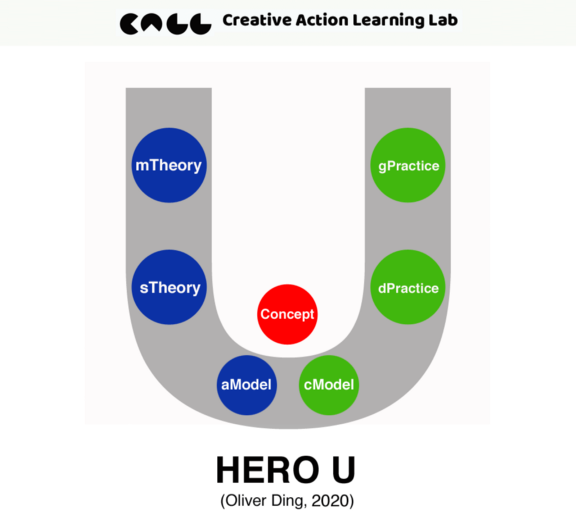
Personal condition refers to the connection between the Concept of “Activity” and Objective of Knowing. If a person doesn’t know any theory and model about “Activity”, then he only can use “Activity” as a normal word as a linguistic concept.
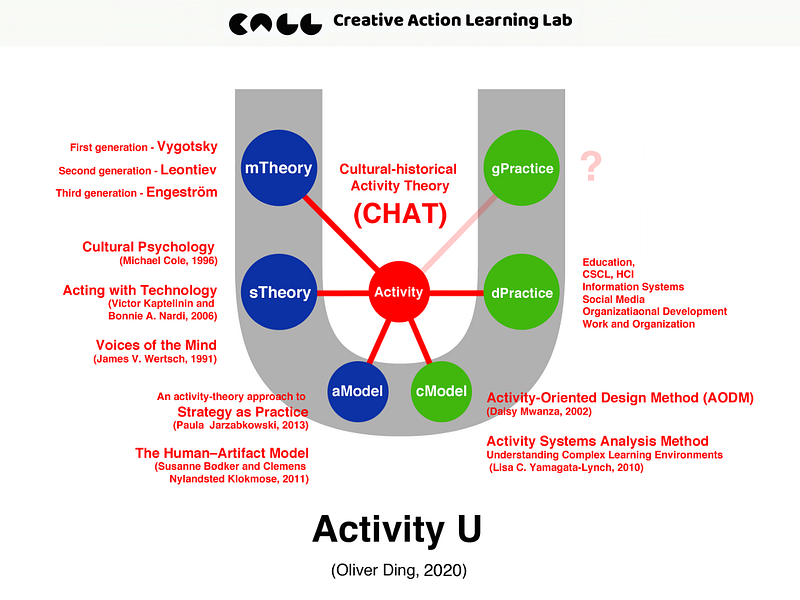
The following Activity U diagram uses the HERO U framework to visualize “Objective of Knowing” around the Concept of “Activity”. If you read this diagram and my article about Activity Theory, you will have more choices for using the Concept of “Activity” in the future. Concepts associated with theories and models are decontextualized because they focus on abstract definitions, forms and meanings that remain constant across speech event contexts. On the other side, concepts associated with practices are contextualized because they focus on particular situations with special conditions and settings.
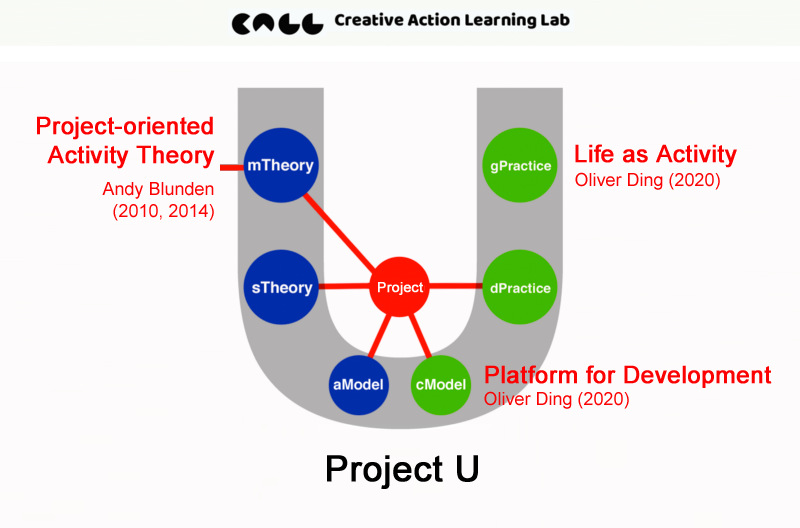
Now let’s use “Project” to replace “Activity” and make a new diagram. I consider Andy Blunden’s Project-oriented Activity Theory as a Meta-theory (mTheory). The Platform for Development framework is considered as a Concrete Model (cModel) while the Life-as-Activity approach is considered at the General Practice (gPractice) level.
Is the concept of “Project” a good candidate for developing a general theory about human activity and social practice? The answer from Andy Blunden is yes.
In a 2014 book Collaborative Projects: An Interdisciplinary Study, He points out, “Writers have come to the notion ‘project’ as an important concept in their work by various paths, from reflections on Cultural-Historical Activity Theory, social work, psychotherapy, Marxism or the study of social movements. But ‘project’ is also a concept which has become more and more prominent in the language of everyday life, whether talking about science and the arts, hobbies, political life or personal biographies. The combination of the philosophical sediment that the concept has acquired in the history of the human sciences, with the connotations that the word has accrued from everyday usage makes the concept of ‘project’ a powerful tool for interdisciplinary science. This is the idea I proposed in my book An Interdisciplinary Theory of Activity (Blunden, 2010).”
1.2 Project as “Orienting Concept”
Blunden’s strategy echoes what Derek Layder suggested: using orienting concepts to guide research. Layder said, “Two important features of orienting concepts are their ‘two-sided’ nature and their reference to social processes. The Two-sided nature of orienting concepts concerns their dual reference to objective and subjective aspects of social life. A concern with social processes focuses on their ability to trace social activity and events over time and space.” (1998, p.101)
A great example of orienting concepts is “career”, Layder pointed out, “The twin virtues of the concept of career stem from its theoretical relevance and the breadth of its empirical applicability. The empirical scope of the concept derives from its use outside as well as inside the context of work and occupations…the concept of career is potentially capable of addressing certain problems in social analysis. In particular, it could help to overcome certain divisions such as that between macro and micro analysis and between interpretive and institutional analysis (‘interactionist’ or ‘structural’ sociology). This is because, as I have said, the concept of career is capable of reaching into both objective and subjective aspects of social life. In these senses, the concept uniquely expresses the intertwining of individual experience and the collective forces that constitute what we generally mean by the term ‘society’. Thus, career is a step towards overcoming the false distinction implicit in the old argument about the ‘individual versus society’.”(1993, pp.131–132)
If we adopt Layder’s idea, we can say “project” is an orienting concept too.
1.3 Project: Individual v.s. Society
Though Layder’s focus is sociological research while Blunden’s focus is theory building, they claim similar stances.
Blunden pointed out, “A concept is needed which is concerned equally with how a person’s mind is shaped by their social situation and cultural context, and how social formations and cultural constellations are shaped by the actions of individuals. The same concept must facilitate scientific investigation at all levels of aggregation. Such a concept must meet certain requirements. It must be able to represent a self-sufficient Gestalt of social life at the individual level, the meso-level with which ‘project’ is normally associated in common parlance, and the cultural-historical level. It must embody movement and change, not some functional or structural conception of ‘dynamic equilibrium’. And it must capture both how the individual human psyche is determined by a person’s social situation and how individual persons participate in real social change. Finally, it must express both a viable ethical conception of modern life and a unit of scientific analysis for the formation of modern life and its conduct.” (2014, p.14)
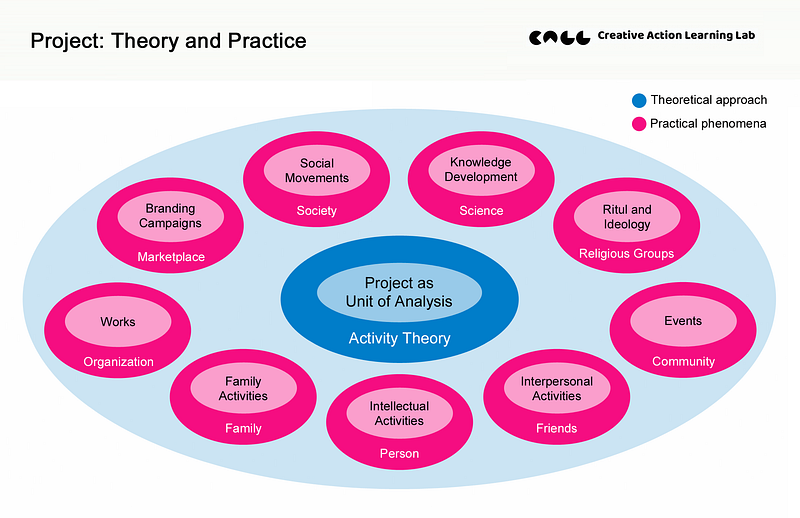
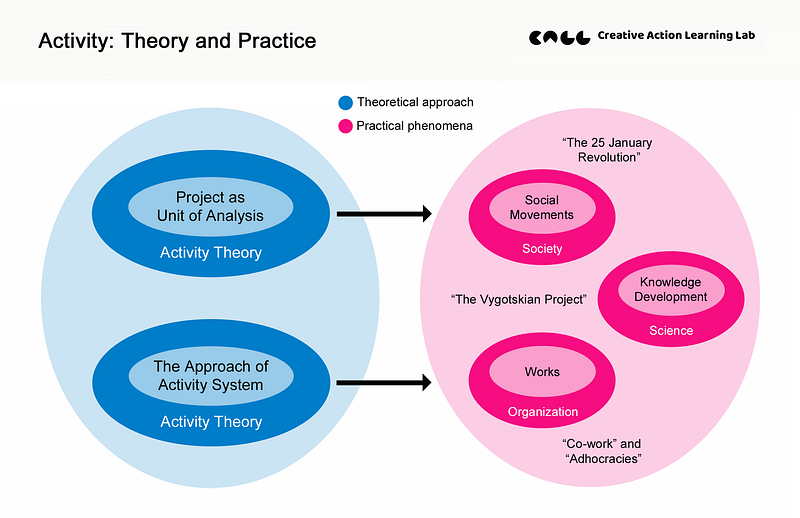
The above diagram visualizes the landscape of “Project”. The pink ellipses refer to practical phenomena and the blue ellipse refers to theoretical approaches. I roughly select nine social domains such as person, family, friends, organization, community, marketplace, religious groups, science, and society. For each type of social domain, I identify their typical activities. After thinking about these concrete practical phenomena with the theoretical concept “Project”, I accept Blunden’s proposal.
Blunden also emphasizes the benefit of developing the concept of “Project” as the foundation of social life, “By taking ‘project’ as a unit of analysis a number of other notorious dichotomies become manageable. For example, if we replace the conception of ‘social structure’ with that of the world as a fabric woven from interacting projects, and at the same time, understand that a project is the only possible manifestation of the human will as a collective will, then the agency/structure dichotomy can be resolved. If we understand that the object of a project is immanent within the development of the project itself, the real unfolding of which is equally a learning process, then there is no dichotomy between development and immanence. There is no quandary between determinism and contingency, because in commitment to projects the individual’s life is itself a determining factor. Because projects both create and instantiate concepts, and are therefore, like actions, are both subjective and objective, this ancient dichotomy is no longer problematic.” (2014, p.15)
It’s not surprise that both Derek Layder and Andy Blunden consider the dichotomy as the problem of social theory since the theoretical conflict between “methodological individualism” and “methodological collectivism” is a classic issue of social science.
If we can understand the motivation behind the proposal of “project as a unit of analysis” for Activity Theory, we can thoroughly comprehend Andy Blunden’s argument.
Part 2: Kinds of Activity Theory
Now let’s zoom in to the landscape of Activity Theory and see the position of “project as a unit of analysis”.
2.1 Activity Theory: Unit of Analysis
In an article titled Activity U (II): Unit of Analysis, Niches of Analysis, Levels of Analysis, I have discussed the notion of “unit of analysis”, there are two kinds of understanding of the notion. A popular one considers “unit of analysis” as “levels of analysis”. The second one is unusual and valuable since it considers “unit of analysis” as “concept of the whole” and “germ cell of a science”. Andy Blunden has been promoting the second approach for many years. You can find his writings here.
Since there are two ways of using “unit of analysis”, it is hard to use it for curating various theoretical approaches of Activity Theory together. In order to make sense of the whole picture of Activity Theory, I use a heuristic tool called “niches of analysis” to roughly present the landscape of Activity Theory (See the following chart).
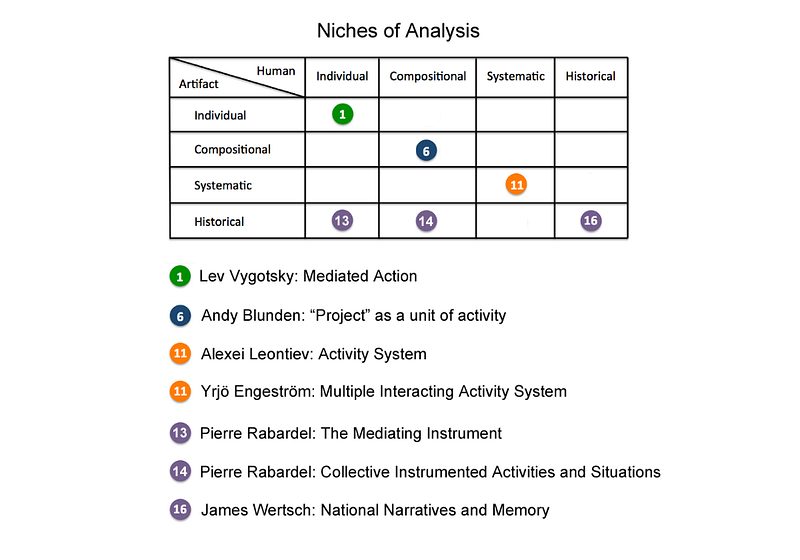
I have discussed the above chart with details in Activity U (II): Unit of Analysis, Niches of Analysis, Levels of Analysis, this time I focus on two approaches: Yrjö Engeström’s Activity System model and Andy Blunden’s “Project as a Unit of Analysis”. I also use “Project-oriented Activity Theory” to name Blunden’s approach, however, this is not the original name coined by Blunden.
According to Blunden, “Activity Theory has its roots in Classical German philosophy especially that of Hegel, in particular as appropriated by Marx (1845), as set out in Theses on Feuerbach. The proximate source of Activity Theory is the Cultural Psychology of Lev Vygotsky. On these foundations, A.N. Leontiev first set out a framework for Activity Theory, elaborated, for example, in The Development of Mind (2009) and Activity, Consciousness and Personality (1978). These foundations were further developed by a number of Soviet writers, by Yrjö Engeström with his Learning by Expanding (1987) followed by numerous journal articles and book chapters, and separately by a number of researchers in Europe.” (2014, p.23)
My focus is Curation and Curativity. From the perspective of Curativity, Activity Theory and social practice theories are about the curating of human actions and experiences. For Activity Theory, human actions and experiences are organized with “hierarchy”, “system”, “temporal chains”, “project”, “concept” and “network”. Schatzki’s hierarchical structure of social practice is very similar to Leontiev’s hierarchical structure of human activity. The jump from “action” to “activity” makes a simple but powerful thinking tool for theorizing “social”.
According to Blunden, “An activity or project is an aggregate of actions, so the conception of a project rests on the conception of an action. In Activity Theory actions are both subjective and objective — behavior is not abstracted from consciousness. Consequently, an aggregate of actions is also equally objective and subjective. Implicit in the concept of ‘action’ is that actions are artifact-mediated; that is, all actions are effected by means of tools or symbols meaningful within the project and usually within the wider culture. Consequently, activities are also inclusive of the material conditions they both create and presuppose.” (2014, p.23)
Some readers may know that I have developed a theory called Curativity Theory which is about “curating pieces into a meaningful whole”. The basic assumption of Curativity is “In order to effectively curate pieces into a meaningful whole, we need Container to contain pieces and shape them.” From the perspective of Curativity, we can consider “Activity/project” as Container for containing “Actions” (Pieces) as a meaningful Whole. However, the theoretical roots of Curativity Theory is James Gibson’s ecological psychology, William James’ Radical Empiricism, and traditional Pragmatism in general. In particular, I have applied Curativity Theory to discuss individual development and culture innovation with a special focus: temporal curation. In order words, I pay attention to “aggregate of happened actions (experience)” . This is an essential difference between Curativity Theory and Activity Theory.
2.2 Project approach v.s. Activity System
Activity Theorists don’t adopt temporality as a theoretical foundation for understanding “aggregate of actions”. For example, Yrjö Engeström uses “system” and Andy Blunden uses “project” to aggregate actions and develop theoretical approaches. The diagram below presents these two approaches.
According to Andy Blunden, “In Activity Theory there is nothing in an activity other than human actions, and this is a thesis with which contemporary interactionist theories would be in agreement, eschewing recourse to biological determinism, religious or structural fatalism or any other force of human action as determinants of human life. But because there is nothing other than human actions to be found in an activity this does not mean that an activity is simply the additive sum of actions. In fact, the activity is generally a precondition for any of the component actions which instantiate it: when we act we do not generally create an activity, we join it. So Activity Theory recognizes that there are aggregates of actions which have a unity of their own for which, as the saying goes, the whole is greater than the sum of the parts. The question then is what is it that gives an activity its unity?” (2014, p.24)
In the above paragraph, Blunden sets the ontological foundation of “Activity” for Activity Theory. I think all Activity Theorists would agree with this statement. The question Blunden pointed out in the last sentence leads us to the epistemological level in which different Activity Theorists provide their own answers.
2.3 Yrjö Engeström’s Strategy and Motivation
For Yrjö Engeström, his strategy is expanding Activity Theory from individual level to collective level with a “activity system” model. According to Blunden, “Yrjö Engeström freed Activity Theory from some of the shortcomings of this first model (that “an activity is defined by a universal, societal concept of its object, instantiated in its principal symbols and name.”) , introducing his ‘expanding model’ of activity. Here the elements mediating subject and object are introduced at the ‘ground floor’, so to speak, of analyzing an activity. The subject and its object are mediated by instruments and the community. In turn the relation between the subject and the community is mediated by norms and rules, and the relation between the community and the object of the activity is mediated by a division of labor. Engeström thus introduced into the concept of an activity, explicit consideration of the culturally produced artifacts used in the activity, the community engaged in the activity, and the norms and division of labor. Engeström describes this model as ‘expanding’ because each mediation arises in response to contradictions and an iterative process of new mediations and new problems bring about an expansion of the activity system and changes in the object.” (2014, p.25)
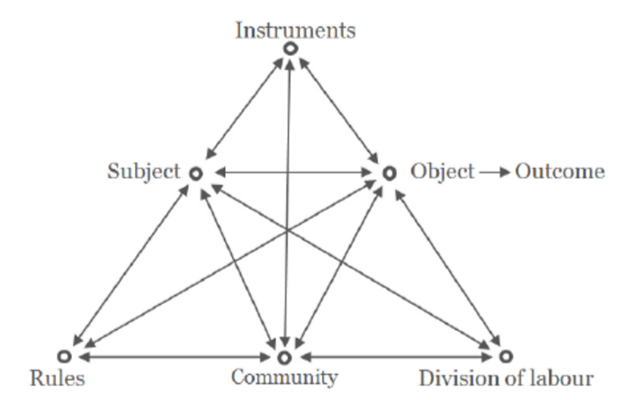
Engeström considers the diagramming approach as an important tool for developing theory. The process of developing the “activity system” model and “expanding learning” model is a great example for rethinking the value of diagram and diagramming. I have reflected this case in an article titled Activity U (IV): The Engeström’s Triangle and the Power of Diagram.
We have to notice that the motivation behind the “activity system” model is that Yrjö Engeström wanted to develop a new theory of learning in organizational work settings. Yrjö Engeström was attracted by the Soviet-Russian tradition of cultural-historical activity theory when he was a university student and activist and started his first activity-theoretical study in 1982. In order to avoid the curricular constraints in school settings, he chose the world of work and organizations as the field of study in which he encountered a more open attitude toward novel ideas and practices. (Engeström & Glaveanu, 2012, p.515). In 1987, he published his keystone work titled Learning by Expanding (1987/2014) in which he developed the now-famous Activity System triangle, the concept and model of Expansive Learning, and the early version of methodology of development work research. Since then, his research has significantly advanced our understanding of development and learning in different work settings and made significant contributions to cultural-historical activity theory.
In order to develop a mode about learning in the work setting, Engeström decided to develop a mode about “learning activity”. In order to understand the “learning activity”, he chose to trace back to two lines. One line is about “activity” while another line is about “learning”. During the process, he had to develop a collective level version of “activity theory” for his research. This process is clearly displayed in the Chapter 2 of Learning by Expanding is An Activity-theoretical Approach to Developmental Research. Thus, we can consider the “activity system” model as a by-product of developing a new theory of learning in the work setting.
2.4 Andy Blunden’s Strategy and Motivation
For Andy Blunden, his strategy is expanding Activity Theory into an interdisciplinary theory of activity from its original version of psychological theory. Blunden’s goal is developing a philosophical theory which can compete with Phenomenology and Existentialism at the Meta-theory level. He said, “What distinguishes Activity Theory from Phenomenology and Existentialism is that for Activity Theory, the project has its origin and existence in the societal world in which the person finds themself; for Phenomenology and Existentialism the psyche projects itself on to the world. For Activity Theory, commitment to a project and formulation of actions towards it, are mediated by the psyche, but a project is found and realized as something existing in the world, be that an entire civilization, a single personality, or anything in between. (See MacIntyre, 1981, p.146)” (2014, p.7). Thus, Blunden doesn’t start from an organizational work setting.
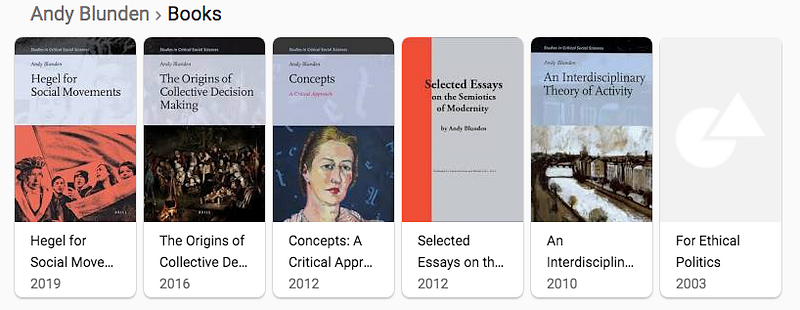
In order to develop the theoretical foundation of “Project as a unit of Activity”, Blunden adopts Hegel’s Logic and Vygotsky’s theory about Concept as theoretical resources. The process is documented in three books: An Interdisciplinary Theory of Activity (2010), Concepts: A Critical Approach (2012), and Collaborative Projects: An Interdisciplinary Study (2014).
The solution of “Project as a unit of Activity” is summarized in a paragraph at the end of Introduction to Collaborative Projects. Blunden said, “How can we understand the relation between the motivation of individual actions on one hand, and on the other hand, the immanent objective of the project which forms the unifying principle of the project uniting all the disparate individual actions into a single activity? Hegel resolved this problem in his solution to the problem of the subsumption of any number of individual actions under a concept, but there is no criteria other than the concept itself determining this subsumption. The relation between an action and the project which gives to the action its rational meaning is the same as the relation between any individual discursive act and the concept which it instantiates, and the same as the relation between any individual thing and the category under which the thing is subsumed. The relation between the individual and the universal is mediated by the particular, that is by praxis, and it not to be conflated with the subjective-objective relation which is a quite distinct relation. The universal has no separate existence, but exists only in and through its particularization by individuals.”(2014, p.26)
What an amazing theoretical approach! I will dig deep into this approach in Part 3. Now let’s move from theory to practice and end Part 2.
2.5 Project as “Objective of Activity”
At the above diagram titled “Activity: Theory and Practice”, I list three practical cases: “The 25 January Revolution” as an example of “Social Movements” in the social domain of “Society”, “The Vygotsky Project” as an example of “Knowledge Development” in the social domain of “Science”. These two examples are presented within the book Collaborative Projects: An Interdisciplinary Study (2014). The third case “Co-work” and “Adhocracies” is an example of “Works” in the social domain of “Organization”. This case is recorded in All Edge: Inside the new workplace networks (2015) which was authored by Clay Spinuzzi.

The Activity System model has been orienting many empirical research since 1987. Clay Spinuzzi’s book All Edge is a great example. Spinuzzi adopts a term “adhocracies” from Alvin Toffler to describe the trend of projectification of works and organizations: “rotating teams of specialists who could come together to swarm a project, disperse at the end of it, and re-form in a different configuration for the next project.” (2015, p.1). Spinuzzi highlights a key organizational principle for differing all-edge adhocracies from bureaucracies: projectification.
The term “projectification” was coined by Christophe Midler who is a management professor in 1995. Midler uses the term to refer to the trend of transformation from hierarchical function-centered organization to cross-functional project-centered organization. According to Spinuzzi, “Projectification is the organizing principle of adhocracies: the organization of work around project teams oriented to defined projects, as opposed to departments oriented to narrow functions (the organizing principle of bureaucracies). The adhocracy is organized around a specific, defined project objective with a specific endpoint.” (2015, p.32)
Spinuzzi also identifies two types of projects. He points out, “…networks are well suited to unique projects that require innovation, flexibility, and creativity, particularly if these projects involve the inexpensive, rapid communication that is necessary for supporting constant mutual adjustment. But they’re not well suited for projects that require repeatability, operating efficiency, or control; those requirements are better fulfilled by an institutional hierarchy.” (2015, p.69)
One typical activity of “adhocracies” is knowledge work. According to Spinuzzi, “Knowledge work is, simply put, work that involves thinking about, analyzing, and communicating things rather than growing or manufacturing things. It includes occupations such as graphic design, web development, and copy-writing. It involves specialist work, it tends to be project oriented, and its products tend to be symbolic (designs, working websites, text) and thus electronically transportable, circulable through information and communication technologies. Knowledge work, in fact, tends to be fast and changing and connective — that is, it needs what organizational networks can provide.” (2015, p.60)
Spinuzzi adopts the Activity System model and other theoretical ideas to theorize organizational network and knowledge work. In order to describe the flat structure of nonemployer firms (NEFs), he identifies two key objectives of NEFs: the front-stage performance and the project. The diagram below represents the network of various activities around these two objectives. The small hexagons refer to activities while the big square refers to the backstage subcontractor network.
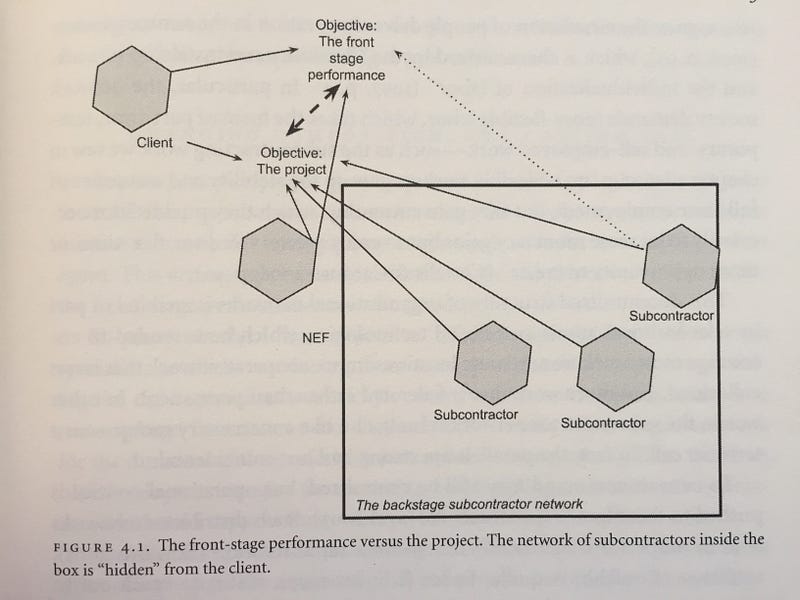
Spinuzzi distinguishes two parts of the organizational activity network of NEF. The front-stage part and the backstage part. He pointed out, “…the front stage was also long term, lasting beyond a specific project. But behind the front stage, these NEFs organized temporary all-edge adhocracies of subcontractors, adhocracies that swarmed the short-term project…At the same time, the nonemployer firms and their subcontractor networks were organized around projects, like any adhocracy. The project gave shape and unity to the network, providing a temporary back stage…To complete each project objective, a nonemployer firm had to assemble a network of subcontractors who shared this objective but saw different aspects of it…” (2015, p.62)
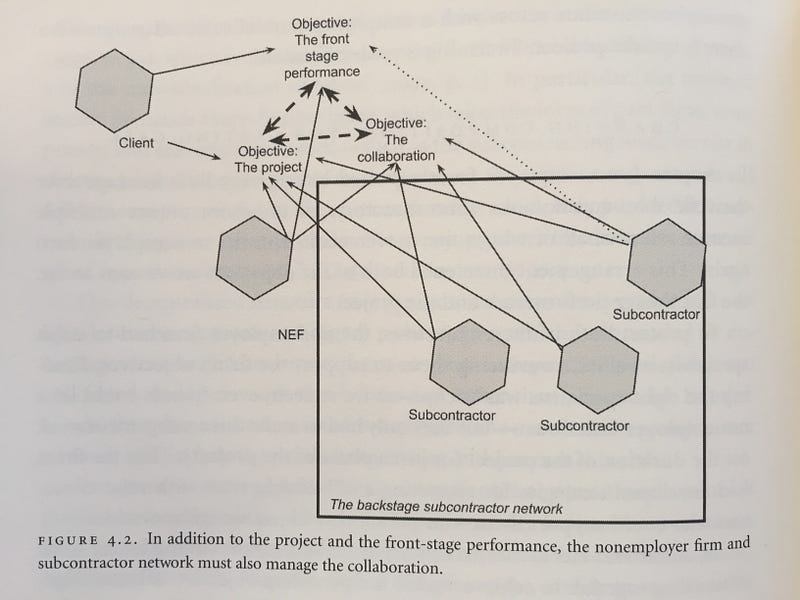
However, there is a third objective within the organizational activity network of NEF: collarabiton. According to Spinuzzi, “…collaboration (in the board sense of working together to achieve a goal) is a persistent objective in knowledge work organizations…In the third objective (the collaboration), projectification requires coordinating the swarm, ideally in a way that will address both the short-term project and the long-term front stage. This projectification requires mutual adjustment, which in turn requires high-volume information transactions for proper coordination…” (2015, p.65)
Spinuzzi adopts the activity system model and its advanced version “activity network” to theorizing the work activities of NEF and other “adhocracies”. Based on the theoretical concepts of these models, he emphasizes the tensions between the above three type of objectives, “Unfortunately, these three objectives (collaboration, the front stage, the project) don’t always line up…the tensions among these objective provide the network with its shape and — ideally — its coherence…these tensions can produce innovations, but they also produce disruptions and instabilities.” (2015, p.65)
This is an excellent case of activity-theoretical empirical research which is especially based on the activity system model and its advanced version “activity network”.
2.6 Collaborative Projects: An Interdisciplinary Study
In contrast, it is hard to find some cases of empirical research which are based on the “Project-oriented Activity Theory” since it is a very young theoretical approach. According to Blunden, “…it has never been the intention of this project to create an alternative theory. The aim is to introduce into Activity Theory one new concept, the concept of ‘project’, which is to take the place of the unit of activity. All the past gains of Activity Theory and Cultural-Historical Psychology need to be retained. But the introduction of this new concept of the unit of activity will have not just an additive effect, but a transformative effect on theory as a whole. The notions of the norms and rules, instruments, community, etc., and the understanding of interaction between activities will be radically changed by the introduction of ‘project’ as a unit of analysis. But it is early days. This book marks only the very first effort. It is vital that everything we have learnt about the internal structure and dynamics of activities (a.k.a. ‘systems of activity’ or ‘projects’) needs to be sublated into the concept of ‘project’ if it is to become a genuinely useful concept for the human sciences.” (2014, p.370)
After deliberately reviewing the unique theoretical concept of “Project-oriented Activity Theory”, I was attracted by its significance and promising prospect. So, what’s the value of the notion of “Project as a unit of activity” at the empirical research level?
Collaborative Projects: An Interdisciplinary Study collects 25 case studies of “projects”. Blunden invites 25 authors to write one chapter for their own projects. According to Helena Worthen who is one of 25 authors, the book is a collection of stories. As Worthen remarks, “It’s probably better to look at the whole book and see what the people writing in it mean by ‘project.’ It draws together a range of reports that make a good argument for rethinking what they should be collectively called. Blunden calls them ‘research,’ and they certainly research. But they are also stories. All the chapters are narratives of something that happened. They involve many people and tell about something that happened over time. There are pauses, when the writers reflect on how the narrative is moving along, but above all the story keeps going…Over time, trial and error clarifies the project until it becomes something recognized, named and acknowledged…In most chapters, there is a point at which some part of the project becomes emblematic of the whole project.” (2014, p.357) Worthen asks same question of the practical value of “Project as a unit of activity”. She says, “In reading through this book, I kept asking myself how I would explain to someone who is not a social scientist how you would use either the project unit of analysis or the whole analytic framework of Activity Theory.” (2014, p.359)
Blunden argues that narrative explanation is going to play a central role in social science, especially the interdisciplinary Activity Theory which is considered as a relatively young branch of science. (2014, p.369) Though I accept the narrative explanation as a way of producing scientific knowledge, I think it is also possible to develop some concrete theoretical models for “conceptual” analysis works. For example, Blunden emphasizes the importance of the concept of Time in Activity Theory, “What the use of ‘project’ as a unit of analysis has done is to introduce into the unit of analysis of Activity Theory the element of time, which, though perhaps we never noticed, was previously absent.” (2014, p.369) This argument echoes my recent works, I recently reviewed the concept of “Chain” in Activity Theory and developed a new approach called Life-as-Activity for connecting Activity Theory and biographical studies.
In my opinion, the best sparkle of the notion of “Project as a unit of activity” is the idea of “Activity as Formation of Concept”. Let’s repeat Blunden’s own words, “…Hegel resolved this problem in his solution to the problem of the subsumption of any number of individual actions under a concept, but there is no criteria other than the concept itself determining this subsumption.”
Part 3: Project as “Formation of Concept”
In this part, I shall unpack the idea of “Activity as Formation of Concept”. Instead of introducing the idea at the theoretical level, I think it is better to start from a case of empirical research which was conducted by Andy Blunden.
3.1 Case Study: “Collaborative Learning Space”
Andy Blunden and Michael Arnold write a chapter titled Formation of the Concept of “Collaborative Learning Space” for the book Collaborative Projects. They share a story of developing a new concept “Collaborative Learning Space” which challenges the traditional policies for the maintenance and construction of shared teaching spaces at the University of Melbourne in 1999–2000.
During 1999 to 2000, Andy Blunden was the supervisor of the Audio-Visual Unit of the university and led a group of technical staff to support teachers using the equipment in the lecture theatres. From this career setting, Blunden found a “problem” and started developing a “solution”, the core of the whole process is formation of a new concept.
According to Blunden, “The social situation we have in mind here is the university, specifically in the 1990s in Australia. Universities are institutions which, as a key part of their activity, provide rooms to teachers and students for the purpose of teaching and learning. However, those in the university responsible for designing, building and allocating teaching spaces, on the whole had an understanding of teaching and learning which reflected a centuries-old, unchanging conception of how university education is done, objectified in the University’s buildings and the configuration of their teaching spaces (c.f. Leontiev 1978, p.66). The teachers on the other hand had diverse views on how to teach, which responded not only to tradition but also to continuously changing views on learning, and had a variety of opinions on what might constitute a suitable space for teaching. Most teachers found the existing infrastructure for teaching unsatisfactory in various respects and to various degrees, but had no means of addressing the problem, as teaching space was largely provided by the central bureaucracy, and there was no position within the bureaucracy responsible for planning and supply of teaching spaces. At the time, there was almost no research literature on the problem of design of physical spaces for teaching and learning. In 2002, a monograph was published in the US (Van Note Chism & Bickford, 2002) raising the same concerns, including a literature summary which confirms that research on university classroom design was embryonic even in 2002.” (2014, p.159)
This is the beginning of a new concept of “Collaborative Learning Space”.
3.2 Three Phases of “Formation of Concept”
The concept of “Collaborative Learning Space” represents Blunden’s solution for solving the problem. Howerer, the formation of the concept or the development of the solution is not simple. Blunden and Arnold review a contradictory developmental process which includes various forms of objectification of “Collaborative Learning Space”. I’d like to summarize their story in three phases.
- Phase 1: Initialization
- Phase 2: Objectification
- Phase 3: Institutionalization
In March 1999, Blunden conducted a research about teaching staff’s expectations on ideal teaching space infrastructure. On 30 March 1999, Blunden reported to management about his insights with an email which initially mentioned a new term “Collaborative Learning”. On 15 April 1999, Blunden used a similar term “Collaborative Learning Space” in an email which informed his collaborators about the concept and the need behind the concept. On 11 May 1999, Blunden received a reply with an allocation of funds “for the development of Collaborative Learning and Teaching Spaces as part of the 2000 Lecture Theatre Upgrade Program” including $165,000 for the Cecil Scutt Room. (2014, p.159-160)
This is the phase 1 of the project: Initialization. Blunden points out, “We see here how the term ‘collaborative learning space’ was invented by teaching staff who were frustrated by the implicit assumption, evident in the configuration of teaching spaces, that all teaching and learning at the University is didactic (teacher-centered) delivery of information. AB (Andy Blunden) provided a vehicle to mediate between the need and a means of its resolution, so that the word ‘collaborative learning space’ first became objectified in AB’s communications, and eventually in an allocation of funds by the University for the construction of ‘Collaborative Learning and Teaching Spaces.’ Initially, no-one knew what such a space would look like, only that it would meet a certain deficit in the university’s infrastructure, by supporting specific modes of activity, that is, concepts of teaching and learning; and none of those responsible for the provision of teaching infrastructure had even heard of the concept of ‘collaborative learning.’ The problem now was to concretize the concept and institutionalize a solution within the university’s material fabric, self-consciousness and practices.” (2014, p.160)
The second phase is the Objectification of the concept “Collaborative Learning Space” at the Cecil Scutt Room. Blunden started working with Arnold at this phase. They decided that the project should focused on meeting the needs of Arnold who is one of 3000 teaching staff. Blunden says, “If successful, the remaining 470 rooms could be subject to a similar process, building excellence through diversity rather than convergence — that is by supporting a range of exemplar concepts of teaching, rather than a single prototype or ideal of teaching. This approach enabled effective collaboration between one teacher and one architect with a clear concept of what was needed, rather than a compromise between numerous stakeholders with the concomitant danger of meeting no-one’s needs.” (2014, p.161)
Blunden claims that there are three aspects of Objectification: symbolic, instrumental and practical. Symbolic objectification refers to giving a name to the new concept or symbolically represented in some other way. The term “Collaborative Learning Space” is a good example of naming a concept. Instrumental objectification refers to inventing and producing some new instrument or constructing of material artifacts. For the project of Collaborative Learning Space, they found that the oval table is the essential object of instrumental objectification. Blunden says, “We have noted that although the oval table was created with the completion of the very first CLS, it was more than a year later before the oval table was recognized as the germ cell. When Blunden (2000) gave a lunchtime talk to staff on CLSS in October 2000, the audience questions focused almost exclusively on the oval tables: where to buy them, how much they cost, what size, shape, etc. It was only at that point that it became clear that the oval table was the ‘germ cell’ of the CLS. But developments over the succeeding decade have shown that indeed the germ cell was the oval table, despite the fact that the table design continues to be refined to this day.” (2014, p.172)
The third phase is Institutionalization. At this phase, the project becomes a sustainable project which attracts support and resources from various institutions. The concept of the project is adopted by many institutions while the objectification of concept becomes normal routines within a community. According to Blunden, “Over the three years before AB retired in 2002, a further 24 CLSS was built using University central funds and others using departmental funds…Of 39 Australian universities, 27 now (2011) have Collaborative Learning Spaces, 5 more have Collaborative Suites or Studios or Rooms, and only 7 have not explicitly applied the term…The concept of designing university classrooms to support collaborative learning is now mainstream, though the spaces are not called ‘collaborative learning spaces’ in every institution. Nonetheless, it is clear that through the creation of the concept of ‘Collaborative Learning Space’ and its instrumental, practical and symbolic objectifications have ensured the transition of the project launched in March 1999 to institutionalization.” (2014, p.166, p.168, p.170)
3.3 A Diagram for Project-oriented Activity Theory
The Collaborative Learning Space project is a wonderful example of the Project-oriented Activity Theory. Inspired by the case study and other writings. I design a diagram to present the core ideas of the new approach.
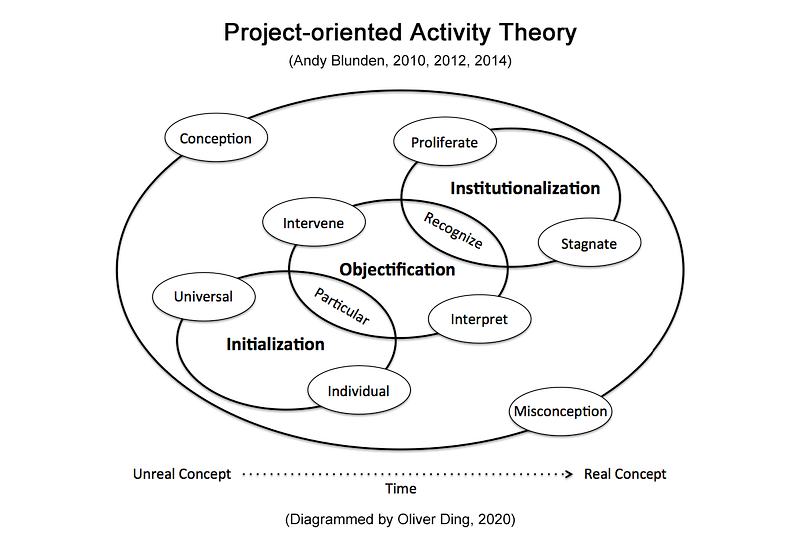
The above diagram highlights three developmental phases of “project as formation of concept”: Initialization, Objectification, and Institutionalization. We should notice that the process of “formation of concept” is a dynamic process. Blunden points out, “A concept is a unit of a social formation and cannot be said to exist until it has achieved a degree of stability and interconnectedness within that form of life. Further, a concept is subject to modification in the course of its objectification which must be taken as part of the concept formation, and not simply the ‘registration’ of the concept.” (2014, p.171) In order words, the key is formation. We should adopt a process view of concept. The process of “formation of concept” is a process of an idea transforming from an “unreal concept” into a “real concept” through various objectifications in the real life world. This is the whole point of Blunden’s 2012 book Concepts: A Critical Approach.
The process is not simple and linear. There are possible misconceptions within different phases. It is possible to enter the initialization phase with a misconception of the situation and start a project with a wrong idea. According to Blunden, Hegel mentioned four developmental stages of projects. The second stage is “on becoming aware of the problem there will be a series of failed projects arising from misconceptions of the situation…”(2014, p.8)
It is also possible to reach fail objectifications from misconception of the connection between the concept and the linguistic representation, visual representation, material artifacts, and situational routines. For the Collaborative Learning Space project, according to Blunden, “There is one misconception which has arisen from the 1999 initiative which is instructive. A key feature of the original design was the IWB (interactive whiteboard), which allowed direct manipulation of and shared eye contact with an electronic text by the whole class…But the IWBs are used as presentation devices, and rarely used for collaboration…and it takes at least two years for teachers to overcome the difficulty in using them…During those first two years, learning is markedly less collaborative. ”(2014, p.169)
Blunden also mentioned a dramatic phenomenon in the phase of Institutionalization. Once the concept of a project becomes a popular idea, some institutions would adopt the concept with their own words in order to brand their activity and property. For the Collaborative Learning Space project, Blunden points out, “This also raises the questions of the role and power of prestige in the institutionalization of a concept. Not all universities in Australia have adopted the term ‘Collaborative Learning Space.’ Every University that has gone through the same process of inventing new designs of classroom to meet their pedagogical needs, or to meet their need to position themselves favorably in the education market, has branded their infrastructure with a new name: ‘Advanced Concept Teaching Space,’ ‘eLearning Studio,’ ‘Flexible Teaching Space,’ ‘Digital Classroom’ and so on. Every institution highlights its innovation with its own brand name.”(2014, p.170)
The above discussion focuses on one case: Collaborative Learning Space. By reading this case, we go through a journey from abstract theory to concrete practice. By designing a new diagram, we take one step of Objectification of the concept “Project as formation of concept”.
Part 4: Reflection and Discussion
I shall share more ideas about the Project-oriented Activity Theory from Andy Blunden with the new diagram in the next article. At the end of this article, I’d like to share my own stories of “Project as formation of concept”.
4.1 The Re-Engagement Project
In early March 2020, SXSW, a 34-year annual tech, music and film festival held in downtown Austin, was canceled due to the coronavirus outbreak. The SXSW 2020 was scheduled to take place from March 13th to March 22nd, Austin Mayor Steve Adler announced the cancellation of the festival on Mar 6, just one week before it.
This inspired me to propose an alternative category of event called Re-Engagement. When offline events are canceled around the world, the obvious Plan B is running online real time conferences and virtual meetings with conferencing software such as Zoom, Google Hangouts and Jitsi. I think we can go further and I consider Re-Engagement as Plan C.
In order to describe my proposal, I created the following Re-Engagement framework with the WXMY diagram.
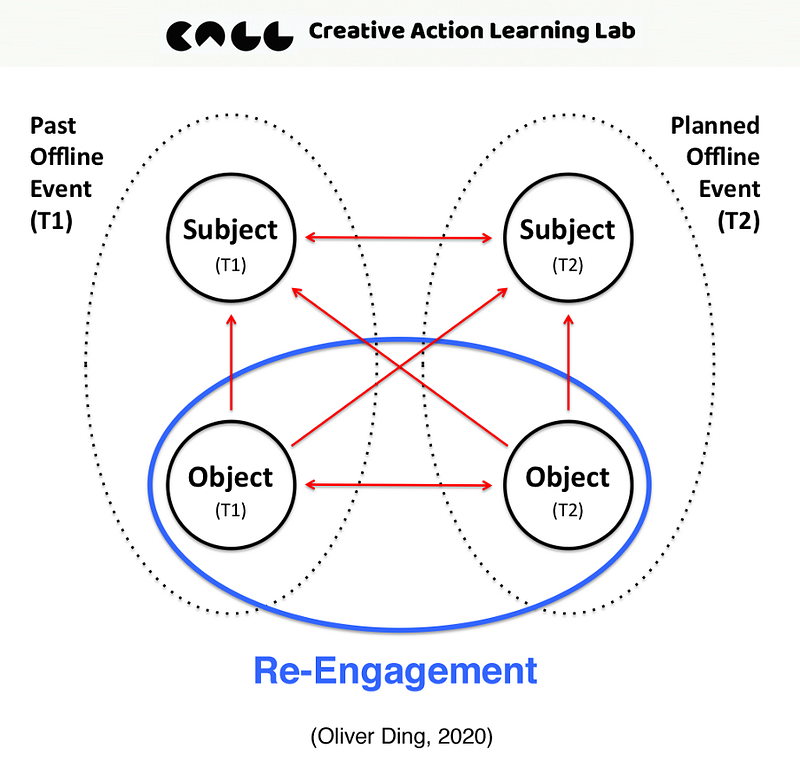
The framework was created with three ideas. The first idea is the diachrony of community. I borrowed the term diachrony from Saussure’s theory of linguistics. For Saussure, it means development and evolution of a language through history. I applied the idea to the practice of community building. While the real time face-to-face offline event focuses on the synchrony of community, the Re-Engagement is designed about the diachrony of community. For offline events, there are past events (T1) and planned events (T2), the Re-Engagement connects T1 and T2 together.

The second idea is the notion of Subject-Object. I learned the idea from Activity Theory. In traditional Activity Theory, the relationship between Subject (human actor) and Object (the objective) forms the core of an activity. The Object leads to Outcomes. For offline events, the Subject are event curators, speakers and attendees while the Object are various themes for discussing and potential collaboration opportunities. The Outcomes are new insights inspired by discussions and new collaboration emerging from the socialized events.
The third idea is the WXMY diagram. By combining the diachrony of community and Subject-Object together and placed them within the WXMY diagram, I realized the Container Z can transform to a new category: Re-Engagement.
I got the idea of Re-Engagement on March 7 and developed the Re-Engagement framework on March 18. If we adopt Blunden’s Project-oriented Activity Theory, we could consider these actions as the phase 1: Initialization. I developed a new concept “Re-Engagement” to help event curators to solve the problem of digital transformation of event experience. While other people just directly move to online events such as Zoom meetings (at concrete level) from offline events such as conferences (at concrete level), I jump from the offline events such as conferences (at concrete level) to “form of events” (at abstract level).
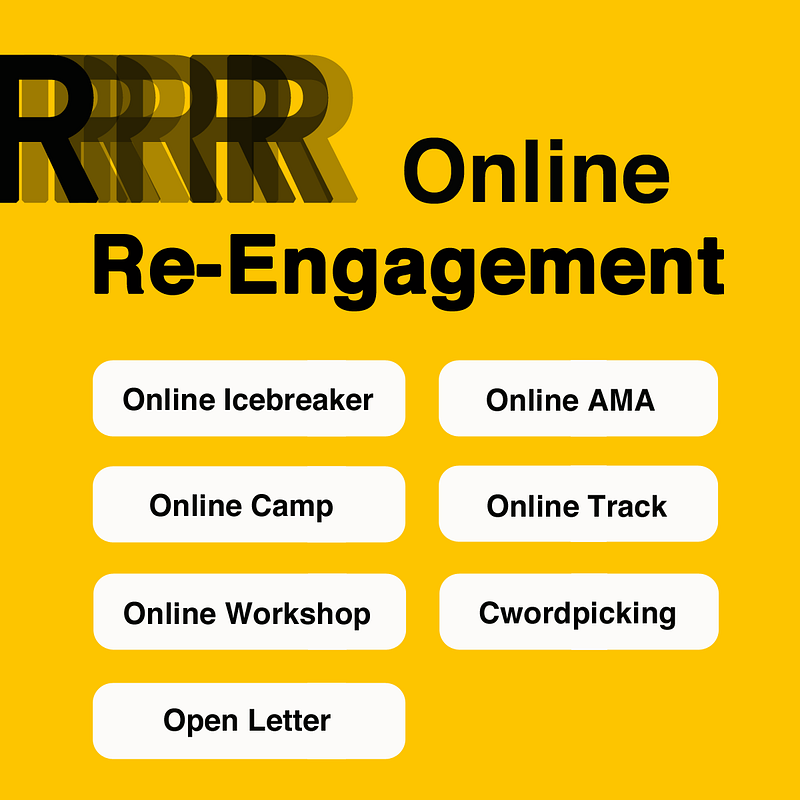
The next step is returning from the abstract level (form of events) to the concrete level (content of events). I designed several subforms of events for the concept “Re-Engagement”. See the picture below:
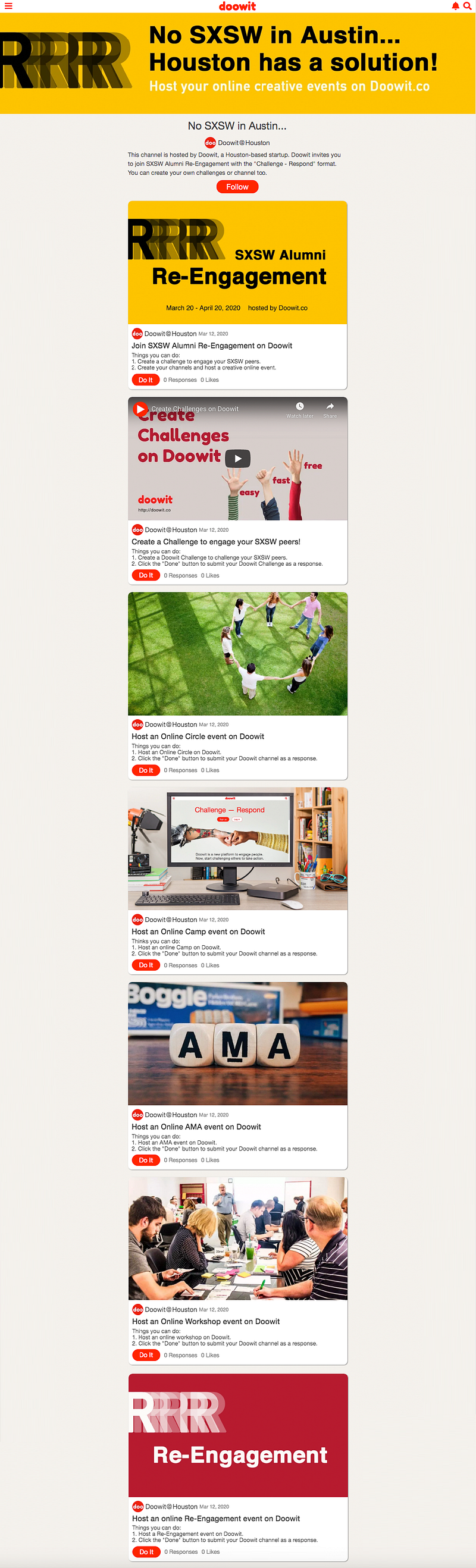
I also applied these ideas to the SXSW case and designed a mini website as a demo of the concept. Since I was a member of the team of Doowit which is a new platform for curating challenge-based activities, I used the Doowit platform to build a Doowit channel to represent my ideas. The screenshot below is the homepage of the channel.
Since then, I have been working on collecting cases in order to design innovative sub-formats of the concept. For instance, I found the concept of “Re-Engagement” can be applied to the academic field after reading a 2019 book Perception as Information Detection: Reflections on Gibson’s Ecological Approach to Visual Perception.
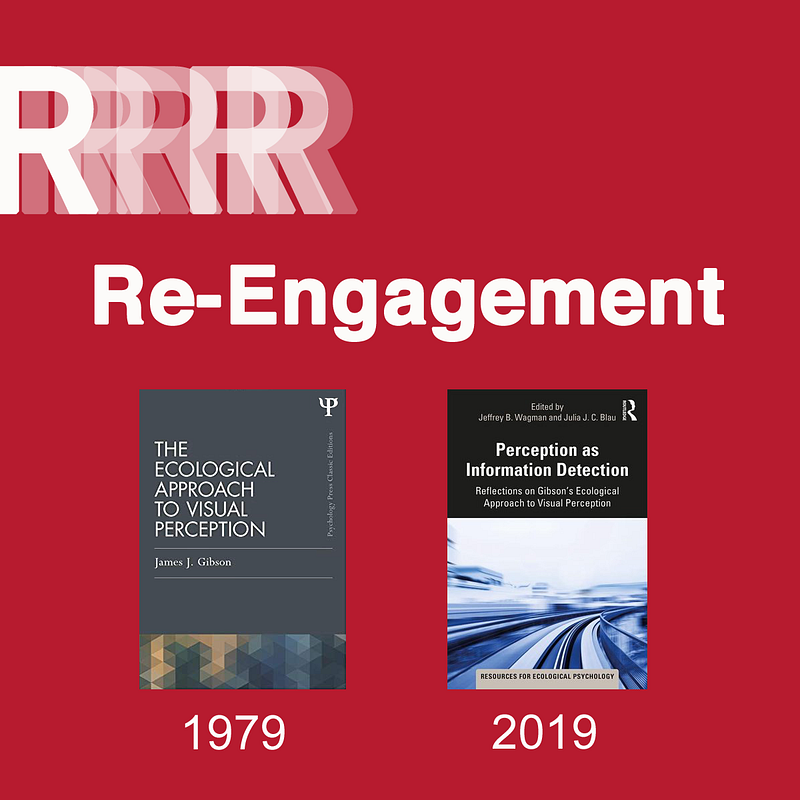
Ecological psychologist James J. Gibson published his landmark volume The Ecological Approach to Visual Perception in 1979. The 2019 book is authored by 16 ecological psychologists with a special form which provides a chapter-by-chapter update to and reflection on the 16 chapters in Gibson’s original volume.
This is an amazing Re-Engagement! Inspired by this book, I realized that the concept of “Re-Engagement” is not only for planning onlife events and face-to-face meetings, but for planning events with a special theme. In order word, the concept of “Re-Engagement” refers to a new form of activity.
This is the beginning of the phase 2: Objectification. According to Andy Blunden, “A concept, like a project, is a larger (molar) unit, which is implicit in each meaningful action, disclosing its motivation. The project inheres in the artifact-mediated actions, norms, rules and symbols flowing from the project’s self-concept and underlying the actions which constitute the project.”(2014, p.9)
4.2 “Formation of Concept” and “Themes of Practice”
I have mentioned my idea “Themes of Practice” in my previous articles several times. In 2019, I developed the idea “Themes of Practice” in order to discuss the “meaning” of the meaningful whole for my book Curativity: The Ecological Approach to Curatorial Practice. I realized the notion of “Theme” is a great tool for curating experience and actions.
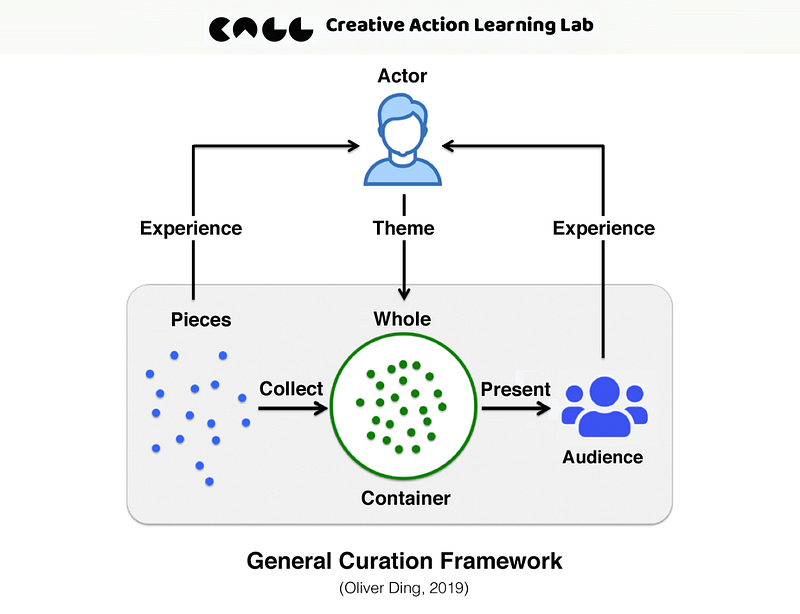
As an application of Curativity Theory, the above General Curation Framework represents the structure and dynamics of curatorial practice. The activity of curatorial practice aims to collect pieces of things into a meaningful whole in order to present a theme to a group of audience. There are three immanent contradictions within the activity of curating: “pieces — whole”, “things — themes” and “curator — audience”. For the first dichotomy, I use the concept of “Container” to balance the pieces and whole. For the last dichotomy, I use the notion of “Everyone A Curator” to deconstruct the concept of “Curator” because I want to claim that the activity of curating is a general social practice.
The dichotomy of “things — themes” refers to two classical great debate of social science: “mind — matter” and “individual — collective”. After reviewing the concept of “theme” in various disciplines such as Cultural Anthropology, Counseling Psychology, Cognitive Psychology and the Philosophy of Science, I developed a new concept “Themes of Practice” to propose a process view of “Theme”.
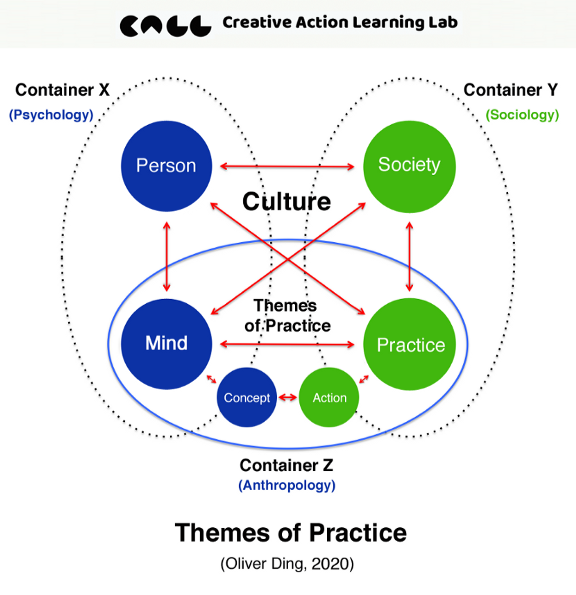
Anthropologist Morris Opler (1945) developed a theoretical “themes” for studying culture. Career counseling therapists and psychologists also developed a theoretical concept called “life theme.” If we put culture themes and life themes together, we see a “great debate” of social science: “individual — collective.” The above diagram visualizes the “concept network” or “idea ecology” of “Themes of Practice”.
I consider the notion of “Themes of Practice” as a “process” type of concept, not a “substance” type of concept. Thus, it is not a new category of themes, but a transformational process between individual life themes and collective culture themes. It refers to both concept and action. It connects mind and practice. It indicates the transformation of both person and society.
After reading Blunden’s book Concepts: A Critical Approach which presents a “Hegel-Marx-Vygotsky” account of “Concept”, I realized this is an essential theoretical resource which can support my idea of “Themes of Practice”. According to Blunden, “Dualism has been around for a long time, and not only in the form of mind/matter dualism. One of the most persistent and debilitating forms of dualism today is the dualism of the individual and society, supported by sciences devoted exclusively to one or the other domain. Since concepts are units both of cultural formations and individuals minds, a theory of concepts confronts this head on…The development of the human sciences along two parallel paths, one concerned with human consciousness, the other concerned with social and political phenomena, can only serve to place barriers in front of people’s efforts to intervene in the affairs determining their own life. By understanding concepts as units of both consciousness and the social formation, I aim to create a counter to this disempowering dogma.” (2012, p.9)
Blunden’s argument on Concept echoes my consideration of the concept of Theme. Since Theme is a particular concept, I can adopt Blunden’s proposal — the “Hegel-Marx-Vygotsky” account of “Concept” — as a theoretical foundation to support the concept of “Themes of Practice”. Furthermore, I can also adopt the Project-oriented Activity Theory to upgrade the General Curation Framework to Cultural Curation Framework.
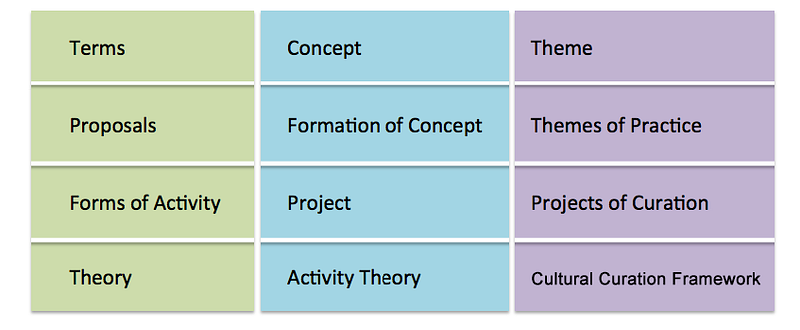
Each curation program can be considered as a Project. Each “Theme of Practice” of a curation program can be considered as a Concept of a Project. Thus, the whole process of a curation program can be considered as “Initialization”, “Objectification” and “Institutionalization” of a “Theme of Practice”.
4.3 Life as Activity: The Chain of Projects
I have developed the Life-as-Activity approach (version 0.3) which is based on the Activity System model. Now, I can offer a new version of the approach: Life as Activity: The Chain of Projects.
As mentioned early, the projectification of work is an emerging trend. From the perspective of personal development, this trend means the projectification of career. In order to better describe the new type of career, I defined a new role called Serial Creators which means a career role based on project-oriented creative knowledge work. The new concept of Serial Creators is a broad category which includes some sub-categories such as microentrepreneurs and serial entrepreneurs. By defining a new concept OF Serial Creators and connecting it to the projectification of career, we can adopt the Project-oriented Activity Theory as a new theoretical resource for new version of Life-as-Activity: The Chain of Projects.
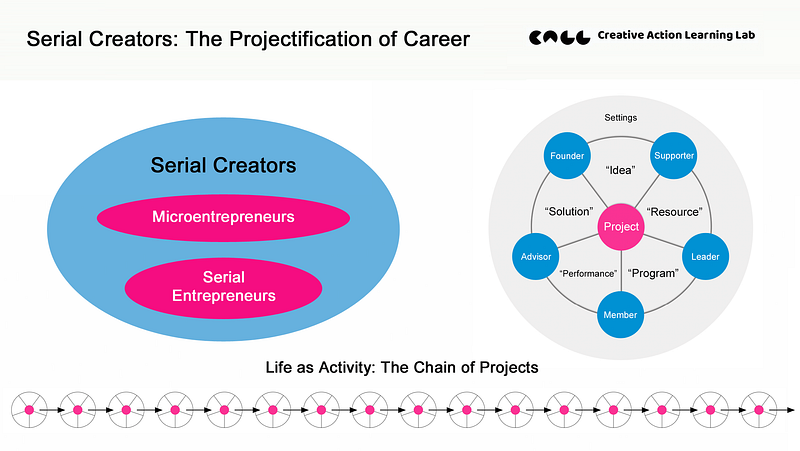
Blunden has pointed out the relation between Identity and Project. He says, “A person’s identity is that central, concrete project (or narrative) which is realized and concretized through a person’s life, subsuming the diversity of projects to which a person commits themselves over their lifetime…So a person’s identity is not just formed by collaborative projects, it is a collaborative project. Projects create themselves at the same time as they create social bonds.” (2014, p.16) This statement echoes the idea of “Life as Activity: The Chain of Projects”.
In addition, Blunden also describes the connection between personality and social position, “A central and defining aspect of the personality is the will. Growth from infancy to adult citizenship entails the development of self-mastery and a will moderated by consciousness of one’s social position. Exercise of the will is in principle possible only through collaborative projects — the person as a sovereign subject comes into being only thanks to communicative self-determination achieved in the realization of shared goals in collaboration with others. The study of projects insights into the formation of will. As human beings are formed as sovereign subjects, so also are the social bonds which will sustain them formed.” (2014, p.17)
Inspired by Blunden’s such arguments, I identify five “Positions of Project” which refers to social positions within a project:
- Founder
- Supporter
- Leader
- Member
- Advisor
A Serial Creator may take one position or several positions within one project or multiple projects. On the other side, one project may contain one serial creator or several serial creators. Multiple projects may share one serial creator. By identifying these five social positions, we can build a map of the project network through social bonds.
By tying the concept of “Themes of Practice” and “Positions of Project”, I find there are five essential “Themes of Practice” between “Positions of Project”:
- “Idea”
- “Resource”
- “Program”
- “Performance”
- “Solution”
“Themes of Practice” and “Positions of Project” describe the internal structure of a project. This concrete hypothesis is not part of Blunden’s original writings. I consider it as a heuristic tool for supporting the Life-as-Activity approach and the Platform-for-Development framework.
4.4 Idea, Initiator, and Initiatee
On July 8, I published an article titled The NICE Way and Creative Actions which proposes a new approach for studying Action-based Creative in the age of platform. After reviewing the historical development of creativity research, I argued that there are two critical theoretical issues of creativity research:
- First, we need a theoretical approach which puts action first and doesn’t consider actions as “creative process” of “creative product”. In other words, what I called Action-based Creativity can be seen as a “Process as Product” approach.
- Second, there is a need to develop a new framework which can help us connect individual daily experience of Action-based Creativity at the micro level with dynamic historical development of collective culture at the macro level.
My solutions are developing the 3I model at the micro level and the NICE way framework at the macro level. As the diagram below shows, the 3I model has three core entities which are idea, initiator and initiatee. It also considers two types of events: act by initiator and react by initiatee. Finally, the model considers platform as the context of entities and events.
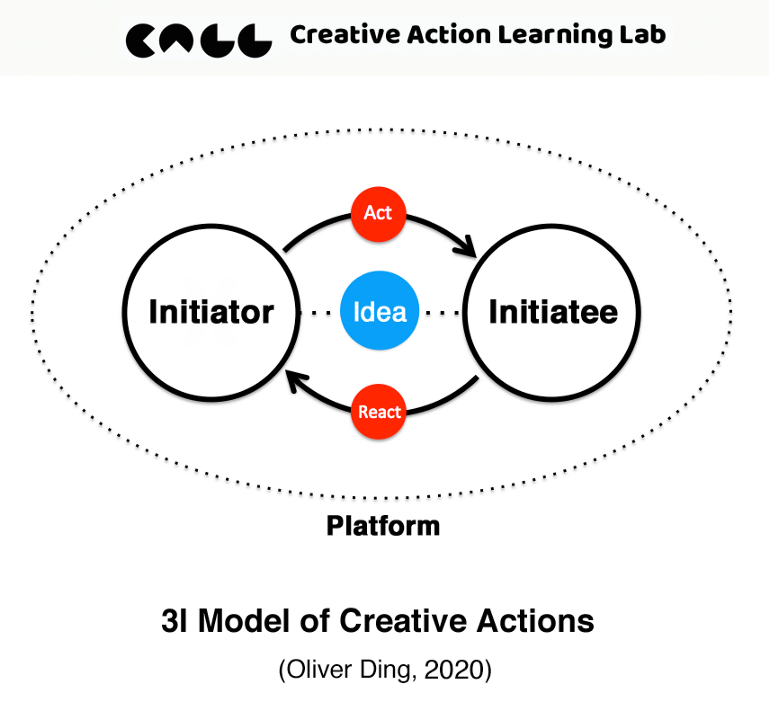
As the above discussion mentioned, acting refers to process and there is no product that remains after acting. In order to make the “Process as Product” approach possible, I use the term “Idea” to refer to the product aspect of creative actions and use the term “Act/React” to refer to the process aspect. This pair of concepts solve the problem of disappearing of immediate experience.
I further consider the “Idea” has three elements including name, form and content. For example, the name of BED Talks is “BED Talks”, its form is “recording a short talk in bed”, and each BED talk has its own unique content. The name part is very important for communication and distribution. A name can generate a hashtag for people to follow on social media platforms, a name can help people mention a creative action in words, a name can be a keyword for searching and finding. Most intended creation actions have a short name and hashtag, sometimes unintended creation actions don’t have a name.
The second pair of concepts are “Initiator” and “Initiatee”. Initiator refers to a person who initiates an act that makes “a grand opening” of a creative action. Initiatee refers to a person who responds to the initiator’s “call-to-action”. For most intended creation actions, it is easy to identify the Initiator and the Initiatee behind a creative action. However, it is not easy to do the same analysis on unintended cases. We leave this challenge for the next section.
The third pair of concepts are “Act” and “React”. It can apply to both Sawyer’s performance creativity and stay-at-home challenges. For performance, the “Act” is performing and the “React” is feedback from the audience. For stay-at-home challenges, the “Act” is the original action and the “React” is the following actions. For intended creation actions, the initiator might specify what initiatees should do while untended creation actions don’t have such strong intention.
The sociocultural approach to creativity research highlights the importance of context. Researchers have been studying various context of creativity such as classrooms, the local cultural traditions, the performance stages, etc. I suggest “platform” as a new type of context for studying creativity, especially creative actions.
To be honest, I read Andy Blunden’s books after July. Now, it is interesting to reflect on the 3i Model and the NICE way with the Project-oriented Activity Theory. I started from the study of creativity while Blunden started from the research of Activity Theory. Both of us want to find a way to connect individual actions and collective culture.
There is a wonderful similarity between these two approaches. While Blunden use “Concept” as a core to build his approach, I use “Idea” as a core for the 3i model. Both of us adopt the process view to develop our approaches. If you want to understand Blunden’s approach, you have to pay attention to “Formation of Concept”. Likewise, you can’t separate the “Idea” aspect from the “Act/React” aspect of Creative Actions. In other words, the “Creative Actions” is defined by three aspects: Idea, Act/React, and Initiator/Initiatee. Thus, the Idea can’t exist without Act/React by Initiator/Initiatee because the “Creative Action” is a whole or a gestalt. My definition of “Idea” includes three elements: name, form, and content. This is similar to traditional view of “Concept”. However, I don’t consider “Idea” independently. So, my consideration on “Idea” echoes Blunden’s innovative view of “Concept”.
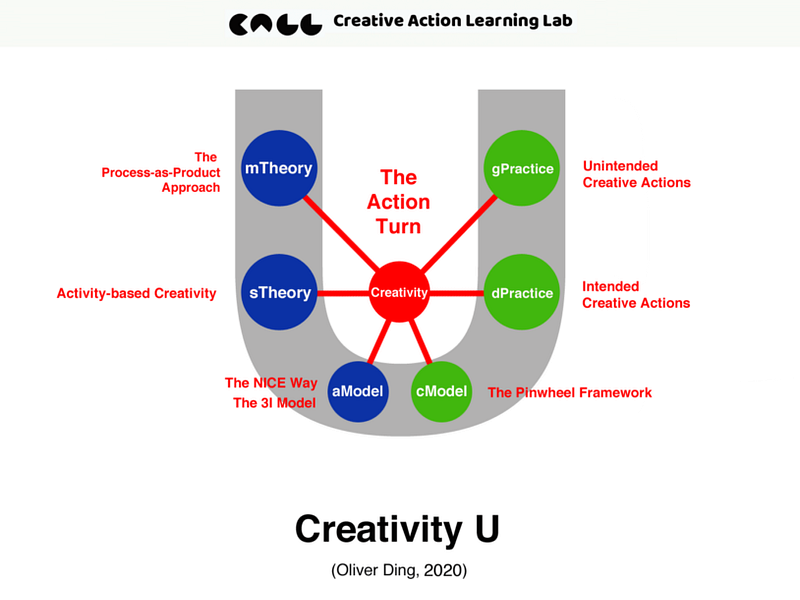
Moreover, Blunden’s approach is a meta-theory while the 3i model and the NICE way are practical models. Since both approaches shared same process view, it is possible to unite them together. However, there is a minor difference between two approaches. Blunden works on challenging the traditional approaches of Activity Theory while I work on challenging the traditional approaches of Creativity studies. My approach doesn’t consider “Activity” as a theoretical concept.
What an exciting serendipity in 2020!
CALL for Action
I have created a template of the Activity System model on Miro, you can access it at the following board:
https://miro.com/app/board/o9J_kmQJc7k=/Activity U
This board is part of the Activity U project, it will be a fun place for collective learning and creating. If you want to join the project, you can DM me on Twitter.
You are most welcome to connect via the following social platforms:
Twitter: https://twitter.com/oliverding Doowit: https://doowit.co/profile/gm0k2ax9 Linkedin: https://www.linkedin.com/in/oliverding
License
This work is licensed under the Creative Commons Attribution-NonCommercial-ShareAlike 4.0 International (CC BY-NC-SA 4.0) License. Please click on the link for details.
References
Andy Blunden (2010) An Interdisciplinary Theory of Activity. Brill.
Andy Blunden (2012) Concepts: A Critical Approach. Haymarket Books.
Andy Blunden (2014) Collaborative Project: An interdisciplinary study. Brill.
Andy Blunden (2017). The germ cell of Vygotsky’s science. In Silva, D.N.H. (Eds.) Vygotsky and Marx: Toward a Marxist Psychology. Taylor & Francis.
Clay Spinuzzi (2015) All Edge: Inside the new workplace networks. University of Chicago Press.
Derek Layder (1993) New Strategies in Social Research: An introduction and guide. Polity Press.
Derek Layder (1998) Sociological Practice: Linking theory and social research. SAGE Publications.
Engeström, Y. (1987) Learning by Expanding: An Activity-Theoretical Approach to Developmental Research. Helsinki: Orienta-Konsultit Oy.
Engeström, Y. & Glăveanu V. (2012) On Third Generation Activity Theory: Interview With Yrjö Engeström. Europe’s Journal of Psychology, 2012, Vol. 8(4), 515–518, doi:10.5964/ejop.v8i4.555
Gibson, J.J. (1979/2015). The ecological approach to visual perception: classic edition. New York: Psychology Press. (originally published in 1979).
Gladwin, T. (1947). Morris E. Opler’s Concept of “Themes”. American Anthropologist. N.S., 49, 1947.
Howard E. Gruber (1989) The Evolving Systems Approach to Creative Work. In Doris B. Wallace and Howard E. Gruber (Eds.) Creative People at Work: Twelve cognitive case studies. Oxford University Press.
Jeffrey B. Wagman & Julia J. C. Blau (Eds, 2019) Perception as Information Detection: Reflections on Gibson’s ecological approach to visual perception. New York: Routledge.


