
Life Discovery: Biography, Journey, Program (and a possible book, Part 1)
Three metaphors for the Life Discovery Project and a possible book

The Life-as-Project Approach is inspired by Project-oriented Activity Theory, Anticipatory Systems Theory, Curativity Theory, and other theoretical resources, it was developed with the following six basic principles:
- Being by Doing
- Engagement as Projection
- End as Means
- Discovery as Development
- Performance as Experiment
- Curativity as Creativity
In the past six months, I applied the Life-as-Project approach to Life Discovery Activity and developed a series of tools such as a toolkit, a canvas, and several models and frameworks.
I also joined the following three Life Discovery Projects:
- Shaper & Supporter Lab: I am a researcher.
- The AAS Board: I am a coach and a service designer.
- The Slow Cognition Project (Phase I): I am a creator.
This journey is documented in many articles I wrote in this publication. Today I will reflect on the journey and outline a TOC for editing a possible book.
Part 2 uses three metaphors to organize a possible book about the Life-as-Project approach.
Part 3 collects articles and links as references.
Contents
1. A Six-month Journey
1.1 Life as Sailing (Jan 4, 2022) 1.2 A Toolkit (Feb 7, 2022) 1.3 A Canvas (Feb 27, 2022) 1.4 A Program (March 22, 2022) 1.5 Significant Insights (April 25, 2022) 1.6 Hiddenness (May 5, 2022) 1.7 Project Network (June 7, 2022)
2. Three Life Discovery Projects
2.1 The Shaper & Supporter Lab (SSL) Program 2.2 The AAS Board Program 2.3 The Slow Cognition Project (Phase I)
3. Three Metaphors about “Life Discovery”
3.1 Biography 3.2 Journey 3.3 Program
4. A Possible Book
1. A Six-month Journey
In the past six months, I have written many articles about the Life Discovery Project. It’s time to edit a “live” book for the project. On June 26, 2022, I started reflecting on the journey of the project.
There are several significant moments in the journey.
1.1 Life as Sailing (Jan 4, 2022)
On Jan 4, 2022, I had a diagram called Sailor’s Mandala for modeling a discussion about an online adult development program. In June 2021, one friend of mine started an online adult development program. The program was designed with three components: 1) Life Purpose Awareness, 2) Personal OKR Practice, 3) Peer Review and Feedback. The major part of the program is a monthly peer-support group on several social media platforms. The name of the diagram refers to a metaphor: Life as Sailing.

1.2 A Toolkit (Feb 7, 2022)
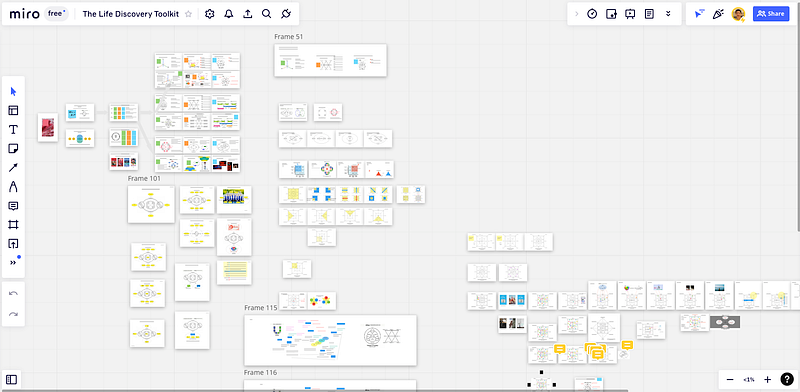
On Feb 7, 2022, I published the Life Discovery Toolkit (v1) with nine questions and nine modules. I also made a board on Miro for sharing the toolkit. Later, I used the board for making some ideas for the Life Discovery Project. See the screenshot below.
1.3 A Canvas (Feb 27, 2022)
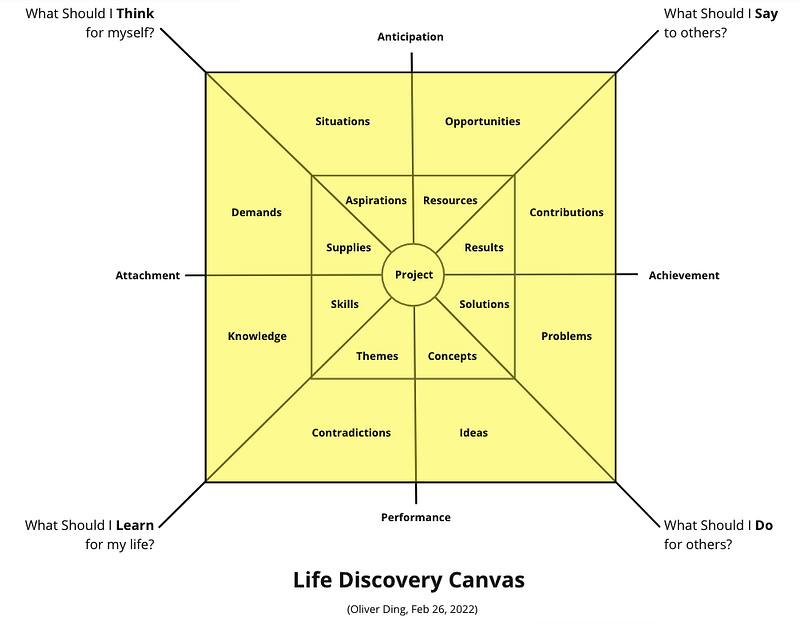
On Feb 27, 2022, I developed the Life Discovery Canvas (v1.0) with six basic principles of the Project-centered approach.
1.4 A Program (March 22, 2022)
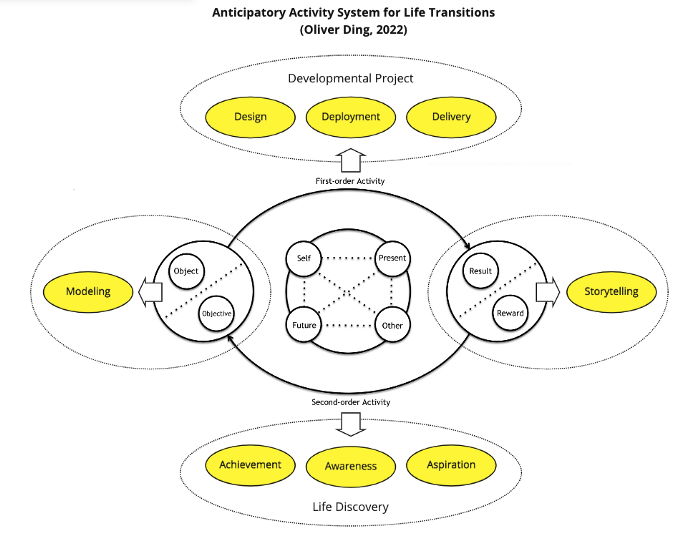
On March 22, 2022, I applied the Anticipatory Activity System framework to Life Transitions. The #AAS4LT program was born.
1.5 Significant Insights (April 25, 2022)
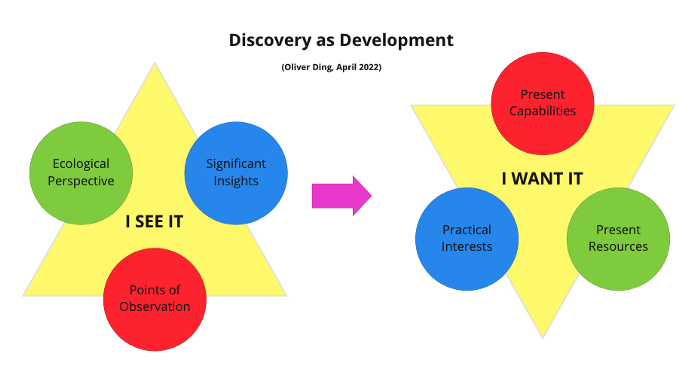
On April 25, 2022, I shared 12 significant insights I captured from January 2022 to April 2022. It led to the following diagram and the Significant Insights Analysis project.
1.6 Hiddenness (May 5, 2022)
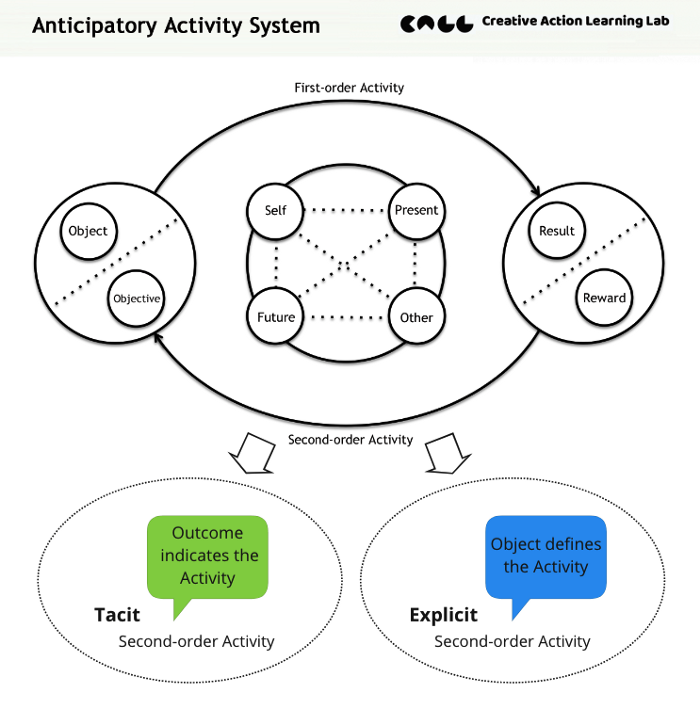
On May 5, 2022, I developed the notion of the Hiddenness of Second-order Activity and defined two types of Second-order Activity: Tacit and Explicit. Life Discovery Activity is a special type of Second-order Activity.
1.7 Project Network (June 7, 2022)
On June 7, 2022, I used the model of “Project Network” to discuss the notion of “Knowledge Centers”. It’s a multiple-level network, not a one-level network. Each level refers to one type of Project. The “Themes” level refers to “Concept as Project”. The “Knowledge Centers” level refers to “Center as Project”. The “People” level refers to “Engagement as Project”.
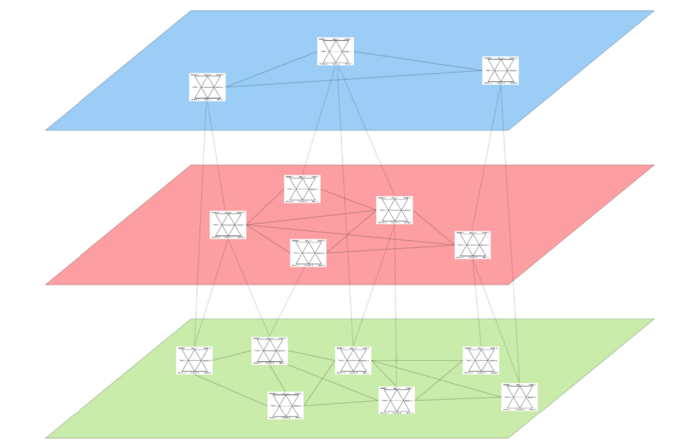
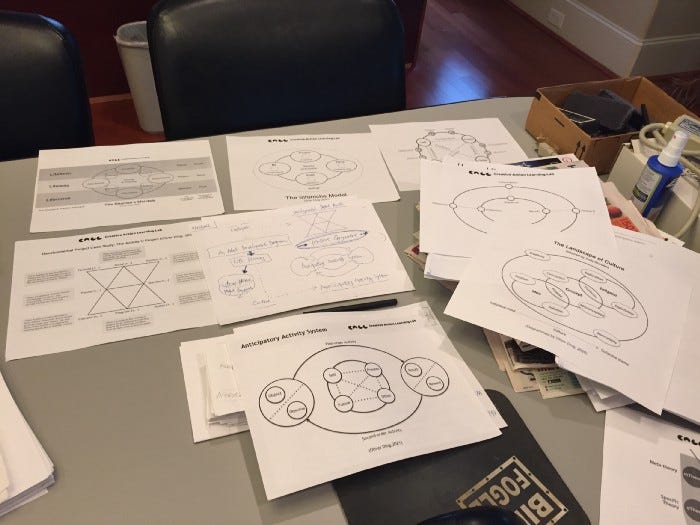
In the past six months, I worked on both the Life Discovery Project and the Anticipatory Activity System framework. On Feb 23, 2022, I shared the complexity of this project network and my challenges. See the picture below.
Life Discovery is not only for Life Transitions. Life Discovery is for both settled life stages and unsettled life stages.
The Life Discovery Activity focuses on 1) Detecting Potential Contradictions, 2) Exploring Potential Themes, and 3) Exploring Potential Opportunities in order to enhance a person’s life development.
This is a wonderful journey for my own life development and the development of a knowledge enterprise.
2. Three Life Discovery Projects
I use the term “Life Discovery Activity” as a general description and the term “Life Discovery Project” for describing particular projects.
I realized that I joined three Life Discovery Projects in the past six months.
- Shaper & Supporter Lab: I am a researcher.
- The AAS Board: I am a coach and a service designer.
- The Slow Cognition Project (Phase I): I am a creator.
Both Shaper & Supporter Lab and the AAS Board are platform-based service programs. Shaper & Supporter Lab is based on Lark while the AAS Board is based on Milanote. We can use the SET framework to understand them.
The SET Framework was originally named the Ecological—Activity Hybrid Approach. It was developed from 2017 to 2020 when I worked on several projects which refer to a new type of social action platform. For example, I worked on a one-to-one video talk product from 2017 to 2018. Later, I worked on other projects which adopt Structured Engagement as a design pattern. These projects share the following aspects:
- Host: a special type of actor who hosts the whole activity.
- Structured Engagement: the activity is human-to-human interactions with a special structured process.
- Environment: the environment is also part of the design of the activity.
For the Shaper & Supporter Lab program, a friend of mine is the host. For the AAS Board program, I am the host. For others, these two programs are Structured Environments outside of their normal daily life.
However, the Slow Cognition Project (phase II) is not a Structured Environment for me. It is inside of my normal daily life. In other words, it is a “Tacit” Life Discovery Project while Shaper & Supporter Lab and the AAS Board are two “Explicit” Life Discovery Projects.
2.1 The Shaper & Supporter Lab (SSL) Program
Shaper & Supporter Lab (SSL) was founded by a friend of mine in April 2021. The program was designed with three components: 1) Life Purpose Awareness, 2) Personal OKR Practice, 3) Peer Review and Feedback. I joined the SSL program as an advisor and a researcher.
I use the Project Engagement approach to guide my research about the program. The approach uses a method called “Multiple-level Project Engagement”. I reflect on the following levels:
- The “My friend — Members” Engagement
- The “Member — Member” Engagement
- The “I — My friend” Engagement
The SSL program is a Life Discovery Project because it guides members to discover their life purposes, make life plans, and take real actions.
2.2 The AAS Board Program
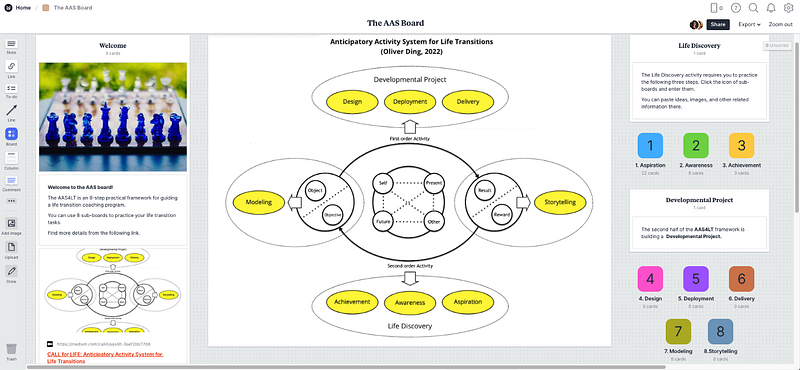
The above screenshot is the home page of the AAS Board program which is a real 1:1 life coaching program. I started hosting an AAS board on Milanote for a life transition coach program on March 26, 2022.
The program is based on the following knowledge models:
- The AAS4LT framework
- The Life-as-Project approach
- The Life Discovery Toolkit (v1.0)
- The Life Discovery Canvas (v1.0)
I invited a friend of mine to join the program in order to test it. For her, this is a Life Discovery Project. I am a life coach and a service designer for her Life Discovery Project.
2.3 The Slow Cognition Project (Phase I)
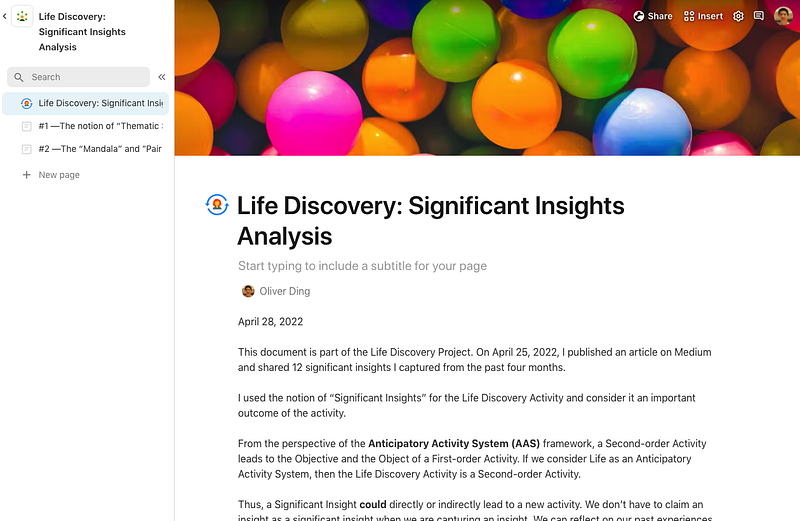
The above screenshot is the homepage of the Significant Insights Analysis project which is part of the Slow Cognition Project (phase I).
I used the notion of “Significant Insights” for the Life Discovery Activity and consider it an important outcome of the activity.
From the perspective of the Anticipatory Activity System (AAS) framework, a Second-order Activity leads to the Objective and the Object of a First-order Activity. If we consider Life as an Anticipatory Activity System, then the Life Discovery Activity is a Second-order Activity.
Thus, a Significant Insight could directly or indirectly lead to a new activity. We don’t have to claim an insight as a significant insight when we are capturing an insight. We can reflect on our past experiences and identify significant insights if they lead to activities that change our life.
From January 2022 to April 2022, I captured many Significant Insights. In order to conduct a mini-research for the Slow Cognition project, I selected the following 12 significant insights as samples.
3. Three Metaphors about “Life Discovery”
The above three Life Discovery Projects inspired me to ask myself a question:
What’s Life Discovery?
To be honest, I didn’t give a definition to the term “Life Discovery” in the beginning. I just used it as a name for a toolkit, a canvas, a concept for a framework, and a program.
From the perspective of the “Themes of Practice” framework, the term “Life Discovery” is a significant theme of my 2022 in the past six months. It refers to a series of related and connected practices such as making a toolkit, designing a canvas, developing a framework, and hosting a life coaching program.
From the perspective of the “Knowledge Curation” approach, what I am doing is curating these various experiences into a knowledge framework for understanding Life Discovery Activity. In this way, we need a definition for the concept of “Life Discovery” and the concept of “Life Discovery Activity”.
From the perspective of the “Slow Cognition” method, my journey over the past six months is a real Life Discovery Project. It’s also a unique Developmental Project because it aims to develop the concept of “Life Discovery”.
What should I do with a possible book titled Life Discovery?
It seems that I don’t want to edit a book to introduce a framework for a coaching program. I think it’s not ready to do it now.
What I want to edit is a book that could represent my real experience around the theme of “Life Discovery” in the past six months. I want to use my experience to unfold the complexity of the Life Discovery Activity.
The insight of “Unfold the complexity of Life Discovery Activity” led me to search and find the following three metaphors:
Biography, Journey, and Program
3.1 Biography
I am recently reading a book titled The Scientific Project of Sociology (Ping-keung Lui, 2010) which is the second series of lectures on sociology-philosophy, taught in a course for MA(Part-time) students at the Department of Philosophy, The Chinese University of Hong Kong, Fall 2010. Its original title was “The Philosophers, the Sociologists, and the Scientific Project of Sociology”.
One of the ideas I learned from the book is the “Text — Life” mapping (the author doesn't use these terms). We can consider social life (life) as a book (text), then we can use Hermeneutics to understand social life. I realized that there are two “Text—Life” mappings for my journey of Life Discovery over the past six months.
I found I often use my own stories as examples for some modules the Life Discovery Toolkit and the AAS Board. The first “Text — Life” mapping refers to my “Biography” as “Text” and my real life as “Life”.
I also used several models and frameworks to research the Shaper & Supporter Lab (SSL) program and design the AAS Board program. Here we see the second “Text — Life” mapping, we can consider my models and frameworks as “Text” and consider two programs as “Life”.
Moreover, one of the goals of Life Discovery Activity is to discover potential Life Themes for further development. I used the Thematic Analysis method for the AAS Board program. This method is related to biographical research, narrative psychology, and Hermeneutics.
3.2 Journey
I also found that I often used the word “Journey” for my articles over the six months.
Life is a meaningful journey.
In fact, this is a metaphor. Moreover, there is a deep idea behind the metaphor: Life is about Spatial Difference.
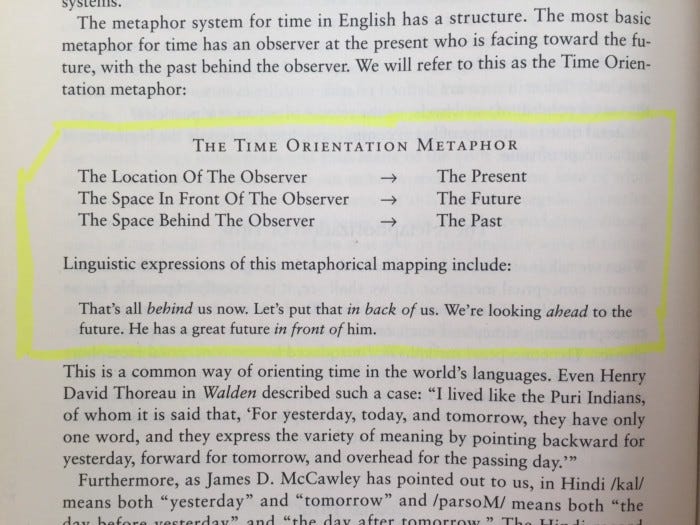
This view is inspired by George Lakoff and Mark Johnson’s ideas on the Cognitive Science of the Embodied Mind in their 1999 book Philosophy in The Flesh and other books. According to Lakoff and Johnson, “Very little of our understanding of time is purely temporal. Most of our understanding of time is a metaphorical version of our understanding of motion in space.” They introduce a metaphor system of time in the book, see the note below:
In the 2000 book Where Mathematics Comes From, George Lakoff and Rafael E. Nunez use the Source-Path-Goal schema as an example of the cognitive science of the embodied mind. See the picture below:
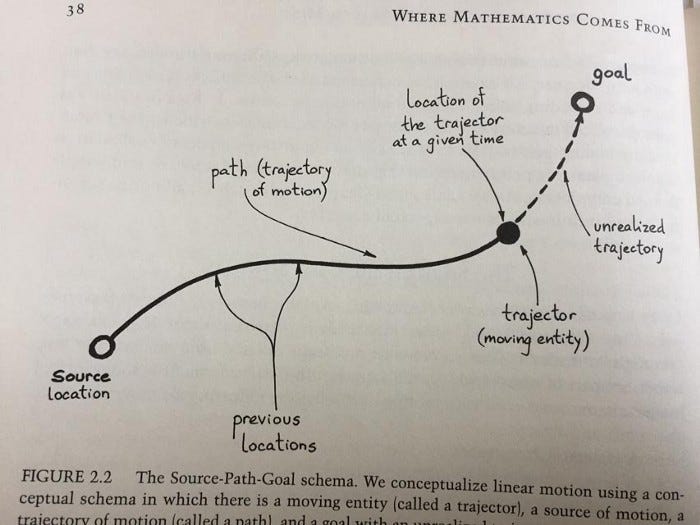
The Source-Path-Goal schema points out that there is an unrealized trajectory between the location of the trajector at a given time (present) and the goal (future). The diagram clearly shows the Temporal Difference between Present and Future is the Spatial Difference between the present location and future goal.
I also use the “Life as Sailing” metaphor for the Life Discovery Project and Life Development in general.

- Life: it is a journey such as sailing at sea.
- Boat: social container such as family, team, group, project, company, community, etc.
- Sea: social context and social environment.
This metaphor refers to everyday life situational challenges, complexities, and opportunities.
For my journey over the six months, the “Journey” metaphor refers to the Theory — Practice connection:
On the THEORY side, most of the ideas about Life Discovery Project are adopted from the Anticipatory Activity System (AAS) framework, the Project-centered Approach, and other theoretical resources. I use these frameworks to reflect on the complexity of Life Discovery Activity and Life Development in general.
On the PRACTICE side, I conducted an empirical research project about a person’s one-year life transitions. Then, I designed and tested the AAS4LT 1:1 life coaching program.
While I used the AAS framework and the Project-centered approach to guide these activities, I also tested these frameworks with these activities.
3.3 Program
As mentioned above, I joined the Shaper & Supporter Lab program as a researcher. I also designed and hosted the AAS Board program (the AAS4LT 1:1 life coaching program).
As a researcher and a designer, I used several models to reflect on these programs as practice.
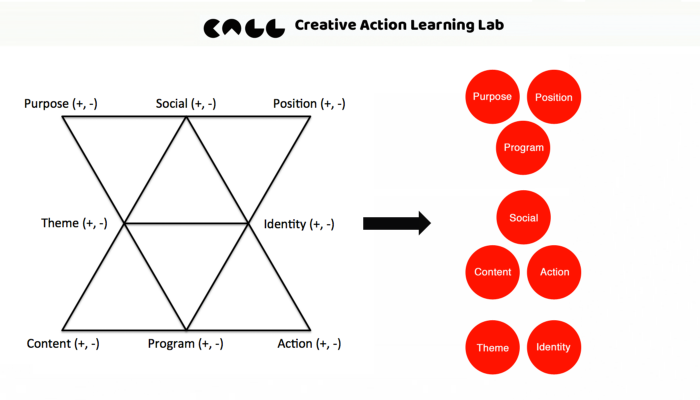
The above diagram is the Developmental Project Model which considers “Program” as an element of a Developmental Project. I consider these two programs as two Developmental Projects. In this way, I can use them to reflect on the Developmental Project Model.
The Shaper & Supporter Lab program is hosted on Lark while the AAS Board program is hosted on Milanote. Both two programs are platform-based services. Lark is a document-centered collaborative digital platform while Milanote is a digital whiteboard for organizing ideas and projects in visual style. Since these two digital platforms offer different Digital Space Affordances, I can compare the difference between these two programs from the perspective of the SET framework.
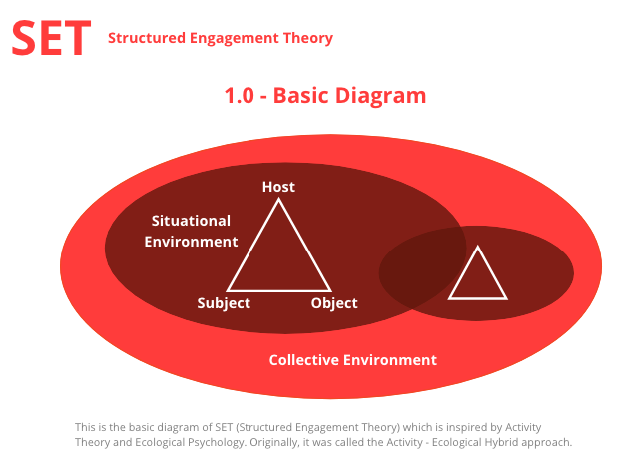
As mentioned above, the SET Framework was originally named the Ecological—Activity Hybrid Approach. It highlights the following ideas:
- Host: a special type of actor who hosts the whole activity.
- Structured Engagement: the activity is human-to-human interactions with a special structured process.
- Environment: the environment is also part of the design of the activity.
For the Shaper & Supporter Lab program, a friend of mine is the host. For the AAS Board program, I am the host. For others, these two programs are Structured Environments outside of their normal daily life.
On Feb 9, 2022, I used “Natural Space” and “Artificial Space” to refer to two types of environments for developing tacit knowledge. While Natural Space refers to non-designed environments, Artificial Space refers to designed environments. Structured Environments are part of Artificial Spaces.
In my 2019 book Curativity, I developed a concept called Curatorial Crafting for discussing the competence of Curation. There are various cognitive skills of curatorial actions such as perceiving, selecting, reflecting, connecting, organizing, presenting, etc. Though I emphasize the principle of “Everyone A Curator”, I highlight different types of situations for curating: First-order Curating, Second-order Curating, and Third-order Curating.
We can use three types of curating to reflect on my activities from making the Life Discovery Toolkit to hosting the AAS Board program.
- First-order Curating: Life Curation. A friend of mine who joined the AAS Board program turned her pieces of life experiences into a new meaningful whole for designing a new developmental project.
- Second-order Curating: Program Curation. As the host and designer of the program, I have to curate the boards, service the guest, maintain the task flow, etc.
- Third-order Curation: Toolkit Curation. As the creator of the Life-as-Project approach, I have to design, test, and modify the toolkit for hosting different programs.
The “Program” metaphor refers to the Approach — Application Knowledge Curation. This type of knowledge curation is about turning personal tacit knowledge into real-life work. The resource of the process is the Life-as-Project approach while the outcome is the AAS board program.
4. A Possible Book
Now we can outline a plan for editing a new possible book.
The name of the new possible book is Life Discovery: The Life-as-Project Approach for Creative Life and Personal Innovation. This name is a concept curation of four concepts. Each concept refers to a special meaning.
- Life Discovery: It refers to Life Discovery Activity in general and my journey around the theme of “Life Discovery”. In fact, I consider “Life Discovery Activity” as a special type of “Knowledge Discovery Activity”.I made a distinction between Knowledge Discovery and Knowledge Production. While the outcome of Knowledge Discovery is Significant Insight, the outcome of Knowledge Production is Knowledge Products. Moreover, Significant Insight will lead to Knowledge Production. We can apply the same logic to Life Discovery and Life Production. From the perspective of the Anticipatory Activity System framework, Life Discovery is a Second-order Activity while Life Production is a First-order Activity.
- The Life-as-Project Approach: It is a new approach to life development. It is an application of the Project-centered approach.
- Creative Life: It means the potential readers are creative knowledge workers who are my primary target audiences.
- Personal Innovation: It means that Life Discovery Activity is not only for Life Transitions. Life Discovery is for both settled life stages and unsettled life stages.
The primary focus of the book is the Life Discovery Activity and my journey of developing the Life-as-Project approach, making the Life Discovery Toolkit, hosting the AAS Board program, etc. I also consider the journey as a case for the Slow Cognition project.
Inspired by the above metaphors, the new book is designed with the following five parts and some keywords.
Part 1: Life as Project
- Creative Life
- Life as Activity
- Activity as Project Engagement
- The Life-as-Project approach
Part 2: Life Discovery
- What’s Life Discovery?
- Biography
- Journey
- Program
Part 3: The Biography
- The Read/Write Life
- Aspiration — Future
- Awareness — Present
- Achievement — Past
Part 4: The Journey
- “Now” as a project network
- Situation — Network
- Challenges — Hierarchy
- Opportunities — Perspective
Part 5: The Program
- “Next” as A Developmental Project
- The Life Discovery Canvas
- Significant Insights
- Discovery as Development
5. The Life Discovery Board (Public, v2)
I also made a public board on Milanote for the Life Discovery Project.
It has a board for the homepage of the project and six sub-boards for tasks. It can be considered an 8-step program.
This is inspired by the #AAS4LT program which was designed with Life Discovery Activity and Developmental Project. In the past two months, I tested the #AAS4LT program with a friend of mine, we closed the part of Life Discovery Activity. After reflecting on the process, I decided to make an independent program for the Life Discovery project.
The Life Discovery Board (v2) is a self-help instrument for you. It’s also a demo of the Life Discovery Program. It has 8 steps which are organized into three groups.
You can find a short introduction in Life Discovery: The Life Discovery Board (public, v2).
Related articles
- Life Discovery: The AAS Framework
- CALL for LIFE: Anticipatory Activity System for Life Transitions
- CALL for LIFE: Modeling A Developmental Project
- The Project Engagement Toolkit (2022)
- Life Discovery: The Life-as-Project Approach
- The Life Discovery Toolkit (v1)
- The Life Discovery Canvas (v1.0) — Part 1: Theoretical Background
- The Life Discovery Canvas (v1.0) — Part 2: Spatial Structure
- The Life Discovery Canvas (v1.0) — Part 3A: Concepts (THINK and LEARN)
- The Life Discovery Canvas (v1.0) — Part 3B: Concepts (SAY and DO)
- The Life Discovery Canvas (v1.0) — Part 4: Inspirations
- Life Discovery: The “Being by Doing” Principle
- Life Discovery: The “Performance as Experiment” Principle
- Life Discovery: The “Engagement as Projection” Principle
- Life Discovery: The “Discovery as Development” Principle
- CALL for LIFE: Oliver Ding @ 2021 and Second-order Activity
- Life Discovery: Twelve Significant Insights from Four Months
- Life Discovery: “Points of Observation” and “Significant Insights”
- Life Discovery: Significant Insights Analysis
- Life Discovery: The “Tacit” Type of Second-order Activity
- Life Discovery: The Unfoldness of Activity
- Life Discovery: Running A Developmental Project
I am also working on building a new website for the Platform Ecology project. You can save the following links:
- PlatformEcology.org
- Twitter: @PlatformEcology
- Linkedin: @PlatformEcology
You are most welcome to connect via the following social platforms:
Linkedin: https://www.linkedin.com/in/oliverding Twitter: https://twitter.com/oliverding Polywork: https://www.polywork.com/oliverding Boardle: https://www.boardle.io/users/oliver-ding


