
Life Discovery: The “Tacit” Type of Second-order Activity
The Hiddenness of Second-order Activity
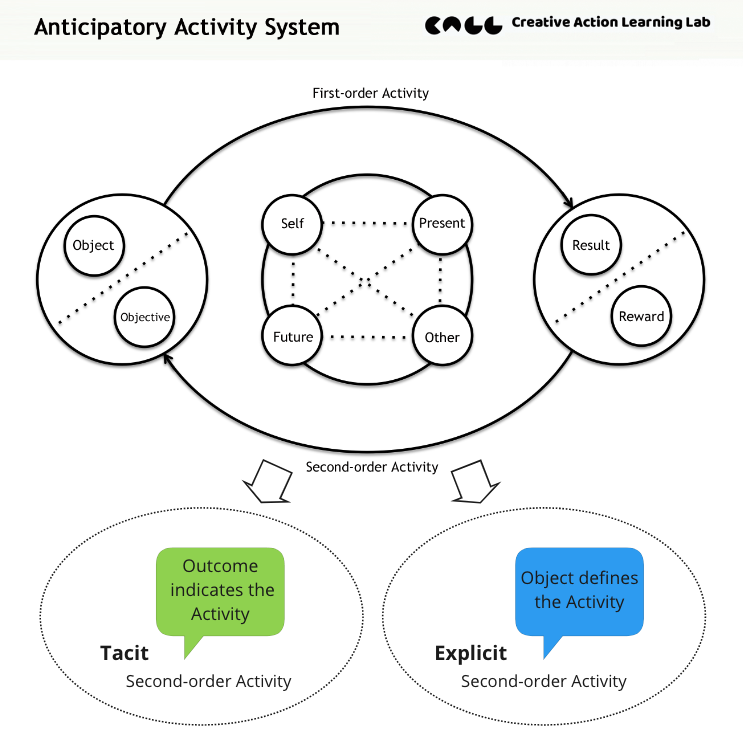
The above diagram shows a typology of Second-order Activity. One is “Tacit” and the other one is “Explicit”. The Explicit Second-order Activity is defined by the Object while the Tacit Second-order Activity can be indicated by the Outcome.
This insight is a mini-milestone of the “Anticipatory Activity System” project.
This morning I sent several messages about the insight to a friend of mine. Then, I moved to Linkedin and wrote a short post on Linkedin. This article aims to expand the original post.
The “Anticipatory Activity System” Project
The Anticipatory Activity System framework is a hybrid theoretical framework that curates the following two theories together:
- Activity Theory
- Anticipatory System Theory
This hybrid approach is inspired by Clay Spinuzzi’s book Network: Theorizing Knowledge Work in Telecommunications. To understand a telecommunications company’s knowledge work, Clay Spinuzzi focuses on the concept of “Network”, and adopts the following two theories to build an abstract framework for theorizing “Network” of knowledge work:
- Activity Theory
- Actor-network theory (ANT)
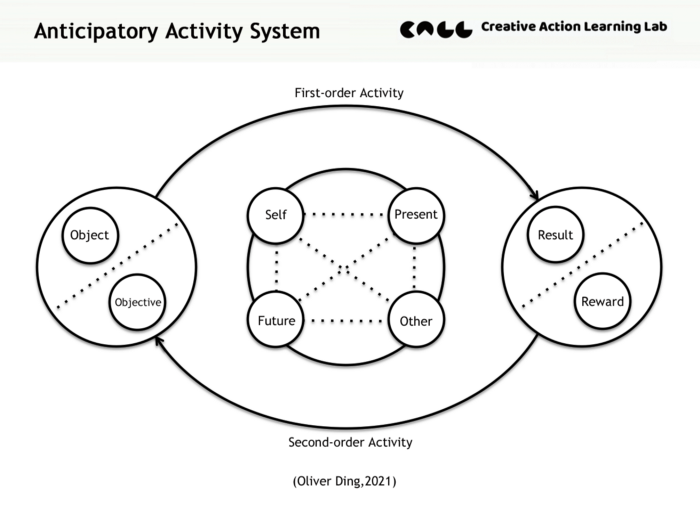
The above diagram is the standard model of the Anticipatory Activity System framework. It was formed by the following pairs of concepts:
- Present — Future
- Self — Other
- Object — Objective
- Result — Reward
- First-order Activity — Second-order Activity
You can find more details from D as Diagramming: Strategy as Anticipatory Activity System.
Object and Outcome
The pair of concepts of “Object — Outcome” was adopted from Yrjö Engeström’s Activity System model which is an established branch of Activity Theory.
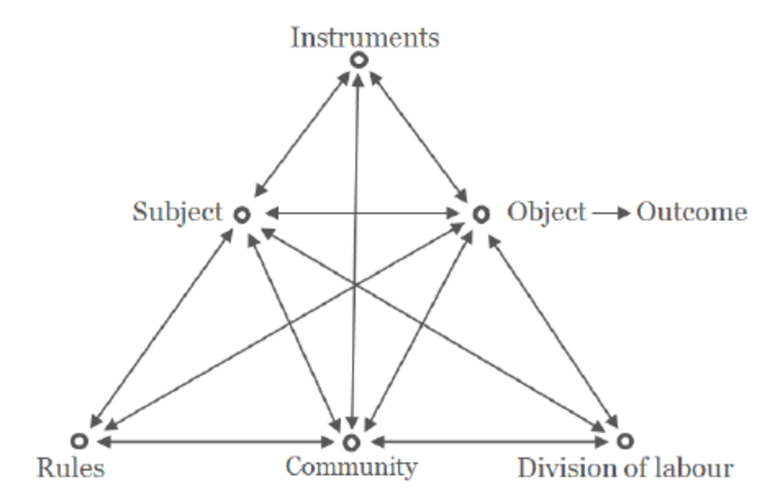
The above Engeström’s triangle — its official name is the Activity System model — is based on the cultural-historical psychologists’ notions of mediation as individual action (subject — instruments — object) at the top of the diagram. Engeström (1987) considered “a human activity system always contains the subsystems of production, distribution, exchange, and consumption.”(p.67), thus, he added the bottom of the triangle to the original individual triangle in order to include other people (community), social rules (rules), and the division of labor between the subject and others.
Researchers have been adopting Activity Theory as a descriptional and orientational framework for analysis and evaluation in a variety of empirical studies. Some researchers also developed practical tools for connecting Activity Theory and empirical studies, for example, the Activity Checklist (Kaptelinin, Nardi, and Macaulay 1999).
According to Kaptelinin and Nardi (2006), there are five basic principles of Activity Theory:
- Object-orientedness
- Tool mediation
- Internalization — externalization
- The hierarchical structure of activity, and
- Development
The Activity System model follows the Object-orientedness principle which is defined by A.N. Leontiev who is the founder of Activity Theory. According to Leontiev, “Separate concrete types of activity may differ among themselves according to various characteristics: according to their form, according to the methods of carrying them out, according to their emotional intensity, according to their time and space requirements, according to their physiological mechanisms, etc. The main thing that distinguishes one activity from another, however, is the difference of their objects. It is exactly the object of an activity that gives it a determined direction.” (1978, p.98)
So, what’s the object of an activity?
The answer from Leontiev is the motive of activity. Leontiev claimed, “According to the terminology I have proposed, the object of an activity is its true motive. It is understood that the motive may be either material or ideal, either present in perception or exclusively in the imagination or in thought. The main thing is that behind activity there should always be a need, that it should always answer one need or another.” He also added a note about the term motive, “Such restricted understanding of motive as that object (material or ideal) that evokes and directs activity toward itself differs from the generally accepted understanding”.(1978, p.98)
According to Kaptelinin and Nardi (2012), “In Russian there are two words with similar but distinct meanings: objekt and predmet. Both refer to objectively existing entities, but the notion of predmet typically also implies a relevance of the entity in question to certain human purposes or interests…Leontiev deliberately referred to the object of activity as predmet rather than object. However, this distinction is usually lost in English translation since both words are translated as ‘object.’ ” (p.29)
However, the concept of Object has a different meaning in the Activity System Model which was developed by Yrjö Engeström with the above triangle diagram. According to Kaptelinin and Nardi (2006), “For Leontiev, the object (predmet) of activity is an object of activities carried out by individuals, either collectively or individually, and is related to motivation. For Engeström, the object, introduced through the ‘subject — object’ distinction — that is, as objekt — is the object of collective activities. The object is defined as ‘the raw material’ or ‘problem space’ at which the activity is directed and which is molded and transformed into outcome…’ ” (2006, p.142–143)
The Anticipatory Activity System framework started from the following model. It adopts the Object-orientedness principle to define the First-order Activity.
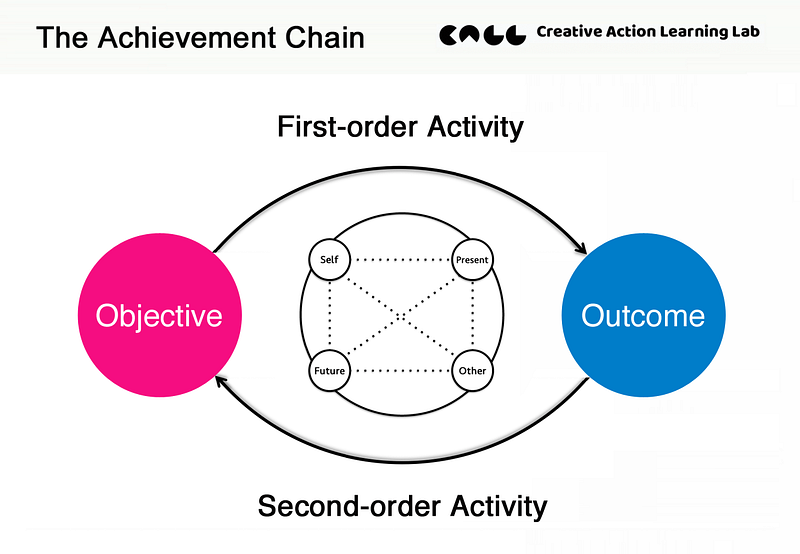
However, the Second-order Activity is quite unique because its outcome defines the object of the First-order Activity.
Second-order Activity
The Second-order Activity is a specific type of activity in which subjects aim to define objectives and goals for their further activities. For example, the Life Discovery Activity and the Knowledge Discovery Activity are two typical Second-order Activities.
In March 2022, I developed an eight-step practical framework for dealing with a difficult challenge: Life Transitions.
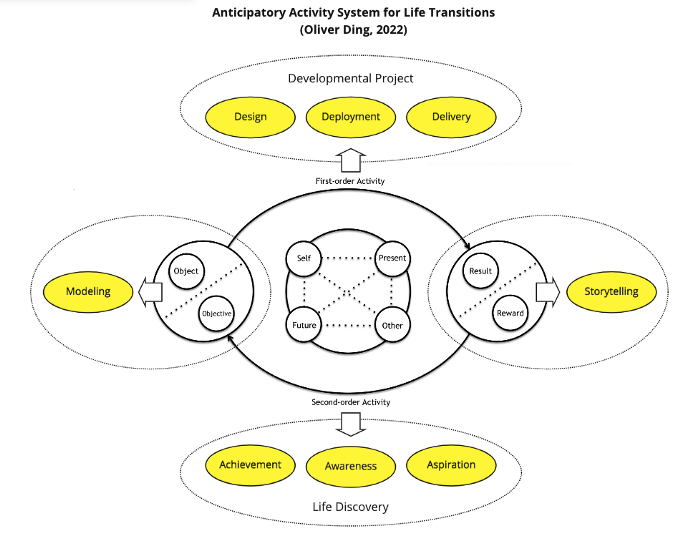
The above diagram is a practical framework for applying the Anticipatory Activity System framework to Life Transitions. It’s called the AAS4LT framework.
The AAS4LT is inspired by the following knowledge resources:
- Anticipatory Activity System: The center of the above diagram.
- Life Discovery Activity: It is a Second-order Activity.
- Developmental Project: It is a First-order Activity.
The Anticipatory Activity System framework (AAS) is an abstract model which aims to understand a special type of human activity that highlights “Self, Other, Present, Future”.
As an application of AAS, the AAS4LT was developed with eight steps for guiding a life transition coaching program.
The AAS4LT framework is born from curating insights from both theoretical development and empirical research.
Though most of the ideas are adopted from the Anticipatory Activity System framework and other knowledge frameworks, the whole structure is inspired by an empirical research project about a person’s one-year life transitions.
In March 2022, I started testing the AAS4LT framework by hosting a 1:1 life coaching program on Milanote.
In April 2022, I reflected on my Knowledge Discovery Activities from the perspective of the AAS framework.
The Hiddenness of Second-order Activity
On April 11, 2022, I published an article titled CALL for LIFE: Oliver Ding @ 2021 and Second-order Activity.
In the article, I used the term “Hiddenness” to describe Second-order Activity.
If a Life Discovery Action is not part of a Life Discovery Activity, it’s hard to find it because it should be part of some First-order Activities.
If several Life Discovery Actions distribute over a long duration or embed in several First-order Activities, can we consider these Life Discovery Actions as one Life Discovery Activity?
This issue leads to the Hiddenness of Second-order Activity. Some Second-order Activities are easy to perceive. For example, a person visits a career coach and discusses the future of career development, a strategic discussion meeting, etc. However, some actions of Second-order Activity are not obviously perceived.
Now we can use a typology to expand this notion. There are two types of Second-order Activities. One is “Tacit” and the other one is “Explicit”.
The Explicit Second-order Activity still follows the Object-orientedness principle. However, the Tacit Second-order Activity is hard to find.
Since the Second-order Activity generates significant insights which lead to the first-order Activity, we can use the Outcome to indicate the Second-order Activity.
Significant Insights as Sense-maker
The typology of Second-order Activity aims to develop a method to study the Hiddenness of Second-order Activity.
Activity Theorists tend to consider the Object as a sense-maker of Activity. Now we can claim that Outcomes such as Significant Insights can be a sense-maker of the Tacit Second-order Activity.
It means we can use the following steps to conduct related research:
- 1) Reflection: Detecting Significant Insights.
- 2) Curation: Gathering related data from historical records and curating a landscape of an activity that produces a Significant Insight.
- 3) Analysis: Discovering Significant Triggers or other issues.
For example, I used the following diagram to analyze my life discovery activity in 2021.
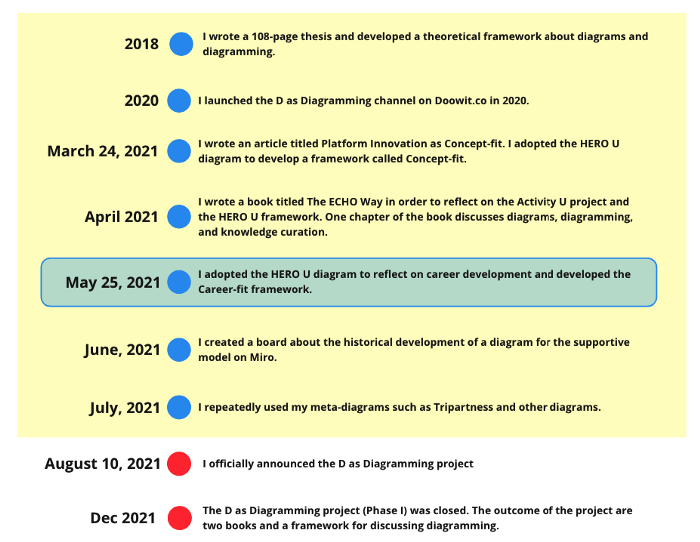
I found the following two types of activities in my life activities in May 2021:
- First-order Activity: Developing the Career-fit framework
- Second-order Activity: Self-reflecting with the Career-fit framework
I consider “Self-reflecting with the Career-fit framework” as a Life Discovery Action. In general, an activity is an aggregation of a set of actions. From the perspective of Activity Theory, an activity is a goal-oriented human activity. I didn’t intend to do a Life Discovery Activity when I was writing the article on May 25, 2021.
The Life Discovery Action of “Self-reflecting with the Career-fit framework” didn’t directly lead to a decision of working on the D as Diagramming project. I didn’t officially announce the D as Diagramming project in May or June.
If we review the related actions in my life, we can find the root of the D as Diagramming project is the thesis I wrote in 2018.
Why did not I work on the D as Diagramming project from 2018 to 2021? Because I was busy developing the Ecological Practice approach. As mentioned above, the approach — at least its phase I — was closed on April 2021.
Thus, we should consider all blue dots and the whole yellow area in the above diagram as a Life Discovery Activity that leads to the D as Diagramming Project. In this way, we can understand a person’s transformation of life theme and identity in a broad context.
On April 25, 2022, I shared 12 significant insights I captured in the past four months. On April 29, 2022, I started the Significant Insights Analysis project.

You can find more details here.
Though this idea was born from the Life Discovery Activity, it can be applied to the Tacit Second-order Activity.
I am also working on building a new website for the Platform Ecology project. You can save the following links:
- PlatformEcology.org
- Twitter: @PlatformEcology
- Linkedin: @PlatformEcology
You are most welcome to connect via the following social platforms:
Linkedin: https://www.linkedin.com/in/oliverding Twitter: https://twitter.com/oliverding Polywork: https://www.polywork.com/oliverding Boardle: https://www.boardle.io/users/oliver-ding


