avatarOliver Ding

Free AI web copilot to create summaries, insights and extended knowledge, download it at here

2508

Abstract

a design philosophy and methodology to create culturally sensitive design for local users. According to Sun,</p><blockquote id="be50"><p>This framework places concrete use activities on center stage, a component that is often missing in current cross-cultural design literature and practice.</p></blockquote><p id="9095">In Sun’s approach, there are two views of culture:</p><ul><li>A taxonomic view of culture</li><li>A dialogic view of culture</li></ul><p id="ee23">In the CLUE framework, Sun regards local culture as the dynamic nexus of contextual interactions that manifests numerous articulations of practices and meanings to replace a taxonomic view of culture.</p><blockquote id="6ba6"><p>The framework advocates a holistic, integrated vision that takes user experience as both situated action and constructed meaning. It proposes a dialogical, cyclical design process to integrate action and meaning in cross-cultural design in order to make a technology usable and meaningful to local users.</p></blockquote><p id="8f51">This approach and the cross-cultural design are perfect examples of the “Social — Theme — Identity” Thematic Space.</p><h1 id="e430">The Evolving Concept System</h1><p id="68b9">In the past several months, I developed a framework for understanding the Evolving Concept System.</p><p id="5b1b">I pay attention to two fields: <b>Knowledge Engagement</b> and <b>Product Engagement</b>. Both two fields share the same pattern of developing a concept system. However, they have different complexities in the stage of Continuous Objectification.</p><p id="5a1f">For a theorist, the Objectification of Concepts is very simple. He/she only needs to write a book! However, for a startup founder, the Objectification of Concepts is quite complicated because he/she needs to build a team and make a real product or a service.</p><p id="f63d">On March 2, 2023, I edited a book (draft) titled <a href="https://readmedium.com/perspectives-on-product-engagement-492fc91747a2"><i>Perspectives on Product Engagement</i></a> (v1.0).</p><p id="e5b7">Later, I used the field of Product Engagement as the context of Continuous Objectification. Based on this setting, I made a model called “<b>Evolving Concept System</b>”. See the diagram below.</p><figure id="0bbd"><img src="https://cdn-images-1.readmedium.com/v2/resize:fit:800/0*5H9a70wzJBqIJ_ft.png"><figcaption></figcaption></figure><p id="4b09">I used “<b>Spontaneous Concept System/Defined Concept System/Scientific Concept System”</b> to e

Options

xplain three parts of an Evolving Concept System.</p><ul><li>Mental Platform: How do you think?</li><li>Behavioral Network: How do you do?</li><li>Material Container: What do you make?</li></ul><p id="8b13">It means the process of Developing A Concept System is not only about thinking, but also about doing, saying, and making.</p><p id="1607">You can find more details in <a href="https://readmedium.com/mental-platform-the-evolving-concept-system-60d65bfe8533"><i>Mental Platform: The Evolving Concept System</i></a>.</p><h1 id="6a19">The Concept-fit Framework</h1><p id="bb7b">Can we connect the Evolving Concept System model with the CLUE framework?</p><p id="26b4">We can use the “<b>Spontaneous Concept System/Defined Concept System” </b>to understand two views of Culture.</p><ul><li>A taxonomic view of culture: driven by platform owners’ Defined Concept System</li><li>A sensitive view of culture: driven by platform users’ Spontaneous Concept System</li></ul><p id="3cba">In this way, Platform Innovation is the process of Concept-fit between platform owners’ Defined Concept System and platform users’ Spontaneous Concept System.</p><p id="2fd7">So, we can use Sun’s empirical study to support <a href="https://readmedium.com/concept-fit-5fe78a458cb8?sk=84e7f9fd2091dcf6bcb5ecbfedf0cdf2">the Concept-fit framework</a>.</p><h1 id="7fcd">Related Links</h1><ul><li><a href="https://readmedium.com/creative-diagramming-graphic-space-affordances-thematic-space-and-possible-paths-8eb7811decc3"><i>[Creative Diagramming] Graphic Space Affordances, Thematic Space, and Possible Paths</i></a></li><li><a href="https://readmedium.com/set-41ea3e5cec5d"><i>[Creative Diagramming] The “Identity — Program — Action” Thematic Space and the “SET” Projects</i></a></li><li><a href="https://www.activityanalysis.net/developmental-project-model/"><i>Developmental Project Model</i></a></li><li><a href="https://readmedium.com/379b8c7825bd"><i>Kinds of Project Engagement</i></a></li><li><a href="https://www.amazon.com/Cross-Cultural-Technology-Design-Culture-Sensitive-Interaction/dp/0199744769"><i>Cross-Cultural Technology Design: Creating Culture-Sensitive Technology for Local Users</i></a></li><li><a href="https://readmedium.com/mental-platform-the-evolving-concept-system-60d65bfe8533"><i>Mental Platform: The Evolving Concept System</i></a></li><li><a href="https://readmedium.com/concept-fit-5fe78a458cb8?sk=84e7f9fd2091dcf6bcb5ecbfedf0cdf2"><i>The Concept-fit framework</i></a></li></ul></article></body>

[Creative Diagramming] The “Social — Theme— Identity” Thematic Space and the “CLUE” Projects

Connect the Developmental Project Model and the “CLUE” Framework
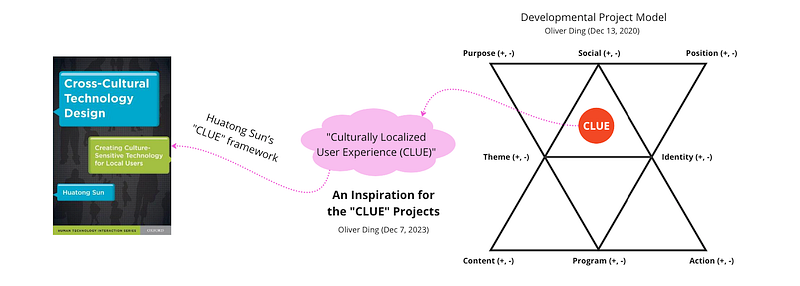
On Oct 31, 2023, I wrote an article titled [Creative Diagramming] Graphic Space Affordances, Thematic Space, and Possible Paths.

Contents

1. Creative Diagramming and Mental Moves 2. Explore Graphic Space Affordances 3. Explore Potential Thematic Spaces of the Developmental Project Model 4. Utilize Potential Thematic Spaces of the Knowledge Discovery Canvas 5. Explore Possible Connections of Diagram Networks 6. Explore the Spatial Structure of Life Discovery Canvas 7. Explore Possible Paths of moving between thematic spaces

Section 3 of the article is about discovering potential thematic spaces of the Developmental Project Model. Section 5 is about connecting diagrams.

Today I will add one more example about section 3 and section 5.

The above diagram features a new type of project: the “CLUE” project.

It is located in the “Social — Theme— Identity” Thematic Space.

I also connect it with Huatong Sun’s “CLUE” Framework.
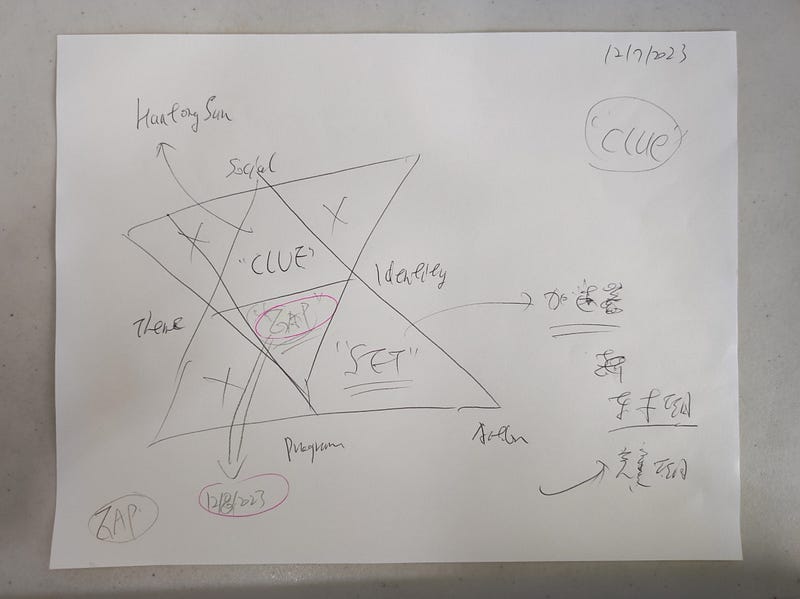
On Dec 7, 2023, I made the above visual note. I found the “Social — Theme — Identity” Thematic Space could be used to place the “CLUE” framework, which Huatong Sun developed in her 2012 book Cross-Cultural Technology Design: Creating Culture-Sensitive Technology for Local Users.
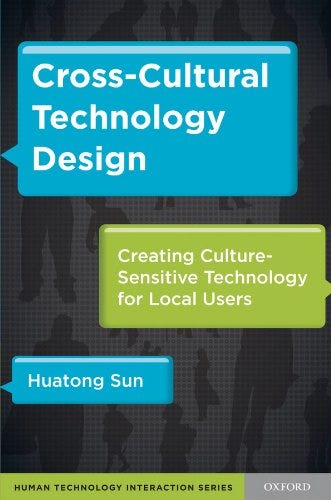
The Culturally Localized User Experience (CLUE) approach

The Culturally Localized User Experience (CLUE) approach is a design philosophy and methodology to create culturally sensitive design for local users. According to Sun,

This framework places concrete use activities on center stage, a component that is often missing in current cross-cultural design literature and practice.

In Sun’s approach, there are two views of culture:

  • A taxonomic view of culture
  • A dialogic view of culture

In the CLUE framework, Sun regards local culture as the dynamic nexus of contextual interactions that manifests numerous articulations of practices and meanings to replace a taxonomic view of culture.

The framework advocates a holistic, integrated vision that takes user experience as both situated action and constructed meaning. It proposes a dialogical, cyclical design process to integrate action and meaning in cross-cultural design in order to make a technology usable and meaningful to local users.

This approach and the cross-cultural design are perfect examples of the “Social — Theme — Identity” Thematic Space.

The Evolving Concept System

In the past several months, I developed a framework for understanding the Evolving Concept System.

I pay attention to two fields: Knowledge Engagement and Product Engagement. Both two fields share the same pattern of developing a concept system. However, they have different complexities in the stage of Continuous Objectification.

For a theorist, the Objectification of Concepts is very simple. He/she only needs to write a book! However, for a startup founder, the Objectification of Concepts is quite complicated because he/she needs to build a team and make a real product or a service.

On March 2, 2023, I edited a book (draft) titled Perspectives on Product Engagement (v1.0).

Later, I used the field of Product Engagement as the context of Continuous Objectification. Based on this setting, I made a model called “Evolving Concept System”. See the diagram below.
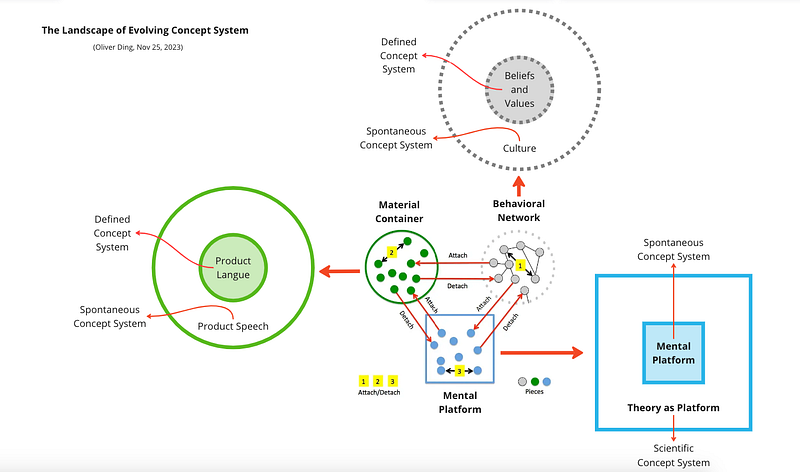
I used “Spontaneous Concept System/Defined Concept System/Scientific Concept System” to explain three parts of an Evolving Concept System.

  • Mental Platform: How do you think?
  • Behavioral Network: How do you do?
  • Material Container: What do you make?

It means the process of Developing A Concept System is not only about thinking, but also about doing, saying, and making.

You can find more details in Mental Platform: The Evolving Concept System.

The Concept-fit Framework

Can we connect the Evolving Concept System model with the CLUE framework?

We can use the “Spontaneous Concept System/Defined Concept System” to understand two views of Culture.

  • A taxonomic view of culture: driven by platform owners’ Defined Concept System
  • A sensitive view of culture: driven by platform users’ Spontaneous Concept System

In this way, Platform Innovation is the process of Concept-fit between platform owners’ Defined Concept System and platform users’ Spontaneous Concept System.

So, we can use Sun’s empirical study to support the Concept-fit framework.

Related Links

Project Management
Projects
Project Based Learning
Culturally Responsive
Cross Cultural Thinking
Recommended from ReadMedium
avatarDanielpourasgharian
Your new knowledge app, Glasp

3 min read