
Mental Moves #8: The Hierarchy of Knowledge Centers
Mental Moves between Knowledge Centers
This post is part of the Mental Moves knowledge project that aims to collect related articles about the concept of “Attachance” and more examples about “Moving between Thematic Spaces” in order to edit a book. You can find more details in the following links:
- March 4, 2023 — Creative Action: The Chance-configuration Theory and Beyond
- March 8, 2023 — Creative Action: The Attachance of Moving Mental Elements
- March 10, 2023 — [Knowledge Engagement] How to develop a concept called “Attachance”?
- March 10, 2023 — #TalkThree 19: The Art of Semantic Awareness
- March 23, 2023 — The Knowledge Engagement Framework (v4)
- March 24, 2023 — TALE: A Possible Theme called “Mental Moves”
- March 24, 2023 — The Concept of Attachance (A list of articles)
- March 30, 2023 — Mental Moves #1: The Transformation of Mental Elements
- April 27, 2023 — Creative Swapping of Mental Elements
- April 29, 2023 — The “Mental Moves” Knowledge Project (Digital Board)
- April 27, 2023 — Mental Moves #2: Creative Swapping of Mental Elements
- May 2, 2023 — Mental Moves #3: Attachance, Thematic Space, and Framework
- May 22, 2023 — Mental Moves #4: Attachance and Creative Dialogue
- June 8, 2023 — Mental Moves #5: The Attachance of Rediscovery and Diagram Development
- June 12, 2023 — Mental Moves #6: Mental Models and the Attachance of Multiple Moves
- June 17, 2023 — Mental Moves #7: Mental Focus and Moving between Thematic Spaces
I coined the term Attachance by combining Attach and Chance in 2018 to discuss some ideas related to Affordance, a core idea of Ecological Psychology.
In 2022, the development of Attachance was tied to the development of Thematic Space which refers to a specific type of container: cognitive container. You can find more details in [Slow Cognition] The Development of the concept of “Thematic Spaces”.
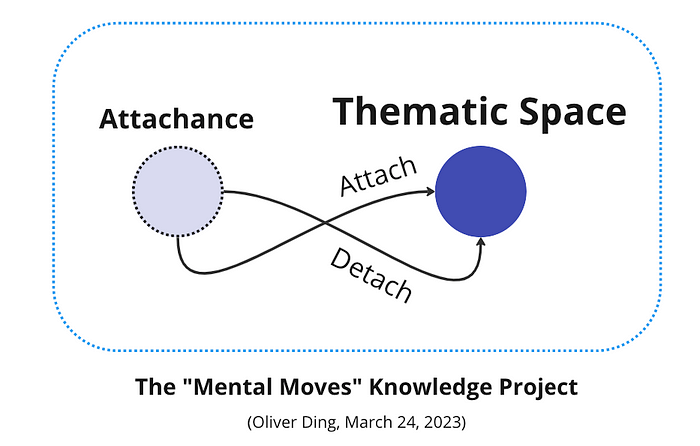
On March 10, 2023, I wrote a short post about the development of “Attachance” on Linkedin. On March 24, 2023, I collected a set of articles about the concept of “Attachance” and “Moving between Thematic Spaces”.
I also launched a board for the Mental Moves knowledge project on Milanote.
The Mental Moves knowledge project started with the concept of “Mental Elements” which is adopted from Dean Keith Simonton’s Chance-configuration theory.
This article aims to discuss Mental Moves between Knowledge Centers.
The Seed of “Knowledge Center”
In Jan 2022, I designed two diagrams for the Activity Analysis project. These diagrams represent my new understanding of the project. Eventually, the website became a new project with a new concept called Knowledge Center.
This is an example of Developing Tacit Knowledge. During two months, my tacit knowledge about Activity Analysis expanded from a simple website into a “Knowledge Center”.
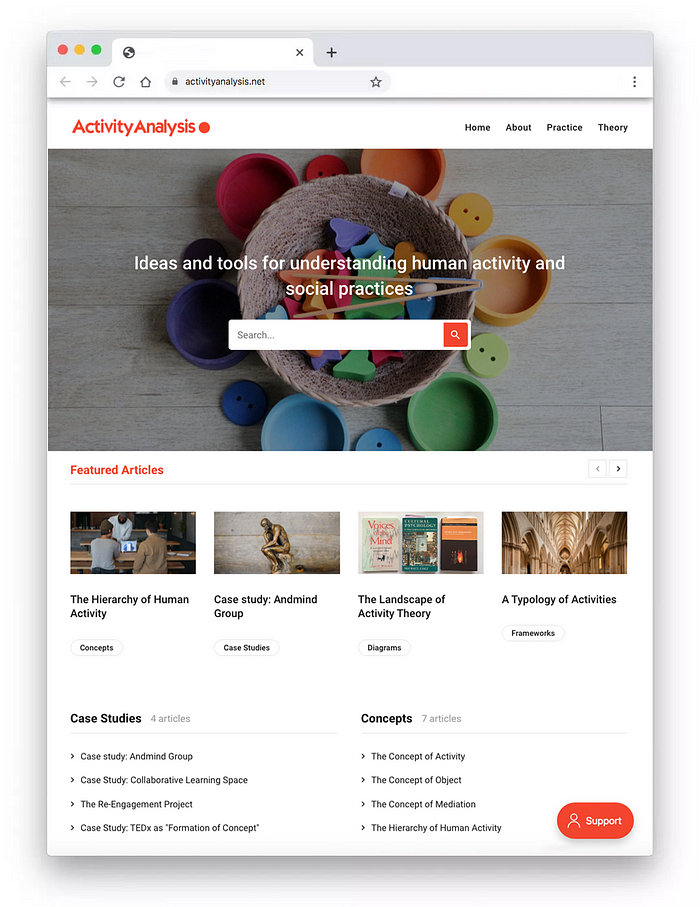
The notion of “Knowledge Center” was born from a talk about Activity Theory and the Activity Analysis project.
On Jan 2, 2022, I had a 71-minute talk with a friend of mine. He is an active curator of early local TEDx events in China. In recent years, he also curated local Design Sprint events in China. In addition, he often curates innovation workshops for local communities.
I briefly introduced the development of my personal studio CALL in the past year. Before the talk, he read the article CALL: Annual Review (2020–2021). The major part of our talk focused on my work on Activity Theory. As mentioned in the article, I completed the Activity U project (phase I) with three books in 2021:
I also introduced the theoretical concepts and methodological methods of Activity Theory.
At the end of the talk, we chatted about the future of CALL in 2022. I mentioned the Activity Analysis project. I told him that I’d like to run it as a Knowledge Center.
The notion of Knowledge Center is a new spark for me. I didn’t use the term to describe the Activity Analysis project before the talk. As a new spark, it emerged from a conversation.
On Jan 13, I designed the diagram below to visualize what I talked about the notion of “Knowledge Center” with my friend on Jan 2.
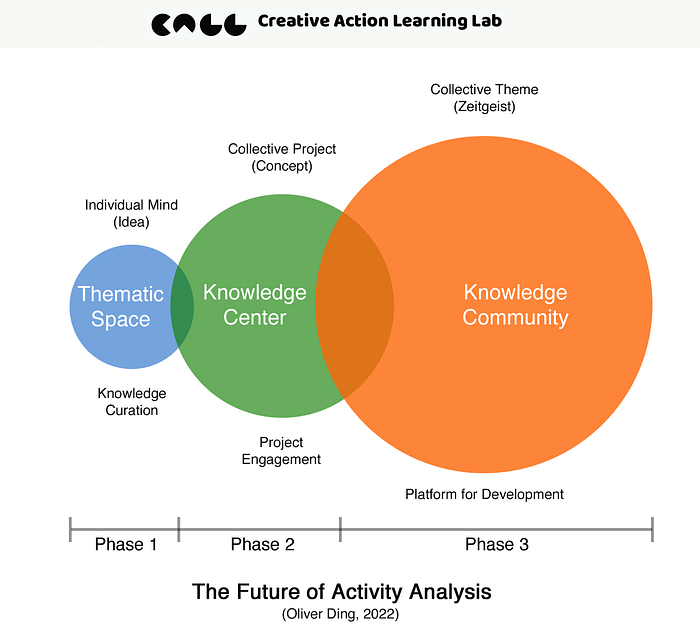
The above diagram describes an imagined project with a new concept.
- An imagined project: the Activity Analysis project
- A new concept: Knowledge Center
You can find more details in Thematic Space: The Art of Continuous Discovery.
What’s a “Center”?
The “Knowledge Center” thematic space appeared with an abstract question:
What’s a “Center”?
The term “Knowledge Center” refers to a Double-theme theme. For me, it means a center for developing certain knowledge. For the Activity Analysis project, certain knowledge refers to Activity Theory and other Social Practice theories.
Why do we need such a center?
What’s a center?
I had a rough answer to the question. A “center” should have its own uniqueness in order to establish its identity and theme. Otherwise, there is no need to build a “center”.
One day I noticed that there is a book about Christopher Alexander’s Pattern Theory on my bookshelf. I suddenly realized that “Center” is a core concept of Alexander’s theory.
The book is titled Pattern Theory: Introduction and Perspectives on the Tracks of Christopher Alexander. It was written by Helmut Leitner who is a fan of Christopher Alexander’s ideas. Leitner was motivated by his experience as a software engineer and by reading about Software Design Patterns. In 2007, he wrote the book in German. Later, the book was translated to English and published in 2015.
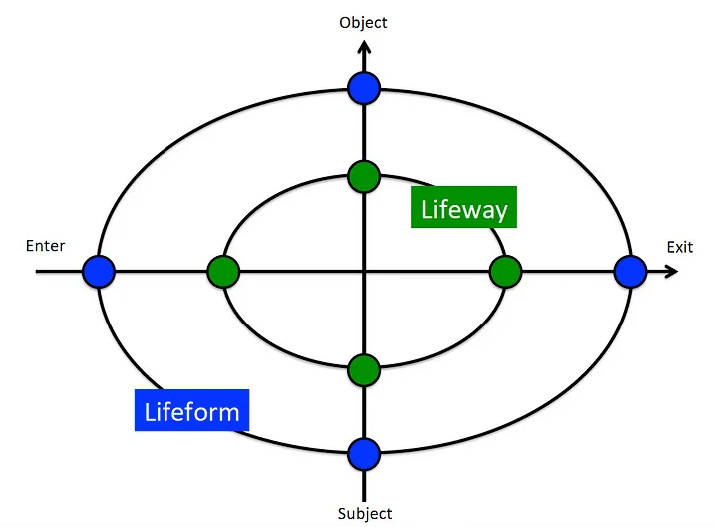
The author also shares the following diagrams for describing the latent structural elements existing around a single point on a sheet of paper.
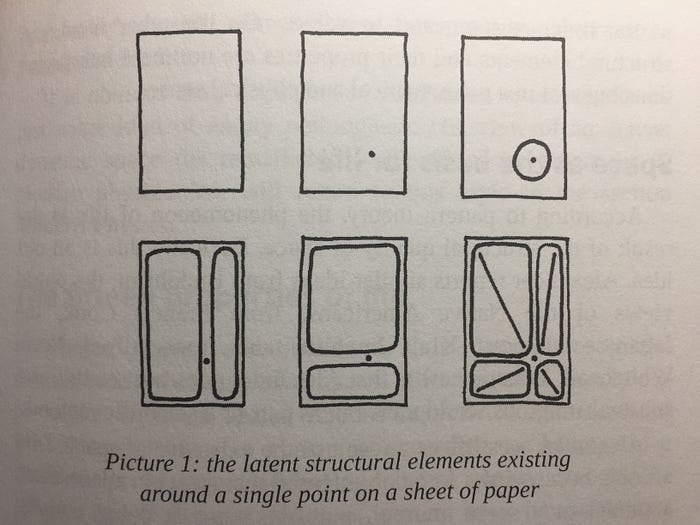
According to the author, “A single point on a sheet is connected to quite a number of structure elements, for example, the sheet; the point; the halo surrounding the point; the rectangles that come into existence by perceiving the point as separating the sheet into an upper, lower, right and left half; the four diagonals; the four quarters of the sheet and the white zones that separate them, starting from the halo of the point…” (2015, p.33)
Quite interesting!
One thing we can learn from the above discussion is Uniqueness.
As mentioned above, the term “Knowledge Center” refers to a Double-theme theme. For me, it means a center for developing certain knowledge.
Now, we should require a degree of uniqueness for certain knowledge.
A related issue is the degree of influence of the “Knowledge Center”. However, I consider “Knowledge Center” as a small-scale level. If a “Knowledge Center” establishes a high degree of influence, it becomes a “Knowledge Community”. In other words, “Knowledge Center” is the seed stage of “Knowledge Community”.
You can find more details in Mapping Thematic Space #4: The “Center” Thematic Space.
A Network of Knowledge Centers
Inspired by Howard Gruber’s “Network of Enterprise”, I work on multiple knowledge centers. Each knowledge center refers to a unique unit of analysis.
However, my real action is one project at one time. For example,
I am recently working on TALE (Thematic Analysis Learning Engagement) which is a brand-new knowledge center. The real project is the Knowledge Engagement Project.
In 2022, I considered Uniqueness as the starting point of a “Knowledge Center”.
A knowledge center is a collective project that aims to develop certain unique knowledge. A “center” should have its own uniqueness in order to establish its identity and theme. Otherwise, there is no need to build a “center”.
In 2023, the issue is about the complexity of a network of knowledge centers.
How can we keep the uniqueness of individual knowledge centers while we can build the synergy effects of a network?
Inspired by the Project Engagement approach (v2.1)’s six units of analysis, I realized that I can use “Units of Analysis” to connect the following seven knowledge centers together.
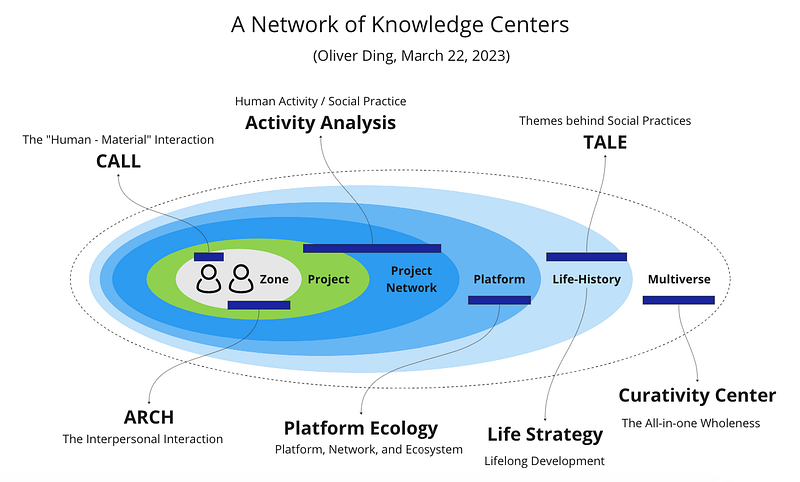
1. CALL(Creative Action Learning Lab) Center The “Human — Material” Interaction
2. ARCH Center The Interpersonal Interaction
3. Activity Analysis Center Human Activity/Social Practice
4. Platform Ecology Center Platform, Network, and Ecosystem
5. Life Strategy Center Lifelong Development
6. TALE (Thematic Analysis Learning Engagement) Center Themes behind Social Practices
7. Curativity Center: The All-in-one Wholeness
What does it mean?
Originally, I used books/theoretical approaches to frame uniqueness. Now I separate theoretical approaches from the wholeness level.
At the wholeness level, the difference between individual knowledge centers is their units of analysis. In this way, I can build a meaningful whole for a network of knowledge centers.
At the uniqueness level, each knowledge center can focus on its own aspects, perspectives, frameworks, tools, etc.
Some theoretical approaches can be applied to one or more knowledge centers. For example, the Ecological Practice Approach.
The Theory of Creative Life can be applied to all six units of analysis.
The Hierarchy of Knowledge Center
In the past several months, I found several mental moves between TALE and other knowledge centers. Let’s see an example.
The diagram below is called “Theoretical Resources for Knowledge Engagement”.
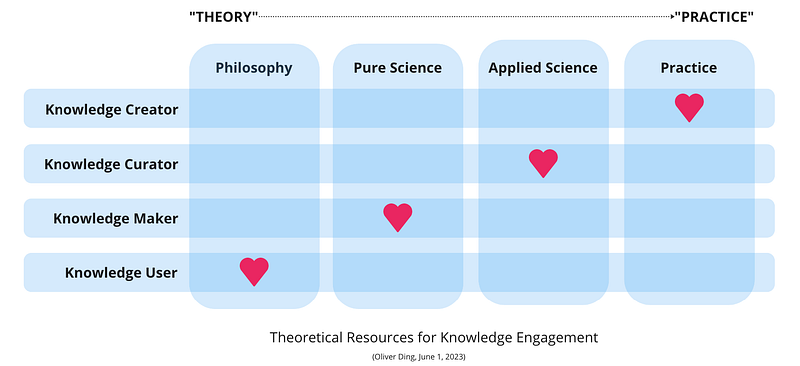
On June 1, 2023, I made the above diagram for writing some notes about the Persona Dynamics Framework. It was part of a long article about the notion of “Themes in the Field” which is the third stage of the “Strategic Thematic Exploration” framework.
On June 23, 2023, I edited a rough Table of Contents for a possible book titled Thematic Exploration: The Early Discovery of Knowledge Engagement (book, v1) and closed the “Strategic Thematic Exploration” framework (phase 1).
Today I detach the above diagram from the Strategic Thematic Exploration project and attach it to the Knowledge Engagement project.
There are three knowledge centers behind this example. See the diagram below.
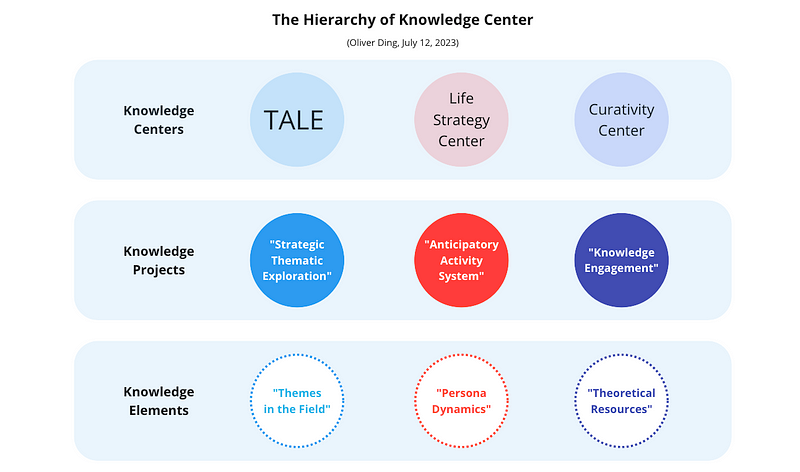
The above three-level hierarchy of knowledge center echoes Activity Theory’s hierarchical model.
The hierarchical structure of activity was originally conceptualized by A. N. Leontiev (1978). We have to notice that the goal of Leontiev was developing a psychological theory at the individual level with the concept of Activity. Thus, we will see three levels of activity correspond to three levels of psychological notions. The three levels of activity are activity, actions, and operations. The three levels of psychological notions are motive, goals, and conditions.
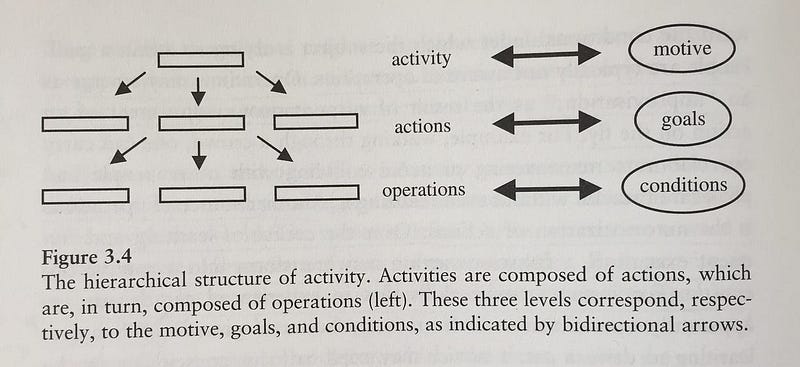
The three levels of knowledge centers roughly correspond to three levels of activity:
- Knowledge Center > Activity (Building Knowledge Enterprise Activity)
- Knowledge Projects > Actions (Develop Knowledge Frameworks)
- Knowledge Elements > Operations (Work on Pieces of Knowledge )
The Project Engagement approach uses “Project” as the unit of analysis of Activity. If we see a knowledge center as a Project, then knowledge projects can be seen as sub-projects.
The diagram of “Theoretical Resources for Knowledge Engagement” was born from the Strategic Thematic Exploration project. As a by-product, it was not the primary focus of the project. Now, we can move it to the Knowledge Engagement project.
You can find more details in Knowledge Engagement: The Utilization of Theoretical Resources.
Moves between Knowledge Centers: Case Study 1
On March 30, 2023, I published a post titled TALE: A Possible theme called “Life Coordinate”.
The theme of “Life Coordinate” is a concept of the Lifesystem Framework which belongs to CALL (Creative Action Learning Lab). See the diagram below.
The week before the day, I worked on updating the Lifesystem Framework, especially the Life Coordinate part. Though I could directly publish a post on CALL’s blog, I decided to turn it into a possible theme for TALE.
This creative action refers to a collaboration between CALL and TALE. I tried this type of creative action several times.
- March 11 — “TalkThree” — CALL > Curativity Center > TALE
- March 22 — “Knowledge Center” — CALL > Curativity Center > TALE
- March 24 — “Mental Moves” — CALL > Activity Analysis Center > TALE
- March 29 — “Expansive Activity Analysis” — Activity Analysis Center > TALE
Curativity Center was defined as a meta-center for building a network of knowledge centers:
- Creative Action Learning Lab (CALL)
- Activity Analysis Center
- Platform Ecology Center
- Life Strategy Center
- Curativity Center
- Thematic Analysis Learning Engagement (TALE)
You can find more details in CALL: The Launch Day of Curativity Center and TALE: A Possible Theme called “Knowledge Center”.
The collaboration between CALL and TALE refers to the “Concept — Theme” Attchance. See the diagram below.
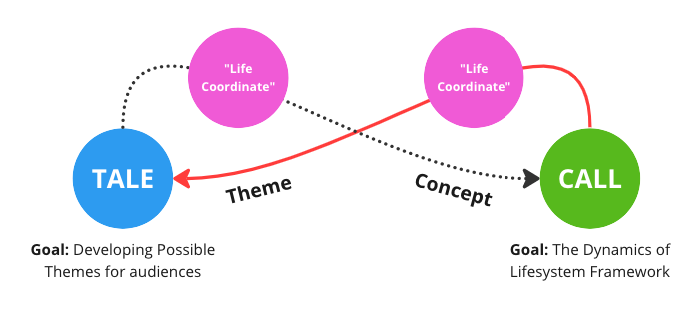
- CALL: “Life Coordinate” is a concept of the Lifesystem Framework (v1.0)
- CALL > TALE: “Life Coordinate” is detached from the Lifesystem framework (v1.0) and attached to TALE as an independent theme.
- TALE: “Life Coordinate” is an independent theme and it is developed to v2.0
- TALE > CALL: “Life Coordinate” is detached from TALE and attached to CALL as a concept of the Lifesystem Framework (v2.0)
The primary goal of the post aimed to turn “Life Coordinate” from a concept into a theme. In this way, the audiences of TALE can use the theme “Life Coordinate” without considering the Lifesystem Framework.
The secondary goal of the post was to build an example of collaborative projects between TALE and other knowledge centers.
Now we can see this type of collaborative project as a mental move.
Moves between Knowledge Centers: Case Study 2
On March 31, 2023, I applied the same technique to turn the Creative Life Curation framework into the Strategic Thematic Exploration framework.
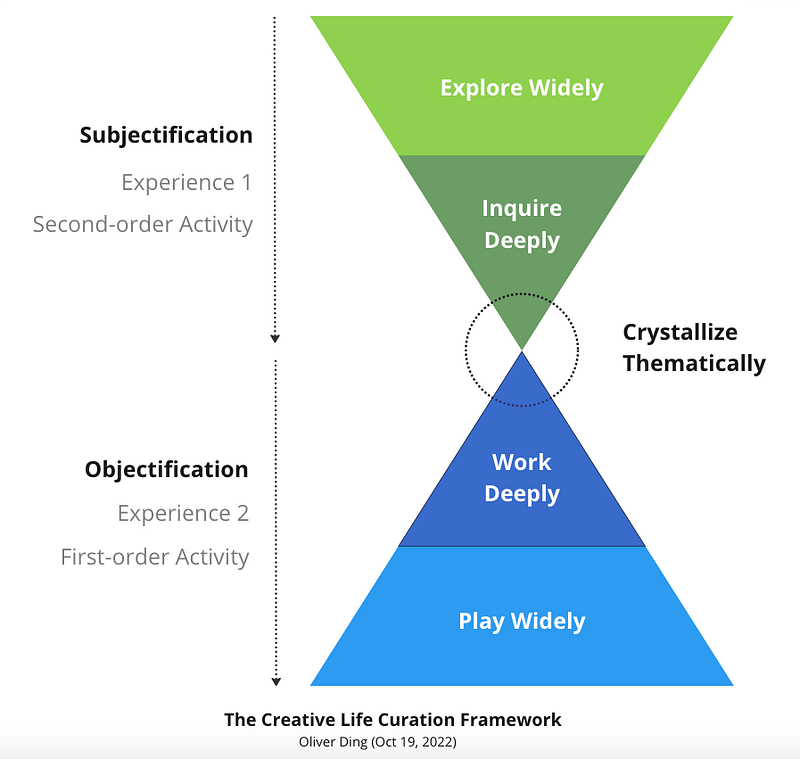
The above diagram is the primary model of the Creative Life Curation framework.
The Life Curation Project is a collaborative project between Curativity Center and Life Strategy Center. So, I used “Creative Life Curation” to name the original framework. My purpose behind the naming is to develop a Domain-specific Model for life curation.
I ran a collaborative project between Curativity Center, Life Strategy Center, and TALE. See the diagram below.
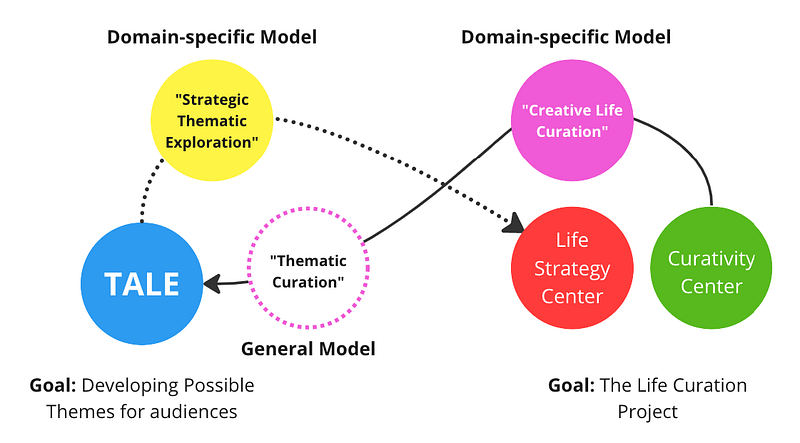
- Curativity Center > TALE: the original model is detached from Curativity Center and attached to TALE with a new name: “Thematic Curation”.
- TALE: The model is detached from “Thematic Curation” and attached to a domain called “Strategic Exploration”, the outcome is a new domain-specific model “Strategic Thematic Exploration”.
- TALE > Life Strategy Center: The “Strategic Thematic Exploration” is detached from TALE and attached to Life Strategic Center.
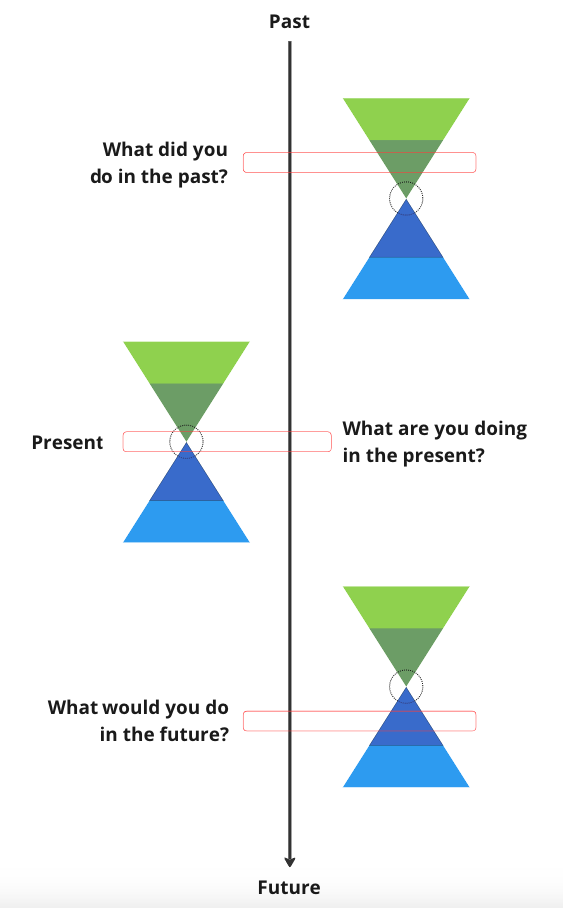
The new framework is represented in the diagram below.
Can I directly rename the original model “Strategic Thematic Exploration”?
Yes, I can.
However, this approach is only can be explained with mysterious intuition. Here I want to apply the Attachance approach to explain the creative process. This is the primary theme of a possible book Mental Moves: The Attachances of Moving Mental Elements.
In Mental Moves #1: The Transformation of Mental Elements, I conducted a case study about the Attachances of moving mental elements. The outcome of the case study is the following diagram about mental elements.
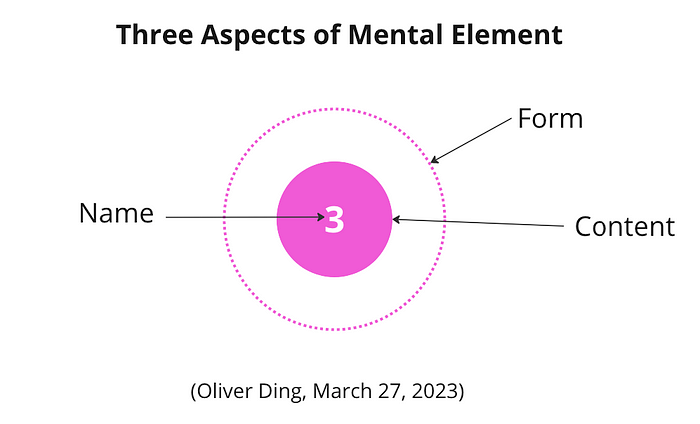
The term “mental elements” is adopted from Dean Keith Simonton’s Chance-configuration theory (Scientific Genius,1988).
As mentioned above, there is a three-level hierarchy of Knowledge Center. If we focus on the level of “Mental Elements”, then we can use the three aspects of mental elements to guide the moves.
- Name: does it have a name?
- Form: does it have an identifiable form?
- Content: does it have more than one identifiable entity?
Let’s apply the “three aspects of mental elements” model to “Creative Life Curation”.
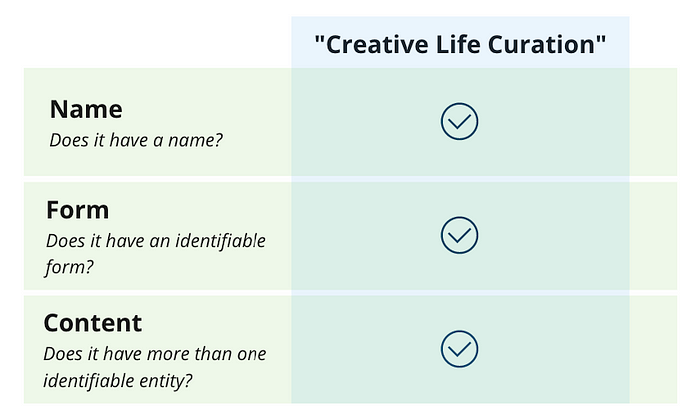
If a mental element has a name, then we can test if the name is separable or inseparable from the whole.
Let’s try to use “Thematic Curation” to rename it. See the diagram below.
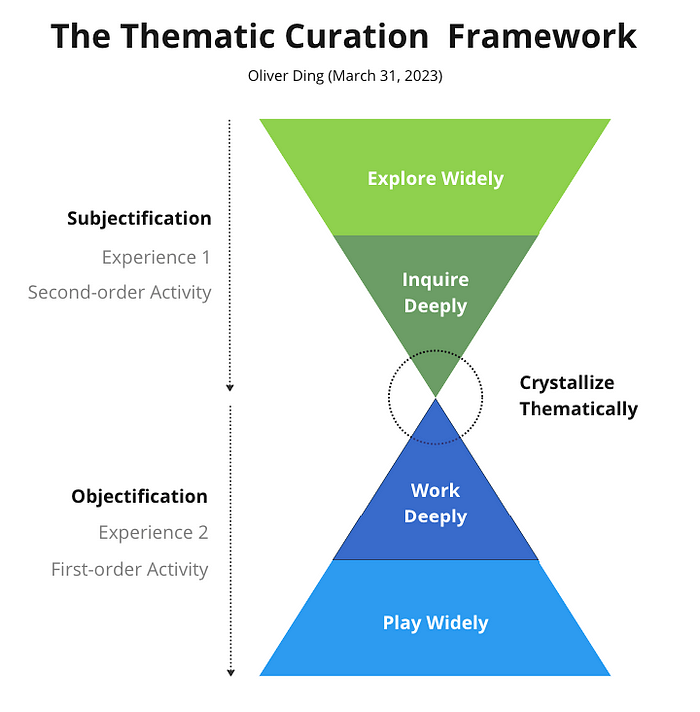
I didn’t modify the original model. It seems the new name works well because a significant step of the model is “Crystallize Thematically” which refers to a turning point.
Before the turning point, the tendency is to discover a meaningful theme for the next phase. After the turning point, the tendency is to spread the meaning of the theme by making various artifacts. These two phases can be understood as two types of thematic curation activity. One is called Subjectifcation and the other one is called Objectifaction.
The new name “Thematic Curation” is perfect for the model. Now we can detach it from Curativity Center and attach it to TALE.
Moves between Knowledge Centers: Case Study 3
Now let’s move to the level of “Knowledge Projects” and discuss mental moves between projects.
The diagram of “Theoretical Resources for Knowledge Engagement” is a great example of this type of mental move. In the above discussion, I have used it as an example to develop the Hierarchy of Knowledge Center.
Now let’s make a diagram of the mental move about it. See the diagram below.
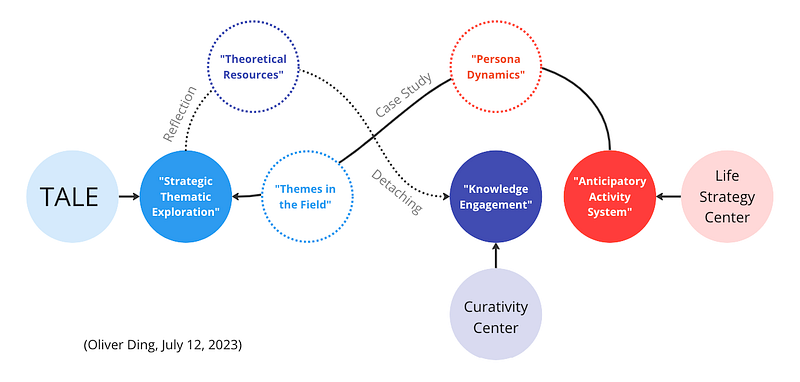
The diagram can be seen as an advanced version of case study 1 and case study 1. I use both Knowledge Centers and Knowledge Projects as Containers. However, Knowledge Projects are primary containers while Knowledge Centers are secondary containers.
- “Anticipatory Activity System” > “Strategic Thematic Exploration”: the knowledge element “Persona Dynamics” was detached from the “Anticipatory Activity System” project and attached to the “Strategic Thematic Exploration” project.
- “Themes in the Field” (“Persona Dynamics”): The knowledge element “Persona Dynamics” is used as an example of the notion of “Themes in the Field” which is part of the “Strategic Thematic Exploration” project.
- “Themes in the Field” || “Theoretical Resouces”: The diagram “Theoretical Resouces” was born from the reflection on the “Themes in the Field” discussion.
- “Strategic Thematic Exploration” > “Knowledge Engagement”: the knowledge element “Theoretical Resouces” was detached from the “Strategic Thematic Exploration” project and attached to the “Knowledge Engagement” project.
We can also see the relationships between Knowledge Centers and Knowledge Projects.
- Life Strategy Center (“Anticipatory Activity System”): The “Anticipatory Activity System” project is hosted by the Life Strategic Center.
- TALE (“Strategic Thematic Exploration”): The “Strategic Thematic Exploration” project is hosted by the TALE Center.
- Curativity Center (“Knowledge Engagement”): The “Knowledge Engagement” project is hosted by the Curativity Center.
Some knowledge projects are collaborative projects between two or more knowledge centers. For example, the “Creative Life Curation” project is a collaborative project between Curativity Center and CALL (Creative Action Learning Lab).
Moves between Knowledge Centers: Case Study 4
In fact, the “Anticipatory Activity System” project is a collaborative project between Activity Analysis Center and Life Strategy Center. Let’s use it as an example for our fourth case study.
On August 28, 2022, I used Theme U to reflect on the development of the “Anticipatory Activity System” framework from August 2021 to August 2022. See the diagram below.
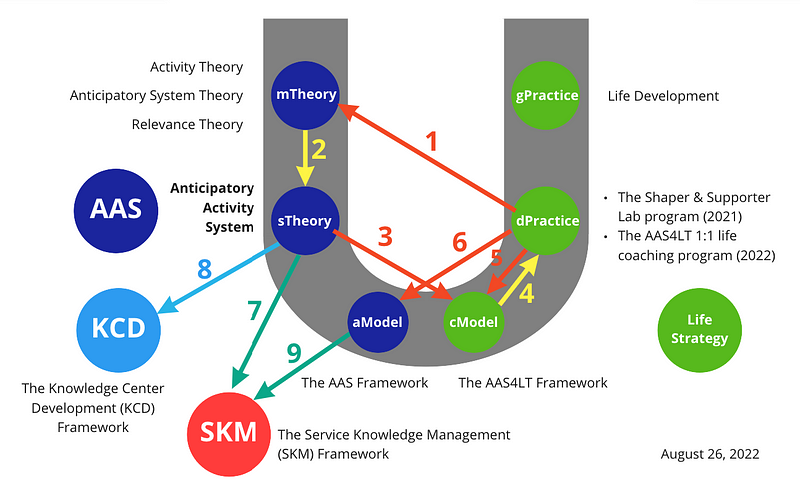
The above diagram was based on the Theme U framework. In fact, I actually used it to manage the development of the Anticipatory Activity System (AAS) framework.
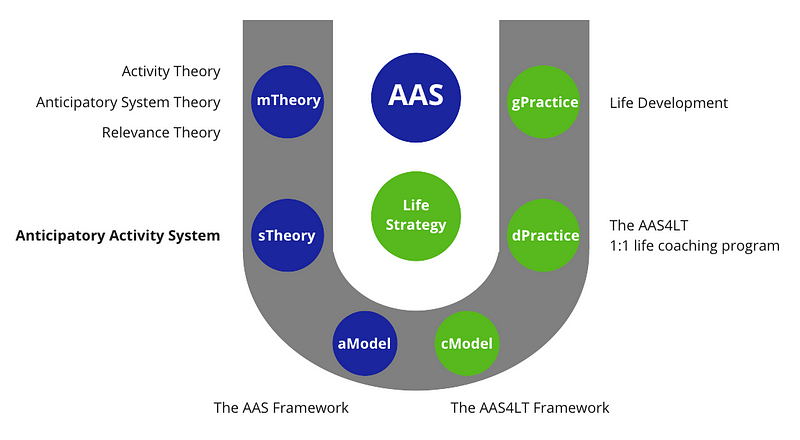
The above diagram is based on the HERO U framework which presents six types of “objects of knowing” in a U shape.
- mTheory: Meta-theory
- sTheory: Specific Theory
- aModel: Abstract Model
- cModel: Concrete Model
- dPractice: Domain Practice
- gPractice: General Practice
For the ASS project, I consider the following “Objects of Knowing” for connecting THEORY (AAS) and PRACTICE (Life Strategy).
- Meta-theory: Activity Theory, Anticipatory System Theory, Relevance Theory, etc.
- Specific Theory: Anticipatory Activity System
- Abstract Model: The AAS Framework
- Concrete Model: The AAS4LT Framework
- Domain Practice: The AAS4LT 1:1 life coaching program
- General Practice: Life Development
You can find more details in Slow Cognition: The Development of AAS (August 21, 2021 — August 26, 2022).
Now I will use the Mental Moves Mapping diagram to reflect on some moves between Activity Analysis Center, Life Strategy Center, and Curativity Center.
Let’s start with the hierarchy of knowledge centers. See the diagram below.
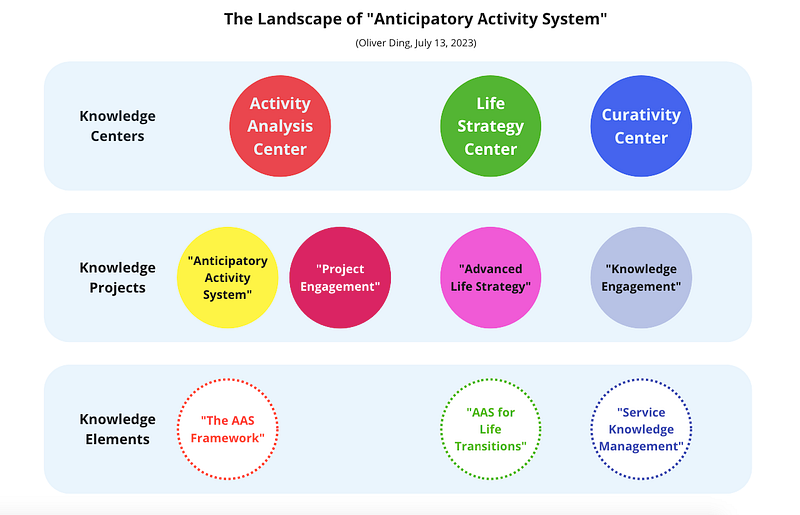
Now let’s see the diagram of mental moves between three knowledge centers.
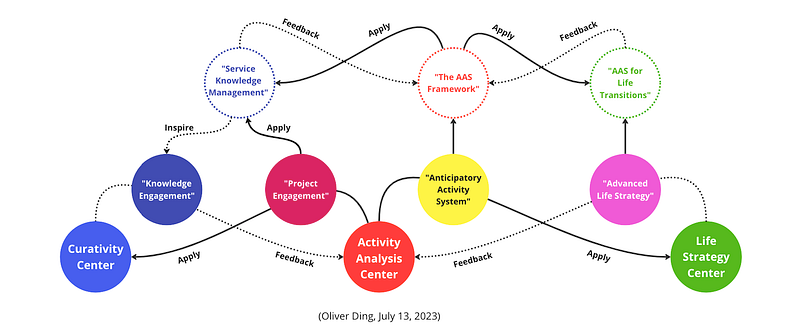
The above diagram represents two major moves between three knowledge centers. The first move appears between Activity Analysis Center and Life Strategy Center.
- Activity Analysis Center > Life Strategy Center: while Activity Analysis Center is a knowledge center about developing theoretical frameworks, Life Strategy Center aims to offer life developmental solutions to knowledge creators. The basic theoretical framework of AAS was detached from Activity Analysis Center and attached to Life Strategy Center.
- Life Strategy Center > Activity Analysis Center: the basic theoretical framework of AAS was applied to generate a concrete model called “AAS for Life Translations”. Later, I detached an abstract model from “AAS for Life Translations” and attached it to Activity Analysis Center.
- Activity Analysis Center (Anticipatory Activity System): the AAS theoretical framework was inspired by Activity Theory, Anticipatory System Theory, and other theoretical resources. I used Activity Analysis Center to host the AAS project.
- Life Strategy Center (Advanced Life Strategy): The original inspiration for AAS was discovered from a Life Discovery program. I also believed that Life Strategy is a great field for applying the AAS theoretical framework.
Here we see three important knowledge elements:
- The basic theoretical framework of AAS
- A concrete model called “AAS for Life Translations”
- An abstract model from “AAS for Life Translations”
Let’s have a look at them one by one. The diagram below is the basic theoretical framework of AAS. It only represents major theoretical concepts.
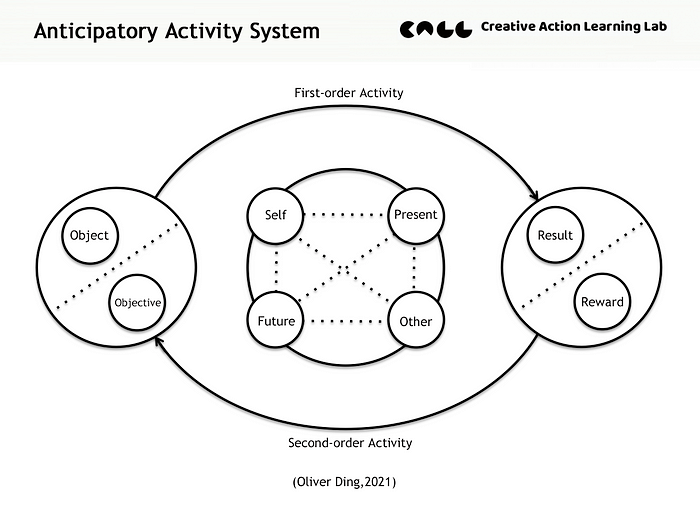
The diagram below is a concrete model called “AAS for Life Translations (AAS4LT)”. I used it to develop a program for hosting a 1:1 life development coaching program.
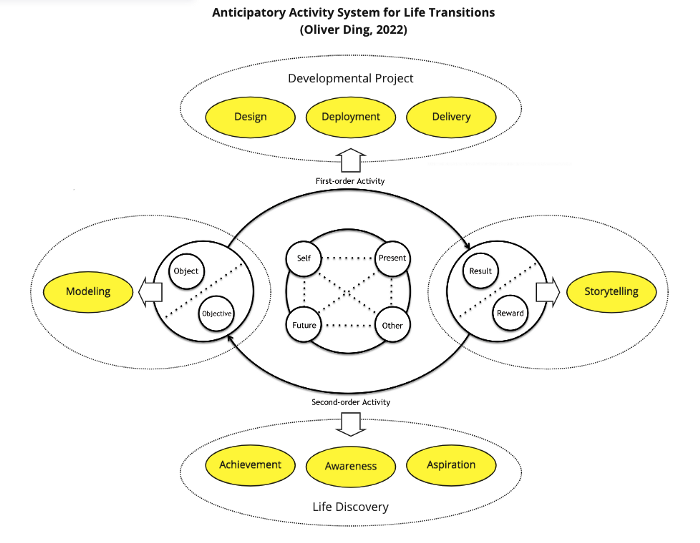
The AAS4LT framework was developed as a concrete model with eight modules. Later I removed some details from the AAS4LT framework and made the following abstract model for general purposes.
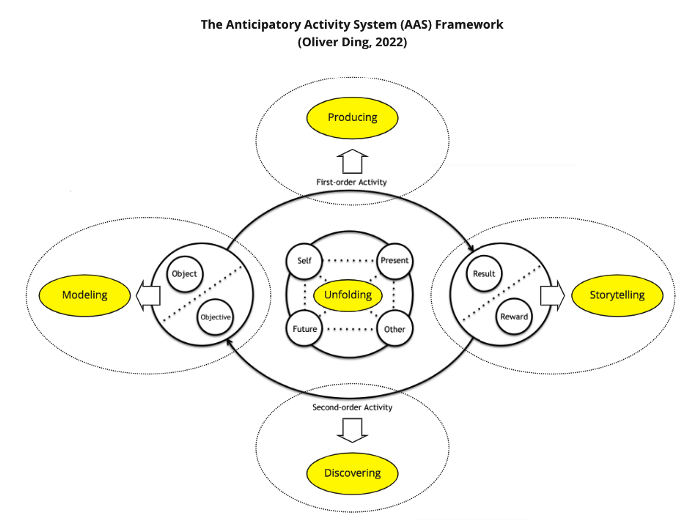
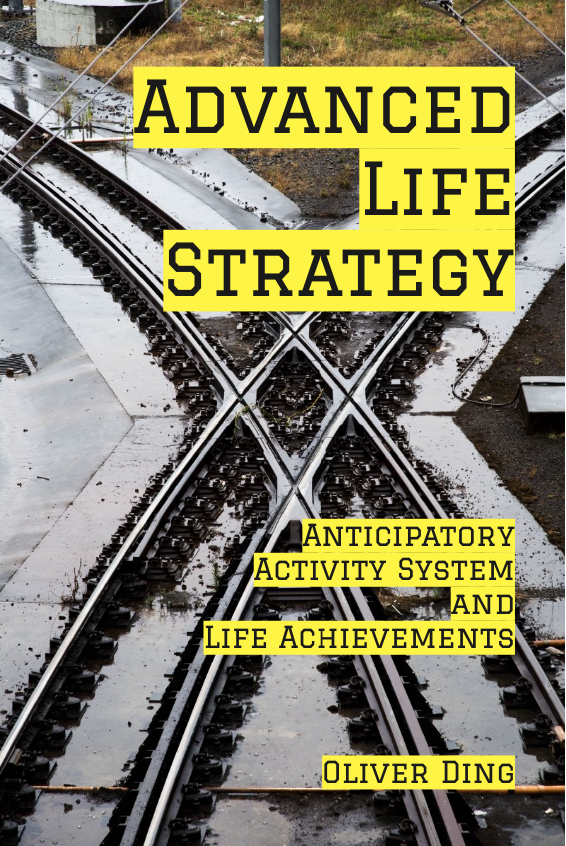
I started developing the AAS theoretical framework in August 2021. After 16 months, I closed the AAS project (phase 1) with a book (draft) titled Advanced Life Strategy: Anticipatory Activity System and Life Achievements on Dec 15, 2022.
The second move appears between Activity Analysis Center and Curativity Center.
- “Activity Analysis Center (Project Engagement)” > “Service Knowledge Management”
In July 2022, I developed the Knowledge Engagement Program (v1) for a client. Though the program focuses on “Service Knowledge Management”, it can be considered a general program for applying the Project Engagement approach to Knowledge Management. You can find a public version of the program on Milanote.
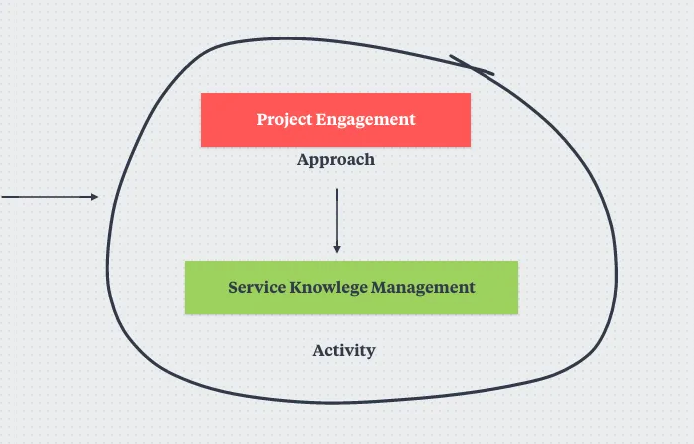
The Project Engagement approach was hosted by Activity Analysis Center. The term “Knowledge Engagement” was used to describe applying Project Engagement to professional knowledge management.
- The AAS Framework > The “Service Knowledge Management” framework
The AAS Framework was adopted to apply to the field of Service Knowledge Management. See the diagram below.
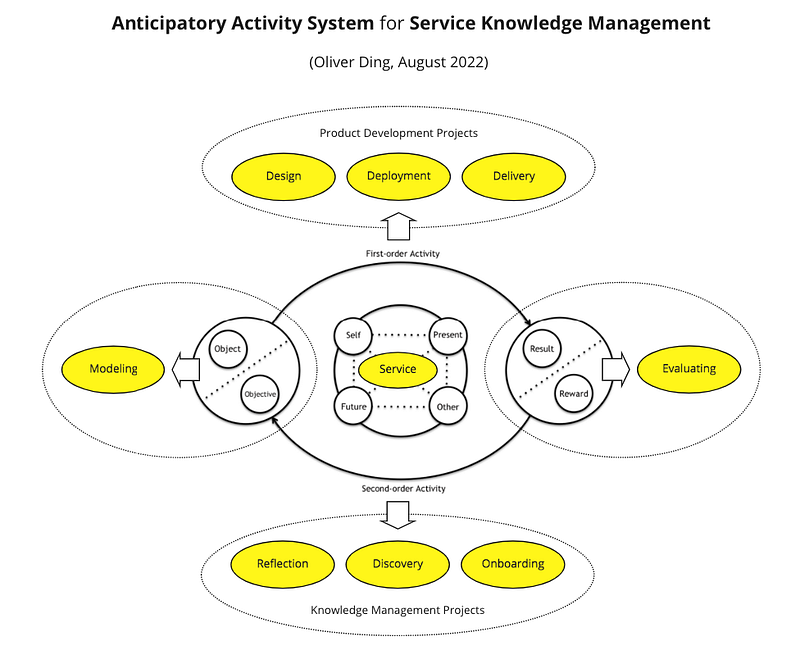
The “Service Knowledge Management” project inspired me to use the term “Knowledge Engagement” for the development of tacit knowledge. Later, it grew into a large project.
In April 2023, I edited a book (draft) titled Knowledge Engagement: Knowledge Center and Creative Life Theory.
Mapping the Dynamics of Networked Knowledge Centers
The above four case studies represent a method for mapping the dynamics of networked knowledge centers.
The method is defined by the following components:
- The Hierarchy of Knowledge Centers: Knowledge Elements — Knowledge Projects — Knowledge Centers
- The Elements of Mental Elements: Name, Form, and Content
- The Visual Style of Diagrams
On Sep 20, 2022, I wrote one case study titled The ARCH of Synergy Effects. I applied a knowledge element called Applied Knowledge Curation that belongs to Curativity Center to design a program called Activity Analysis Intervention for Activity Analysis Center. See the diagram below.
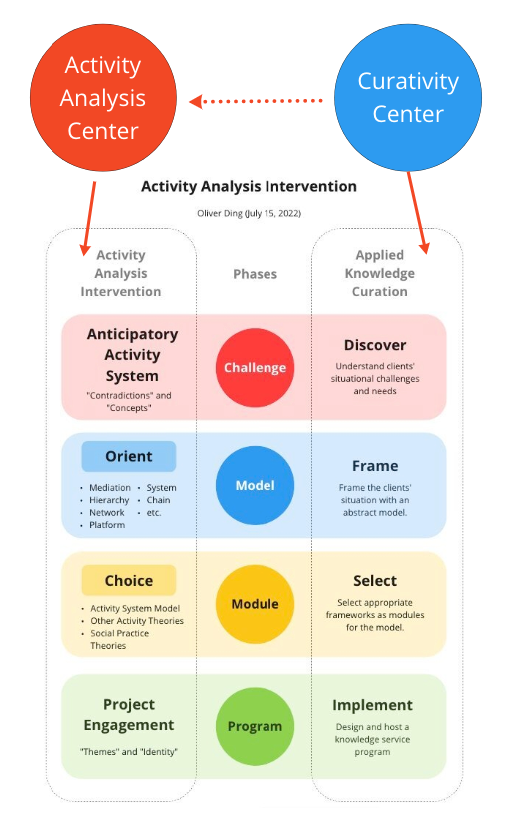
I didn’t use the term “Mental Moves” for the case study and the article. Now we can see it is an example of Mental Moves.
Networked Knowledge Centers as Value Circle
A by-product of this post is an insight about the theme of “Value Circle”. On Jan 17, 2023, I decided to select the following two themes as my 2023 annual themes.
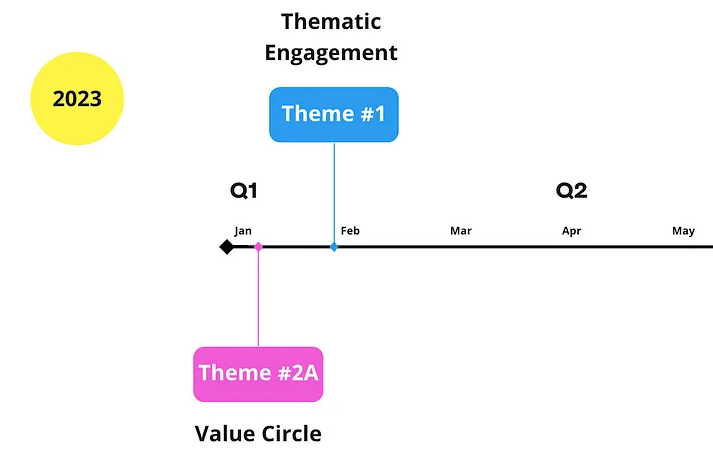
The theme “Thematic Engagement” is not new, but the TALE project is new.
In 2022, I closed several projects and made several possible books. I also started several new projects. For example:
1. The Knowledge Center Project 2. The Thematic Engagement Project 3. The City Curation Project 4. The ARCH Project
In 2023, I will work on these unfinished projects too. Moreover, I’d like to launch a new Knowledge Center for the Thematic Engagement project. On Jan 1, 2023, I launched TALE which stands for Thematic Analysis Learning Engagement. You can find more details here.
The possible theme “Value Circle” is about connecting my knowledge themes with professional business circles.
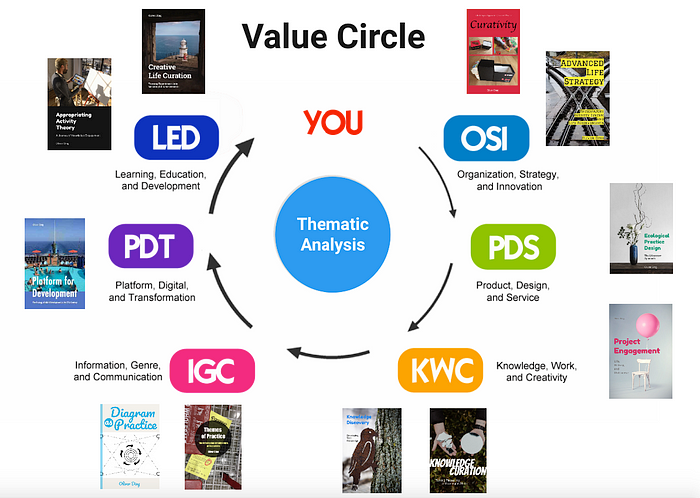
In the past several months, the theme “Value Circle” was developed into a new idea about networked knowledge centers for knowledge creators.
What a fantastic Creative Attachance!
References
- March 22, 2023 — TALE: A Possible Theme called “Knowledge Center”
In Jan 2022, I designed two diagrams for the Activity Analysis project. These diagrams represent my new understanding of the project. Eventually, the website became a new project with a new concept called Knowledge Center.
This is an example of Developing Tacit Knowledge. During two months, my tacit knowledge of Activity Analysis expanded from a simple website into a “Knowledge Center”.
- April 6, 2023 —[Mental Moves] The Attachance of moving between Knowledge Centers (Linkedin)
I am recently working on the “Mental Moves” project which aims to conduct several case studies about the concept of “Attachance”.
I also applied insights I learned from the research project to the newest activities. For example, the attached diagram represents an insight about moving mental elements between knowledge centers.
- Sept 20, 2022 — The ARCH of Synergy Effects
The Activity Analysis Intervention (AAI) Program is the first collaborative project between Activity Analysis Center and Curativity Center.
The AAI program was born with a synergy effect between Activity Analysis Center and Curativity Center.


