
Frame for Work: The Ontology of Knowledge Frameworks and Ecological Actualism
A Case Study of the Ecological Actualism Framework
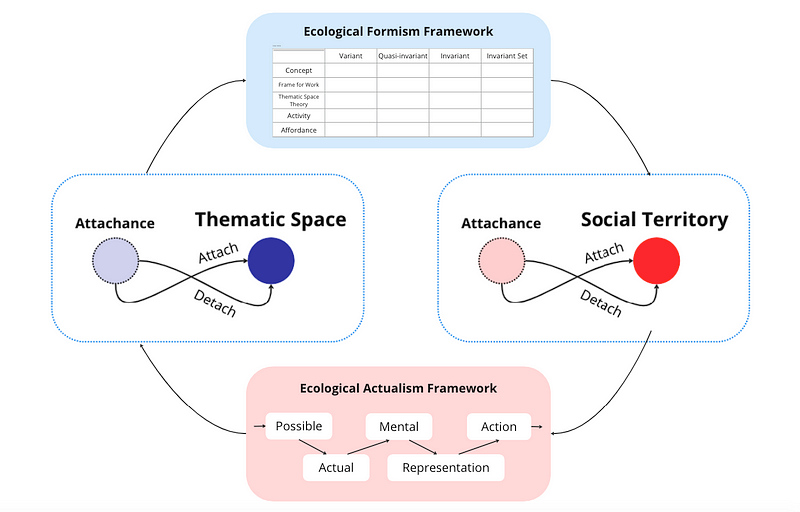
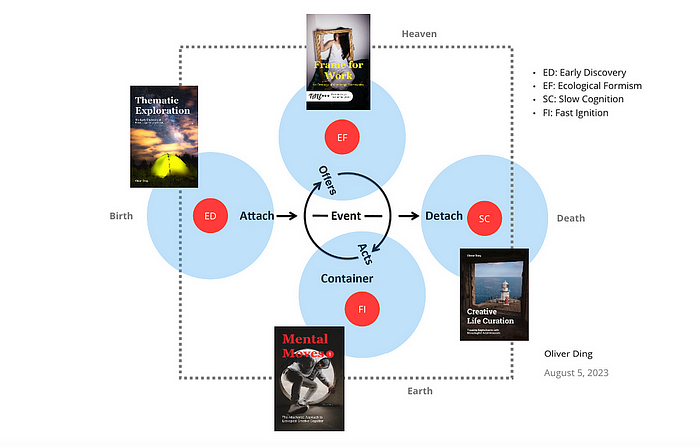
The above diagram is an integrated ecological approach to social cognition.
It was formed by two sub-frameworks: the Ecological Formism framework and the Ecological Actualism framework.
This article aims to use the Ecological Actualism framework to develop a new ontology of Knowledge Frameworks. We can also see it as a case study of the Ecological Actualism framework.
In the last section, I present a new framework of Knowledge Frameworks and use it to close the “Frame for Work” project (Phase I).
Contents
1. The Ecological Actualism Framework
2. Five Moments of Knowledge Frameworks
2.1 From Possible to Actual 2.2 From Logical to Representation 2.3 From Mental to Action 2.4 From Make to Use 2.5 From Use to Possible
3. The Meaning of Ecological Actualism
3.1 A Developmental Dynamic Process 3.2 Graphic Space Affordances 3.3 Explore Thematic Spaces and Beyond 3.4 Potential Action Opportunities
4. A New Framework of Knowledge Frameworks
1. The Ecological Actualism Framework
In Jan 2023, I worked on a thematic conversation about “Strategic Exploration” and discussed building a knowledge framework around a primary theme with a friend.
I used “a possible configuration of a theme network” to describe the structure of the things inside the thematic space. Moreover, I developed the notion of “Ecological Formism” with the following distinction:
- Possible: many possible configurations of a theme network
- Actual: a particular configuration of a theme network
- Representation: a diagram of a particular configuration
This is a major outcome of the project from my perspective. On Jan 30, 2023, I realized that the further task is to develop a new ontology of knowledge frameworks after publishing the post about the Field of Meta-learning (v1.0).
To remember this significant insight, I made a cover image and used “Frame for Work” as a new possible theme.

Now I want to keep the “Possible — Actual — Representation” schema but detach the term “Ecological Formism” from it.
I use the term “Ecological Actualism” to name the “Possible — Actual — Representation” schema.
In fact, the “Possible — Actual — Representation” schema is similar to the universal hierarchy of activity and practice.
On Sep 29, 2020, I published an article titled Activity U (VI): The Hierarchy of Human Activity and Social Practice. The article is part of the Activity U project. A side-product of the article is a universal hierarchy of activity and practice. See the table below.
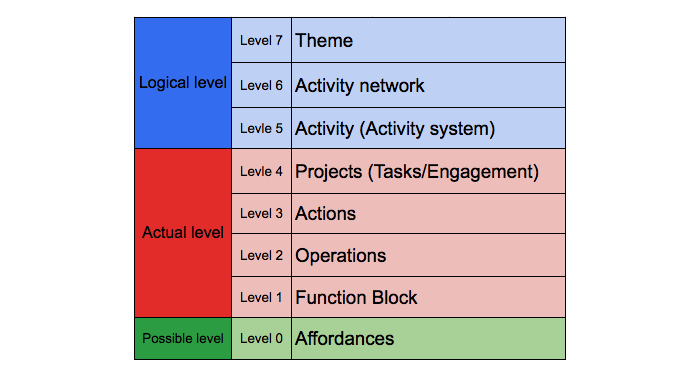
Human activity and social practice are extremely complex, the hierarchy is a great thinking tool for understanding them. Based on perspectives from activity theorists and other researchers, I found there is an eight-level hierarchy of activity and practice. The six mid-levels are adopted from activity theorists. The top level is adopted from anthropologist Morris Opler (1945). The low level is adopted from ecological psychologist James J. Gibson (1979).
I also classify these eight levels into three types: “logical level”, “actual level”, and “possible level”. We can call the logical level as ideal level too. I don’t have perfect terms to name these types.
On Mar 12, 2021, I published an article to introduce the concept of Supportance. I used the diagram below to discuss the actualization of supportances.
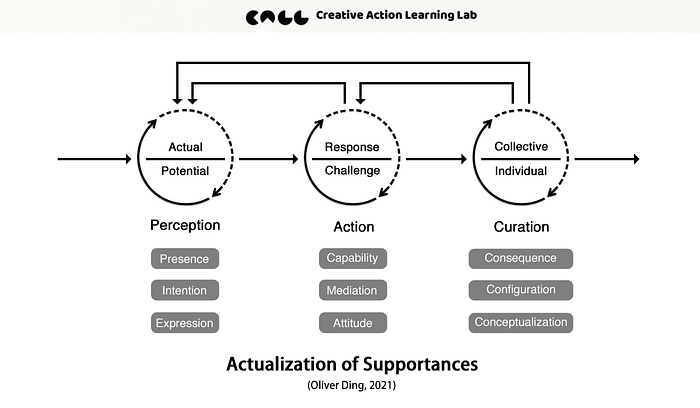
On April 2, 2021, I combined the above two diagrams and made a new diagram for the Ecological Practice approach.
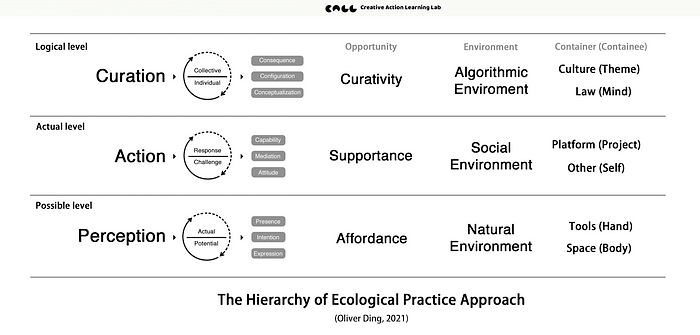
The above diagram summarizes the core concepts of the Ecological Practice Approach. It is an expansive version of the Germ-cell version.
If we combine the “Possible — Actual — Logical” schema with the “Possible — Actual — Representation” schema, we see a new hierarchy of knowledge engagement and social life in general.
- Possible
- Actual
- Logical
- Representation
I call this new framework “Ecological Actualism”.
Let’s apply the Ecological Actualism Framework to the “Frame for Work” project which is about the ontology of knowledge framework.
- Possible: many possible configurations of a theme network
- Actual: a particular configuration of a theme network
- Logical/Mental: a person perceives the particular configuration of a theme network as his/her mental model
- Representation: he/she makes a diagram (or other cognitive objects) as the representation of the mental model
Moreover, if the representation is used, he/she or other people could perceive new possibilities of using the representation. In [Creative Diagramming] Graphic Space Affordances, Thematic Space, and Possible Paths, I have discussed many examples of using diagrams and knowledge frameworks.
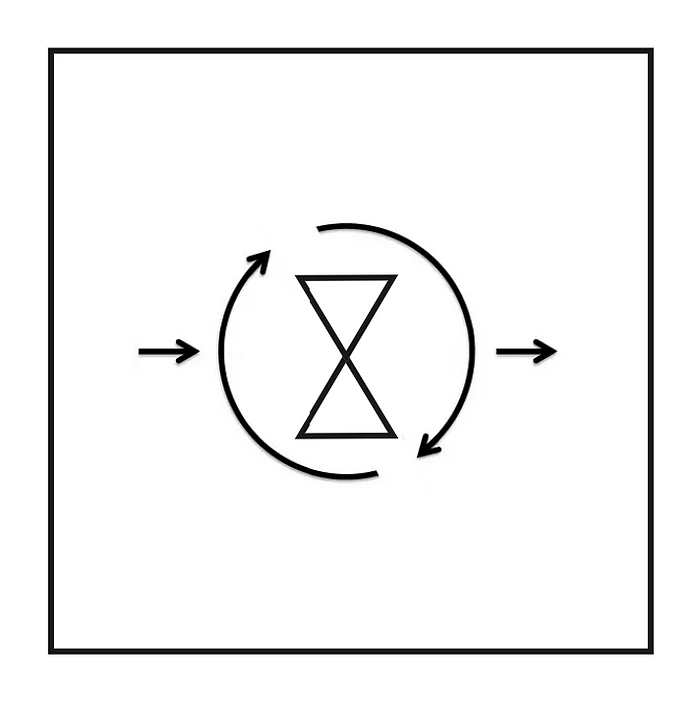
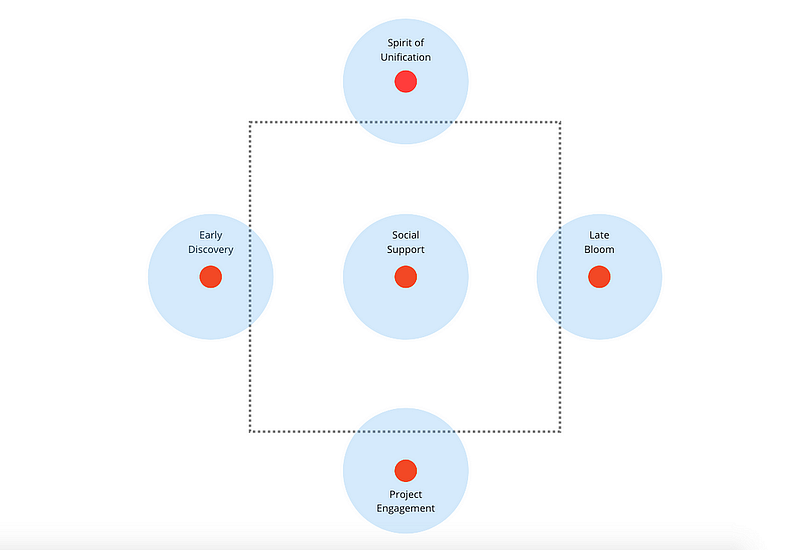
In this way, we see a new cycle of “Possible — Actual — Logical/Mental — Representation”.
Thus, the “Ecological Actualism” framework is a dynamic developmental process. It is a cyclical process.
2. Five Moments of Knowledge Frameworks
I pay attention to two fields: Knowledge Engagement and Product Engagement. Both two fields share the same pattern of developing a concept system. However, they have different complexities in the stage of Continuous Objectification.
For knowledge engagement, a typical objectification of a concept system is a Knowledge Framework or knowledge model. In the past several months, I developed a series of diagrams about knowledge frameworks. If we put them together, it represents an example of the Ecological Actualism framework.
2.1 From Possible to Actual
On June 23, 2023, I edited a book (draft) titled Thematic Exploration: The Early Discovery of Knowledge Engagement (book, v1) and introduced a framework called Strategic Thematic Exploration.
Strategic Thematic Exploration and Conceptual Elaboration are two phases of EARLY DISCOVERY of the journey of knowledge Engagement. The further phase is Continuous Objectification which aims to turn a concept system into real things.
I use “Strategic Thematic Exploration” to frame a creative space for exploring the strategic intent with the thematic analysis methods, especially for knowledge engagement.
I consider “From Theme to Framework” as a significant early phase for the journey of knowledge engagement. There are six stages in the phase.
- A Possible Theme without Clue
- A Possible Theme with Clue
- A Primary Theme without related themes
- A Primary Theme with its network
- A Knowledge Concept with a working definition
- A Knowledge Framework with a set of concepts
Since a knowledge framework is formed by a set of concepts, I also use Spontaneous Concept System to refer to the early version of a knowledge framework.
You can find more details in The “Strategic Thematic Exploration” Framework (v1.1).
For the Ecological Actualism framework, we pay attention to the Possible — Actual transformation.
- Possible: many possible configurations of a theme network
- Actual: a particular configuration of a theme network
The Possible—Actual transformation is a process of slow cognition. I associated the process with the actions of note-taking. See the diagram below.
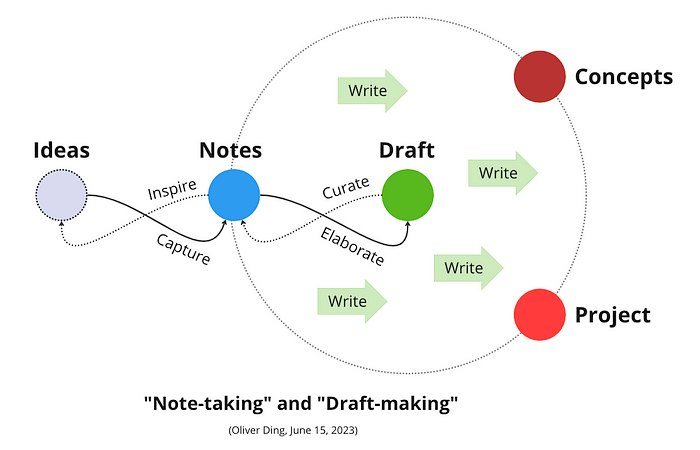
The raw materials of a knowledge framework are a network of themes. We have to develop these themes and turn them into concepts, then turn a set of concepts into a meaningful concept system which is also called a knowledge framework.
We could capture many ideas about the network of themes or concepts. We could write many notes and many drafts.
2.2 From Logical to Representation
The second stage of the Ecological Actualism framework is the Logical — Representation transformation. We always want to use an external representation to represent our thoughts on a knowledge framework.
Diagrams are a typical external representation of knowledge frameworks. We could also use tables or text-only descriptions to represent knowledge frameworks. The diagram below uses diagrams as an example.
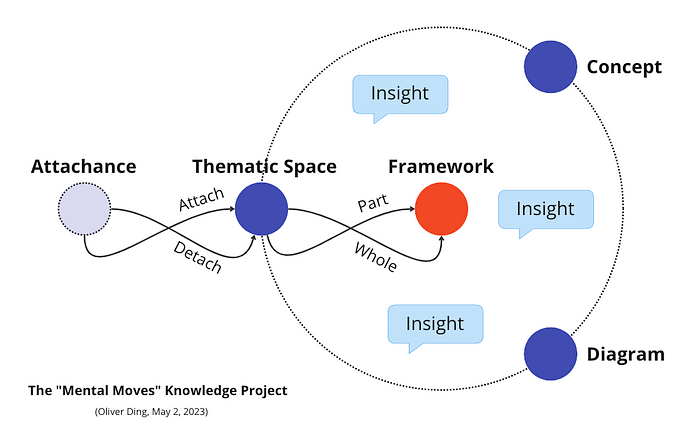
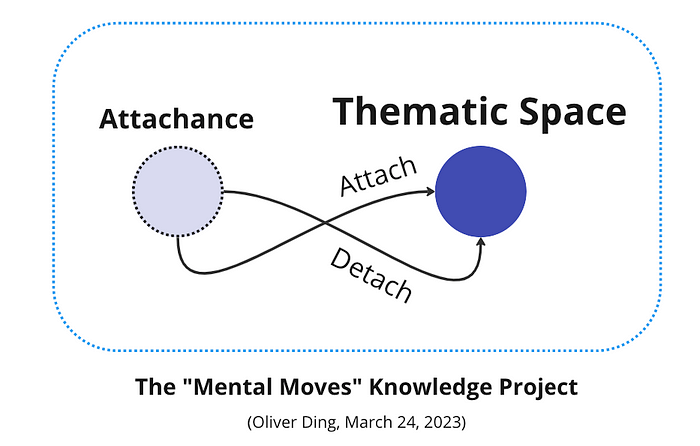
I often associated the concept of “Attachance” with my works of developing knowledge frameworks. I always identified thematic spaces within a particular knowledge framework and emphasized the Attachance of moving between thematic spaces. I also encouraged people to take the attachance of moving between different knowledge frameworks.
Originally, I considered “Concept” and “Diagram” as two significant aspects of knowledge frameworks. I added Thematic Space to the list recently.
I should emphasize that this idea is not for every knowledge framework. It only works well for some knowledge frameworks.
You can find more details in Mental Moves #3: Attachance, Thematic Space, and Framework.
2.3 From Mental to Action
The third stage of the Ecological Actualism framework is the Mental — Action transformation. See the diagram below.
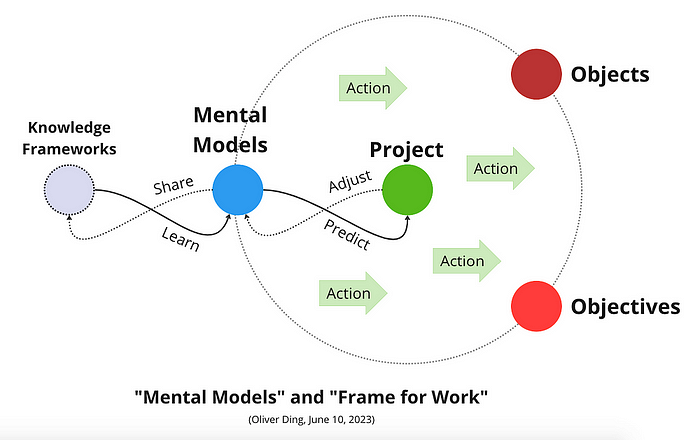
Some authors use “Mental Models” and “Knowledge Frameworks” interchangeably. I didn’t use “Mental Models” in my articles. However, I used “Abstract Models” and “Concrete Models” for the HERO U framework and I used them to describe two types of knowledge frameworks.
In June 2023, I worked on the “Mental Moves” knowledge project and decided to make a distinction between “Knowledge Frameworks” and “Mental Models”:
- Knowledge Frameworks: public objective knowledge
- Mental Models: private subjective knowledge
If we accept this distinction, we see a mediation between Knowledge Frameworks and a Project. See the diagram below.
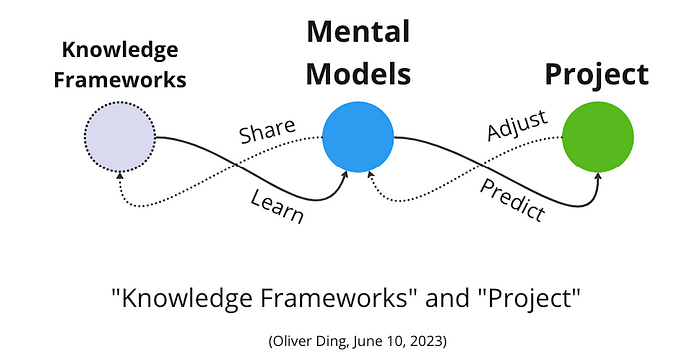
The term “Mediation” can be understood from the perspective of Activity Theory. Lew Vygotsky claimed that human action and psychological functions are mediated by tools which refer to technical tools that work on objects and psychological tools that mediate the mind and environment.
A person has to learn and understand a knowledge framework to use it as a psychological tool for his/her projects. The learned knowledge framework is a mental model which is part of the person’s mind.
Why do we need this distinction? Because we can’t ignore at least the following four facts:
- The learned knowledge framework may not be the actual knowledge framework.
- A person also can curate several learned knowledge frameworks together and turn them into a new mental model.
- A person also can detach several knowledge elements from some knowledge framework and attach them to some mental models.
- A person also can invent his/her mental models without adopting anything from others’ knowledge frameworks.
Since the difference between Knowledge Frameworks and Mental Models is large, I believe the distinction is needed for the Ecological Actualism framework.
You can find more details in Mental Moves #6: Mental Models and the Attachance of Multiple Moves.
2.4 From Make to Use
At the end of the journey of Knowledge Engagement, a knowledge framework could be transformed into a simple product such as a book, or a canvas.
The fourth stage of the Ecological Actualism framework is the Make — Use transformation.
As mentioned above, I pay attention to two fields: Knowledge Engagement and Product Engagement. Both two fields share the same pattern of developing a concept system. However, they have different complexities in the stage of Continuous Objectification.
For the field of Product Engagement, a knowledge framework is usually for guiding the work of making a product. However, we could find some specific domains in which knowledge frameworks are part of the product. For example, a SaaS platform developed could have a knowledge framework about the human activity they are working on.
In this way, we can use the Product Langue framework to understand the Make — Use transformation.
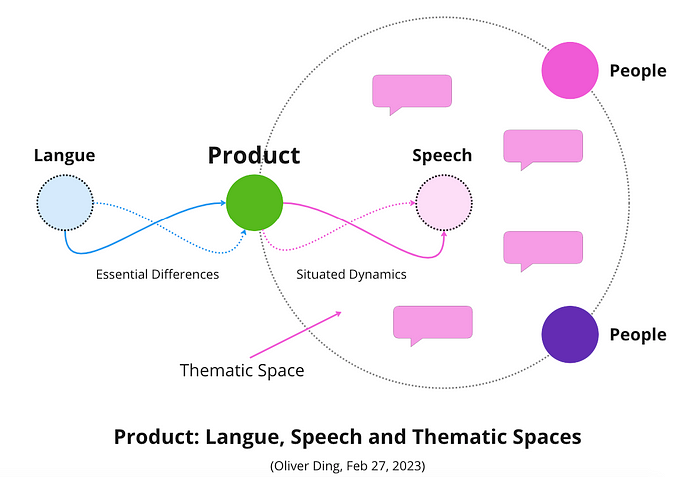
In general, a knowledge framework is a concept system. For the field of Product Engagement, I use the term “Concept System” in discussions.
The above diagram is the basic model of “Product Langue”. The “Langue” is a representation of a “Product”s core which describes its uniqueness. In different concrete situations, the “Langue” is represented by different things which are focuses of product speech.
Based on the above model, I identify 14 types of thematic spaces and 5 types of product speech. See the diagram below.
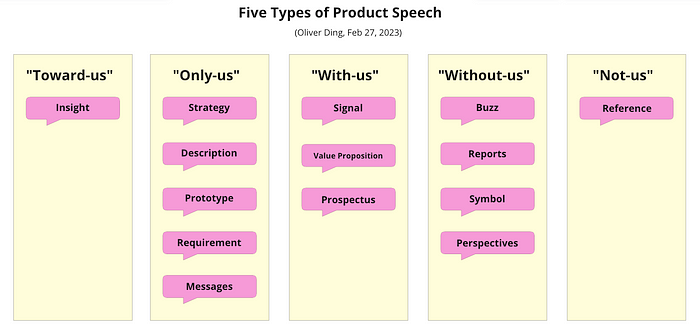
Each thematic space has its own rules for its thematic conversation and speech in general. These rules can be found in real-life social practices. For example, “Consumer Research” and “Initial Public Offering (IPO)” are two different social practices of business development.
There is a connection between the “Evolving Concept System” model and the Product Langue framework.
- Product Langue = A Defined Concept System, made by the Founder
- Product Speech = The Continuous Objectification of the Defined Concept System, made by the Founder. It is also perceived by Users as a Spontaneous Concept System
In this stage, we have to pay attention to the “Founder — User” relationship which is a specific type of “Self — Other” relationship. In this situation, the term “Defined Concept System” is used to describe the Founder’s perspective, and the term “Spontaneous Concept System” is used to describe the Users’ perspectives.
You can find more details in TALE: Product, Langue, and Speech and Mental Platform: The Evolving Concept System.
2.5 From Use to Possible
The fifth moment is about the Use — Possible transformation.
It simply jumps back to the first moment: the Possible — Actual transformation.
This is a dynamic developmental cycle!
3. The Meaning of Ecological Actualism
Though this article is about Knowledge Frameworks (Diagrams), we could use it as an example to understand the meaning of Ecological Actualism.
3.1 A Developmental Dynamic Process
I use “stage” for the above sections. It’s better to use “moment” to describe these actions.
Each transformation is a moment.
There are many possible patterns we can find from the sequence of these five types of moments. The “Stage” view is one of these patterns.
The Ecological Actualism framework sees a knowledge framework and a diagram are no longer a static knowledge representation, but a developmental dynamic process.
The process is a dynamic creative territory for exploring, reflecting, and curating.
The core idea of this view is the “Representation — Thematic Space — Perceiver” structure. A user could perceive potential thematic space of a representation (a diagram) of a knowledge framework, and discover some new creative spaces.
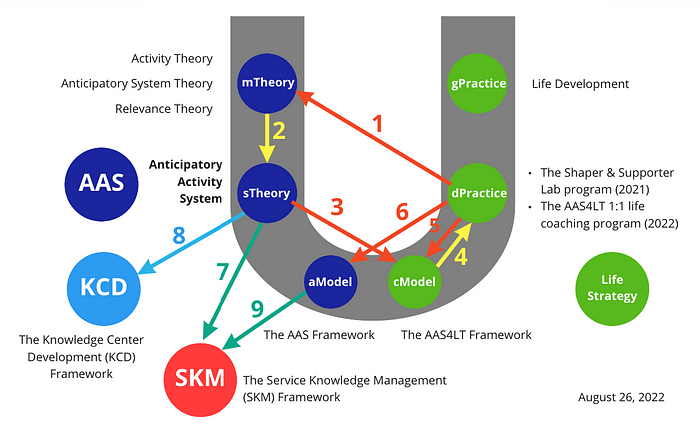
For example, the diagram below shows the night moves of the journey of developing the Anticipatory Activity System (AAS) framework. You can find more details in Slow Cognition: The Development of AAS (August 21, 2021 — August 26, 2022).
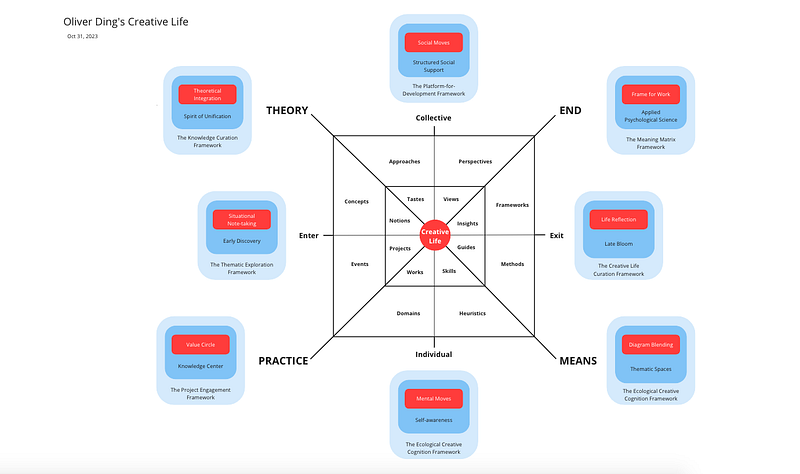
We can also find many similar actions from [Creative Diagramming] Graphic Space Affordances, Thematic Space, and Possible Paths.
For example, I used the Knowledge Discovery Canvas (a representation of a knowledge framework) to discover several potential thematic spaces. You can find more details in Creative Life Curation: Discover Thematic Spaces of Creative Life.
What are the benefits of this view to knowledge frameworks?
For knowledge creators, this view gives new opportunities to develop the adaptability and utility of an existing knowledge framework (and its diagrams).
For knowledge users, this view gives new opportunities to flexibly turn an existing knowledge framework into a situational heuristic tool.
3.2 Graphic Space Affordances
The Ecological Actualism framework emphasizes Potential Action Opportunities that emerge from the “Object—Environment — Actor” structure.
This view is inspired by Ecological Psychologist James G. Gibson’s Affordance Theory and his ecological approach to visual perception in general.
What’s Affordance? Let’s have a look at the original definition made by Gibson:
The affordances of the environment are what it offers the animal, what it provides or furnishes, either for good or ill. The verb to afford is found in the dictionary, but the noun affordance is not. I have made it up. I mean by it something that refers to both the environment and the animal in a way that no existing term does. It implies the complementarity of the animal and the environment. (p.119)
Though the core of Gibson’s theory is visual perception, we can see the whole “Perception-Affordance-Action” loop as a theory of action and apply it to new fields. Perceiving affordances is for taking actions, taking actions has an impact on the environment and changes the affordances of the environment. I draw the diagram below to visualize this loop.
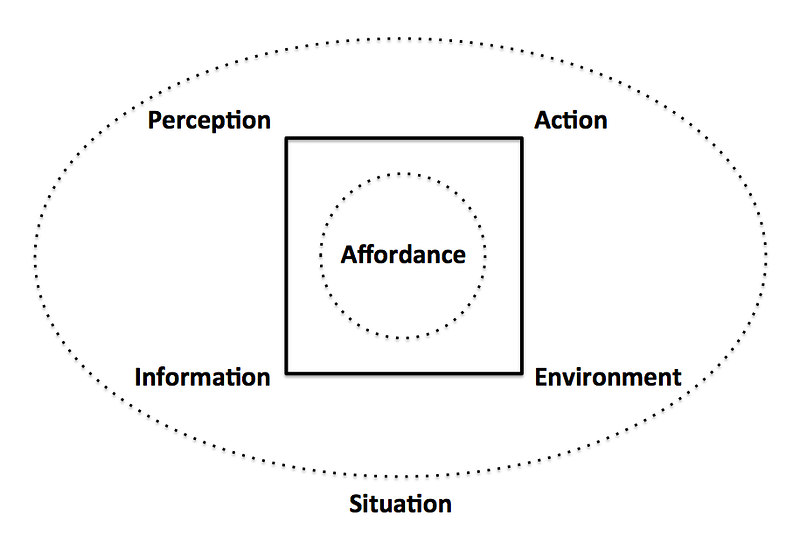
Gibson’s approach focuses on the physical environment, it is hard to directly apply it to Knowledge Frameworks. However, we can pay attention to Diagrams which are the External Representation of knowledge frameworks.
Our approach to knowledge frameworks is built on the concept of Graphic Space Affordances.
Though the term Affordance was coined by Gibson for his theory of ecological perception, the term is often misused in the literature in diffuse and imprecise ways. Outside ecological psychology, some authors expand the original meaning of Affordance from perception-based relative aspects to non-perception analysis. I personally don’t like this approach because the perception level analysis and the non-perception analysis have different conditions and require different analysis frameworks. It’s hard to maintain a consistent theoretical meaning for the concept of Affordance.
Some authors’ re-conceptualization of Affordance may have a special contribution to their domains, however, their new definitions of Affordance may add misunderstanding to Gibson’s original meaning. Eventually, the term Affordance became a normal word. I want to keep Gibson’s original meaning for the concept of Affordance and remain at the analysis level of the natural/material/technological environment.
Since Gibson’s Affordance theory is all about body-scale physical environments, It’s hard to apply it to digital environments because there are obvious differences between the physical environment and the digital environment. Thus, one-to-one accurate mapping is impossible and unnecessary.
Information Systems researchers and Social Media researchers tend to use the concept of Affordances at an abstract high-level or concrete feature-oriented low level. Tina Bucher and Anne Helmond made a great review of these situations in their paper The Affordances of Social Media Platform (2018). For example, danah boyd suggested four affordances: persistence, replicability, scalability, and searchability at the high level for social network sites (2011). On the other side, HCI researchers and designers focus on the affordances of buttons, screens, and special features at the low level for interface design. For example, William W. Gaver published a paper titled Technology Affordances (1991) and separated Affordances from the information available about them allowing the distinction between correct rejections and perceived hidden and false affordances.
My own approach is 1) adopting the Ecological Physical method to discuss digital environments, and 2) Using a metaphor called “Information as Light” to translate Gibson’s terms for discussing digital environments. You can find more details here: #SocialPxD — ReEngagement with Twitterville: An Introduction to Ecological Physics Method.
For the present discussion about diagrams and affordances, I designed a simple diagram below to develop a rough typology of Space Affordances.
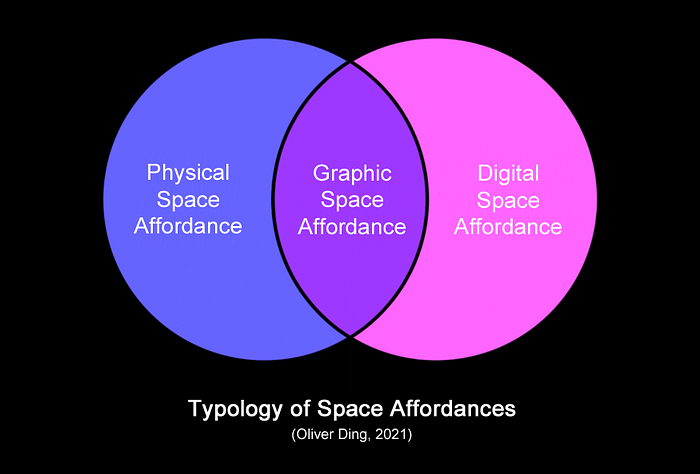
Gibson actually didn’t use “Space Affordances” as a term in his books. He talked about various types of environments such as Surfaces, Objects, Other Persons and Animals, Places, and Hiding Places. I use the term Physical Space Affordances to refer to Surfaces, Containers, Places, etc. On the other hand, Non-space Affordances refer to Non-container Objects, Other Persons, and Animals.
The typology of Space Affordances highlights Graphic Space Affordance which is coined for discussing Diagrams in particular. It considers the affordances of white space in a graphic. In graphic design, white space means the space that surrounds the elements. Graphic Space Affordance asks a simple question:
What can I do with the white space of a diagram?
Digital Space Affordance considers the affordances offered by digital screens and virtual spaces. It’s a huge challenge to develop a general framework for the concept of Digital Space Affordance. I’d like to directly discuss some case studies about diagrams and digital spaces such as Miro which is a digital whiteboard platform.
Gibson’s 1979 book The Ecological Approach to Visual Perception has 16 chapters. Gibson used the last two chapters to talk about pictures, videos, and visual awareness. The title of Chapter 15 is Pictures and Visual Awareness and Chapter 16 is Motion Pictures and Visual Awareness.
Gibson became interested in pictures and films during the war as a psychologist concerned with training young men to fly airplanes.
Based on the notion of Ecological Invariant, Gibson suggested that the picture is an array of persisting invariants of structure that are nameless and formless. This definition assumes that some of the invariants of an array can be separated from its perspective structure, not only when the perspective keeps changing, as in life. Thus, we can see formless invariants in a picture that seems to consist entirely of forms. Gibson gave us an example of a child and a cat:
This says that when the young child sees the family cat at play the front view, side view, rear view, top view, and so on are not seen, and what gets perceived is the invariant cat. The child does not notice the aspects of perspectives of the cat until he is much older; he just sees the cat rolling over. Hence, when the child first sees a picture of a cat he is prepared to pick up the invariants, and he pays no attention to the frozen perspective of the picture, drawing, photograph, or cartoon. It is not that he sees an abstract cat, or a conceptual cat, or the common features of the class of cats, as some philosophers would have us believe; what he gets is the information for the persistence of that peculiar, furry, mobile layout of surfaces…The child never sees a man as a silhouette, or as a cutout like a paper doll, but probably sees a sort of head-body-arms-legs invariant. Consequences, any outline drawing with this invariant is recognized as a man, and the outlines tend to be seen as the occluding edges of a man with interchangeable near and far sides. (p.259)
Gibson also argued that a picture is also a record that enables the invariants that have been extracted by an observer — at least, some of them — to be stored, saved, put away retrieved, or exchanged.
The notion of Ecological Invariants is part of Gibson’s Ecological Physical Method. You can find more details in a previous article #SocialPxD — ReEngagement with Twitterville: An introduction to Ecological Physics Method.
The above discussion tells us that Gibson didn’t pay attention to the white space of graphics. As mentioned above, I am quite conservative on repurposing the concept of Affordance. However, I’d like to coin the term Graphic Space Affordance (GSA) for discussing Diagrams in particular. The value of the concept of GAS refers to the affordances of white space of a graphic for people. It starts with a simple question: What can I do with the white space of a diagram?
In graphic design, white space means the space that surrounds the elements. By focusing on the affordances of white space of diagrams, we can find some constraints for design and some opportunities for innovation.
Let’s see an example of the affordance of white space.
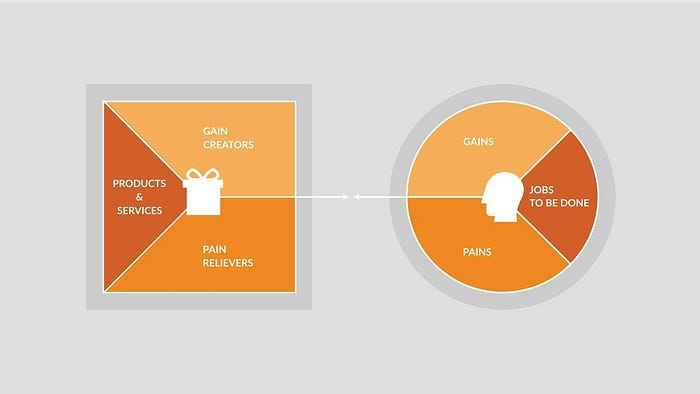
The Value Proposition Canvas was introduced in a 2014 book titled Value Proposition Design. This is a popular canvas for startup product design and business model development. However, Craig Walmsley argued that business model design should consider ethics as an important perspective for valuing value. Walmsley said, “In part, that’s because the core design tools we use tend to omit the relations between people that would give them meaningful ethical content. That is to say, they pay little attention to the customer’s friends and family, the company’s employees, competitors, or society at large. Or to the consequences of a proposition in the wider world — the carbon footprint, or the length of time it would take for a product to biodegrade, for example. Paying attention to just the business and customer means not paying attention to the ethical implications of design choices.”
In order to develop a new tool that replaces the traditional “business — customer” mindset, Walmsley developed a new canvas: Impact Canvas.
How did he make the alternative?
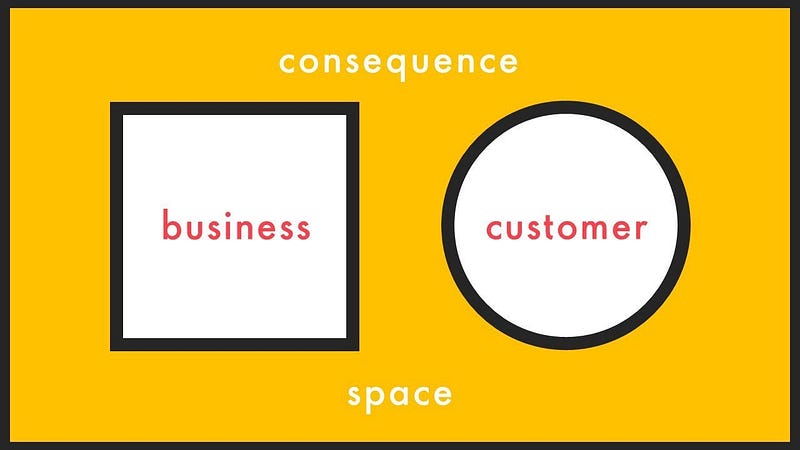
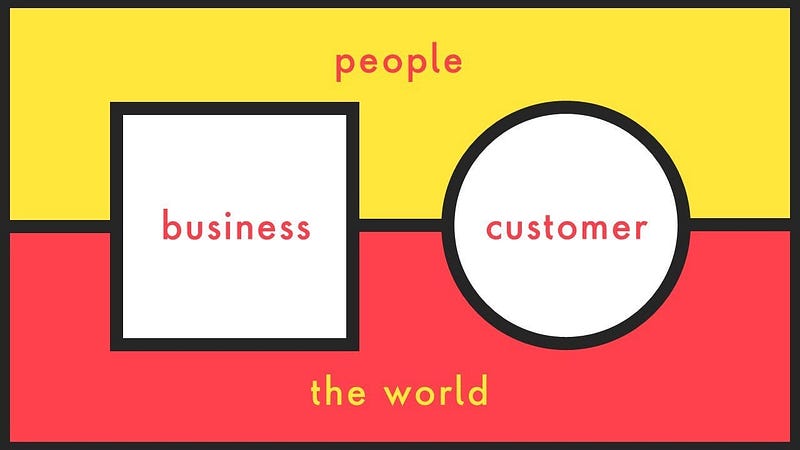
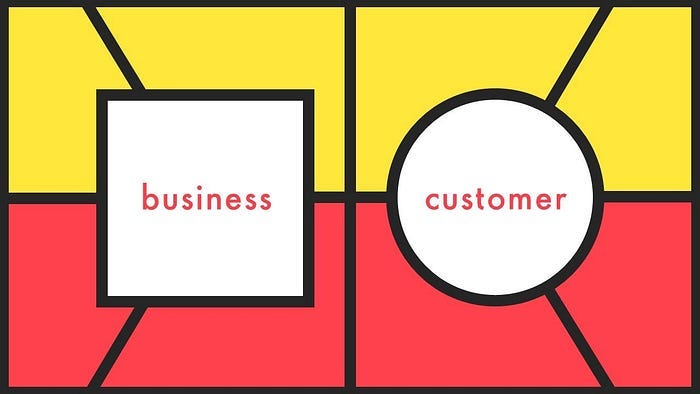
Walmsley perceived the white space of the Value Proposition Canvas and defined it as Consequence Space. Then, he divided the Consequence Space into different areas of impact. The final canvas is called the Impact Canvas. See the picture below.
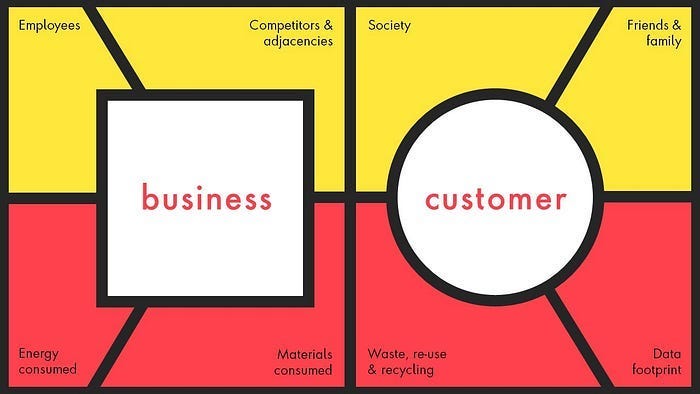
This is a great example of taking Graphic Space Affordances for innovation.
Graphic Space Affordances also connect to both Physical Space Affordances and Digital Space Affordances. Physical Space Affordances are considered a physical container of a diagram. The size of the physical container also impacts Graphic Space Affordances.
You can find more details in D as Diagramming: An Integrated Framework for Studying Knowledge Diagrams (Part 4A).
3.3 Explore Thematic Spaces and Beyond
Building on the Graphic Space Affordances, we can add more creative ideas to our actions. For example,
- Exploring and utilizing potential thematic spaces,
- Exploring possible connections between two knowledge networks,
- Exploring the spatial structure of a knowledge framework (diagram),
- Exploring possible paths of moving between thematic spaces
For example, I recently worked on exploring potential thematic spaces of the Developmental Project Model. The diagram below is an example of the exploration.
On Oct 23, 2023, I discovered a new type of developmental project called “ECHO” at the “Social — Position — Identity” thematic space.
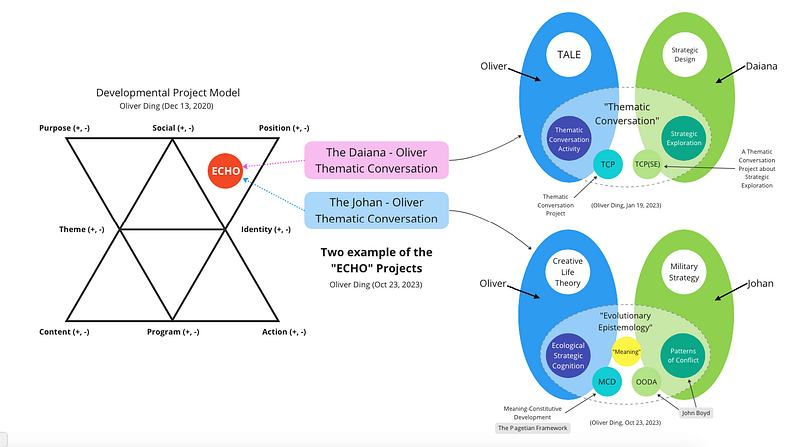
The above diagram also shows a connection between the Developmental Project Model and the ECHO Way (v2.0).
- The Daiana — Oliver Thematic Conversation (Jan 2023)
- The Johan — Oliver Thematic Conversation (Oct 2023)
You can find more examples in [Creative Diagramming] Graphic Space Affordances, Thematic Space, and Possible Paths.
3.4 Potential Action Opportunities
Baggs and Chemero (2020) argued the meaning of “ecological psychology” is not clear, they suggested that “… Gibson’s ecological approach can perhaps be read as an unprecedented account of the conditions of mental life: it is an account of the structure of things ‘out there’ — the structure that an animal can potentially come into contact with. What it generally is not is an account of what animals actually do when they come into contact with their surroundings.”
Gibson didn’t use the term “Ecological Psychology” to name his theoretical approach. He used “the ecological approach to visual perception” to name his book.
What can we learn from Gibson’s thought?
We even can trace back to Gibson’s philosophical thought. According to Edward S. Reed, Gibson’s idea can be seen as “experience + action”.
The primary difference between Holt and the young Gibson lay in the latter’s evenhanded treatment of both action and experience. “Holt didn’t believe in phenomenology,” Gibson (1979c, 89) was to recall years later. Even at his most behavioristic, Gibson not only believed in phenomenology, but also used it to guide his research and theorizing. Gibson’s psychology united experience and action, whereas James’s psychology had applied only to experience and Holt’s only to action.
For Gibson, the core of the ecological approach is the “Perception-Affordance-Action” loop. Harry Heft compared Gibson’s starting point with Gestalt psychologist Kurt Koffka’s idea in Ecological Psychology in Context (2001):
…as a scientist, Gibson followed Koffka’s (1935) lead by going beyond the phenomenological question of “what do things look like?” to ask two further questions: a functional question followed by a more analytical one. The functional question is “What properties of its econiche does an animal perceive in carrying out its various activities?” The analytical question is “What conditions make these functionally significant properties available to be perceived?”…J.J. Gibson began his later books (1966, 1979) by asking ,“What is there to be perceived?”(p.146)
Heft pointed out, “Gibson’s preliminary answer to these questions is that the perceptual systems of animals have evolved to support perceiving and utilizing the affordances of the environment.” (p.146)
The Ecological Actualism Framework follows Gibson’s philosophical thought.
4. A New Framework of Knowledge Frameworks
By adopting the Ecological Actualism Framework, we define a new ontology of knowledge frameworks.
Now we can expand it into a meta-framework for understanding knowledge frameworks. See the diagram below.
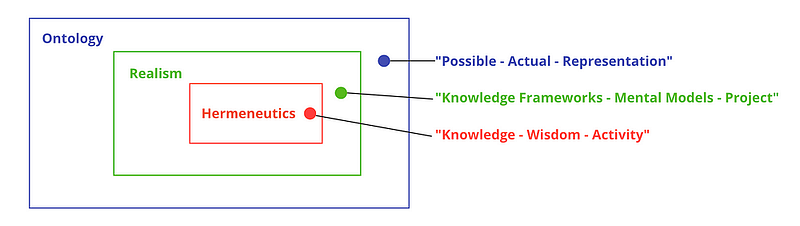
The above diagram uses a schema called “Ontology — Realism — Hermeneutics” to build a model of the “Frame for Work” project.
The “Ontology — Realism — Hermeneutics” schema is adopted from Ping Keung Lui’s theoretical sociology.
The structure of Lui’s theoretical sociology is a nested structure. See the diagram below. According to Lui, “The realism comprises a subjectivist structuralism and an objectivist stock of knowledge, while the hermeneutics is an interpretation and an analysis. Second, I shall present an ontology that nests the realism within its boundaries.” (p.250, 2016, Aspects of Sociological Explanation)
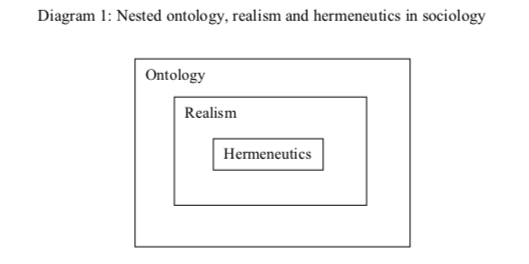
We should see this grand theory as a dialogue between philosophy and sociology because “Ontology” and “Hermeneutics” are respectable terms in philosophy, but “Realism” — sandwiched between them — is not. Lui emphasizes that Realism is the sociological matter proper (p.251, 2016, Aspects of Sociological Explanation).
The above sections have given a complete explanation of the new Ontology of knowledge frameworks. Let’s move to the Realism:
- Knowledge Frameworks — Mental Models — Project
The above discussion has mentioned the dissection between Knowledge Frameworks and Mental Models. How about the relationship between Mental Models and a Project?
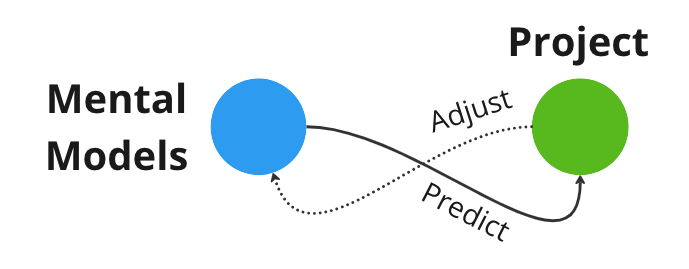
A Project can be seen as a collection of a series of actions. How do these actions form a Project? The answer is the following three elements of a project:
- Objectives: the goals of a project
- Objects: the things people are working on
- Mental Models: the plan or knowledge for predicting the development of the project
The above diagram connects Mental Models with a Project. In this manner, Mental Models are functioning as Predictive Models of Projects.
The term “Predictive Models” is an important element of the Anticipatory Activity System (AAS) framework.
The “Anticipatory Activity System (AAS)” framework adopts Activity Theory and Anticipatory System theory to discuss “Self, Other, Present, Future”. You can find more details here.
For a particular project, a person will develop a particular model to help her model the development of the project. In other words, she will use a model to predict the future of the project.
The model can be explicit, such as a diagram with a document. However, the model can be tacit, the person just uses her mind without any instruments to display the model. What I found from my empirical research is that sometimes the person would like to visualize or write her model about the project because this way is a great way of thinking. But the person would like to keep the model as a private information, unless the project needs the public versin of the model for storytelling.
The mutual relationship between Mental Models (Predictive Models) and a Project is dynamic.
The model is the outcome of the “objective — subjective” knowledge curation. For example, a friend of mine adopted some psychological knowledge and the OKR method to build a model and use the model to develop her life development program. She modified her model several times to match the changes of her clients within 12 months.
Finally, we can reach the part of Hermeneutics: Knowledge — Wisdom — Activity. See the diagram below.
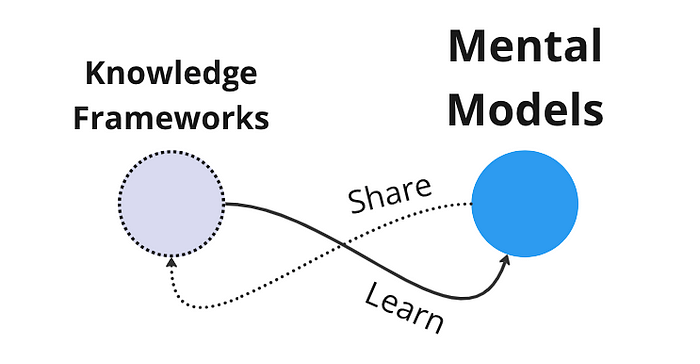
The “Predict — Adjust” interactions echo the “Learn — Share” interactions. While the former is about mental moves between “Knowledge” and “Wisdom”, the latter is about mental moves between “Wisdom” and “Activity”.
If we put the above discussion together, we can see the “Knowledge — Wisdom — Activity” schema of mental moves behind the diagram below.
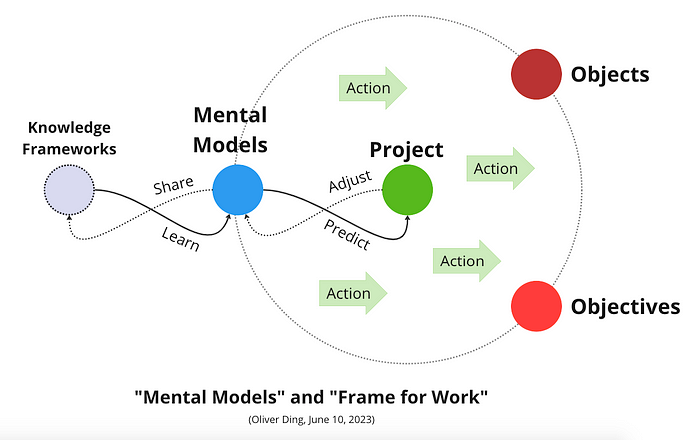
You can find more details about the above diagram in Mental Moves #6: Mental Models and the Attachance of Multiple Moves.
You can also find more details about the “Ontology — Realism — Hermeneutics” schema in Knowledge Engagement: The Utilization of Theoretical Resources.
This is the outcome of the “Frame for Work” project (Phase I). Now it’s time to close the project.

- Started: May 10, 2023
- Closed: Dec 13, 2023
- Outcome: 1) A case study of the Ecological Actualism Framework, and 2) A new framework of knowledge frameworks
Related Articles
- Social Moves: An Integrated Ecological Approach to Social Cognition — Dec 5, 2023
- TALE: A Possible Theme called “Frame for Work” — May 10, 2023
- Mapping Thematic Space #7: The Center of the “Ecological Interaction” Thematic Space — Feb 25, 2022
- #SocialPxD — ReEngagement with Twitterville: An Introduction to Ecological Physics Method — June 19, 2020
- [Creative Diagramming] Graphic Space Affordances, Thematic Space, and Possible Paths — Oct 31, 2023
- Mental Moves #3: Attachance, Thematic Space, and Framework — May 2, 2023
- Mental Moves #6: Mental Models and the Attachance of Multiple Moves — June 12, 2023
- Mental Platform: The Evolving Concept System — Nov 30, 2023


