
#SocialPxD — ReEngagement with Twitterville
An Introduction to Ecological Physics Method
#SocialPxD stands for Social Platform Experience Design.
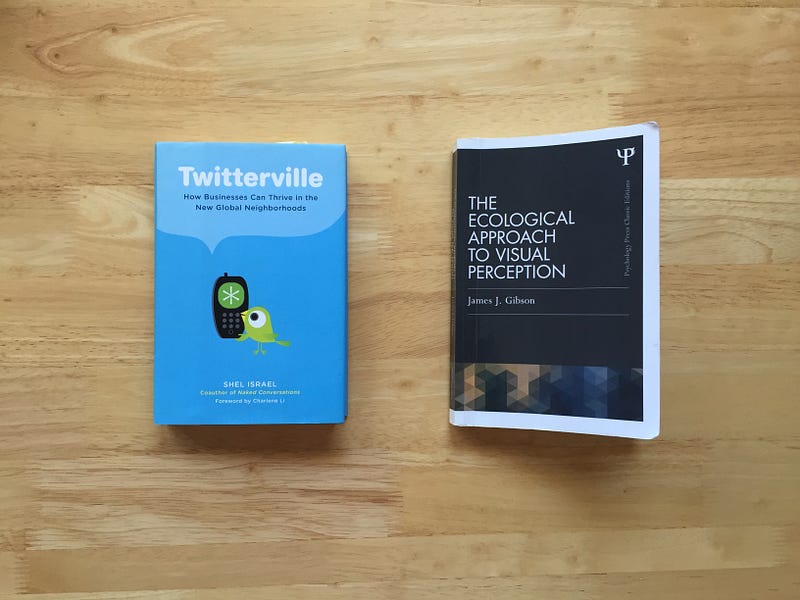
In 2009, Shel Israel published Twitterville: How Businesses Can Thrive in the New Global Neighborhoods when Twitter was only 3 years old. Shel Israel pointed out, “Unlike other hot social media spaces, Twitterville is dominated by professionals, not students. And despite its size, it still feels like a small town. Twitter allows people to interact much the way they do face-to-face, honestly and authentically.”
Now Twitter is no longer a small town, it has over 321 million active users (February 2019). Does the notion of Twitterville still stay relevant?
As Israel mentioned years before, “No matter where you’re from or what you do for a living, you will find conversations on Twitter that are valuable. Despite the millions of people joining the site, you’ll quickly find the ones who can make a difference to you.” I think Twitterville is still a valuable idea because it describes a unique perspective that views Twitter as a living place for open social interactions as well as personal growth and development.
Israel used a narrative approach to research Twitter and focused on business professionals. Inspired by Ecological psychologist James J. Gibson’s ecological approach, I adopt Twitterville as a metaphor and redefine it as a theoretical concept: Twitterville is the Ecological Environment of the Twitter world. This new definition brings us a new unit of analysis: an ecological-level setting of Tweeting practice.
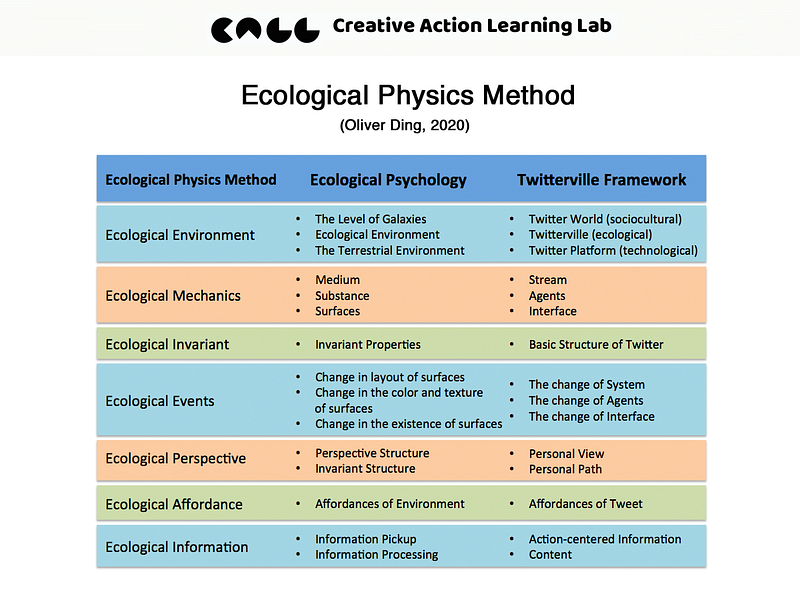
This article aims to introduce the Ecological Physics Method and apply it to Twitterville. I will quote Gibson’s ideas from his book The Ecological Approach to Visual Perception (1979/2015) and translate them into the context of Twitter research. The Ecological Physics Method incorporates the following seven aspects: Ecological Environment, Ecological Mechanics, Ecological Invariant, Ecological Events, Ecological Perspective, Ecological Affordance, and Ecological Information into a unified framework.
Gibson didn’t use the term Ecological Physics Method, he only used the term Ecological Physics. After reading Gibson’s book, I realized he used a brand new method to build his theory. In order to summarize his method for cross-disciplinary application, I called the method the Ecological Physics Method.
The chart below highlights concepts and terms Gibson used for his ecological psychology and my translations of these terms for Twitterville. The approach taken to presenting these concepts makes it possible to structure and ensure clarity when explaining basic principles of Ecological Physics to the target audience of this article — the platform thinking community, many of whom are not specialists in Gibson’s ecological psychology.
I hope this approach to interpreting Gibson’s theory and method and Shel Israel’s notion could help you understand the theory and practice better, however, there are obvious differences between the physical environment and the digital environment. Thus, one-to-one accurate mapping is impossible and unnecessary.
Contents
1 Gibson’s Ecological Approach 2 Twitterville as an Ecological Environment 3 Ecological Mechanics 4 Information as Light 5 Ecological Invariant 6 Ecological Events 7 Ecological Perspective 8 Ecological Affordance 9 Ecological Information 10 Picture, Video, and Visual Awareness 11 Make Use of Action-centered Platforms
1. Gibson’s Ecological Approach
The notion of the Ecological Approach is about the “Organism—environment” relationship. Various theorists from different fields have different versions of ecological approaches. As the founder of ecological psychology, James J. Gibson had unique thoughts on the “Organism-Environment” relationship.
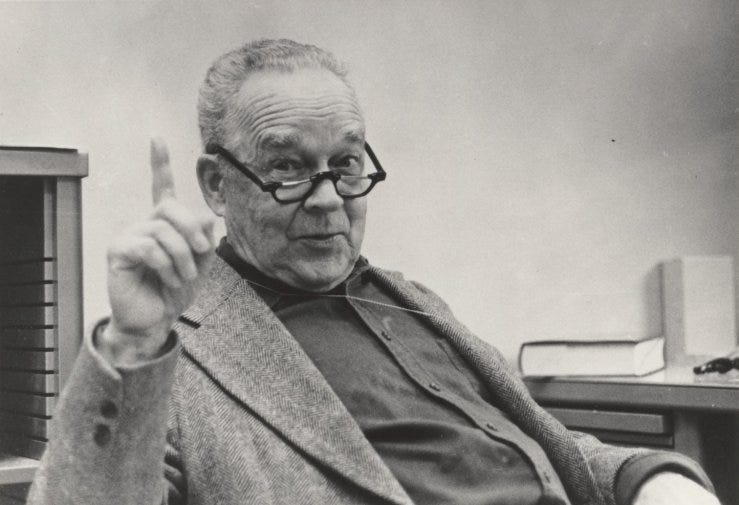
For Gibson, the core of the ecological approach is the “Perception-Affordance-Action” loop. Harry Heft compared Gibson’s starting point with Gestalt psychologist Kurt Koffka’s idea in Ecological Psychology in Context (2001):
…as a scientist, Gibson followed Koffka’s (1935) lead by going beyond the phenomenological question of “what do things look like?” to ask two further questions: a functional question followed by a more analytical one. The functional question is “What properties of its econiche does an animal perceive in carrying out its various activities?” The analytical question is “What conditions make these functionally significant properties available to be perceived?”…J.J. Gibson began his later books (1966, 1979) by asking ,“What is there to be perceived?”(p.146)
Heft pointed out, “Gibson’s preliminary answer to these questions is that the perceptual systems of animals have evolved to support perceiving and utilizing the affordances of the environment.”(p.146)
What’s Affordance? Let’s have a look at the original definition made by Gibson:
The affordances of the environment are what it offers the animal, what it provides or furnishes, either for good or ill. The verb to afford is found in the dictionary, but the noun affordance is not. I have made it up. I mean by it something that refers to both the environment and the animal in a way that no existing term does. It implies the complementarity of the animal and the environment. (p.119)
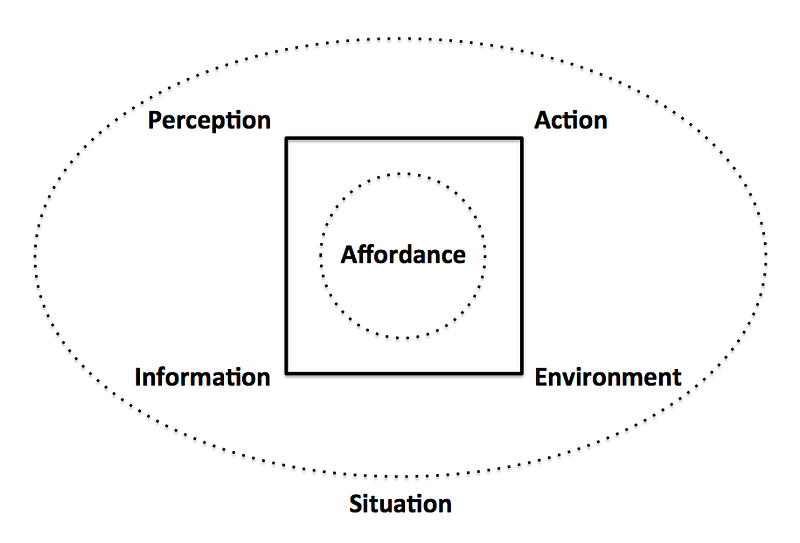
Though the core of Gibson’s theory is visual perception, we can see the whole “Perception-Affordance-Action” loop as a theory of action and apply it to new fields. Perceiving affordances is for taking actions, taking actions has an impact on the environment and changes the affordances of the environment. I draw the diagram below to visualize this loop.
Gibson’s approach focuses on the physical environment, it is hard to directly apply it to digital platforms. Instead of modifying the original definition of Affordance and turning it into a buzzword, I adopted Gibson’s Ecological Physics Method to guide my research. Gibson only used the term Ecological Physics, he said “To be sure, we define what it is in terms of ecological physics instead of physical physics, and therefore it possesses meaning and value to begin with” (p.139).
Harry Heft shared more background on Ecological Physics in his book Ecological Psychology in Context (2001). He said,
With ecological optics, Gibson was proposing instead an ecological physics on the basis of which it is coherent to talk about meaning and value, that is, psychological qualities, in the environment. As an ecological physics, it is a relational physics of a different sort than the field physics embraced by Gestalt psychologists. Instead of being a physics of a relationship field of physical objects, it is a physics of a relational field of animal and environment. Here the crucial distinction is not between the nonpsychological and the psychological, but rather between potential and actual (or realized) structure in experience (p.224).
Gibson was not the initiator of Ecological Physics. Heft mentioned this issue and highlighted Fritz Heider’s idea and his relationship with Gibson, “In 1926, Fritz Heider published a remarkable paper based on his dissertation. Heider’s ‘Thing and Medium’ is a landmark in the development of ecological psychology. It profoundly shaped the ideas of Gibson and Brunswik…Heider made a start at developing an ecological physics by drawing a distinction between the object of perception and that which mediates the object of perception being perceived. ” (p.225)
After reading Gibson’s book, I realized he used a brand new method to build his theory. I called the method the Ecological Physics Method.
The Ecological Physics Method has seven aspects:
1- Ecological Environment 2- Ecological Mechanics 3- Ecological Invariant 4- Ecological Events 5- Ecological Perspective 6- Ecological Affordance 7- Ecological Information
Detailed discussions about these aspects are presented as follows. I will introduce Gibson’s original ideas and translate these ideas one by one for our Twitter case study: Twitterville.
2. Twitterville as an Ecological Environment
The key notion of ecological environment is extremely important and the foundation of Gibson’s ecological approach. The most important aspect of Gibson’s ecological environment is it considers a meaningful environment:
The world of physical reality does not consist of meaningful things. The world of ecological reality, as I have been trying to describe it, does. If what we perceived were the entities of physics and mathematics, meanings would have to be imposed on them. But if what we perceive are the entities of environmental science, their meanings can be discovered. (p.28)
The second aspect of Gibson’s ecological environment is the level of analysis.
The world can be described at different levels, and one can choose which level to begin with. Biology begins with the division between the nonliving and the living. But psychology begins with the division between the inanimate and the animate, and this is where we choose to begin. ( p.1)
From the perspective of physics, the world contains many things from atoms through terrestrial objects to galaxies. We understand the world based on the levels. The astronomical world is understandable based on the light-years level while the world of atoms is measurable at the level of millionths of a millimeter and less. Gibson chose the terrestrial scale world as the ecological environment:
We are concerned here with things at the ecological level, with the habitat of animals and men, because we all behave with respect to things we can look at and feel, or smell and taste, and events we can listen to. The sense organs of animals, the perceptual systems are not capable of detecting atoms or galaxies.(p.5)
How to apply the notion of Ecological Environment to the Twitter world? What is the level of atoms within the Twitter World? What is the level of galaxies within the Twitter world? What is the terrestrial level within the Twitter world?
I consider the “What’s happening” section as the level of galaxies within the Twitter world. This section and other global features point to global-level activities within the Twitter world. It displays the most relevant global issues to all Twitter users.

The level of atoms within the Twitter world is located at each click on the interface such as liking a tweet, bookmarking a tweet, replying, etc.
Finally, I consider Twitterville as the terrestrial level within the Twitter world. This is my version of Ecological Environment for understanding social interactions on Twitter.
Now we can say the Twitter platform is a physical world that is built with hardware, software, and interface design while Twitterville is the ecological environment which is the digital habitat of people. Though the Twitter platform provides ground for Twitterville, people are not going to the Twitter world to use features, but to detect action opportunities offered by their Twittervilles.
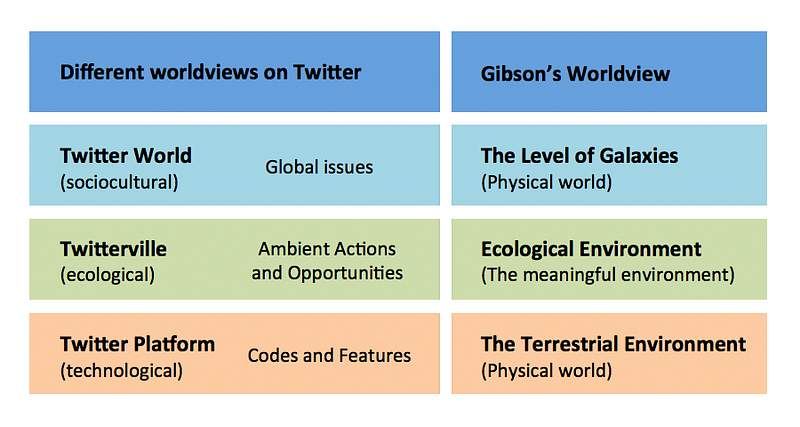
The above figure summarizes our discussion on the unit of analysis. Gibson looked at many levels of the physical world and chose an ecological environment scale based on the terrestrial environment. For Twitter, I looked at many levels of Twitter and chose the ecological environment scale called Twitterville which is full of ambient actions and opportunities.
I am not going to say that the sociocultural level and technological level are not important. For the sociocultural level, there are many established theoretical approaches such as Activity Theory, Sociocultural perspective, Social Representation, Symbolic Interactionism, etc.
3. Ecological Mechanics
The second aspect of the Ecological Physics Method is Ecological Mechanics. Gibson invented many terms for his theory, the core of them is a triad: Medium, Substance, and Surfaces. To simplify the complex story, I draw the following diagram.
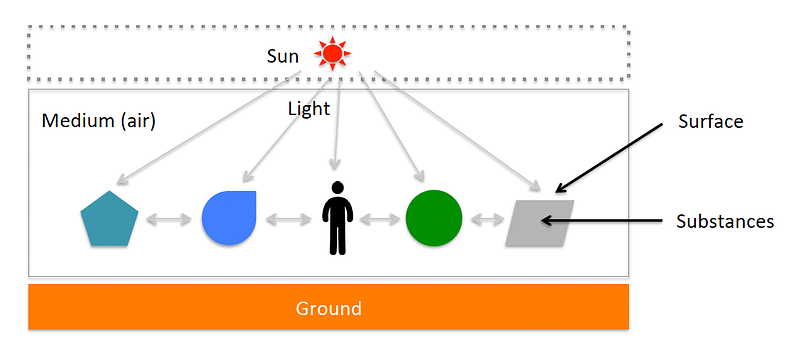
As I mentioned above, Gibson focused on the terrestrial environment for animals (including humans). Animals, plants, humans, natural objects such as rock, sand, mud, clay, metal… These are Substances. Air and water are Medium because they afford locomotion to animate the body and they are generally transparent, transmitting light. The medium is separated from the substances of the environment by Surfaces.
Why did Gibson use these new terms? Because he aimed to challenge the traditional views of perception and behavior. He said,
If we understand the notion of medium, I suggest, we come to an entirely new way of thinking about perception and behavior. The medium in which animals can move about (and in which objects can be moved about) is at the same time the medium for light, sound, and odor coming from sources in the environment. (p.13)
What Gibson developed is a theory called The Ecological Approach to Visual Perception. If we pay attention to the subject of “Visual Perception”, then we can understand why he focuses on Medium, Substance, and Surfaces. The land is the ground that supports animals. Gibson highlighted the difference between radiant light and ambient light. While radiant light comes from a point source, ambient light comes to a point in the medium. Thus, the Surfaces become very important because they reflect light and make ambient light available. Gibson’s ecological optics are complex, if you want to go deeper, check out Wikipedia and read his book.
Let’s move to the Surfaces which are the foundation of Gibson’s Ecological Mechanics because ecological events occur at the level of substances and the surfaces that separate them from the medium. From Gibson’s perspective, the change and force behind the change are different from other mechanics. He pointed out:
It has to do with what might be called ecological mechanics, which is rather different from either celestial mechanics on the one hand or particle mechanics on the other, including thermodynamics. … The terrestrial substratum is an absolute frame of reference for them, since it is itself never displaced or turned. The world does not move, not at this level of analysis. … At this level of analysis, the deformations and disruptions of a surface are not reduced to the motions of elementary particles of matter, either. (p.88)
Now it’s time to go back to the Twitter world. Can we use Gibson’s triad? or can we make different versions of the triad? What are the ecological mechanics of Twitterville?
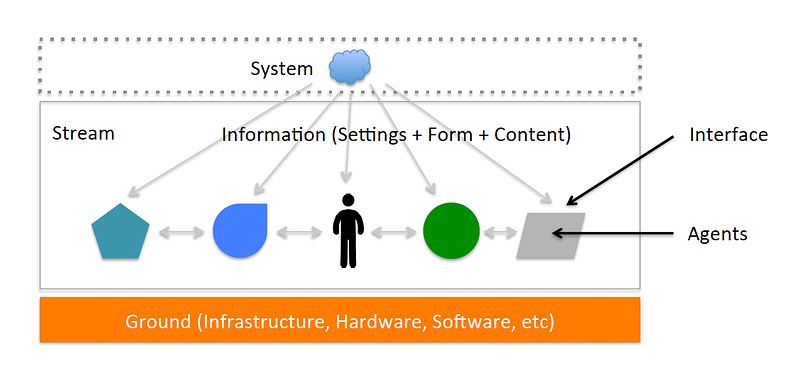
The above diagram is my answer. I translated Gibson’s triad into new terms for the digital world.
Stream as Medium Agents as Substances Interface as Surfaces
There is no air in the digital world, but people are contained by a continuous and dynamic Stream of information-response activities. Like air, the Stream is not visible and it is transparent.
Agents are Twitter users. Agents can be a person, a team, a brand, a company, an organization, or even a robot. Since one person might have multiple Twitter user accounts, it is not appropriate to use Person or People as Substances.
The interface is easy to understand. It separates the Stream and the Agents.
In fact, there is a most important key point for this translation. I use a metaphor to organize the whole thinking process.
4. Information as Light
I use “Information as Light” as a metaphor and build the new triad around it. There is no light in the digital world, but there is an essential thing called Information. Without light, there wouldn’t be any plants, animals, people, and other forms of life on earth. Without information, the internet would be a hot and dry desert and Twitter would be a ghost town.
There is a small issue with this metaphor because Gibson also used “Information” for his theory. It is worth noting that Gibson used “Ecological Information” which is different from “Digital Information.”
Now we can describe the whole story of the Ecological Mechanics of Twitterville. There is a group of agents within Twitterville, that continuously act on information-response within the stream. Agents send information to others and respond to information they receive at the interface.
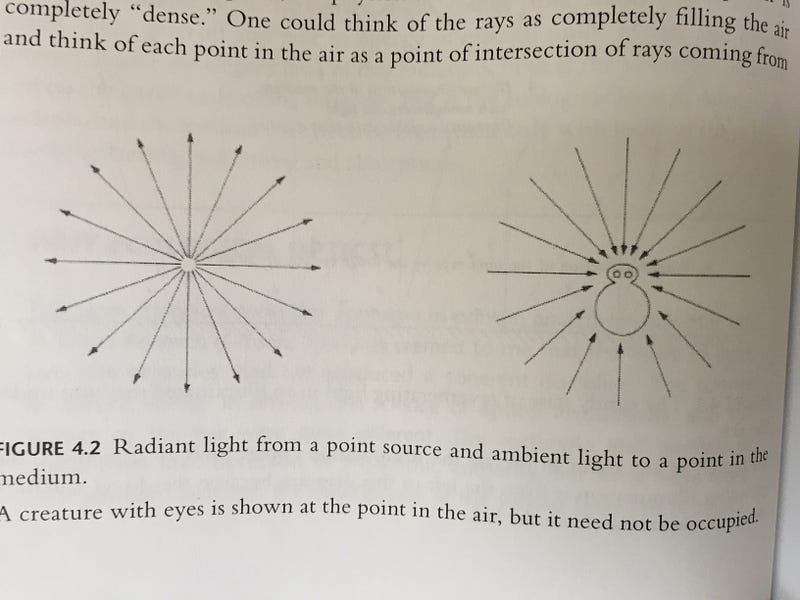
Notice the above picture from Gibson’s book. The pair of Radiant light/Ambient light also fits the “Information as Light” metaphor. I use Radiant Information for the one-to-many stream and Ambient Information for the many-to-one stream.
5. Ecological Invariant
The third aspect of the Ecological Physics Method is Ecological Invariant. Gibson used the term Invariant in two ways, one is Invariant Properties for talking about the environment and another is Invariant Structure for discussing Ambient Optic. Now let’s focus on the former and return to the latter soon.
Invariant Properties point to stable properties of the environment. For example, Gibson summarized the following invariant properties of the atmosphere.
…the characteristics of an environmental medium (atmosphere) are that it affords respiration or breathing; it permits locomotion; it can be filled with illumination so as to permit vision; it allows detection of vibrations and detection of diffusing emanations; it is homogeneous; and finally, it has an absolute axis of reference, up and down. All these offerings of nature, these possibilities or opportunities, these affordances as I will call them, are invariant. They have been strikingly constant throughout the whole evolution of animal life. (p.14)
Obviously, we can’t apply the same timescale of invariants for talking about atmosphere and Twitterville. The latter has a very short history. We can only consider the evolution of the Twitter platform and identify what invariants and variants are.
Let’s look at the basic structure of the Twitter platform. There are many ways to describe the structure of Twitter. For example, if you see Twitter as a “Media” platform, you can adopt the model of communication: Sender — Message-Receiver. I see Twitter as a “Social” platform and build a model of interaction: Act— Tweet —React.
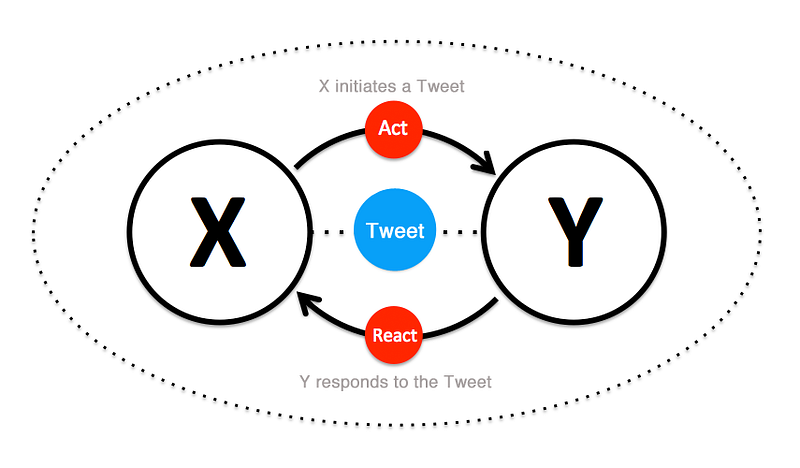
From the perspective of action, I don’t choose Tweet as the basic unit of Twitter, but the interaction based on Tweet as a basic unit of Twitter. User X initiates a tweet (Act), and User Y responds to the tweet User X initiated (React). User X and User Y connect to each other (Connect) through a tweet (Tweet).
The Tweet part, the Act part, the React part, and the Connect part are Invariant Structures of the Twitter platform. This structure defines what the Twitter platform is and it has never changed.
Now, let’s pay attention to the Act part. The way of initiating a tweet had several major changes and minor changes in the history of Twitter. For example, the original tweet is text only with a 140-character limit. In 2011, the platform announced its own integrated photo-sharing service which allows users to upload a photo and attach it to a tweet. In 2013, the platform launched Twitter Cards which allows developers and media to connect their apps, media, products, photos, videos, and galleries to Tweets. These two updates dramatically change the way of initiating a tweet, I consider them major changes.
According to Wikipedia, “In 2016, Twitter announced that media such as photos, videos, and the person’s handle, would not count against the already constrictive 140 character limit. A user photo post used to count for a large chunk of a Tweet, about 24 characters. Attachments and links would also no longer be part of the character limit.” These features can be seen as minor changes.
While the major updates change the Invariant Properties of the Twitter platform, the minor updates only impact the Variant Properties. Before adding photos to tweets, Text-only was the key Invariant Property of Twitter for many years. Now Visual Card is the key Invariant Property of Twitter.
We can apply the same principle to the React part and the Connect part. The way of Reacting and the way of Connecting points to the Invariant Properties of Twitter. For example, Retweet and Retweet with Comment are major updates of the React part. The Following/follow feature didn’t change.
It’s hard to make a clear and strict boundary between Invariant Properties and Variant Properties within the context of digital platforms. I think it is fine to keep it as a useful thinking tool as a key aspect of the Ecological Physics Method.
Be careful, we have to distinguish between the change of structure of the environment and the change of properties of the environment. For digital platforms, the change of structure will lead to converting into something else. If we remove the React part and the Connect part from Twitter, it will become a mini version of WordPress. We can also see a real example, Quora launched a new major part called Spaces in 2018. The original core of the Quora platform is Question/Answer. Now it has two cores: Question/Answer and Spaces. Adding Spaces to Quora is a change of structure of the environment while adding photos to a tweet on Twitter is a change of property of the environment.
Gibson didn’t talk much about the “Invariant Structure of Environment” since the atmosphere, the land, and the sea are stable for both humans and animals. For the ecological level discussion, it doesn’t make sense to focus on the aeons of geological history. Gibson used “Invariant Structure” for discussing the ambient optic array. From the above Quora/Twitter examples, it seems the idea of “Invariant Structure of Environment” is more applicable to studying digital platforms.
6. Ecological Events
The fourth aspect of the Ecological Physics Method is Ecological Events. For Gibson, ecological events are different from microphysical and astronomical events. Gibson considered ecological events as changes in surfaces.
Ecological events,…occur at the level of substances and the surfaces that separate them from the medium…Tentatively, it would seem that they can be divided into three main varieties: change in the layout of surfaces, change in the color and texture of surfaces, and change in the existence of surfaces. Change of layout is caused by forces; change of color and texture is caused by change in the composition of the substance; and change in the existence of a surface is caused by a change in the state of the substance. (p.86)
Gibson paid attention to the surface because surfaces reflect light. For Twitterville, I pay attention to the following three types of ecological events.
The change in System The change of Agents The change in Interface
For Twitterville, the change in System means the changes in the Twitter platform and information sent by the Twitter platform. Each notification is an ecological event. Each recommendation is an ecological event too.

The change of Agents includes changes in profile, changes in pinned Tweets, changes of Tweets published, and Updates.

The change in Interface can be considered as two types, one is the change of design and another is the change of content. The Twitter Card is a major change to the Twitter interface. And newest Tweets are the change of content.

For Twitterville, the normal ecological events are daily tweeting activities.
7. Ecological Perspective
The fifth aspect of the Ecological Physics Method is the Ecological Perspective. A key aspect of Gibson’s ambient optic theory is the Point of Observation, which I called it Ecological Perspective.
The diagram below is one of the classical diagrams Gibson made, it shows two points of observation. Gibson said, “The thin solid lines indicate the ambient optic array for the seated observer, and the thin dashed lines the altered optic array after standing up and moving forward. The difference between the two arrays is specific to the difference between the points of observation, that is, to the path of locomotion. Note that the whole ambient array is changed, including the portion behind the head. And note that what was previously hidden becomes unhidden.”(p.65)
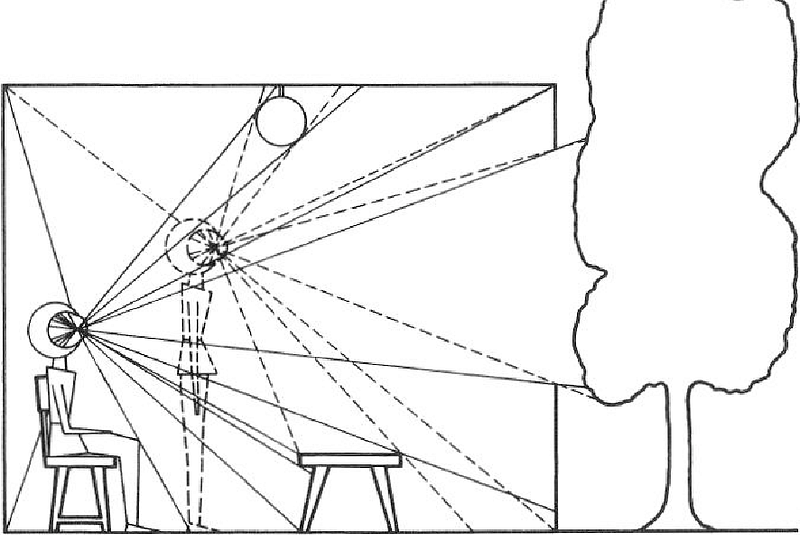
Gibson argued that there are two kinds of structure for discussing ambient optics: Perspective Structure and Invariant Structure.
There are many invariants of structure, and some of them persist for long paths of locomotion while some persist only for short paths. But what I am calling the perspective structure changes with every displacement of the point of observation — the shorter the displacement the smaller the change, and the longer the displacement the greater the change. Assuming that the environment is never reduplicated from place to place, the arrested perspective is unique at each stationary point of observation, that is, for each point of observation there is one and only one arrested perspective. On the other hand, invariants of structure are common to all points of observation — some for all points in the whole terrestrial environment, some only for points within the boundaries of certain locales, and some only for points of observation within (say) a single room. But to repeat, the invariant structure separates off best when the frozen perspective structure begins to flow. (p.66)
This claim is critical for understanding Gibson’s ecological approach. But, the ambient optic is too abstract. Let’s find an example from real life.
Yesterday I played the hide-and-seek game with my son.

Look at the above picture and think about my Point of Observation at that time.

From the point of the last picture, I moved several steps and saw my son! Look at this picture and think about my Point of Observation again. Once I moved, my point of observation changed. Once my point of observation changed, my ambient optic arrays changed.
William M. Mace wrote a paper about Ambient Optic Array and he pointed out:
When one opaque surface hides another, from some point of view, Gibson argued that the mode of disappearance specifies only a change in point of view and not a change in the existence of a hidden surface. A surface in the world that is seen to be hidden surface is seen to persist if occlusion is the only change defined. (p.78)
The notion of ecological perspective allows different people to perceive different views of the same real world. Some authors suggested there is a need to adopt a concept called Umwelt as the first-person perspective of personal environment because they believed that Gibson only talked about habitat at the species level (Edward Baggs and Anthony Chemero, 2018). I think they made a wrong claim since the ecological perspective has already provided a solution for the first-person view.
Now let’s apply the Ecological Perspective to Twitterville. What’s the Point of Observation and moving within Twitterville? I have used the “Information as Light” metaphor to translate Gibson’s triad. I used “Information” to replace Gibson’s “Light” and use “Stream” to replace Gibson’s “Medium”. Now, it is time to connect them with an Ecological Perspective.
First, let’s adopt Perspective Structure and Invariant Structure for discussing Stream. For Twitterville, all tweets are mediated by the Twitter Platform (System), they are organized and displayed within pages (Interface). If you see tweets on one page where all people can see, that means Invariant Structure. The page can be a particular tweet page, a hashtag page, a search result page, a Twitter user’s profile, or a LIVE event page curated by the Twitter team. For these pages, the original Tweet, the hashtag, the search keywords, the Twitter user, and the theme of the LIVE event are Invariants.
Second, the Perspective Structure of Stream can be defined as Personal View and Personal Path on Twitterville. Your Twitter Home timeline can only be viewed by yourself and the content of your Home timeline depends on accounts you have chosen to follow. This is one of your Personal Views on Twitterville. You can also use your own hashtags and create a new hashtag page for yourself and others. These brand-new hashtags can be seen as Personal Views too.
Third, let’s use Personal Path to talk about “move” within the Stream of Twitterville. A path of Stream is a moving line that crosses several spots. For example, you read your home timeline (spot 1), then click one of the hashtags and go to the hashtag page (spot 2), then click the icon of one user and go to his profile page (spot 3), then click one item within his profile and go to one of his tweets (spot 4), then click a hyperlink and go to a webpage (spot 5)…This trajectory is your Personal Path. Others can’t copy it.
The notion of ecological perspective highlights the agency of humans. For all Twitter users, the Twitter platform is the same real world, but you decide which accounts you want to follow and make your home timeline. You decide which hashtags you want to explore and curate. You decide which hyperlinks you want to click.
8. Ecological Affordance
Gibson’s Affordance theory is very hard to understand because he held a special epistemological stance. He said,
An important fact about the affordances of the environment is that they are in a sense objective, real, and physical, unlike values and meanings, which are often supposed to be subjective, phenomenal, and mental. But, actually, an affordance is neither an objective property nor a subjective property; or it is both if you like. An affordance cuts across the dichotomy of subjective-objective and helps us to understand its inadequacy. It is equally a fact of the environment and a fact of behavior. It is both physical and psychical, yet neither. An affordance points both ways, to the environment and to the observer. (p.129)
Psychologists usually place their theoretical concepts either in the environment (objective) or the mind (subjective). Gibson didn’t agree with both sides. In other words, Gibson was against the Cartesian dualism (Mind-body dualism). This is the core of Gibson’s ecological approach.
Information Systems researchers and Social Media researchers tend to use the concept of Affordances at the abstract high level or the concrete feature-oriented low level. Tina Bucher and Anne Helmond made a great review of these situations in their paper The Affordances of Social Media Platform (2018). For example, danah boyd suggested four affordances: persistence, replicability, scalability, and searchability at the high level for social network sites (2011). On the other side, HCI researchers and designers focus on the affordances of buttons, screens, and special features at the low level for interface design. For example, William W. Gaver published a paper titled Technology Affordances (1991) and separated Affordances from the information available about them allowing the distinction between correct rejections and perceived, hidden, and false affordances.
Bucher and Helmond proposed a relational and multi-layered platform-sensitive approach to apply Affordance in researching Twitter and other social media platforms. They expanded the notion of the user from end-user to platform user and argued that advertisers, developers, and researchers are taking Twitter’s affordance via the Twitter APIs. They didn’t call this approach Platform Affordance.
As I mentioned above, I chose Twitterville as my research objective. Since many authors coined their own version of Affordance, I use “Ecological Affordance” to refer to Gibson’s original version and consider it as a part of the Ecological Physics Method.
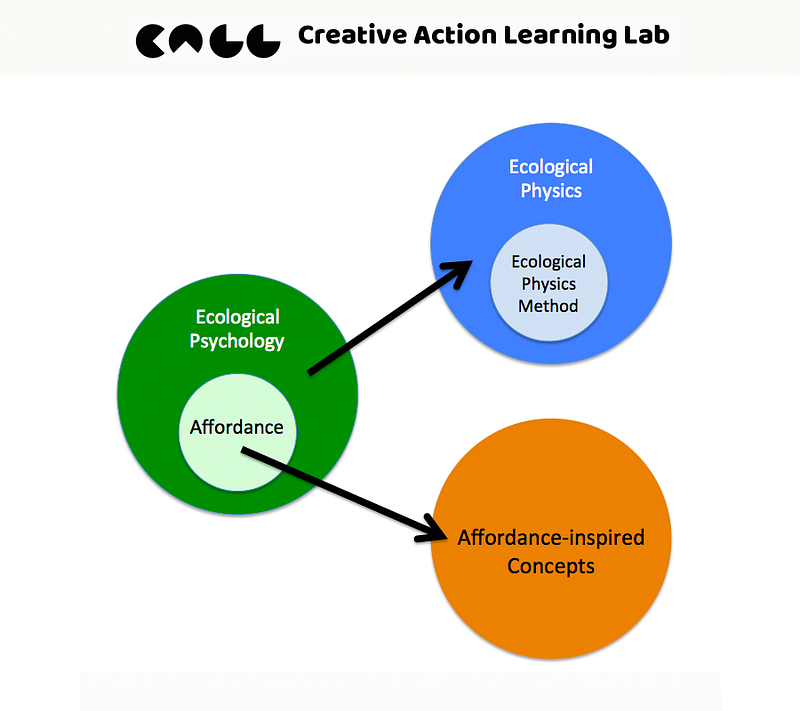
How to apply Ecological Affordance to Twitterville? The high-level approach is good, but it doesn’t provide useful help for us. For example, danah body’s four affordances: persistence, replicability, scalability, and searchability are too general for studying Twitterville.
Following the above Ecological Invariant, I chose the Affordance of Tweet as my starting point. A classical example is RT (ReTweet). Originally, RT was not an official feature of the Twitter platform, users just manually retweeted by actualizing the affordance of 140 characters' input box. Twitter launched the RT feature in 2015.
Today, Retweet and Retweet with commons have already been added to the platform as official features, but the affordance of the input box is still there. The input box still allows you to do manual retweets.
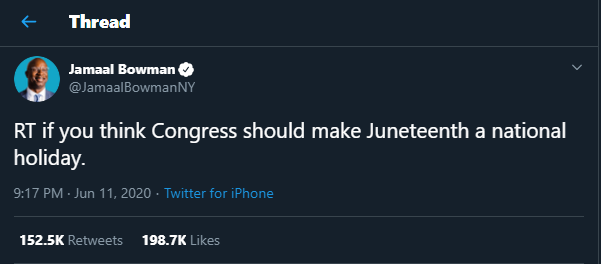
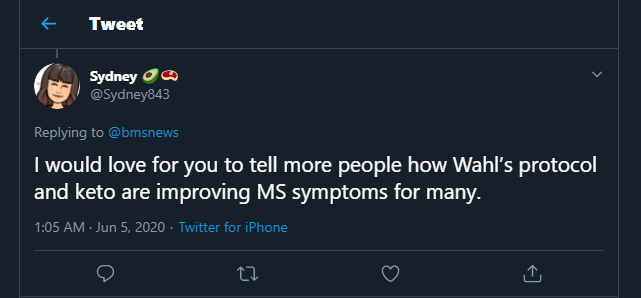
Let me share an example. I saw the above tweet and manually retweeted it.

I copied the entire tweet and added “RT”, then click on the “Tweet” button.
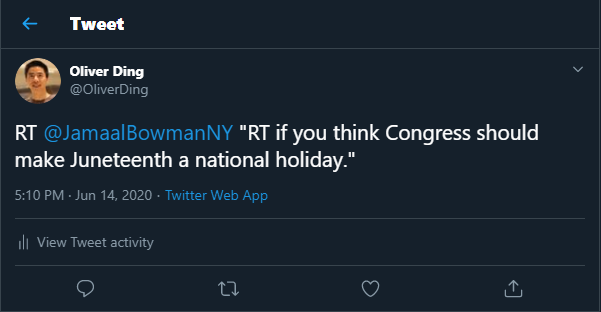
I posted a new tweet by manually retweeting the original tweet.
The high-level approach chooses “category” to describe Affordance, such as “persistence”, “replicability”, “scalability”, and “searchability”, these are categories. This approach is not for the tweet level analysis. From the perspective of Ecological Affordance, I argue that a better way to describe Affordance is not using a “category”. As I mentioned at the beginning, the ecological approach considers the “Perception-Affordance-Action” loop. We should focus on people’s behavior first, then figure out the affordance between the behavior and the tweet.
Let’s look at another example. The tweet below points to a theme #10yearchallenge which requires people to share two photos for a comparison. This user didn’t only upload two photos but also made signs with text. One sign points to the left with the text “10 years ago” while another sign points to the right with the text “current”.

Twitter allows users to send a tweet including up to 4 photos, a GIF, or a video. The Ecological Affordance of Tweet is based on these features. You can’t add 5 photos to a tweet, there is no such feature. These features provide a base for Ecological Affordance and set a baseline for Ecological Affordance.
Feature: Twitter allows users to add two images to a tweet. Affordance: Users can add two images for a comparison.
Instead of giving a category to behavior, I suggest you describe the whole experience behind one tweet. It’s a hard way because you have to collect many stories behind many tweets and then find the deep structure. Also, if you want to adopt Ecological Affordance, please do not set “correct ways” of using Twitter or any platform and product while you are doing study work.
9. Ecological Information
The final aspect of the Ecological Physics Method is the hardest thing to explain in this article. Gibson didn’t use a term called “Ecological Information”, I use this term to refer to the ecological approach to Information. Gibson’s view on Information is part of his Information Pickup theory which is different from traditional Information Processing theory.
The term information cannot have its familiar dictionary meaning of knowledge communicated to a receiver. This is unfortunate, and I would use another term if I could. The only resource is to ask the reader to remember that picking up information is not to be thought of as a case of communicating. The world does not speak to the observer. Animals and humans communicate with cries, gestures, speech, pictures, writing, and television, but we cannot hope to understand perception in terms of these channels; it is quite the other way around. Words and pictures convey information, carry it, or transmit it, but the information in the sea of energy around each of us, luminous or mechanical or chemical energy, is not conveyed. It is simply there. The assumption that information can be transmitted and the assumption that it can be stored are appropriate for the theory of communication, not for the theory of perception (p.231).
Gibson’s Information is not Shannon and Weaver’s Information. For Gibson, the qualities of objects are specified by information. The information in ambient light, along with sound, odor, touches, and natural chemicals, are inexhaustible.
As I mentioned above, I used the “Information as Light” metaphor to translate Gibson’s terms for the digital environment. What is my version of “Information”? For the digital environment, do we pick up “Ecological Information”? In order to avoid misunderstanding, I draw the following diagram.
From the perspective of Gibson’s ecological approach, the “Organism-Environment” relationship is explained by a “perception-action” loop. In a particular situation, there is information specifying the structure of the environment; by picking ecological information, people perceive the affordances of the environment; people select one or more affordances and take real actions.
Thus, I believe the ecological information should be tied to affordance and action. In other words, Ecological Information is Action-centered Information. If information points to potential actions for people, then we can claim it as Ecological Information. If the information doesn’t point to any potential action, then we can call it Content. See the flowchart below.
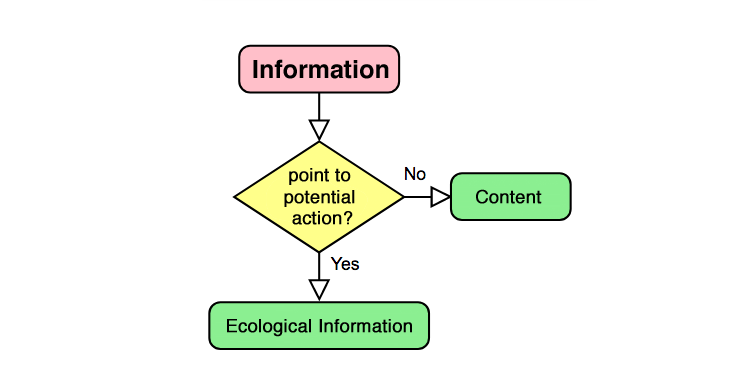
This principle helps us bypass the complex academic debate between Gibson’s Information Pickup theory and traditional Information Processing theory and adopt an ecological approach for researching Twitterville.
10. Picture, Video and Visual Awareness
The Ecological Approach to Visual Perception has 16 chapters. Gibson used the last two chapters to talk about pictures, videos, and visual awareness. The title of Chapter 15 is Pictures and Visual Awareness and Chapter 16 is Motion Pictures and Visual Awareness.
Gibson’s view on text, pictures, and video brings us an Ecological Perspective on Content. I’d like to add this piece to the Ecological Psychics Method, at least for studying Twitterville. The current Twitter platform is no longer text text-only medium, it also supports pictures and videos. For Gibson’s theory, this piece is not an essential part. For our Twitterville framework, this piece is very important for guiding the analysis of Tweets.
Gibson became interested in pictures and films during the war as a psychologist concerned with training young men to fly airplanes. That experience inspired him to reflect on the visual education:
In 1940–1946 a million Americans were learning this quite unnatural skill. I was impressed by the possibilities of visual education, inadequately so-called. You cannot tell students how to fly; you cannot let them learn by trial and error. You can have them learn by imitation, but that is expensive; you should try to show them how to fly. If the stimulus situation could be simulated, they would learn without danger of crashing. But just how did a picture, still or moving, simulate the real situation that the student would later face? How did pictures in general prepare the young for life? (p.261)
Based on the Ecological Invariant, Gibson suggested that the picture is an array of persisting invariants of structure that are nameless and formless. This definition assumes that some of the invariants of an array can be separated from its perspective structure, not only when the perspective keeps changing, as in life. Thus, we can see formless invariants in a picture that seems to consist entirely of forms. Gibson gave us an example of child and a cat:
This say that when the young child sees the family cat at play the front view, side view, rear view, top view, and so on are not seen, and what gets perceived is the invariant cat. The child does not notice the aspects of perspectives of the cat until he is much older; he just sees the cat rolling over. Hence, when the child first sees a picture of a cat he is prepared to pick up the invariants, and he pays no attention to the frozen perspective of the picture, drawing, photograph, or cartoon. It is not that he sees an abstract cat, or a conceptual cat, or the common features of the class of cats, as some philosophers would have us believe; what he gets is the information for the persistence of that peculiar, furry, mobile layout of surfaces…The child never sees a man as a silhouette, or as a cutout like a paper doll, but probably sees a sort of head-body-arms-legs invariant. Consequences, any outline drawing with this invariant is recognized as a man, and the outlines tend to be seen as the occluding edges of a man with interchangeable near and far sides. (p.259)
Gibson also argued that a picture is also a record that enables the invariants that have been extracted by an observer — at least, some of them — to be stored, saved, put away retrieved, or exchanged. Thus, Gibson highlighted the value of visual education.
Pictures convey knowledge at second hand and thus are efficient methods of teaching the young. But the knowledge they convey is not explicit. It is not put into words. Most of the formless invariants in the array from a picture could not be put into words anyway. They can be captured by an artist but not described.(pp.261)
Gibson also presented a theory of filming and film editing. He said, “The motion picture camera occupies a point of observation in a studio set or on a real location, just as the head of an observer does in an ambient environment. (p.284)”. Here we can notice he used an analogy that the field of view of the camera can be seen as the field of view of the eyes in the head. He also pointed out, “A cut represents a displacement of the camera between shots. The most intelligible cuts, I suggest, are those between shots that have some invariant structure in common (p.285)”.
If we adopt Gibson’s Ecological Perspective on Content, we can focus on whether we can find real invariants within people’s real lives through pictures and videos they share on Twitter. For example, the below picture is a screenshot of a video I found on Twitter. Can you find an invariant and an affordance?
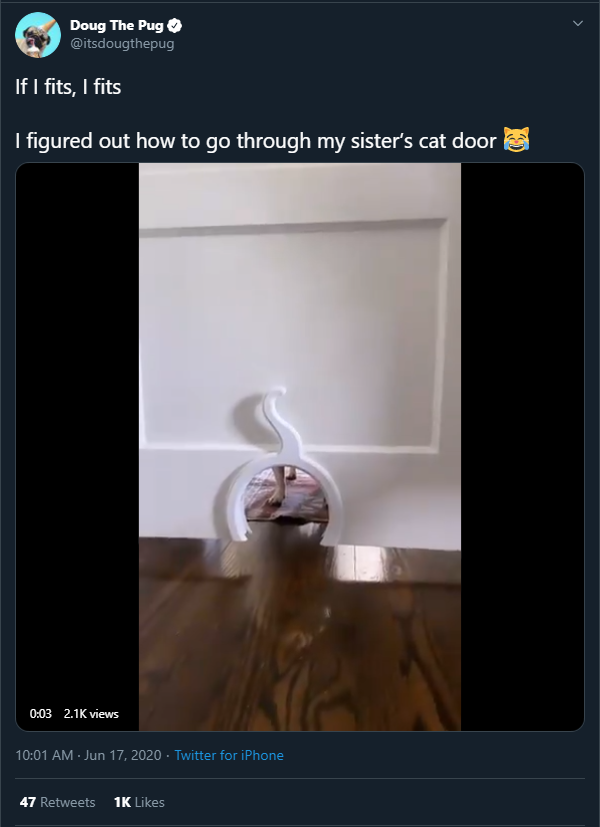
Ecological Physics Method is a situation-based method. If we want to run a real research project, we have to go to some real places. This requirement sets the cost of research. From the methodological perspective, the ecological perspective on pictures and video has great value because it helps us solve the cost issue of field study. By collecting tweets on Twitter, we can get data for playing the Ecological Psychics Method.
11. Make Use of Action-centered Platforms
The Twtitterville is where we find meaning and value on the Twitter platform. I hope the Ecological Physics Method can help platform thinkers, designers, curators, creators, and makers do a better job of finding opportunities with the Twitter platform.
My personal studio CALL (Creative Action Learning Lab) focuses on Creative Actions and Action-based Creativity.
My personal motivation behind the Ecological Physics Method is making use of Action-centered Platforms.
The perspective of Action-centered Platform focuses on the “perception-information-affordance-action” loop while the social media perspective focuses on the “content-attention” loop. It doesn’t matter if we can call Twitter an Action-centered Platform or not, what I care about is how we engage with Twitterville, the ecological environment supported by the Twitter platform.
The future development of the Ecological Physics Method definitely will expand to other social platforms.
I want to send a special thank you to Shel Israel, who has enriched and influenced my perspective on Twitter and the digital environment and opened a door to a new world of opportunities.
Citation
For attribution in academic contexts, please cite this work as:
Oliver Ding, “ReEngagement with Twitterville: An Introduction to Ecological Physics Method”, https://readmedium.com/19ef37e0ac17, Houston (2020).
License
This work is licensed under the Creative Commons Attribution-NonCommercial-ShareAlike 4.0 International (CC BY-NC-SA 4.0) License. Please click on the link for details.
References
Israel, Shel (2009). Twitterville: how businesses can thrive in the new global neighborhoods. New York: Portfolio.
Gibson, J.J. (1979/2015). The ecological approach to visual perception: classic edition. New York: Psychology Press. (originally published in 1979).
Heft, Harry (2001). Ecological Psychology in Context: James Gibson, Roger Barker, and the Legacy of William James ’s Radical Empiricism. New York: Psychology Press.
Baggs, E., & Chemero, A. (2018/2020). The third sense of environment. https://doi.org/10.31234/osf.io/sxmrz also in Jeffrey B. Wagman & Julia J. C. Blau (Eds.), Perception as Information Detection: reflections on Gibson’s ecological approach to visual perception (pp. 5–20). New York: Routledge.
Bucher, T., & Helmond, A. (2018). The affordances of social media platforms. In J. Burgess, A. Marwick, & T. Poell (Eds.), The SAGE handbook of social media (pp. 233–253). Sage Publications.
boyd danah (2011). Social network sites as networked publics: Affordances, dynamics, and implications. In: Papacharissi Z (ed.), A Networked self: identity, community, and culture on social network sites. New York: Routledge, pp. 39–58.
Gaver, William (1991). Technology Affordances. CHI ’91: Proceedings of the SIGCHI Conference on Human Factors in Computing Systems. March 1991, Pages 79–84 https://doi.org/10.1145/108844.108856


