
D as Diagramming: An Integrated Framework for Studying Knowledge Diagrams (Part 4A)
Explore the conceptual space “Opportunity” and the perspective of “Ecological Situation”: Physical Space Affordances and Graphic Space Affordances.
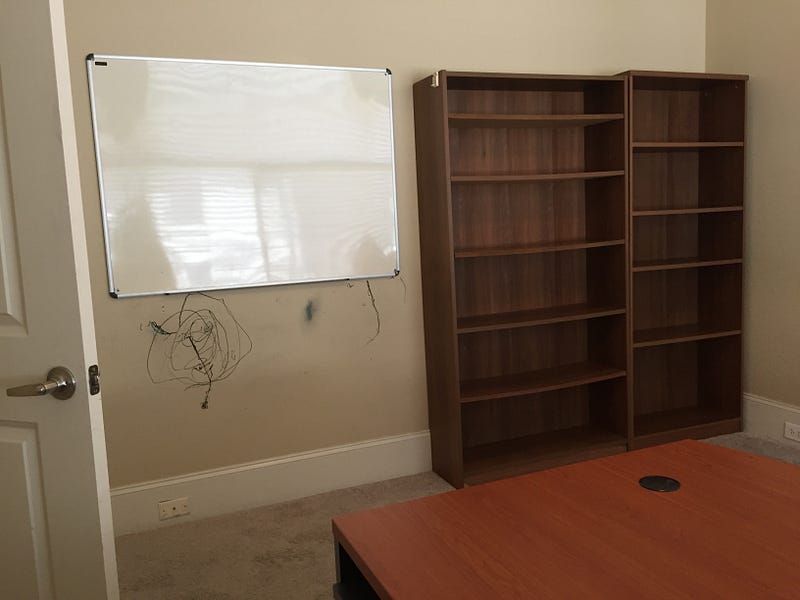
A blank whiteboard affords drawing diagrams. An empty bookshelf affords to display books. A clear desktop affords placing a computer, pens, notebooks, and mugs. The ecological psychologist James J. Gibson coined the term Affordance to describe a special type of relationship between environment and organisms, “the affordances of the environment are what it offers the animal, what it provides or furnishes, either for good or ill.”
This post is part of the D as Diagramming project which aims to explore the power of diagrams and diagramming for turning tacit knowledge into explicit knowledge.
In a previous article, I introduced an integrated framework for studying knowledge diagrams. The framework offers four perspectives. You can find more details from the links below:
- Part 1: Cognitive Representation
- Part 2: Cultural Significance
- Part 3A: Mediating Instrument (the Means-End spectrum, the Part—Present evolution)
- Part 3B: Mediating Instrument (the Part — Whole curativity, the Ambiguity — Precision dynamics)
The last perspective is Ecological Situation which is generated from the Opportunity conceptual space. In this article, I will discuss Diagrams, Affordances, and Opportunities.
Contents
8. The Conceptual Space of Opportunity
8.1 The Opportunity Formula 8.2 Affordance as Opportunity 8.3 Typology of Space Affordances 8.4 Physical Space Affordances 8.5 Graphic Space Affordance 8.5.1 Peiphen’s Stickman and their Playground 8.5.2 From Value Proposition to Impact Canvas 8.5.3 English, Chinese, and Graphic Space Affordances
8. The Conceptual Space of Opportunity
The integrated framework is formed by four conceptual spaces: Architecture, Relevance, Activity, and Opportunity. Each conceptual space refers to a set of similar theoretical approaches. Each theoretical approach could generate a set of perspectives. You can find more details about the framework in Part 1.
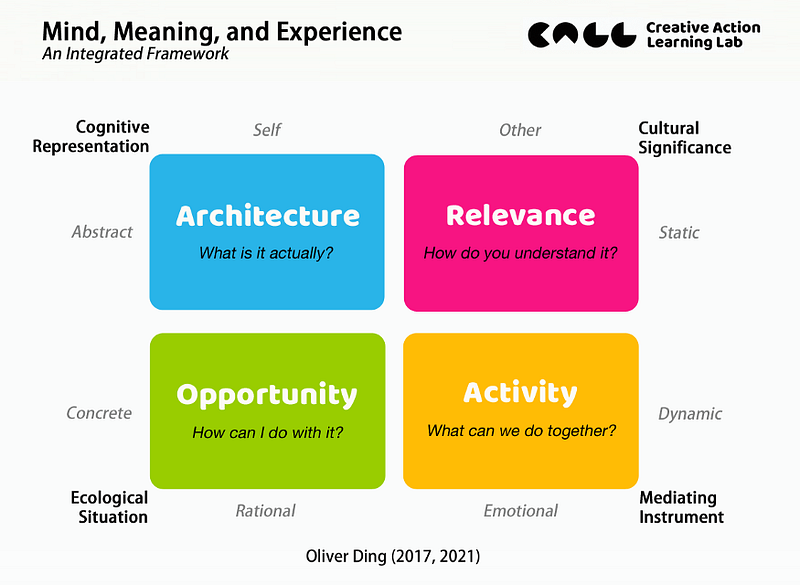
According to the Merriam-Webster dictionary, the meaning of Opportunity is an amount of time or a situation in which something can be done. When I use the term Opportunity to name a conceptual space, I claim that there is an essential notion behind the concept of Opportunity: Possible Actions. This claim connects the Opportunity conceptual space with the term Possible Practices and the Ecological Practical approach which is one of my theoretical works.
Possible Actions can be understood with two inseparable aspects:
- a) Potentials that are offered by the environment or the situation, and
- b) Capabilities, a skill, an ability, or knowledge that makes a person able to do a particular action.
The Potentials — Capabilities coupling echoes the Environment — Organisms coupling. Thus, I use this framework to curate Affordances, Opportunities, Possible Actions, and Possible Practices into one big container which is named the conceptual space of Opportunity.
Why don’t I directly name it the conceptual space of Affordance? The Ecological Practice approach is inspired by ecological psychology, but it also developed its own theoretical concepts such as Attachance, Supportance, Curativity, Infoniche, Lifeway/Lifeform/Lifesystem, etc. I started from the concept of Affordance and went beyond the field of visual perception. For example, the concept of Supportance is about social interactions and intersubjectivity. You can find more details here: The Development of Ecological Practice Approach.
8.1 The Opportunity Formula
In order to explain the value of the ecological practice approach, I adopt the concept of Opportunity as a mediation and redefined it as the formula below:
Opportunity = From a perspective (X), You (U) could do things (Y) with an object (Z).
This formula requires more details than the above two aspects. I add perspective and object to the formula.
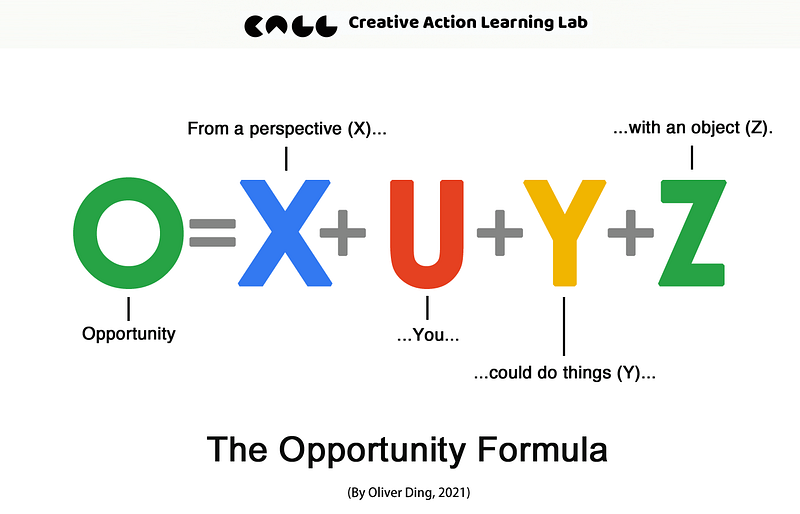
This is a heuristic tool for connecting Theory (the ecological practice approach) and Practice (real-life actions). In this way, I can apply the concept of Affordance and other theoretical concepts as Perspectives to the formula. You can find more details about the formula here: D as Diagramming: The Opportunity Formula.
For the present discussion, I will focus on Affordance and Diagrams.
- Perspective (X): Affordance Theory
- Object (Z): Diagrams
In addition, I will also discuss the perspective of Supportance with a case study about the digital whiteboard platform Miro.
8.2 Affordance as Opportunity
Initially coined by Gibson, the term Affordance has been adopted by scholars from various domains such as psychology, human factors, design, communication, sociology, neuroscience, artificial intelligence, etc. The renowned philosopher Daniel Dennett (2017) even suggested that “Affordances” should be more widely known by the general public.
For readers who are not familiar with the term Affordance and Gibson’s Affordance Theory, I’d like to share the following picture as a starting point. You can find more details here: Hammer, Hammering, and Affordance.
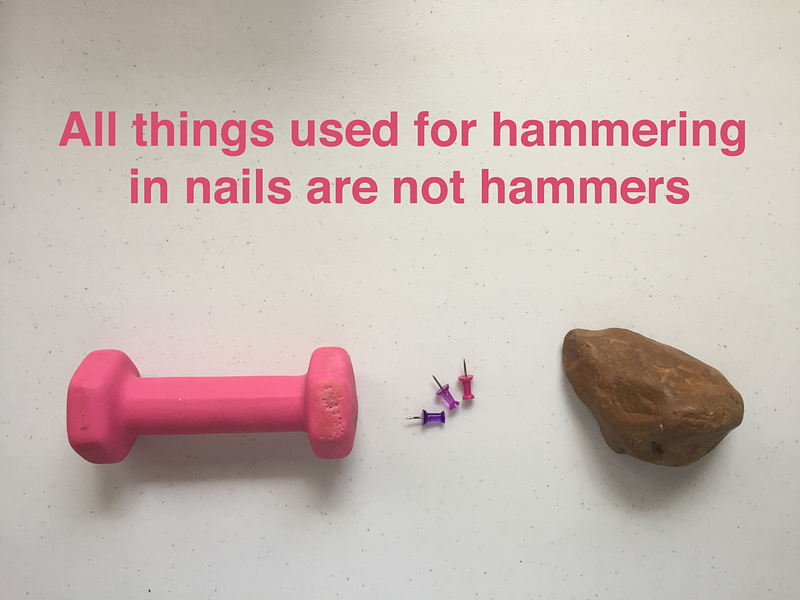
Traditionally, psychologists assumed that objects are composed of their qualities. Gibson rejected this view, “…But I now suggest that what we perceive when we look at objects are their affordances, not their qualities…The fact that a stone is a missile does not imply that it cannot be other things as well. It can be a paperweight, a bookend, a hammer, or a pendulum bob. It can be piled on another rock to make a cairn or a stone wall. These affordances are all consistent with one another. The differences between them are not clear-cut, and the arbitrary names by which they are called do not count for perception. If you know what can be done with a graspable detached object, what it can be used for, you can call it whatever you please.”(p.126)
The radical aspect of affordance theory is that it challenges the traditional view on the meaning of objects “concept first” and turns it to “percept first”. Concepts are about linguistic meaning and ordinary classes of objects. Gibson argued, “To perceive an affordance is not to classify an object…The theory of affordances rescues us from the philosophical muddle of assuming fixed classes of objects, each defined by its common features and then given a name. As Ludwig Wittgenstein knew, you cannot specify the necessary and sufficient features of the class of things to which a name is given. They have only a ‘family resemblance.’ But this does not mean you cannot learn how to use things and perceive their uses. You do not have to classify and label things in order to perceive what they afford.” (p.126)
In fact, affordance theory doesn’t only consider objects but considers objects as our environment. For Gibson, “objects, other persons and animals, places and hiding places” are our surrounding environment.
How to adopt Affordance Theory to discuss Diagrams and Diagramming?
The answer is we need to consider both diagrams and their environments. Thus, the perspective of the “Ecological Situation” encourages us to pay attention to the real-world environments of diagram-in-use. The primary question is not what a diagram is about, but where the diagram is.
Where is the diagram?
The diagram is in mind! Our first perspective Cognitive Representation is about this answer. The present discussion doesn’t want to repeat it.
The diagram is in books, papers, walls, whiteboards, floors, napkins, slides, canvases, tweets, blog posts, digital boards, etc. The “Ecological Situation” perspective aims to study opportunities behind these situations.
8.3 Typology of Space Affordances
Though the term Affordance is coined by Gibson for his theory of ecological perception, the term is often misused in the literature in diffuse and imprecise ways. Outside ecological psychology, some authors expand the original meaning of Affordance from perception-based relative aspects to non-perception analysis. I personally don’t like this approach because the perception level analysis and the non-perception analysis have different conditions and require different analysis frameworks. It’s hard to maintain a consistent theoretical meaning for the concept of Affordance.
Some authors’ re-conceptualization of Affordance may have a special contribution to their domains, however, their new definitions of Affordance may add misunderstanding to Gibson’s original meaning. Eventually, the term Affordance became a normal word. I want to keep Gibson’s original meaning for the concept of Affordance and remain at the analysis level of the natural/material/technological environment.
Since Gibson’s Affordance theory is all about body-scale physical environments, It’s so hard to apply it to digital environments because there are obvious differences between the physical environment and the digital environment. Thus, one-to-one accurate mapping is impossible and unnecessary.
Information Systems researchers and Social Media researchers tend to use the concept of Affordances at an abstract high-level or concrete feature-oriented low level. Tina Bucher and Anne Helmond made a great review of these situations in their paper The Affordances of Social Media Platform (2018). For example, danah boyd suggested four affordances: persistence, replicability, scalability, and searchability at the high level for social network sites (2011). On the other side, HCI researchers and designers focus on the affordances of buttons, screens, and special features at the low level for interface design. For example, William W. Gaver published a paper titled Technology Affordances (1991) and separated Affordances from the information available about them allowing the distinction between correct rejections and perceived hidden and false affordances.
My own approach is 1) adopting the Ecological Physical method to discuss digital environments, and 2) Using a metaphor called “Information as Light” to translate Gibson’s terms for discussing digital environments. You can find more details here: #SocialPxD — ReEngagement with Twitterville: An Introduction to Ecological Physics Method.
For the present discussion about diagrams and affordances, I design a simple diagram below to develop a rough typology of Space Affordances.
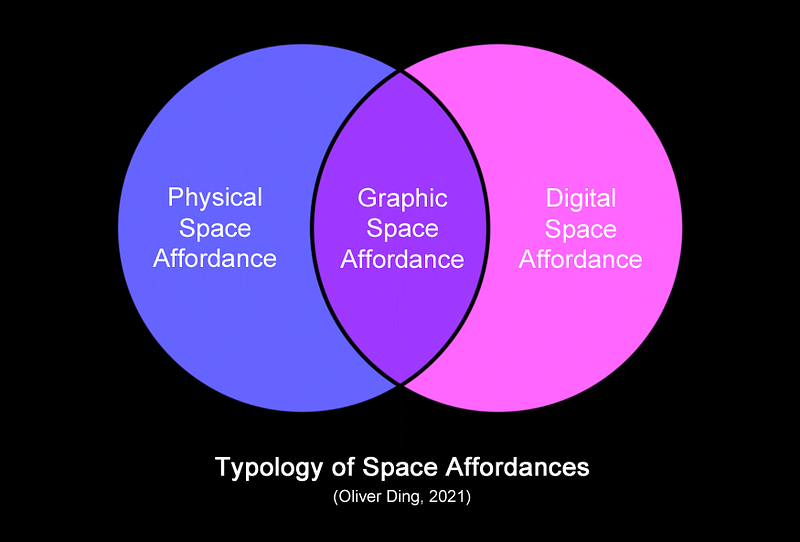
Gibson actually didn’t use “Space Affordances” as a term in his books. He talked about various types of environments such as Surfaces, Objects, Other Persons and Animals, Places, and Hiding Places. I use the term Physical Space Affordances to refer to Surfaces, Containers, Places, etc. On the other hand, Non-space Affordances refer to Non-container Objects, Other Persons, and Animals.
The typology of Space Affordances highlights Graphic Space Affordance which is coined for discussing Diagrams in particular. It considers the affordances of white space in a graphic. In graphic design, white space means the space that surrounds the elements. Graphic Space Affordance asks a simple question:
What can I do with the white space of a diagram?
Digital Space Affordance considers the affordances offered by digital screens and virtual spaces. It’s a huge challenge to develop a general framework for the concept of Digital Space Affordance. I’d like to directly discuss some case studies about diagrams and digital spaces such as Miro which is a digital whiteboard platform.
8.4 Physical Space Affordances
We see diagrams in various types of physical objects and physical spaces. A typical physical environment for diagrams is a physical whiteboard which is usually placed on a wall.
What’s the Physical Space Affordance of a whiteboard? It offers an affordance of drawing and writing on a vertical surface while a person is standing close to the surface. If we understand this affordance, we can use alternatives such as a large-size paper to offer the same affordance if we don’t have a whiteboard. The screenshot below is adopted from a video about the Product Field canvas. Wolfgang Wopperer-Beholz, one of three co-founders of the Product Field canvas, stands close to a wall in which there is a large-size paper.
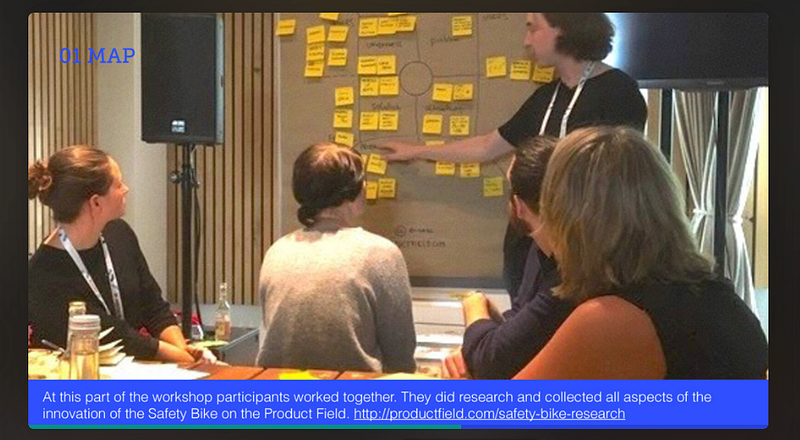
The video is a short introduction to the Product Field canvas. He draws a large size canvas on the paper and describes the value of the canvas. In fact, the same Physical Space Affordance can be found in the scenario of a workshop. See the screenshot below. Do you see yellow sticky notes on the canvas?
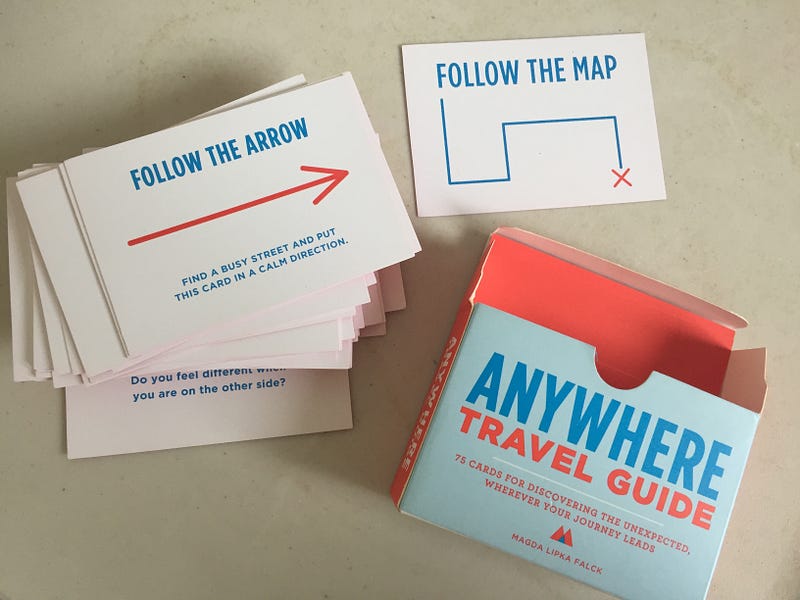
A diagram can be a small size too. A typical small-size container of diagrams is a card. For example, Anywhere Travel Guide is a handy deck that includes 75 cards to inspire exploration for travelers. Some cards present simple diagrams. See the picture below. A card is smaller than a big wall, so it offers a different affordance for a special type of Environment — Organisms coupling: the card—hand interaction.
As mentioned above, the diagram is in books, papers, walls, whiteboards, floors, napkins, slides, canvases, tweets, blog posts, digital boards, etc. Let’s have a look at an example of napkins. If you read articles and books about business models, network effects, sharing economy, and platform strategy, you probably know a famous sketch drawn by David Sacks — a silicon valley VC. On June 6, 2014, he tweeted a napkin with a diagram that describes the business model of Uber. The screenshot is part of a thread he wrote in 2019.
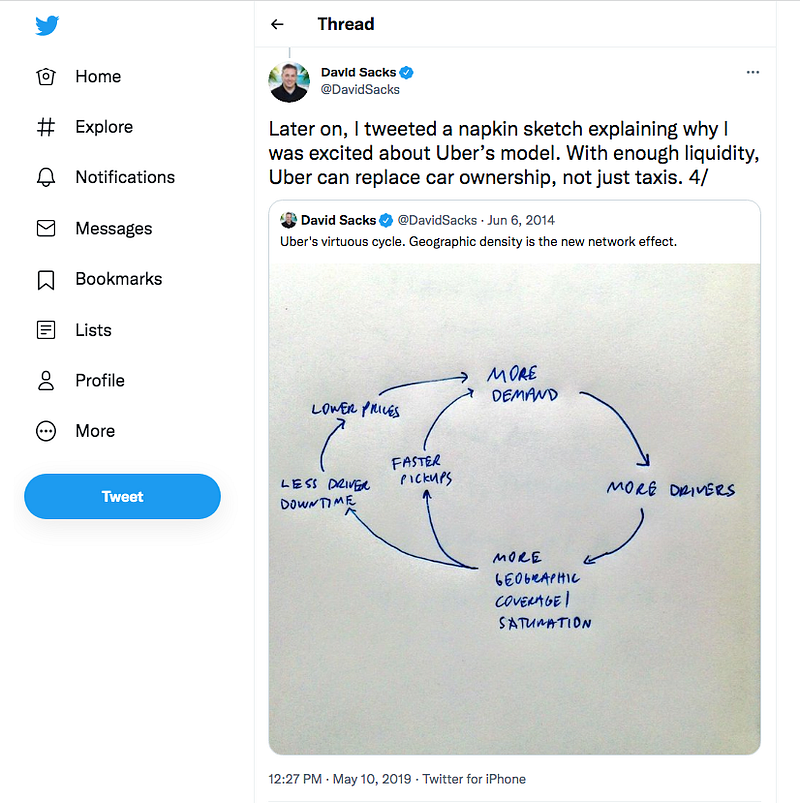
Did David Sacks draw the diagram in a restaurant? I don’t know. For our discussion, a napkin does offer an affordance for drawing diagrams. Affordance theory doesn’t care about the “official” features of an object. A person could draw diagrams on napkins even though the Affordance of drawing diagrams is not an “official” feature of napkins.
The above discussion offers us a pattern of Environment — Organisms coupling for understanding Physical Space Affordances:
- hand—paper (diagram)
- hand — card/napkin (diagram)
- body — wall (diagram)
- body — whiteboard (diagram)
- foot — floor (diagram)
One side of the pattern refers to a part of a person’s body while the other side refers to a part of an environment. In addition, we can see the third element between these two sides: mediating instrument. For example, pen and sticky notes are tools for drawing diagrams.
8.5 Graphic Space Affordance
Gibson’s 1979 book The Ecological Approach to Visual Perception has 16 chapters. Gibson used the last two chapters to talk about pictures, videos, and visual awareness. The title of Chapter 15 is Pictures and Visual Awareness and Chapter 16 is Motion Pictures and Visual Awareness.
Gibson became interested in pictures and films during the war as a psychologist concerned with training young men to fly airplanes.
Based on the notion of Ecological Invariant, Gibson suggested that the picture is an array of persisting invariants of structure that are nameless and formless. This definition assumes that some of the invariants of an array can be separated from its perspective structure, not only when the perspective keeps changing, as in life. Thus, we can see formless invariants in a picture that seems to consist entirely of forms. Gibson gave us an example of a child and a cat:
This says that when the young child sees the family cat at play the front view, side view, rear view, top view, and so on are not seen, and what gets perceived is the invariant cat. The child does not notice the aspects of perspectives of the cat until he is much older; he just sees the cat rolling over. Hence, when the child first sees a picture of a cat he is prepared to pick up the invariants, and he pays no attention to the frozen perspective of the picture, drawing, photograph, or cartoon. It is not that he sees an abstract cat, or a conceptual cat, or the common features of the class of cats, as some philosophers would have us believe; what he gets is the information for the persistence of that peculiar, furry, mobile layout of surfaces…The child never sees a man as a silhouette, or as a cutout like a paper doll, but probably sees a sort of head-body-arms-legs invariant. Consequences, any outline drawing with this invariant is recognized as a man, and the outlines tend to be seen as the occluding edges of a man with interchangeable near and far sides. (p.259)
Gibson also argued that a picture is also a record that enables the invariants that have been extracted by an observer — at least, some of them — to be stored, saved, put away and retrieved, or exchanged.
The notion of Ecological Invariants is part of Gibson’s Ecological Physical Method. You can find more details in a previous article #SocialPxD — ReEngagement with Twitterville: An introduction to Ecological Physics Method.
The above discussion tells us that Gibson didn’t pay attention to the white space of graphics. As mentioned above, I am quite conservative on repurposing the concept of Affordance. However, I’d like to coin the term Graphic Space Affordance (GSA) for discussing Diagrams in particular. The value of the concept of GAS refers to the affordances of white space of a graphic for people. It starts with a simple question: What can I do with the white space of a diagram?
In graphic design, white space means the space that surrounds the elements. By focusing on the affordances of white space of diagrams, we can find some constraints for design and some opportunities for innovation.
8.5.1 Peiphen’s Stickman and their Playground
My son Peiphen is a big fan of Alan Becker who is a famous Youtuber for his creative “Animator v.s. Animation” video and other stick figure animations. Peiphen likes watching Alan Becker’s videos and drawing stickman pictures too.
One day in the summer of 2019, Peiphen went to my office. Most times, he read books. He also played something in his creative ways. For example, he turned IKEA Bevisa memory cards into a “truck.” You can find this story here. He also drew something on my whiteboard and turned it into a playground for his stickman.
At that time, the whiteboard was not blank. I drew a diagram of “Platform Ecology” from the perspective of ecological ecology in the spring of 2019. I kept the diagram on the whiteboard for the long-term thinking of the Platform Ecology project. In fact, the project is for testing my new ideas about expanding ecological psychology from the traditional physical environment into the digital environment. The term Infoniche was coined at that time. Later, I wrote some ideas in the book After Affordance in 2020. I also applied the Infoniche framework to discuss the structure of the developmental platform and wrote the book Platform for Development at the end of 2021.
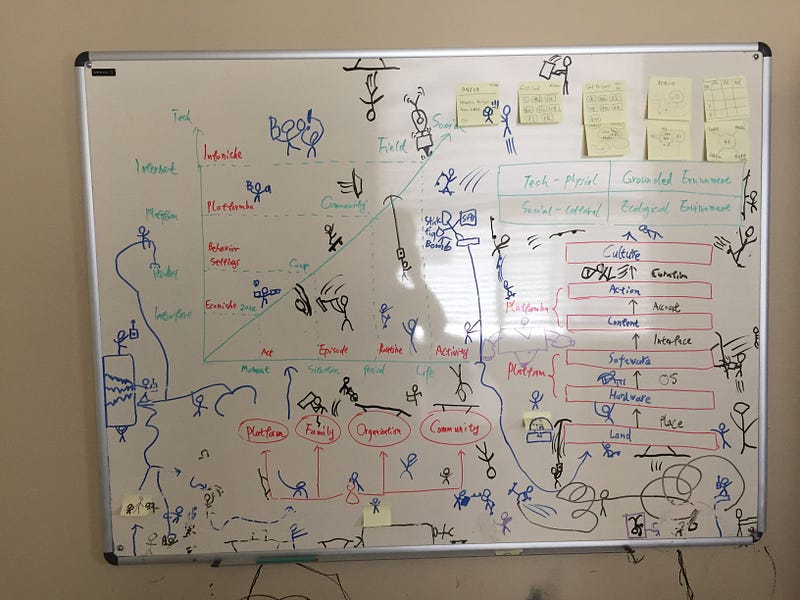
The above picture is my whiteboard. How to read this whiteboard?
I used Green and Red pens to draw my diagram and Peiphen used Blue and Black pens to draw his stickman.
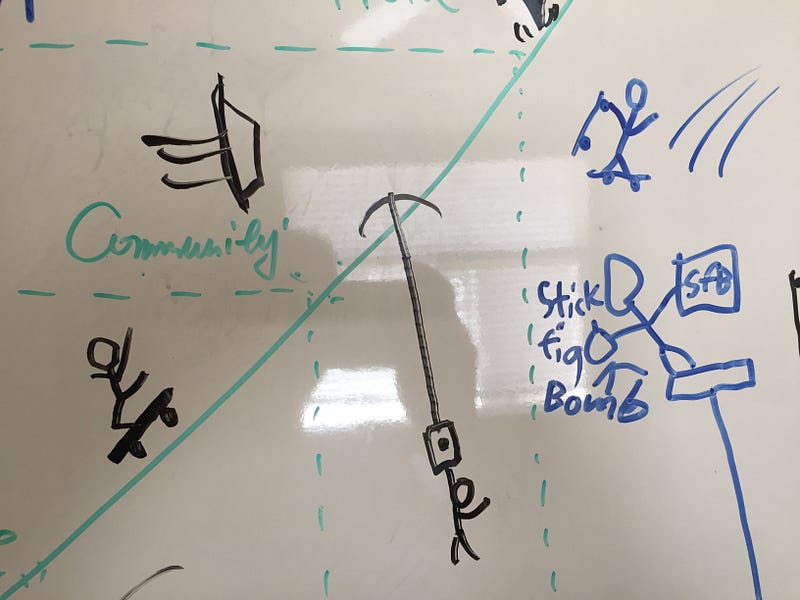
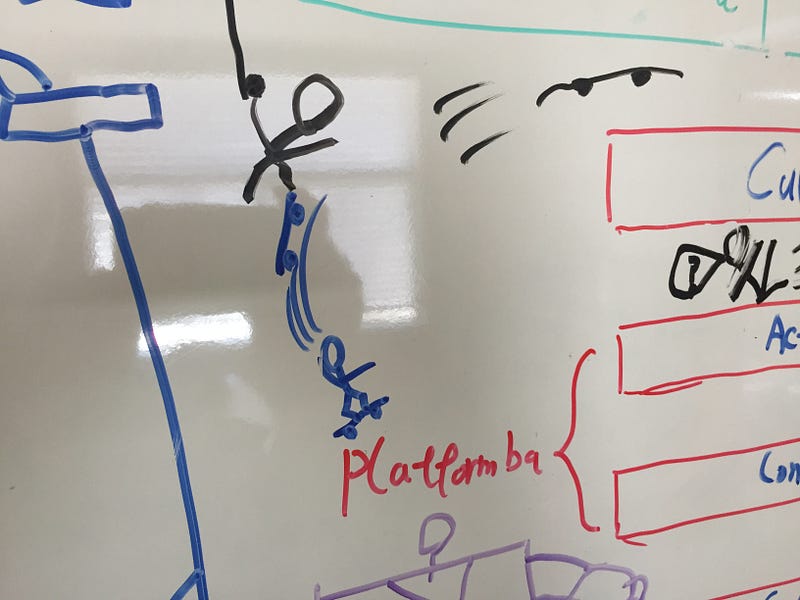
The secret of Peiphen’s creative ways is Graphic Space Affordance.
He just ignored my diagram and saw them as lines.
He took these lines and the white space for his drawing.
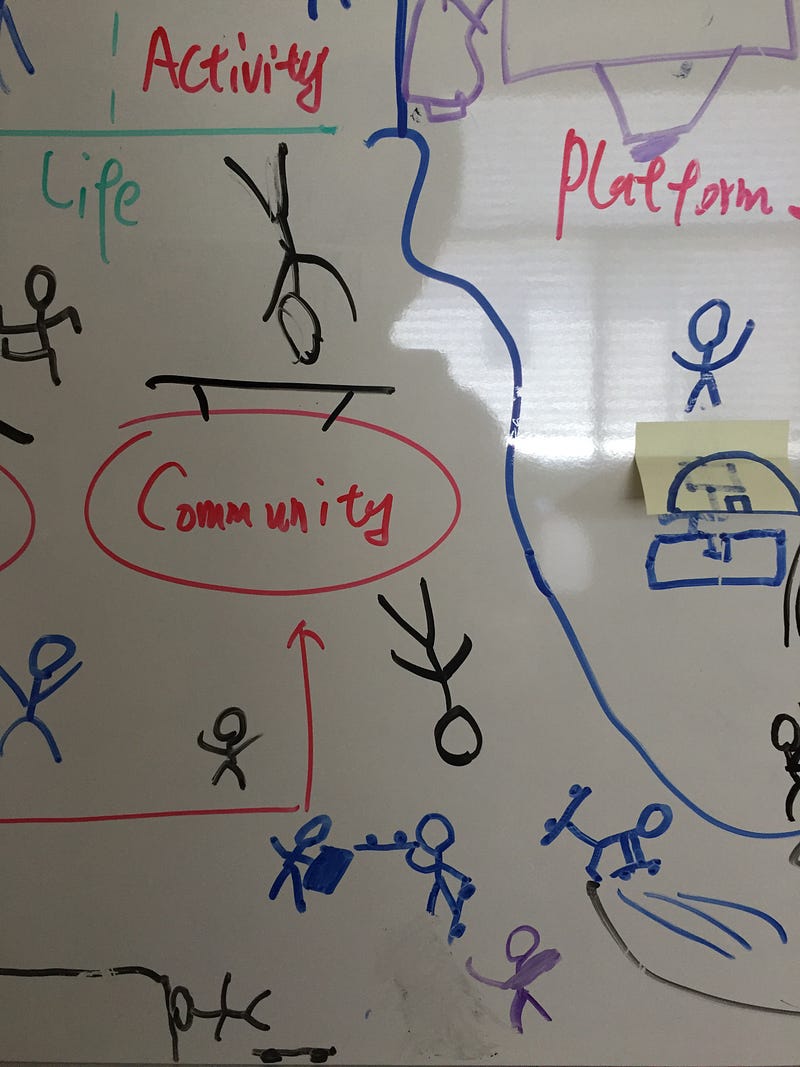
An oblique line was perceived as a zipline by Peiphen. He didn’t know Gibson’s Affordance theory and his slogan “To perceive an affordance is not to classify an object.” For Peiphen, there was no diagram that represented a framework for Platform Ecology. He didn’t perceive the diagram as a whole because I didn’t explain the diagram to him.
8.5.2 From Value Proposition to Impact Canvas
What about if we have learned the meaning of a diagram? Can we perceive the Graphic Space Affordances of a diagram?
Let’s see an example of the affordance of white space.
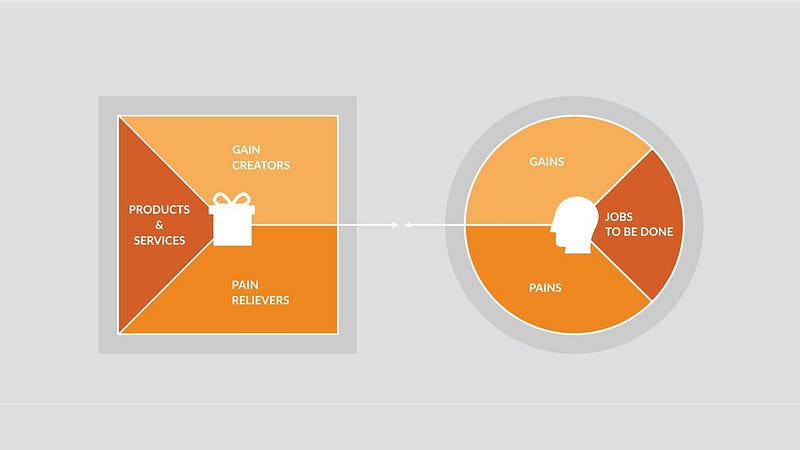
The Value Proposition Canvas was introduced in a 2014 book titled Value Proposition Design. This is a popular canvas for startup product design and business model development. However, Craig Walmsley argued that business model design should consider ethics as an important perspective for valuing value. Walmsley said, “In part, that’s because the core design tools we use tend to omit the relations between people that would give them meaningful ethical content. That is to say, they pay little attention to the customer’s friends and family, the company’s employees, competitors, or society at large. Or to the consequences of a proposition in the wider world — the carbon footprint, or the length of time it would take for a product to biodegrade, for example. Paying attention to just the business and customer means not paying attention to the ethical implications of design choices.”
In order to develop a new tool that replaces the traditional “business—customer” mindset, Walmsley developed a new canvas: Impact Canvas.
How did he make the alternative?
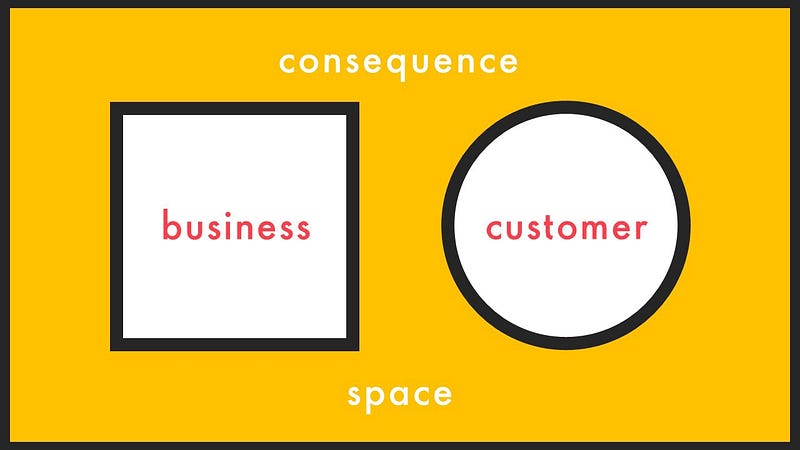
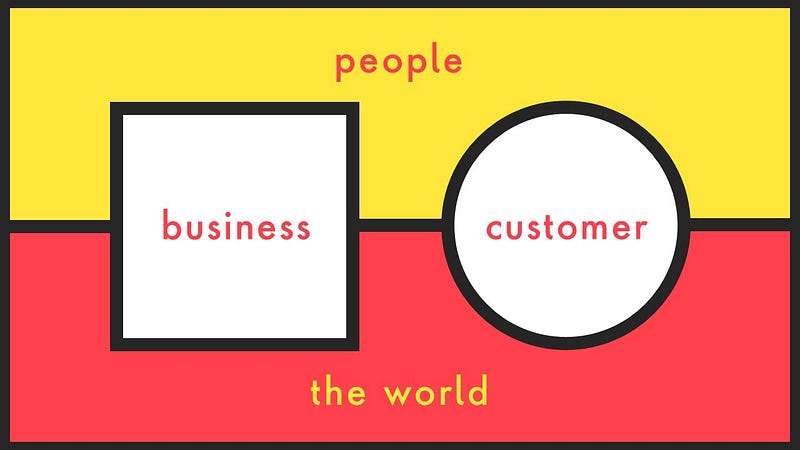

Walmsley perceived the white space of the Value Proposition Canvas and defined it as Consequence Space. Then, he divided the Consequence Space into different areas of impact. The final canvas is called the Impact Canvas. See the picture below.
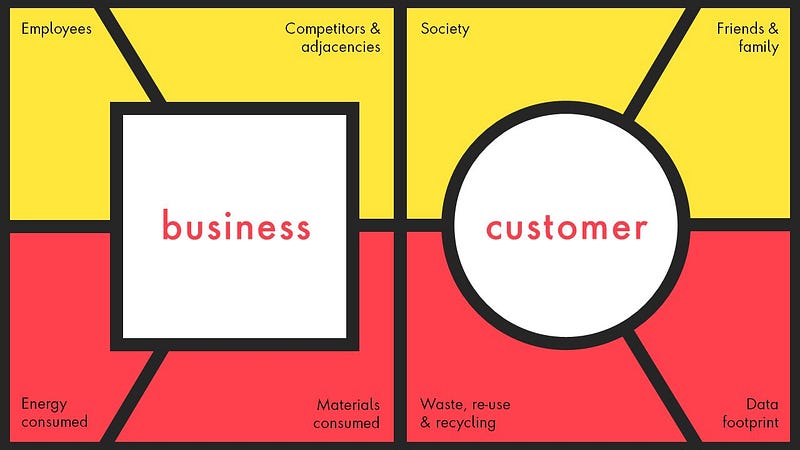
This is definitely a great example of taking Graphic Space Affordances for innovation.
8.5.3 English, Chinese, and Graphic Space Affordances
As mentioned in Part 1, I use the term Diagrams interchangeably with Knowledge Frameworks. What’s actually the difference between these two things? It’s hard to give a definition to the concept of DiagramS. For the D as Diagramming project, I set simple criteria for sorting diagrams: the number of concepts contained in a diagram.
If a diagram only represents one concept, then I call it a Single Concept Diagram. If a diagram represents more than one concept and the relationship between these concepts, then I call it a Multiple Concepts Diagram. My primary interest is not Single Concept Diagrams, but Multiple Concept Diagrams. When I used the term Diagrams interchangeably with Knowledge Frameworks, I always talked about Multiple Concepts Diagrams.
As a bilingual, I often design knowledge diagrams in Chinese and English. Since there is a significant difference in visual layout between Chinese words and English words, the same diagram doesn’t offer the same Graphic Space Affordance for Chinese designers and English designers.
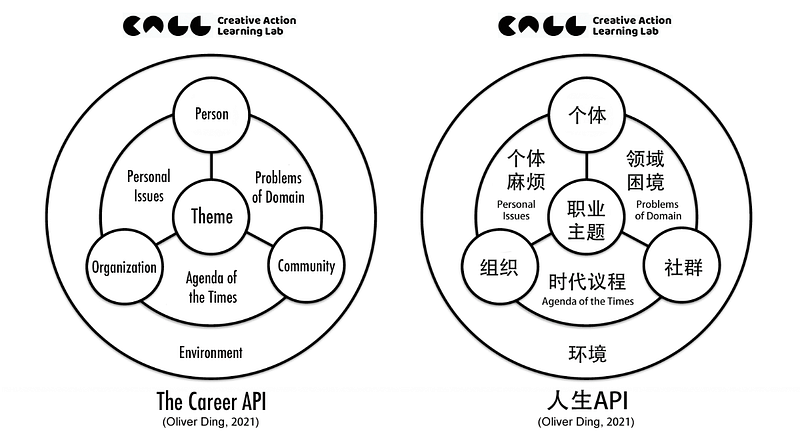
The above pictures show two versions of the same diagram. When I design the English version, I can’t use the same size text for “Person”, “Organization”, and “Community” because the circles offer a negative Graphic Space Affordance. In other words, there is a constraint. However, I can use the same size text for the Chinese version. The circles offer a positive Graphic Space Affordance. Also, a circle can display more Chinese words than English words. For example, I use one-word “Theme” for the English version and two words “职业主题(Career Theme)” for the Chinese version.
Graphic Space Affordances also connect to both Physical Space Affordances and Digital Space Affordances. Physical Space Affordances consider a physical container of a diagram. The size of the physical container also impacts Graphic Space Affordances.
The next post (4B) will discuss other two topics from the Ecological Situation perspective:
- 8.6 Digital Space Affordances
- 8.7 The Opportunity of Objectification
You are most welcome to connect via the following social platforms:
Linkedin: https://www.linkedin.com/in/oliverding Twitter: https://twitter.com/oliverding Polywork: https://www.polywork.com/oliverding Boardle: https://www.boardle.io/users/oliver-ding
License
This work is licensed under the Creative Commons Attribution-NonCommercial-ShareAlike 4.0 International (CC BY-NC-SA 4.0) License. Please click on the link for details.


