
CALL for LIFE: Anticipatory Activity System for Life Transitions
An eight-step practical framework for dealing with a difficult challenge
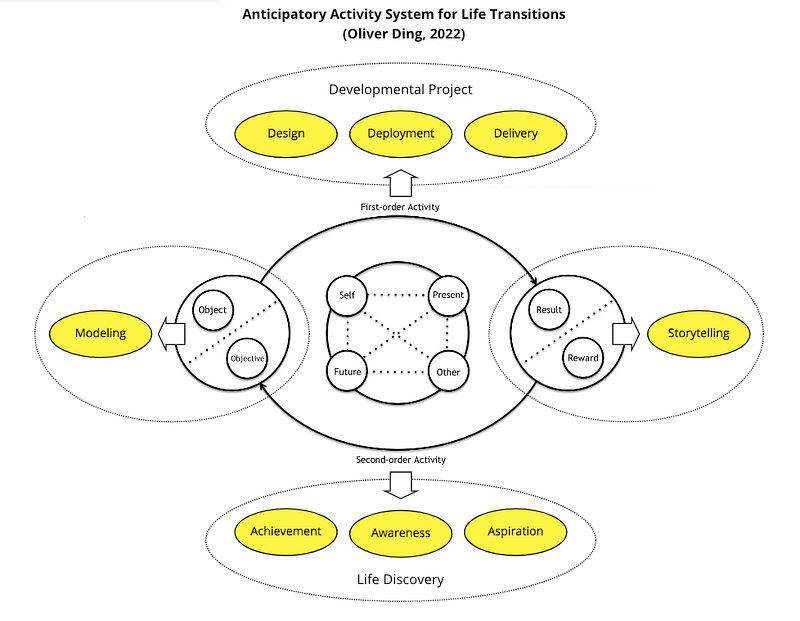
The above diagram is a practical framework for applying the Anticipatory Activity System framework to Life Transitions. Let’s call it AAS4LT.
The AAS4LT is inspired by the following knowledge resources:
- Anticipatory Activity System: The center of the above diagram.
- Life Discovery Activity: It is a Second-order Activity.
- Developmental Project: It is a First-order Activity.
The Anticipatory Activity System framework (AAS) is an abstract model which aims to understand a special type of human activity that highlights “Self, Other, Present, Future”.
As an application of AAS, the AAS4LT was developed with eight steps for guiding a life transition coaching program.
Anticipatory Activity System
The Anticipatory Activity System framework is a hybrid theoretical framework that curates the following two theories together:
- Activity Theory
- Anticipatory System Theory
This hybrid approach is inspired by Clay Spinuzzi’s book Network: Theorizing Knowledge Work in Telecommunications. To understand a telecommunications company’s knowledge work, Clay Spinuzzi focuses on the concept of “Network”, and adopts the following two theories to build an abstract framework for theorizing “Network” of knowledge work:
- Activity Theory
- Actor-network theory (ANT)
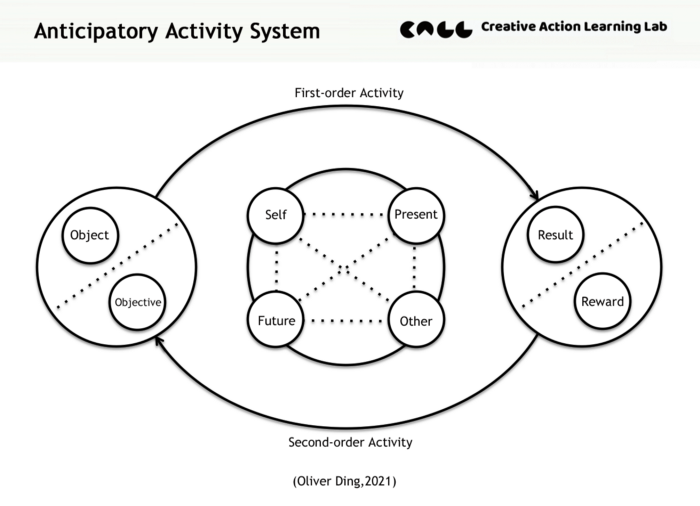
The above diagram is the standard model of the Anticipatory Activity System framework. It was formed by the following pairs of concepts:
- Present — Future
- Self — Other
- Object — Objective
- Result — Reward
- First-order Activity — Second-order Activity
You can find more details from D as Diagramming: Strategy as Anticipatory Activity System.
Second-order Activity
The Second-order Activity is a specific type of activity in which subjects aim to define objectives and goals for their further activities.
For the AAS4LT framework, I choose the Life Discovery Activity for the Second-order Activity. In Feb 2022, I developed several knowledge resources for the Life Discovery Activity.
- Life Discovery Toolkit (v1.0)
- Life Discovery Canvas (v1.0)
- The Life-as-Project Approach
I adopt three modules from the Life Discovery Toolkit (v1.0) for the AAS4LT framework:
- Aspiration
- Awareness
- Achievement
The above three modules will help people find objectives and goals for their further life activities.
First-order Activity
The second half of the AAS4LT framework is First-order Activity which refers to normal activities.
I choose the Developmental Project model to design and develop First-order Activities for the duration of Life Transitions. The process has the following three steps:
- Design
- Deployment
- Delivery
While Life Discovery Activity connects Reward and Objective, the Development Projects aims to connect Object and Result. We pay attention to the transformation of objects and their results.
Modeling and Storytelling
In addition, the AAS4LT framework also considers the following two steps:
- Modeling
- Storytelling
Modeling is for managing and reflecting on First-order Activity. We have to make a plan for a Developmental Project, and we have to modify the plan to adapt to the change of environments. In this dynamic process, we might develop abstract models as cognitive representations to help us cope with information overload.
Storytelling is for sharing our results and challenges publically and building a social supportive system for a life transition program. As a process of narrative, Storytelling focuses on the development of Identity of Project and Themes of Project and the development of Personal Identity and Personal Life Themes.
An Eight-step Practical Framework
The AAS4LT framework aims to offer life coaches a new tool for dealing with life transitions from the perspective of the Anticipatory Activity System framework. Though the theoretical support is very important, the result depends on the long-term engagement between life coaches and clients.
Let’s summarize the eight steps below:
- Aspiration
- Awareness
- Achievement
- Design
- Deployment
- Delivery
- Modeling
- Storytelling
There is an ideal sequence of the process between these eight steps. If everything goes well, we can pass these steps one by one. However, the real-life is not a simple linear model. We might need to jump between these steps. The real process is iterative, taking many cycles through the process.
Strategies
In the original article about Anticipatory Activity System, I claimed that we can use the Anticipatory Activity System to understand Strategy.
A core idea of Anticipatory System Theory is the Predictive Model. According to Robert Rosen, “An anticipatory system is a natural system that contains an internal predictive model of itself and of its environment, which allows it to change state at an instant in accord with the model’s predictions pertaining to a later instant.” In contrast, a reactive system only reacts, in the present, to changes that have already occurred in the causal chain, while an anticipatory system’s present behavior involves aspects of past, present, and future.
From the perspective of Anticipatory Activity System, Strategy is a process of developing advanced predictive models in order to manage the complexity of anticipation and performance.
Does the AAS4LT framework offer some strategies for developing advanced predictive models?
No.
The AAS4LT framework focuses on helping people deal with the challenge of life transition in a short duration. However, the design of the AAS4LT framework offers some strategic suggestions for each part.
- The most important part is the Developmental Project part in which people develop themselves. How to design a Developmental Project? This is about strategic decisions.
- In the process of Life Discovery, if we discover huge structural tensions in a person’s life, then we need to adopt some strategic creative techniques to help the person solve potential problems.
- The distinction between Objective (what is motive about) and Object (what is acted on) suggests a good strategic technique: switching between abstract objectives and concrete objects.
- The distinction between Results (the change of objects) and Reward (the feedback from others) suggests balancing between Self-Reward and Other-Reward and managing the Explore — Exploit Cycle.
These strategic suggestions are just general ideas. For real-life cases, it all depends on the client’s situation and the coach’s knowledge and skills.
Insights from an Empirical Research
The AAS4LT framework is born from curating insights from both theoretical development and empirical research.
Though most of the ideas are adopted from the Anticipatory Activity System framework and other knowledge frameworks, the whole structure is inspired by an empirical research project about a person’s one-year life transitions.
If you read my articles about iART Framework, you probably know that The Anticipatory Activity System is an expanded version of iART Framework which was born from an empirical research project about an adult development program.
I’d like to call the program SSL which stands for Shaper & Supporter Lab. Anyway, it is just a codename. SSL was founded by a friend of mine in April 2021.
The program was designed with three components: 1) Life Purpose Awareness, 2) Personal OKR Practice, 3) Peer Review and Feedback. My friend also adopted the Building In Public approach to share her goals, challenges, progress, and discussions with others on social media platforms.
I use the Project Engagement approach to guide my research about the program. The approach uses a method called “Multiple-level Project Engagement”. I reflect on the following levels:
- The “My friend — Members” Engagement
- The “Member — Member” Engagement
- The “I — My friend” Engagement
This method is what I called “Cultural Projection Analysis” of Project-oriented Activity Theory. You can find more details here: Activity U (X): Projecting, Projectivity, and Cultural Projection.
My friend started the journey in Feb 2021. Last month, we worked on reflecting on her life transition in the past 12 months. In the process of reflection, I realized that she did two activities during the one-year journey.
- Second-order Activity: She spent several months on Life Discovery.
- First-order Activity: Seh started the Shaper & Supporter Lab program as a Developmental Project.
I also observed that she also worked hard on modeling her project and storytelling about her life discovery.
This insight inspired me to create the AAS4LT framework. This is an awesome discovery!
Further Reading
I have written many articles about Anticipatory Activity System, Life Discovery Activity, Developmental Project Model, and Modeling/Diagramming. You can find them on CALL (https://medium.com/call4).
- Strategy as Anticipatory Activity System
- The Life Discovery Toolkit (v1)
- Life Discovery: The Life-as-Project Approach
For the AAS4LT framework, you can read the following articles to understand the eight steps:
- Aspiration: What kind of hero are you?
- Awareness: What is the status of your primary life project?
- Achievement: What have you created so far?
- Design: How to find ideas for your developmental projects?
- Deployment: How to manage your primary developmental project?
- Delivery: How do you echo the development of culture?
- Modeling: I am working on a study called Modeling A Project. I will share my discovery later. Now you can read the following related articles.
8. Storytelling: I will start a new study about Projects and Storytelling. Now you can read the following related articles.
You can also find the AAS4LT framework, the Life Discovery Toolkit and the Life Discovery Canvas on the following board on Miro:
You are most welcome to connect via the following social platforms:
Linkedin: https://www.linkedin.com/in/oliverding Twitter: https://twitter.com/oliverding Polywork: https://www.polywork.com/oliverding Boardle: https://www.boardle.io/users/oliver-ding


