
[Creative Diagramming] The “Identity — Program — Action” Thematic Space and the “SET” Projects
Connect the Developmental Project Model and the SET Framework
On Oct 31, 2023, I wrote an article titled [Creative Diagramming] Graphic Space Affordances, Thematic Space, and Possible Paths.
Contents
1. Creative Diagramming and Mental Moves 2. Explore Graphic Space Affordances 3. Explore Potential Thematic Spaces of the Developmental Project Model 4. Utilize Potential Thematic Spaces of the Knowledge Discovery Canvas 5. Explore Possible Connections of Diagram Networks 6. Explore the Spatial Structure of Life Discovery Canvas 7. Explore Possible Paths of moving between thematic spaces
Section 3 of the article is about discovering potential thematic spaces of the Developmental Project Model. Section 5 is about connecting diagrams.
Today I will add one more example about section 3 and section 5.
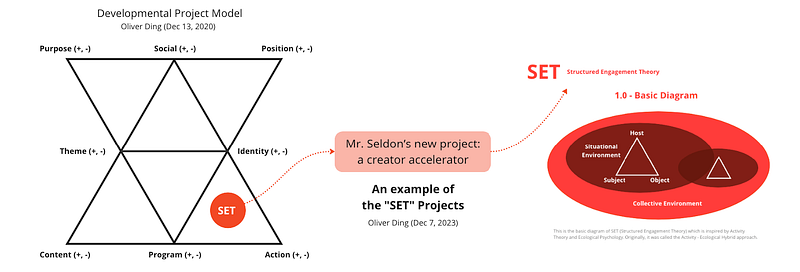
The above diagram features a new type of project: the “SET” project.
It is located at the “Identity — Program — Action” Thematic Space.
I also connect it with the SET Framework.
Mr. Seldon’s New Project
I mentioned Mr. Seldon’s story in Case study: Andmind Group [Activity Theory].
Mr. Seldon is an ambitious serial entrepreneur with a unique educational background in psychological science. In 2015, Mr. Seldon moved to the educational field and started his third business: Andmind Group. Mr. Seldon didn’t use “Andmind Group” as a name for his business. I just use this term to refer to various activities of his new enterprise.
In 2014, Andmind Group started as a social media group with about 250 members. In 2015, Mr. Seldon registered Andmind Company as a business entity and started formal daily operations. By 2017, the enterprise of Andmind Group expanded to various activities (see the diagram below).
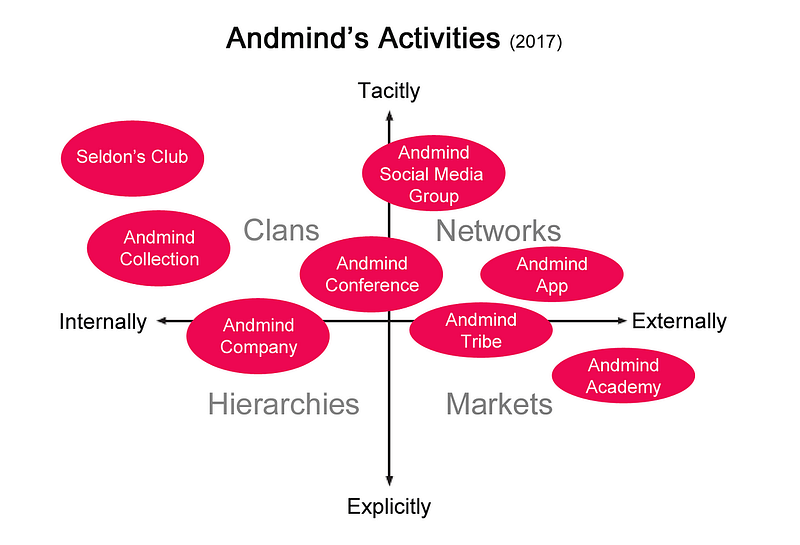
In order to understand the whole story, we should trace back to his psychobiography (including self-identity). Mr. Seldon is not a normal entrepreneur, he likes reading and writing. The essential activity of his life is embracing “the third culture” by writing scientific articles on his personal blog. His social models are Steven Pinker, James G. March, Richard Dawkins, Vladimir Nabokov, Isaac Asimov, and Paul Graham. If we connect Andmind Group with his personal life theme, then we can understand it is not a simple business.
In the past several years, his business has grown quickly. In 2023, he launched a new company to establish a new system of life development.
Last month, the new company launched a 42-day creator accelerator.
This program inspired me to add “SET” to the “Identity — Program — Action” Thematic Space.
The SET (Structured Engagement Theory) Framework
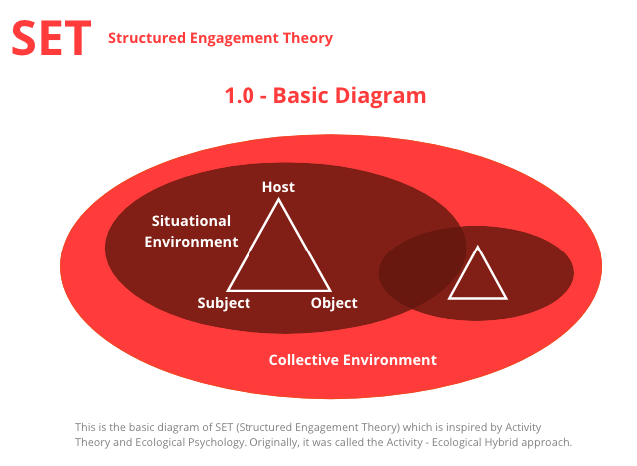
The SET Framework was originally named the Ecological — Activity Hybrid Approach. It was developed from 2017 to 2020 when I worked on several projects that referred to a new type of social action platform.
Traditionally, Activity Theory uses “Subject — Mediation — Object” as a basic unit of analysis. The Activity system model expands the basic unit of analysis to “Subject — Mediation — Object — Rules — Community — Divisions of Labour”. However, I found there is a gap between Activity Theory and Intersubjective Social Design.
For example, I worked on a one-to-one video talk product from 2017 to 2018. Later, I worked on other projects that adopted Structured Engagement as a design pattern. These projects share the following aspects:
- Host: a special type of actor who hosts the whole activity.
- Structured Engagement: the activity is human-to-human interactions with a special structured process.
- Environment: the environment is also part of the design of the activity.
I started learning Activity Theory, Ecological Psychology, and other theories around 2015. Since then, I have often used some theoretical concepts such as Mediation from Activity Theory, Affordance from Ecological Psychology, etc for our product development discussions.
I realized the Activity System model, which is a popular theoretical framework of Activity theory, is not an ideal framework for theorizing above intersubjective social actions. In 2019, I developed the Ecological — Activity Hybrid Approach by adopting ideas from Activity Theory and Ecological Psychology. In 2020, I renamed the approach SET which stands for Structured Engagement Theory.
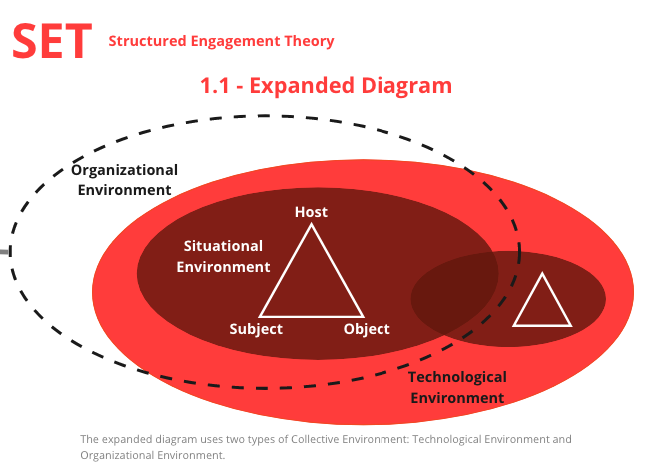
In 2021, I applied the SET framework to study digital whiteboard platforms such as Miro and Milanote. I designed an expanded diagram for my research. This expanded version has three types of environments:
- Situational Environment: For example, a Miro board and related events.
- Organizational Environment: For example, the team behind the Miro board.
- Technological Environment: For example, Miro and other related digital platforms.
In Feb 2022, I used the SET framework to study an adult developmental program. This change encouraged me to think about the connection between Activity Theory and Service Design. See the diagram below.
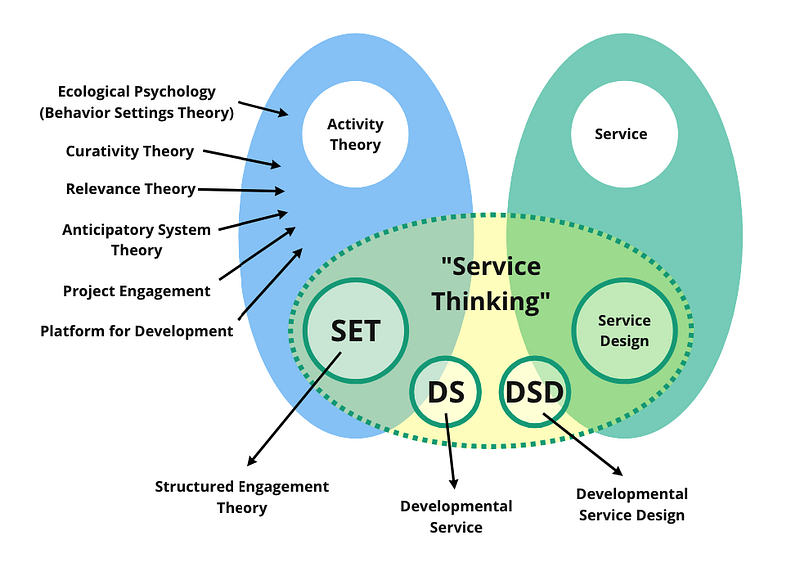
- SET: Structured Engagement Theory
- DS: Developmental Service
- DSD: Developmental Service Design
- SD: Service Design
Developmental Service Design could adopt the mindset and workflow of the Design Process and tools from the Service Design community, it also could expand its toolkits from Developmental Service Study.
This is the amazing engagement between Theory and Practice. Each dialogue always leads to a new creative space.
A Creator Accelerator is a Developmental Service that could be studied with the SET Framework.


