
Social Moves (book, v1, 2023)
The Attachance Approach to Social Cognition

In July 2023, I finished the “Mental Moves” knowledge project and edited a possible book titled Mental Moves: The Attachance Approach to Ecological Creative Cognition. On August 24, 2023, I started the “Social Moves” knowledge project which uses “Social Territory” as the primary concept.
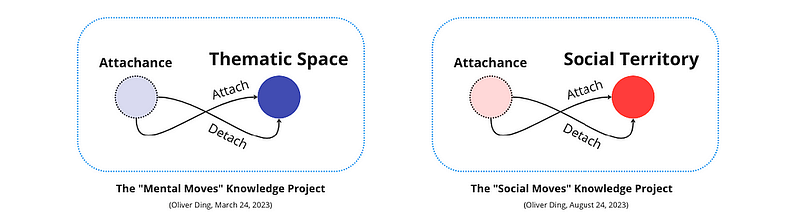
The term “Social Territory” was inspired by Ping-keung Lui’s term “Social Territory” and his Subjectivist Structuralism which is part of his theoretical sociology.
I have claimed that “Knowledge Center” is a type of Social Territory. You can find more details in Knowledge Engagement: The Creative Course Framework.
If we put “Mental Moves” and “Social Moves” together, we see a new unit of analysis of Social Cognition. While “Social Moves” are about Social Actions, “Mental Moves” are about related Mental Activities.
Social Cognition = Social Moves (Mental Moves)
Both “Mental Moves” and “Social Moves” shared the concept of “Thematic Space” and the concept of “Attachance”.
In the past weeks, I developed an integrated ecological approach to social cognition.
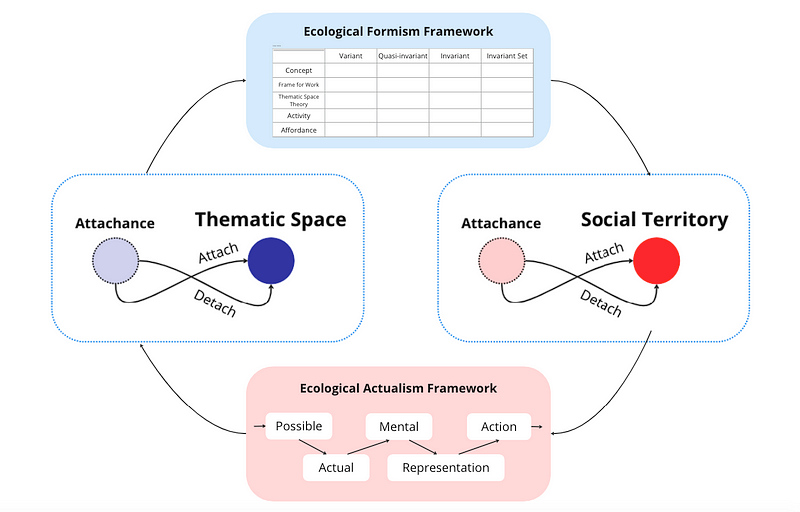
It was formed by two sub-frameworks: the Ecological Formism framework and the Ecological Actualism framework.


Since I used “the Attachance Approach” for the Mental Moves project, I decided to use it to name the new approach for the Social Moves project.
This article aims to collect articles about the Attachance Approach to Social Cognition and close the Social Moves project (phase 1).
Contents
1. The Concept of Attachance 2. The Attachance Approach to Social Cognition 3. Ontology: Social Moves (Mental Moves) 4. Realism: the Ecological Actualism framework 5. Hermeneutics: the Ecological Formism framework 6. The Limitation
7. A Possible Book Part 1: Social (Cognition) Part 2: Thematic Space Theory Part 3: Frame for Work Part 4: Life as Activity Part 5: Graphic Space Affordances Part 6: The Territory of Concepts
1. The Concept of Attachance
The “Mental Moves” project aims to curate more examples of “Moving between Thematic Spaces”. It means the primary object of the project is the concept of Attachance.
I coined the term Attachance by combining Attach and Chance in 2018 to discuss some ideas related to Affordance, a core idea of Ecological Psychology.
Affordance means potential action opportunities offered by environments. I want to highlight the meaning and value of actual action itself, however, the term Affordance only refers to potential actions. Thus, I coined the term Attachance to emphasize the potential opportunities offered by actual actions, especially the attaching act and the detaching act.
In 2019, I started working on my theoretical account of the Ecological Practice approach after finishing a book titled Curativity. The 2019 version of the approach is a curated toolkit version. The concept of Attachance is part of the toolkit. In May 2020, I wrote a book titled After Affordance: The Ecological Approach to Human Action in which I proposed several new theoretical ideas for expanding ecological psychology to the modern digital environment. The primary theme of After Affordance is the concept of Attachance.
The concept of Attachance is planned to develop as 1) an ecological practice concept for practice studies such as interaction design and startup innovation, and 2) a philosophical concept for developing a social theory.
The book After Affordance only achieves the first goal and it focuses on the following acts:
- Attaching to an environment
- Detaching from an environment
- Attaching to an object
- Detaching from an object
I use the concept of Attachance in many ways.
The Attachance Perspective refers to its philosophical meaning. You can find more details in D as Diagramming: The Attachance Perspective.
The theoretical concept of “Attachance” for the Ecological Practice Approach. It refers to what I explored in the 2020 book After Affordance. For example, I used it and Affordance together for discussing creative actions. You can find more details in Creative Actions: Second-order Affordance and Attachance.
The word “Attachance” is for normal discussions. I often discuss some stories or topics from the perspective of Attachance. You can find an example in Possible Practices: Attach, Detach, and Opportunities.
In 2022, the development of Attachance was tied to the development of Thematic Space. As mentioned above, Thematic Spaces refer to a specific type of container: cognitive container. You can find more details in [Slow Cognition] The Development of the concept of “Thematic Spaces”.
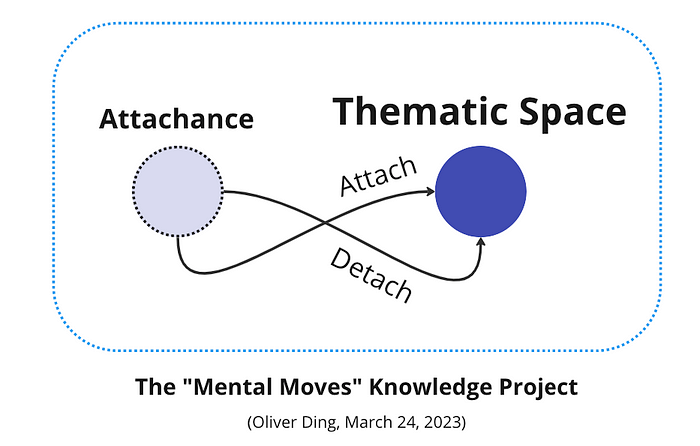
On March 24, 2023, I made a list of articles about the concept of Attachance. You can find more details in the following link:
2. The Attachance Approach to Social Cognition
The concept of Attachance belongs to the Ecological Practice approach which is inspired by Ecological Psychology, Activity Theory, and social practice theories. In a broad sense, the Ecological Practice approach has its philosophical roots in traditional Pragmatism and contemporary embodied cognitive science.
Traditional scholars tend to use the following structure in the field of social sciences: Ontology > Epistemology > Methodology.
- Ontology: What’s this?
- Epistemology: What’s the knowledge about this?
- Methodology: How do we actually know the knowledge about this?
This schema has its roots in Western Philosophy, beginning with the ancient Greek philosophy of the pre-Socratics.
This is not “the one and the only” approach to building systematic thinking of knowledge engagement.
Inspired by Ping-keung Lui’s theoretical sociology, I used the “Ontology > Realism > Hermeneutics” schema to curate my theoretical frameworks. You can find more details in Knowledge Engagement: The Utilization of Theoretical Resources.
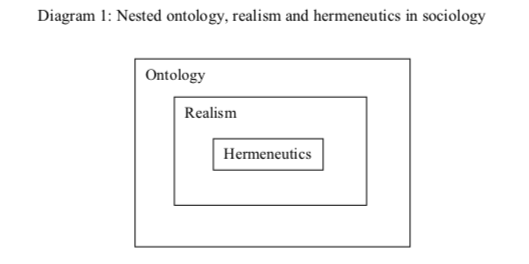
The structure of Lui’s theoretical sociology is a nested structure. See the diagram below. According to Lui, “The realism comprises a subjectivist structuralism and an objectivist stock of knowledge, while the hermeneutics is an interpretation and an analysis. Second, I shall present an ontology that nests the realism within its boundaries.” (p.250, 2016, Aspects of Sociological Explanation)
We should see this grand theory as a dialogue between philosophy and sociology because “Ontology” and “hermeneutics” are respectable terms in philosophy, but “realism” — sandwiched between them — is not. Lui emphasizes that Realism is the sociological matter proper (p.251, 2016, Aspects of Sociological Explanation).
It can perhaps be said to be the apple in the scientist’s eye,138 though the term “realism” may sound naïve to the phenomenological ear. It is much closer to “what is” than “what is the meaning of”.
In a certain sense, science is always naïve though not simple. With the freedom of imagination being exercised by the scientist to its fullest, it presupposes in the first instance that there is really a reality out there, at least in the Schutzian sense, that is, the reality is often “taken- for-granted”, “questionable but unquestioned.” The presupposition may be naïve, but its buttresses are not. The sociologist — who should be a scientist more than a philosopher — relies on empirical (or positivistic) investigations to buttress his discipline.
Lui considers the following four realities for the grand theory:
- the Weberian course of action
- the Giddensian course of action
- Social Territory
- Symbolic Universe
Realism is determined by Ontology. Realism leads to Hermeneutics which considers two parts: the actors’ interpretation and the researcher’s analysis.
The diagram below shows three layers of the Attachance Approach to Social Cognition.
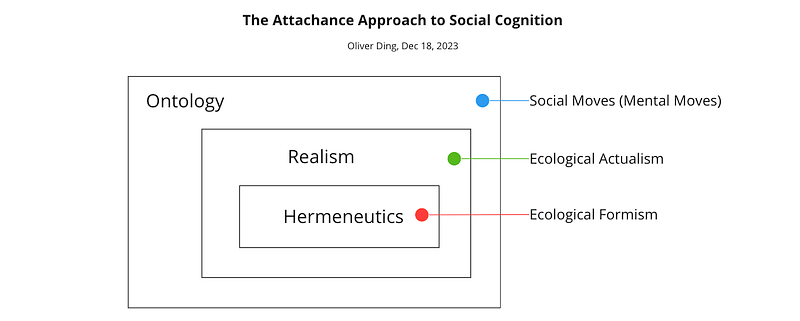
- Ontology: Social Moves (Mental Moves)
- Realism: the Ecological Actualism framework
- Hermeneutics: the Ecological Formism framework
The rest of the articles will unpack this nested structure.
3. Ontology: Social Moves (Mental Moves)
As mentioned above, If we put “Mental Moves” and “Social Moves” together, we see a new unit of analysis of Social Cognition. While “Social Moves” are about Social Actions, “Mental Moves” are about related Mental Activities.
Social Cognition = Social Moves (Mental Moves)
Both “Mental Moves” and “Social Moves” shared the concept of “Thematic Space” and the concept of “Attachance”.
This ontological definition of Social Cognition was inspired by the basic model of the Ecological Practice approach.
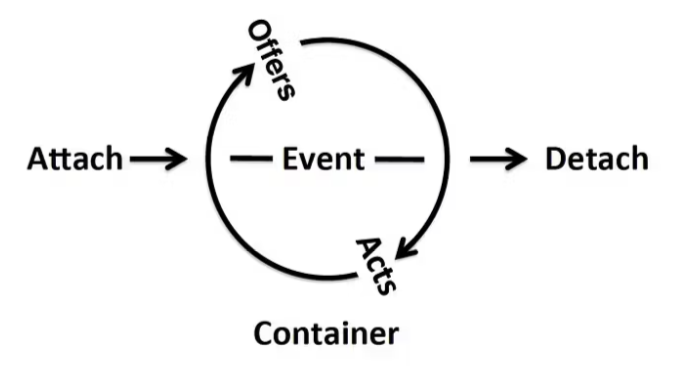
The above diagram combines three core concepts of the Ecological Practice approach: Affordance, Attachance, and Containance. The term “Offers” is an affordance-inspired concept, it refers to opportunities afforded by the Container. The group of “Offer — Act” forms “Event” which changes the status of the Container. The new status of the Container affords new opportunities that guide the new acts and events.
The above diagram also represents the concept of Attachance at the level of Container. We can consider Entering the Container as an Attaching act and Exiting the Container as a Detaching act. However, the diagram doesn’t represent the second attachance which is inside the Container. The Ecological Practice approach considers the “Form of Act” as “Attach” or “Detach”. Any act is either an attaching act or a detaching act.
For the Social Moves project, “Thematic Spaces” and “Social Territory” are two types of “Container”.
- Mental Moves: Thematic Space
- Social Moves: Social Territory
At the Ontology level, both concepts are very abstract. We need to see them at the Realism level and the Hermeneutics level.
4. Realism: the Ecological Actualism framework
I pay attention to two fields: Knowledge Engagement and Product Engagement. Both two fields share the same pattern of developing a concept system. However, they have different complexities in the stage of Continuous Objectification.
For knowledge engagement, a typical objectification of a concept system is a Knowledge Framework or knowledge model. In the past several months, I developed a series of diagrams about knowledge frameworks. If we put them together, it represents an example of the Ecological Actualism framework.
I roughly consider five moments of Knowledge Frameworks.
- From Possible to Actual
- From Logical to Representation
- From Mental to Action
- From Make to Use
- From Use to Possible
In general, I use the diagram below to represent the ecological actualism framework.
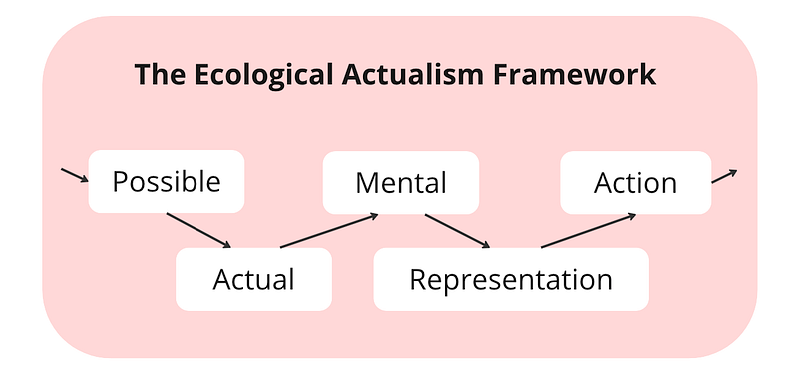
The Ecological Actualism framework sees a knowledge framework and a diagram are no longer a static knowledge representation, but a developmental dynamic process.
The process is a dynamic creative territory for exploring, reflecting, and curating.
The core idea of this view is the “Representation — Thematic Space — Perceiver” structure. A user could perceive potential thematic space of a representation (a diagram) of a knowledge framework, and discover some new creative spaces.
The Ecological Actualism framework emphasizes Potential Action Opportunities that emerge from the “Object — Environment — Actor” structure.
This view is inspired by Ecological Psychologist James G. Gibson’s Affordance Theory and his ecological approach to visual perception in general.
You can find more details in Frame for Work: The Ontology of Knowledge Frameworks and Ecological Actualism.
5. Hermeneutics: the Ecological Formism framework
The Ecological Formism framework is an epistemological framework that frames five units of analysis from four types of knowing.
The “Variant > Quasi-invariant > Invariant > Invariant Set” schema defines four types of knowing.
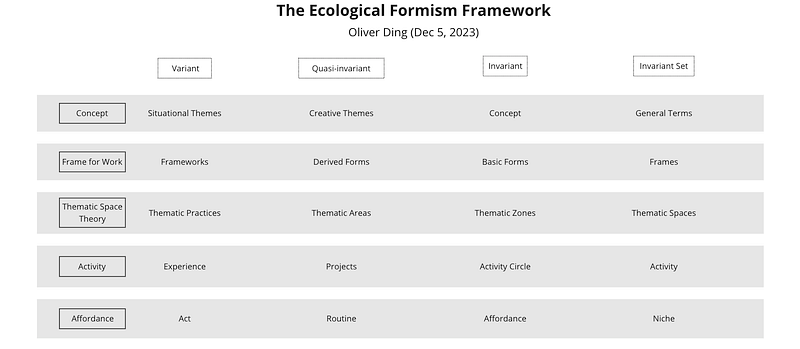
In the above diagram, we see five levels of analysis:
- Concept
- Frame for Work
- “Thematic Space Theory” (TST)
- Activity
- Affordance
The “Concept” level is about the transformation between themes and concepts.
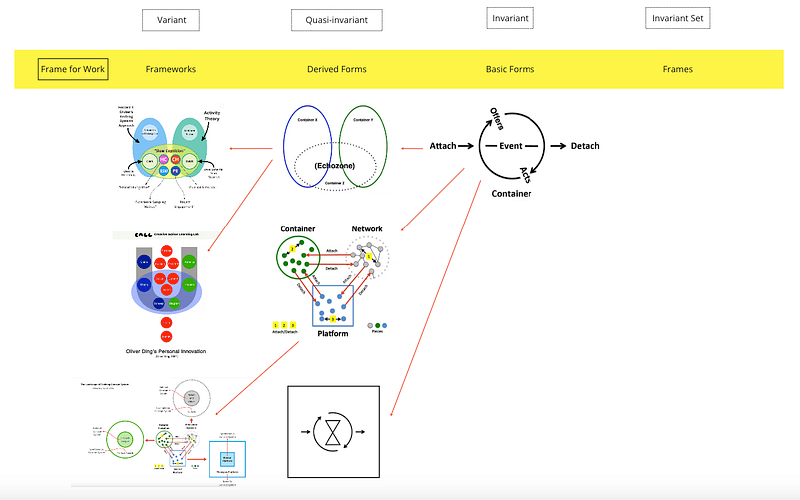
The “Frame for Work” level is about the emergence of knowledge frameworks. The diagram below is a case study of the “Frame for Work” level. You can find more details in Frame for Work: The Hermeneutics of Knowledge Frameworks and Ecological Formism.
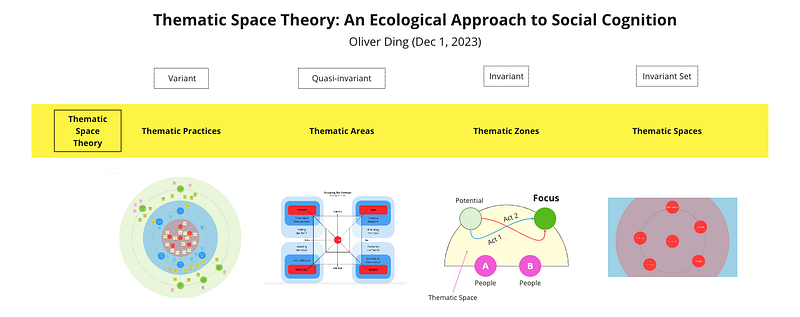
The TST level (the “Thematic Space” level) is a middle level that connects “Activity” and “Frame for Work”. You can find a case study about Psychological Knowledge Engagement and Knowledge Discovery Canvas in Social Moves: Thematic Zones, Thematic Areas, and Social Territory.
The “Activity” level is about different patterns of actions. You can find more details in Knowledge Engagement: The Concept of “Activity”.
The “Affordance” level is related to the Operation level of Activity. You can find more details in [Creative Diagramming] Graphic Space Affordances, Thematic Space, and Possible Paths.
You can find more details in Social Moves: An Integrated Ecological Approach to Social Cognition.
In Lui’s theoretical sociology, the concept of “Social Territory” is the core of the Realism part.
The Ecological Formism Framework offers a solution to connect the concept of “Thematic Space” with the concept of “Social Territory”. See the diagram below.
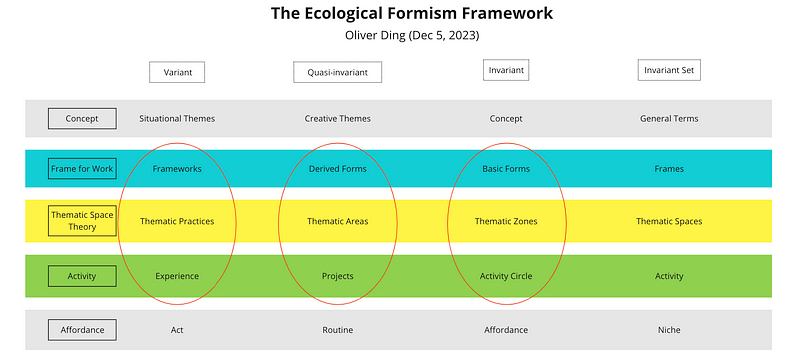
The above diagram highlights the connection between three units of analysis:
- The “Activity” level
- The “Thematic Space Theory (TST)” level
- The “Frame for Work (Knowledge Framework)” level
We also can see three cross-level connections:
- Variant: Experience — Thematic Practices — Frameworks
- Quasi-invariant: Projects — Thematic Areas — Derived Forms
- Invariant: Activity Circle — Thematic Zones — Basic Forms
You can find more details in Frame for Work: The Hermeneutics of Knowledge Frameworks and Ecological Formism.
6. The Limitation
The Social Moves project (phase 1) focused on creating a brand-new theoretical framework for understanding social cognition.
The framework is a meta-framework that curates a set of sub-framework together. I used some case studies to support some sub-frameworks.
The next phase of the project is expected to conduct more case studies.
7. A Possible Book
Now it’s time to edit a possible book and close the Social Moves project.
It is divided into the following six parts. Part 1 is the introduction to the new approach. Part 2 to Part 6 are about five units of analysis.
- Part 1: Social (Cognition)
- Part 2: Thematic Space Theory
- Part 3: Frame for Work
- Part 4: Life as Activity
- Part 5: Graphic Space Affordances
- Part 6: The Territory of Concepts
Since I have edited books (drafts) about Activity Theory and Concepts, the primary focus of this book is about 1) the integrated ecological approach to social cognition, 2) the Thematic Space Theory (TST) framework, and 3) a new framework of Knowledge Frameworks.
Some numbers about the possible book:
- 6 parts
- 44 articles
- Total 636 min read
- Total 168,540 words (about 337 sing-spaced pages)
Part 1: Social (Cognition)
Part 1 introduces the brand-new integrated ecological approach to social cognition.
- A possible theme called “Social Moves” (9 min)
- An Integrated Ecological Approach to Social Cognition (17 min)
- Thematic Zones, Thematic Areas, and Social Territory (26 min)
- The Ontology of Knowledge Frameworks and Ecological Actualism (23 min)
- The Hermeneutics of Knowledge Frameworks and Ecological Formism (23 min)
- From “Ecological Complexity (2020)” to “Creative Social Cognition (2023)” (8 min)
- Knowledge Engagement: The Creative Course Framework (7 min)
- Thematic Spaces: Life, History, and Multiverse (16 min)
Part 2: Thematic Space Theory
Part 2 focuses on the Thematic Space Theory (TST) framework, especially the development of the concept of “Thematic Space”.
- What’s “Thematic Space”? (11 min)
- The Development of the concept of “Thematic Spaces” (18 min)
- The Notion of Thematic Spaces (11 min)
- This is just an accident! An example of Ecological Awareness — Theme as Space (9 min)
- Thematic Space: Project as Story (15 min)
- Moving between Thematic Spaces (14 min)
- Life = Project = Thematic Space (11 min)
- Psychological Knowledge Engagement as Social Moves (3 min)
Part 3:Frame for Work
Part 3 collects more articles about the “Frame for Work” project and the framework of Knowledge Frameworks.
- A Possible Theme called “Frame for Work” (8 min)
- From Possible to Actual: Possible Configurations of A Theme Network (15 min)
- From Logical to Representation: Attachance, Thematic Space, and Framework (7 min)
- From Mental to Action: Mental Models and the Attachance of Multiple Moves (18 min)
- From Make to Use: Product, Langue, and Speech (14 min)
- Weaving the Mind and Clarifying the Order (20 min)
- Four Perspectives and Creative Identities (12 min)
- Frame Analysis in Context (27 min)
Part 4: Life as Activity
In the past years, I have written several books about Activity Theory. You can find more details on Appropriating Activity Theory (Book). For the Social Moves project, I selected some articles as references for the “Activity” unit of analysis.
- The Concept of “Activity” (15 min)
- The Activity Circle (Oliver Ding, 2017) (9 min)
- ARCH: A Visual Language of Interpersonal Interactions and Collaborative Project Engagement (6 min)
- Projecting, Projectivity, and Cultural Projection (26 min)
- Developmental Project Model (12 min)
- Projectivity as Cultural Attachance (37 min)
- Running the “GAP” Project (24 min)
Part 5: Graphic Space Affordances
For the Social Moves project, the “Affordance” level refers to potential action opportunities. In Part 5, I focus on the concept of Graphic Space Affordances and its relationship with the Thematic Space Theory (TST) framework and the Frame for Work framework.
- Creative Diagramming: Graphic Space Affordances, Thematic Space, and Possible Paths (24 min)
- Physical Space Affordances and Graphic Space Affordances (16 min)
- Creative Life: The World of Works and Five Possible Books (14 min)
- Creative Life Curation: Discover Thematic Spaces of Creative Life (4 min)
- The Life Discovery Canvas (v1.0) — Part 2: Spatial Structure (15 min)
- The “Identity — Program — Action” Thematic Space and the “SET” Projects (5 min)
- The “Social — Theme — Identity” Thematic Space and the “CLUE” Projects (4 min)
- The Serendipity of Making A New Framework (5 min)
Part 6: The Territory of Concepts
The “Concept” level is about themes and concepts. This issue is not the primary focus of the Social Moves project. I selected several articles as references.
- Themes of Practice: Concept, Activity, and Cognition (29 min)
- The Territory of Concepts (11 min)
- Mental Platform: The Evolving Concept System (13 min)
- The Grasping the Concept Model — (10 min)
- The Theme of “Conceptual Elaboration” (15 min)
If you want to know more about concepts and themes, you can check my book (draft) Grasping the Concept: The Territory of Concepts and Concept Dynamics.
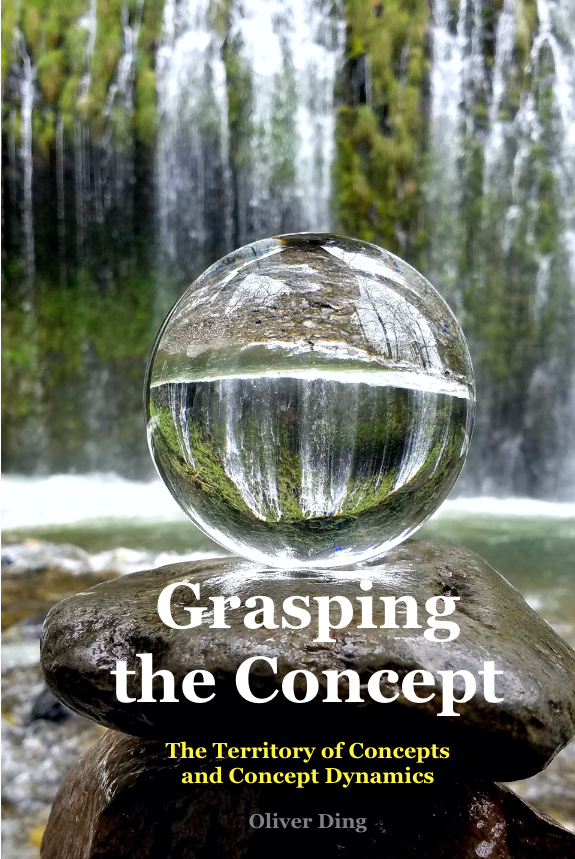
Related books (Drafts)
- Creative Life Theory: Building A Knowledge Enterprise
- Thematic Exploration: The Early Discovery of Knowledge Engagement (book, v1)
- Mental Moves: The Attachance Approach to Ecological Creative Cognition
- Knowledge Discovery: Developing Tacit Knowledge with Thematic Space Canvas
- Knowledge Curation: Turning Pieces into A Meaningful Whole
- Life Discovery: Biography, Journey, Program
- Perspectives on Product Engagement
- Diagramming as Practice
- Diagram Blending: Building Diagram Networks
- Creative Life Curation: Discover Thematic Spaces of Creative Life


