
Social Moves: Thematic Zones, Thematic Areas, and Social Territory
A Case Study of the Ecological Formism Framework
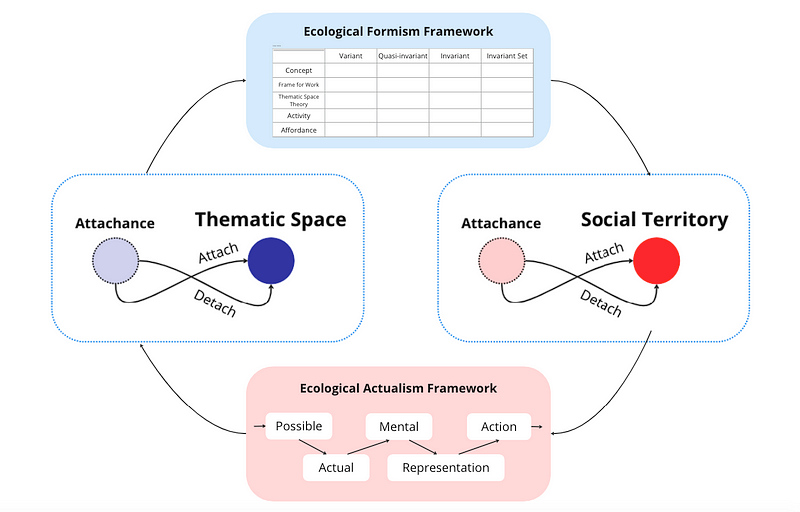
The above diagram is an integrated ecological approach to social cognition.
It was formed by two sub-frameworks: the Ecological Formism framework and the Ecological Actualism framework.
In the past several months, I used the concept of “Thematic Space” to conduct some case studies about Psychological Knowledge Engagement.
I will use the Thematic Space Theory (TST) Framework in this article to review these case studies.
Since the TST Framework is a part of the Ecological Formism framework, we can see this article as a case study of the latter.
Contents
Part 1: The Background
1.1 The Ecological Formism Framework 1.2 Thematic Space Theory 1.3 Knowledge Discovery Canvas
Part 2: Thematic Spaces of Knowledge Discovery Canvas
2.1 Four Thematic Areas 2.2 Thematic Zones 2.3 Four In-area Thematic Zones 2.4 Six Cross-area Thematic Zones 2.5 Thematic Practices: Possible Thematic Spaces of Creative Life
Part 3: Four Case Studies of Psychological Knowledge Engagement
3.1 Psychological Knowledge Engagement 3.2 Robert Kegan’s Knowledge Enterprise 3.3 The Mindset Engagement Project 3.4 The Likert 7 Project 3.5 Psychological Counseling Platform
Part 4: The Social Territory of Social Moves
4.1 The Concept of Social Territory 4.2 Activity, Thematic Space, and Knowledge Framework 4.3 Four Kinds of Knowing
Part 1: The Background
Part 1 briefly introduces the Ecological Formism framework, Thematic Space Theory, and the Knowledge Discovery Canvas.
1.1 The Ecological Formism Framework
The Ecological Formism framework is an epistemological framework that frames five units of analysis from four types of knowing.
The “Variant > Quasi-invariant > Invariant > Invariant Set” schema defines four types of knowing.
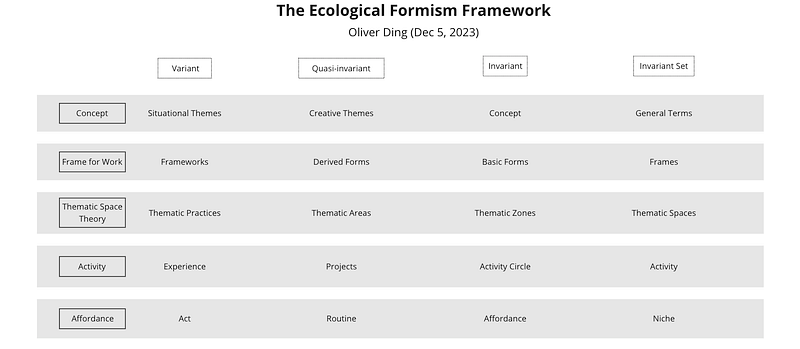
In the above diagram, we see five levels of analysis:
- Concept
- Frame for Work
- “Thematic Space Theory” (TST)
- Activity
- Affordance
The “Concept” level is about the transformation between themes and concepts.
The “Frame for Work” level is about the emergence of knowledge frameworks.
The TST level (the “Thematic Space” level) is a middle level that connects “Activity” and “Frame for Work”.
The “Activity” level is about different patterns of actions.
The “Affordance” level is related to the Operation level of Activity.
You can find more details in Social Moves: An Integrated Ecological Approach to Social Cognition.
1.2 Thematic Space Theory
On Dec 1, 2023, I made a new framework to connect the concept of “Thematic Space” and the concept of “Social Territory”.
Since it is an abstract model, I used “Thematic Space Theory (TST)” to name this framework. See the diagram below.
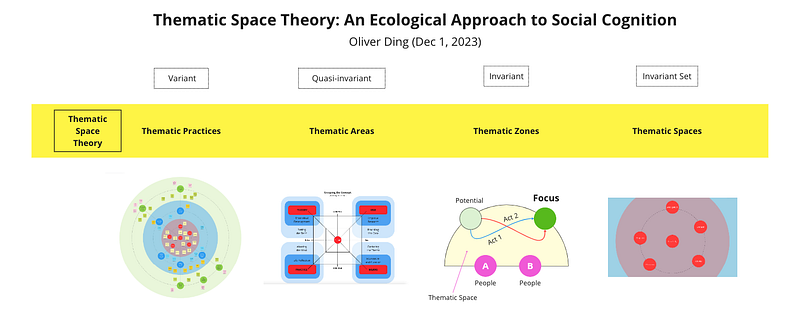
The above TST framework uses “Variant > Quasi-invariant > Invariant > Invariant Set” as the foundation to define four types of entities for knowing.
- Invariant: Thematic Zones
- Invariant Set: Thematic Spaces
- Quasi-invariant: Thematic Areas
- Variant: Thematic Practices
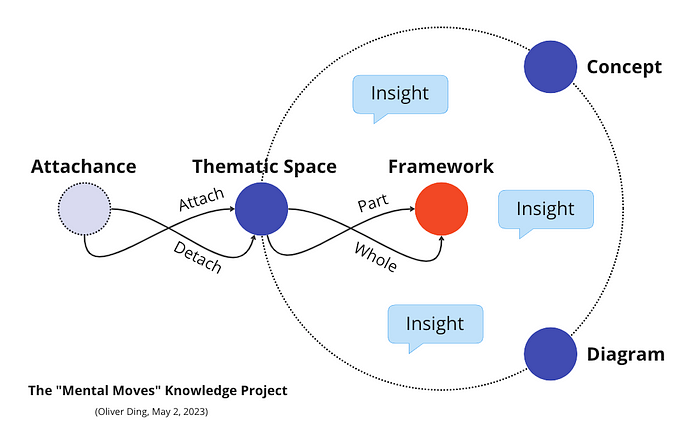
The level of “Invariant Set” refers to a set of themes and their thematic spaces. Also, it defines the concept of “Thematic Space” as a general term. In this way, we could use it as a normal word.
To connect the concept of “Thematic Space” and the concept of “Social Territory”, I decided to use the term “Thematic Zones” as the basic unit of analysis for Social Moves. The term “Thematic Zones” was inspired by the ARCH framework.
The level of Variant refers to the origin experience of life world. For the TST framework, I used the term “Thematic Practices” to highlight the thematic aspect of human life.
From one side, the level of “Quasi-invariant” can be seen as Patterns or Structures of the level of “Variant”. On the other side, the level of “Quasi-invariant” can be seen as the Context of the level of “Invariant”. I used the term “Thematic Areas” to name this level.
1.3 Knowledge Discovery Canvas
As mentioned above, The TST level (the “Thematic Space” level) is a middle level that connects “Activity” and “Frame for Work”.
In this article, I will use the Knowledge Discovery Canvas as an example of a knowledge framework for framing the activity of Psychological Knowledge Engagement, and discover thematic spaces of the canvas for case study.
- Frame for Work (Knowledge Frameworks): The Knowledge Discovery Canvas
- Activity (Work): the activity and practice of Psychological Knowledge Engagement
The Knowledge Discovery Canvas is divided into four areas: THEORY, PRACTICE, END, and MEANS.
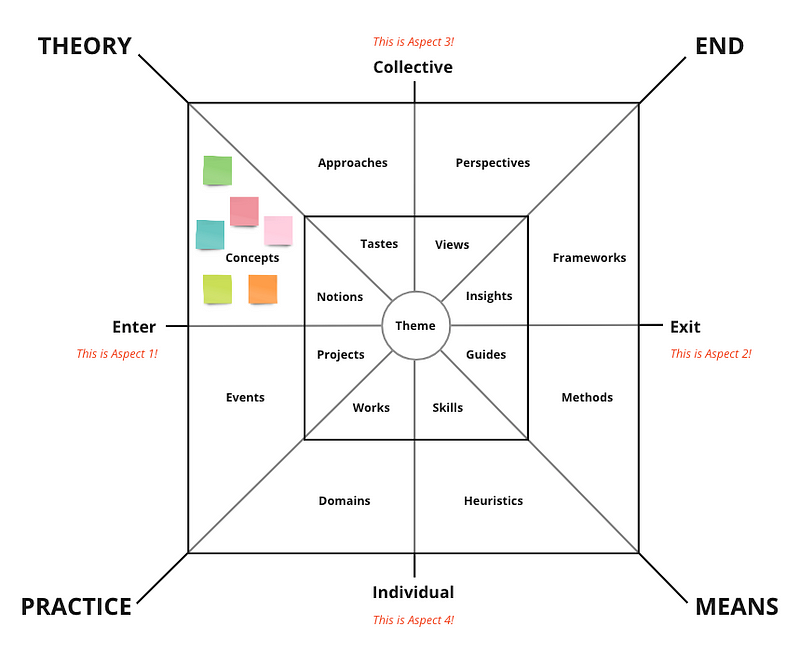
I used “Flow, Story, Model” as a metaphor to describe the whole process of the Knowledge Discovery Activity.
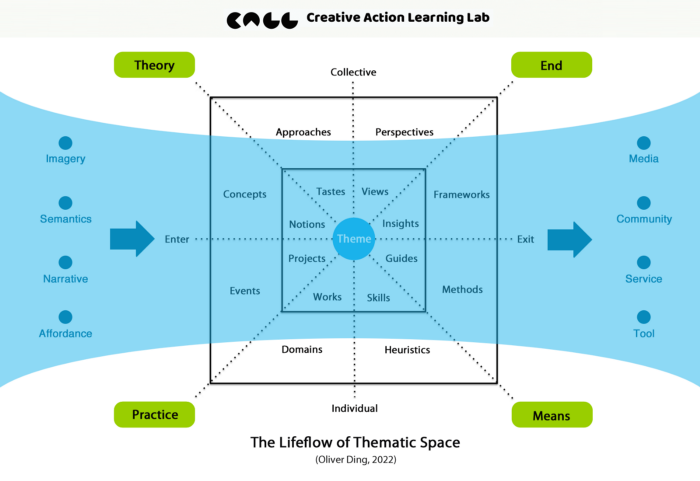
The above diagram puts Thematic Space in the context of life development with a simple metaphor: Flow, Film, and Floor Plan.
- Experience > Flow > Life as a continuous flow
- Story > Film > Project as a film with a prominent theme
- Model > Floor Plan > Thematic space as a floor plan
I use “continuous flow” as a metaphor to describe Life and Experience. This metaphor is inspired by William James’ metaphor “Stream of Thought”. The Story refers to the level of social-communicative context. At this level, a person could tell his journey of developing tacit knowledge with others. I use Film as a metaphor for this layer.
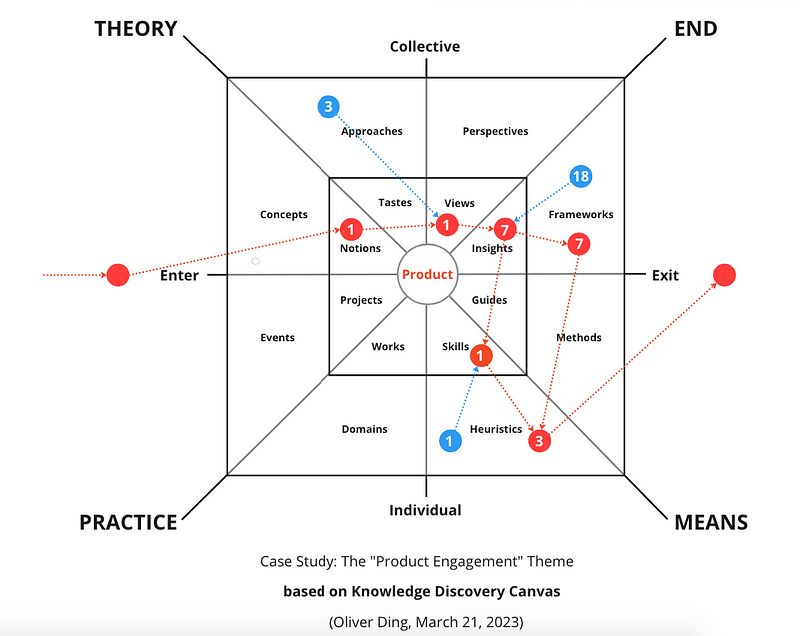
In this way, we can use the Knowledge Discovery Canvas as a knowledge framework to understand the activity of Knowledge Engagement. For example, I used the canvas to reflect on the development of the Product Engagement approach.
You can find more details about the Knowledge Discovery Canvas in Knowledge Discovery (Book).
Part 2: Thematic Spaces of Knowledge Discovery Canvas
In Frame for Work: The Ontology of Knowledge Frameworks and Ecological Actualism, I introduce five moments of knowledge frameworks:
- From Possible to Actual
- From Logical to Representation
- From Mental to Action
- From Make to Use
- From Use to Possible
The core idea of the Ecological Actualism framework is the “Representation — Thematic Space — Perceiver” structure. A user could perceive potential thematic space of a representation (a diagram) of a knowledge framework, and discover some new creative spaces.
For example, I used the Knowledge Discovery Canvas (a representation of a knowledge framework) to discover 8 potential thematic spaces for the Creative Life Curation project.
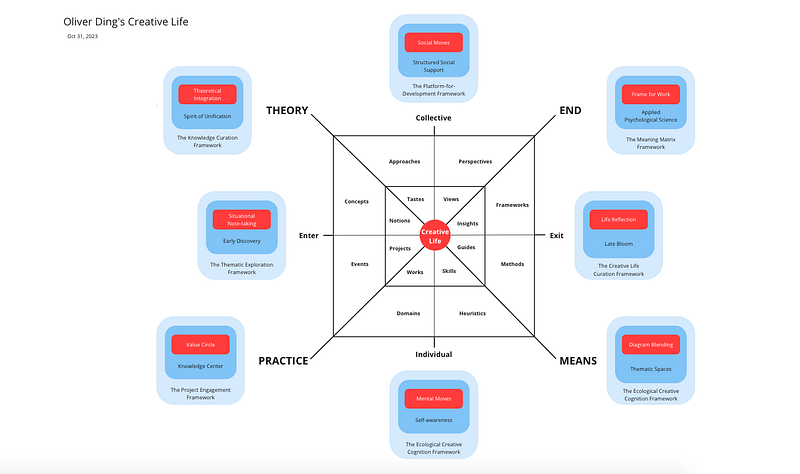
You can find more details in Creative Life Curation: Discover Thematic Spaces of Creative Life.
For the Creative Life Curation project, I used the term “Thematic Space” as a normal word. I didn’t apply the Ecological Formism framework to the project.
In this article, I will apply the Ecological Formism framework to discuss the thematic spaces of the Knowledge Discovery Canvas.
2.1 Four Thematic Areas
From Sept 9, 2023, to Nov 20, 2023, I worked on a case study about the concept of “Mindset” in the field of psychological knowledge engagement. A by-product of the case study is the “Grasping the Concept” model. See the diagram below.
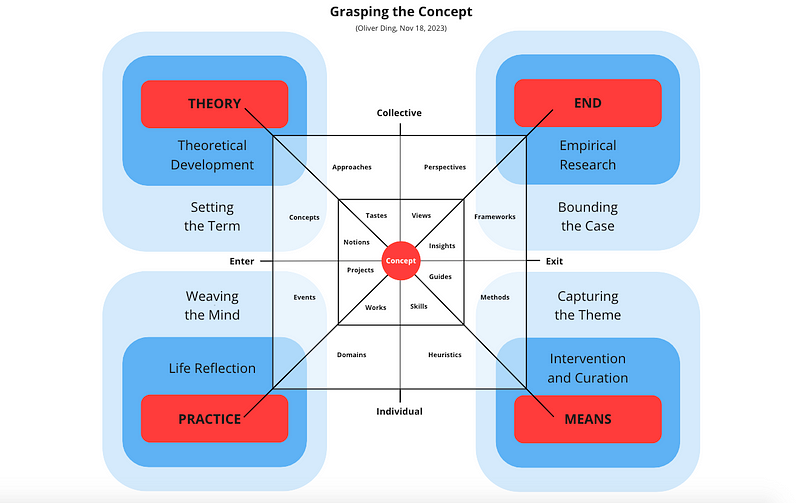
The above diagram highlights four types of thematic spaces which refer to four sociocultural areas.
- Theoretical Psychologists — The THEORY thematic space
- Empirical Psychologists — The END thematic space
- Intervenors — The MEANS thematic space
- Actors — The PRACTICE thematic space
Now I use “Thematic Areas” to name these four thematic spaces.
2.2 Thematic Zones
The term “Thematic Zones” was inspired by the ARCH framework.
The ARCH framework roughly uses five stages to understand the development of interpersonal relationships. The third stage is Think Together and its key word is Relevance. See the diagram below.
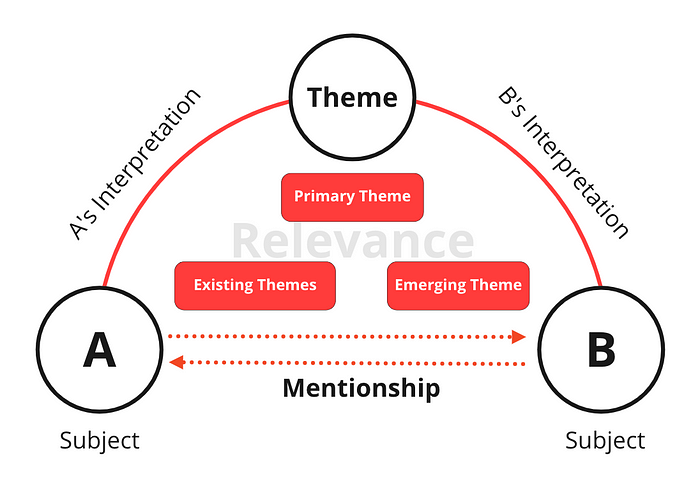
The primary theoretical resource behind the above diagram is “Themes of Practice”. You can find more details in Themes of Practice (2019–2021).
In general, the term “Thematic Zones” refers to interpersonal social interactive spaces.
Based on the Knowledge Discovery Canavs, I found ten thematic zones on Nov 30, 2023. See the diagram below.
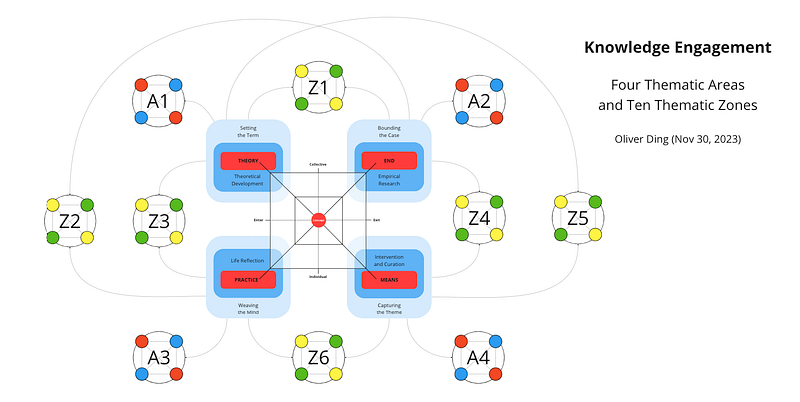
In the above diagram, I used different colors to distinguish two types of thematic zones.
2.3 Four In-area Thematic Zones
If two members of a thematic zone come from the same Thematic Area, then the thematic zone is an In-area Thematic Zone.
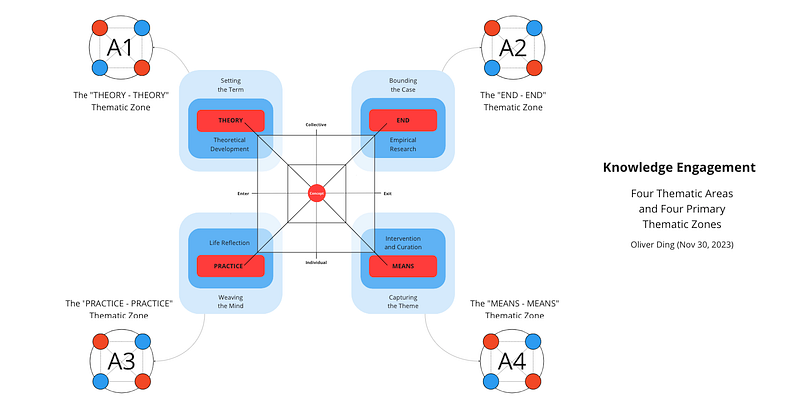
- A1: The “THEORY — THEORY” Thematic Zone
- A2: The “END— END” Thematic Zone
- A3: The “PRACTICE — PRACTICE” Thematic Zone
- A4: The “MEANS — MEANS” Thematic Zone
2.4 Six Cross-area Thematic Zones
If two members of a thematic zone come from two different Thematic Areas, then the thematic zone is a Cross-area Thematic Zone.
I discovered six cross-area Thematic Zones.
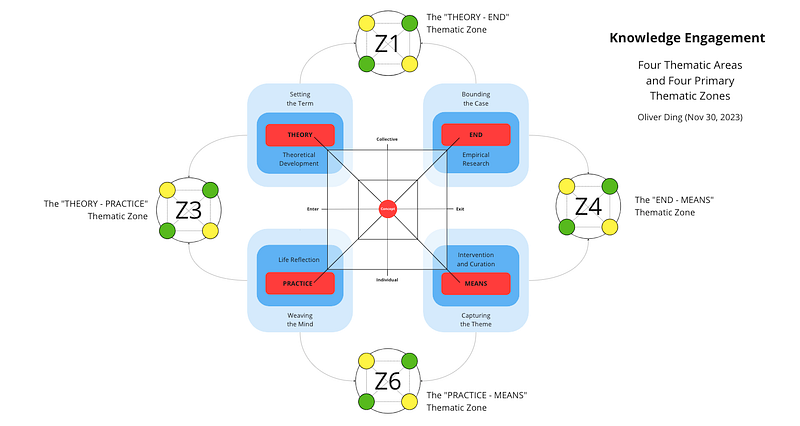
- Z1: The “THEORY — END” Thematic Zone
- Z3: The “THEORY — PRACTICE” Thematic Zone
- Z4: The “END — MEANS” Thematic Zone
- Z6: The “PRACTICE — MEANS” Thematic Zone
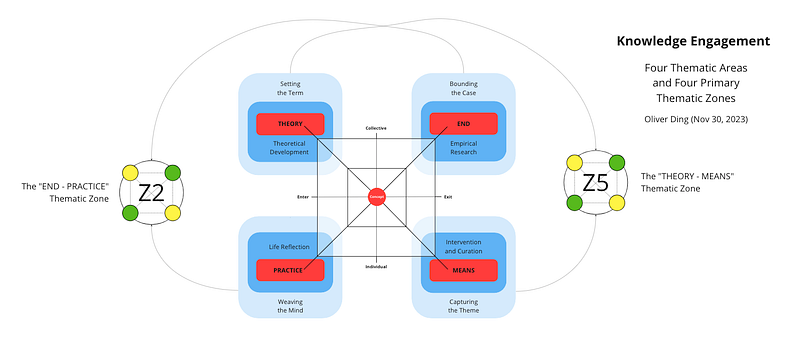
- Z2: The “END — PRACTICE” Thematic Zone
- Z5: The “THEORY — MEANS” Thematic Zone
If we consider three members or more members and they come from different thematic areas, we can discover more thematic spaces. So far, I only paid attention to the above ten thematic zones.
2.5 Thematic Practices: Possible Thematic Spaces of Creative Life
The level of Variant refers to the origin experience of life world. For the TST framework, I used the term “Thematic Practices” to highlight the thematic aspect of human life.
It means “Practices” are the Container of “Themes”.
I used a visual sign to represent this type of Thematic Space for the Creative Life Curation project. See the diagram below.
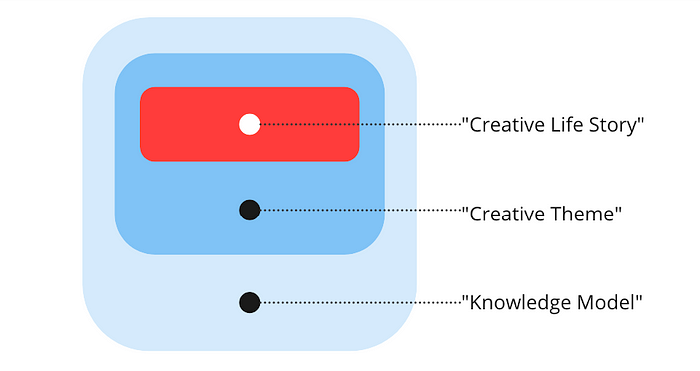
The above basic unit represents a thematic space in a three-layer structure:
- Creative Life Story
- Creative Theme
- Knowledge Model
Creative Life Story refers to an interesting real-life story from a person’s creative life.
Creative Theme refers to a theme behind a creative life story. Each story is associated with a theme that defines a thematic space.
Knowledge Model refers to a knowledge framework for understanding the thematic space.
On Nov 2, 2023, I published an article to introduce a new method to explore a creative life’s thematic spaces by using the Knowledge Discovery Canvas. You can find more details in Creative Life Curation: Discover Thematic Spaces of Creative Life. I used the method to discover Robert Kegan’s creative thematic spaces. See the diagram below.
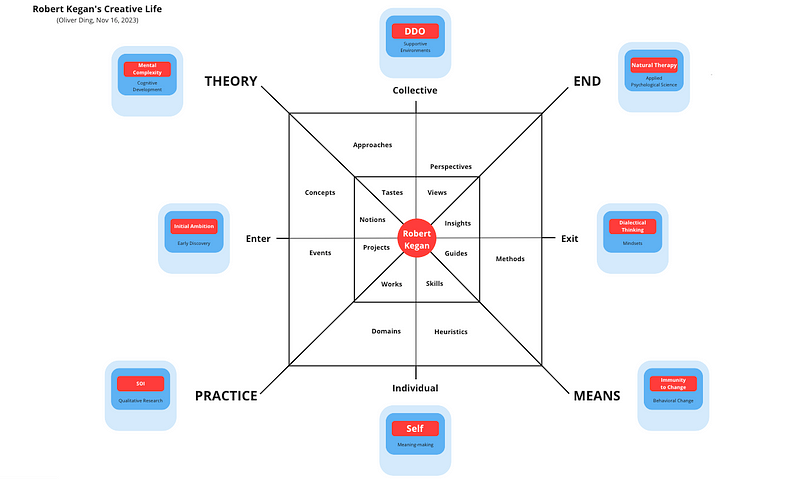
This three-layer structure was designed for the Activity Analysis & Intervention (AAI) program. For the present discussion, we don’t need Knowledge Models.
The eight thematic spaces are placed around the Knowledge Discovery Canvas.
- Enter: Early Discovery (Initial Ambition)
- Exit: Mindsets (Dialectical Thinking)
- THEORY: Cognitive Development (Mental Complexity)
- PRACTICE: Qualitative Research (SOI), SOI stands for Subject-Object Interview
- END: Applied Psychological Science (Natural Therapy)
- MEANS: Behavior Change (Immunity to Change)
- Individual: Meaning-making (Self)
- Collective: Supportive Environments (DDO)
You can find more details in Psychological Knowledge Engagement and Robert Kegan’s Knowledge Enterprise.
How many thematic spaces could we find in a person’s creative life?
Theoretically, it is unlimited!
It all depends on our real projects of using thematic spaces. Though I discovered 8 thematic spaces in Kegan’s case study, the number could be less than 8 or more than 8.
Part 3: Four Case Studies of Psychological Knowledge Engagement
In the past several months, I conducted several case studies of psychological knowledge engagement. Now I will use the Ecological Formism Framework to reflect on these case studies.
The first three case studies are based on the Knowledge Discovery Canvas, and the fourth case is based on the concept of “Thematic Zones”.
3.1 Psychological Knowledge Engagement
In the previous articles about the concept of “Mindset”, I discussed four types of psychological knowledge engagement using the Knowledge Discovery Canvas.
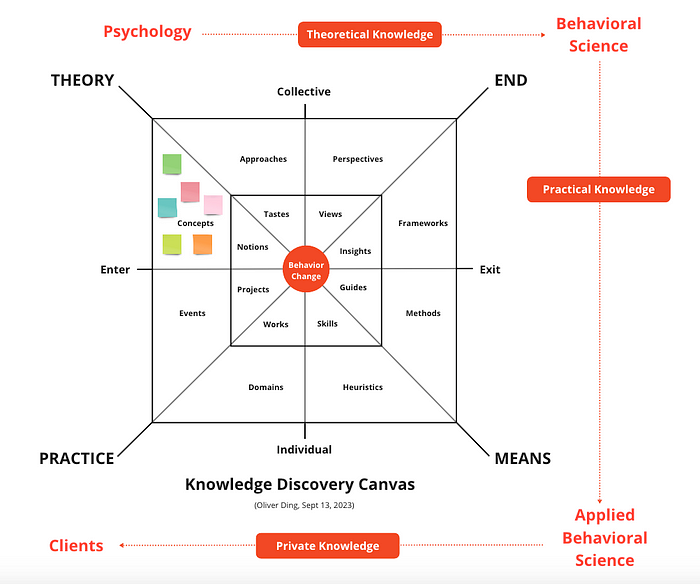
I also associated four types of roles with the Knowledge Discovery Canvas.
- Theoretical Psychologists
- Empirical Psychologists
- Intervenors
- Actors
While Theoretical Psychologists and Empirical Psychologists are working on producing public knowledge, Intervenors and Actors are working on solving mental problems or optimizing subjective experience by using psychological knowledge.
These four types of knowledge creators have different perspectives and behavioral patterns because they have different construal levels, practical interests, points of observation, methodological preferences, and expressive conventions (or language habits).
In general, Theoretical Psychologists think and work with the following perspective.
- Construal Levels: Meta-theory or the most abstract level
- Practical Interests: The progress of the discipline as a meaningful whole
- Points of Observation: The “Concept — Theory” Move
- Methodological Preferences: Concept Analysis and Formal Representation
- Expressive Conventions: Mathematical formulas or Conceptual frameworks
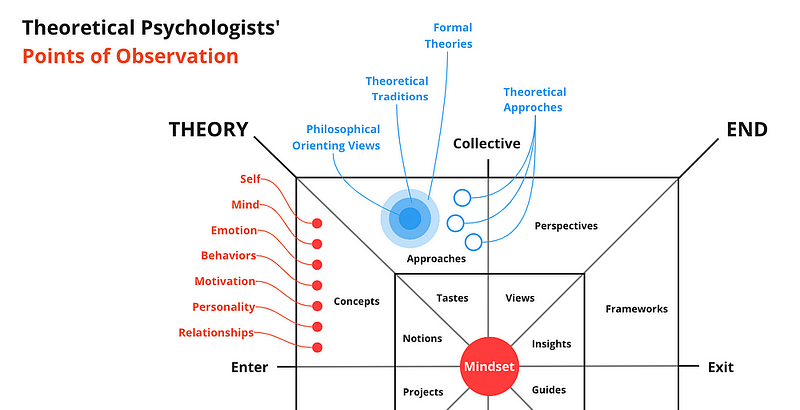
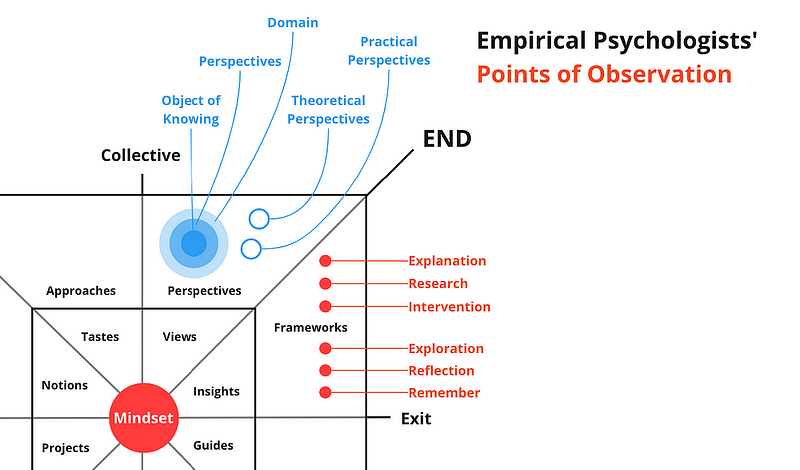
Empirical Psychologists move to a different position and they have a different perspective:
- Construal Levels: Specific-theory or abstract models/frameworks
- Practical Interests: Develop a particular innovation concept or framework for the discipline
- Points of Observation: The “Perspective — Framework” Move
- Methodological Preferences: methods for Empirical Research, such as laboratory experiments
- Expressive Conventions: Conceptual frameworks and data charts
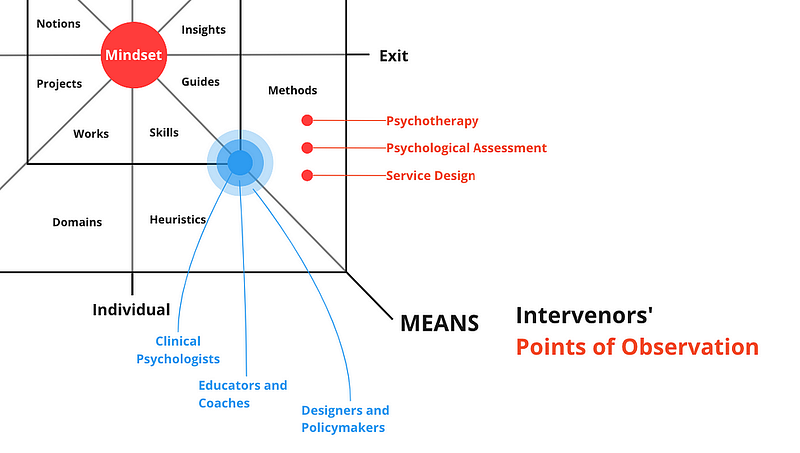
Intervenors also have their specific needs for psychological knowledge engagement:
- Construal Levels: concrete models/frameworks and related test tools
- Practical Interests: Develop a particular intervention program for behavior change or related education
- Points of Observation: The “Methods — Heuristics” Move
- Methodological Preferences: methods for design, communication, test, report, etc.
- Expressive Conventions: face-to-face communication and questionnaire test
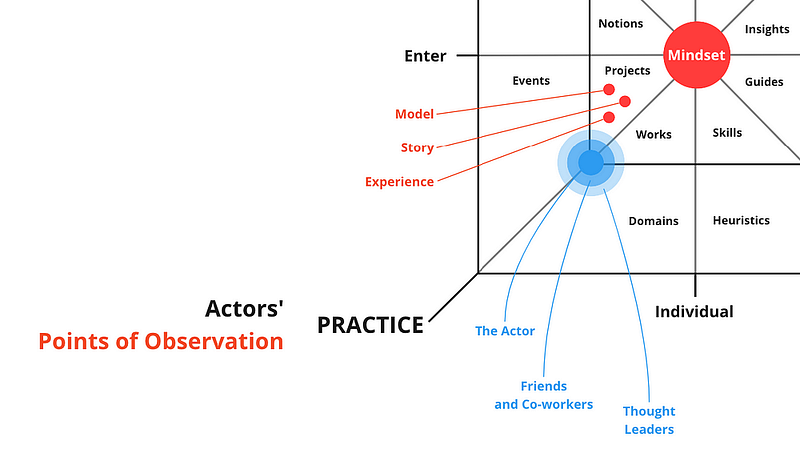
While Actors come from various domains, they share a primary theme: Subjective Experience. For Actors, psychological knowledge engagement is all about understanding their own subjective experience and making sense of their life situations, either stressful or enjoyable.
- Construal Levels: concrete models/frameworks, simple heuristic tools, etc.
- Practical Interests: learning for work or reflecting on life experiences, solving own problems, etc
- Points of Observation: The “Work—Project” Move
- Methodological Preferences: reflection, discussion, reading, etc.
- Expressive Conventions: face-to-face communication, metaphorical words, storytelling, etc.
You can find more details in the original articles:
- The Concept of Mindset and Theoretical Integration (48 min read)
- The Concept of Mindset and Empirical Psychologists (27 min read)
- The Concept of Mindset and Intervenors (28 min read)
- The Concept of Mindset and Actors (39 min read)
3.2 Robert Kegan’s Knowledge Enterprise
In the real-life world, people can move between the Four Thematic Areas of knowledge engagement. A person could engage with psychological knowledge in different situations.
Let’s use Robert Kegan’s creative life as an example to see a multiple-role psychological knowledge enterprise.
Who is Robert Kegan?
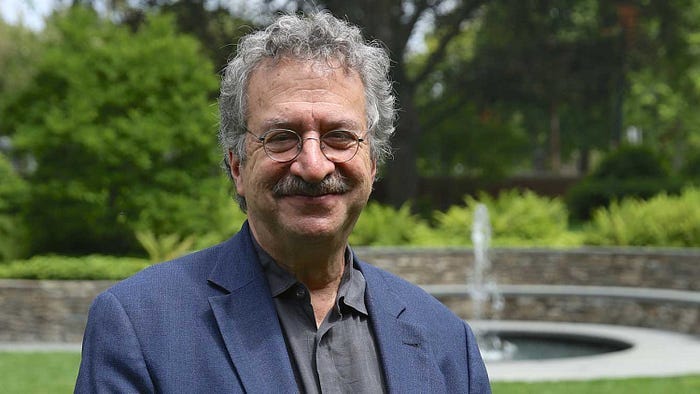
Robert Kegan is a teacher, a therapist, a researcher-theorist, and an author.
According to Wikipedia, Robert Kegan (born August 24, 1946) is an American developmental psychologist. He was the William and Miriam Meehan Professor in Adult Learning and Professional Development at Harvard Graduate School of Education. He taught there for forty years until his retirement in 2016.
As a prolific author, Kegan has written several theoretical books and practical books on adult development and organizational behavior change.
He is a licensed psychologist and practicing therapist, lectures widely to professional and lay audiences, and consults in the area of professional development.
Based on Robert Kegan’s books, I used the Knowledge Discovery Canvas to represent Robert Kegan’s knowledge enterprise. The canvas was designed with two spaces: Outer Space and Inner Space. While Outer Space refers to objective knowledge, Inner Space refers to subjective knowledge. Kegan’s ideas are public knowledge, so we only need to use Outer Space.
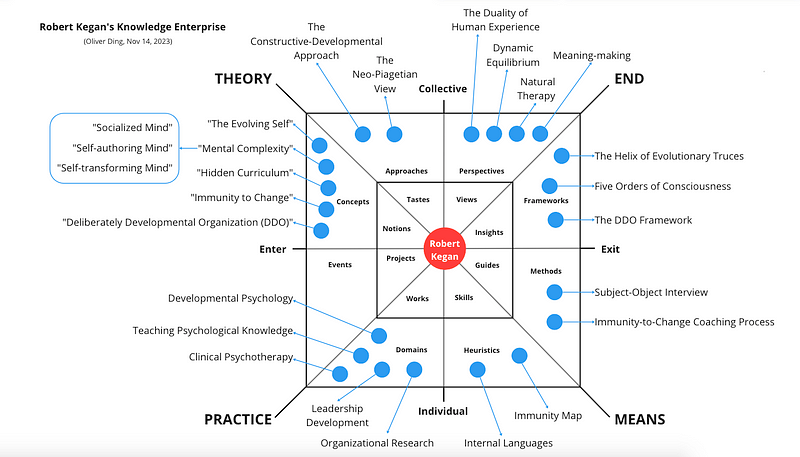
Kegan moved between four areas. From 1982 to 2016, he moved from theoretical development to practical applications. His early two books were published by Harvard University Press, his late books were published by Harvard Business Review Press and other publishers.
There is no boundary in his journey of engaging with psychological knowledge.
The Evolving Self (1982) and In Over Heads (1994) were published by Harvard University Press as academic books. They fully represent Kegan’s Constructive — Developmental theoretical approach to adult development.
After 1994, he moved to the field of applied psychological science and worked with Lisa Laskow Lahey on the Immunity-to-Change project which aims to apply Kegan’s approach to organizational behavioral change. They co-authored several books including How the Way We Tak Can Change the Way We Work (2001), Immunity to Change (2009), and An Everyone Culture (2016).
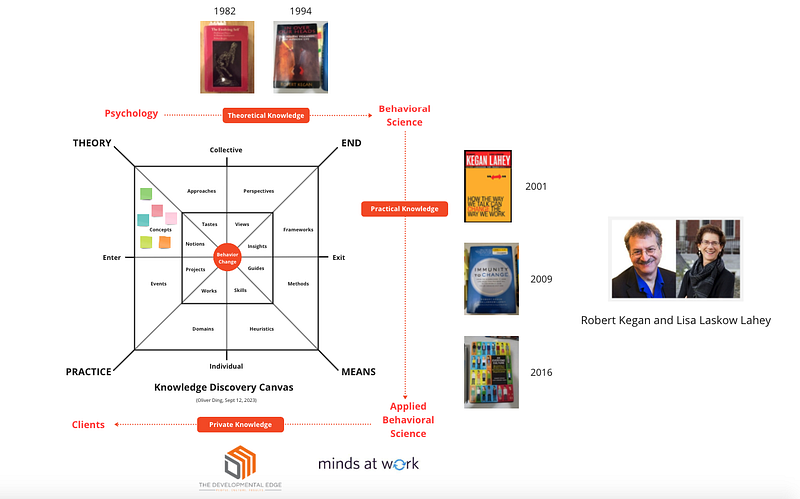
Kegan and Lahey started collaboration on the Mental Complexity knowledge enterprise in the 1980s.
Kegan’s knowledge enterprise is a large Collaborative Project about the concept of “Mental Complexity” which establishes a Knowledge Center around the Constructive — Developmental theoretical approach.
Lisa Laskow Lahey made a significant contribution to the growth of the knowledge enterprise because developing the research method and assessment is a critical step in building an intermediate object to bridge theory and practice. She also co-authored books with Kegan. In addition, she is the leader of Minds at Work which is a professional firm specializing in teaching the Immunity-to-Change approach.
What does Kegan’s knowledge enterprise look like from the perspective of “Social Moves”? See the diagram below.
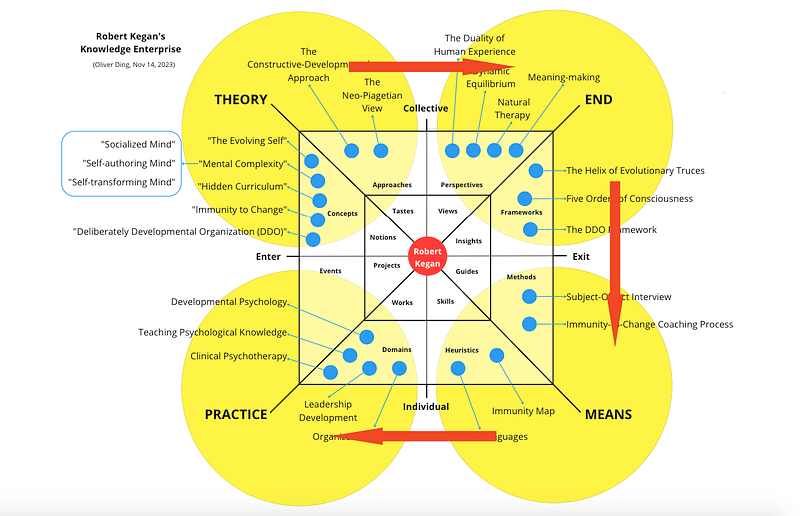
As mentioned in the beginning, Kegan switched between four roles and moved between four Thematic Areas of psychological knowledge engagement.
- Theoretical Psychologists — The THEORY Thematic Area
- Empirical Psychologists — The END Thematic Area
- Intervenors — The MEANS Thematic Area
- Actors — The PRACTICE Thematic Area
Since the four Thematic Areas correspond to four types of roles, moving between these thematic spaces means moving between four social spaces.
This is a perfect example of Social Moves (Mental Moves).
You can find more details in Psychological Knowledge Engagement and Robert Kegan’s Knowledge Enterprise.
3.3 The Mindset Engagement Project
From Sept to Nov, I worked on a collaborative project about the concept of Mindset. A friend of mine and I worked on a thematic conversation about developing a brand-new theoretical framework of Mindset.
If we use the Ecological Formism Framework to reflect on this thematic conversation. We can find there are two phases of the development of the project.
In phase 1, we stayed at the Z1 thematic zone (the “THEORY — END” thematic zone), the primary outcome is the Mental Tuning Framework.
In Phase 2, we moved to the Z4 thematic zone (the “END — MEANS” thematic zone), the primary outcome is the Mindset Activation Framework.
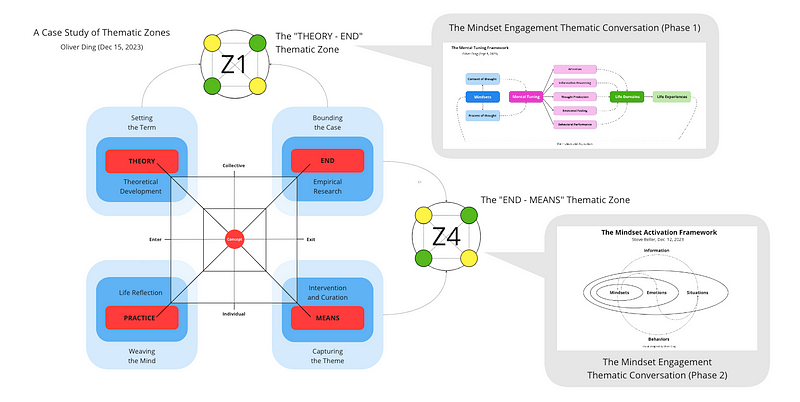
On Sept 9, 2023, I published an article titled Knowledge Engagement: The Concept of Mindset and Theoretical Integration.
In the article, I used the Knowledge Discovery Canvas to discuss psychological knowledge engagement. I also used the “Home — Away” terms as metaphors to describe Points of Observation.
We can assign these areas as Home for four types of creators.
- The THEORY Area: The Home of Theoretical Psychologists
- The PRACTICE Area: The Home of Actors
- The END Area: The Home of Empirical Psychologists
- The MEAN Area: The Home of Intervenors
For each type of creator, the other three types of creators’ Home means Away.
Each type of creator can do their homework in their Home, they can also visit other types of creators’ Home to run the thematic conversation for collaborative knowledge creation.
I didn’t use the term “Thematic Zones” in the article. Now we can use “Thematic Zones” to replace the “Home — Away” metaphor.
In phase 1 of the thematic conversation, I played the role of a Theoretical Psychologist while my friend was an Empirical Psychologist. We met at the Z1 thematic Zone (the “THEORY — END” thematic zone).
At the Construal Level, Theoretical Psychologists work at the most abstract level of psychological science. While Empirical Psychologists are busy with the Hypothesis — Data Gap, Theoretical Psychologists think and work as Philosophers in the field of Psychological Science.
The primary Practical Interest of Theoretical Psychologists is to accelerate the progress of the discipline as a meaningful whole. They work on reflecting the historical development of the field and anticipating the strategic intent of the whole field.
Theoretical Psychologists tend to use Concept Analysis and Formal Representation as their primary methods and use Empirical Psychologists’ creative works as their raw materials. This particular method also leads to unique Expressive Conventions: they often use Mathematical formulas or Conceptual frameworks to represent their outcomes.
How do theoretical psychologists work? I offered an answer in the article:
Now we can visit the Home of Theoretical Psychologists and invite them to join a thematic conversation about a possible theory of Mindset.
They would like to ask us the following questions:
What’s the relationship between the Concept of Mindset and the Primary Orienting Concepts in the field?
What kind of theory do you want to build?
What’s the relationship between the possible theory and existing theories?
What’s the unique contribution of the possible theory?
Usually, Theoretical Psychologists tend to reject ambitious proposals to establish a new theoretical concept and build a brand-new theoretical approach. Unless the creator could offer reasonable answers to the above questions.
In the article, I made a demo of theoretical integration by curating Carol S. Dweck’s version of Mindset theory and Peter Gollwitzer’s version of Mindset theory together.
A by-product of the article is the Mental Tuning Framework.
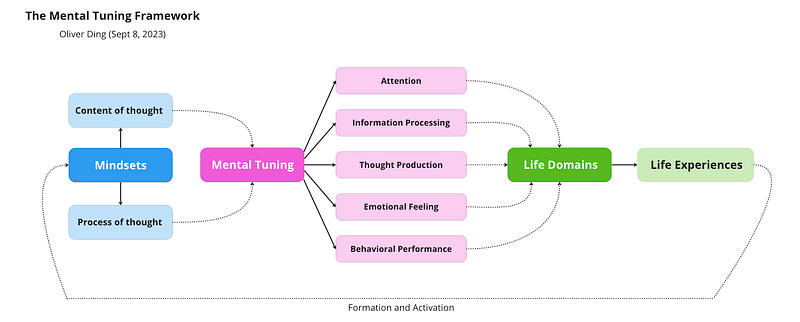
Later, I continued the work of theoretical integration and used the Mental Tuning Framework as a meta-framework to curate more psychologists’ work.
In Phase 2, we met at the Z4 thematic zone (the “END — MEANS” thematic zone). The primary goal of the conversation changed to help my friend develop a new theoretical framework that could integrate his experiences and knowledge on mindset, emotion, and well-being.
One of my friend’s theoretical resources is Richard Lazarus’s Cognitive Appraisal Theory. I reviewed the theory and used the Mental Tuning Framework to make a new framework called “Coping Activity as Mental Tuning”. See the diagram below.
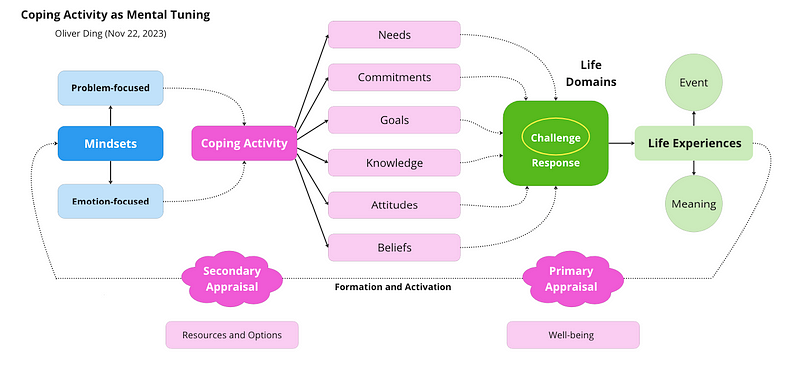
Then, I moved to use the Knowledge Discovery Canvas to imagine the landscape of “Mindset Engagement Theory”. See the diagram below.
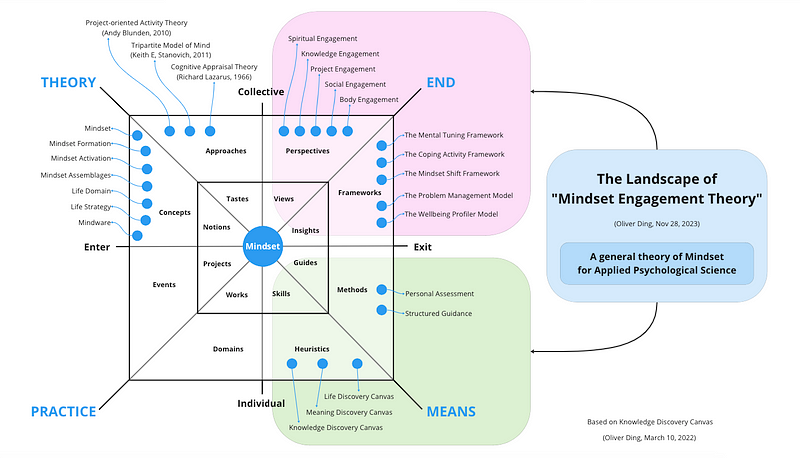
In the third step, I designed a visual representation of the Mindset Activation framework. See the diagram below.
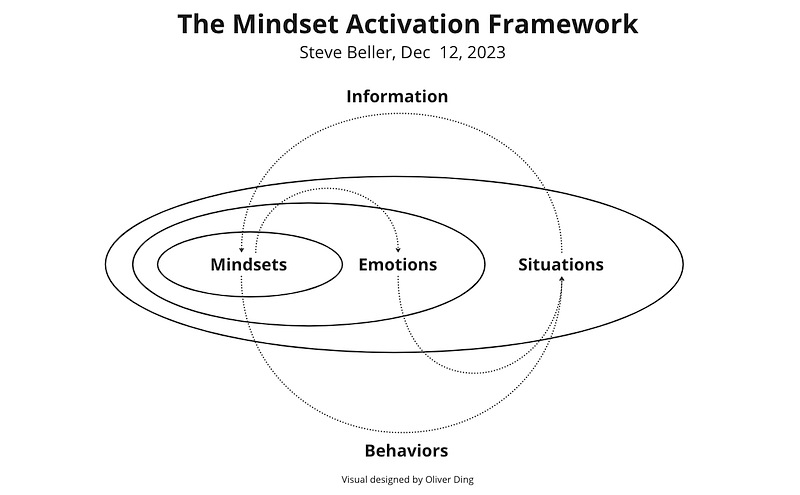
From the perspective of the Ecological Formism Framework, this case study is unique because it indicates the power of Knowledge Discovery Canvas for developing collective tacit knowledge.
It also indicates the concepts of “Thematic Areas” and “Thematic Zones” are useful “Frame for Work”.
In the Early Discovery phase of knowledge engagement, we often face unclear objectives and uncertain problems. The Ecological Formism Framework could offer us solid support.
3.4 The Likert 7 Project
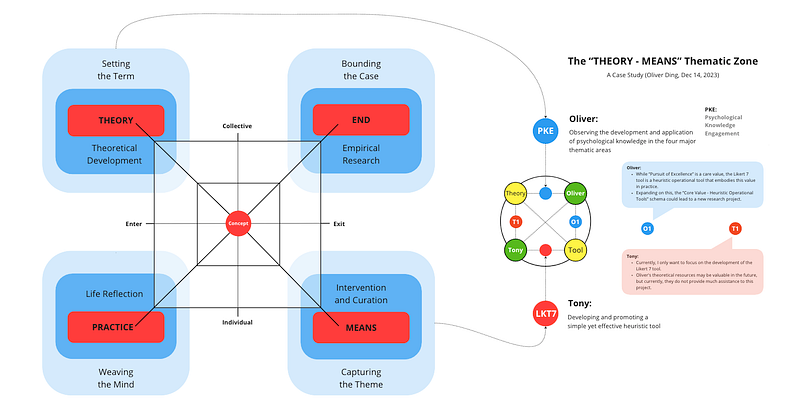
In the past ten days, I had a thematic conversation with Tony who is a friend of mine.
As a C-suite executive of a public listing company, he is interested in developing and promoting tools of thought to encourage the value of the pursuit of excellence.
He recently worked on a side project about a ranking system that allows people to rank anything with a 7-point scale. One of the reasons behind the project is the tool could help people put the value of the pursuit of excellence into practice. Let’s call it the Likert 7 (LKT7) Project.
Our thematic conversation was located in the “THEORY — MEANS” Thematic Zone. While I came from the THEORY thematic area, he came from the MEANS thematic area. See the diagram below.
After closing phase 1 of the project of Mindset Engagement, I started the project of Psychological Knowledge Engagement on Nov 29, 2023. I realized that it could be a great project for my work on the Knowledge Engagement approach and the Social Moves project.
The four thematic areas and ten thematic zones offered me a framework for understanding the complexity of the contemporary ecosystem of psychological knowledge.
- The THEORY Area: The Home of Theoretical Psychologists
- The PRACTICE Area: The Home of Actors
- The END Area: The Home of Empirical Psychologists
- The MEAN Area: The Home of Intervenors
This framework may be wrong, or too simple. But, it is a good hypothesis for an empirical research project.
As an Intervenor, Tony had a different goal to develop and promote a simple yet effective heuristic tool without systematic theoretical study.
Our thematic conversation looks like this:
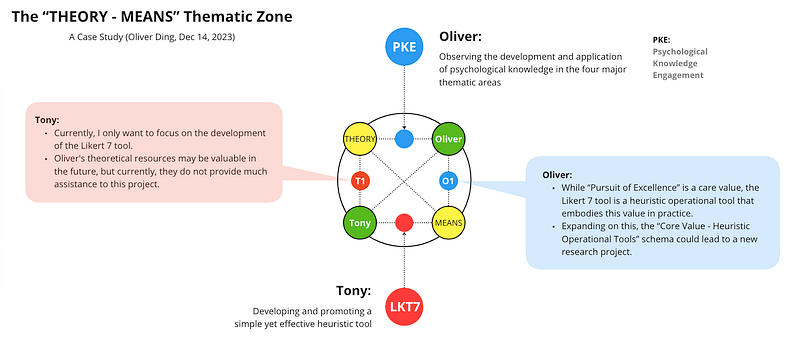
From my perspective, the Likert 7 project is interesting because it offers me an example of the “Core Value — Heuristic Operational Tools” schema. While “Pursuit of Excellence” is a care value, the Likert 7 tool is a heuristic operational tool that embodies this value in practice.
I am wondering if Tony could apply this schema to other core values.
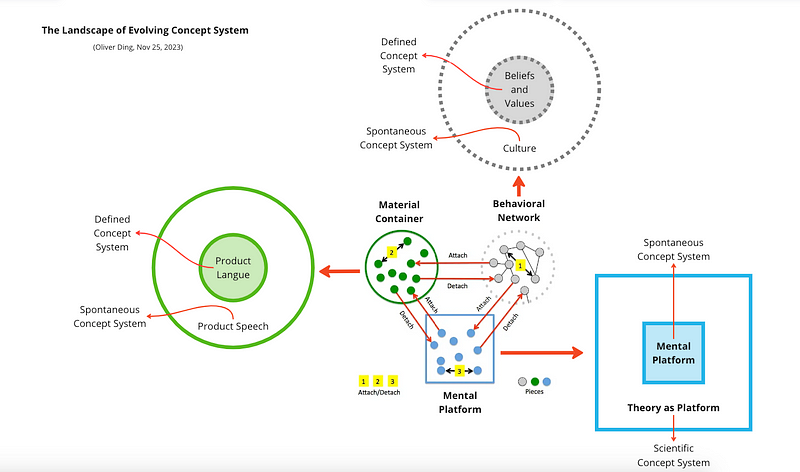
Moreover, if we see a core value as a concept system, then this story is also related to the Evolving Concept System model.
From Tony’s perspective, he only wants to focus on the development of the Likert 7 tool. My theoretical resources may be valuable in the future, but currently, they do not provide much assistance to his project.
The concept of “Thematic Zone” is about interpersonal social interaction. By connecting “Thematic Zone” and Knowledge Discovery Canvas together, we can get a better view of knowledge-related dialogue in everyday life.
3.5 Psychological Counseling Platform
The above three case studies are based on the Knowledge Discovery Canvas. Let’s see an example that uses some models of Activity Theory as the foundation of case studies.
In Sept 2023, I used a Psychological Counseling Platform as an example to conduct a case study about “Social Moves”.
On Sept 29, 2023, I launched the Activity Analysis & Intervention (AAI) Project on the Activity Analysis Center’s website.
Then, I sent it to a friend of mine.
On Sept 30, 2023, I made the following draft visual note and sent it to him.
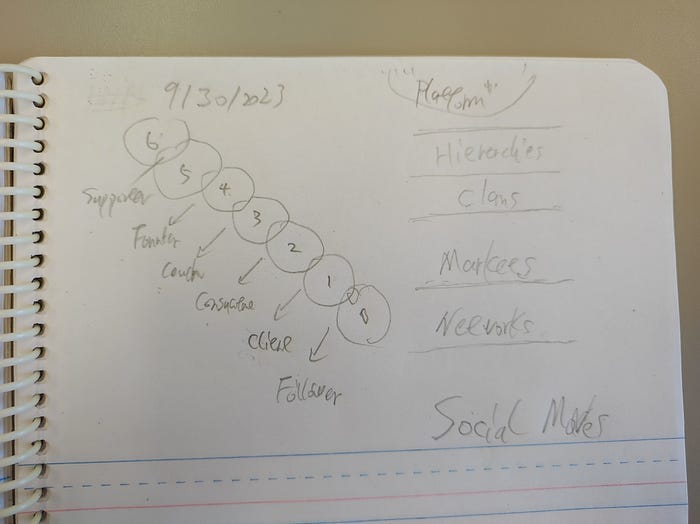
I just now realized that the AAI model can be used to understand “social moves”.
See the attached visual note.
I added more circles to expand the original AAI model. Now it has 6 types of roles.
Supporters such as investors Founders Coaches Consultants Clients Followers
Each circle is located in a “social zone” such as Markets, Clans, etc.
Moreover, each circle can be understood as an “AAS” (Anticipatory Activity System).
Now we have a rough theory of “social moves”.
People’s social life can be understood as moving between different types of “Activity Circles” and “Anticipatory activity system”.
Good mindsets could guide people to moving on the path to his ideal life, and bring positive Life experience, activate positive emotions.
Bad mindsets could lead to unsuccessful moves which cause negative Life experiences and negative emotions.
The “Social Moves” theme was born from my recent projects.
One important insight about the “Social Moves” theme is a case study about a web3.0 platform which is founded by a friend of mine.
I see the multiple circle structure in the web3 platform.
The multiple circle structure is also inspired by Ecological Psychologist Roger Barker’s Behavior Settings Theory.
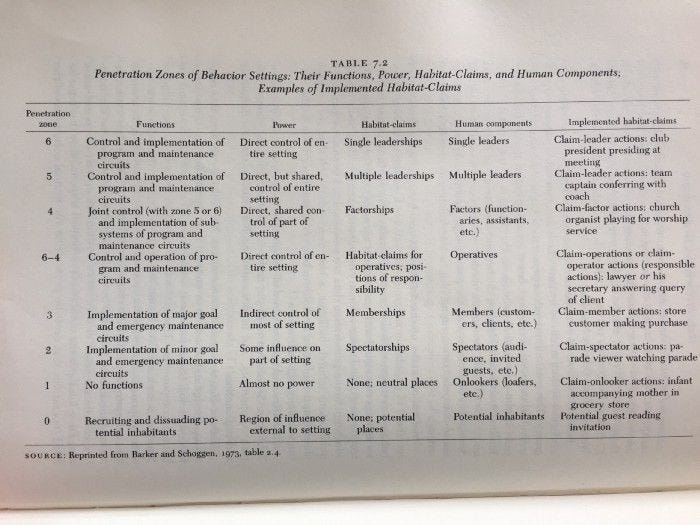
I mentioned Barker’s Behavior Settings Theory in my email. Barker developed a systematic analysis method for the Behavior Settings theory. One module of his method is “Zone of Penetration” which refers to the penetration dimension of Behavior Settings. He identified seven Zones of Penetration(1989, p.127–128).
- Zone 6: Single leader
- Zone 5: Joined Leaders
- Zone 4: Active functionary
- Zone 6, 5, and 4: Operative or performers
- Zone 3: Member or customer
- Zone 2: Audience or invited guest
- Zone 1: Onlookers
- Zone 0: Potential inhabitants
This visual note is about the “Social Moves” project. The theme of Social Moves was inspired by the theme of Mental Moves. While the Mental Moves project is more about knowledge creators’ creative cognition, the Social Moves project is more about their creative social action.
This case study was inspired by two friends of mine. One of them had rich experiences of psychological knowledge engagement. He developed psychological assessment software from 2004 to 2010. From 2014 to the present, he established a successful cognitive scientific education company. Last year, he developed a new theoretical approach to personality psychology. Based on the new theory, he recently launched a brand-new system of psychotherapy.
In contrast, the other one is working on a journey of career transition. In 2022, She left a job at a big tech company and started learning psychological counseling by attending a course offered by a digital psychological knowledge platform. Several months ago, she finished the course and started her new career as a psychological counselor.
I reflected on their creative life stories and realized that there is something called “Psychological Counseling Platforms” in their stories.
On Oct 10, 2023, I made the diagram below to reproduce the visual draft note.
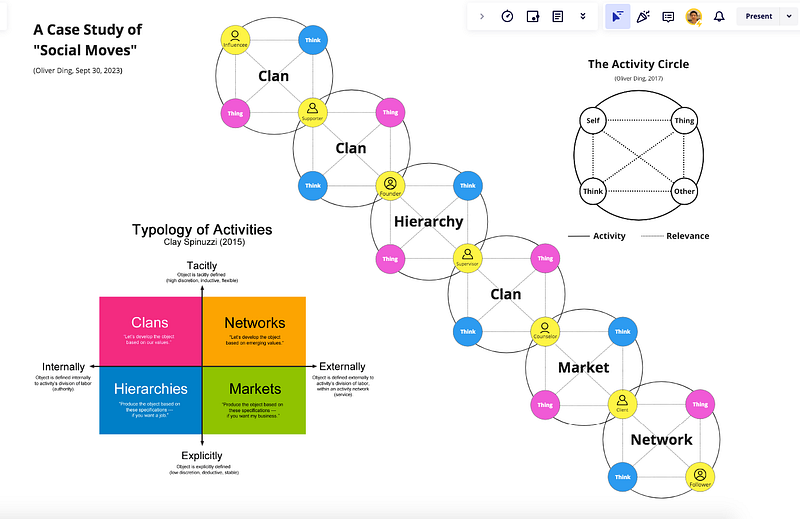
I use a Psychological Counseling Platform as an example to run the case study. There are seven key roles in the platform:
- Influencee
- Supporter
- Founder
- Supervisor
- Counselor
- Client
- Follower
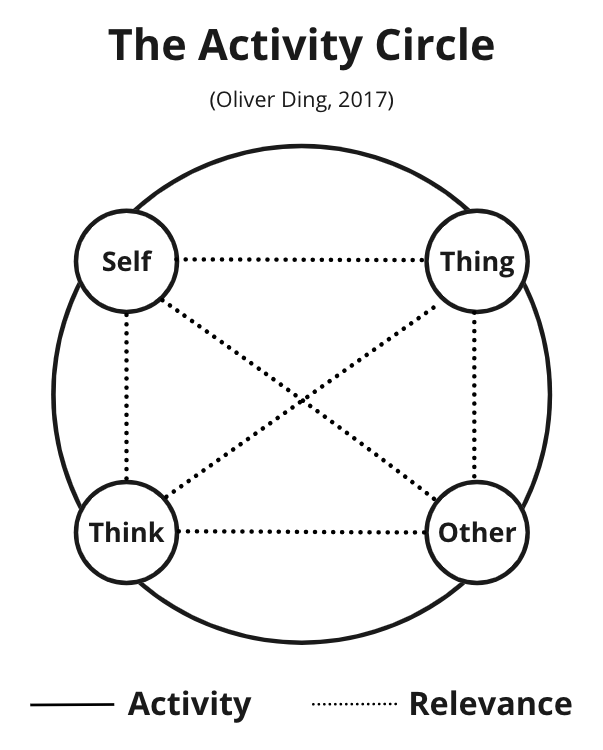
Each Circle refers to an “Activity Circle” which refers to the social structure of “Self, Other, Thing, Think”. You can find more details in The Activity Circle (Oliver Ding, 2017).
The four types of activities indicate four types of Activity Circles.
- Clan
- Hierarchy
- Market
- Network
People’s social life can be understood as moving between different types of “Activity Circles”.
This case study only features the Chain of Activity Circles. If we return to the NEXT Way (2021), we can find two types of network structures: hub and chain. See the diagram below.
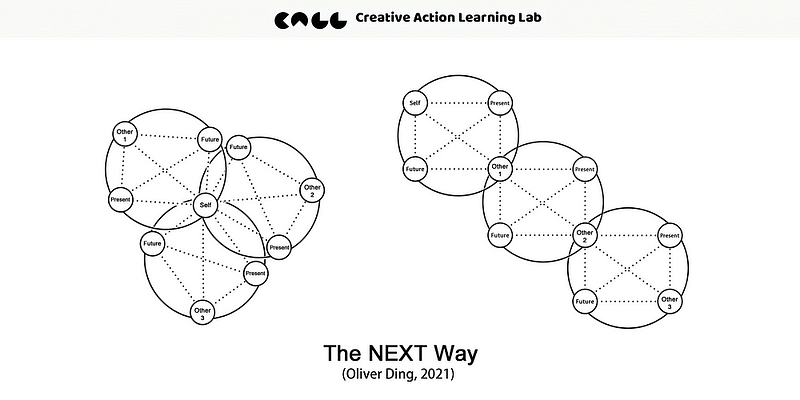
In 2021, I used the iART system to name the social structure of “Self, Other, Present, Future”.
The above left diagram represents the Hub model. A person connects to several other people. The diagram below puts three iART diagrams together:
- Self — Other 1
- Self — Other 2
- Self — Other 3
The Self can adopt different perspectives for these three different iART systems because there are different types of relationships. For example, if the Self is a founder of a startup, Other 1 may be an investor, Other 2 may be a family member, and Other 3 may be a mentor.
The above right diagram represents the Chain model which shows a chain of social relationships:
- Self > Other 1 > Other 2 > Other 3 > …
Each two people form an iART system with a particular relationship. The whole social network is a networked system of many iART systems. This is a very complicated model because each person has his/her own perspective of his/her iART system. Each person has his/her social position. Also, the interpersonal relationship is dynamic.
I named the networked iART Systems The NEXT Way on Sep 5, 2021.
- N: Networked
- E: Expectation
- X: Uncertainty
- T: Trust and Trends
These four keywords are useful for understanding “Social Moves” too.
The above diagram used the Activity Circle model as the basic model. People’s social life can be understood as moving between different types of Activity Circles. You can find more details in Value Circle #4: From “ARCH” to “Activity Circle”.
From the perspective of the Ecological Formism Framework, the Activity Circle can be understood as Thematic Zones.
The Four Types of Activities (Clan, Hierarchy, Market, and Network) can be understood as Four Thematic Areas.
This case study doesn’t use the Knowledge Discovery Canvas as the basic model but uses some models of Activity Theory as the foundation. We see a new direction in using the Ecological Formism Framework with other knowledge frameworks together.
Part 4: The Social Territory of Social Moves
In July 2023, I finished the “Mental Moves” knowledge project and edited a possible book titled Mental Moves: The Attachance Approach to Ecological Creative Cognition. On August 24, 2023, I started the “Social Moves” knowledge project which uses “Social Territory” as the primary concept.
The above four case studies offer a solution to connect the Ecological Formism Framework to the concept of “Social Territory”.
4.1 The Concept of Social Territory
The term “Social Territory” was inspired by Ping-keung Lui’s term “Social Territory” and his Subjectivist Structuralism which is part of his theoretical sociology.
I have claimed that “Knowledge Center” is a type of Social Territory. You can find more details in Knowledge Engagement: The Creative Course Framework.
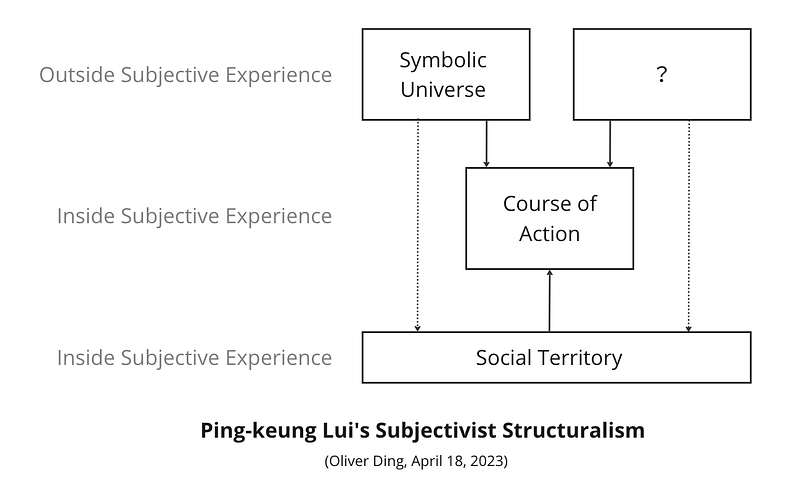
The structure of Lui’s theoretical sociology is a nested structure. See the diagram below. According to Lui, “The realism comprises a subjectivist structuralism and an objectivist stock of knowledge, while the hermeneutics is an interpretation and an analysis. Second, I shall present an ontology that nests the realism within its boundaries.” (p.250, 2016, Aspects of Sociological Explanation)
We should see this grand theory as a dialogue between philosophy and sociology because “Ontology” and “hermeneutics” are respectable terms in philosophy, but “realism” — sandwiched between them — is not. Lui emphasizes that Realism is the sociological matter proper (p.251, 2016, Aspects of Sociological Explanation).
Lui considers the following four realities for the grand theory:
- the Weberian course of action
- the Giddensian course of action
- Social Territory
- Symbolic Universe
Lui’s theory is a meta-theory.
I generally use “Social Territory” in the “Social Moves” knowledge project.
If we put “Mental Moves” and “Social Moves” together, we see a new unit of analysis of Social Cognition. While “Social Moves” are about Social Actions, “Mental Moves” are about related Mental Activities.
Social Cognition = Social Moves (Mental Moves)
Both “Mental Moves” and “Social Moves” shared the concept of “Thematic Space”.
For the Mental Moves project, the concept of “Thematic Space” is associated with knowledge models/knowledge frameworks.
For the Social Moves project, I need to find a way to connect “Thematic Space” and “Social Territory”.
4.2 Activity, Thematic Space, and Knowledge Framework
The Ecological Formism Framework offers a solution to connect the concept of “Thematic Space” with the concept of “Social Territory”. See the diagram below.
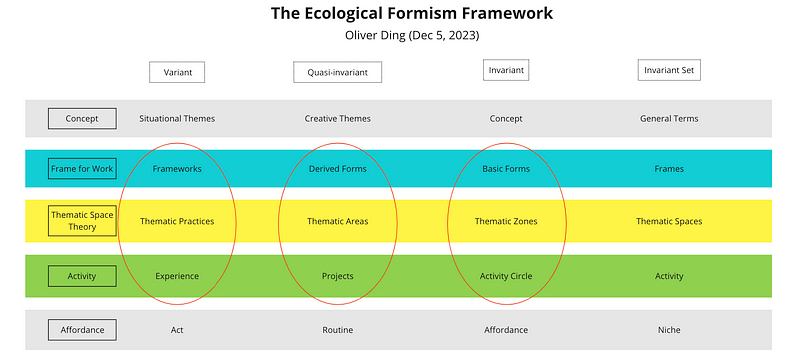
The above diagram highlights the connection between three units of analysis:
- The “Activity” level
- The “Thematic Space Theory (TST)” level
- The “Frame for Work (Knowledge Framework)” level
We also can see three cross-level connections:
- Variant: Experience — Thematic Practices — Frameworks
- Quasi-invariant: Projects — Thematic Areas — Derived Forms
- Invariant: Activity Circle — Thematic Zones — Basic Forms
In the case of Kegan’s knowledge enterprise, I used the Knowledge Discovery Canvas to discover several thematic spaces of Kegan’s creative life. I also applied this method to the Creative Life Curation project. You can find more details in Creative Life Curation: Discover Thematic Spaces of Creative Life.
This method can be assigned to the Variant section because we pay attention to a particular person’s life experience.
The Mindset Engagement project and the Likert 7 project are assigned to the Quasi-invariant section. In these two cases, four Thematic Areas of Knowledge Engagement are the social settings of two projects and our thematic conversations about these projects.
The fourth case — Psychological Counseling Platform — is assigned to the Invariant section. In this case, we see a clear connection between the Activity Circle and Thematic Zones.
In the Mental Moves project, the concept of Thematic Space is related to both Activity and Knowledge Frameworks. Now I used the Ecological Formism Framework to represent this relationship.
Moreover, you can also find more details about the connection of “Affordance — Activity — Thematic Space — Knowledge Frameworks” in Frame for Work: The Ontology of Knowledge Frameworks and Ecological Actualism.
4.3 Four Kinds of Knowing
In Four Mindsets of Knowledge Engagement and “AAI as Mental Tuning”, I introduced four types of “Mindsets of Knowledge Engagement” for the “AAI as Mental Tuning” framework.
- Knowing-for-all (Theoretical Psychologists’ Mindset)
- Knowing-for-fact (Empirical Psychologists’ Mindset)
- Knowing-for-us (Intervenors’ Mindset)
- Knowing-for-me (Actors’ Mindset)
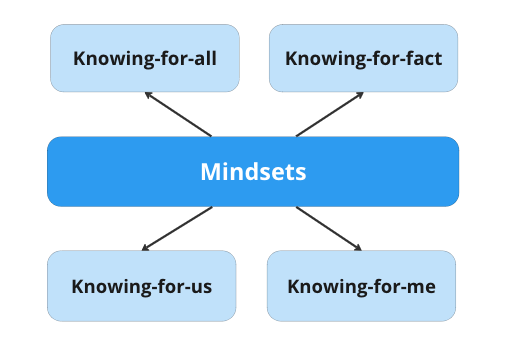
These four types of mindset echo the four types of knowing behind the “Variant > Quasi-invariant > Invariant > Invariant Set” schema.
If we return to Lui’s theoretical sociology, we can find a nested structure. See the diagram below.
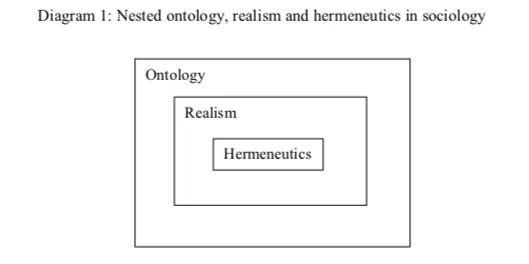
The Realism is determined by the Ontology. It also leads to the Hermeneutics which considers two parts: the actors’ interpretation and the researcher’s analysis.
The Ecological Formism Framework is the “Hermeneutics” of the integrated ecological approach to social cognition. While Lui’s approach considers two parts, my approach considers four parts.
- Theoretical Psychologists: Invariant Set
- Empirical Psychologists: Invariant
- Intervenors: Quasi-invariant
- Actors: Variant
Five units of analysis are objects of the Hermenrutics.
In this way, the Ecological Formism Framework offers an operational framework to study the concept of Social Territory.
In the Mental Moves project, I only used one concrete example of Social Territory: Knowledge Center. So, I didn’t have to develop a general framework.
In the Social Moves project, I changed my strategy and developed a general solution.
Related Articles
- Social Moves: An Integrated Ecological Approach to Social Cognition — Dec 5, 2023
- Psychological Knowledge Engagement as Social Moves — Nov 29, 2023
- Psychological Knowledge Engagement and Robert Kegan’s Knowledge Enterprise — Nov 29, 2023
- Social Moves: Weaving the Mind and Clarifying the Order — Dec 7, 2023
- The Art of Situational Note-taking: Running the “GAP” Project — Dec 8, 2023
- Frame for Work: The Ontology of Knowledge Frameworks and Ecological Actualism — Dec 13, 2023
- TALE: A Possible Theme called “Frame for Work” — May 10, 2023
- Creative Life Curation: Discover Thematic Spaces of Creative Life — Nov 2, 2023


