
The Concept of Mindset and Actors
A case study for the “Territory of Concepts” project
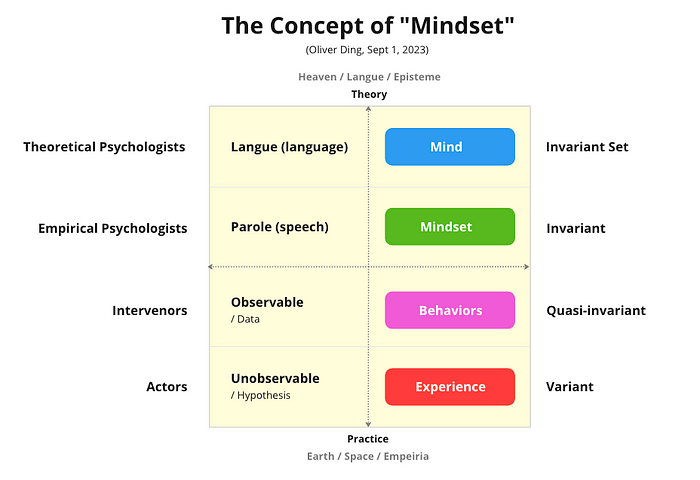
The above diagram uses the “Universal Reference” diagram, the “Kinds of Actors” framework, and a sub-framework of “Ecological Formism” to explore a thematic network around “Mindset” and build a Configurational Theory of “Mindset”.
This diagram goes beyond the original “Universal Reference” diagram and offers us a new creative space for discussing the Concept — Theory Transformation which is part of the “Territory of Concepts” project.
In The Concept of Mindset and Theoretical Integration (48 min read), I focused on Theoretical Psychologists and made a demo of theoretical integration by curating Carol S. Dweck’s version of Mindset theory and Peter Gollwitzer’s version of Mindset theory together.
A by-product of the article is the Mental Tuning framework. See the diagram below.
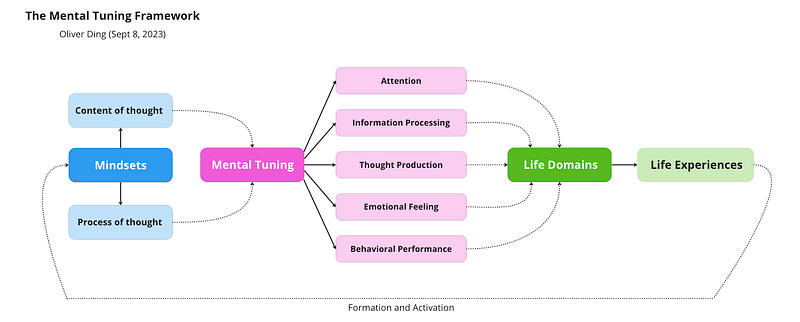
In The Concept of Mindset and Empirical Psychologists (27 min read), I focused on Empirical Psychologists and used Job Crafting as an example to test the Mental Tuning framework.
In The Concept of Mindset and Intervenors (28 min read), I focused on Intervenors and used ACT (Acceptance and Commitment Therapy) as an example to test the Mental Tuning framework.
This article will continue the journey and focus on Actors and their mindset-related creations. I use the following three keywords to organize this article:
- Experiences
- Stories
- Mindsets
While I give a general description of psychological knowledge engagement, I also share my own life experiences and perspectives for discussion.
In Part 4, I select Dan P. McAdams’ theoretical approach to Personal Myth and Narrative Identity as an example to test the Mental Tuning framework.
Contents
1. Actors and Experiences
2. How Do Actors Think
2.1 Actors’ Points of Observation 2.2 Flow, Story, and Model 2.3 Experiences and “Naive Psychology” 2.4 The Self — Other Relationship 2.5 Actors as Applied Knowledge Curators
3. How Do Actors Work
3.1 The ECHO Trip 3.2 An Idea Called “Ecological Strategic Cognition” 3.3 Domains and Works 3.4 Events and Projects 3.5 Stories and Themes
4. Experiences, Stories, and Mindsets
4.1 Dan P. McAdams on Personality Psychology 4.2 Life Stories: Personal Myth and Narrative Identity 4.3 Imagoes, Power, and Love 4.4 Agentic Mindset and Communal Mindset 4.5 Personal Mythmaking as Mental Tuning 4.6 Personal Innovation and the ECHO Way
1. Actors and Experiences
In The Concept of Mindset and Theoretical Integration (48 min read), I introduced the Kinds of Actors and defined four types of actors for psychological knowledge engagement.
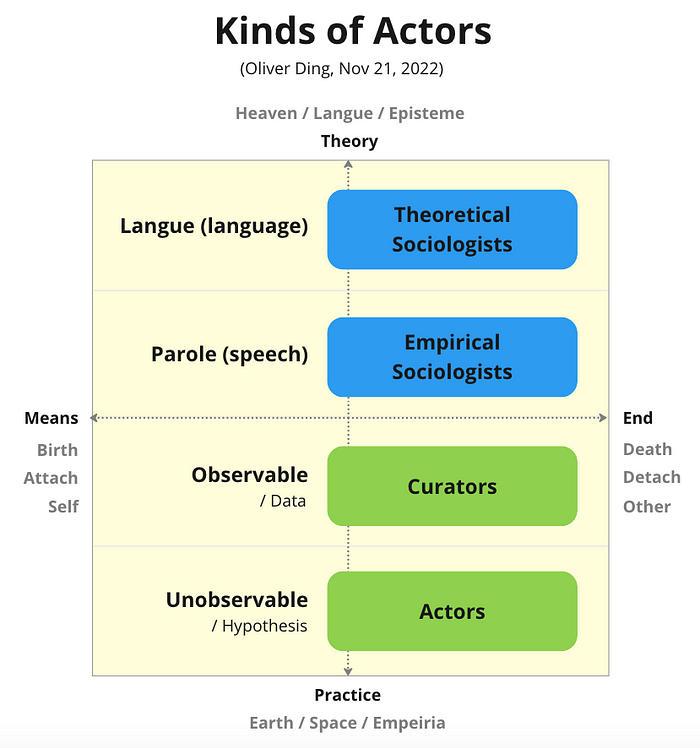
The above diagram is based on a diagram called Universal Reference. The Vertical group refers to the Degrees of Abstraction of “Knowledge”.
Originally, I used it to discuss sociological knowledge creators. Now we can apply the same logic to discuss psychological knowledge creators.
- Theoretical Psychologists
- Empirical Psychologists
- Intervenors
- Actors
While Theoretical Psychologists and Empirical Psychologists are working on producing public knowledge, Intervenors and Actors are working on solving mental problems or optimizing subjective experience by using psychological knowledge.
These four types of knowledge creators have different perspectives and behavioral patterns because they have different construal levels, practical interests, points of observation, methodological preferences, and expressive conventions (or language habits).
In general, Theoretical Psychologists tend to think and work with the following perspective.
- Construal Levels: Meta-theory or the most abstract level
- Practical Interests: The progress of the discipline as a meaningful whole
- Points of Observation: The “Concept — Theory” Move
- Methodological Preferences: Concept Analysis and Formal Representation
- Expressive Conventions: Mathematical formulas or Conceptual frameworks
Empirical Psychologists move to a different position and they have a different perspective:
- Construal Levels: Specific-theory or abstract models/frameworks
- Practical Interests: Develop a particular innovation concept or framework for the discipline
- Points of Observation: The “Perspective — Framework” Move
- Methodological Preferences: methods for Empirical Research, such as laboratory experiments
- Expressive Conventions: Conceptual frameworks and data charts
Intervenors also have their specific needs for psychological knowledge engagement:
- Construal Levels: concrete models/frameworks and related test tools
- Practical Interests: Develop a particular intervention program for behavior change or related education
- Points of Observation: The “Methods — Heuristics” Move
- Methodological Preferences: methods for design, communication, test, report, etc.
- Expressive Conventions: face-to-face communication and questionnaire test
While Actors come from various domains, they share a primary theme: Subjective Experience. For Actors, psychological knowledge engagement is all about understanding their own subjective experience and making sense of their life situations, either stressful or enjoyable.
- Construal Levels: concrete models/frameworks, simple heuristic tools, etc.
- Practical Interests: learning for work or reflecting on life experiences, solving own problems, etc
- Points of Observation: The “Work — Project” Move
- Methodological Preferences: reflection, discussion, reading, etc.
- Expressive Conventions: face-to-face communication, metaphorical words, storytelling, etc.
In The Concept of Mindset and Intervenors, we used the Knowledge Discovery Cavnas to talk about Behavior Change from the perspective of Intervenors. Now we can use the same canvas for the present discussion.
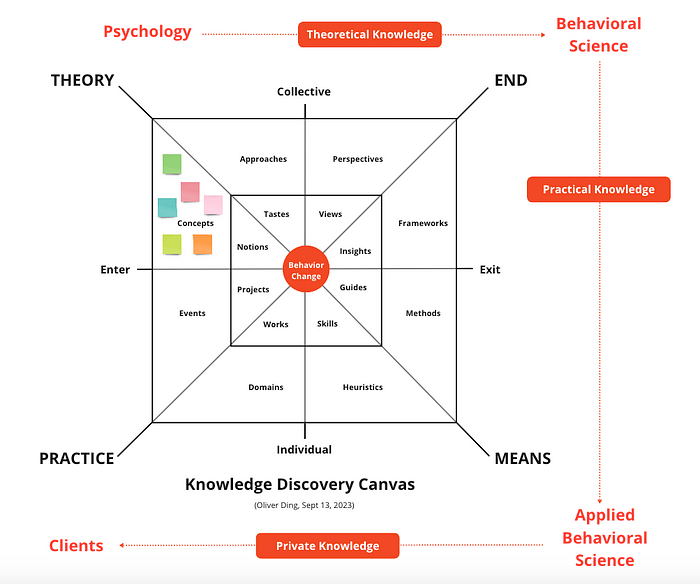
- Theoretical Knowledge: Psychology > “Behavior Science”
- Practical Knowledge: “Behavior Science” > “Applied Behavior Science”
- Private Knowledge: Consultants > Clients
According to Wikipedia, “A behavioral change can be a temporary or permanent effect that is considered a change in an individual’s behavior when compared to previous behavior… This change is generally characterized by changes in thinking, interpretations, emotions, or relationships. These changes can be either good or bad, depending on which behavior is being affected.”
It’s clear that behavior change belongs to the field of applied psychological science or applied behavioral science. The “Behavior Change” theme refers to a field of using theoretical knowledge to solve practical problems. Some people use “Behavior Science” as an umbrella term that refers to a variety of disciplines, including fields like psychology, sociology, and anthropology, etc.
Since the present discussion is about Psychological Knowledge Engagement, I will only use “Applied Psychological Science” and “Applied Psychological Knowledge” for this article.
If an Actor asks an Intervenor to help him with behavior change, then we see the “Intervenor — Client” activity circle. If the Actor uses applied psychological knowledge to help himself with any support from Intervenors, then we call it learning and self-transformation.
Moreover, the Actor could discuss his/her situation with friends who are not professional Intervenors. He/She may also share his/her experiences of engaging psychological knowledge in public spaces such as social media platforms.
The Self — Other relationship is significant in the Actor’s journey of engaging with psychological knowledge.
2. How Do Actors Think
In The Concept of Mindset and Theoretical Integration, I used the Knowledge Discovery Canvas to discuss Theoretical Psychologists’ Points of Observation. I will continue to use the canvas for the present discussion.
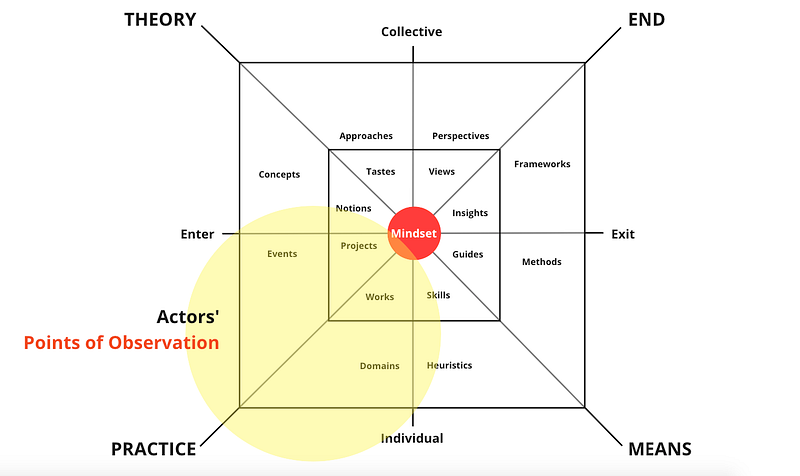
The Knowledge Discovery Canvas is designed with four areas: the THEORY area, the PRACTICE area, the END area, and the MEANS area.
Let’s use the “Home — Away” terms as metaphors to describe Points of Observation.
We can assign these areas as Home for four types of creators.
- The THEORY Area: The Home of Theoretical Psychologists
- The PRACTICE Area: The Home of Actors
- The END Area: The Home of Empirical Psychologists
- The MEAN Area: The Home of Intervenors
For each type of creator, the other three types of creators’ Home means Away.
Each type of creator can do their homework in their Home, they can also visit other types of creators’ Home to run the thematic conversation for collaborative knowledge creation.
The PRACTICE area is the Home of Actors.
2.1 Actors’ Points of Observation
What do Actors’ Home look like? See the diagram below.
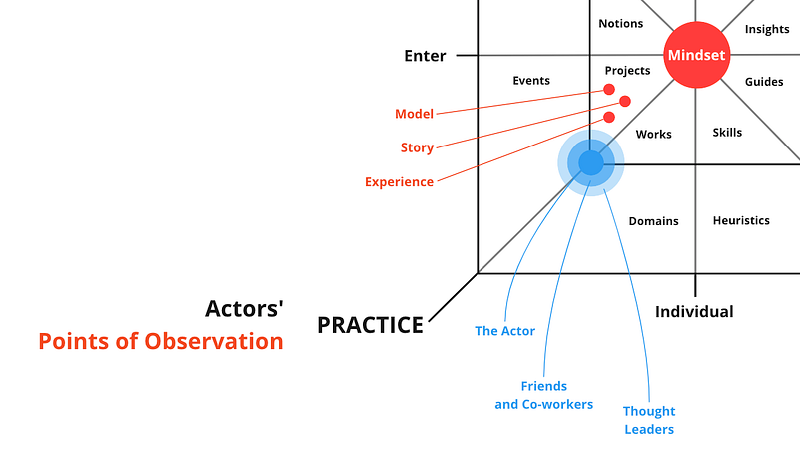
At the Construal Level, Empirical Psychologists work on specific theories or abstract models/frameworks, while Theoretical Psychologists work at the most abstract level of psychological science. While Empirical Psychologists are busy with the Hypothesis — Data Gap, Theoretical Psychologists think and work as Philosophers in the field of Psychological Science. Intervenors think on a different level because their primary objects are concrete models/frameworks and related test tools. Actors stay at the lowest construal level and only care about everyday life experiences.
The primary Practical Interest of Actors is to apply psychological knowledge to help them understand their own subjective experiences and make decisions to solve situational problems or discover possible opportunities for life development.
The actors’ mental focus is on the Work — Project Move. They have to connect applied psychological knowledge with particular situational challenges. Experienced actors use specific methods and heuristic tools for their life development.
In general, Actors tend to talk about their life experiences with their friends and co-workers. They also read books and articles written by thought leaders. They also like to use face-to-face communication to talk about experiences and use questionnaire tests to understand themself.
2.2 Flow, Story, and Model
In Thematic Space: Flow, Film, and Floor Plan, I developed a model to understand the context of tacit knowledge. We can use it for the present discussion.
The model uses three metaphors to represent three levels of knowing in everyday life.
- Experience > Flow > Life as a continuous flow
- Story > Film > Project as a film with a prominent theme
- Model > Floor Plan > Thematic space as a floor plan
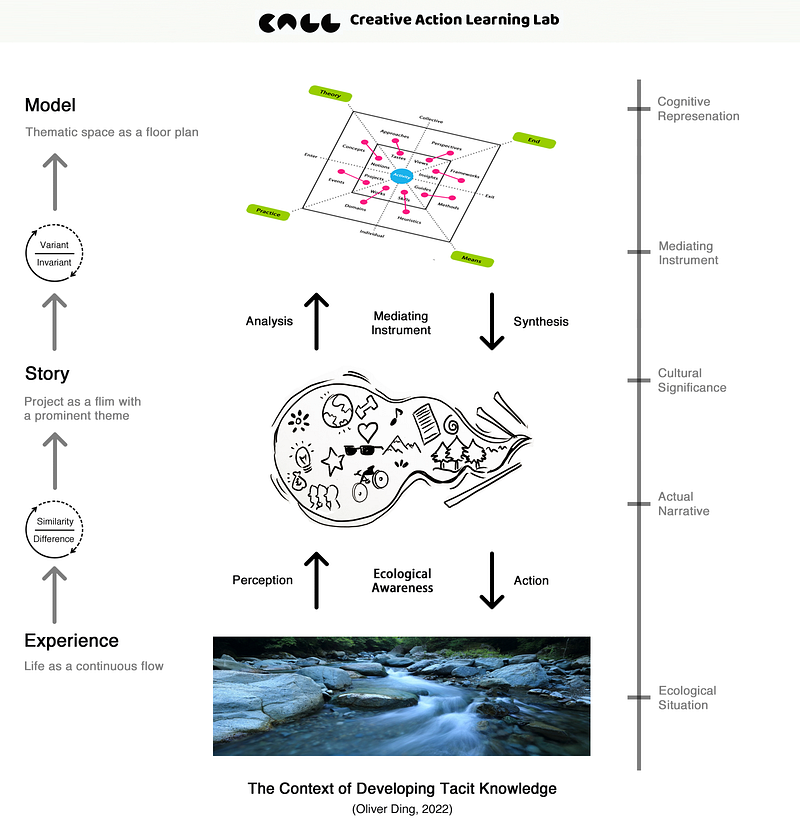
I use “continuous flow” as a metaphor to describe Life and Experience. This metaphor is inspired by William James’ metaphor “Stream of Thought”.
James used the stream metaphor to reject the British empiricists’ view of consciousness which refers to the chain or train metaphor. According to James:
“Consciousness, then, does not appear to itself chopped up in bits. Such words as “chain” or “train” do not describe it fitly as it presents itself in the first instance. It is nothing jointed; it flows. A “river” or a “stream” are the metaphors by which it is most naturally described. In talking of it hereafter let us call it the stream of thought, of consciousness or of subjective life. (vol. 1, p.239)
What James emphasized is the Subjective Life. I follow this metaphor and directly use Life as a continuous flow to describe a person’s subjective experience of his own life. You can’t use a knife to cut a stream, you only can use a container to contain it.
The Story layer refers to the level of social communicative context. At this level, a person could tell his journey of developing tacit knowledge with others.
The Story layer is also inspired by my experience of writing my learning autobiographies and working on learning narrative-related projects. I often write reflection notes for each project. I also share my journey with others.
At the Model layer, I used the Floor Plan metaphor. A model is not a reality, but by modeling reality, we have a special way of knowing. By using models, a person could explore the knowing of Analysis. For example, I used the canvas of Thematic Space to review my “Activity” thematic space. The process, the result, and the value are totally different from the Story layer.
However, we should remember the model is not our destination. The model is a mediating instrument for producing our outcome of tacit knowing activities. We need to return to the Story layer from the Model layer. We need to transform insights from Analysis into actionable guides by Synthesis.
Finally, the actionable guides should be transformed into real actions in ecological situations and returned to the Experience layer.
The “Flow — Story — Model” metaphor is also inspired by James G. March (1928–2018) who was an American political scientist, sociologist, and a pioneer of organizational decision-making. He mentioned that there are three types of wisdom in his 2010 book The Ambiguities of Experience.
What are the three types of wisdom?
- Models: a model is an abstract cognitive representation.
- Stories: a story is a model too, but it is easy to understand.
- Actions: you just do it, then you get it.
We can use this metaphor as a model to understand Actors’ tacit knowledge of using psychological knowledge for life development.
2.3 Experiences and “Naive Psychology”
Actors’ tacit knowledge of using psychological knowledge for life development is associated with “Naive Psychology”.
What’s Naive Psychology?
In a 1958 book titled The Psychology of Interpersonal Relations, Fritz Heider mentioned the value of studying common-sense psychology for the scientific understanding of interpersonal relations.
In everyday life we form ideas about other people and about social situations. We interpret other people’s actions and we predict what they will do under certain circumstances. Though these ideas are usually not formulated, they often function adequately. They achieve in some measure what a science is supposed to achieve: an adequate description of the subject matter which makes prediction possible.
In the same way one talks about a naive physics which consists of the unformulated ways we take account of simple mechanical laws in our adapted actions, one can talk about a “native psychology” which gives us the principles we use to build up our picture of the social environment and which guides our reactions to it.
… scientific psychology has a good deal to learn from common-sense psychology. In interpersonal relations, perhaps more than in any other field of knowledge, fruitful concepts and hunches for hypotheses lie dormant and unformulated in what we know intuitively.
… Actually, all psychologists use common-sense ideas in their scientific thinking; but they usually do so without analyzing them and making them explicit.
It is also our belief that the insights concerning interpersonal relations embodied in fables, novels, and other literary forms, provide a fertile source of understanding.
…
Allport (1937), too, thinks that a “still greater treasure for the psychologist lies in the world’s store of drama, biographies, poetry, and fiction” (p.60). Of course, it is clear that the job of the psychologist does not stop with the insights of the creative writers.
(1958, pp. 5-6)
The ecosystem of psychological knowledge is quite complicated. “Naive Psychology” is not either good or bad. It is just there. It is always the meaning matrix of scientific psychology.
Ordinary people use their Personal Psychological Knowledge to guide their thoughts and actions in their work and life development.
Where does their Personal Psychological Knowledge come from?
- Scientific psychological knowledge published by scientists
- Native psychological knowledge told by others
- Tacit psychological knowledge developed by themselves
Actors curate these three types of knowledge together as a pool for psychological knowledge engagement.
A typical example of Native Psychological Knowledge is Ray Dalio’s 2017 book Principles: Life & Work.
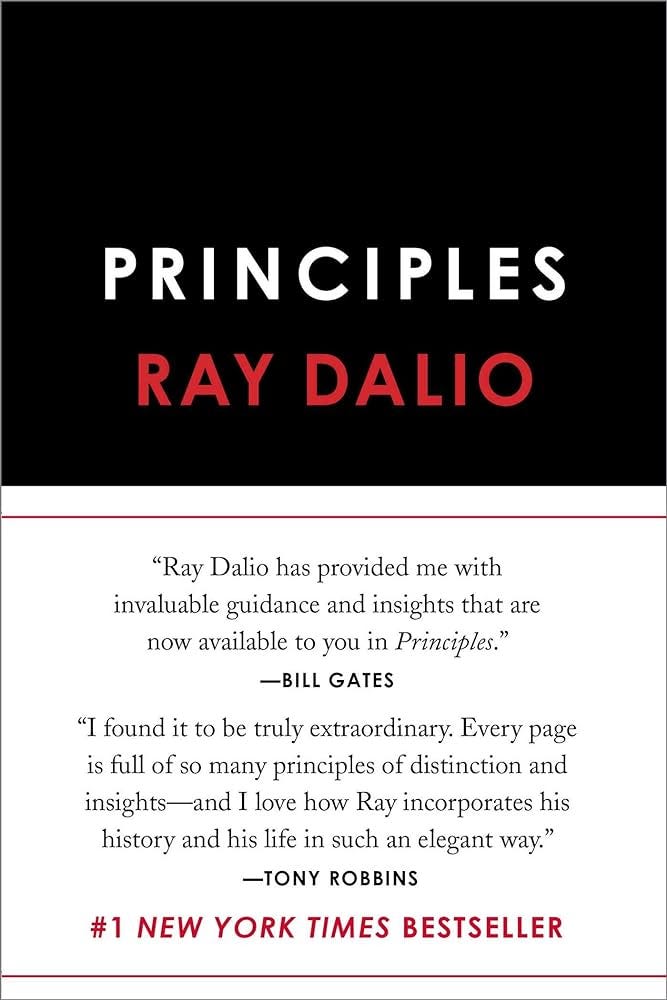
After receiving a frank memo from his top lieutenants in 1993 concerning his interpersonal performance as a manager, Bridgewater Associates’ Ray Dalio began to develop a unique company culture based on principles and unadorned feedback. He originally published a shorter version of Principles online in 2011, where it received over three million downloads. It was officially released as Principles: Life & Work on September 19, 2017, by Simon & Schuster.
Source: Wikipedia
Ray Dalio is not a scientific psychologist, but a hedge fund manager and an entrepreneur. The book Principles came from his own experiences of running a business in a real-life world. It represents his native psychology.
A particular reader of the book Principles may curate Ray Dalio’s native psychological knowledge with other psychological knowledge learned from other sources together to form his own system of psychological knowledge.
The Self — Other relationship is significant in Actors’ psychological knowledge engagement.
2.4 The Self — Other Relationship
In HERO U — A New Framework for Knowledge Heroes, I distinguished three kinds of knowing from the perspective of outcome and motivation:
- Knowing-for-all
- Knowing-for-us
- Knowing-for-me
Actors’ psychological knowledge engagement belongs to Knowing-for-me.
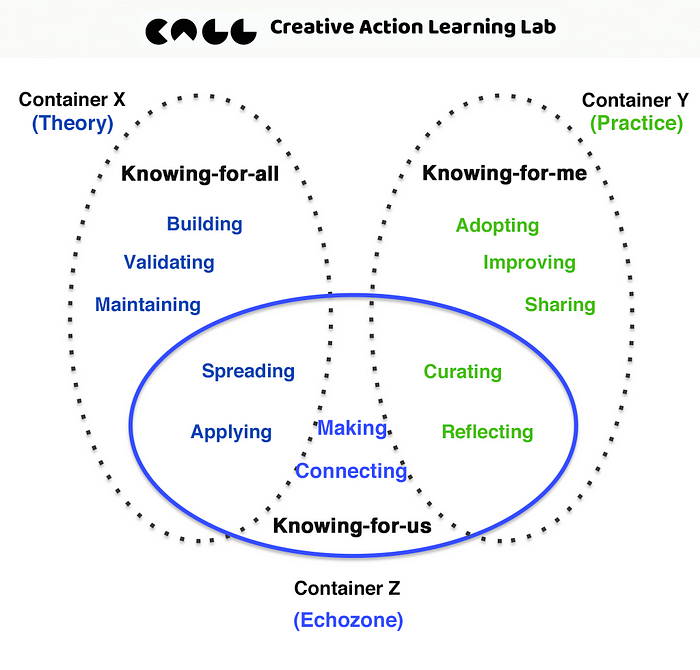
The Knowing-for-me activity is located in the Practice container. The outcome and motivation are about adopting and sharing reliable and accessible knowledge for improving individual or collective professional work and daily life practice without commitment to contributing to the progress of public knowledge.
As mentioned above, the Self — Other relationship is critical in Actors’ psychological Knowledge Engagement.
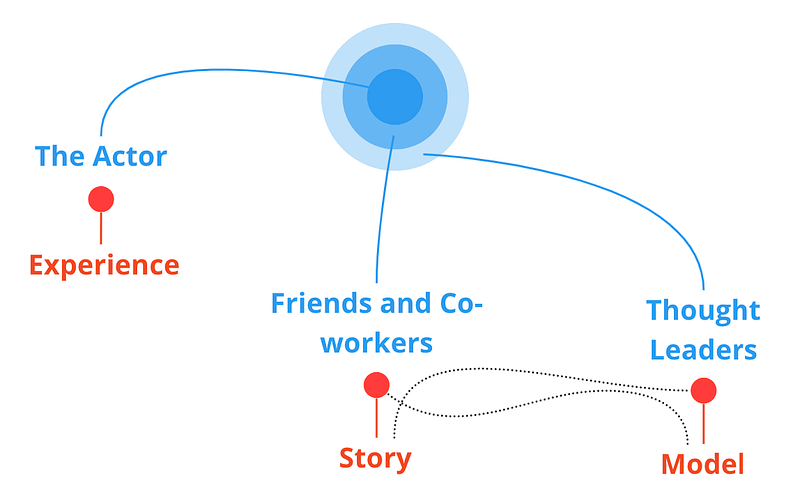
I selected two types of Others for the present discussion. See the above diagram. I also assign two types of knowledge engagement to them.
- The Actor: Experience
- Friends and Co-workers: Story and Model
- Thoughts Leaders: Model and Story
The Actor can self-reflect on his/her life experiences and use his/her psychological knowledge to understand life experiences.
The Actor may share his/her life experiences as Stories to his/her friends and get feedback and advice from them.He/She may also use this advice to guide his/her actions.
Thoughts Leaders are book authors, bloggers, YouTubers, podcast hosts, etc. The Actor may learn psychological knowledge from thought leaders and use it to guide his/her life development.
Both friends and thought leaders could talk about stories and models. However, thought leaders tend to offer more models. The quality of these models depends on particular thought leaders.
2.5 Actors as Applied Knowledge Curators
Life is a real practice. How do we apply various theoretical knowledge to such a practice?
This question leads to a significant gap between Theory and Practice. Knowledge heroes create various theories, frameworks, models, etc. Their creativity drives them to make unique and general ideas. Eventually, they build a highly fragmented knowledge ecology that is not accessible to ordinary people.
On the other hand, more and more people share their life stories through various channels such as social media platforms and traditional events and meetings. We are living in an age of information overload. There are more and more cognitive needs coming from social environments such as our friends, teams, communities, and society.
In 2019 I developed Curativity Theory for understanding general curation practice and wrote a book. In 2020, I started the Knowledge Curation project which aims to apply Curativity Theory to connect Theory and Practice. From the perspective of Curativity Theory, ordinary people need to add “Curation” to develop their minds.
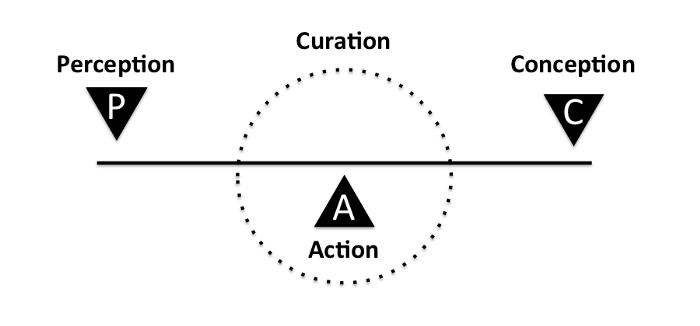
Traditionally, researchers tend to use “perception, conception, and action” as three keywords to discuss mind-related topics. From the perspective of Curativity Theory which is about turning pieces into a meaningful whole, I want to expand the foundation of mind-related topics from three keywords to four keywords.
In fact, Actors are doing it without mentioning it explicitly. They always learn and organize different types of psychological knowledge from various sources. They always select a piece of psychological knowledge from their mind and apply it to a particular situation. They always change their belief in a particular knowledge after using it.
In this way, all Actors are applied knowledge curators.
3. How Do Actors Work
As mentioned above, the actors’ mental focus is on the Work — Project Move. It’s about Doing something and its related Experience.
It’s hard to give a general description of this issue. I want to share my personal stories related to the “Flow—Story—Model” schema and my perspectives on it, especially my thoughts on the Life-as-Project approach.
3.1 The ECHO Trip
From June 24 to July 3, I had a wonderful 10-day road trip with my wife and two little sons.
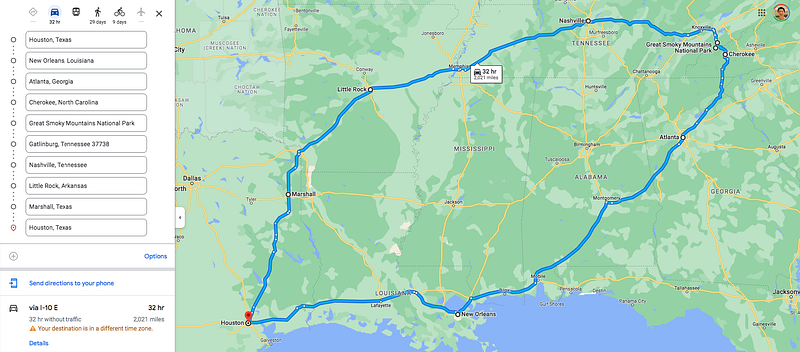
During the busy trip, I couldn’t write notes with details. In order to record exciting moments and engaging experiences, I used short meaningful keywords to capture some insights while taking pictures.
These short meaningful keywords are Situational Themes of my life.
After returning to Houston, I listed 21 situational themes and conducted a “Creative Life Curation” project.
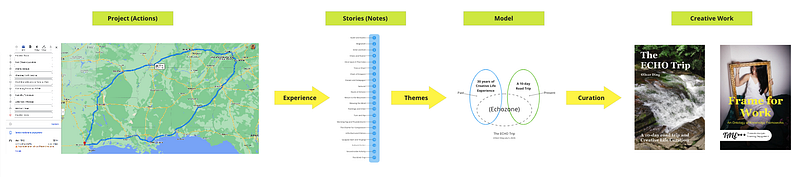
The above picture is the overview of the project.
- Project (Actions) → Stories (Notes) → Model → Creative Work
The 10-day road trip was a project that included a series of actions. After the project was completed, it became my life Experience.
If I do nothing with my subjective experiences of the 10-day road trip. It is only my memory. If I want to share it with others, I have to write notes, take pictures, record the trip, etc. In this way, I made Stories of the trip for the social communicative context.
Though I didn’t write notes with details, I made 21 situational themes of the trip. These themes are Personal Signs which refer to my Subjective Meanings of the trip. These themes can be seen as micro-stories.
However, the “Creative Life Curation” project went beyond normal storytelling and social media sharing. It moved from the Story level to the Model level. I adopted the ECHO Way model as a tool to analyze the deep structure of these themes. In this way, I ran the “Creative Life Curation” project and turned pieces of life experiences into meaningful Creative Work. I also used The ECHO Trip to name a possible book about the project.
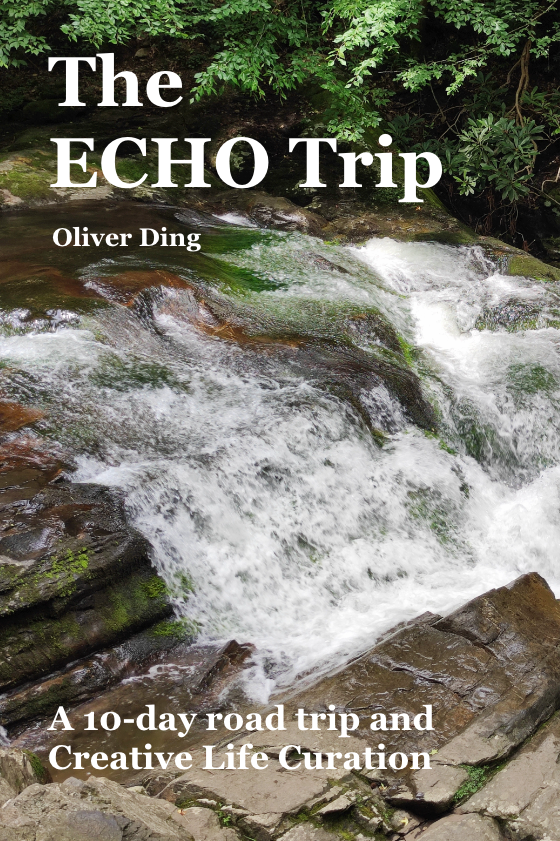
As a “Creative Life Curation” project, The ECHO Trip used thematic analysis and thematic mapping to represent a thematic dialogue between Individual Situational Themes and Individual Life Themes.
You can find more details in The ECHO Trip: A 10-day Road Trip and Creative Life Curation.
3.2 An Idea Called “Ecological Strategic Cognition”
The ECHO Trip is about a normal life experience. Now let’s see an example of creative thinking.
On July 31, I closed the Mental Moves project with a possible book titled Mental Moves: The Attachance Approach to Ecological Creative Cognition (Introduction, Table of Contents). In general, the book is about my reflection on Creativity.
Inspired by the book, I detached the theme of “Ecological Strategic Cognition” from the Life Strategy Center and attached it to TALE (Thematic Analysis Learning Engagement). Now we can see it as an independent knowledge element.
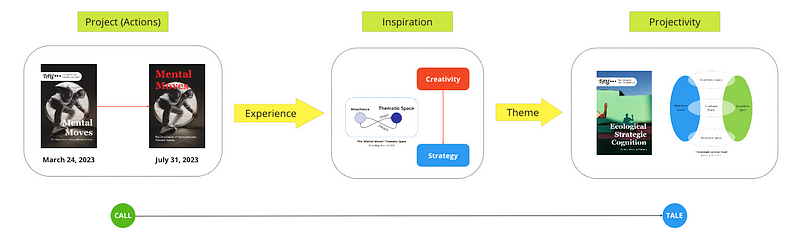
The above diagram represents a model behind the creative process:
Project (Actions) > Experience > Inspiration > Theme > Projectivity
The “Mental Moves” Knowledge Project was started on March 24, 2023, and closed on July 31, 2023, with a possible book Mental Moves: The Attachance Approach to Ecological Creative Cognition.
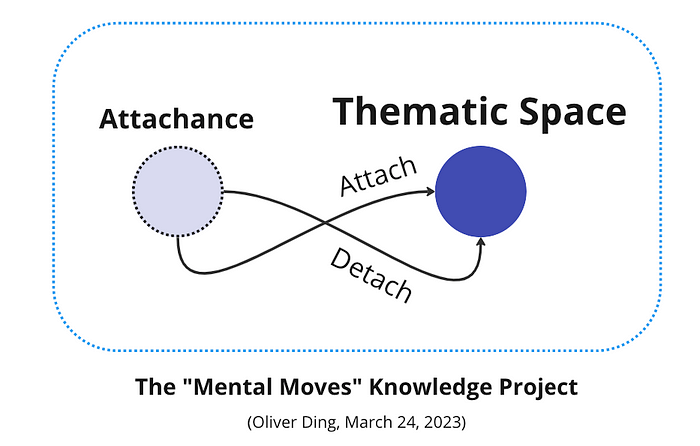
On August 4, 2023, I reflected on the “Mental Moves” Knowledge Project and returned to the theme of “Ecological Strategic Cognition”.
It means my mental focus was detached from my “Creativity” thematic space and attached to my “Strategy” thematic space.
In this way, I started exploring a new Projectivity which means an opportunity to run a new knowledge project about “Ecological Strategic Cognition”.
On Jan 9, 2021, I published an article titled Activity U (X): Projecting, Projectivity, and Cultural Projection which introduces the concept of Projectivity and the notion of Cultural Projection. This article is an essential part of my 2021 book Project-oriented Activity Theory.
What’s Projectivity?
It refers to potential action opportunities of forming a project or participating in a project for people to actualize their development with others. You can find more details in Project Engagement (v2): Life, History, and Multiverse.
The new Projectivity was supported by two things:
- The theme of “Ecological Strategic Cognition”
- The Strategic Curation Model
On August 4, 2023, I wrote an article about the new Projectivity. During the process of writing the article, I developed a new framework for the theme of “Ecological Strategic Cognition” and used the framework to curate more relevant knowledge models for the project.
You can find more details in TALE: A Possible Theme called “Ecological Strategic Cognition”.
3.3 Domains and Works
The term “Work” refers to the “Domains — Works” mapping on the Knowledge Discovery Canvas. It is about actors’ creations and products and their context: domains.
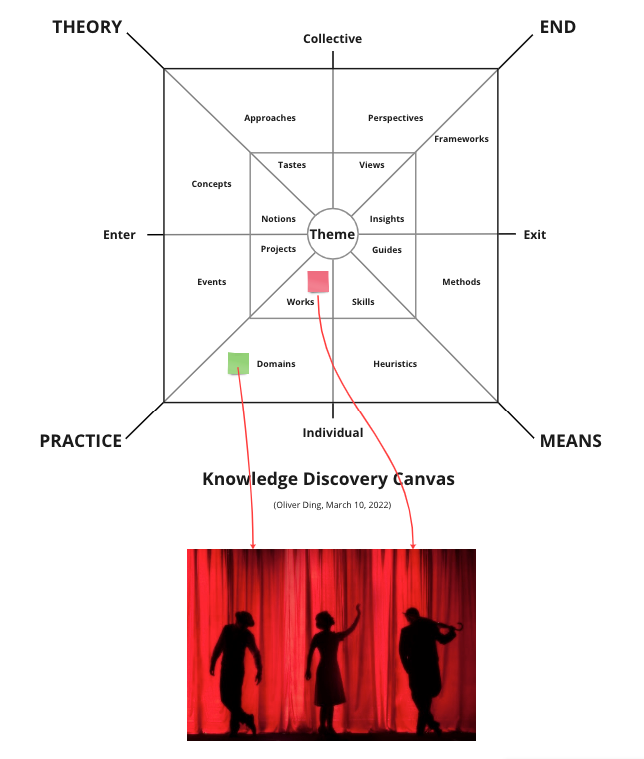
In Knowledge Discovery: The “Domains — Works” Mapping, I discussed the following three ideas:
- Part 1 introduces Mihaly Csikszentmihalyi’s Social Systems Model of Creativity and reviews its core concepts: Domain, Field, and Person.
- Part 2 introduces my own work titled The Epistemology of Domain.
- Part 3 adopts the Themes of Practice framework to discuss Works.
For the present discussion, I’d like to briefly introduce the Epirstmology of Domain.
On July 27, 2021, I finished a 71-page thesis titled The Epistemology of Domain which offers a brand new theory about Domain.
The subtitle of the thesis is Themes of Practice, The Landscape of Domains, and Niche Construction. The core idea of the Themes of Practice framework is about the transformation between individual life themes and collective culture themes. Niche Construction Theory is about the individual—environment relationship. The thesis focuses on the “Person — Domain” relationship, not only on the concept of Domain.
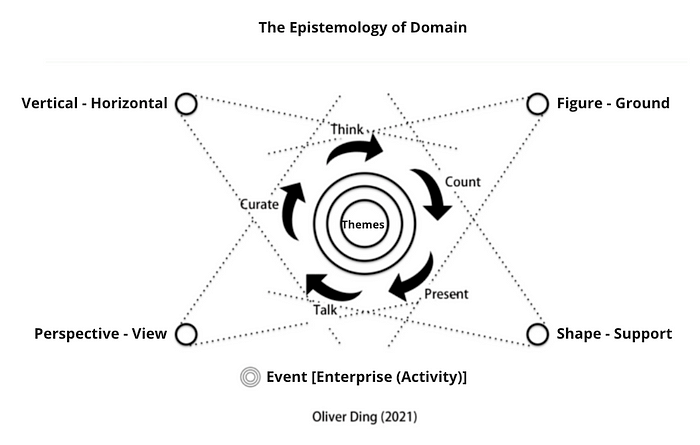
The core of the above diagram is an Object of Knowing with three nested circles which represent nested layers: Layer 3 [Layer 2 (Layer 1)]. What’s the core of the Epistemology of Domain? It is “Event [Enterprise(Project)]”. See the diagram below.
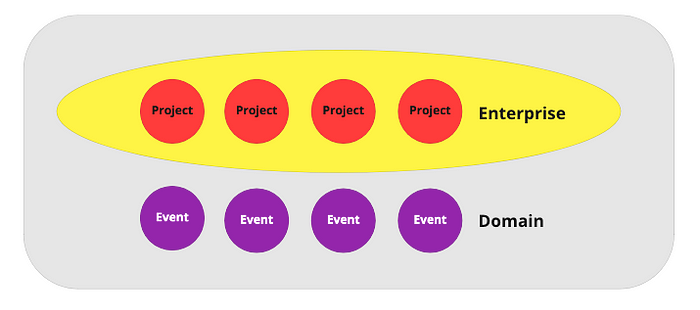
Originally, I used “Event [Enterprise (Activity)]” for the Epistemology of Domain. For the Knowledge Discovery Canvas, I use Project to replace Activity. In fact, my notion of Project refers to Project-oriented Activity Theory which is a branch of Activity Theory. The next section will offer more details about Events and Projects.
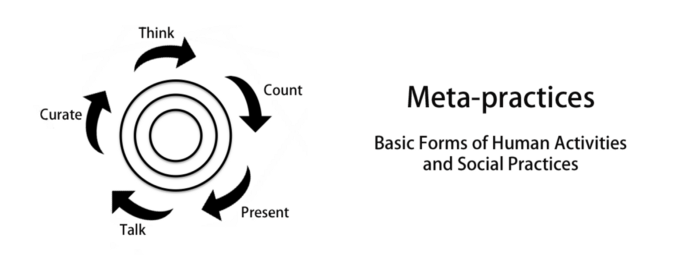
The second component of the above diagram refers to five states. For the Epistemology of Domain, I use five typical “Forms of Actions” for the framework.
- Think
- Count
- Present
- Talk
- Curate
The third component is four perspectives. The first part of the thesis The Epistemology of Domain focuses on developing the following four perspectives:
- The Vertical — Horizontal perspective
- The Figure — Ground perspective
- The Perspective — View perspective
- The Shape — Support perspective
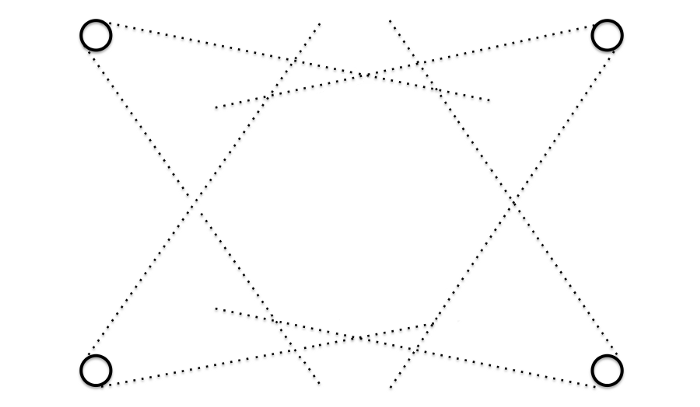
These four perspectives can be understood from the following 2x2 matrix.
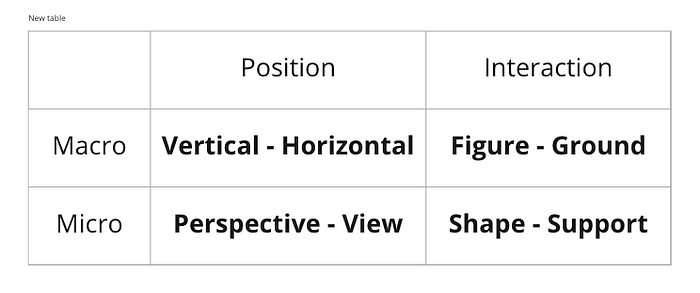
The Vertical — Horizontal perspective refers to two types of practical domains: horizontal domains and vertical domains.
- Horizontal domains refer to general functions in society such as “organization, strategy, and innovation”.
- Vertical domains refer to specific industries, for example, farms (agriculture), buses (transportation), and movies (entertainment).
The Figure — Ground perspective refers to the main activities and the side activities of a practical domain. For example:
- Main activities refer to Large Enterprises, Small-medium Businesses, Professional Service Firms, Technological Platforms, etc.
- Side activities refer to Educational Service Organizations, Media, Trade Associations, Communities, etc.
The Perspective — View perspective refers to Offline Perspectives and Embedded Stances.
- Offline Perspectives only consider cognitive thinking without considering a person’s social position and practical benefits.
- Embedded Stance primarily considers a person’s social position and practical benefits.
The Shape — Support perspective refers to two types of social actions. We can roughly understand them as Self-determined and Support Others.
Finally, I’d like to mention the center of the Epistemology of Domain: Themes. This refers to my concept of Themes of Practice. You can find more details A Journey of Engaging with the Theme of “Themes” (2017–2023).
3.4 Events and Projects
The term “Project” refers to the “Events — Projects” mapping on the Knowledge Discovery Canvas. For example, 9/11 is a historical event. In Sept 2011, I worked for a web content curation and information organizing app called BagTheWeb. In order to service the BagTheWeb user community, I suggested developing a new feature called Channels for collective content curation. The first channel was called Curation as Memorial. I designed a logo for the channel. I also used the channel to curate content about 9/11 on BagTheWeb. For me, this is a significant project.
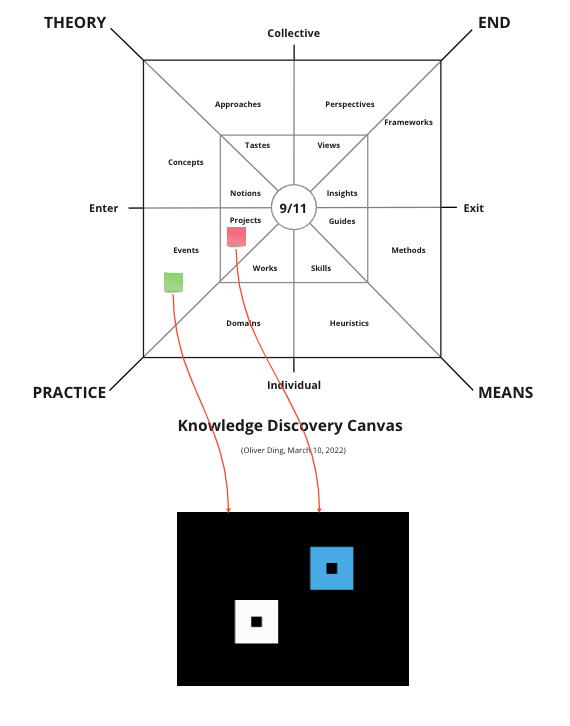
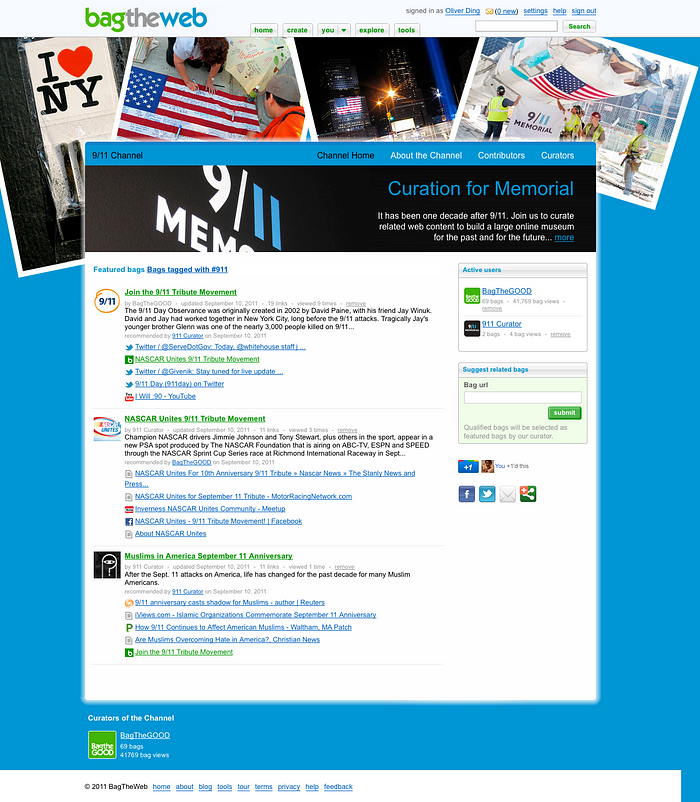
Though this is a business-for-good example, I personally consider the Curation for Memorial project as a case of my long-term life project: Curation Commons. I also found that the theme of “Curation for Memorial” is part of many people’s lives. For example, watch the following talk from Steve Rosenbaum who is the author of Curation Nation (2011) and Curate This (2014).
The Life-as-Project approach uses “events” and “projects” to present social context and individual biography. The difference between “events” and “projects” is individual involvement. If the person directly gets involved in an activity — it means she is the subject of the activity or part of the community of the activity — then the activity is a project of her biography. If the person doesn’t directly get involved in the activity, then the activity is an event of her biography.
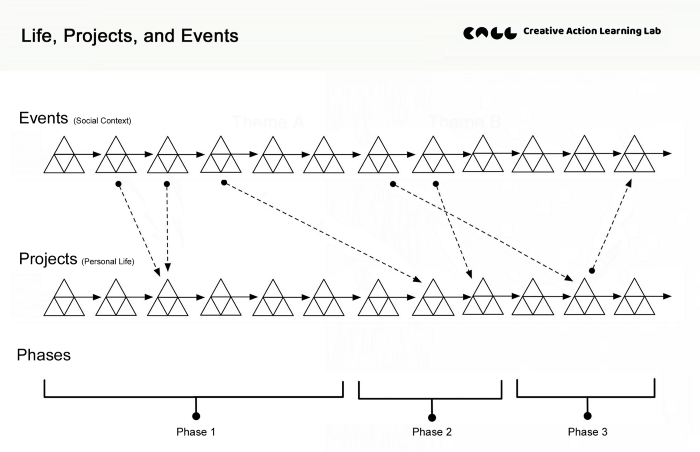
Let’s use the biography of Yrjö Engeström who is a leading Activity Theorist as an example. According to Annalisa Sannino, there are four main phases in Engeström’s development as an activity theorist, “(1) the European student movement of the 1960s and the discovery of activity theory; (2) the study of instruction and the turn from school learning to workplace learning; (3) developmental work research and the theory of expansive learning; and (4) the formation of activity-theoretical communities aimed at changing societal practices.” (2009, p.11) We can use the above diagram to represent Engeström’s biography.
Phase 1
- Event 1: the European student movement of the 1960s.
- Project 1: Engeström wrote his first book (Engeström,1970), Education in Class Society: Introduction to the Educational Problems of Capitalism (in Finnish).
- Event 2: Leontiev’s Problems of the Development of the Mind, published in East Germany in 1973 (Leontjew,1973), and Davydov’s Types of Generalizations in Instruction, which was available in East Germany in 1977 (Dawydow, 1977).
- Project 2: Engeström discovered Activity Theory by reading Davydov’s book and II’enkov’s essay on the dialectics of the abstract and the concrete.
- Project 3: Engeström adopted Activity Theory for his thesis, The Imagination and Behavior of School Students Analyzed from the Viewpoint of Education for Peace (in Finnish) in 1979. This empirical study documents the work of nearly 2,000 students who wrote essays on war and violence.
Phase 2
- Project 1: Engeström attempted to change school instruction by bringing Davydov’s ideas to politically and pedagogically radical Finnish teachers. He published a chapter in the 1984 book Learning and Teaching on a Scientific Basis.
- Project 2: Engeström started paying attention to workplace learning and human resource development in organizations. His first work-related study (1984) was concerned with janitorial cleaning, which was considered to be the occupation with the lowest prestige in Finland. The main motivation for studying the work of cleaners was to demonstrate that this work is creative and has an intellectual basis and to show the possibilities of development.
Phase 3
- Project 1: From 1986 to 1989, Engeström led a study with the primary health care practitioners and patients of the city of Espoo, where patients were facing excessive waiting times before receiving health care and a lack of continuity of care.
- Project 2: Engeström adopted Davydov (1990)’s “learning activity” to investigate/implement radical change at work.
- Project 3: Engeström developed the triangular model of activity systems and the theory of expansive learning and published Learning by Expanding (1987).
Phase 4
- Event 1: Michael Cole directed the Laboratory of Comparative Human Cognition (LCHC) at the University of California, San Diego.
- Project 1: Engeström was invited to work at LCHC.
- Project 2: Engeström initiated communities for adopting activity theory for changing societal practices in Finland.
- Project 3: Inspired by the LCHC, Engeström founded the Center for Activity Theory and Development Work Research at the University of Helsinki.
- Event 2: Georg Rückriem worked on the translations of Leont’ev’s works in Germany.
- Project 4: Engeström suggested the idea of a conference in which scholars within Germany and elsewhere could gather to discuss ways of influencing human practices on the basis of activity theory. Subsequently, Rückriem started organizing the first conference of the International Society for Cultural Research and Activity Theory (ISCRAT), which took place in 1986.
- Event 3: LCHC published a Quarterly Newsletter titled Mind, Culture, and Activity.
- Project 5: Engeström suggested the creation of the journal Mind, Culture, and Activity, which was originally published as the Quarterly Newsletter of LCHC.
- Event 4: In 1995, Finland was struggling to overcome an economic recession, as were many other countries. The problems of the Finnish economy, however, were also connected with the collapse of the Soviet Union, which had been Finland’s main trading partner. Companies were under economic pressure and needed to find short-term solutions to the crisis.
- Project 6: Developmental work research was formulated in terms of a long developmental cycle of interventionist work lasting 3 to 5 years (Engeström & Engeström,1986). Companies in these years could not afford to engage in this kind of transformative venture. The intervention methodology of the Change Laboratory, as compressed cycles of transformation within the broader frame of developmental work research, was elaborated to meet the needs of these institutions.
- Event 5: The Center for Activity Theory and Development Work Research inspired the emergence of similar institutions, such as the Centre for Sociocultural and Activity Theory Research at the University of Bath in the United Kingdom, the Centre for Sociocultural and Activity Theory Research at the University of Oxford in the United Kingdom, and the Center for Human Activity Theory at the University of Kansai in Osaka, Japan.
The above example is just for showing the concepts of “events”, “projects”, and “concepts” within our approach.
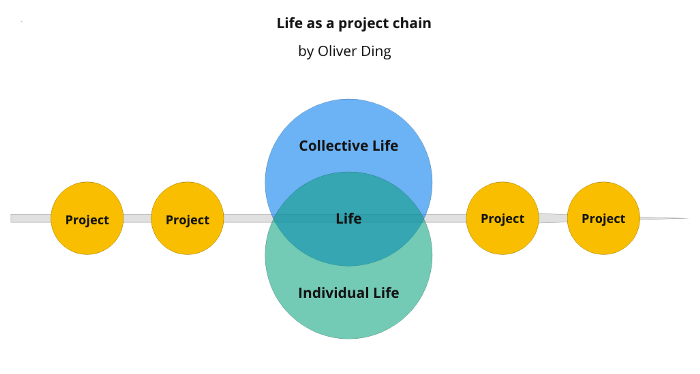
The concept of Life can be understood as Collective Life and Individual Life. We can use the concept of Project to understand both of them. A person’s real life is a set of real actions. The concept of Project is a way of curating these actions. On the other hand, Collective Life can be curated with Projects too.
You can find more details in Knowledge Discovery: The “Events — Projects” Mapping and Project Engagement (v2): Life, History, and Multiverse.
3.5 Stories and Themes
The “Flow—Story—Model” schema also has some details about Cultural Significance and actual Narrative.
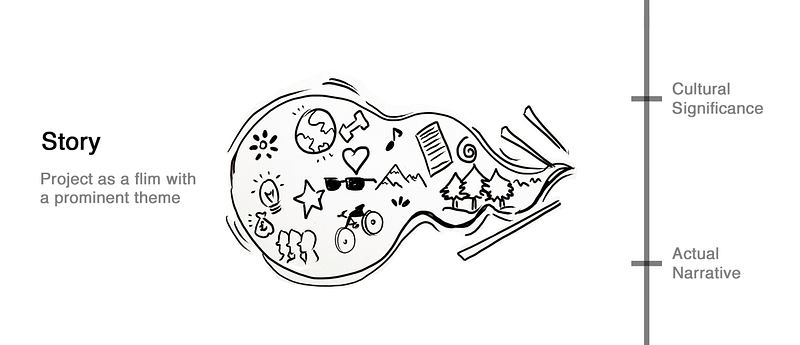
The Story layer is inspired by my experience of writing my learning autobiographies and working on learning narrative-related projects. I often write reflection notes for each project. I also share my journey with others. For example, I had a 99-minute conversation with a friend of mine on Jan 8, 2022. I briefly introduced my journey of epistemic development from 2019 to 2022. I spent about 60 minutes sharing my story and some core ideas of several major works. You can find more details here.
In order to make a clear statement, I define two types of stories.
- Story 1: it is framed by Cultural Significance.
- Story 2: it refers to Actual Narrative.
Story 1 refers to told stories that are framed by Cultural Significance. Once a person starts to share his stories with others, he must consider Relevance in the communicative context.
Story 2 refers to the real story which is not told yet. Story 2 is a set of immediate actions (experience) with a structure. The structure could be a planned project, a real project, and an imagined project.
By adopting some concepts and frameworks from Project-oriented Activity Theory, I developed an insightful perspective on Cultural Significance and Actual Narrative. The diagram below roughly summarizes the discussion.
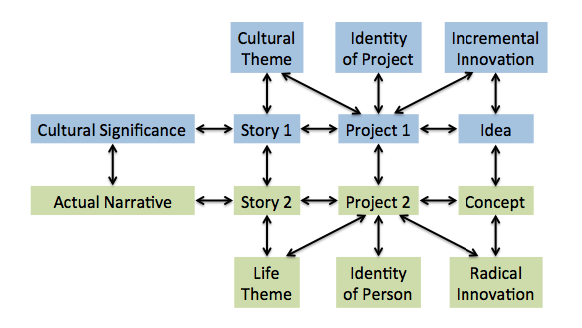
Anthropologist Morris Opler (1945) developed a theoretical “theme” for studying culture. Career counseling therapists and psychologists also developed a theoretical concept called “life theme.”
I consider the notion of “Themes of Practice” as a “process” type of concept, not a “substance” type of concept. Thus, it is not a new category of themes, but a transformational process between individual life themes and collective culture themes.
Finally, we can connect story, theme, event, and history together. See the diagram below.
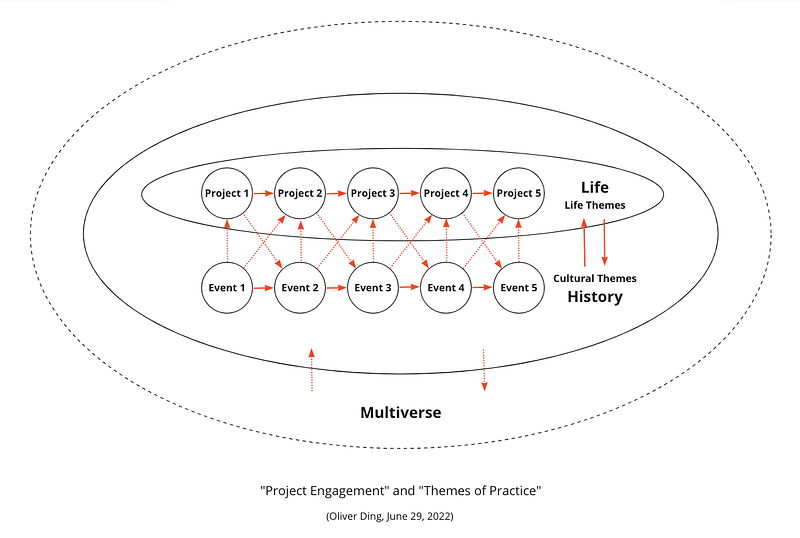
While Life is the outcome of the diachronic unfolding of the chain of projects, history is the outcome of the diachronic unfolding of the chain of events.
You can find more details in Thematic Space: Project as Story and Project Engagement (v2): Life, History, and Multiverse.
4. Experiences, Stories, and Mindsets
In this article, I don’t want to select a particular Actor’ mindset for a case study.
Since the above discussion is about experience and stories, I’d like to select a related mindset from an Empirical Psychologist.
I have mentioned the Shape — Support perspective in the above discussion.
The Shape-Support perspective refers to two types of social actions. We can roughly understand them as Self-determined and Support Others.
This perspective was inspired by many psychologists’ ideas. One of these ideas comes from Dan P. McAdams’ theory about life stories and narrative identity.
4.1 Dan P. McAdams on Personality Psychology
Dan P. McAdams is a personality psychologist who prefers to use narrative psychology to explore the meaning of life and their impact on personality and life development.
McAdams is the author of The Person: An Introduction to the Science of Personality Psychology, a classroom textbook. The first paragraph of the Preface of the book gives me a totally different view of Personality.
Personality Psychology is not what it used to be. In the beginning, Freudians fought with Jungians, behaviorists lashed out against humanists, and everybody picked their favorite grand theory of personality and defended it to the death. Once upon a time, personality research was viewed to be trivial — mainly about dubious labels that we apply to people in order to predict what they will do, labels that turn out not to predict very well at all. But things have changed, and dramatically so. In the last twenty years, personality psychology has emerged as a vital and fascinating field of study, filled with new theoretical insights and important findings that speak to what it means to be a person in today’s world. With strong connections to social psychology, clinical psychology, life-span developmental studies, and cognitive neuroscience, personality psychology is today, first and foremost, the scientific study of the person. There is noting more interesting to persons than persons. And there is nothing more important. (2006, p.xvii)
McAdams has a unique theoretical approach to understanding Personality. He defines Personality as a patterning of dispositional traits, characteristic adaptations, and integrative life stories set in culture shaped by human nature. He used this approach to connect classical theories and the newest research and insights.
The framework is also used to edit the book titled The Person: An Introduction to the Science of Personality Psychology. See the title of the four parts of the book:
- Part 1: The Background: Persons, Human Nature, and Culture
- Part II: Sketching the Qutline: Dispositional Traits and the Prediction of Behavior
- Part III: Filling in the Details: Characteristic Adaptations to Life Tasks
- Part IV: Making a Life: The Stories We Live By
The three-level personality model is described in detail in the following chart.
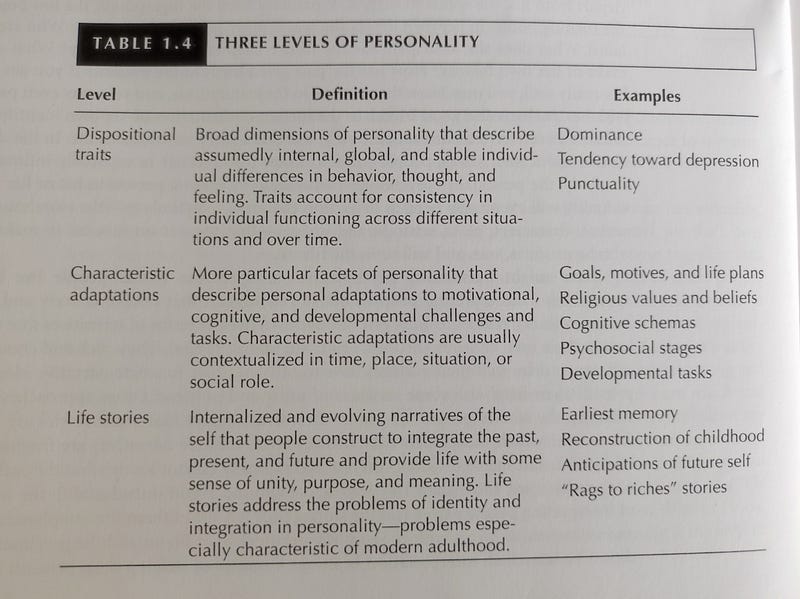
According to McAdams, this unique framework has an advantage for writing a textbook about personality.
Today’s undergraduate textbooks in personality psychology follow two different formats, both of which were developed in the 1960s. One type of book devotes a chapter apiece to each of the grand theories of personality developed in the first half of the twentieth century… The second type of text focuses on research topics and issues. While these books try to reflect the scientific work that personality psychologists actually do, they offer no vision or organization regarding what that work is fundamentally about…(2006, p.xvii)
What about the great theories? What about Freud? The behaviorists? They are still here, but I have reorganized theories and research to fit the integrated vision I have sketched above. This actually turns out to be very easy to do, for different theories address different aspects of human nature, cultural context, and human individuality. (2006, p.xviii)
If we use the “Ontology > Realism > Hermeneutics” schema to view McAdams’ model, we can see a unique theoretical framework of Personality.
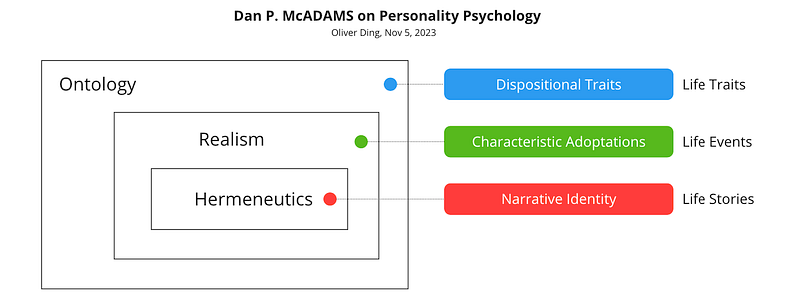
The new framework is more useful than traditional theories of Personality because it creates a good balance between changeable and unchangeable. While dispositional traits are hard to change, narrative identity could be changed.
According to McAdams, the concept of Personality is useful because we are interested in a significant question: What do we know when we know a person? And he believed that his model is a good answer to the question:
In order to “know” a person — both from the standpoint of science and the standpoint of everyday life — we must first have some sense of what all persons have in common by virtue of human nature and how social context and culture shape every person’s life. Once we have an understanding of human nature and cultural context, then we can proceed to consider human individuality on three successive levels. (2006, p.xvii)
Level 3 is the level of the life story: What does her life mean? What gives his life a sense of unity and purpose?
In fact, McAdams is also a narrative psychologist. In 1993, he published a book titled The Stories We Live By: Personal Myths and the Making of the Self and introduced a new theory of identity and self. The origins of the book’s core ideas can be traced to the first chapter of his 1985 professional book Power, Intimacy, and the Life Story.
4.2 Life Stories: Personal Myth and Narrative Identity
McAdams’ theory of self and identity was built around “the idea that each of us comes to know who he or she is by creating a heroic story of the self”. He used the term “Personal Myth” to describe this idea. (1993, p.11)
What is a personal myth? First and foremost, it is a special kind of story that each of us naturally constructs to bring together the different parts of ourselves and our lives into a purposeful and convincing whole. Like all stories, the personal myth has a beginning, middle, and end, defined according to the development of plot and character. We attempt, with our story, to make a compelling aesthetic statement. A personal myth is an act of imagination that is a patterned integration of our remembered past, perceived present, and anticipated future. As both author and reader, we come to appreciate our own myth for its beauty and its psychosocial truth. (1993, p.12)
What’s the difference between McAdams’ Personal Myth and my ideas of Story 1 and Story 2?
As mentioned above, I defined two types of stories for the “Flow — Story — Model” schema.
- Story 1: it is framed by Cultural Significance.
- Story 2: it refers to the Actual Narrative.
Story 1 emphasizes the Relevance aspect of the Story layer while Story 2 emphasizes the Architecture aspect of the Story layer.
Story 2 refers to the real story which is not been told yet. A Story 2 is a set of immediate actions (experience) with a structure. The structure could be a planned project, a real project, and an imagined project.
Story 1 refers to telling stories that are framed by Cultural Significance. Once a person starts to share his stories with others, he must consider Relevance in the communicative context.
We can claim that McAdams’ Personal Myth is Story 3 and it connects to Narrative Identity.
- Story 1: it is framed by Cultural Significance.
- Story 2: it refers to the Actual Narrative.
- Story 3: it connects to Narrative Identity.
Story 2 is real, but not told yet. Story 1 is real and is also told to others. Both Story 1 and Story 2 refer to our remembered past.
Story 3 is not totally real because it comes from “an act of imagination that is a patterned integration of our remembered past, perceived present, and anticipated future”.
Since Story 3 also includes our anticipated future, it looks like a large ongoing life project that has a set of finished sub-projects and a set of planned projects.
An important aspect of McAdams’ Personal Myth is not telling our life stories, but making ourselves through myth.
I do not believe that there are gods and goddesses within you, waiting to be recognized. We do not discover ourselves in myth; we make ourselves through myth. Truth is constructed in the midset of our loving and hating; our tasting, smelling, and feeling; our daily appointments and weekend lovemaking; in the conversations we have with those to whom we are closest; and with the stranger we meet on the bus. Stories from antiquity provide some raw materials for personal mythmaking, but not necessarily more than the television sitcoms we watch in prime time. Our sources are wildly varied, and our possibilities, vast. (1993, p.12)
Personal mythmaking looks like planning a life project with personal anticipation and cultural projecting.
So far, we have found some similarities between McAdams’ Personal Myth and my Life-as-Project approach. However, there is a major difference between these two approaches.
According to McAdams, life stories are subjective meaning-making:
In the subjective and embellished telling of the past, the past is constructed — history is made. History is judged to be true or false not solely with respect to its adherence to empirical fact. Rather, it is judged with respect to such narrative criteria as “believability” and “coherence.” There is a narrative truth in life that seems quite removed from logic, science, and empirical demonstration. It is the truth of a “good story.” (1993, p.28)
The Life-as-Project approach doesn’t follow this kind of “narrative truth” because logic, science, and empirical demonstration are useful tools to discover new insights from our pasts.
McAdams also used the term “Narrative Identity” to emphasize the difference between his theoretical approach with Erik Erikson’s concept of Identity in his 2006 book The Person: A New Introduction to Personality Psychology (2006, fourth edition).
According to Erik Erikson, beginning in adolescence and young adulthood modern people are faced with the psychosocial challenge of constructing a self that provides their lives with unity, purpose, and meaning. For the first time in the life course, these questions become problematic, and interesting: “Who am I?” “How do I fit into the adult world?” As we address these questions, Erikson maintained, we begin to construct what he called a configuration, which includes constitutional givens, idiosyncratic libidinal needs, significant identification, effective defenses, successful sublimations, and consistent roles” (Erikon, 1959, p.116) The identity configuration works to integrate “all identifications with the vicissitudes of the libido, with the aptitudes developed out of endowment, and with the opportunities offered in social roles.” (2006, p.405)
McAdams considered different contents for identity configuration.
What might this unique “configuration” of identity look like? In my own theoretical writing. I have argued that the identity configuration of which Erikson speaks should be seen first and foremost as an integrative life story that a person begins to construct in late adolescence and young adulthood. A growing number of personality, social, cognitive, developmental, and clinical psychologists today describe identity in terms of a narrative or story that people construct in a social world. Following Singer (2004) and others, we will use the term narrative identity to refer to the internalized and evolving story of the self that a person consciously and unconsciously constructs to bind together many different aspects of the self. Narrative identity provides a person’s life with some degree of unity, purpose, and meaning. (2006, p.405)
It’s clear that McAdams emphasized the newest development of psychological research that is outside the scope of traditional theories of developmental psychology such as Erikson’s theory which still considers the concept of “libido”.
In general, McAdams’ approach utilized narrative psychology to explain the power of life stories to self and identity.
4.3 Imagoes, Power, and Love
McAdams called the characters that dominate our life stories imagoes.
In seeking patterns and organization for identity, the person in the early adult years psychologically pulls together social roles and other divergent aspects of the self to form integrative imagoes. Central conflicts or dynamics in one’s life may be represented and played out as conflicting and interacting imagoes, as main characters in any story interact to push forward the plot. (1993, p.122)
It seems the concept of Imago is a bridge between “Self” and “Social Roles”.
An imago is a personified and idealized concept of the self. Each of us consciously and unconsciously fashions main characters for our life stories. These characters function in our myths as if they were exaggerated and one-dimensional form; hence, they are “idealized.” Our life stories may have one dominant imago or many. The appearance of two central and conflicting imagoes in personal myth seems to be relatively common. (1993, p.122)
Where do imagoes come from?
Imagoes exist as carefully crafted aspects of the self, and they may appear as the heroes or villains of certain chapters of the life story. They are often embodied in external role models and other significant persons in the adult’s life. As out personal myths mature, we cast and recast our central imagoes in more specific and expansive roles. We come to understand ourselves better by a comprehensive understanding of the main characters that dominate the plot of our story, and push the narrative forward. With maturity, we work to create harmony, balance, and reconciliation between the often conflicting imagoes in our myth. (1993, p.123)
Now we can see a typology of imago. See the picture below.
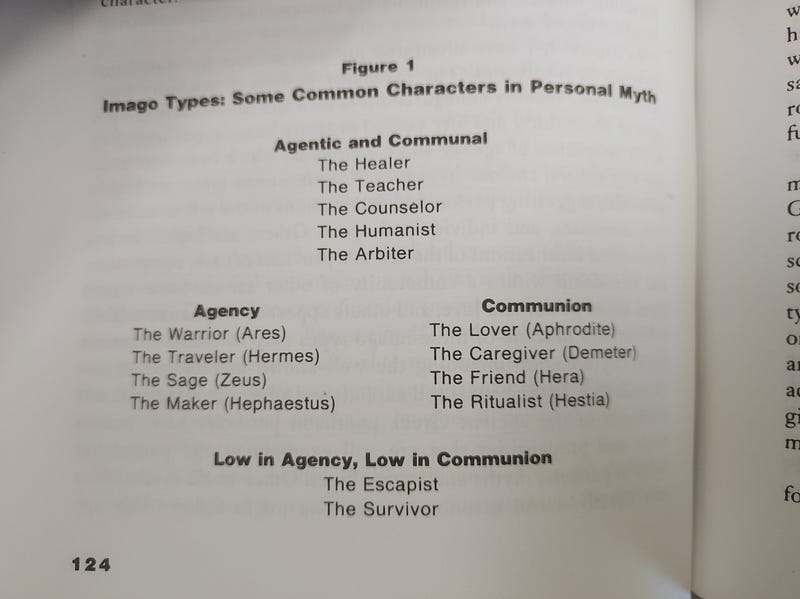
McAdams used the properties of agency and communion to organize imago types because they are two central themes of stories and personal myths.
A simple keyword related to the agency theme is Power.
In literature, drama, song, and verse, there are many different kinds of characters who act, think, and feel in agentic ways. These are characters who seek to conquer, master, control, overcome, create, produce, explore, persuade, advocate, analyze, understand, win.
They are described by such adjectives as aggressive, ambitious, adventurous, assertive, autonomous, clever, courageous, daring, dominant, enterprising, forceful, independent, resourceful, restless, sophisticated, stubborn, and wise, among many others. (1993, p.134)
A simple keyword related to the communion theme is Love.
There are numberless characters who act, think, and feel in communal ways. Oriented toward love and intimacy, these are characters who seek to unite with others in passionate embrace, who love and care for others, who nurture, cooperate, encourage, communicate, and share with others. They work to provide settings for love and intimacy, and to cultivate the best in human intercourse.
They are described by adjectives such as affectionate, charming, altruistic, enticing, gentle, kind, loyal, sensitive, sociable, sympathetic, and warm, among many others. (1993, p.148)
Power and love are the two great themes of stories because they correspond to the two central psychological motivations in human life.
4.4 Agentic Mindset and Communal Mindset
I have mentioned the Shape — Support perspective in the above discussion.
The Shape-Suport perspective refers to two types of social actions. We can roughly understand them as Self-determined and Support Others.
In McAdams’ approach, I found a similar pair of themes called Agentic and Communal characters. I’d like to claim that these two themes can be considered as two mindsets.
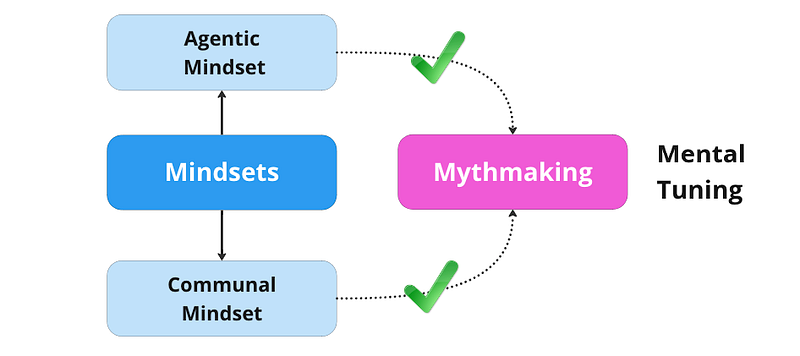
According to McAdams, “An especially agentic person is driven by recurrent desires for power and achievement. The power motive is a desire for feeling strong and having impact on the world. The achievement motive is a desire for feeling competent and doing things better than others do them. Power and achievement motives, although both agentic, differ from each other in important ways.” (1993, p.282)
On the other side, the communal character is associated with intimacy motivation, “The intimacy motive is a recurrent desire for warm, close, and sharing interaction with other human beings…Intimacy motivation is associated with an especially communal friendship style…Some recent research suggests that intimacy motivation may be implicated in health and psychological well-being. Many theories of personality and psychotherapy suggest that the capacity for intimacy is a hallmark of adjustment and maturity in life.”(1993, p.287, pp.288–289)
4.5 Personal Mythmaking as Mental Tuning
Following the above idea, I used the Mental Tuning framework to represent McAdams’ approach.
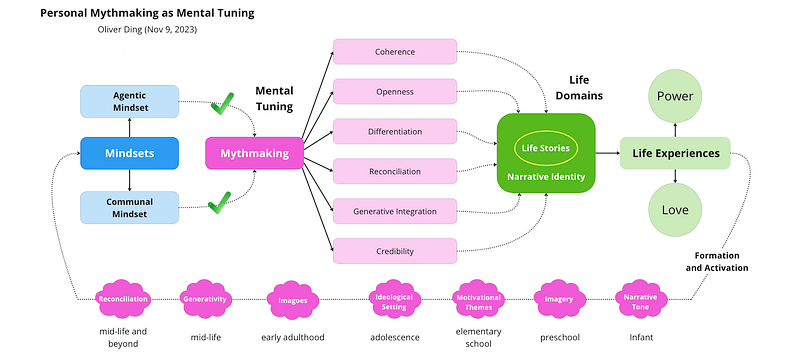
The above diagram has three parts. The blue part refers to the Mindsets and Mental System. The green part refers to the Behavioral System. The pink part refers to the connection between the Mental System and the Behavioral System.
I use “Life Domains” and “Life Experiences” to represent the Behavioral System. McAdams’ approach focuses on Life Stories and Narrative Identity. I also use Power and Love as two keywords for Life Experiences.
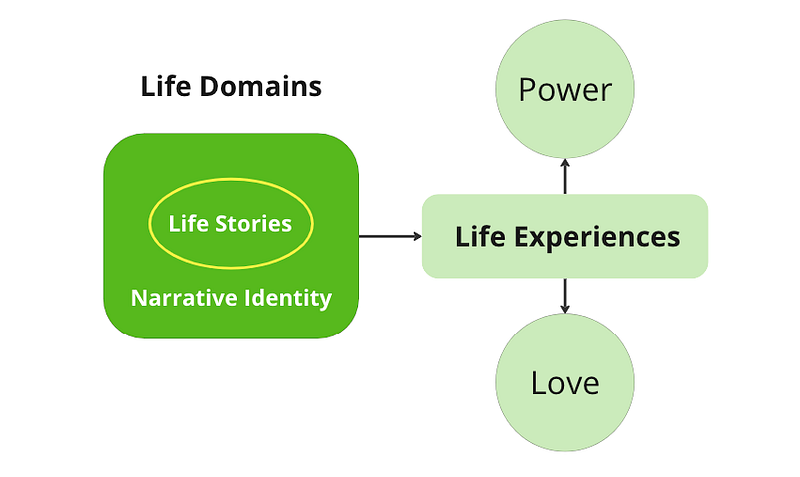
The concept of “Life Experiences” is used to emphasize the subjective aspect of the Behavioral System. This aspect is very important to understanding the Formation of Mindsets and the Activation of Mindsets.
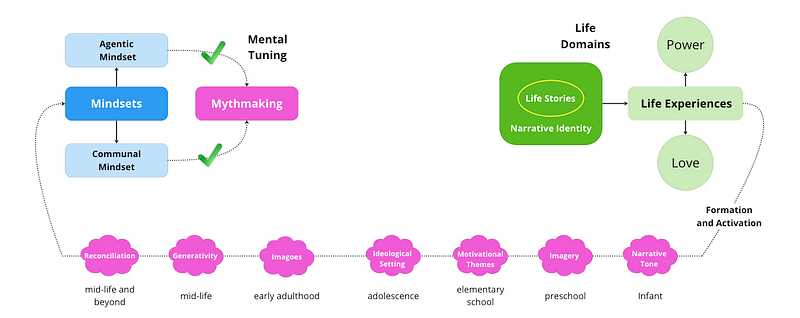
McAdams developed an explicit developmental framework of personal myth. There are several significant elements that impact personal mythmaking. Each element is linked to a particular developmental period (1993, pp.270–271).
- Narrative tone has its origins in infant attachment
- Imagery originates in preschool play and imagination
- Motivational themes may be traced back to the elementary-school years
- The ideological setting is laid down in adolescence
- Imagoes begin to form in early adulthood
- The generativity script becomes more salient as we move into mid-life and beyond
The middle part of the new framework is defined by a new term called “Mental Tuning”. In a general sense, “Mental Tuning” refers to active self-regulation strategic techniques that aim to improve particular psychological functions that are related to Life Domains.
McAdams pointed out that there are two different kinds of progressive change in personal mythmaking:
- Developmental: oriented toward the future.
- Personological: oriented to the past rather than the future.
The Personological change is a profound and difficult kind of identity transformation that is typically the stuff of intense, in-depth psychotherapy.
The Developmental change could be understood with six criteria: Coherence, Openness, Differentiation, Reconciliation, Generative Integration, and Credibility. (1993, pp.272–273)
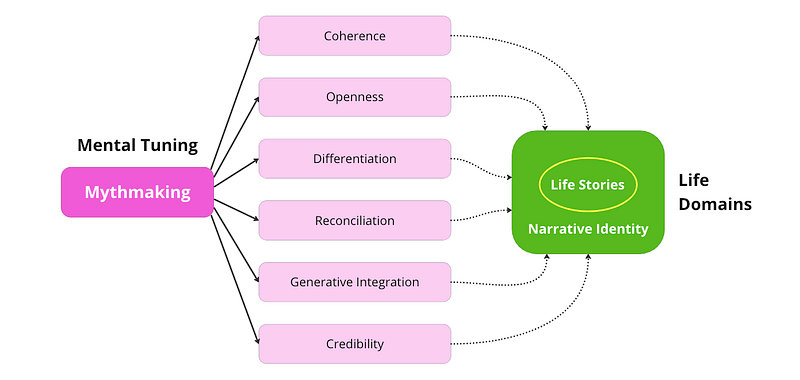
- The first two criteria — coherence and openness — form a dialectical tension in identity… Ideally, your personal myth should strike a balance between the two, but the balance is likely to be weighted differently at different points in development.
- A similar kind of dynamic may be identified for the criteria of differentiation and reconciliation. A mature personal myth should display many different parts and aspects…You may need to refashion the story in a way that brings the different characters together in some manner, or in a way that makes their oppositions even starker, so as to find unity and purpose in the dialectical contradictions of mid-life.
- As you move from adolescence through young adulthood and into mid-life, generative integration becomes an increasingly important criterion in personal mythmaking… generative integration has no worthy “opposite”. It simply grows steadily in importance over time.
- Equally steady is the sixth criterion, credibility. But the importance of credibility in myth does not generally increase or decrease across the life span…The good and mature personal myth is grounded in social and personal reality. It is what you have created from the real resources you have been given. Mature identity does not transcend its resources; it is true to its context. The myth and the mythmaker must be credible if we are to live in a credible world.
McAdams noticed that the dialectical contradiction of opposite themes is a significant aspect of personal mythmaking.
This is a great insight!
4.6 Personal Innovation and the ECHO Way
In May 2021, I made a life reflection and developed a framework called Career-fit. Later, I developed it into the ECHO Way (v2.0).
The ECHO Way is a tool for turning dialectical contradiction of opposite themes into developmental opportunities. I’d like to introduce it here as a reference.
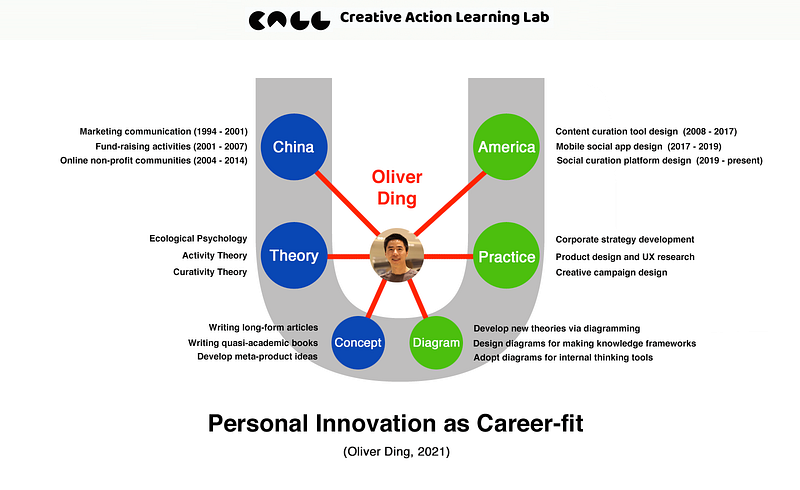
There are many ways for achieving personal innovation. One way is reflecting on your career experience. Inspired by a previous article Platform Innovation as Concept-fit, I created the above diagram for my own personal innovation.
I use Career-fit to name this new framework. The Career-fit framework has four key words: Experience > Themes > Projects > Opportunities. It roughly suggests the following five steps for personal innovation:
- Reflect on career experience
- Discover pairs of opposite themes
- Fit all pairs of opposite themes
- Join or initiate relevant projects
- Fit career themes with career opportunity
The above diagram shows three Pairs of Opposite Themes of my career experience.
- China v.s. America
- Theory v.s. Practice
- Concept v.s. Diagram
If you read my previous articles, you probably know a term called Themes of Practice. The term refers to a bridge between individual life themes and collective cultural themes. Anthropologist Morris Opler (1945) developed a theoretical “themes” for studying culture. Career counseling therapists and psychologists also developed a theoretical concept called “life themes.” If we adopt it for discussing career development and personal innovation, we can consider Career Themes as a special type of life theme and culture theme too.
The core of the Career-fit framework is Structure and Dynamics of career themes. The idea of Pairs of Opposite Themes refers to significant differences between career themes. The idea of Meta-themes refers to using one high-level theme to curate similar career themes. The idea of the Development of Themes refers to the transformation of career themes.
If we want to explore personal innovation, the great starting point is Pairs of Opposite Themes because they could lead to Structural Tensions such as boundary, distance, difference, heterogeneity, contradiction, and complementation. If we can turn one or more structural tensions into creative opportunities, then we could find a way of personal innovation.
You can find more details in Personal Innovation as Career-fit, The ECHO Way (v2.0), and Life Discovery: The “Present — Future” Fit and The ECHO Way.