
Knowledge Discovery: The “Domains — Works” Mapping
Things you made and the Themes of Practice framework

This article is part of the Slow Cognition Project which focuses on Developing Tacit Knowledge with Thematic Space Canvas. The Knowledge Discovery Canvas is an application of the Thematic Space Canvas.
The Knowledge Discovery Canvas has two nested squares which divide the thematic space into two sub-spaces: inner space and outer space. For Developing Tacit Knowledge, the inner space is all about personal knowing activities while the outer space is related to social interactions.
Based on the above settings, I generated a series of mapping between outer space and inner space:
- Approaches — Tastes
- Concepts — Notions
- Events — Projects
- Domains — Works
- Perspectives — Views
- Frameworks — Insights
- Methods — Guides
- Heuristics — Skills
Today I’ll focus on the Domains — Works mapping and use the Themes of Practice framework for the present discussion.
The Notion of “Domains (Works)”
The Domains — Works mapping can be seen as a nested structure: Domains (Works). For example, an art curator’s work is an exhibition while the domain is the field of art. It’s clear that we are talking about social domains, not cognitive domains or others. Also, I use the term works to refer to final outcome of creative activities.
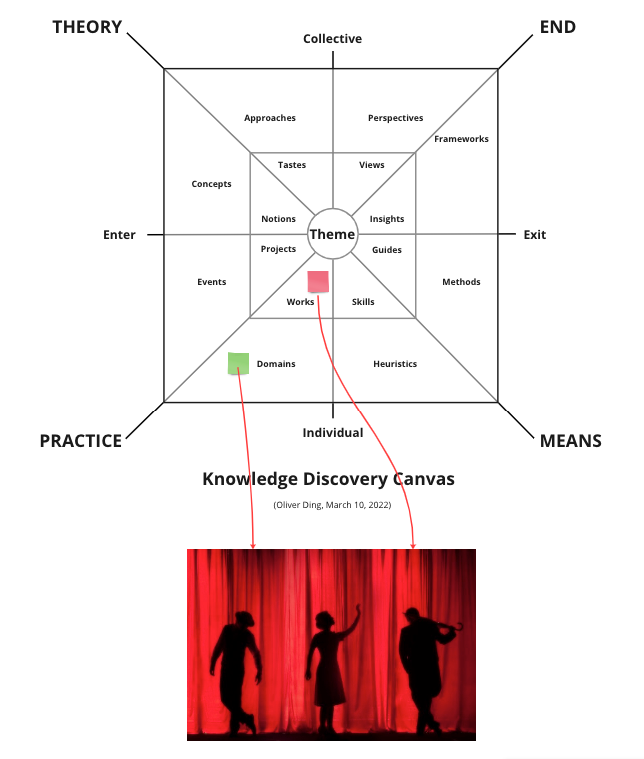
For the Knowledge Discovery Canvas, the Domains — Works mapping echoes the Events — Projects mapping. Events present the dynamics of Domains while Works are the outcome of Projects.
The following sections are organized into three parts:
- Part 1 introduces Mihaly Csikszentmihalyi’s Social Systems Model of Creativity and reviews its core concepts: Domain, Field, and Person.
- Part 2 introduces my own work titled The Epistemology of Domain.
- Part 3 adopts the Themes of Practice framework to discuss Works.
There are many theories and frameworks for understanding Domains or Industries. For the Knowledge Discovery Canvas, I focus on the structure and dynamics of “Domains[Person(Works)]”. My unit of analysis is a person, not an organization. If you want to understand “Domains (Organization)”, Michael Porter’s five forces model and Organizational Ecology (Michael T. Hannan and John H. Freeman, 1989) are great knowledge resources.
Part 1 Creativity and Domains
Part 1 introduces Mihaly Csikszentmihalyi’s Social Systems Model of Creativity and reviews its core concepts: Domain, Field, and Person. I also point out the rise of creative actions in the age of platforms.
1.1 Creativity Studies: Domain, Field, and Person
In order to understand the impact of social context, Mihaly Csikszentmihalyi and other researchers developed the Social Systems Model of creativity during the 1980s and 1990s. The diagram below shows the model contains three components: person, domain, and field. Csikszentmihalyi said, “Creativity occurs at the interface of three subsystems: An Individual who absorbs information from the culture and changes it in a way that will be selected by the relevant Field of gatekeepers for inclusion into the Domain, from whence the novelty will be accessible to the next generation.” (2014, p.166)
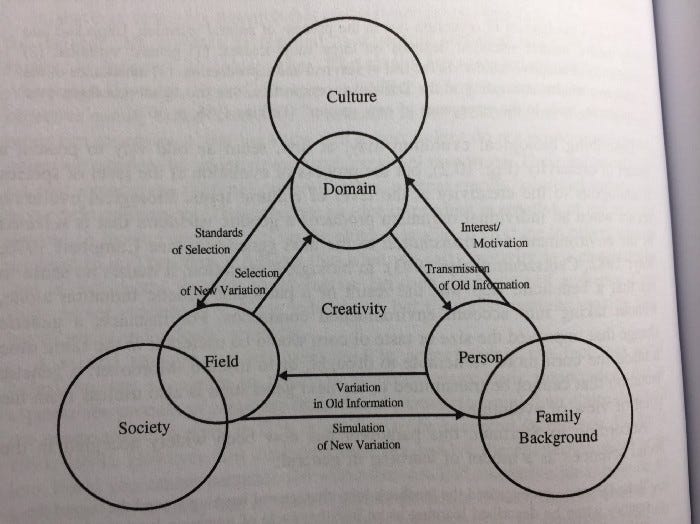
The Systems Model of creativity is suitable for traditional domains such as art, science, film, performance, etc. However, the model is reliant on a stable set of gatekeepers as a Field and a bounded Domain which requires a stabilized social structure. For some creative actions, it is hard to find Field and Domain for evaluating creative actions. Also, it is obvious that emergent digital platforms are a key context for these creative actions. The Field and Domain can’t explain digital Platforms.
1.2 Culture as Symbolic Domains
The Systems Model of creativity adopts the sociocultural approach which pays attention to culture. We have to notice that Csikszentmihalyi defined the Domain as a symbolic aspect of environments while the Field as a social aspect of environments. He didn’t include the material aspect into the concept of Domain. Thus, he defined culture as symbolic domains, “It is useful in this context to think about cultures as systems of interrelated domains … The claim is simply that in order to understand creativity, it is useful to think of culture in this way.” (2014, pp.105–106) In other words, we have to notice Csikszentmihalyi’s “sociocultural approach” is a pure symbolic approach that doesn’t consider the material aspect as part of the culture.
Moreover, he adopted Dawkins’s idea of “Memes” as a foundational concept to explain Domain. He said, “Typically, the memes and rules that define a domain tend to remain stable over time. It takes psychic energy to learn new terms and new concepts, and in so far as psychic energy is a very scarce and necessary resource, and provided that the old terms and rules are adequate to the task, it makes sense for domains to remain stable.” (2014, p.106)
Csikszentmihalyi’s view of Domain can be seen as a pure ideal frame. The view of Field also claimed that only established organizations and professional experts can evaluate creativity. This leads to two issues. First, at the practical level, it’s hard to only talk about “memes and rules” for a domain without discussing its material, technological, geographic, and political aspects. Second, it only considers experts inside the domain for evaluating creativity and ignores the creator-consumer relationship.
1.3 Professional Domains
Sawyer pointed out that many scientific books about creativity have been limited to those expressions of creativity that are highly valued in Western culture. For example, “Csikszentmihalyi’s 1996 book Creativity is based on interviews with approximately 100 highly creative individuals; all of these individuals create in areas highly valued in dominant cultural groups in Western, European cultures: the sciences, the fine arts.”(2012, p.6, p.8) From the Four-C model’s perspective, the Systems Model is perfect for “Big-C”, but it is hard to apply the concept of Field and Domain to “mini-c ” and “little-c”.
Though we can apply Field and Domain to “Pro-c”, we still can argue that professional domains (Pro-c domains) are not stable as Big-C domains. The reason is Pro-c domains change fast and can’t maintain a clear boundary. Also, the competition between similar domains is dynamic and it became new normal. Thus, it is hard to only use “memes, rules, and system of notation” to identify a professional domain.
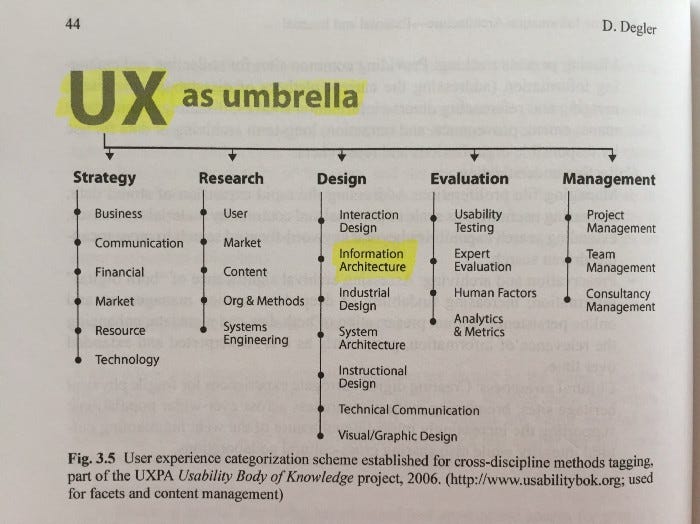
Let’s look at an example of the dynamics of professional domains. In recent years, new professional domains emerged and grew fast and also disappeared quickly, especially web/mobile practice-related domains. Information Architecture (IA) as a professional practice went popular in the mid-1990s and changed in the mid-2020s. In 2002, the Information Architecture Institute was registered as a nonprofit (501c6) organization. In 2019, their board of directors decided to dissolve the IA Institute as a legal business entity. Before the final announcement, insiders have discussed reframing the domain of Information Architecture in order to adopt the change of context. In 2013, 42 researchers, educators, and practitioners attended a workshop called “Reframing Information Architecture” at ASIS&T Information Architecture Summit in Baltimore, Maryland. Later, they collected papers and published a book for pushing the conversation further. One author suggested reframing Information Architecture as a sub-section under the User Experience umbrella. Then, we see another professional organization: User Experience Professionals Association.
1.4 Domain and Cultural Evolution
Though Csikszentmihalyi talked about the change in Domains, he suggested that the change is caused by the long-term cultural evolution. For example, he identified “the game of marbles played by Swiss children” as an informal Domain. He said, “For instance, Piaget gave a very detailed description of how rules are transmitted in a very informal domain: that of the game of marbles played by Swiss children. This domain is relatively enduring over several generations of children, and it consists of specific names of marbles of different sizes, colours, and compositions. Furthermore, it consists of a variety of arcane rules that children learn from each other in the course of play. So even without a notation system, domains can transmit from one generation to the next through imitation and instruction.” (2014, p.106)
Csikszentmihalyi also mentioned the example of ancient Greece. He said, “Domains tend to change when one culture is exposed to the memes of another, usually equally advanced but different culture. Thus ancient Greece, being at the crossroads of trade between the North and the South, and between the East and the West, was influenced by ideas and practices converging from the Asiatic steppes and from Egypt, and from Europe as well as Persia and the Middle East. In Europe, similar melting pots for ideas arose later in Venice, Florence, Burgundy, the Hanseatic ports, and the great sea-faring nations such as Portugal, Spain, England, and the Netherlands.” (2014, p.107)
If we pay attention to the professional domains such as IA and UX, the perspective of long-term cultural evolution is too restrictive. It’s better to include the short-term cultural dynamics for considering the change of Domain in order to maintain the social system model of creativity. The short-term cultural dynamics are not only about memes and rules, but also related to material, technological, geographic, and political aspects.
1.5 Creator, Customer, and Platform
The second issue is about the relationship between “Person — Field” and “Creator — Customer”. Csikszentmihalyi defined “Field” as a group of gatekeepers such as teachers, critics, journal editors, museum curators, agency directors, and foundation officers who decide what belongs to a domain and what does not. (2014, p.104) For the high art and other Big-C domains, the relationship between “Person-Field” is important for creativity as the social system model claimed. However, for “Pro-c”, “mini-c” and “little-c”, we have to consider the relationship of “Creator — Customer” too.
Today, most creators can share their creative ideas and products on digital platforms and gain feedback and support from their customers directly. For example, Kickstarter and other crowdfunding platforms allow various types of creators to get funded by potential customers directly. Patreon and other membership platforms make it easy for artists and creators to get paid by their customers. Musicoin built a blockchain platform for music creators directly connect with their customers.
The Platform also brings us a new issue for discussing the evaluation of creativity: machine algorithms. In 2016, Michael Bhaskar suggested a hybrid model in his book Curation. He said, “Selection is about finding the right things. Defining what is ‘right’ in any given context can’t be boiled down to the information analyzed by a machine. This is not to say machines aren’t valuable — they are and will be a massive part of the curatorial business over the next century. But we will see a balance. Human and algorithmic curation working together, complementing each other.” (p.115)
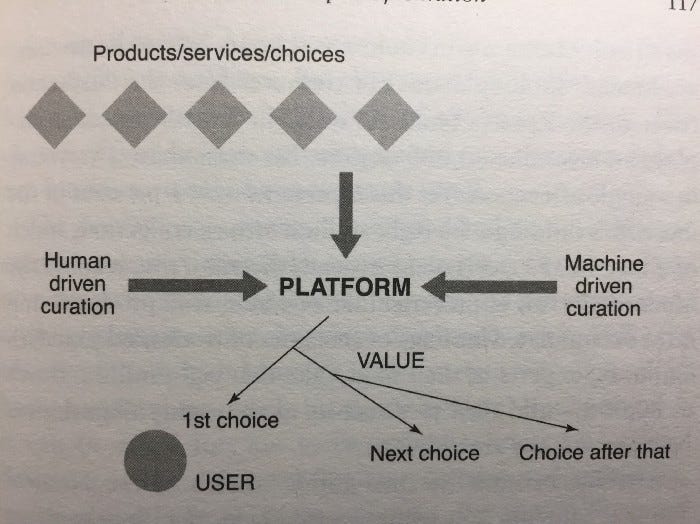
Though Bhaskar talked about business curation, his insight on the complementation between human-driven curation and machine-driven curation can be applied to discussing creative actions. In the age of platforms, the traditional “Person — Field” relationship has been transformed into a more complex “Creator — Customer — Curator — Platform” relationship.
For more details about “Creative Actions”, you can check out The NICE Way and Creative Actions.
Part 2 The Epistemology of Domain
On July 27, 2021, I finished a 71-page thesis titled The Epistemology of Domain which offers a brand new theory about Domain. The thesis was written in Chinese. Here I’d like to introduce the final outcome of the project.
The subtitle of the thesis is Themes of Practice, The Landscape of Domains, and Niche Construction. The core idea of the Themes of Practice framework is about the transformation between individual life themes and collective culture themes. Niche Construction Theory is about the individual—environment relationship. The thesis focuses on the “Person — Domain” relationship, not only on the concept of Domain.
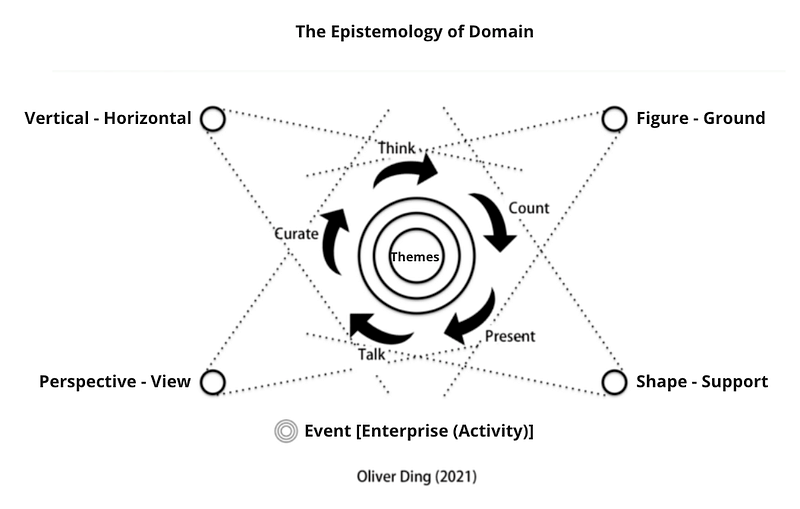
The above model is designed with a meta-diagram called Stage. I have used the Stage meta-diagram for the D as Diagramming project. You can find more details here.
2.1 The Domain as Stage Metaphor
I used the Mind as Play metaphor to develop an epistemological framework in 2017. The metaphor has three parts:
- Objects of Knowing = Actors
- Perspectives = Stage Lights
- Domain = Stage
The Domain as Stage metaphor uses the following elements:
- Domain = Stage
- Perspectives = Stage Lights
- Social Actors = Actors
- Activities = Play/Show

The Mind as Play metaphor and the Domain as Stage metaphor are inspired by the American sociologist Erving Goffman’s The Presentation of Self in Everyday Life. Goffman viewed theatre as a metaphor and developed the dramaturgical analysis method for sociological study. For Goffman, everyday life is a theatre. For me, everyday cognitive activities are plays. Also, I consider creative career activities as plays.
2.2 The Core
The core of the Stage meta-diagram is an Object of Knowing with three nested circles which represent nested layers: Layer 3 [Layer 2 (Layer 1)]. For example, I consider “Diagramming for Knowledge Curation” as an Object of Knowing for the D as Diagramming project, its nested conceptual structure can be understood as Explicit Knowledge [Diagramming (Tacit Knowledge)]. See the diagram below.
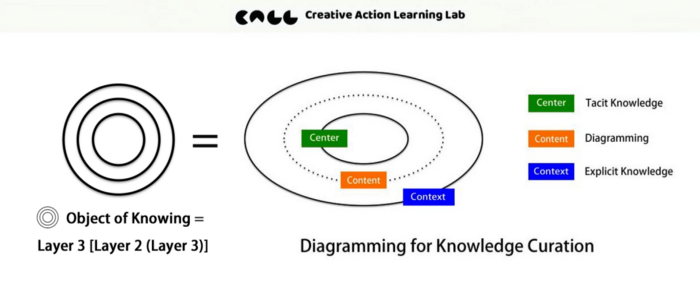
If we only want to show a nested conceptual structure, it doesn’t matter if we use circles or ellipses. If we move to visual graphic design, then we can’t ignore the difference in visual layout between circles and ellipses. Actually, this is one of the reasons why we need an integrated framework for studying knowledge diagrams.
What’s the core of the Epistemology of Domain? It is “Event [Enterprise(Project)]”. See the diagram below.
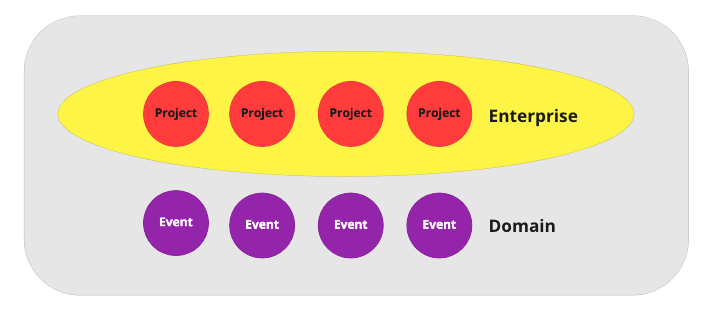
Originally, I use “Event [Enterprise (Activity)]” for the Epistemology of Domain. For the Knowledge Discovery Canvas, I use Project to replace Activity. In fact, my notion of Project refers to Project-oriented Activity Theory which is a branch of Activity Theory.
I have discussed the “Events — Projects” Mapping in a previous article. My approach uses “events” and “projects” to present social context and individual biography. The difference between “events” and “projects” is individual involvement. If the person directly gets involved in an activity — it means she is the subject of the activity or part of the community of the activity — then the activity is a project of her biography. If the person doesn’t directly get involved in the activity, then the activity is an event of her biography.
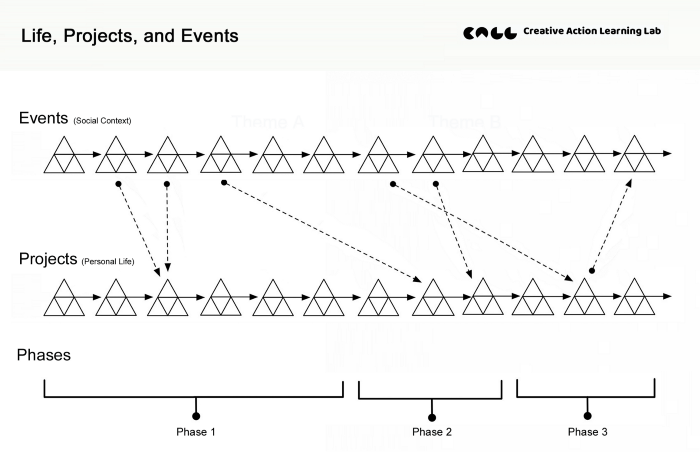
The term “Enterprise” is adopted from Howard E. Gruber’s approach Networks of Enterprise. Howard E. Gruber’s approach is titled the evolving systems approach to the study of creative work (1974,1989). It has a nickname called “Networks of Enterprise” because this is the core concept of the approach.
Gruber’s approach uses “Task — Project — Enterprise — Network of Enterprise” as a structure to understand a creative person’s work. It is different from Activity Theory’s “Operation — Action — Activity” hierarchy.
- Task
- Project
- Enterprise
- Networks of Enterprise
The concept of “Networks of Enterprise” refers to the pattern of work in the life of a creative individual. Gruber said, “We use the term enterprise to stand for a group of related projects and activities broadly enough defined so that (1) the enterprise may continue when the creative person finds one path blocked but another open toward the same goal and (2) when success is achieved the enterprise does not come to an end but generates new tasks and projects that continue it.” (1989, p.11) You can find more details here.
For the Epistemology of Domain, I consider Enterprise as a set of Projects.
The term “Event” also can be understood from the perspective of Event System Theory which is an event-oriented approach to the organizational sciences. According to the authors of Event System Theory, “Organizations are dynamic, hierarchically structured entities. Such dynamism is reflected in the emergence of significant events at every organizational level. Despite this fact, there has been relatively little discussion about how events become meaningful and come to impact organizations across space and time. We address this gap by developing event system theory, which suggests that events become salient when they are novel, disruptive, and critical (reflecting an event’s strength). Importantly, events can originate at any hierarchical level and their effects can remain within that level or travel up or down throughout the organization, changing or creating new behaviors, features, and events. This impact can extend over time as events vary in duration and timing or as event strength evolves. Event system theory provides a needed shift in focus for organizational theory and research by developing specific propositions articulating the interplay among event strength and the spatial and temporal processes through which events come to influence organizations.”
Though Event System Theory was originally developed for organizational sciences, their perspective is also useful for the Epistemology of Domain.
In summary, the “Event [Enterprise(Project)]” refers to the following three theoretical resources:
- Event System Theory
- Howard E. Gruber’s approach Networks of Enterprise
- Project-oriented Activity Theory
2.3 The Forms of Actions
The second component of the Stage meta-diagram refers to five states. In fact, you can use Steps, Phases, Types, Categories, etc for your own frameworks. You can also use four, six, or other numbers.
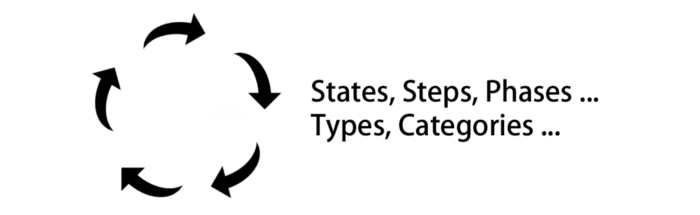
For the Epistemology of Domain, I use “Forms of Actions” for the framework. I also highlight the following five typical forms of actions:
- Think
- Count
- Present
- Talk
- Curate
In order to discuss the purpose of diagramming in various contexts, I adopted a typology about human activities and social practices from my 2017 work. The typology focused on “actor” and asked one question: how does the actor act? Originally, I found five typical types of actions: Think, Say, Make, Play and Curate. Later, I added more types such as “Count” into the list and renamed it meta-practices which means basic forms of human activities and social practices.
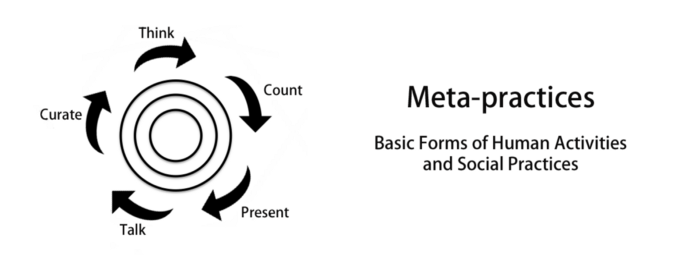
For the D as Diagramming project, I use the above five basic forms of social practices: Think, Count, Present, Talk, and Curate. Since the project is more about producing knowledge, I don’t consider Make and Play. As mentioned above, the Stage meta-diagram encourages you to decide the number of concepts. We can expand the five meta-practices to seven meta-practices if we need to do it.
- Think: using diagrams for thinking about an idea, a problem, a topic…
- Count: using diagrams to present data…
- Present: using diagrams for presentation, pitch…
- Talk: using diagrams for meetings, discussions …
- Curate: using diagrams for turning pieces into a meaningful whole…
- Make: using diagrams (such as IKEA assembly instructions) for making something (such as a TV cart)…
- Play: using diagrams for entertainment and fun activities…
These the above five typical forms of actions were developed for the D as Diagramming project, I think they are also suitable for the Epistemology of Domain.
2.4 Four Perspectives
The third component is four perspectives. Again, you can use three, five, six, or other numbers.
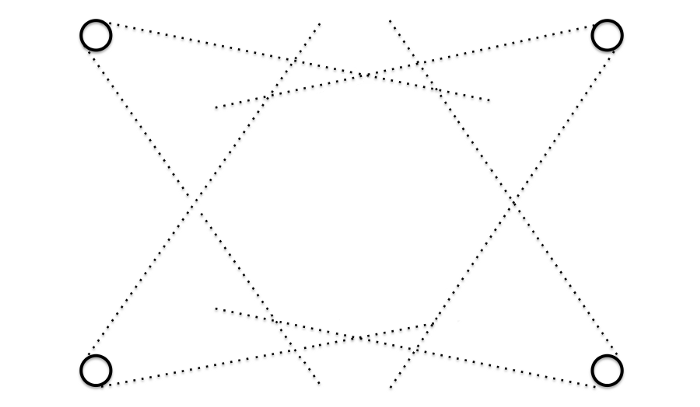
The first part of the thesis The Epistemology of Domain focuses on developing the following four perspectives:
- The Vertical — Horizontal perspective
- The Figure — Ground perspective
- The Perspective — View perspective
- The Shape — Support perspective
These four perspectives can be understood from the following 2x2 matrix.
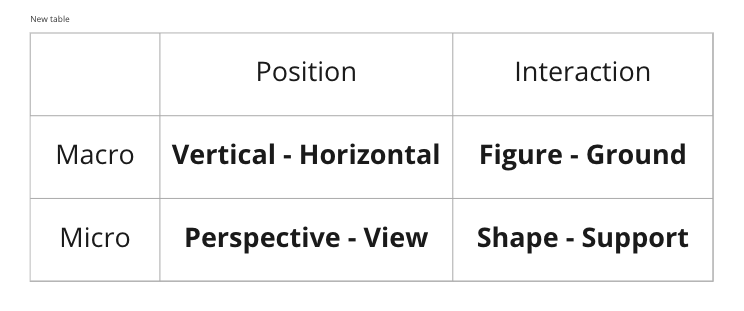
The Vertical — Horizontal perspective refers to two types of practical domains: horizontal domains and vertical domains.
- Horizontal domains refer to general functions in society such as “organization, strategy, and innovation”.
- Vertical domains refer to specific industries, for example, farm (agriculture), bus (transportation), and movies (entertainment).
The Figure — Ground perspective refers to the main activities and the side activities of a practical domain. For example:
- Main activities refer to Large Enterprises, Small-medium Businesses, Professional Service Firms, Technological Platforms, etc.
- Side activities refer to Educational Service Organizations, Media, Trade Associations, Communities, etc.
The Perspective — View perspective refers to Offline Perspectives and Embedded Stance.
- Offline Perspectives only consider cognitive thinking without considering a person’s social position and practical benefits.
- Embedded Stance primarily considers a person’s social position and practical benefits.
The Shape — Support perspective refers to two types of social actions. We can roughly understand them as Self-determined and Support Others.
2.5 The Themes
Finally, I’d like to mention the center of the Epistemology of Domain: Themes. This refers to my concept of Themes of Practice. You can find more details here.
I started developing the concept of Themes of Practice in 2019 for Curativity Theory. I have mentioned the concept in my previous articles many times. The purpose of the concept is to connect the “life theme” and “culture theme”.
Anthropologist Morris Opler (1945) developed a theoretical “theme” for studying culture. Career counseling therapists and psychologists also developed a theoretical concept called “life theme.” If we put cultural themes and life themes together, we see a great debate in social science: “individual — collective”.
I consider Themes of Practice as a process type of concept, not a substance type of concept. Thus, it is not a new category of themes, but a transformational process between individual life themes and collective culture themes. It refers to both concept and action. It connects mind and practice. It indicates the transformation of both person and society.
For the Epistemology of Domain, we can identify a set of themes for understanding a particular domain.
2.6 Summary
The table below is the summary of the Epistemology of Domain.
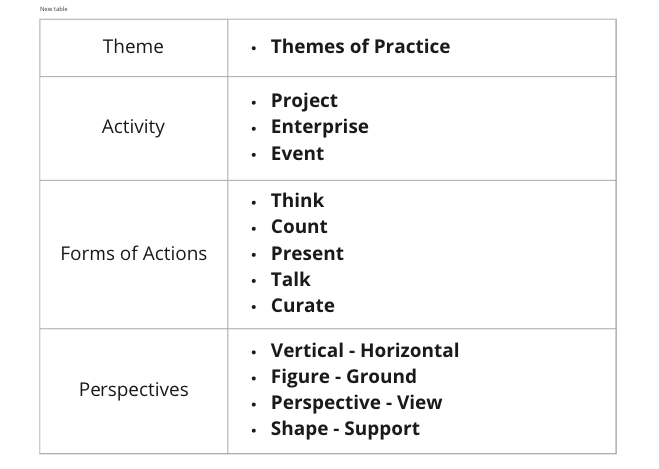
The Stage meta-diagram is for understanding complex things by using multiple components to curate multiple knowledge resources.
Part 3 The Themes of Practice Framework
As mentioned above, the concept of “Themes of Practice” is for understanding the transformation between individual life themes and collective cultural themes. Part 3 introduces a related framework.
3.1 A Concrete Model
The Themes of Practice Framework is a concrete model for case studies. See the diagram below.
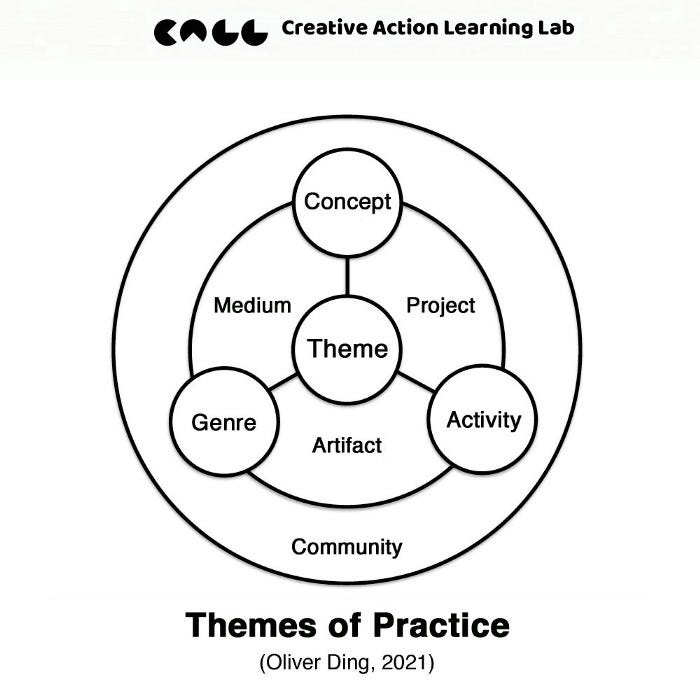
The framework is inspired by Activity Theory, Genre theories, and other theoretical approaches. As a concrete model, the framework is perfect for case studies because it offers a structure for observing and evaluating the “Practice” part of “Themes of Practice”.
For a particular theme, we can ask the following questions:
- Concept: What are related concepts for this theme?
- Project: What are related projects for this theme?
- Genre: What are related Genres for this theme?
- Media: What are related media for this theme?
- Activity: What are related activities for this theme?
- Artifact: What are related artifacts for this theme?
- Community: What are related communities for this theme?
- Who: who is the person behind this case study?
- When: when is the career duration behind this case study?
- Where: Where did these career events of this case study happen?
The above diagram only presents the general information for a theme. It doesn’t offer information on “who/when/where”. For a real case study, we need to collect personal information from the above ten dimensions.
You can find more details in The Career Theme Canvas.
3.2 An Example
We can also use the Themes of Practice framework to understand the landscape of works. For example, I worked on the Slow Cognition project. The diagram below shows my works based on the project.
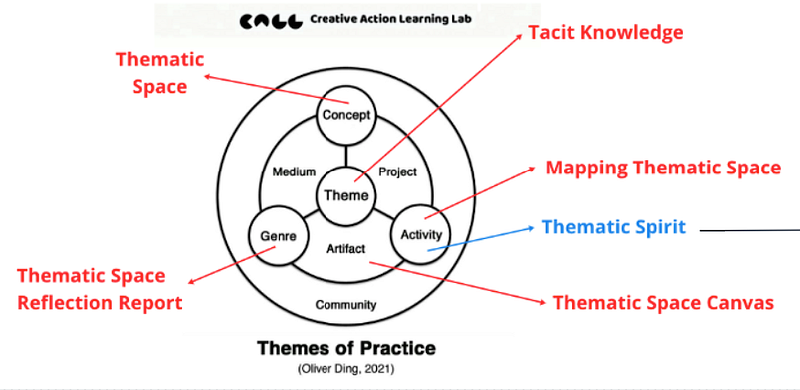
The Slow Cognition project focuses on the theme of Developing Tacit Knowledge. In the past three months, I created several new things.
- Concept: I started with the new concept “Thematic Space” which is inspired by “Conceptual Space”.
- Artifact: I detached “Thematic Space” from the model of Knowledge Curation, and designed the “Thematic Space Canvas”.
- Activity: I considered the “Thematic Space Canvas” as a toy, and play the game “Mapping Thematic Space”. I also run a “Thematic Spirit” with a friend.
- Genre: I wrote several “Thematic Space Reflection Reports”. As a blogger, I really enjoy the new genre!!! It is so fun to write these reports!!!
You can start from a tiny space and expand the landscape to a large space. If you have a map of the large space, then you don’t need to think about strategic planning.
If you can perceive the whole, you don’t need to think about it.
3.3 The “Projects— Works” Connection
The above discussion introduces some frameworks for understanding the pair of concepts of “Domains — Works”.
For the Knowledge Discovery Canvas, we can also connect “Projects” with “Works” since “Works” are products of “Projects”.
Related Articles
- Knowledge Discovery: The “Events — Projects” Mapping
- Project-oriented Activity Theory (Book)
- D as Diagramming: The Mind as Play Metaphor
- D as Diagramming: An Integrated Framework for Studying Knowledge Diagrams (Part 1)
- Themes of Practice (2019–2021)
- The Career Theme Canvas
- The Slow Cognition Project
- Slow Cognition: A Meta-canvas for Developing Tacit Knowledge
- Knowledge Discovery: Concepts, Notions, and the Concept Dynamics Framework
- Knowledge Discovery: The “Approaches — Tastes” Mapping
- Knowledge Discovery: The “Perspectives — Views” Mapping
- Knowledge Discovery: The “Frameworks — Insights” Mapping
- Knowledge Discovery: The “Events — Projects” Mapping
- Knowledge Discovery: The HERO U Canvas
- Knowledge Discovery: The Concept Dynamics Framework
- Knowledge Discovery: The “Double Theme” Strategy
- Knowledge Discovery: The “Middleware” Strategy
I am also working on building a new website for the Platform Ecology project. You can save the following links:
- PlatformEcology.org
- Twitter: @PlatformEcology
- Linkedin: @PlatformEcology
You are most welcome to connect via the following social platforms:
Linkedin: https://www.linkedin.com/in/oliverding Twitter: https://twitter.com/oliverding Polywork: https://www.polywork.com/oliverding Boardle: https://www.boardle.io/users/oliver-ding


