
Knowledge Discovery: The “Events — Projects” Mapping
The 9/11 Curator Project and Beyond
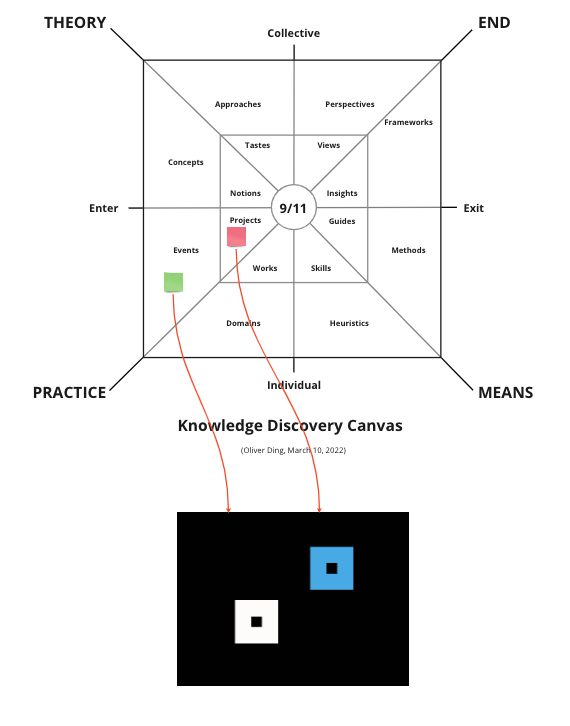
This article is part of the Slow Cognition Project which focuses on Developing Tacit Knowledge with Thematic Space Canvas. The Knowledge Discovery Canvas is an application of the Thematic Space Canvas.
The Knowledge Discovery Canvas has two nested squares which divide the thematic space into two sub-spaces: inner space and outer space. For Developing Tacit Knowledge, the inner space is all about personal knowing activities while the outer space is related to social interactions.
Based on the above settings, I generated a series of mapping between outer space and inner space:
- Approaches — Tastes
- Concepts — Notions
- Events — Projects
- Domains — Works
- Perspectives — Views
- Frameworks — Insights
- Methods — Guides
- Heuristics — Skills
Today I’ll focus on the Events — Projects mapping and use my “9/11” thematic space as an example for the present discussion.
The original name of Knowledge Discovery Canvas is Thematic Space Canvas, the term “Knowledge” should be understood as “Tacit Knowledge about a particular Theme”. The primary theme can be anything such as an abstract academic concept (Activity), a word (Life), a topic (Strategy), or an event (9/11).
9/11 Curator and Curation for Memorial
In Sept 2011, I worked for a web content curation and information organizing app called BagTheWeb. In order to service the BagTheWeb user community, I suggested developing a new feature called Channels for collective content curation.
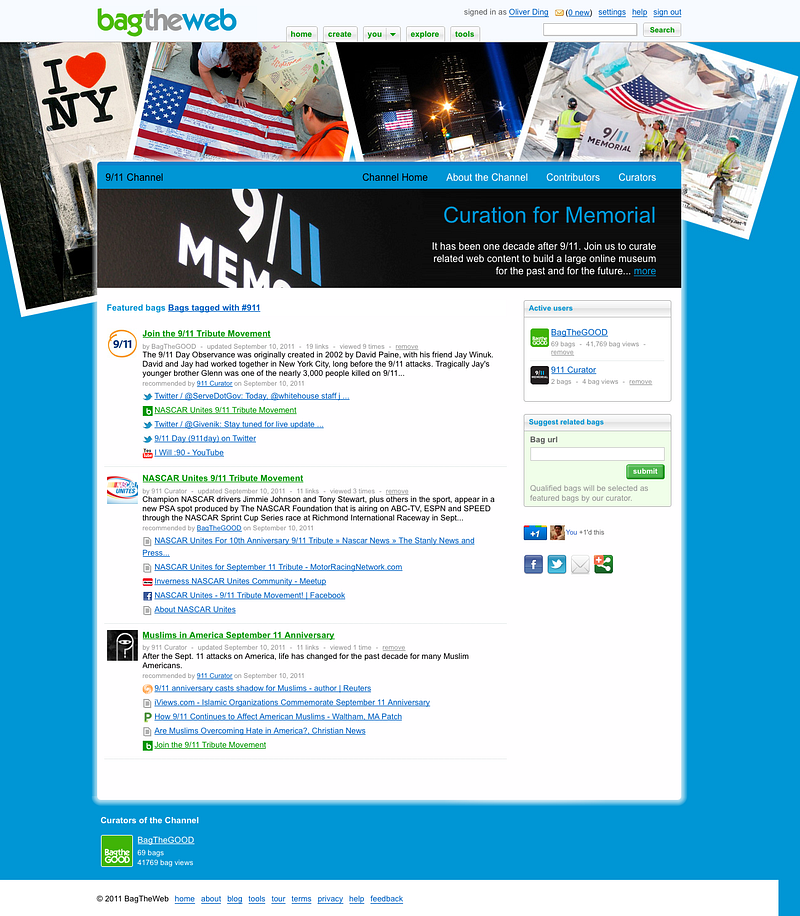
The above screenshot is the first channel called Curation as Memorial. I designed the channel and the following logo for a user account called 9/11 Curator.

Though this is a business-for-good example, I personally consider the Curation for Memorial project as a case of my long-term life project: Curation Commons. I also found that the theme of “Curation for Memorial” is part of many people's life. For example, watch the following talk from Steve Rosenbaum who is the author of Curation Nation (2011) and Curate This (2014).
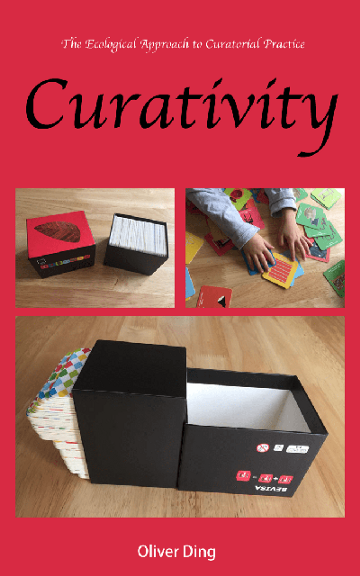
After having 10 years of various curation-related practical work experience and theory learning, I coined a term called Curativity and developed Curativity Theory. In 2019, I wrote the book Curativity: The Ecological Approach to General Curation Practice and use the story as an example of my “Curation” theme.
The new term Curativity refers to “curating pieces into a meaningful whole” which means general curatorial practice. The reason why I coined the term is that I was not satisfied with the specific view of curation such as “professional curation means art and museum.” I argued that there is a need to redefine “curatorial practice” as a general social activity and a universal experience. In other words, I was calling an interdisciplinary view of curation or curatorial practice.
Curativity Theory adopts James Gibson’s “Affordance”, George Lakoff’s “Container” and Donald Schön’s “Reflection” as epistemological tools. The diagram below shows the basic elements of Curativity: Pieces — Container — Whole. The basic assumption behind the diagram and the new term is: “In order to effectively curate pieces into a meaningful whole, we need Container to contain pieces and shape them.”
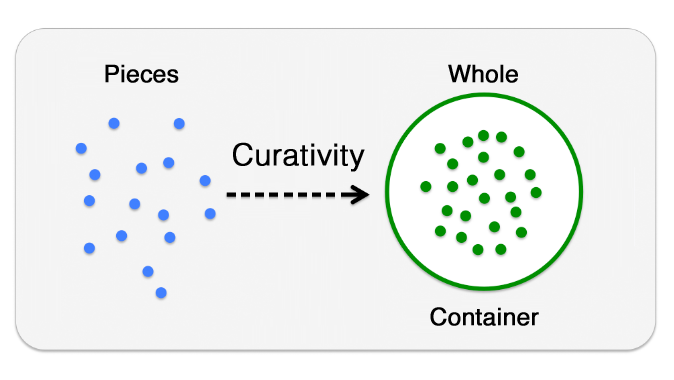
In order to avoid unnecessary debate on the concept of curation or curatorial practice, I coined the term Curativity to refer to my argument. Thus, Curativity is an ontological level invention. It points to a new space for knowing and understanding.
The Preface of Curativty reviews my own life experience through the perspective of curation and I found that the theme of curation is an important theme in my life themes. I also tell the story of writing the book and offer two guides for two types of readers. The 9/11 Curator and the Curation as Memorial project is part of the preface.
Where the “9/11” theme refers to a public event, the 9/11 Curator and the Curation as Memorial project refer to my projects. For my “9/11” theme, the “Events — Projects” mapping also echo to my “Curation” theme.
Events and Projects
On Nov 29, 2020, I published the Life as Activity (v0.3) Framework and discussed the pair of concepts of “Events — Projects”. Though the framework has been upgraded to v2.0 and its newest version the Life as Project approach, I still keep my thoughts about “Events — Projects”. This section is adopted from the original v0.3 article.
My approach uses “events” and “projects” to present social context and individual biography. The difference between “events” and “projects” is individual involvement. If the person directly gets involved in an activity — it means she is the subject of the activity or part of the community of the activity — then the activity is a project of her biography. If the person doesn’t directly get involved in the activity, then the activity is an event of her biography.
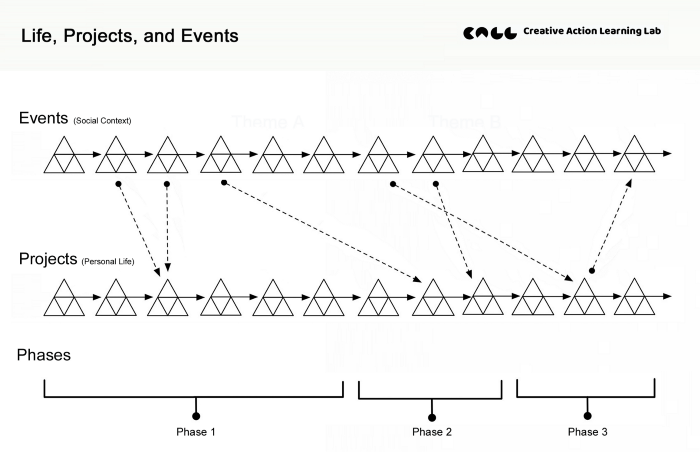
Let’s use the biography of Yrjö Engeström who is a leading Activity Theorist as an example. According to Annalisa Sannino, there are four main phases in Engeström’s development as an activity theorist, “(1) the European student movement of the 1960s and the discovery of activity theory; (2) the study of instruction and the turn from school learning to workplace learning; (3) developmental work research and the theory of expansive learning; and (4) the formation of activity-theoretical communities aimed at changing societal practices.” (2009, p.11) We can use the above diagram to represent Engeström’s biography.
Phase 1
- Event 1: the European student movement of the 1960s.
- Project 1: Engeström wrote his first book (Engeström,1970), Education in Class Society: Introduction to the Educational Problems of Capitalism (in Finnish).
- Event 2: Leontiev’s Problems of the Development of the Mind, published in East Germany in 1973 (Leontjew,1973), and Davydov’s Types of Generalizations in Instruction, which was available in East Germany in 1977 (Dawydow, 1977).
- Project 2: Engeström discovered Activity Theory by reading Davydov’s book and II’enkov’s essay on the dialectics of the abstract and the concrete.
- Project 3: Engeström adopted Activity Theory for his thesis, The Imagination and Behavior of School Students Analyzed from the Viewpoint of Education for Peace (in Finnish) in 1979. This empirical study documents the work of nearly 2,000 students who wrote essays on war and violence.
Phase 2
- Project 1: Engeström attempted to change school instruction by bringing Davydov’s ideas to politically and pedagogically radical Finnish teachers. He published a chapter in the 1984 book Learning and Teaching on a Scientific Basis.
- Project 2: Engeström started paying attention to workplace learning and human resource development in organizations. His first work-related study (1984) was concerned with janitorial cleaning, which was considered to be the occupation with the lowest prestige in Finland. The main motivation for studying the work of cleaners was to demonstrate that this work is creative and has an intellectual basis and to show the possibilities of development.
Phase 3
- Project 1: From 1986 to 1989, Engeström led a study with the primary health care practitioners and patients of the city of Espoo, where patients were facing excessive waiting times before receiving health care and a lack of continuity of care.
- Project 2: Engeström adopted Davydov (1990)’s “learning activity” to investigate/implement radical change at work.
- Project 3: Engeström developed the triangular model of activity systems and the theory of expansive learning and published Learning by Expanding (1987).
Phase 4
- Event 1: Michael Cole directed the Laboratory of Comparative Human Cognition (LCHC) at the University of California, San Diego.
- Project 1: Engeström was invited to work at LCHC.
- Project 2: Engeström initiated communities for adopting activity theory for changing societal practices in Finland.
- Project 3: Inspired by the LCHC, Engeström founded the Center for Activity Theory and Development Work Research at the University of Helsinki.
- Event 2: Georg Rückriem worked on the translations of Leont’ev’s works in Germany.
- Project 4: Engeström suggested the idea of a conference in which scholars within Germany and elsewhere could gather to discuss ways of influencing human practices on the basis of activity theory. Subsequently, Rückriem started organizing the first conference of the International Society for Cultural Research and Activity Theory (ISCRAT), which took place in 1986.
- Event 3: LCHC published a Quarterly Newsletter titled Mind, Culture, and Activity.
- Project 5: Engeström suggested the creation of the journal Mind, Culture, and Activity, which was originally published as the Quarterly Newsletter of LCHC.
- Event 4: In 1995, Finland was struggling to overcome an economic recession, as were many other countries. The problems of the Finnish economy, however, were also connected with the collapse of the Soviet Union, which had been Finland’s main trading partner. Companies were under economic pressure and needed to find short-term solutions to the crisis.
- Project 6: Developmental work research was formulated in terms of a long developmental cycle of interventionist work lasting 3 to 5 years (Engeström & Engeström,1986). Companies in these years could not afford to engage in this kind of transformative venture. The intervention methodology of the Change Laboratory, as compressed cycles of transformation within the broader frame of developmental work research, was elaborated to meet the needs of these institutions.
- Event 5: The Center for Activity Theory and Development Work Research inspired the emergence of similar institutions, such as the Centre for Sociocultural and Activity Theory Research at the University of Bath in the United Kingdom, the Centre for Sociocultural and Activity Theory Research at the University of Oxford in the United Kingdom, and the Center for Human Activity Theory at the University of Kansai in Osaka, Japan.
The above example is just for showing the concepts of “events”, “projects”, and “concepts” within our approach.
Since Activity Theory has the key concept of Object which is a sense-maker of the theory. So, I think we can assign similar sense-makers to Project and Event. For example, I think the primary sense-maker of a Project can be Identity and the primary sense-maker of an Event can be Theme.
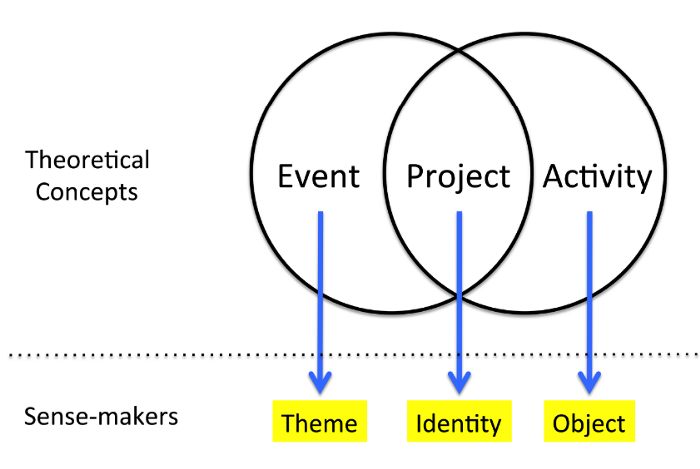
The above diagram is a possible way to conceptualize the relationship between event, project, and activity within the Life-as-Activity approach. As a core concept of the approach, Project refers to both events and activities and it shares some aspects with them. In other words, Project’s primary sense-maker is Identity and its secondary sense-makers are theme and object. Thus, we can use theme, identity, and object as sense-makers of the Life-as-Activity approach.
Furthermore, for the Life-as-Activity approach, I think we can consider the Event as Environment while the Activity as the System and consider Project as a switch between an event (environment) and an activity (system). This means people’s actions (involvement) turn events into activities.
Projectivity and Cultural Projection
On Jan 9, 2021, I published an article titled Activity U (X): Projecting, Projectivity, and Cultural Projection which introduces the concept of Projectivity and the notion of Cultural Projection. This article is an essential part of my 2021 book Project-oriented Activity Theory.
What’s Projectivity? It refers to potential action opportunities of forming a project or participating in a project for people to actualize their development with others.
The concept of Projectivity connects Project, Projecting, Projection together and can be used as a foundation for Cultural Projection Analysis.
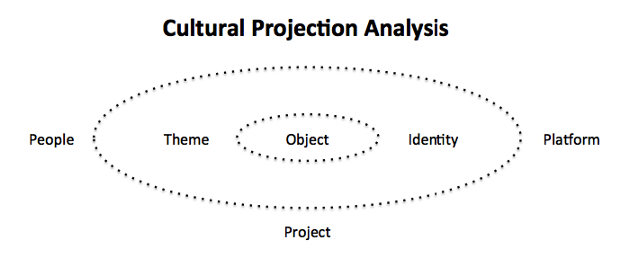
As mentioned above, there are some sense-makers for the Life-as-Activity approach. Thus, I applied the idea to develop a framework for Cultural Projection Analysis.
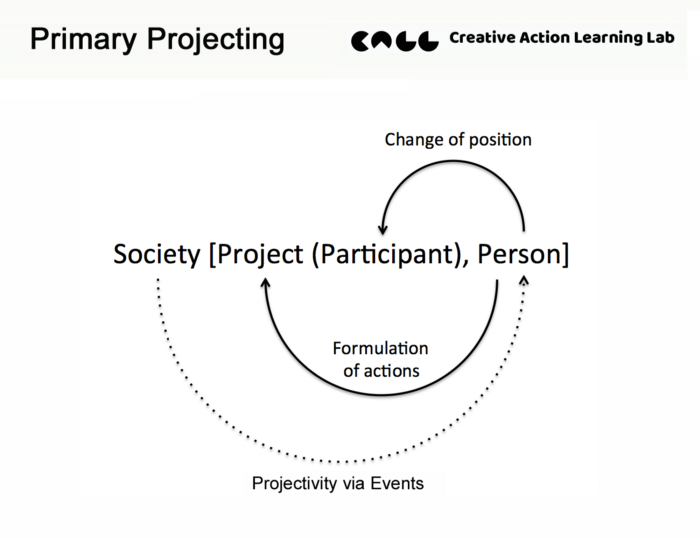
First, there is a social/cultural environment that contains Events. By perceiving and knowing Events, people recognize the Primary Projectivity which is offered by the social/cultural environment, and initiate a Project. For the Primary Projectivity, its sense-maker is Events.
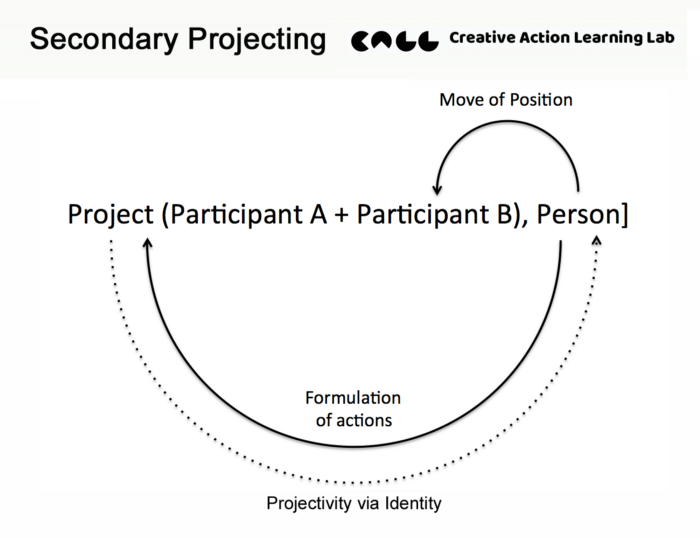
Once a project is initiated, it offers Secondary Projectivity for other people to recognize the potential action opportunities of participating in the project. For the Second Projectivity, its sense-maker is the Identity of an established Project.
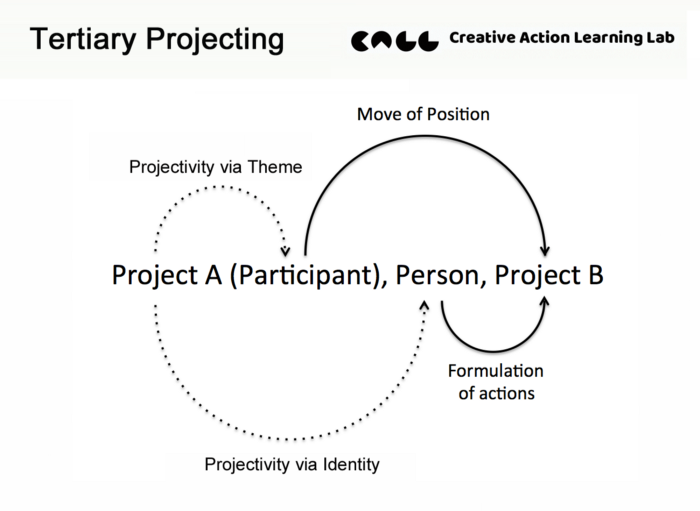
Third, the participants of a project could perceive and know the Tertiary Projectivity and initiate a new project which is inspired by the project. For the Tertiary Projectivity, its sense-maker is the Themes and Identity of an established Project.
You can find more details here.
For Knowlege Discovery Canvas, we only need to consider the “Events — Projects” mapping. The Cultural Projection Analysis framework offers a solution to understanding the mapping.
Related Articles
- The Slow Cognition Project
- Slow Cognition: A Meta-canvas for Developing Tacit Knowledge
- Knowledge Discovery: Concepts, Notions, and the Concept Dynamics Framework
- Knowledge Discovery: The “Approaches — Tastes” Mapping
- Knowledge Discovery: The “Perspectives — Views” Mapping
- Knowledge Discovery: The “Frameworks — Insights” Mapping
- Knowledge Discovery: The HERO U Canvas
- Knowledge Discovery: The Concept Dynamics Framework
- Knowledge Discovery: The “Double Theme” Strategy
- Knowledge Discovery: The “Middleware” Strategy
- Life as Activity (version 0.3)
- Life Discovery: The Life-as-Project Approach
- Activity U (X): Projecting, Projectivity, and Cultural Projection
- Curativity Theory: The Ecological Approach to General Curation Practice
- Curativity Theory: Table of Contents and Related Articles
I am also working on building a new website for the Platform Ecology project. You can save the following links:
- PlatformEcology.org
- Twitter: @PlatformEcology
- Linkedin: @PlatformEcology
You are most welcome to connect via the following social platforms:
Linkedin: https://www.linkedin.com/in/oliverding Twitter: https://twitter.com/oliverding Polywork: https://www.polywork.com/oliverding Boardle: https://www.boardle.io/users/oliver-ding


