
Life as Activity (version 0.3)
The Life-as-Activity approach is a by-product of Activity U. The Activity U project is a case study for “HERO U” which is a framework for closing the gap between theory and practice. HERO U is a new framework for knowledge heroes who want to make unique epistemic impacts. I have introduced the framework and its diagram in HERO U — A New Framework for Knowledge Heroes.
In the first article of the Activity U project Activity U: The Landscape of Activity Theory (Part I), I used the HERO U framework to represent various development of Activity Theory.
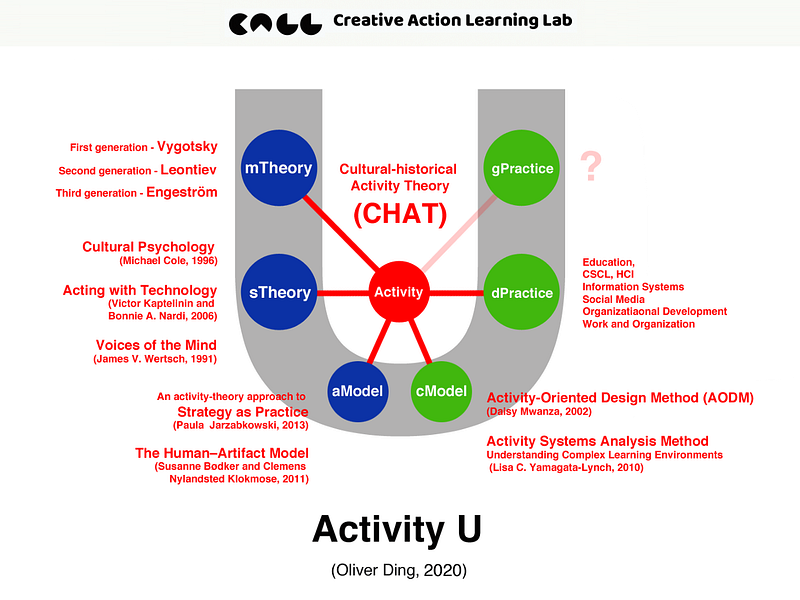
Diagram U presents six types of “Objective of Knowing”:
- mTheory: Meta-theory
- sTheory: Specific Theory
- aModel: Abstract Model
- cModel: Concrete Model
- dPractice: Domain Practice
- gPractice: General Practice
I didn’t find some example for “gPractice: General Practice”. Thus, I suggested a term for it: Life as Activity. I considered this suggestion as version 0.1 of the Life-as-Activity approach.
In Activity U (VII): The Chain of Activity and Life as Temporal Activity Chains, I discussed the Chain topic and developed a framework for the Life-as-Activity approach which is based on Temporal Activity Chains. I consider this framework as version 0.2 of the Life-as-Activity approach.
Today I add a piece from the perspective of the Self-Reference System as background for discussion. Thus, this is version 0.3 of the Life-as-Activity approach.
Part 1: Version 0.1
(This part is a section of Activity U: The Landscape of Activity Theory (Part I))
General Practice (gPractice) means daily life as a general context of knowing. For example, personal growth, productivity, mental health, career value, and life meaning are typical issues for most adults.
Though activity theory is a theory for professional research, I do believe it is useful for ordinary people to reflect on their daily life. I suggest the following approach:
Life as Activity
We can see our daily life and the whole life as an activity. In fact, the founder of activity theory once considered using Life Theory to name his theory. According to Kaptelinin and Nardi (2006), “Leontiev’s ambition was to translate this general statement into a concrete description of how the first phenomena that can be called “psyche” emerged in history, and how they developed into the current variety of mental phenomena. To accomplish this goal Leontiev needed a special kind of analytical tool, a concept more general than psyche, that would make it possible to define the context in which the psyche emerges and develops. An obvious candidate for such a concept is ‘Life’, since ultimately this is what undergoes evolutionary change. However, this concept is too general and too vague. ‘Activity,’ as we will see below, was chosen by Leontiev as a concept that can provide a more concrete insight into what ‘Life’ is.” (pp.51–52)
Life is a wonderful activity!
Part 2: Version 0.2
(This part is a section of Activity U (VII): The Chain of Activity and Life as Temporal Activity Chains)
2.1 The Historicality of Individuals
According to R.Keith Sawyer (2005), “The theoretical connections of socioculturalism to both Marxian theory (through Vygotsky) and to pragmatism have been widely noted (e.g., Cole 1995b, 112). The pragmatists Dewey and Mead elaborated the process ontology of Whitehead and Bergson, contributing to the sociocultural emphasis on practices and processes.” (p.127)
This section will introduce a processual approach to sociology from Andrew Abbott who is an American sociologist and social theorist working at the University of Chicago. Abbott’s works follow a special theme: the elaboration of a processual approach to the social world. In 2016, Abbott published a book titled Processual Sociology which is a collection of essays. The processual approach rejects the major traditional views of social world such as the sociology of Durkheim, the Marxian social conflict theory, the symbolic anthropology promoted by Clifford Geertz and David Schneider. According to Abbott, “A processual approach begins by theorizing the making and unmaking of all these things — individuals, social entities, cultural structures, patterns of conflict — instant by instant as the social process unfolds in time. The world of the processual approach is a world of events. Individuals and social entities are not the elements of social life, but are patterns and regularities defined on lineages of successive events. They are moments in a lineage, moments that will themselves shape the next iteration of events even as they recede into the past. The processual approach, in short, is fundamentally, essentially historical. ” (p.x)
The first chapter of Processual Sociology is The Historicality of Individuals in which Abbott argued that “the common theory of ‘levels’ of the social process — biology, personality, social structure, culture or whatever other series we may use — is fundamentally mistaken. There are no levels. Social entities and forces are not larger than individuals. They are just a different kind of pattern defined on events, which are the true substrate of the social process. ” (p.1) According to Abbott, “…the historicality of the individual is in its first sense biological. Biological individuals carry forward with themselves a huge mass of historical experience, written quite literally in and on their bodies. The historicality of individuals is in its second sense memorial. It arises in the peculiar concentration of memory in biological individuals…What is different is that the memory of individual humans is concentrated in their biological selves in a way that the memory of social structures is not…the individual memorial self is less diaphanous than are the memorial selves of social structures…persons as legal beings have roughly the same historial endurance as do corporations, which are after all personae fictae.” (p.7)
Abbott’s argument is not alone. In 1997, Derek Layder published Modern Social Theory: Key debates and new directions and presented his social domains theory. Layder suggested four principal social domains: Psychobiography (including self-identity), Situated activity, Social setting (including fields) and Contextual resources. Layder argued that “we must also understand the self as a historical emergent and have some means of tracing and registering its ever developing nature. The notion of ‘psychobiography’ points to the development of the self as a linked series of evolutionary transitions, or transformations in identity and personality at various significant junctures in the live of individuals. In this sense psychobiography traces the life ‘career’ of an individual and ties together both the subjective and the objective facets of an individual’s experience (Hughes 1937).” (p.47)
He also pointed out, “Durkheim’s ideas suggest that modern societies provide the social conditions under which individuation flourishes. The notion of psychobiography complements this by adding a psychological dimension. It stresses that individuality is not only a matter of social pressure towards specialization and the expression of differences. It indicates that over their life-careers, individuals have quite different social experiences and are entangled in webs of social relationships that are unique both in terms of their quality and in terms of the personalities and behavioural patterns of those involved in them…If, as sociologists, we want to understand people as real, fully rounded human beings, we must understand them in their unique individualities — only in this way will we avoid viewing them as mere reflections of social influences. Thus we must look to the reverse side of the social arena to understand the specific configurations of real people that popular the ‘back regions’ of social life…By identifying psychobiographies as a unit of analysis, we are concentrating on the intersection or join between two fundamental features of the human social world.” (p.51)
Traditionally, Activity Theorists didn’t talk about individuality and psychobiography quite markedly. I once mentioned the notion of “Life as Activity” at the end of Activity U (I): The Landscape of Activity Theory. By adopting the newest temporal concepts such as “Chain of activity” and “Temporal Activity Chains”, we can achieve the goal of developing a framework of Life as Activity.
2.2 Life as Temporal Activity Chains
The “Temporal Activity Chains” model is based on Yrjö Engeström’s Activity Systems model which has a special diagram called “Engeström’s Triangle”.
Engeström’s triangle is based on the cultural-historical psychologists’ notions of mediation as individual action (subject — instruments — object) at the top of the diagram. Engeström (1987) considered “a human activity system always contains the subsystems of production, distribution, exchange, and consumption.”(p.67), thus, he added the bottom of the triangle to the original individual triangle in order to include other people (community), social rules (rules), and the division of labor between the subject and others.
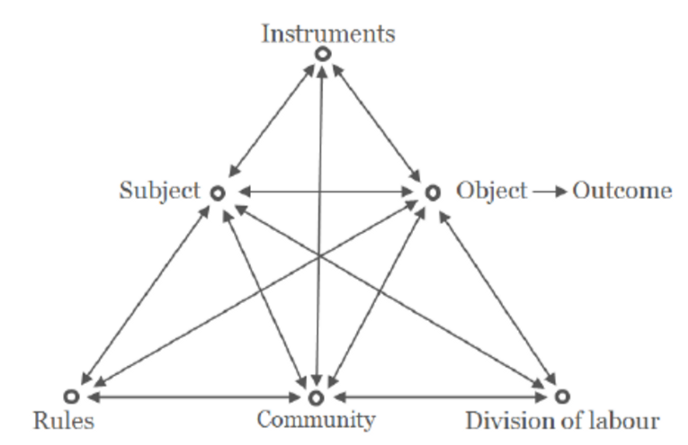
The above Engeström’s Activity Systems model is a collective version of activity theory and it was widely used in organizational learning and innovation, educational settings, HCI, and other domains. Activity Theorists didn’t apply the activity systems model to individual career or personal development. However, by adopting Paul Richard Kelly’s Temporal Activity Chains, we can develop a new framework for individual subjectivity analysis.
Let’s roughly outline the new framework in four steps:
- Step 1. Data collecting: Turning biographical stories into lived activities.
- Step 2. General analysis: Understanding five general life chains.
- Step 3. Advanced analysis: Mapping specific issues with temporal activity chains.
- Step 4. Meta-analysis: Reflecting the history and projecting the future
The biography-based study is not new in social sciences. For example, Howard E. Gruber developed the evolving systems approach to the study of creative work (1989). The Biographic-narrative interpretive method (BNIM) has been used for over thirty years. I consider the Life-as-Activity framework as a new member of the biographical research family.
The following sections shall discuss details of the four steps of the Life-as-Activity framework and mention similar methods and approaches.
2.3 Data Collecting: Turning biographical stories into lived activities (Step 1)
The first step is collecting enough biographical stories and transforming these data into lived activities. Some methods such as the biographical narrative interpretive method (BNIM) considers listening to and interpreting the narratives of individuals and collecting two types of data: lived life and told stories. In comparison to BNIM, our approach only focuses on lived activities that refer to real biographical experiences, not told experiences.
Our approach also uses “events” and “projects” to present social context and individual biography. Both “events” and “projects” are represented with the format of an “activity system”. The difference between “events” and “projects” are individual involvement. If the person directly gets involved in an activity — it means she is the subject of the activity or part of the community of the activity — then the activity is a project of her biography. If the person doesn’t directly get involved in the activity, then the activity is an event of her biography.
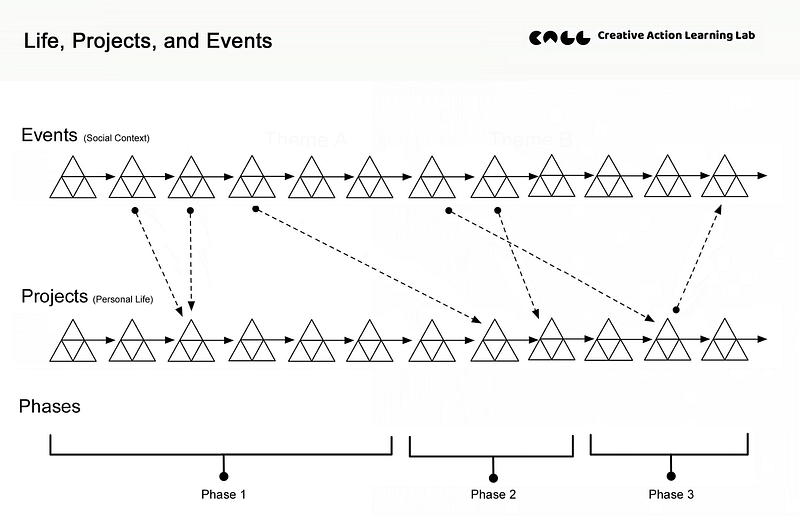
Let’s use the biography of Yrjö Engeström as an example. According to Annalisa Sannino, there are four main phases in Engeström’s development as an activity theorist, “(1) the European student movement of the 1960s and the discovery of activity theory; (2) the study of instruction and the turn from school learning to workplace learning; (3) developmental work research and the theory of expansive learning; and (4) the formation of activity-theoretical communities aimed at changing societal practices.” (2009, p.11) We can use the above diagram to represent Engeström’s biography.
Phase 1
- Event 1: the European student movement of the 1960s.
- Project 1: Engeström wrote his first book (Engeström,1970), Education in Class Society: Introduction to the Educational Problems of Capitalism (in Finnish).
- Event 2: Leontiev’s Problems of the Development of the Mind, published in East Germany in 1973 (Leontjew,1973), and Davydov’s Types of Generalizations in Instruction, which was available in East Germany in 1977 (Dawydow, 1977).
- Project 2: Engeström discovered Activity Theory by reading Davydov’s book and II’enkov’s essay on the dialectics of the abstract and the concrete.
- Project 3: Engeström adopted Activity Theory for his thesis, The Imagination and Behavior of School Students Analyzed from the Viewpoint of Education for Peace (in Finnish) in 1979. This empirical study documents the work of nearly 2,000 students who wrote essays on war and violence.
Phase 2
- Project 1: Engeström attempted to change school instruction by bringing Davydov’s ideas to politically and pedagogically radical Finnish teachers. He published a chapter in the 1984 book Learning and Teaching on a Scientific Basis.
- Project 2: Engeström started paying attention to workplace learning and human resource development in the organization. His first work-related study (1984) was concerned with janitorial cleaning, which was considered to be the occupation with the lowest prestige in Finland. The main motivation for studying the work of cleaners was to demonstrate that this work is creative and has an intellectual basis and to show the possibilities of development.
Phase 3
- Project 1: From 1986 to 1989, Engeström led a study with the primary health care practitioners and patients of the city of Espoo, where patients were facing excessive waiting times before receiving health care and a lack of continuity of care.
- Project 2: Engeström adopted Davydov (1990)’s “learning activity” to investigate/implement radical change at work.
- Project 3: Engeström developed the triangular model of activity systems and the theory of expansive learning and published Learning by Expanding (1987).
Phase 4
- Event 1: Michael Cole directed the Laboratory of Comparative Human Cognition (LCHC) at the University of California, San Diego.
- Project 1: Engeström was invited to work at LCHC.
- Project 2: Engeström initiated communities for adopting activity theory for changing societal practices in Finland.
- Project 3: Inspired by the LCHC, Engeström founded the Center for Activity Theory and Development Work Research at the University of Helsinki.
- Event 2: Georg Rückriem worked on the translations of Leont’ev’s works in Germany.
- Project 4: Engeström suggested the idea of a conference in which scholars within Germany and elsewhere could gather to discuss ways of influencing human practices on the basis of activity theory. Subsequently, Rückriem started organizing the first conference of the International Society for Cultural Research and Activity Theory (ISCRAT), which took place in 1986.
- Event 3: LCHC published a Quarterly Newsletter titled Mind, Culture, and Activity.
- Project 5: Engeström suggested the creation of the journal Mind, Culture, and Activity, which was originally published as the Quarterly Newsletter of LCHC.
- Event 4: In 1995, Finland was struggling to overcome an economic recession, as were many other countries. The problems of the Finnish economy, however, were also connected with the collapse of the Soviet Union, which had been Finland’s main trading partner. Companies were under economic pressure and needed to find short-term solutions to the crisis.
- Project 6: Developmental work research was formulated in terms of a long developmental cycle of interventionist work lasting 3 to 5 years (Engeström & Engeström,1986). Companies in these years could not afford to engage in this kind of transformative venture. The intervention methodology of the Change Laboratory, as compressed cycles of transformation within the broader frame of developmental work research, was elaborated to meet the needs of these institutions.
- Event 5: The Center for Activity Theory and Development Work Research inspired the emergence of similar institutions, such as the Centre for Sociocultural and Activity Theory Research at the University of Bath in the United Kingdom, the Centre for Sociocultural and Activity Theory Research at the University of Oxford in the United Kingdom, and the Center for Human Activity Theory at the University of Kansai in Osaka, Japan.
The above example is just for showing the concepts of “events”, “projects”, and “concepts” within our approach.
2.4 General analysis: Understanding five general life chains (Step 2)
Based on the Activity System model — Engeström’s triangle — I discover five general life chains:
- The Motivation Chain: the focus is “Subject — Object”.
- The Achievement Chain: the focus is “Subject — Outcome”
- The Productivity Chain: the focus is “Subject — Instrument”
- The Competence Chain: the focus is “Subject — Division of labor”
- The Communication Chain: the focus is “Subject — Community/Rules”
These life chains present five issues of subjectivity: Motivation, Achievement, Productivity, Competence, and Communication. In the context of the Activity System model, Motivation refers to the “Subject — Object” relationship, and Achievement refers to the “Subject — Outcome” relationship. Other three issues refer to three subsystems of the activity system: Productivity refers to the production subsystem, Competence refers to the Distribution subsystem, and Communication refers to the Exchange subsystem.
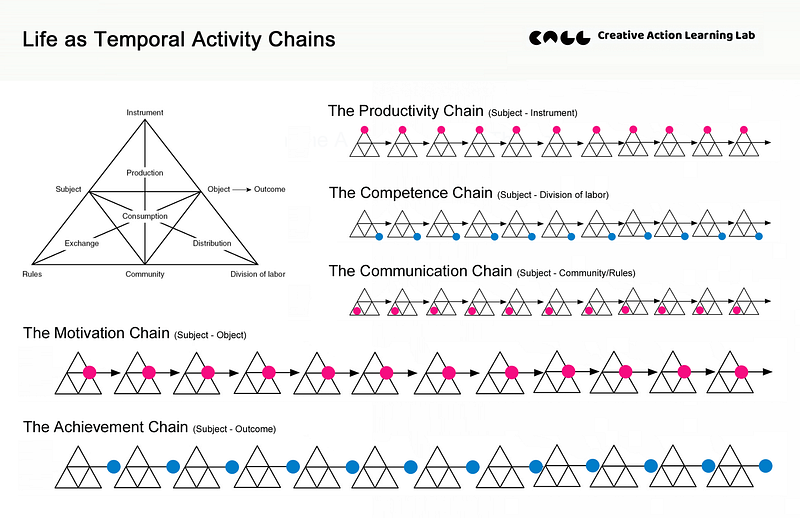
By adopting the Temporal Activity Chains schema, we can achieve the goal of visualizing “the Historicality of Individuals” by discussing five issues of subjectivity.
2.4.1 The Motivation Chain: Needs and Supports
For example, let’s look at the motivation chain (subject-object) first. The “object of activity” is one of the most basic concepts of activity theory. According to Victor Kaptelinin (2005), “The object of activity has a dual status; it is both a projection of human mind onto the objective world and a projection of the world onto human mind. Employing the object of activity as a conceptual lens means anchoring and contextualizing subjective phenomena in the objective world, and changes one’s perspective on both the mind and the world.” Thus, by collecting the change of objects of temporal activity chains, we can understand the change in individual motivation too.
Kaptelinin (2005) pointed out, “…the object of activity can be defined as ‘the sense-maker’ which gives meaning to and determines values of various entities and phenomena. Identifying the object of activity and its development over time can serve as a basis for reaching a deeper and more structured understanding of otherwise fragmented pieces of evidence.” According to Kaptelinin, the original Leontiev (1975/1978) definition of the object of activity as “its true motive” has some conceptual issue. He argued, “If the object of activity is its true motive, then two concepts — ‘the object of activity’ and ‘the motive of activity’ — mean basically the same thing.” He suggested that it is better to separate the object of activity from the motive of activity in order to deal with poly-motivated activities.
This suggestion creates room for the motivation chain (subject-object) since the motivation is at the individual level while the object is at the collective level. Thus, we can adopt other psychological theories about the motivation for our analysis. For example, the Self-Determination Theory (SDT) is an established theory about human motivation. SDT claimed that there are three basic psychological needs are those for autonomy, competence, and relatedness. According to Richard M. Ryan and Edward L. Deci who are the founders of SDT, “Our conceptualization of the effects of social contexts is pertinent to both motivation and behavior in immediate situations and to development and wellness over time. In other words, supports for autonomy, competence, and relatedness not only are theorized to facilitate more self-determined and high-quality functioning in the immediate situation, but they are also understood to promote the development of more effective self-functioning, resilience, and enduring psychological health for the long term.” (p.12) By connecting SDT with Activity Theory, we can discuss the subject-object with the three basic psychological needs.
Kaptelinin (2005) also suggested four criteria for “successful” objects of activities: “ (a) balance: the effective motives should be properly represented; if a motive is systematically ignored, the activity may face a breakdown; (b) inspiration: the object of activity should be not only rationally feasible but also attractive and energizing, ( c) stability: if the object changes too often, the activity can be disorganized; and (d) flexibility (the opposite of stability): when the factors, such as motives and available means, change, the object of activity should be redefined to avoid becoming obsolete and ineffective.” We can consider these four criteria as supports offered by the object of activity.
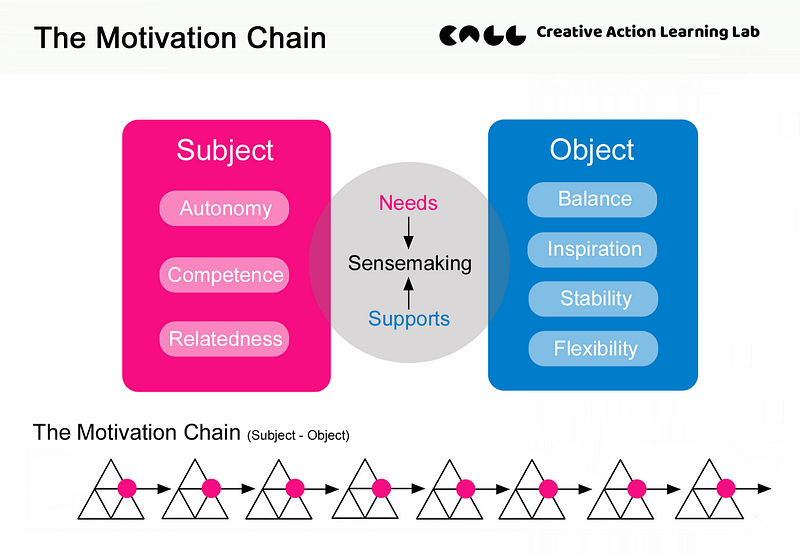
The above diagram summarizes the discussion about the motivation chain by combining three basic psychological needs and four criteria for good objects of activities. It is a rough sketch for making a formal framework.
2.4.2 The Achievement Chain: Product, By-product and Meta-product
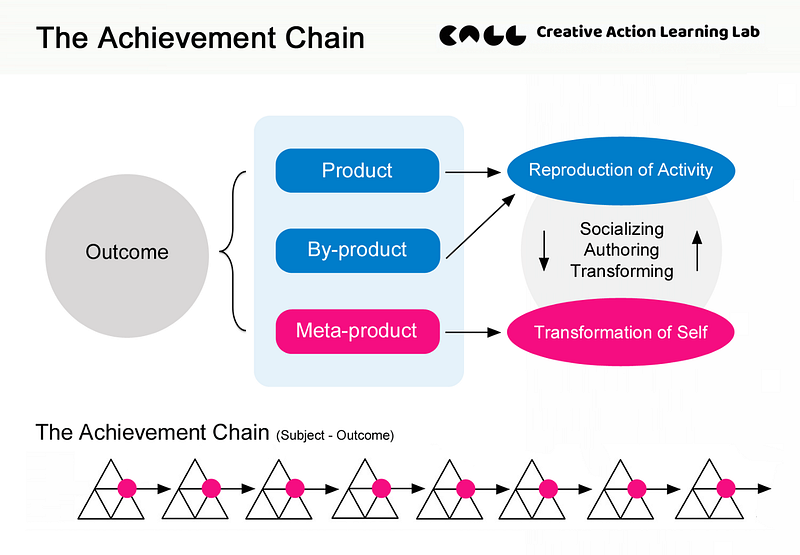
The achievement chain focuses on the subject—outcome relationship. From the perspective of Life-as-Activity, the task is to identify individual achievement from the collective outcome. One useful way is to distinguish between three types of outcomes: product, by-product, and meta-product. The product refers to the intended outcome within the original object of activity and the by-product refers to the unintended outcome beyond the original object of activity. The meta-product refers to the self. This notion means the transformation of self as the outcome of temporal activity chains.
We have learned the concept of an Activity Network. One way of forming an activity network is to turn the outcome into the object. In other words, one activity’s outcome can lead to a new activity by adopting the outcome of the old activity as the object of the new activity. I use “Reproduction of Activity” to describe the same phenomena. Both products and by-products can generate new activities.
Finally, the Life-as-Activity approach understands “Development” as an interactive process of “Reproduction of Activity” and “Transformation of Self”. The outcome of the activity generates products, by-products, and meta-products. Products and by-products generate new activities while meta-products contribute to the transformation of self which leads to better individual performance within the new collective activity.
By-product is a normal phenomenon for experienced individual workers and teams. In his study of Charles Darwin, Howard Gruber (1974) showed that even a great scientist embraces by-productive thinking in his creative work process. Gruber said, “In his beautiful book Productive Thinking, Max Wertheimer, founder of Gestalt psychology, focused his attention on the kind of direct thinking that goes to the heart of the probiel under attack. In Darwin’s long and twisting path, however, there are several striking examples of important steps toward the theory of evolution through natural selection being taken as by-products of efforts that seemed to move in other directions…The theory of coral reefs was based on an extrapolation from what Darwin has learned about the formation of continental mountain chains; if mountains are up-raised, he reasoned, the adjacent sea bed must sink; from this slow subsidence of the sea bed, the coral-reef theory followed. That theory does not deal at all with organic evolution, but it does provide a formal model quite analogous to Darwin’s eventual theory. Darwin did not have a five-year plan to move through this important sequence of ideas. It evolved. The monad theory, itself short-lived in Darwin’s thought and not entirely original, led him to his branching model of evolution. This became a cornerstone of his thought.” (1974, p.112) In contemporary knowledge work activities, there are many ways to generate by-products. Activity theorists also claim that the mediation of an activity can be transformed into an object of a new activity.
Gruber also introduces another concept to explain how the individual maintains his sense of direction with the by-product effect: purpose. According to Gruber, it refers to a person’s ability to imagine himself outside the perspective of the moment, to see each sub-task in its place as part of the larger task he has set himself. He said, “This abstract purposefulness and perspective, this standing outside, is an activity undertaken in quite a different spirit from that in which the creative person immerses himself, lose himself in the material of nature. To accomplish his great synthesis Darwin had to be able to alternate between these two attitudes. To see more deeply into nature, he needed the perceptual, intuitive direct contact with the material. To understand what he had seen, and to construct a theory that would do it new justice, he had to re-examine everything incessantly from the varied perspectives of his diverse enterprises.” (1974, p.113) From the perspective of Life-as-Activity, the purpose is the key to holding the complex temporal activity chains over long periods of time.
There are many theories of the transformation of self. For adult development, I’d like to adopt Robert Kegan’s “neo-Piagetian” approach: the constructive—developmental approach which attends to the development of the activity of meaning-constructing. Kegan considers “person” as an activity, not a thing. He said, “Like the idea of construction, the idea of development liberates us from a static view of phenomena. As the idea of construction directs us to the activity that underlies and generates the form or thingness of a phenomenon, so the idea of development directs us to the origins and processes by which the form came to be and by which it will pass into a new form. This shift — from entity to process, from static to dynamic, from dichotomous to dialectical — is a shift with H.K.Wells (1972) notices in the historical development of modes of scientific thought.” (1982, p.13)
In order to present his theory to various readers from different contexts, Kegan uses different terms to name his theoretical concepts. For example, in his 1982 book The Evolving Self: Problem and Process in Human Development, he used “evolutionary truces” and “self”. He identifies two universal psychological orientations in human experience: independence v.s. inclusion and claims the tension between these two orientations is the core of human mental development. Based on this notion, he developed a stage model called the “helix of evolutionary truces” and discovered five stages: Incorporative Self, Impulsive Self, Imperial Self, Interpersonal Self, Institutional Self, and Interindividual Self.
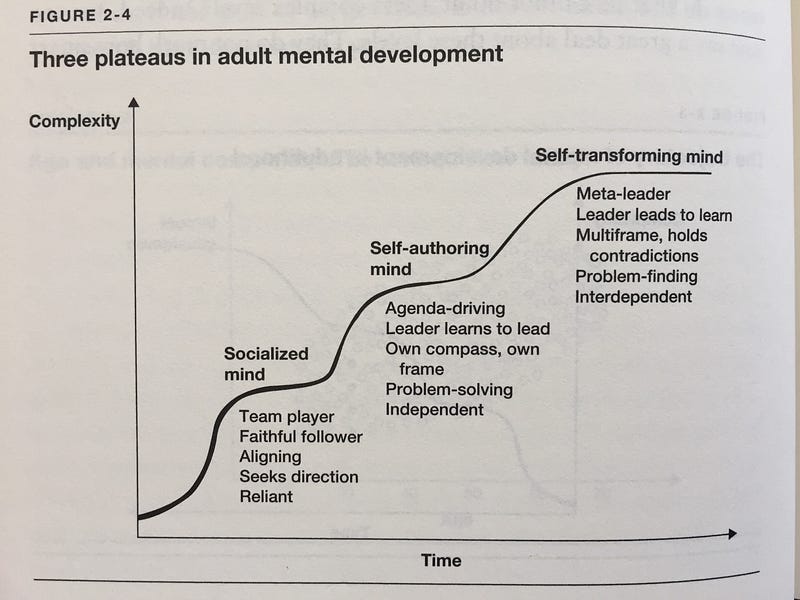
In a 2009 book, Kegan used “adult mental complexity”, “adult meaning systems”, and “mind”. He said, “There are qualitatively different, discernibly distinct levels (the “plateaus”); that is, the demarcations between levels of mental complexity are not arbitrary. Each level represents a quite different way of knowing the world…These three adult meaning systems — the socialized mind, self-authoring mind, and self-transforming mind — make sense of the world, and operate within it, in profoundly different ways.” (2009, pp.15–16).
The terms Kegan used such as “self”, “mind”, “mental” and “knowing” don’t refer to thinking processes alone. Kegan pointed out this issue in a 1994 book, “I am referring to the person’s meaning-constructive or meaning-organizational capacities. I am referring to the selective, interpretive, executive, and construing capacities that psychologists have historically associated with the ‘ego’ or the ‘self.’ I look at people as the active organizers of their experience. ‘organisms organize,’ the developmental psychologist William Perry once said; ‘and human organisms organize meaning.’ This kind of ‘knowing,’ this work of the mind, is not about ‘cognition’ alone, if what we mean by cognition is thinking divorced from feeling and social relating. It is about the organizing principle we bring to our thinking and our feelings and our relating to others and our relating to parts of ourselves.” (1994, p.29)
We have learned that HCI researchers adopted Activity Theory as a post-cognition approach to HCI study. Thus. Kegan’s approach is similar to Activity Theory in rejecting the pure cognition approach. For Life-as-Activity, we can adopt the three plateaus in adult mental development and consider the activity as an environment. Thus, I add Socializing, Authoring, and Transforming as three keywords for referring to Kegan’s three plateaus.
Let’s look at the details of the person-environment relationship from Kegan’s approach (2009, p.17):
- The socialized mind: We are shaped by the definitions and expectations of our personal environment.
- The self-authoring mind: We are able to step back enough from the social environment to generate an internal “seat of judgment” or personal authority that evaluates and makes choices about external expectations.
- The self-transforming mind: We can step back from and reflect on the limits of our own ideology or personal authority; see that any one system or self-organization is in some way partial or incomplete; be friendlier toward contradiction and opposites; seek to hold on to multiple systems rather than projecting all but one onto the other.
Activity Theorists consider contradictions as the source of the development of activity systems. By combining Kegan’s approach and Activity Theory with the Temporal Activity Chains framework, we can discover a path of developing individual agency with activities.
- The stage of the socialized mind is embedded in activities: the person doesn’t have awareness of the status and contradictions of an activity system.
- The stage of self-authoring mind embedded in activities: the person has his own judgment about the contradictions of an activity system. However, he only thinks about the issue from his position or role.
- The stage of the self-transforming mind is embedded in activities: the person can make sense of the contradictions of an activity system from different perspectives and different positions. Further, he intends to work out a solution to solving the existing contradictions.
In terms of Activity Theory, a person at the stage of the self-transforming mind is qualified for surfacing contradictions and conflict and modeling a new activity system. In this way, the achievement of Life-as-Activity is both development of individuals and collective activity systems.
The above two sections discuss two general life chains, the other three issues refer to three subsystems of the activity system:
- The Productivity Chain refers to the Production subsystem,
- The Competence Chain refers to the Distribution subsystem,
- The Communication Chain refers to the Exchange subsystem.
Since this article is the starting point of the Life-as-Activity framework, I’d like to leave these three issues for readers. Now, let’s move to the third step: Mapping specific issues with temporal activity chains.
2.5 Advanced Analysis: Mapping Specific Issues with Temporal Activity Chains (Step 3)
Step 2 is based on the structure of the Activity System. However, from the perspective of individual life development, we don’t have to be limited by the Activity System model. By adopting the Temporal Activity Chains, we can discuss important issues for personal growth.
At this stage, the issues are open to personal situations and knowledge. In the following sections, I shall provide two examples of mapping two general issues with temporal activity chains.
2.5.1 Mapping Networks of Enterprise
I have mentioned Howard E. Gruber’s evolving systems approach to the study of creative work (1974,1989). Though Gruber’s study focuses on creative people, I think his approach can be applied to contemporary knowledge workers.
One of the core concepts of Gruber’s approach is Networks of Enterprise which refers to the pattern of work in the life of a creative individual. Gruber said, “We use the term enterprise to stand for a group of related projects and activities broadly enough defined so that (1) the enterprise may continue when the creative person finds one path blocked but another open toward the same goal and (2) when success is achieved the enterprise does not come to an end but generates new tasks and projects that continue it.” (1989, p.11)
Our approach also uses “projects” to refer to individual biography. Thus, we can consider Gruber’s “enterprise” as a tool for organizing “projects” within the temporal activity chains. According to Gruber, the enterprise has some characteristics such as variety, longevity and durability, and tradeoffs (1989, p.11–12). First, “Enterprises rarely come singly. The creative person often differentiates a number of main lines of activity…The person has an agenda, some measure of control over the rhythm and sequence with which different enterprises are activated.” This is also an outstanding characteristic of contemporary knowledge workers. Second, an enterprise takes a long time. For example, “Milton began the work that led to Paradise Lost in 1640 but did not complete it until 1667.” For contemporary knowledge workers, this depends on their purpose for ambitious goals. Third, “In constructing the network of enterprise the individual faces a tradeoff between density and breadth…The fact that different kinds of activity entail different sorts of risk adds to the usefulness of a diversified network of enterprise, allowing the creator to be by turns daring and secure, as emotional needs wax and wane.” This is also significant to contemporary knowledge workers.
Gruber didn’t provide a schema for analyzing networks of enterprises. In order to incorporate the concept into Life-as-Activity, I create the diagram below as a tool for mapping networks of enterprises. I highlight several possible operations within organizing various enterprises: open, close, suspense, activate, re-open, ongoing, merge, and branch.
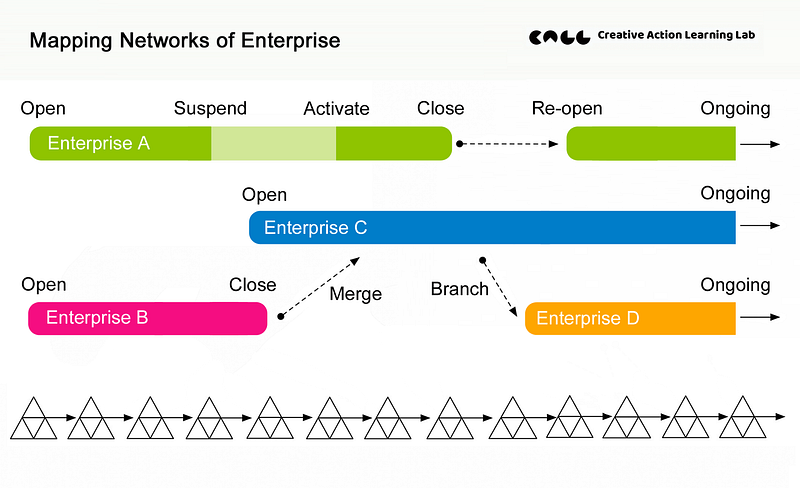
I’d like to share my own experience in discussing the above diagram. For example, Enterprise A can refer to my identity as a digital activist in virtual community building. I started this enterprise in 2008 when I co-founded a nonprofit online project with a friend. In 2010, my first son was born. Thus I suspended it around 2010 and activated it around 2012 when I co-founded another nonprofit project focusing on social learning. In 2013, my second son was born. Later, I decided to close the enterprise around 2014. I recently reopened this enterprise by founding CALL (Creative Action Learning Lab) in 2019.
Enterprise B can refer to my activities in creating digital curation tools. Enterprise C can refer to my activities in building a theory about curation. After the team decided to close the digital curation tool project, I merged my activity on this project into building a theory about curation. I adopted theories from ecological psychology and other fields and used them to reflect my practice of building digital curation tools and other activities. One of the major projects of Enterprise C is writing a book titled Curativity. One of the by-products of writing the book is the Ecological Practice approach. I started writing the book in Sept 2018 and finished its draft in March 2019. In May 2019, I branched the Ecological Practice approach from Enterprise C and created a new room for it: Enterprise D.
Gruber also pointed out the relationship between the Self and the Network of Enterprise, “First, and most important, by constituting the person’s organization of purpose, it defines the working self. Each creative person has certain conceptions of his or her life tasks. Although we think of the creative person as highly task-oriented rather than ego-oriented, it is also true that the set of tasks taken as a whole constitutes a large part of the ego: to be oneself one must do these things; to do these things one must be oneself. Second, the network of enterprise provides a structure that organizes a complex life. In the course of a single day or week, the activities of the person may appear, from the outside, as a bewildering miscellany. But the person is not disoriented or dazzled. He or she can readily map each activity onto one or another enterprise. Third, the network provides an organization of goals within which the person can set different levels of aspiration. Finally, the network of enterprise helps the creative person to define his or her own uniqueness.” (1989, p.13)
Thus, by adopting the idea of Networks of Enterprise for Life-as-Activity, we can have a powerful tool for understanding the interactive process of “Reproduction of Activity” and “Transformation of Self”.
2.5.2 Mapping Themes of Practice
Gruber’s approach emphasizes purpose. He said, “the task of understanding creative work requires a conception of the creative person as an evolving system in an evolving milieu. Each such system is comprised of three subsystems — organizations of knowledge, purpose, and affect. Each of these subsystems has a dual aspect: in one sense it has a life of its own, in another it contributes to the internal milieu of the others.” (1989, p.7) Also, he pointed out, “When someone is ‘purposeful,’ we mean that he or she cannot easily be deflected from the pursuit of a chosen course. Together, the deflections and the responses to them illuminate the purposes, not only for onlookers like us, but for the striving creative subjects themselves.” (1989, p.10)
We have to pay attention to “the pursuit of a chosen course.” So, how to choose a course and connect it to the historical development of individuals? My own answer is adopting the concept of Themes of Practice for the Lift-as-Activity approach and combining it with the temporal activity chains. The diagram below represents a way of mapping themes of practice.
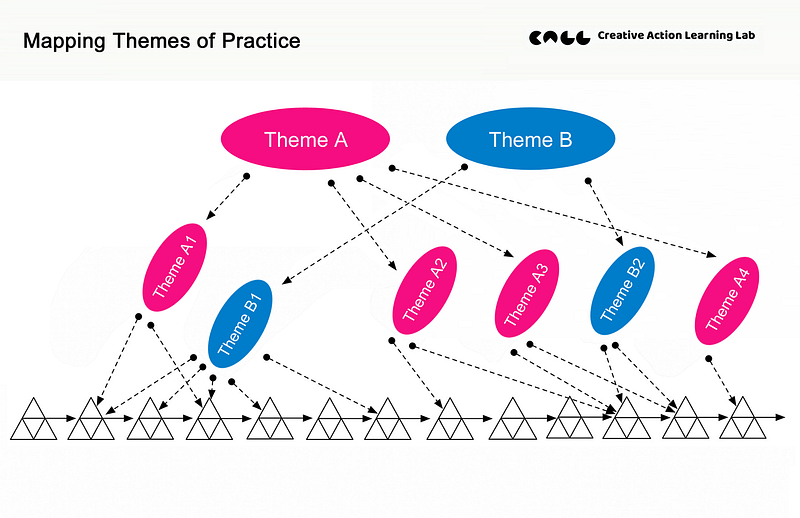
Anthropologist Morris Opler (1945) developed theoretical “themes” for studying culture. Career counseling therapists and psychologists also developed a theoretical concept called “life theme”. If we put cultural themes and life themes together, we see a great debate of social science: “individual — collective.” I consider the notion of Themes of Practice as a process type of concept, not a substance type of concept. Thus, it is not a new category of themes, but a transformational process between individual life themes and collective culture themes. It refers to both concept and action. It connects mind and practice. It indicates the transformation of both person and society.
I have mentioned there is no level called “theme” in the hierarchy of activity from the perspective of general activity theory. However, from the perspective of temporal activity chains, it is reasonable to add “theme” as a new level for organizing the temporal distribution of various activities.
2.5.3 Mapping Infrastructural Competence
The information infrastructures and digital platforms are important contexts for contemporary knowledge workers. In 2019, Steve Sawyer, Ingrid Erickson, and Mohammad Hossein Jarrahi published a paper titled Infrastructural Competence. The authors were inspired by Star and Ruhleder’s (1996) ’s notion that infrastructures are sociotechnical entities and Claudio Ciborra (2000)’s idea of bricolage which refers to the making-do practices people use to ply resources at hand toward desired goals.
The authors pointed out the rising standardization of a project-based economy, an organizational structure in which specialists can be efficiently leveraged, “The ways of working have also been evolving, and the current primacy of project-based work not only has increased the shift to specialization among workers, but also is one of the forces underpinning today’s ‘gig economy’ and its related dependence on freelance or contract workers. Global platforms such as Mechanical Turk and Upwork reify the identity of knowledge workers as itinerant experts who move from one project to the next as they amalgamate a career. In some ways, the rising recognition of expertise in knowledge work has been the undoing of work itself, as workers are now more valued for their skills than they are for their humanity.”
The authors defined Infrastructural Competence as an individual’s user-oriented relationship with infrastructure that enables him or her to generate a functional, operable, personalized, patterned, or routinized set of sociotechnical practices that accomplish a necessary task or set of tasks. (2019, p.271) Based on the use-centered and practice- or routines-oriented perspective on using infrastructure, the authors identify five attributes of infrastructural competence:
- Goal oriented
- Reliant on digital assemblages
- Enacted and operationally resilient
- Situated and relational
- Expectation based on professional identity
From the perspective of Activity Theory, Infrastructural Competence connects to skills in using digital instruments within the collective activity systems. From the perspective of temporal activity chains, mapping infrastructural competence means measuring the change of skills by using digital instruments. Furthermore, we can also watch the creativity of making new instruments.
2.6 Meta-analysis: Reflecting the history and projecting the future (Step 4)
The fourth step considers the analyzing activity of biography itself as an object of analysis. We should consider the process as a project and its outcome should be a decision that leads to a new project.
This step echoes Yrjö Engeström’s Developmental Work Research which was mentioned in the above discussion. His approach adopts Lev Vygotsky’s concept of Zone of Proximal Development (ZPD in the English version, but zona blizhaishego razvitia — ZBR — in the original Russsian). For Engeström, a zone is a distance or the area between the individually experienced present and collectively generated foreseeable future. From the perspective of Developmental Work Research, the future of activity has two types of possibilities, one is expanded activity and another is contracted activity.
According to Jaan Valsiner and Rene van der Veer (2014), “the idea in ZBR — conceptualizing the processes of emergence of novelty in field terms — has had a recent parallel in the Trajectory Equifinality Model (TEM — Sato, 2009; Sato et al., 2007 2009, 2010, 2012). TEM grows out of the theoretical need of contemporary science to maintain two central features in its analytic scheme — time and (linked with it) the transformation of potentialities into actualities (realization).”
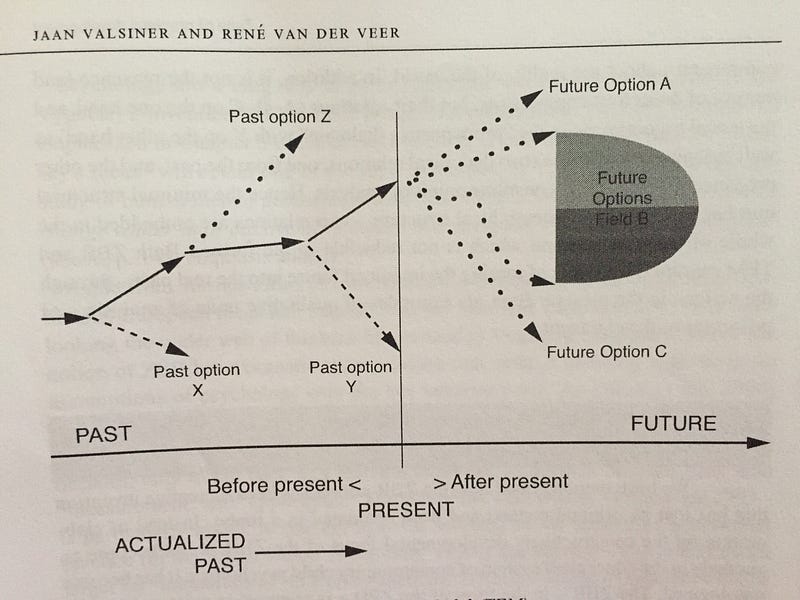
The above diagram represents the Trajectory Equifinality Model. The uniqueness of the model is that it includes both “real” (actual developmental trajectory up to the present) and “ir-real” (possible trajectories that existed in the past and are assumed to exist for the future). Jaan Valsiner and Rene van der Veer said, “TEM thus transcends the preponderance of psychology to include in its schemes only real phenomena, and treats reconstructions and imaginations as equal to the former.”
More interestingly, there is a coincidence that James G. March argued a similar notion with the concept of “Near Histories” in 1991 and Hazel Markus suggested “Possible Selves” for discussing future behavior in 1986.
In his seminal book, The Ambiguities of Experience, James March explores the role of experience in organizational intelligence. He argued that “If there is one lesson to be gleaned from the explorations in this book, it is that learning from experience is an imperfect instrument for finding the truth…Experience may possibly be the best teacher, but it is not a particularly good teacher. (2010, p.114)” However, March suggested some approaches for turning experience into general knowledge, for example, multivariate statistics which relies on generic models and large databases. For small sample sizes of ordinary experience, March also recommended case studies, “thick description” (Geertz, 1973), “near histories (March, Sproull, and Tamuz 1991)”, and Literature as sources of knowledge.
The concept of “near histories” refers to the virtual experience which could happen but didn’t really happen in the past. Marche pointed out, “It is probably necessary to consider events from the perspective of multiple preferences. It is probably necessary to supplement the data of history with the data of virtual experience, using ‘near histories’ and hypothetical histories. In this way, the process of translating experience into understanding and understanding into action will often be an exercise of imagination that supplements or replaces data-based inference and logical derivation (March, Sproull, and Tamuz 1991).” (2010, p.117) In fact, near histories are a special case of a more general approach -the construction of hypothetical histories. March and other authors discussed this issue deeply in a 1991 paper titled Learning from samples of one or fewer. They said, “We explore how organizations convert infrequent events into interpretations of history, and how they balance the need to achieve agreement on interpretations with the need to interpret history correctly. We ask what methods are used, what problems are involved, and what improvements might be made. Although the methods we observe are not guaranteed to lead to consistent agreement on interpretations, valid knowledge, improved organizational performance, or organizational survival, they provide possible insights into the possibilities for and problems of learning from fragments of history.” (1991)
In 1986, Hazel Rose Markus and Paula Nurius published a paper titled Possible Selves to challenge the traditional theories of self-knowledge. According to Markus and Nurius, “Possible selves represent individuals’ ideas of what they might become, what they would like to become, and what they are afraid of becoming, and thus provide a conceptual link between cognition and motivation. Possible selves are the cognitive components of hopes, fears, goals, and threats, and they give the specific self-relevant form, meaning, organization, and direction to these dynamics. Possible selves are important, first, because they function as incentives for future behavior (i.e., they are selves to be approached or avoided) and second, because they provide an evaluative and interpretive context for the current view of self.”
The context of “near histories” is organizational intelligence and development while the context of “possible selves” is individual cognition and motivation. Based on the Trajectory Equifinality Model (TEM) and Activity Theory’s ZPD, we can adopt “near histories” and “possible selves” to our discussion of Life-as-Activity.
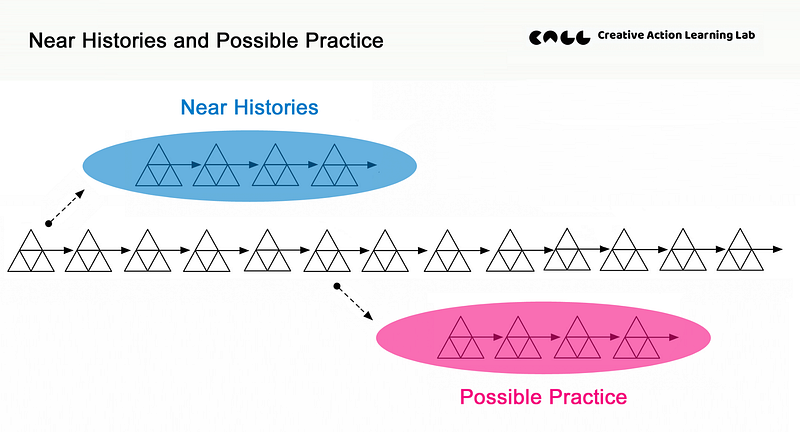
The above diagram highlights “Near Histories” and “Possible Practice” with temporal activity chains. The “Near Histories” refers to the reflecting individual history and the “possible practice” refers to the projecting “possible selves” into “possible activities” as future projects. By reflecting on history, we can discover our personal preferences, talents, themes, resources, etc. By projecting possible practice, we connect our “possible selves” with “possible activities” through constructing projects. We can open new projects with a new direction which is guided by one possible self or re-open old projects with new resources. In this way, we open a room for building possible practice for ourselves and others. In addition, we can project our possible selves by joining projects opened by others too.
2.7 An Open Toolkit for Biographical Studies
The above discussion proposes an activity-theoretical approach to biography-based study. I called this new approach Life as Activity. There are four activity-theoretical aspects of this approach:
- Activity System model (Yrjö Engeström, 1987)
- Temporal Activity Chains (Paul Richard Kelly, 2018)
- Project orientation analysis (Andy Blunden, 2014)
- Zone of Proximal Development (Lev Vygotsky, 1933)
I also adopt several concepts from other theoretical resources about motivation, mental complexity, creative work, cultural life, organizational development, and self-knowledge. For example:
- Self-Determination Theory (Edward Deci and Richard Ryan, 1971, 2017)
- The constructive—developmental approach (Robert Kegan, 1982, 2009)
- The evolving systems approach to the study of creative work (Howard E. Gruber, 1974,1989)
- Culture Themes (Morris Opler,1945)
- Near Histories (James March, 1991)
- Possible Selves (Hazel Rose Markus, 1986)
Thus, the Life as Activity approach is not a pure application of Activity Theory, but an open toolkit that has two groups of theoretical concepts. The first group comes from Activity Theorists and sets the foundation for the approach. Without this foundation, we can’t call this approach an activity-theoretical approach. The second group comes from non-activity theorists and provides more tools for explaining individual life. Since there are many theories for the development of individual life, the second group is an open room for appropriating theories.
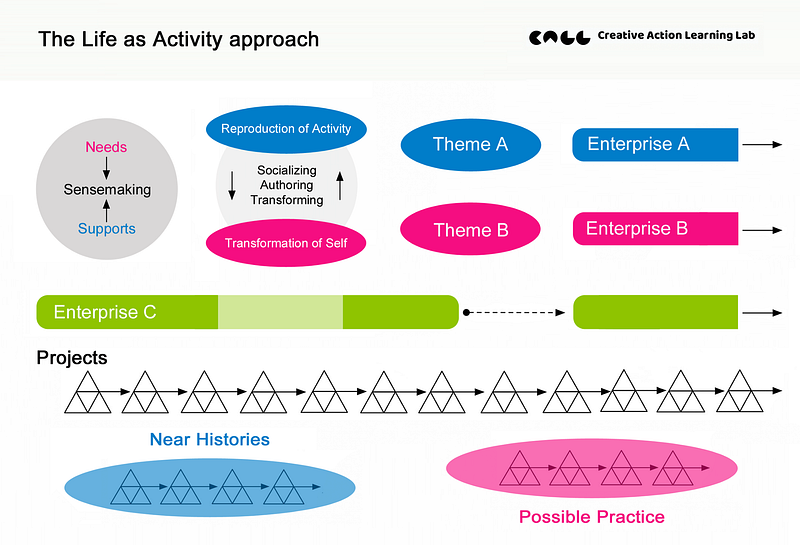
The Life as Activity approach requires strong analytical skills such as paying attention to detail, evaluating problems, critical thinking, decision-making, and creativity. In other words, it is a cognitive approach. However, I consider the process of adopting this approach is also a process of developing cognitive skills too.
In the last decade of the twentieth century, self-study of teaching and teacher education practices expanded and developed as a substantial interest in the field was generated. According to J. John Loughran (2007), “For a growing number of teacher educators, Self-study of Teacher Education Practices (S-STEP) has become an empowering way of examining and learning about practice while simultaneously developing opportunities for exploring scholarship in, and through, teaching.” I think the Life as Activity approach echoes the rise of Self-study activity within the education community and other types of knowledge work communities.
One important aspect of Life as Activity is the concept of reproduction of activity. According to Andy Blunden (2014), “What distinguishes Activity Theory from Phenomenology and Existentialism is that for Activity Theory, the project has its origin and existence in the societal world in which the person finds themself; for Phenomenology and Existentialism the psyche projects itself on to the world. For Activity Theory, commitment to a project and formulation of actions towards it, are mediated by the psyche, but a project is found and realized as something existing in the world, be that an entire civilization, a single personality, or anything in between. (see MacIntyre, 1981, p.146)…a project is a concept of both psychology and sociology.” The Life as Activity approach adopts the project orientation analysis as a basis. Thus, it provides a systematic framework for all types of knowledge workers to reflect career development and domain development.
Finally, the Life as Activity approach is also suitable for long-term partners. Since long-term partners shared some activities within a long-term duration, it is possible to apply the Life as Activity approach for joint analysis. However, this is an advanced version of the Life as Activity approach.
Part 3: Activity, Project, and Event
After publishing Activity U (VII): The Chain of Activity and Life as Temporal Activity Chains, I had a short discussion about the Life-as-Activity approach with some friends.
A friend pointed out a critical issue about activity, project, and event. He said, “Long before I came across CHAT, I formed the view that events were the substance of history and development, and that time can be conceived of only via events…But I haven’t yet thought through the relation between projects and events. The main thing is that one does not reduce to the other. Units like this are irreducible. But the relation is interesting isn’t it? ‘Projects’ cannot be reified, so while they are important to understanding ontology and resolving certain key problems in natural science, projects do not exist outside of social life; events on the other hand can be imputed to Nature. Events span both nature and society.”
As I mentioned above, I use the terms events, projects, and activity system for step 1 of the Life-as-Activity approach: Data Collecting: Turning biographical stories into lived activities. Biographical researchers use the concept of “events” to describe natural events, social activities, social movements, and social projects as the natural/social context of a person’s life. Some researchers also use “stories” as a unit of analysis of a person’s life. The Life-as-Activity approach requires transforming these data into “activity” in order to use the activity system model for subsequent steps.
My original concern with the Life-as-Activity approach is the “project” concept and “activity system” model. The approach is based on Temporal Activity Chains which is developed by Paul Richard Kelly (2018) who adopts Yrjö Engeström’s Activity Systems model as his foundation. For activity theorists, the concept “project” has its unique meaning which refers to Andy Blunden’s notion “Project as a unit of analysis of activity theory”.
In Collaborative Projects: An Interdisciplinary Study, Andy Blunden (2014) claimed several reasons for his approach, “A project is the focus for an individual’s motivation, the indispensable vehicle for the exercise of their will and thus the key determinant of their psychology and the process which produces and reproduces the social fabric. Projects therefore give direct expression to the identity of the sciences of the mind and the social sciences. Projects belong to both: a project is a concept of both psychology and sociology. Social and political theory resting on the concept of ‘project’ is humanist because it gives realistic expression to the agency of individuals in societal affairs and concrete content to social relations.” (p.15)
I am not sure if I can adopt both Andy Blunden’s project-oriented approach and Yrjö Engeström’s Activity Systems model within one practical framework. In fact, I use the activity system model to describe personal “life projects”. It looks like I am in the middle place between Andy Blunden’s position and Yrjö Engeström’s position. On the one side, I like the project-oriented approach because it opens a room for discussing individually with Activity Theory. On the other side, I like the Activity Systems model which provides an analysis framework for practical applications.
Outside Activity Theory, a major theoretical resource I adopted for the Life-as-Activity approach is the evolving systems approach to the study of creative work (Howard E. Gruber, 1974,1989). I really like this approach. However, the approach is used for researching major creators such as Charles Darwin, Jean Piaget, and Williams James. I want to apply this approach to contemporary knowledge workers.
Gruber’s core theoretical concept is “Network of Enterprise”. He uses the term “enterprise” to stand for a group of related projects and activities broadly enough defined so that (1) the enterprise may continue when the creative person finds one path blocked but another open toward the same goal and (2) when success is achieved the enterprise does not come to an end but generates new tasks and projects that continue it.” (1989, p.11)
I use both “projects” and “enterprise” for the Life-as-Activity approach. The “projects” also refers to Gruber’s “projects” which are part of “enterprise”. Activity Theory doesn’t provide a higher level concept than “activity” for organizing a group of activities. The notion of “Activity Network” is not for personal life. Thus, I think Gruber’s “enterprise” is good enough for the Life-as-Activity approach.
The discussion inspired me to think further about “Activity, Project, and Event”. One rough idea is the sense-makers. Since Activity Theory has the key concept Object which is a sense-maker of the theory. So, I think we can assign similar sense-makers to Project and Event. For example, I think the primary sense-maker of Project can be Identity and the primary sense-maker of Event can be Theme.
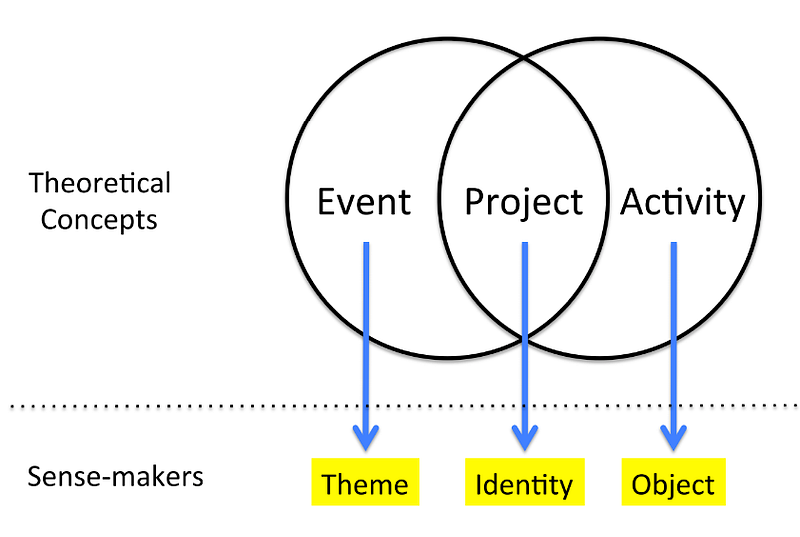
The above diagram is a possible way to conceptualize the relationship between event, project, and activity within the Life-as-Activity approach. As a core concept of the approach, Project refers to both events and activities and it shares some aspects with them. In other words, Project’s primary sense-maker is Identity and its secondary sense-makers are Theme and Object. Thus, we can adopt Theme, Identity, and Object as sense-makers of the Life-as-Activity approach.
Furthermore, for the Life-as-Activity approach, I think we can consider Events as Environments while the Activity as System and consider Project as a switch between events (environments) and activity (system). This means people’s actions (involvement) turn events into activities.
However, the System/Environment notion goes beyond the scope of Activity Theory. We need to adopt theoretical resources outside Activity Theory for further discussion. For example, Niklas Luhmann’s Social Systems Theory which is a self-referential systems theory.
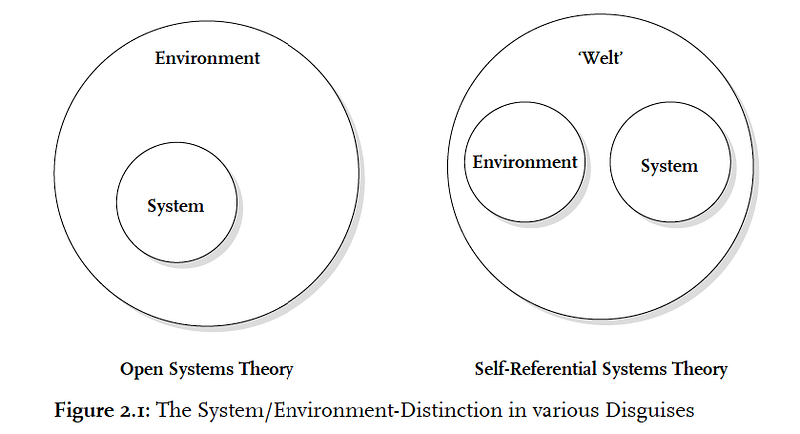
According to Luhmann, there are two types of systems: open system and self-referential system. The above diagram shows the major difference between these two types of systems is the relationship between the system and the environment. For open systems, the system is part of its environment. However, for self-referential systems, the system and environment are exclusive. The term “Welt” refers to a new whole of “system + environment” within the self-referential systems theory.
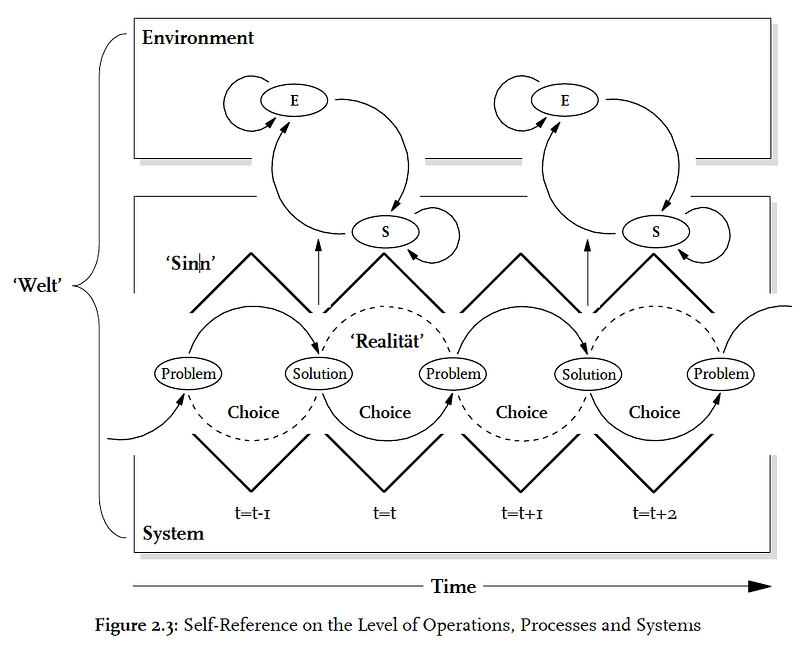
According to Jan-Peter Vos (2002), the actions of social systems can be viewed on three levels of aggregation: the operational level, the level of processes, and the system level. “ On the operational level, self-referential systems are able to create ‘Realität’ or reality by naively commencing in action and asymmetrising the tautology between system and environment in the process…This implies that something can be regarded as real or unreal in the future, dependent on what is regarded as real and unreal in the present past….On the level of processes , the self-reproduction or autopoiesis of operations or ‘Realität’ is dependent on the reproduction of structures or meaning in the sense of what is possible and impossible to regard as real and unreal… On the systemic level , the self-reproduction of ‘Realität’ and ‘Sinn’ is dependent on the reproduction of the system/environment-distinction in the sense of what is regarded as important and unimportant by self-referential systems with respect to the meaningful constitution of their ‘Welt’… In being self-reflexive with respect to their ‘Realität’, ‘Sinn’ and ‘Welt’, social systems have but two forms of observation at their disposal, i.e. tautology and paradox.”
Luhmann’s self-referential system theory is extremely complex. It seems it’s better to launch a new project called Luhmann U for appropriating self-referential system theory.


