
Don’t Tell Me How I Feel
Further advice for supporting loved ones through meltdowns

Part two
I recently published an article entitled Supporting Loved Ones Through Meltdowns. I realized afterward that I had (a lot) more to say on the matter, but felt it would make more sense to separate the content into two articles, as the first one was already quite long.
This is the follow-up to that piece. While there are a few points repeated here for emphasis, it is building and expanding on what I outlined previously.
When the plan isn’t working
You’re doing everything right. You’ve read all the books on your loved one’s condition or neurology, you’ve read all about emotional regulation. You’ve created a “chill zone” in your household, providing a safe space where anyone can calm down when feeling overwhelmed.
You’ve learned how to remain calm when they are expressing emotions or words which are hard to hear, or when their behaviour is hurtful.
You’re doing everything right and still you feel as though nothing’s working.
Most importantly, please understand this: You can do everything perfectly and still a person can have a meltdown.
This is especially true for disabled and neurodivergent people. Our brains are wired differently and every day we endure a world that was not designed for our ways of being, thinking, and feeling.
Every day we deal with micro-aggressions, ignorance, discrimination, lack of understanding, and lack of accommodation. We get weird, judgemental looks; we’re frequently criticized, corrected, ostracized, and rejected.
There are lots of amazing things about having a divergent brain. We have many strengths. We also face many difficulties simply because we’re different from the majority. Sometimes our brains and environment conspire against us and we behave in ways we later regret.
Every individual experience is different, but know this. If you love someone who experiences intense emotions and meltdowns, it’s not your fault, and it’s not their fault. It just is.
Sometimes shit happens.
When advice backfires
Some professional recommendations for supporting emotional regulation and co-regulation have gaps, or they simply don’t work for neurodivergent people.
Social-emotional learning (SEL) programs like the Zones of Regulation have some great starting points, but still leave a lot to be desired. This is especially true for neurodivergent kids.
One piece of advice these programs tend to offer is to “label” the feeling for the child, to help them expand their vocabulary around feelings, and to help improve their self-awareness.
Have you ever had anyone tell you, “you seem angry”?
How did that make you feel?
I can tell you from my own experience — in both my personal and professional life — being told I seem angry only serves to make me angrier. A lot of others respond similarly, and resent having someone tell them how they feel, especially when they are off base.
Actually, sometimes especially when they are correct, so… all the time, I guess?

Interoception
A lot of neurodivergent people struggle with something called interoception, which is how we receive and interpret the signals being sent from within our bodies.
Some people have poor interoception, meaning their signals have to be extremely obvious before they notice. For example, I don’t recognize I’m hungry until I’m irritable or feeling shaky, whereas those with a more effective sense of interoception will notice much sooner.
Some people have an incredibly sensitive sense of interoception, leading them to experience their body’s signals very intensely. This can lead to strong reactions to things others may barely notice, which can impact one’s ability to self-regulate.
Don’t tell me how I feel
Rather than telling someone how they feel, or even asking them how they feel — because they may not know, and trying to explain it may only cause further frustration and upset — we can simply offer our support.
“What can I do to help?”
Later when everyone is regulated and calm, there may be a conversation about different strategies we can use to regulate, and different words we can use to help describe our emotions and the physical manifestation of our feelings.
Shhhhh…
In my previous piece, I explained that our brains are incapable of accessing logic and reason when we’re highly dysregulated. This means there’s no point in trying to talk things out when people are upset, it will only lead to frustration on both sides.
It’s also important to remember that a lot of Autistics experience difficulty communicating when dysregulated. Many people describe being unable to speak, or extreme difficulty putting into words what they are experiencing.
Some people who are minimally speaking become completely non-speaking; some who are generally talkative become minimally speaking. This is different from not wanting to talk about it, and it’s not a manipulation tactic, nor is this about intentionally freezing someone out.
When a person who already has executive functioning challenges is experiencing significant stress, the overload to our brains can easily flip our Prefrontal Cortex (PFC) “offline”, meaning we lose much of our higher-level cognitive processes.
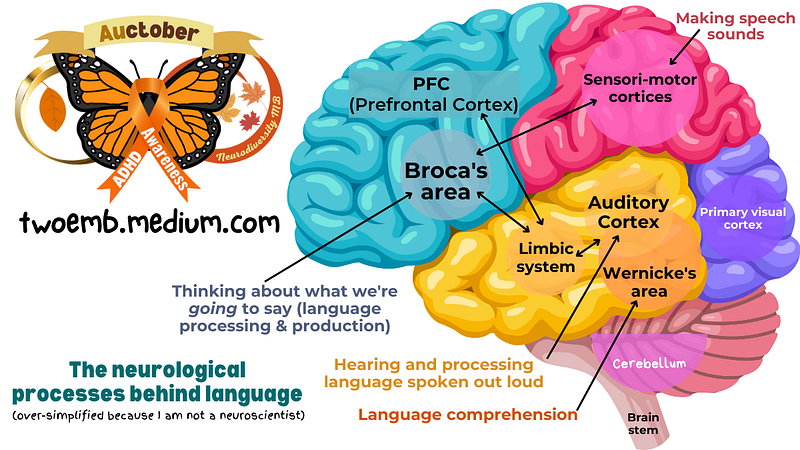
Not only does this mean we may have difficulty expressing ourselves clearly, we may also have difficulty interpreting and processing accurately what is being said to us and what is happening around us.
This is why fewer words are better (more on that in the previous article).
When people are in fight-or-flight mode, the most helpful response is to provide a calm and safe environment, offering reassurance in our actions and words (or lack thereof) they are safe. That’s it.
More troubleshooting
When someone is dysregulated… Think low and slow
- Keep your voice calm and quiet, avoid raising your voice or yelling.
- Use as few words as possible and choose words that will trigger a sense of safety, rather than a sense of threat or conflict.
- Provide alternative forms of communication if helpful (AAC, text, email, writing by hand, sign language — whatever the person prefers).
- Keep your body’s movements calm so your actions match your tone (this can be difficult for those of us who stim, fidget, talk with our hands, and have difficulty controlling the tone and volume of our voice — do the best you can with the skills you have).
- Don’t invade their personal space unless the person expresses they would like physical presence or comfort.
- If safe to do so, get down to the person’s level so you are not looming above them — (note, it’s important to not be patronizing or condescending, you are doing this to avoid any sense of intimidation).
For parents, caregivers, and partners
When the plan doesn’t seem to be working, remember to focus on the intent of the plan, rather than the specifics. The goal isn’t to work out who did what, or find solutions, the only objectives right now are creating a sense of felt safety and facilitating emotional regulation.
Some more approaches to try
Keep in mind these are suggestions only. You and your loved ones know each other best and will know what would be most effective to support one another.
These are also a combination of ideas that may work best with kids, and others that may work best with teens or adults — take what you need from it and leave the rest, or adapt it to be more age-appropriate.
Authenticity is also important, so please do paraphrase in a way that feels most genuine and natural for you.
- Offer alternatives: “Is there something you think might help right now?” or “is there somewhere else you’d rather go where I can give you space?”
- Be clear with boundaries, but flexible with options. “I get that you’re really upset right now, and the plan we came up with sounds stupid in this moment — but I’m asking you to give it a try because we thought it would help. If there’s something else you’d rather try, I’m here to support you.”
- Validate and acknowledge. “I know you’re really upset about that. I promise we will discuss all of this tomorrow, but for now, let’s just focus on .”
- Be proactive. Whenever possible, don’t wait until someone is already dysregulated before offering support. Notice the early, more subtle signs they are becoming slightly agitated, and offer comfort and compassion before things escalate.
- Also, don’t wait until someone is clearly struggling to carve out quality time to reconnect. We’re all more tolerant and patient when we feel refreshed and relaxed. We can give ourselves and our loved ones little top-ups every day by spending time together and connecting in meaningful ways.
We all want to know we are seen, cared for, and will be heard. Even — especially — in our most difficult moments.
Please remember, a meltdown is not a tantrum. A person who is feeling overwhelmed by intense emotions is not choosing to feel or behave this way. Some brains and bodies are more sensitive than others, and our neurology is not a choice.
We all want to know we are seen, cared for, and will be heard. Especially in our most difficult moments.
© Jillian Enright, Neurodiversity MB
Related Articles
When you join medium, as a member you’ll have access to unlimited reads for only $5 per month. If you use my referral link, I’ll earn a small commission, and you’ll earn my undying gratitude.
If you’d prefer give a one-time tip, you can support my writing on Ko-Fi — also, it’s free to follow me on Facebook!

References
Delahooke, M. (2022). Brain-Body Parenting: How to stop managing behaviour and start raising joyful, resilient kids. Harper Collins.
Goodall, E., & Brownlow, C. (2022). Interoception and Regulation: Teaching skills of body awareness and supporting connection with others. Jessica Kingsley Publishers.


