
Giving Your Child A Voice
Teaching skills for emotional regulation

In January I wrote a few articles about emotions and regulation, in particular a piece about co-regulation, in which I discussed different ways we can respond to our children when they are experiencing intense emotions.
I want to expand on this with additional tools for helping our children improve their self-awareness and self-regulation skills. I want us to give our children V.O.I.C.E.
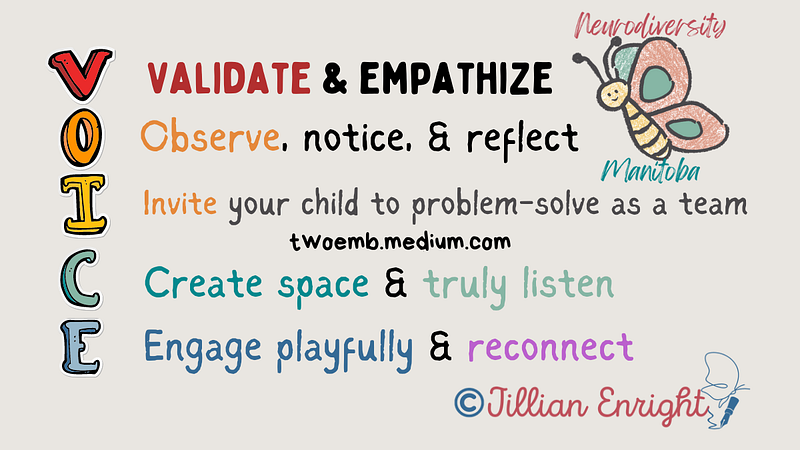
V — Validate & empathize
Validating our children’s experiences and feelings means taking them seriously, believing and truly listening to their perspective.
“Validating the reaction offers an opportunity to build the child’s resilience, promote self- advocacy, and encourage the child to trust their instincts.” — Dr. Mona Delahooke
Children frequently feel as though adults can’t possibly understand, and we often prove them right by minimizing and invalidating their experiences.
“Some responses cause kids to feel (often accurately) that their concerns are being ignored, disregarded, dismissed, or diminished.” — Dr. Ross Greene
We can help our children feel seen, heard, and understood by acknowledging, and empathizing with, their feelings.
We don’t need to see the importance of drinking from the green cup instead of the yellow up to know it matters to our child. We don’t need to believe that “every single one” of our child’s friends has a cell phone except them in order to care about how they feel.
O — Observe, notice, and reflect
When we reflect upon what we’ve observed in a non-judgemental way, we are allowing our children to feel seen in another way.
If a child just said something unkind to a friend or sibling, for example, instead of chastising or punishing them, we could observe their peer’s reaction.
“Your sister looks pretty upset about what just happened. It looked like you guys were having trouble agreeing on how to play that game together.”
By noticing, we’re not laying any blame or labelling anyone’s behaviours as “mean” or wrong, we’re simply stating what we observed and allowing our child to take it from there.
If our child needs some time to cool off before we even mention what happened, that’s okay too — we can offer ways for them to self-regulate or co-regulate, such as cuddling quietly, reading a book, listening to some relaxing music, or colouring.
Once they’re able to hear our observations, they can correct and expand upon our version of events, giving us insight into their experience and thought process when it happened.
When they’re regulated, they’ll be able to hear our remark about their sister looking sad, and perhaps empathize — “yeah, she was crying, I guess I shouldn’t have yelled at her like that.”
I — Invite your child to problem-solve with you
I’ve written previously about Dr. Ross Greene’s Collaborative Proactive Solutions (CPS) model, in which adults and children work as a team to brainstorm solutions and find the one that works best for everyone.
Rather than impose our own consequences or solutions, we can ask our children how they think the problem can be resolved as fairly as possible. We can guide them through a conflict-resolution process, teaching and role-modelling important life skills in the process.
C — Create space (and truly listen)
Do we well and truly provide our children ample time and space to share their feelings with us, without interruption and without correction? It can be very difficult.
I confess, I’ve essentially attempted to talk my son out of his feelings in the past. “What do you mean you don’t want to go to swimming? You always have fun!”
It may be true that once he gets in the pool he has a great time, but if I try to use logic to convince him how much he loves swimming, and don’t actually listen to him, then I’ll never learn why he was resistant to going in the first place.
We need to make it safe for our children to honestly express their thoughts and feelings to us so we can help them work through tough situations and emotions.
E — Engage playfully
After a heavy or difficult conversation, or a period of dysregulation, your child may need to blow off some steam. One fun way to do this is by engaging in well-timed humour and play. (It’s advisable to read the situation, and your child, first to determine if this will be well-received).
Some children love to de-stress through laughter, jokes, maybe tickling. Others might prefer more rough-and-tumble interactions, play wrestling, a pillow fight, or even a nerf war.
Whatever suits your child and family — and the current mood — go for it. If you and your child had a disagreement, this can also be a great way to reconnect.
Give your child a voice
It’s a cruel irony that by the time we become parents, we’ve essentially forgotten what it’s like to be a kid (or maybe that’s just me, I have a memory like a sieve).
Imagine having others control all the important parts of your life — when you eat and sleep, whether you can go out or stay home, sometimes even what you wear. When you don’t like something you’re told “too bad”, and no dessert until you eat your vegetables!
Many of our children’s problems seem trivial to us because we have control over significant aspects of our lives. Our brains have fully matured, and we have decades of lived experience to draw from.
We can’t expect our children to respect and take seriously the feelings of others unless we first show them that courtesy, role-modelling perspective taking and empathy. The first step to raising considerate, compassionate children is being considerate, compassionate parents. ❤
© Jillian Enright, Neurodiversity MB

When you join medium, as a member you’ll have access to unlimited reads for only $5 per month. If you use my referral link, I’ll earn a small commission, and you’ll earn my undying gratitude.
Related Articles
References
Delahooke, M. (2022). Brain-Body Parenting: How to stop managing behaviour and start raising joyful, resilient kids. Harper Collins.
Greene, Ross, W. (2021). Lost & Found: Unlocking collaboration and compassion to help our most vulnerable, misunderstood students, and all the rest. (2nd ed.). Jossey-Bass.
Kohn, A. (2005). Unconditional Parenting: Moving from rewards and punishments to love and reason. Simon & Schuster, Inc.
Murphy, L. K. (2020). Declarative Language Handbook: Using a thoughtful language style to help kids with social learning challenges feel competent, connected, and understood. © Linda K. Murphy.


