
Emotion in Motion
A series of stories about emotions and emotional regulation
Stories About Emotions
A few days ago I wrote a flurry of stories about emotional dysregulation and co-regulation, which has prompted me to compile my related stories to make them easier to find.
October 2023 updates
More articles about emotional dysregulation, self- regulation, and co-regulation!
SEL programs have some benefits, but misusing them can be harmful.
Social-emotional learning is an intentional focus on the development of social and emotion al skills and competencies in school. The five core competencies of SEL focus seem fairly innocuous…
The Real Reasons We All Struggle with Emotions
There are three primary reasons why we all struggle with emotional regulation, and with emotions in general.
This article isn’t about our inability to talk about our feelings, the problems begin before we even get to that point.… (especially for neurodivergent folks).
Alexithymia, interoception, and emotional regulation:
How Emotional Regulation is Like Bike Riding
Skills need to be taught and supported, they don’t come pre-programmed. Think of teaching regulation skills like teaching children to ride a bicycle. We don’t just put a kid on a bike and expect them to figure it out for themselves…
Why Emotional Regulation Is So Damn Difficult
Emotional self-regulation requires neurological maturity and a complex set of skills. When I was about 9 or 10 years old I was signed up for Girl Guides against my will. I loved the outdoors and camping, so it was assumed I would enjoy this program. I did not. There weren’t a lot of traditional scouting activities…
April 2023 update
Why do Autistics and people with ADHD seem to get worked up so easily?
Why do we seem to be more “sensitive” than others, more emotional, or hot-tempered?
I explain why neurodivergent folks often struggle with dysregulation.
Executive dysfunction
How Executive Dysfunction Impacts Daily Life
The first piece I wrote specifically describing the brain regions impacted by ADHD and autism, and the neural functions responsible for helping us to regulate our emotions.
Everything You Never Wanted To Know About Executive Functions
Because you didn’t know what they were, or even that they existed, so how could you want to know about them?
I have two degrees in field of psychology and I graduated without knowing what executive functions are, or even that they exist. I didn’t learn about executive functions until my son was diagnosed…
Interoception and emotion regulation
I wrote this piece back in November. This article explains how interoception, and being aware of our physical experiences of emotions, helps us improve our self-regulation capabilities.
Then came the flurry earlier this week.
Emotions aren’t rational, but they are natural
As I was doing research for one article, I came across a troubling pattern, and this distracted me from my original piece. I had to change course and write this one before I could continue.
Keeping our cool
I shared my intent in a local ADHD parenting group. I shared these images below, and asked if parents had specific questions about co-regulation they would like to read about:
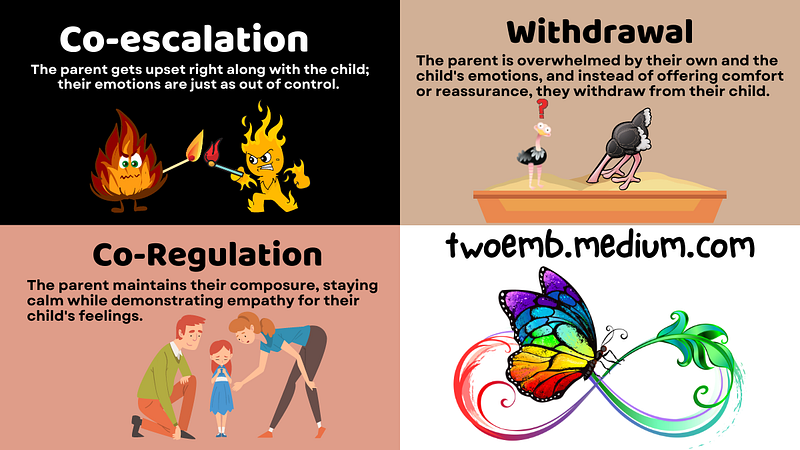
One parent asked about tips for not co-escalating, for keeping our cool when our children are dysregulated, so again I was (happily) waylaid from my original article, and stopped to write this one:
Patience is most certainly finite
Many of us have heard people spout opinions about how “kids these days” are too coddled. We protect them from failures and defend them from disappointment. In doing so, we don’t allow kids to develop a thick skin (which apparently is desirable).
In order to not coddle our kids, they need to experience the disappointments and hardships of life, so they can develop resilience and learn how to persist in the face of adversity. ‘Survival of the fittest’ and all.
Except this isn’t the bloody hunger games and I’m no Effie Trinket.
Exploring co-regulation
Once I got those out of my system, I was finally able to return to the originally-intended article.
We all become dysregulated sometimes. This happens when the demands of the environment exceed our ability to deal with them in a calm, skillful manner at that moment in time.
When someone we love is upset, there are essentially three different responses we can give them, which I discuss in this article:
In tandem with co-regulation, we need to give our children a voice:
Autistic People Are Not Emotionless Robots
Untangling and explaining alexithymia
Alexithymia is a term used to describe difficulty feeling, identifying, or recognizing emotions.
This pathologization has been used to stereotype Autistic people as “unfeeling”, lacking in emotions, and unable to read the emotions of others.
This is a gross oversimplification which is harmful to many Autistic people.
While some Autistics may struggle to experience or identify emotions in the way that allistics (non-autistic people) do, that does not mean we do not feel emotions, not even close.
In fact, a lot of Autistics experience emotions very intensely.
When emotions become to much
Supporting Loved Ones Through Meltdowns
Sometimes feelings become overwhelming and we pass our breaking point.
Here’s are some ways you can help someone through these very difficult experiences.
Don’t tell me how I’m feeling
When people do experience intense emotions, some of the advice offered is to help people identify and name their feelings.
This can backfire, especially for people whose external appearances may not match their internal experiences.
Rather than trying to guess or tell someone how they “look like” they’re feeling, which can sometimes escalate things, here’s what you can do instead:
When you join medium, as a member you’ll have access to unlimited reads for only $5 per month. If you use my referral link, I’ll earn a small commission, and you’ll earn my undying gratitude.


