
Autistic People Are Not Emotionless Robots
Untangling and explaining alexithymia
Alexithymia refers to difficulty feeling, identifying, or recognizing emotions in oneself, and accurately identifying emotions in others.
This pathologization has been used to stereotype Autistic people as “unfeeling”, lacking in emotions, and unable to read the emotions of others. This is a gross oversimplification that is harmful to many Autistic people.
While some Autistics may struggle to experience or identify emotions in the way that allistics (non-autistic people) do, that does not mean we do not feel emotions, not even close.
In fact, a lot of Autistics experience emotions very intensely, and those who do struggle to recognize and name emotions are not always Autistic.
Alexithymia has been described in other neurotypes as well, including people with Borderline Personality (BPD), Obsessive-Compulsive Disorder (OCD), major depression (MD), and post-traumatic stress disorder (PTSD), to name a few.
As Dr. Devon Price explained in his recent book, Unmasking Autism, many Autistics struggle to figure out why we’re feeling emotions.
For some it’s not identifying what emotion we’re feeling, it’s noticing that we’re feeling something before we’re already carried away by it.
“When we’re upset or uncomfortable, we often fail to recognize it until we’re nearly on the verge of a complete meltdown.” — Dr. Devon Price
This can be due, in part, to challenges with interoception, which hinder our ability to perceive and recognize the physical indications of our emotions.
Neuronormative concepts
Another possibility is that emotions, their sensations, and their external expressions are described and taught to us through a neuronormative lens.
Dr. Walker defines neuronormativity as the following:
“The performance of the local dominant culture’s current prevailing images of how a so-called “normal” person with a so-called “normal” mind thinks and looks and behaves.” — Dr. Nick Walker
Social-emotional lessons at school, and learned cultural norms and expectations are based on what non-autistic people experience, perceive, and deem “normal”.
Except what we know about autism is Autistics have a significantly different sensory experience from allistics. Our bodies and brains perceive and experience the sensory world much differently from those of non-autistic people.
As Dr. Walker explains,
“[We live in] a society designed around the sensory, cognitive, developmental, and social needs of non-autistic individuals.” — Dr. Nick Walker
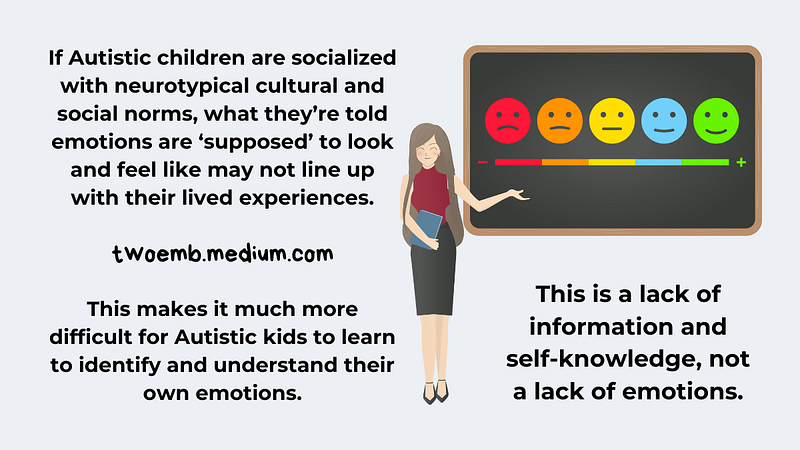
If Autistic children are taught social-emotional curricula by neurotypical teachers and are socialized with neurotypical cultural and social norms, what they’re told emotions are “supposed” to look and feel like may not line up with their lived experiences.
When they are asked to name what they are feeling, or interpret the emotions a neurotypical person is conveying, they might misunderstand or misinterpret because they’ve never been taught what those emotions feel like from the perspective of an Autistic person.
This is a lack of information and self-knowledge, not a lack of emotions.
In that vein, Dr. Price further explains in his book that we are literally conditioned to disregard, ignore, and suppress our emotions and responses so as to “appear neurotypical”.
Many Autistics are even taught specifically how to read and interpret neurotypical emotional expressions so we can be more aware, mindful, and “considerate” of their feelings.
“Autistics aren’t given the tools to understand how emotions feel in our bodies, and because we are taught to prioritize others’ feelings above our own.” — Dr. Devon Price
To my knowledge, there aren’t many social skills programs teaching neurotypical people how to better identify, interpret, and understand Autistic emotional expressions.
Neuronormative attitudes
Along similar lines, there’s also the idea that the neurotypical way of doing — well, anything — is superior to all other ways of doing things. We do this with essentially any majority: linguistic, ethnic, cultural, etc., but it is becoming less socially acceptable to do so.
Not so with autism. There’s an assumption that because we interpret, express, and experience emotions differently from allistics, we’re somehow deficient. It’s literally written this way in the DSM-V:
“Deficits in social-emotional reciprocity… reduced sharing of emotions or affect… failure to initiate or respond to social interactions.” — DSM-V
This is an ableist assumption.
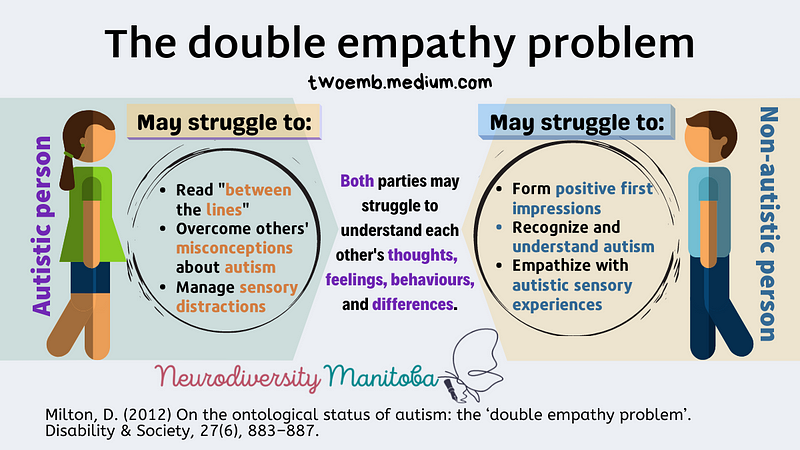
Autistic scholars have instead described what is known as the Double Empathy Problem, which emphasizes the fact that both autistics and allistics struggle to understand each other’s thoughts, feelings, behaviours, and differences.
Cultural differences
It’s more accurate and inclusive to conceptualize this as a cultural difference.
Different cultures have different social expectations for how people express their feelings, just as allistics and autistics have different ideas about how one ought to express and interpret emotions.
Our world is made up of many different neurotypes with endless varieties of communication, sensory, and processing styles. Because one is more prevalent than others does not mean it is better.
It’s important to keep in mind that many social norms are painfully arbitrary and change over time.
Rather than making assumptions based on stereotypes, we need to understand miscommunications happen because of differences in expectations and interpretations.
We can reduce these instances by checking in with one another, clarifying intentions and meaning, and by ensuring our communication is as clear and effective as possible.
Trauma, PTSD, and alexithymia
Another theory about alexithymia was termed “secondary” alexithymia by Dr. Peter Sifneos in 1972. He posited severe trauma prompted the overuse of defense mechanisms such as repression of one’s emotions.
This theory was based purely on Dr. Sifneos’ clinical experience and has not been empirically validated, but I found it interesting nonetheless. Given that as many as 60% of Autistic adults have experienced trauma, this correlation makes sense.
It’s as though we can’t win with neurotypicals. If we have intense emotions and are very expressive, we’re “too much”. Shouldn’t stim in public. Tone it down, calm down, settle down. Yet if we don’t express enough emotions, we’re alexithymic automatons.
Instead of having all these rules about how many emotions people are permitted to display, why don’t we just — Oh wait, I do have a permit!

Dear society, stop policing Autistic, neurodivergent, and disabled humans and start making space for people to be different.
Thanks.
© Jillian Enright, Neurodiversity MB
Related Stories
When you join medium, as a member you’ll have access to unlimited reads for only $5 per month. If you use my referral link, I’ll earn a very small commission, and you’ll earn my undying gratitude.
References
López-Muñoz, F., & Pérez-Fernández, F. (2020). A History of the Alexithymia Concept and Its Explanatory Models: An Epistemological Perspective. Frontiers in Psychiatry, 10. https://doi.org/10.3389/fpsyt.2019.01026
Mahler, K., Hample, K., Jones, C., Sensenig, J., Thomasco, P., Hilton, C. (2022). Impact of an Interoception-Based Program on Emotion Regulation in Autistic Children. Occupational Therapy International. https://doi.org/10.1155/2022/9328967
Milton, D. (2012). On the ontological status of autism: the ‘double empathy problem’. Disability & Society, 27(6), 883–887. https://doi.org/10.1080/09687599.2012.710008
Price, D. (2022). Unmasking Autism: Discovering the new faces of neurodiversity. Penguin Random House LLC.
Ramírez-Bermúdez, J. (2018). El reverso creativo de la alexitimia. Salud Mental, 41(1),49–52. https://doi.org/10.17711/SM.0185–3325.2018.008
Rumball, F., Happé, F. and Grey, N. (2020). Experience of Trauma and PTSD Symptoms in Autistic Adults: Risk of PTSD Development Following DSM-5 and Non-DSM-5 Traumatic Life Events. Autism Research, 13, 2122–2132. https://doi.org/10.1002/aur.2306
Sifneos, P. E. (1972). Short-term Psychotherapy and Emotional Crisis. Harvard University Press.
Timoney, L.R., Holder, M.D. (2013). Definition of Alexithymia. In: Emotional Processing Deficits and Happiness. Springer Briefs in Well-Being and Quality of Life Research. Springer. https://doi.org/10.1007/978-94-007-7177-2_1
Walker, N. (2021). Neuroqueer Heresies: Notes on the neurodiversity paradigm, Autistic empowerment, and postnormal possibilities. Autonomous Press.


