
Defining Neurotypical Privilege
Why language and perspective are so important

“If the primary language of the society in which you were born is well-suited to the purpose of describing your sensory experiences, your needs, and your thought processes, you may have neurotypical privilege.” — Dr. Nick Walker
Picture this
Imagine you’re a passenger in a friend’s car. You aren’t feeling well: You have a fever and a headache. Your friend has the heat cranked up and the music on full blast. You might say “I’m not feeling well, could you please turn down the heat and the volume?”
Now imagine this same scenario, but the language you speak doesn’t have words for the concepts of “hot” or “loud”. You don’t know how to work the controls on your friend’s car and when you try to communicate with them, they’re not understanding what it is you want.
Have you ever had experiences that you didn’t quite understand, until one day someone described them so eloquently, putting words and names to something you have always wondered about and struggled with?
I certainly have, many times, and it is both validating and a relief to finally have words to express what are experiencing. A profound quote from Neurodiversity Studies: A New Critical Paradigm sums this up very well:
“Owning the words that describe my own experiences… allowed a more complete and meaningful experience to emerge.”— Jackson-Perry et al.
Language matters
Having precise language to conceptualize and communicate our experiences helps us first to process them internally, and then describe them so others may better understand.
When you’re neurotypical, the dominant society and culture have developed around your experiences and your needs, so these words and ideas are much more readily available. The majority of others usually understand your experience because they have similar experiences.
“Neurotypicals live, act, and experience the world in a way that consistently falls within the boundaries of neuronormativity.”— Dr. Nick Walker
When your neurology diverges from the majority, you’re part of the neurominority. It becomes much more difficult to convey to others what you experience because they don’t have a frame of reference, nor the vocabulary to form a mental image of what you are trying to explain.
This often results in people dismissing, minimizing, and invalidating our experiences, because if “most people” haven’t had them, then they’re probably not real.
Many neurodivergent people have even internalized these ableist ideas, minimizing their own experiences, and sometimes invalidating those of their fellow neurodivergents.
People are trained and pressured from earliest childhood into the performance of neuronormativity — the performance of the local dominant culture’s current prevailing images of how a so-called “normal” person with a so-called “normal” mind thinks and looks and behaves. — Dr. Nick Walker
Discarding outdated ideas
There are two distinct categories in the DSM-V for the criteria used to diagnose autism, one of which is: “persistent deficits in social communication and social interaction”.
That entire premise is built upon the arrogance of neuronormativity, the assumption that the neurotypical way of communicating is so superior to others that any other style of communication is considered “disordered” and “deficient”.
This is what happens when neurotypical people try to describe, research, and explain the neurodivergent experience, one they have not themselves lived.
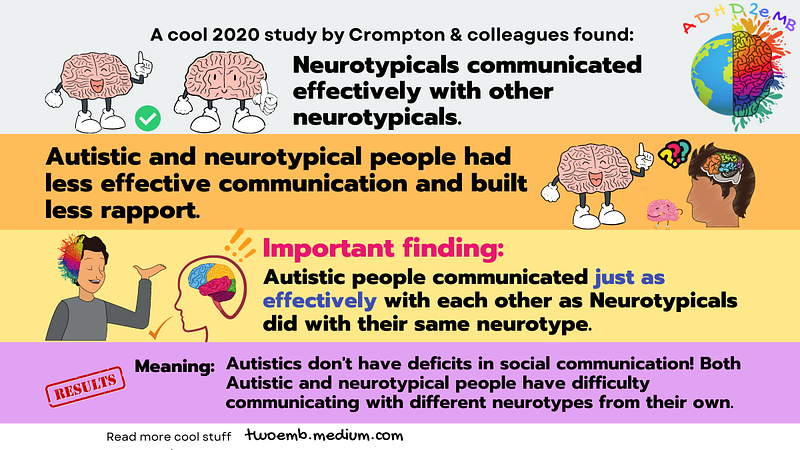
Recent research very clearly demonstrated just how neuronormative* and NT-centred this perspective is. The study showed that neurotypicals communicated effectively with other neurotypicals. Neurotypicals and Autistics struggled to communicate effectively with each other.
* “Neuronormativity is the performance of the local dominant culture’s current prevailing images of how a so-called “normal” person with a so-called “normal” mind thinks and looks and behaves.” — Dr. Nick Walker
Autistics communicated just as effectively with each other — with those of the same neurotype — as neurotypicals did with each other.
Perspective matters
If you had a room full of only-French and only-English speaking people, would people not communicate better with those who speak the same language?
If the majority of the people were French-speaking, would we consider the English-speaking people deficient? Or would we understand that a language barrier was to blame, not any individual person, or particular group of people?
What Autistics encounter when trying to communicate with neurotypicals are cultural and neurodivergence barriers: it’s two people — or groups of people — who communicate in very different ways. It’s just been assumed the neurotypical communication styles are superior, because they’re the majority.
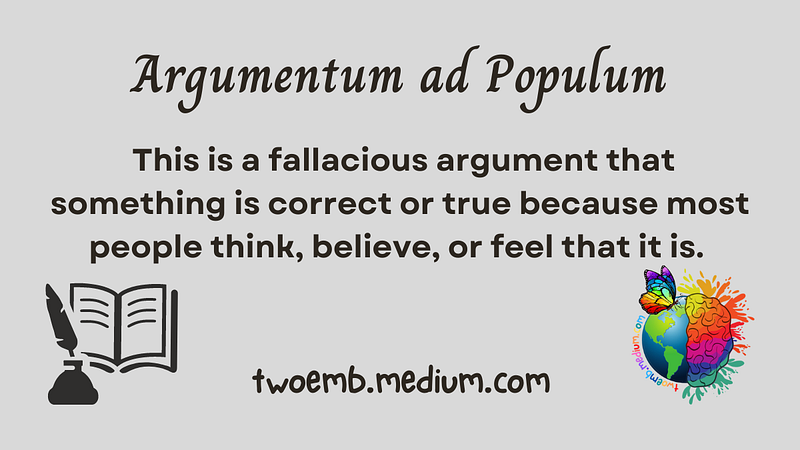
“Everybody does it this way, so it must be the best way” is a belief based on a logical fallacy called Argumentum ad Populum. There have been plenty of times in our history when most people believed something that turned out to be incorrect or inaccurate.
Popular does not mean better, nor more accurate, or even correct. Common does not automatically mean superior. In many cases, it actually means the opposite (just sayin’).
The distinction matters
“A neurodivergent person diverges from the prevailing culturally constructed standards and culturally mandated performance of neuronormativity.” — Dr. Nick Walker
If you are neurotypical, one way you can begin to effect change is to acknowledge your own neurotypical privilege.
This does not mean you are privileged in all areas of your life, that you do not have your own struggles, or that society does not disable you in other ways.
It simply means that being neurotypical comes with advantages and privileges in our current society. Through the lens of the neurodiversity paradigm it means your neurotype, or cognitive style, is implicitly assumed to be superior over divergent minds.
The next step is to actively welcome, celebrate, and engage with the differences among us as sources of learning and growth. It’s not good enough to just “accept differences” in a manner that merely tolerates the existence of divergent minds and people.
Common does not mean superior, but rare can indeed be valuable.
© Jillian Enright, Neurodiversity MB
November 2023 update
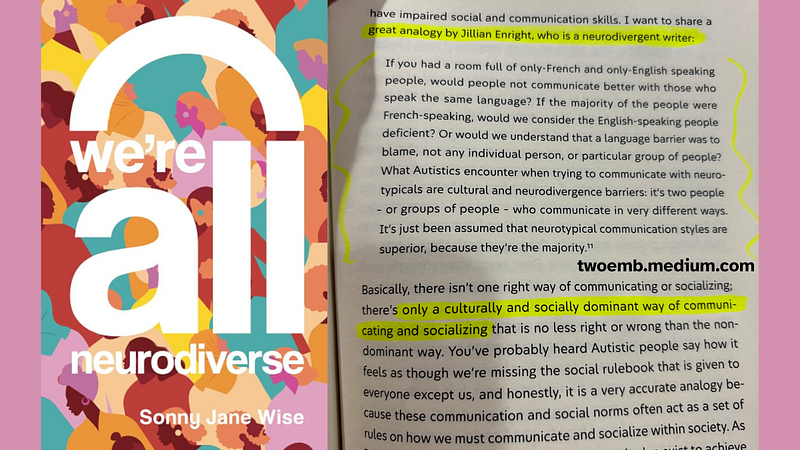
This article was quoted in a recently published book, We Are All Neurodiverse, by Sonny Jane Wise.
Ways to support my work
You can leave a “tip” on Ko-Fi at https://Ko-Fi.com/NeurodiversityMB
Become a paid subscriber to my Substack publication
Check out my online store at https://NeurodiversityMB.ca/shop
Read and share my articles from twoemb.medium.com
Related Articles
References
American Psychiatric Association. (2013). Diagnostic and statistical manual of mental disorders (5th ed.). https://doi.org/10.1176/appi.books.9780890425596
Chapman, R. (2021). Neurodiversity and the Social Ecology of Mental Functions. Perspectives on Psychological Science. https://doi.org/10.1177/1745691620959833
Crompton, C. J., Ropar, D., Evans-Williams, C. V., Flynn, E. G., & Fletcher-Watson, S. (2020). Autistic peer-to-peer information transfer is highly effective. Autism, 24(7), 1704–1712. https://doi.org/10.1177/1362361320919286
Jackson-Perry, D., Bertilsdotter Rosqvist, H., Layton Annable, J., Kourti, M. (2020). Sensory strangers: Travels in normate sensory worlds. In Bertilsdotter Rosqvist, H., Chown, N., & Stenning, A. (Eds). Neurodiversity Studies: A new critical paradigm. Routledge.
Walker, N. (2021). Neuroqueer Heresies: Notes on the neurodiversity paradigm, Autistic empowerment, and postnormal possibilities. Autonomous Press.


